

Saved Bookmarks
This section includes 7 InterviewSolutions, each offering curated multiple-choice questions to sharpen your Current Affairs knowledge and support exam preparation. Choose a topic below to get started.
| 1. |
If the angle between the line·x=(y−1)/2=(z-3)/λ and the plane· x+ 2y+ 3z= 4 iscos-1(√(5/14)) then λ equals : |
|
Answer» `2//5` |
|
| 2. |
All the point (a, y) in the plane satisfying the equation x^(2)+2x sin (xy)+1=0 lie on - |
|
Answer» a pair of STRAIGHT lines `2 sin (xy) = -(x+1/x)` 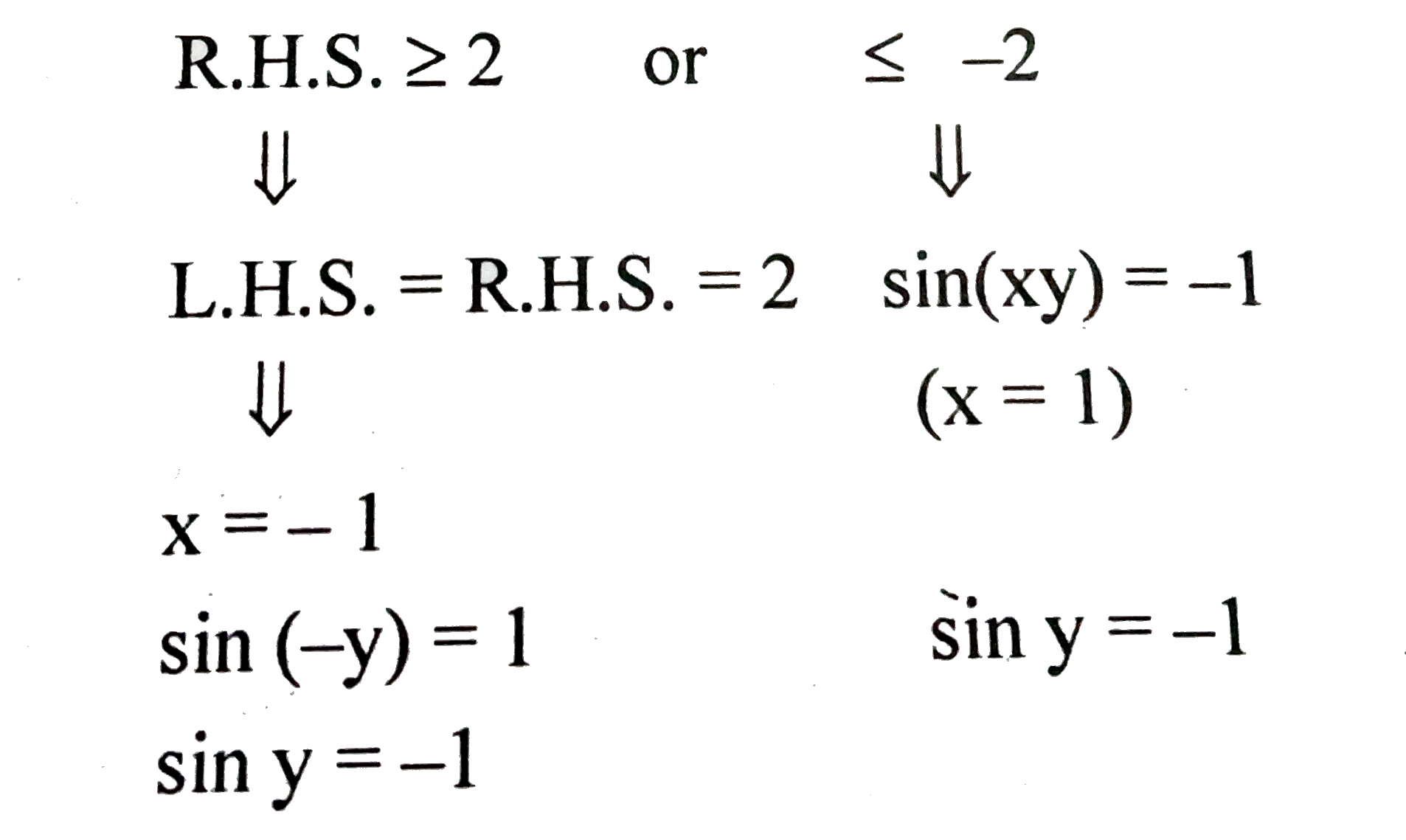 `y=2npi//(PI)/(2), ninI` HENCE pair of straight lines. |
|
| 3. |
Answer the followings true or false. (i) vecaand-veca are collinear.(ii)Two collinear vectors are always equal in magnitude. (iii)Two vectors having same magnitude are collinear. (iv)Two collinear vectors having the same magnitude are equal. |
|
Answer» |
|
| 4. |
Let A = R - {3} and B = R - {1}. Consider the function f : A rarrB defined by , f(x) = ((x-2)/(x-3)) is f one - one and onto ? |
|
Answer» |
|
| 5. |
If x= sint, y= cos2t then prove that (dy)/(dx)= -4sint |
| Answer» | |
| 6. |
A load of mass M kg is suspended from a steel wire of length 2 m and radius 1.0 mm in Searle's apparatus experiment. The increase in length produced in the wire is 4.0 mm, Now the loads is fully immersed in a liquid of relative density 2. The relative density of the material of load is 8. The new value of increase in length of the steel wire is : |
|
Answer» 3.0 mm |
|
| 7. |
Let f(x) = sgn (x) and g (x) = x(x^(2)-5x+6). The function f(g(x)) is discontinuous at |
|
Answer» Infinitely many points `THEREFORE f{g(x)}` is discontinuous at the points where g (x) =0 OR at x = 0,2,3. |
|
| 8. |
Show that the function e^x/x^p is strictly increasing for x gt p gt 0. |
|
Answer» Solution :Let `f(x) = e^x/x^p` Then ``f.(x) = (e^x CDOT x^p - e^x cdot px^p-1)/(x^2p)` The FUNCTION is increasing if f. `(x) GT 0` `RARR (e^x cdot x^p - e^x cdot px^p-1)/(x^2p)gt 0` `(e^x cdot x^(p-1) cdot (x-p) gt 0 rArr x gt p. |
|
| 9. |
The sum of the roots of the equation x + 1 - 2 log_(2) (2^(x) + 3) + 2 log_(4) (10 - 2^(-x))= 0 "" is |
|
Answer» `log_(2) 11` |
|
| 10. |
Matrices A and B will be inverse of each other only if- |
|
Answer» AB = BA |
|
| 11. |
Integrate the following function : int(e^(x))/(sqrt(4-e^(2x)))dx |
|
Answer» |
|
| 12. |
The tangents at a point P onx^(2)//a^(2) -y^(2)//b^(2) =1cuts one of its directrices in Q. Then PQ subtends at the corresponding focus an angle of |
|
Answer» `pi//3 ` |
|
| 13. |
A die is rolled until a 6 is obtained. What is the probability that you end up in the third roll. |
|
Answer» SOLUTION :Probability of GETTING a 6 in the 3rd ROLL `=5/6xx5/6xx1/6=25/216` |
|
| 14. |
C_0^2 + C_1^2 + C_2^2 + ………+C_25^2 = |
|
Answer» `""^49C_50` |
|
| 16. |
Prove that the point of intersection of two perpendicular tangents tot he hyperbola (x^(2))/(a^(2))-(y^(2))/(b^(2)) = 1 lies on the circle x^(2) + y^(2) = a^(2) - b^(2) |
|
Answer» |
|
| 17. |
Thesum ofthe coefficients inthe expansionof( 1 +x + x ^ 2 )^nis |
|
Answer» Solution :Toobtain sum OFCO- efficientsofbinomialexpansion,substitute`X = 1 `intheexpansion `THEREFORE`sumofco -efficient`= (1+ 1+ 1) ^n ` `= 3^n ` |
|
| 18. |
Reflecting the point (2, –1) about y -axis,coordinate axes are rotated at 45^@angle in negative direction without shifting the origin. The new coordinates of the points are - |
|
Answer» `( - (1)/(SQRT2) , - (3)/(sqrt2) )` |
|
| 19. |
At what points in the interval [0, 2pi], does the function sin 2x attain its maximum value? |
|
Answer» |
|
| 20. |
If the value of int_(-2)^(2) | x cos pi x| dx = k//pi then the value of k is |
| Answer» Answer :B | |
| 21. |
Let f(x)=(sqrt(sinx))/(1+root(3)(sinx)). If D is the domain of f, then D contains : |
|
Answer» `(0,PI)` |
|
| 22. |
Find the critical points of each of the following functions : y=e^(x)sinx |
|
Answer» |
|
| 24. |
Let f (x)= [{:(x ^(2alpha+1)ln x ,,, x gt0),(0 ,,, x =0):} If f (x) satisfies rolle's theorem in interval [0,1], thenalpha can be: |
|
Answer» `-1/2` |
|
| 25. |
The valueof [veca xx vecp vecb xx vecq vecc xx vecr]+[veca xx vecq vecb xx vecr vecc xx vecp] +[veca xx vecr vecb xx vecp vecc xx vecq]equals to: |
| Answer» Answer :A | |
| 26. |
A :cos^(3) x + cos^(3)(120^@ + x) + cos^(3)(120^(@) - x)=(3)/(4) cos 3 x R :cos theta + cos (120^(@) + theta ) cos (120^(@) - theta ) = 0 and cos thetacos(120^(@) + theta ) cos (120^(@) - theta ) = (1)/(4) cos 3 theta |
|
Answer» A is true , R is true and R is correct explanation of A |
|
| 27. |
Ifn is a positiveinteger, show that(1 + i)^(n)+ (1 - i)^(n) = 2 ^((n+2)/2) cos ((npi)/4). |
| Answer» | |
| 28. |
Which of the following is true : |
|
Answer» `SIN '(pi)/(12)= (SQRT(3) - 1)/(2sqrt(2))` |
|
| 29. |
int_(0)^(2) (2x-2)/(2x-x^(2))dx= |
|
Answer» 0 |
|
| 30. |
Prove that tan^(-1)1+tan^(-1)2+tan^(-1)3 =pi |
|
Answer» |
|
| 31. |
If (1)/((ax+b)(cx+d))=(A)/(ax+b)+(B)/(cx+d) then (1)/((ax+b)^(2)(cx+d))= |
|
Answer» `(A)/((ax-B)^(2))+(AB)/(ax-b)+(B^(2))/(cx+d)` |
|
| 32. |
C(13,5)= |
| Answer» | |
| 33. |
Range of the function f(x)= x^(2)-6x+5/x^(2)-5x+6 is |
|
Answer» R |
|
| 34. |
Differntiate the following functions by proper substitution.cos^(-1)((1-t^2)/(1+t^2)) |
|
Answer» SOLUTION :`y=COS^(-1)((1-t^2)/(1+t^2))`[PUT`t=tantheta` `cos^(-1)FRAC(1-tan^2thet)(1+tan^2theta)` `=cos^(-1)cos2theta=2theta=2tan^(-1)t` `thereforedy/dx=2/(1+t^2)` |
|
| 35. |
Let ABC be a given triangle. Points D and E are on sides AB and AC respectively and point F is on line segment DE. Let (AD)/(AB)=x, (AE)/(AC)=y, (DF)/(DE)=z. Let area of DeltaBDF=Delta_(1), Area of DeltaCEF=Delta_(2)and area of DeltaABC=Delta. Q. (Delta_(1))/(Delta) is equal to : |
|
Answer» xyz |
|
| 36. |
Let ABC be a given triangle. Points D and E are on sides AB and AC respectively and point F is on line segment DE. Let (AD)/(AB)=x, (AE)/(AC)=y, (DF)/(DE)=z. Let area of DeltaBDF=Delta_(1), Area of DeltaCEF=Delta_(2)and area of DeltaABC=Delta. Q. (Delta_(2))/(Delta) is equal to : |
|
Answer» `(1-X)y(1-Z)` |
|
| 37. |
Number of X is randomly selected from the set of odd numbers and Y is randomly selected from the set of even numbers of the set {1,2,3,4,5,6,7}. Let Z = X + Y, then What is P(Z=5) equal to? |
|
Answer» Solution :`n(S)=12` `n(E_(1))=12` `P(Z=5)=(n(E_(1)))/(n(S))=(2)/(12)=(1)/(6)` |
|
| 38. |
Prove that, int sin n theta sec theta d theta =- ( 2 cos (n-1) theta)/(n -1) - int sin (n-2) theta sec theta d theta Hence or otherwise evaluate int _(0) ^(pi//2) ( cos 5 theta sin 3 theta)/(cos theta) d theta. |
|
Answer» |
|
| 39. |
If log_(7)12=a ,log_(12)24=b,then find value of log_(54)168 in terms of a and b. |
|
Answer» |
|
| 40. |
If a lt b lt c lt d, then the eqution 3(x - a) (x - c) + 5 (x - b) (x - d) = 0 has |
|
Answer» REAL and DISTINCT roots |
|
| 41. |
Two A.M's A_(1) and A_(2), two G.M's G_(1) and G_(2) and two H.M's H_(1) and H_(2) are inserted between two numbers a and b. (i) Express A_(1) + A_(2) in terms of a and b. (ii) Express G_(1) G_(2) in terms of a and b. (iii) Express 1/H_(1) + 1/H_(2)1 in terms of a and b. (iv) Show that 1/H_(1) + 1/h_(2) = (A_(1) + A_(2))/(G_(1) G_(2)) |
|
Answer» |
|
| 42. |
Fill int the blanks choosing correct answer from the bracket. InDelta ABC if b^2 + c^2 lt a^2 then _____ angle is obtuse. |
|
Answer» A |
|
| 44. |
consider the function f:R rarr R,f(x)=(x^(2)-6x+4)/(x^(2)+2x+4) Range of fX() is |
|
Answer» `((-oo,-(2)/(3))] cup[2,0)` `f(x)-8((x^(2)+2x+4)-x(2x+2))/((x^(2)+2x+4)^(2)]` `f(X)=0 rarrx2 or -2` `f(2)=(4-12+4)/(4+4+4)=-4/12=-1/3` `f(2)=(4+12+4)/(4-4+4)=5` The graph of y =f(X) is as SHOWN 
|
|
| 45. |
The vector equation of the plane containing the line vec r (-2 hat i - 3 hat+ 4 hatk) + lambda (3 hat i - 2 hat j - hat k) and the point hat i + 2 hatj + 3 hat kis .......... |
|
Answer» `vec R . (vec i + 3 HAT k) = 10 ` |
|
| 46. |
If alpha, beta, gamma are the roots of x^(3) + 2x + 5 = 0 thent the equation whose rootsbeta gamma + (1)/(alpha), gamma alpha + (1)/(beta), alpha beta + (1)/(gamma)is |
|
Answer» `5X^(3) + 8x- 64 =0 ` |
|
| 47. |
The points (2,1, -1), (1,1,1), (2,2,1), (0,2,5) are |
|
Answer» coplanar |
|
| 48. |
Find the equation of the circle which cuts each of the following circles orthogonally. x^2+y^2+2x+17y+4=0 x^2+y^2+7x+6y+11=0 x^2+y^2-x+22y+3=0 |
|
Answer» |
|
| 49. |
Prove that the infinitesimals alpha=x and beta=x cos (1//x) (as x to 0) are not comparable, ie, their ratio has no limit. |
|
Answer» (e) `ROOT3(TAN^(2)x)` |
|
| 50. |
I : The degree of the differential equation of ((d^(3)y)/(dx^(3))) + 4((d^(3)y)/(dx^(2))) = x^(2) log ((d^(2)y)/(dx^(2))) is 2 II : The number of arbitrary constant in the general number of a differential equation is equal to the degree of the differential equation. Which of the above statement is correct. |
|
Answer» only I |
|