

Saved Bookmarks
This section includes 7 InterviewSolutions, each offering curated multiple-choice questions to sharpen your Current Affairs knowledge and support exam preparation. Choose a topic below to get started.
| 1. |
Two events A and B are such that P(A) = (1)/(2), P(A|B) = (1)/(4) and P(B|A) = (1)/(2) Consider the following statements : (I) P(bar(A) | bar(B)) = (3)/(4) (II) A and B are mutually exclusive (III) P(A|B) + P(A|B) = 1. Then |
|
Answer» Only I is correct |
|
| 2. |
Let f be a function defined on [a,b] such that f'(x)gt 0, for all x in (a, b). Then prove that f is an increasing function on (a, b). |
|
Answer» |
|
| 3. |
An integer m is said to be related to another integer n if m is a integral multiple of n. This relation in Z is reflexive, symmetric and transitive. |
|
Answer» |
|
| 4. |
Find the equation of circle passing through each of the following three points. (5,7),(8,1),(1,3) |
|
Answer» |
|
| 5. |
Find the values of a and b such that the function defined by is continuous. f(x) = {(x^(2)+1",",""xle 2),(ax + b",", 2 lt x lt 10),(2x+1",", ""x ge 10):} |
|
Answer» |
|
| 6. |
Find the unit vector in the direction of the vectorveca=hati+hatj+2hatk. |
|
Answer» |
|
| 7. |
Sum of coefficients of expansion of B is 6561 . The difference of the coefficient of third to the second term in the expansion of A is equal to 117 . Ifn^(m) is divided by 7 , theremainder is |
|
Answer» 1 ` THEREFORE((5)/(2) + (1)/(2))^(N) = 6561` ` rArr 3^(n) = 6561rArr 3^(n) = 3^(8) ` ` therefore n = 8 ` ` n^(m) = 8^(6) = (1 + 7) ^(6) = (1 + 7K) ` Hence , remainder is 1 . |
|
| 8. |
Sum of coefficients of expansion of B is 6561 . The difference of the coefficient of third to the second term in the expansion of A is equal to 117 . The ratio of the coefficient of second term from the beginning and the end in the expansion of B , is |
|
Answer» 125 ` therefore((5)/(2) + (1)/(2))^(n) = 6561` ` rArr 3^(n) = 6561rArr 3^(n) = 3^(8) ` ` therefore n = 8 ` `("coefficient of " T_(2) " in" ((5x)/(2) + (x^(-2))/(2))^(8))/("coefficient of " T_(2) " in" ((x^(-2))/(2) + (5x)/(2))^(8))= (""^(8)C_(1) ((5)/(2))^(7) ((1)/(2)))/(""^(8)C_(1) ((1)/(2))^(7) ((5)/(2))) = 5^(6) = 15625` |
|
| 9. |
A= (5/2+x/2)^n, B=(1+3x)^m Sum of coefficients of expansion of B is 6561 . The difference of the coefficient of third to the second term in the expansion of A is equal to 117 . The value of m is |
|
Answer» 4 ` therefore ((5)/(2) + (1)/(2))^(n) = 6561` ` RARR 3^(n) = 6561rArr 3^(n) = 3^(8) ` ` therefore n = 8 ` Coefficient` (T_(3) - T_(2)) = 117` ` ""^(m)C_(2) 3^(2) - ""^(m)C_(1) 3^(1) = 117` ` rArr m = 6` |
|
| 10. |
Find the sum of all those integers n for which n^2+20n+15 is the square of an integer. |
|
Answer» |
|
| 11. |
The point 'E' divides the segment PQ internally in the ratio 1 : 2 and R is any point not on the line PQ. If F is a point on QR such that QF : FR = 2 : 1 then show that EF is parallel to PR. |
|
Answer» |
|
| 12. |
Prove that (1- sec 8 alpha )/(1- sec 4 alpha )=(tan 8 alpha )/( tan 2 alpha ) |
|
Answer» |
|
| 13. |
A tangent drawn to hyperbola(x^(2))/( a^(2)) -(y^(2))/( b^(2)) =1atP((pi )/( 6))forms a triangle of area 3a^(2)square units , with coordinates axes, then the square of its eccentricity is |
|
Answer» 15 |
|
| 14. |
The value of int_(0)^(2) | cos ""(pi)/( 2) t|dtis equal to |
|
Answer» `(3)/( 4pi )` |
|
| 15. |
If a = I + j - k, b = I - j + k, c = I - j - k then a xx (b xx c) = |
|
Answer» 0 |
|
| 16. |
Find derivatives of the following functions.sin 5x + cos7x |
|
Answer» SOLUTION :`y = SIN 5x + cos 7x dy/dx = d/dx(SIN5X) + d/dx(cos 7x) = 5COS 5x - 7sin 7x` |
|
| 17. |
P points are chosen on each of the three coplanar lines. The maximum number of triangles formed with vertices at these points is |
|
Answer» `p^(3)+3P^(2)` |
|
| 18. |
Solve sqrt(1-y^(2))dx = [ sin^(-1) (y-x) ] dy |
|
Answer» |
|
| 19. |
Let a, b, c be district real numbers. If a, b, c are in G.P and a + b + C = bx, the x in |
|
Answer» a. `(0, INFTY)` |
|
| 20. |
Which condition of Rolle's theorem is violated by the functionf(x) = sin x in [0,(3pi)/\4] |
| Answer» SOLUTION :`f(0)=0,f((3PI)/4)=sin((3pi)/4)=1/sqrt2 `as `f(0)nef((3pi)/4)` The CONDITION f(a) = (B) is VIOLATED. | |
| 21. |
If r is a real number |r| lt 1 and if a= 5(1-r) , then |
|
Answer» `0 lt a lt 5 ` |
|
| 22. |
Find the equation of the common chord of the following pair of circles x^2+y^2-4x-4y+3=0 x^2+y^2-5x-6y+4=0 |
|
Answer» |
|
| 23. |
lim _(x to (pi)/(2))(sin x )/(cos ^(-1)[(1)/(4 ) (3 sin x- sin 3x)]),(where [.] denotes greatest integer function) is : |
| Answer» ANSWER :A | |
| 25. |
If (1,2) ,(4,3) are the limiting points of a coaxal system , then the equation of the circle in its conjugate system having minimum area is |
|
Answer» `x^(2) + y^(2)- 2X - 4Y + 5 = 0 ` |
|
| 26. |
int{1+2 tan x(tanx+sec x)}^((1)/(2))dx=.... |
|
Answer» `LOG (SECX+tanx)+c` |
|
| 27. |
Show that the line 2x - y+12=0 is a tangent to the parabola y^(2) = 16x. Find the point of contact also. |
|
Answer» |
|
| 28. |
Solve the following differential equations. (1-x^(2))(dy)/(dx)+2xy=x sqrt(1-x^(2)) |
|
Answer» |
|
| 29. |
Find the area of the parallelogram whose diagonals are determined by the vectors 3hati+hatj-2hatk and hati-3hatj+4hatk. |
|
Answer» |
|
| 30. |
8 different things are arranged along a circle. In how many ways can 3 objects be selected such that no two of the selected objects are consecutive. |
|
Answer» |
|
| 31. |
Match the following lists: |
Answer» 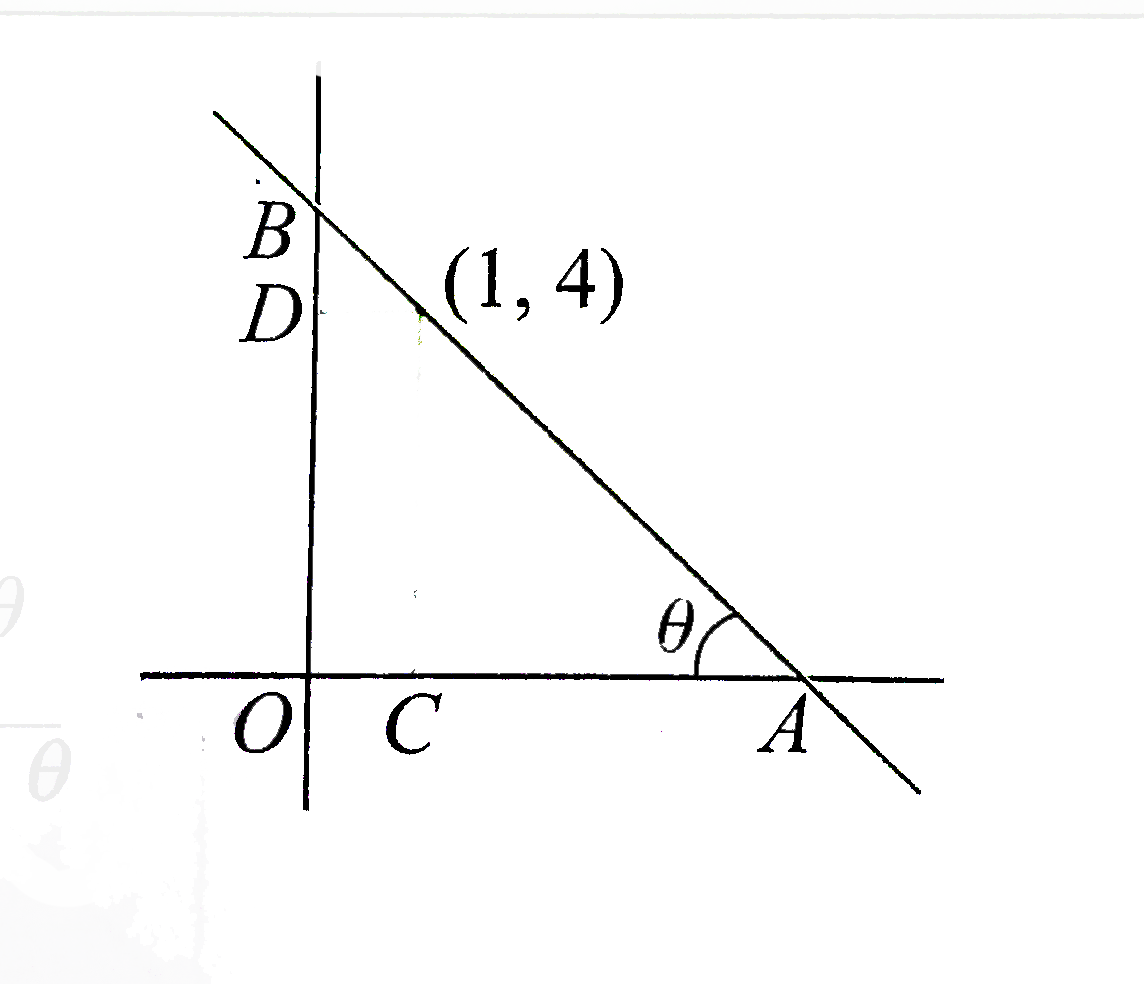 `OA = 1+4 "cot" theta` `OB = 4+ "tan" theta` `OA+OB = 5+4 "cot" theta + "tan" theta` ` ge 5 +2 sqrt(4 "cot" theta " tan" theta)` `=5+(2 xx 2)=9` (b) 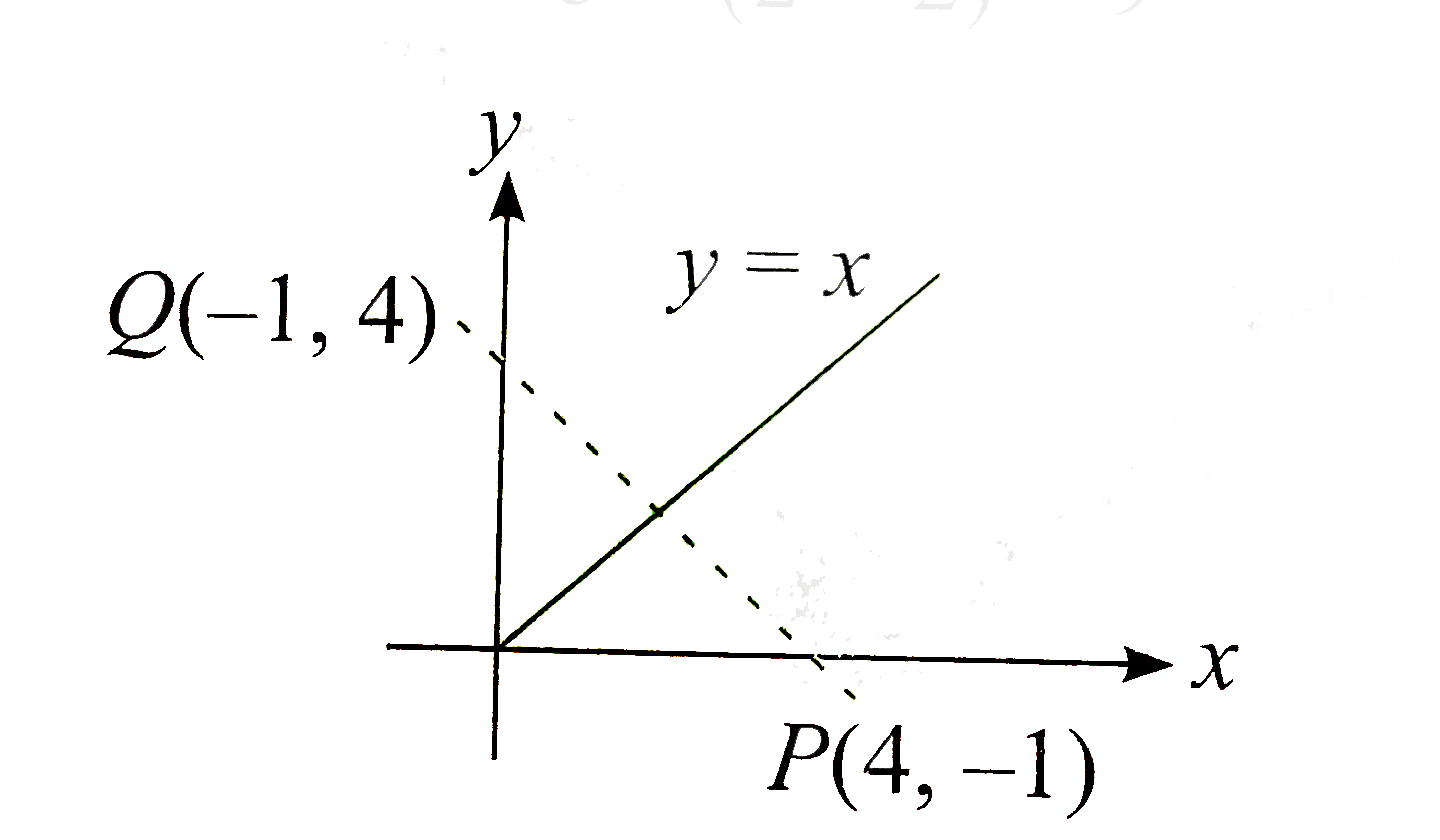 The REFLECTION of P(4, -1) on y=x is Q (-1, 4). Hence, `PQ = sqrt((4+1)^(2) + (-1-4)^(2)) = sqrt(50) = 5sqrt(2)` (c) 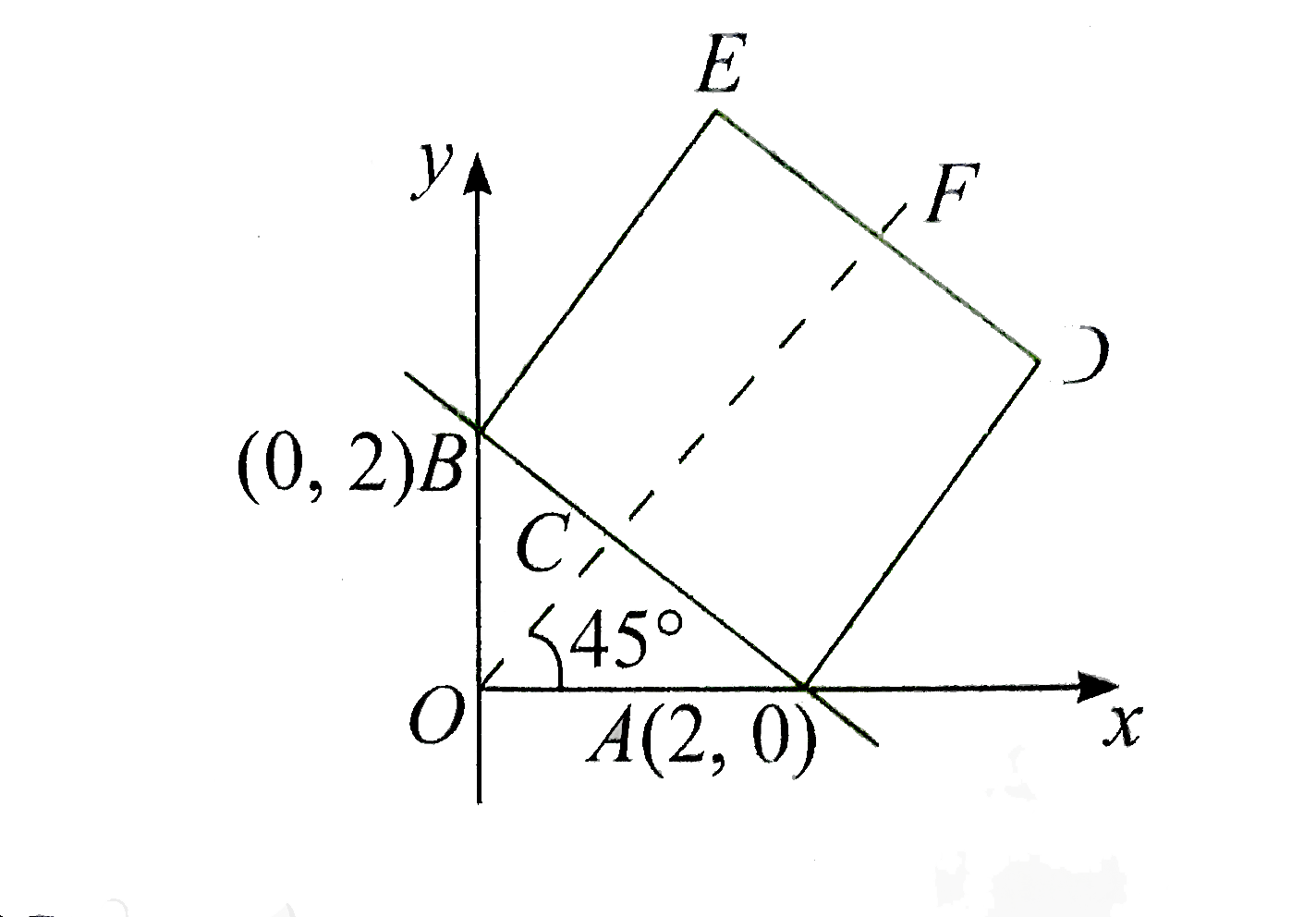 `AB = 2sqrt(2)` `OC = sqrt(2)` The maximum value of d is `OF = sqrt(2) + 2sqrt(2)` `=3sqrt(2)` (d) The given line is `x= 4+(1)/(sqrt(2))((y+1)/(sqrt(2)) " or " y=2x-9` Hence, the INTERCEPT MADE by the x-axis is 9/2. |
|
| 32. |
If A={x:f(x)=0} and B={x:g(x)=0} then AcapB will be |
|
Answer» `[F(X)]^(2)`+`[g(x)]^(2)`=0 |
|
| 33. |
Match the following lists: |
|
Answer» `|{:(3, 1, -4),(1, -2, -6),(lambda, 4, lambda^(2)):}| = 0` `"or " lambda^(2) +2lambda-8 =0` `"or " lambda=2, -4` b. The points are COLLINEAR. HENCE, `|{:(lambda+1, 1, 1),(2lambda+1, 3, 1),(2lambda+2, 2lambda, 1):}| = 0` `"or " 2lambda^(2) - 3lambda-2 =0 " or " lambda = 2, -(1)/(2)` c. The point of intersection of x-y=1 and 3x+y-5=0 is (1,2). It lines on the line `x+y-1-|(lambda)/(2)| = 0 ""therefore lambda = +-4` d. The midpoint of (1, -2) and (3, 4) will satisfy `y-x-1+lambda=0` `therefore lambda = 2` |
|
| 34. |
Match the following lists: |
Answer» 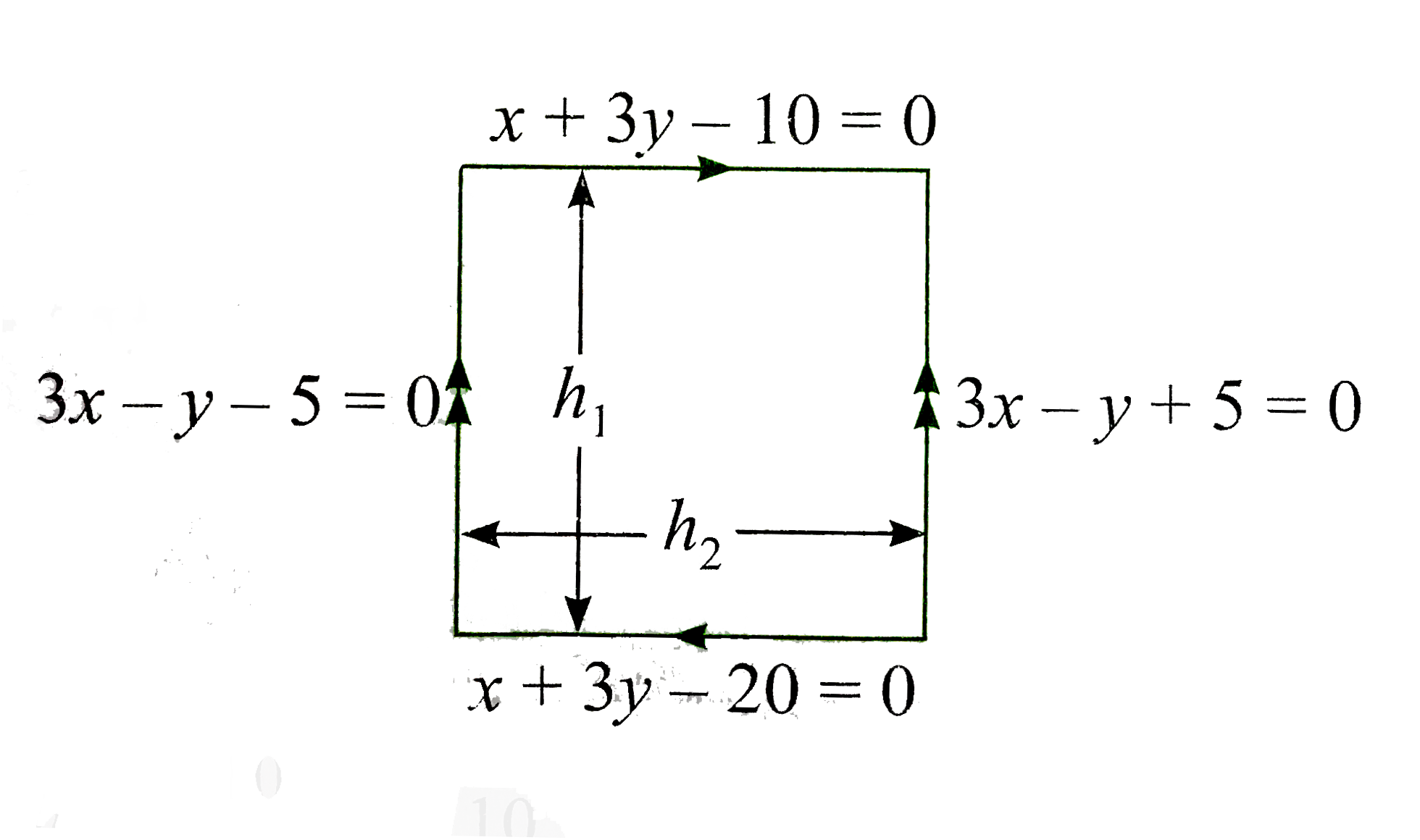 `h_(1) = |(10)/(sqrt(10))| = sqrt(10)` `h_(2) = (10)/(sqrt(10)) = sqrt(10)` HENCE, the given LINES form a square of side `sqrt(10)`. THEREFORE, the AREA is 10 sq. units. 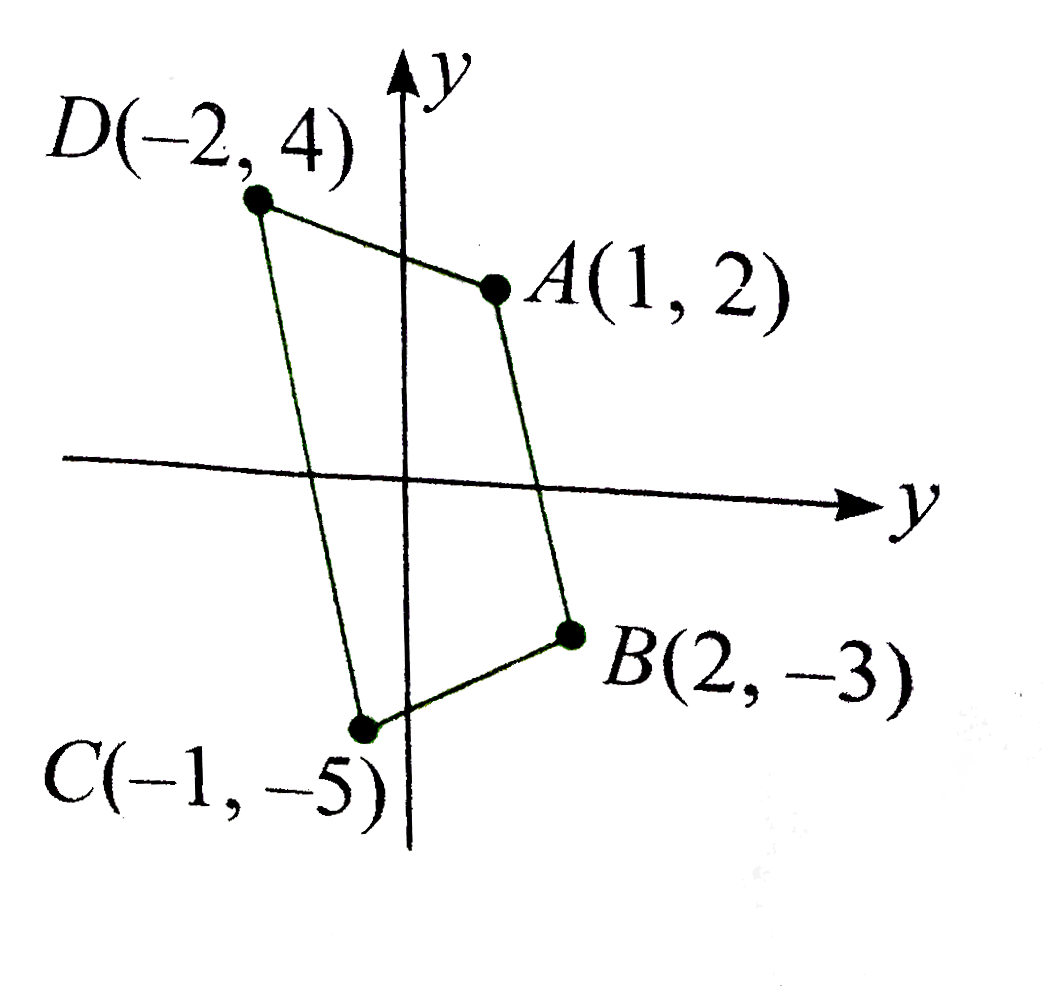
|
|
| 35. |
Match the following lists: |
Answer» 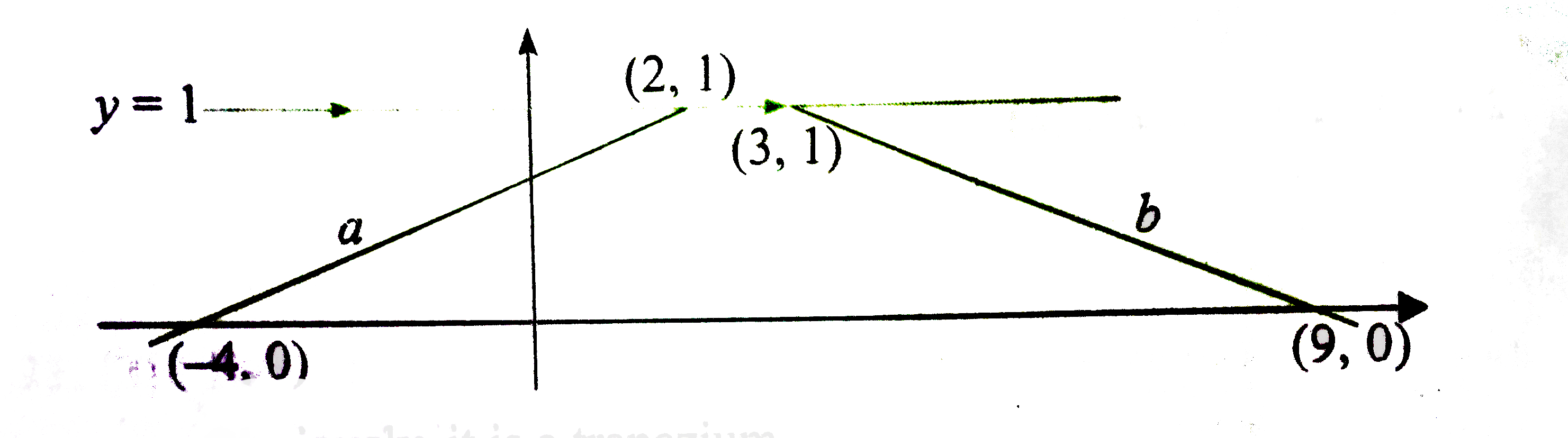 Obviously, it is a trapezium. `a = sqrt(37)` `b = sqrt(37)` `therefore a =b` Hence, it is and isosceles trapezium. Therefore, it is a cyclic QUADRILATERAL. b. 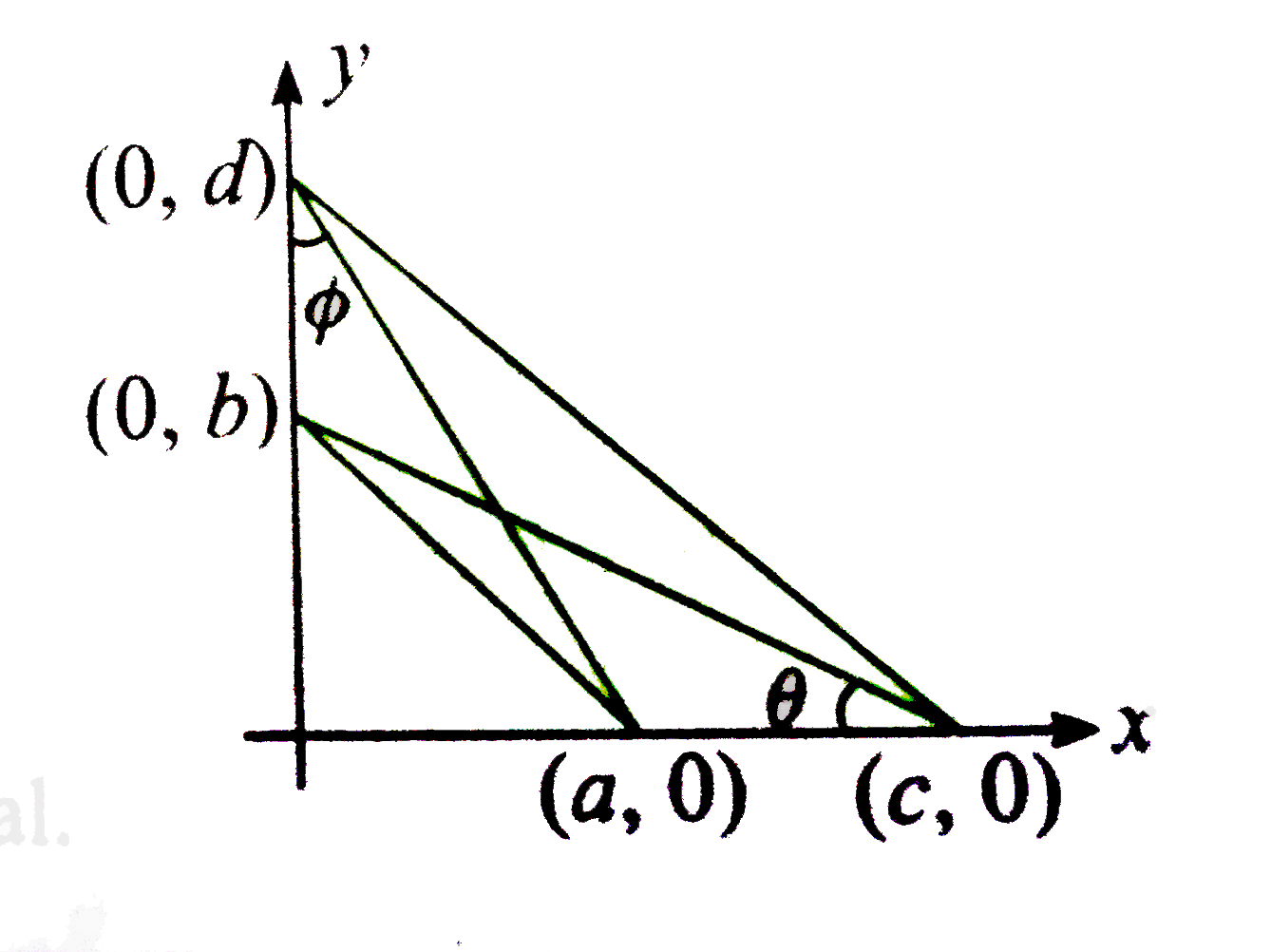 ac= bd `"or " (b)/(c) = (a)/(d)` `"tan "theta = (b)/(c)` `"tan "PHI = (a)/(d)` `"or " theta = phi` Hence, it is a cyclic quadrrilateral. c. `ax+- by +-c = 0` `"If " y=0, y=+-(c)/(a)` `"If " x= 0, y= +-(c)/(d)` Therefore, it is a rhombus. d. 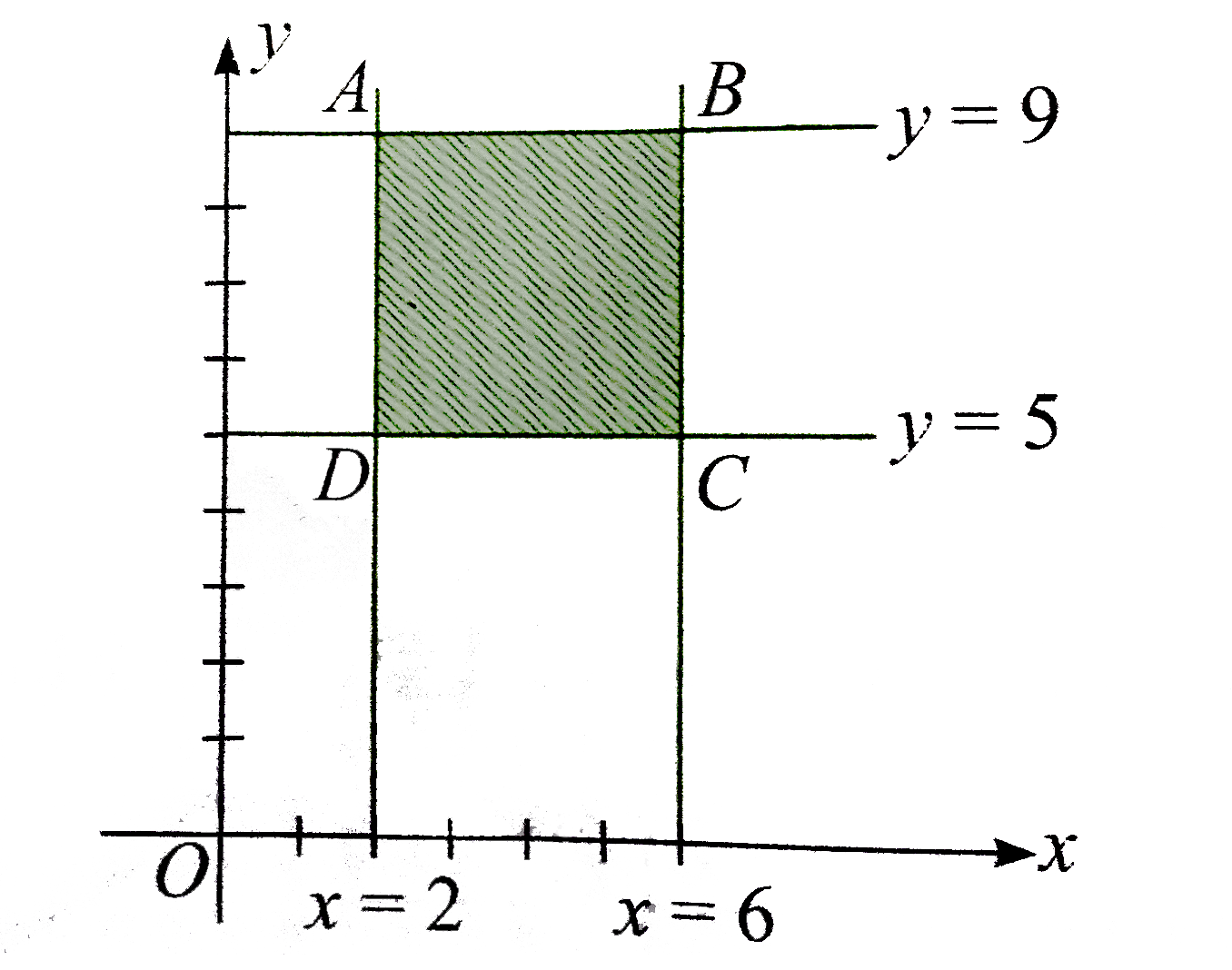 (x-6)(x-2) =0 x = 6 and x = 2 `y^(2) - 14y+45=0` (y-9)(y-5) = 0 Therefore, it is a SQUARE. |
|
| 36. |
If x=a+b, y=a omega+b omega^2,z=a omega^2+bomega show thatx^3+y^3+z^3=3(a^3+b^3) |
|
Answer» SOLUTION :`L.H.S.=x^3+y^3+z^3` `(a+b)^3+(aomega+bomega^2)^3+(aomega^2+b^2)^3` `a^3+3a^2b+3ab^2+b^3+a^3omega^3+3a^2b^2bomega^2+3aomegab^2omega^4+b^3omega^6+a^3omega^6+3a^2omega^4bomega+3aomega^2b^2omega^2+b^3omega^3` `=a^3+a^3+a^3+b^3+b^3+b^3+3a^2b(1+omega^4+omega^5)+3ab^2(1+omega^5+omega^4)` `3a^3+3b^3+0+0=3(a^3+b^3)="R.H.S.(PROVED)"` |
|
| 37. |
If 0lt plt 2pi and sin^(-1)(sinp)lt (x^(2))/(y)+(3y^(2))/(x)+(1)/(81xy)forall x ,yin R^(+) then p in |
|
Answer» `2n pi PM (pi)/(4)+(pi)/(12)` |
|
| 39. |
Draw a coordinate plane and plot the following points : x=0 |
|
Answer» |
|
| 40. |
(1 + omega) (1 + omega^(2)) (1 + omega^(3)) (1 + omega^(4)) (1 + omega^(5)) (1 + omega^(6)) …. (1 + omega^(3n)) = |
| Answer» Answer :C | |
| 41. |
Miki has 7 jazz CDs for every 12 classical CDs in his collection. If he has 60 classical CDs, how many jazz CDs does he have? |
|
Answer» |
|
| 42. |
If 4P(A) = 6 P(B) = 10 P(A cap B) = 1then P(B | A)= ………. |
| Answer» Answer :A | |
| 43. |
The value of ((1+sqrt3i)/(1-sqrt3i))^(64)+((1-sqrt3i)/(1+sqrt3i))^(64) is |
| Answer» Answer :B | |
| 44. |
P is a point denoting z in the argand diagram and if (z-i)/(z-1) is always purely imaginary, then locus of P is |
|
Answer» the CIRCLE with centre `(1/2,1/2)` and RADIUS `1/sqrt2` |
|
| 45. |
1 + i^(2) + i^(4) + i^(6) + … +i^(2n) = |
|
Answer» POSITIVE |
|
| 46. |
Let p(gt0) be the first of the n arthimaticmeans betweens between two numbers and q(gt0) the first of n harmonic means between the same numbers. Then prove that qnotin(p,((n+1)/(n-1))^(2)p)andpnotin(((n-1)/(n+1))^(2)q,q) |
|
Answer» SOLUTION :Let a and b be two numbers and `A_(1),A_(2),A_(3),…A_(n)` be n A.M's between a and b. Then `a,A_(1),A_(2),…,A_(n)`,b are in A.P. There are (n+2) terms in the series `rArra+(n+1)d=b` `rArrd=(b-1)/(n+1)` `rArrA_(1)=p=a+(b-1)/(n+1)=(an+b)/(n+1)` ..(1) The first H.M between a and b, when nHM's are inserted between a and b can be obtained by replacing a by `1/a` and b by `1/b` in eq. (1) and then taking its reciprocal. Therefore,`q=1/(((1/a)n+1/b)/(n+1))=((n+1)AB)/(bn+a)` Substitute b=p(n+1)-an[from (1)] in equation (2) to get `aq+nq[p(n+1)-an]=(n+1)a[p(n+1)-an]` `rArrna^(2)-[(n+1)p+(n-1)q]a+npq=0` `rArr" Discriminant" ge0 (because ` is a real) `rArr[(n+1)p+(n-1)q]^(2)-4n^(2)pqge0` `rArr(n-1)^(2)q^(2)+{2(n^(2)-1)-4n^(2)}pq+(n+1)^(2)p^(2)ge0` `rArrq^(2)-2(n^(2)+1)/((n-1)^(2))pq+((n+1)/(n-1))^(2)p^(2)ge0` `rArr[q-p((n+1)/(n-1))^(2)][q-p]ge0` `rArrq` can not lie between p and q `((n+1)/(n-1))^(2)` ALSO `[p((n+1)/(n-1))^(2)-q][p-q]ge0` `rArr[p-q((n-1)/(n+1))^(2)][p-q]ge0` `rArr p` can not lie between q `((n-1)/(n+1))^(2)` and q |
|
| 47. |
By solving linear programming problem maximize Z=9x+3y subject to 2x+3y le13 , 3x+y le5 and x,yge0 using graphical method we get x =2,y=k and z=28 find the value of k |
| Answer» | |
| 48. |
The maximum number of equivalence relations on the set A = {1,2,3}are .......... |
|
Answer» 1 |
|
| 49. |
Find the unit vector in the direction of vector vec(PQ) , where P and Q are the points (1,2,3) and (4,5,6) , respectively. |
|
Answer» |
|