

Saved Bookmarks
This section includes 7 InterviewSolutions, each offering curated multiple-choice questions to sharpen your Current Affairs knowledge and support exam preparation. Choose a topic below to get started.
| 1. |
If A and B are two events such thatP (A/B) = 0.6, P(B/A) = 0.3, P(A) = 0.1the n, P(barA nn barB) = |
|
Answer» `0.88` |
|
| 2. |
If b_i=1-a_i na = Sigma_(i=1)^(n)a_i, nb = Sigma_(i=1)^(n) b_i " then " Sigma_(i=1)^(n) a_b_i+Sigma_(i=1)^(n)(a_i-a)^2= |
|
Answer» ab `=NA-Sigmaa_(i)^(2)` `=na-Sigma(a_(i)-a+a)^(2)` `=na-Sigma[(a_(i)-a)^(2)+a^(2)+2A(a_(i)-a)]` `=na-Sigma(a_(i)-a)^(2)-Sigmaa^(2)-2aSigma(a_(i)-a)` `rArrSigmaa_(i)b_(i)+Sigma(a_(i)-a)^(2)=na-na^(2)-2a(na-na)` `=na(1-a)=nab` `[{:(becauseSigmab_(i)=Sigma1-Sigmaa_(i)),(thereforenb=n-na),(or a+b=1):}]` |
|
| 3. |
If bar(a)=hati+hatj+hatk,bar(b)=hati+hatj,bar( c )=hati and (bar(a)xx bar(b))xx bar( c )=lambda bar(a)+mu bar(b) then lambda+mu = ………… |
|
Answer» 0 |
|
| 4. |
For the function g whose graph is given. Arrange the following numbers in increasing order and explain your reasoning. g(0), g'(-2), g'(0), g'(2), g'(4) |
Answer» Solution : From the graph, the VALUE off(0) = 0. Also TANGENT to` y = g(x) " at" x = 0` MAKES an obtuse ANGLE with thepositive x - AXIS, hence ` g'(0) lt 0`. The measure of acute angle of inclination with the positive x - axis for tangent at ` x =- 2, x = 2, x = 4` is in decreasing order. Hence ` g'(-2), gt g'(2) gt g'(4)`. Thus, values in increasing order are ` g'(0) lt g(0) lt g'(4) lt g'(2) lt g'(-2)`. |
|
| 5. |
Maximize the function z = 6x+ 3y , subject to the constraints : 4x+y ge 80, x+5y ge 115, 3x+2y le 150, x ge 0, y ge 0 |
|
Answer» |
|
| 6. |
If A and B are matrices of same order , then (AB'-BA') is a …………. |
|
Answer» SKEW SYMMETRIC MATRIX |
|
| 7. |
The numbers a_(n)=6^(n)-5n for n=1,2,3,… whrn divided by 25 leave the remainder |
|
Answer» 9 |
|
| 8. |
{{:(-16=7y+4x),(k = (7)/(8)y + (1)/(2)x ):} If the system of linear equatioons above has infinitely many solutions, and k is a constant, what is the value of k ? |
|
Answer» Solution :The systym has infinitely many solutions, so both equations must describe the same line . Notice that if you multiply the x-and y-coefficients in the SECOND equation by 8, you arrive at the x-and y-coeffcients in the FIRST equation. The CONSTANT k times 8 must then equal the constant in the first equation, `or -16:` `9k=-16` `k =-2` The correct answer is (C ). |
|
| 9. |
Which of the following are false : Statement-I : (int_(0)^(pi//2) (sqrt(cos x))/(sqrt(cos x + sqrt(sin x)))= pi/2 Statement-II : int_(0)^(pi//2) log(tan x) dx=1 Statement-III: int_(0)^(pi//2) log sin x dx = - pi log 2 |
|
Answer» Only I, II |
|
| 10. |
If vec a, vec b, vec c non zero coplanar vectors, then, [2 vec a - vec b3 vec b - vec c4 vec c - vec a] = |
|
Answer» 0 |
|
| 11. |
Verify Mean value Theorem for the function f(x)= x^(2) in the interval [2,4] |
|
Answer» |
|
| 12. |
If y = a cos (sin 2x) + b sin (sin 2x), then y _(2) + (tan 2x) y_(1)= |
|
Answer» 0 |
|
| 13. |
Let a_(ij) denote the element of the ith row and jth column in a 3xx3 determinant (1 le ile 3, 1lejle3) and let a_(ij)=-a_(ji) for every i and j . Then the determinant has all the principal diagonal elements is : |
|
Answer» 1 |
|
| 14. |
Let f(x) = 5x tanx + 8 sin(tan x) +In(cos x) then in the interval (-pi/4, 0) |
|
Answer» F(x)is INCREASING |
|
| 15. |
If two dice are rolled then the probability of getting 4 or more on both the dice is |
|
Answer» `(1)/(2)` |
|
| 16. |
Find the points of discontinuity of the following function. (a) f(x)= (3x + 7)/(x^(2) -5x + 6) (b) f(x)= (1)/(|x|-1)-(x^(2))/(2) (c ) f(x)= (sqrt(x^(2) + 1))/(1+ sin^(2)x) (d) f(x)= tan ((pi)/(2)x) |
|
Answer» |
|
| 17. |
The value of int_(0)^(1.5) x^(2)[x^2] dx is (sqrt(2) = 1.41) |
|
Answer» |
|
| 19. |
Forn ge 2, if I_(n)= int (sin x + cos x)^(n) dx " then " nI_(n)-2(n - I) I_(n-2) = |
|
Answer» `(sin x + COS x)^(N+1) (sin x - cos x)+c` |
|
| 20. |
If int x^(3) e^(5x)dx=(e^(5x))/(5^4)(f(x))+c, then f(x)= |
|
Answer» `E^(5x)[(X^(3))/(5)-(3x^(2))/(25)+(6X)/(125)-(6)/(625)]+c` |
|
| 22. |
Make sure that a formal change of the variable t = x^((2)/(5))leads to thewrong resultin the integral int_(-2)^(2) 5 sqrt(x^(2)) dx. find the mistake andexplain it |
|
Answer» |
|
| 23. |
If alpha,beta and gamma are angles made by a line with coordinate axes such that alpha=beta=2gammaandanglealpha is acute, then cos alpha= |
|
Answer» `(SQRT(17)-1)/(8)` |
|
| 24. |
Using differentials, find the approximate value of each of the up to 3 places of decimal. (26.57)^((1)/(3)) |
|
Answer» |
|
| 25. |
If A + B + C = 2S, then sin (S-A) + sin (S-B) - sin C= |
|
Answer» `-4"sin" (S-A)/(2) "sin"(S-B)/(2) "sin"(C )/(2)` |
|
| 26. |
Evaluate the definite integrals in exercise. overset((pi)/(3)) underset((pi)/(6)) int (sinx +cosx)/(sqrt(sin2x))dx |
|
Answer» |
|
| 27. |
A : If a = i + j + k, b = 4i + 3j + 4k, c = i + alpha j + beta k are linearly dependent and |c| = sqrt(3) then alpha = +- 1, beta = 1 R : For coplanar vectors every vector can be expressed as linear combination of other. |
|
Answer» A, R are CORRECT, R is correct EXPLANATION of A |
|
| 28. |
Let L_(1) : vecr = (veci + vecj + veck) + lambda(veci + vecj), lambda in R, L_(2):hati + (mu + 1)hatj + (mu +1)hatk, mu in R are two lines intersecting at point 'A'. Through point B(3,3,1) a line in drawn making an angle of 60^(@) with L_(2) and intersecting it a point 'C'. Then area of triangleABC is: |
|
Answer» `2sqrt(2)` `r =(1,1,1) + MU(0,1,1)` int pt. `A -= (1,1,1)` Let c be `(1, 1+mu, 1+mu)` `vec(AC) = 011` `vec(BC) =2,2- mu, -mu` `AC ^ BC = 60^(@) rArr (0+2-mu - mu)/(sqrt(2) sqrt(4+(2-mu)^(2)+mu^(2)))=1/2` 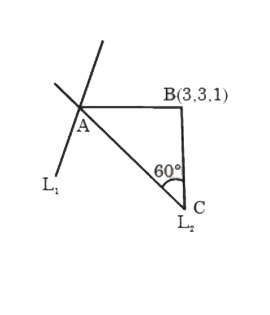 `(4+4mu)^(2) = 2(4 + 4+mu^(2) - 4mu + mu^(2))` `16(1+mu^(2) -2MU) = (16 + 4mu^(2) - 8mu)` `12mu^(2) - 24mu rArr mu =0, mu=2` `mu=0, mu=2` 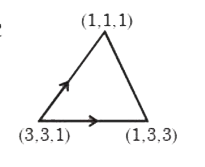 C(1,1,1)(1,3,3) `1/2|{:(hati,hatj,hatk),(-2,0,2),(-2,-2,0):}|=1/2{hati(4) - hatj(4) + k(4)}` `|(2hati - 2hatj + 2hatk)|=2sqrt(3)=asqrt(b)` a=2, b=3 |
|
| 29. |
Integrate the following inttan^3xsec^2x dx (tanx=v) |
|
Answer» SOLUTION :`inttan^3xsec^2xdx` [PUT tanx=t then sec^2xdx=dt] `intt^3dt=(1/4)t^4+C=(1/4)tan^4x+C` |
|
| 30. |
Let the sum sum _( n =1) ^(g) (1)/(n ( n +1) ( n +2)) written in its lowest terms be p /q. Find the value of q-p. |
|
Answer» |
|
| 31. |
Find (dy)/(dx) in the following y= cos^(-1) ((2x)/(1+ x^(2))), -1 lt x lt 1 |
|
Answer» |
|
| 32. |
Three faces of dice are marked integer 1, two faces are marked integer 2 and one face is marked with integer 5. Then find the mean of an event of getting number on dice while tossing. |
|
Answer» 2 |
|
| 33. |
Find the areas enclosed between the circle x^(2) + y^(2)-2x + 4y-11=0 and the parabola y= -x^(2) + 2x + 1- 2 sqrt3 |
|
Answer» |
|
| 34. |
int_(0)^(1) (dx)/(x^(2)+2x sin alpha +1)= |
|
Answer» `( pi/4 - ALPHA/2) COSEC alpha` |
|
| 36. |
Length of the double ordinateof the parabola y^(2) = 4x, at a distance of 16 units from its vertex is |
|
Answer» 4 |
|
| 37. |
On the occasion of Dipawali festival ,each student of a class sends greeting cards to others.If there are 20 students in the class, the numbers of cards send by student is |
|
Answer» `""^(20)C_(2)` |
|
| 38. |
If f(x) = (sqrt(x-2sqrt(x-1)))/(sqrt(x-1)-1) ,then - |
|
Answer» `f'(10) = 1 ` |
|
| 39. |
Let Q(a, b) be a point on the line x+y=1. Then the equation of a set of points P(x, y) such that its distance from the line x+y= 1 is equal to its distance from the point Q(a,b) is |
|
Answer» X + y - a - B = 0 |
|
| 40. |
One kind of cake requires 200g of flour and 25g of fat, and another kind of cake requires 100g of flour and 50g of fat. Find the maximum number of cakes which can be made from 5kg of flour and 1 kg of fat assuming that there is no shortage of the other ingredients used in making the cakes. |
|
Answer» |
|
| 41. |
Find the derivative of the following functions with respect to x tan (2x+3) |
|
Answer» |
|
| 42. |
Let X = {1,2,3,4,5,6,7,8,9}. ' Let R _(1) be a relation in X given by R_(1) = {(x,y): {x,y} sub {1,4,7}} or {x,y} sub {2,5,8} or {x,y} sub {3,6,9}. Show that R _(1) = R _(2). |
|
Answer» |
|
| 43. |
Total number of possible matrices of order 3xx3 with each entry 2 or 0 is ……….. |
|
Answer» 9 |
|
| 44. |
Evaluation of definite integrals by subsitiution and properties of its : int_(1)^(5)(|x-3|+1-x|)dx=.......... |
| Answer» Answer :D | |
| 45. |
int(sinx + 8 cosx)/(4 sinx + 6 cosx)dx is equal to |
|
Answer» `x+1/2log(4 sin x + 6 COSX)+C` |
|
| 46. |
Considerthe realfunction f(x ) = ( x+2)/( x-2) find the domainand rangeof thefunction |
|
Answer» |
|
| 47. |
Find the orthocentre of the triangle whose sides are x+2y=0,4x+3y-5=0, 3x+y=0 |
|
Answer» |
|


