

Saved Bookmarks
This section includes 7 InterviewSolutions, each offering curated multiple-choice questions to sharpen your Current Affairs knowledge and support exam preparation. Choose a topic below to get started.
| 1. |
If x=a sec^(2)theta, y=a tan^(2)theta" then "(d^(2)y)/dx^(2)= |
|
Answer» 0 |
|
| 2. |
A satellite of .................... |
|
Answer» `:. LT=(pi AB)2m` `L=(2PI abm)/T=(2pim ((r_(a)+r_(p))/2) sqrt(r_(p) r_(a)))/T= (m pi (r_(a)+r_(p)) sqrt(r_(a) r_(p)))/T` |
|
| 3. |
Integrate the following functions sec^2x/sqrt(tan^2x+4) |
|
Answer» Solution :PUT TAN X = t. Then `dt = sec^2x dx` therefore` int sec^2 x/sqrt(tan^2 x+4) dx = int dt/sqrt(t^2+4)` = `log|t+sqrt(t^2+4)|+c` =`log |tanx+ sqrt(tan^2 x+4)|+c` |
|
| 4. |
int (x^(2)+4)/(x^(4)+16)dx=(1)/(ksqrt(2))tan^(-1)((x^(2)-4)/(2sqrt(2)x))+c, then the value of k is- |
|
Answer» |
|
| 5. |
Value of (""^(40)C_(0))(""^(40)C_(15))-(""^(40)C_(1))(""^(40)C_(16))+(""^(40)C_(2))(""^(40)C_(12))……-(""^(40)C_(25))(""^(40)C_(40)) equals |
| Answer» Answer :A | |
| 6. |
Consider the binary operation '*' on R-{-2} defined a * b =a+b+(ab)/(2), for all a,b in R-{-2}. Find the value of x if 1 * (x * 2) = 8. |
|
Answer» |
|
| 7. |
Evalute the following integrals int (1 - 2x^(3))x^(2) dx |
|
Answer» |
|
| 8. |
Which of the following set are finite and which are infinite ?The set Q or rational number. |
| Answer» SOLUTION :"The SET Q of rational numbers" is an infinite set. | |
| 9. |
Find the unit vector in the direction of sum of vectors vec(a)=2hati-hatj+hatk and bar(b)=2hatj+hatk. |
|
Answer» |
|
| 10. |
Integrate the function is exercise. sqrt(4-x^(2)) |
|
Answer» |
|
| 11. |
Two unbaised dice are rolled and given that they are showing different digits. The probability of getting both even is |
|
Answer» `(1)/(5)` |
|
| 13. |
Let A and B be two events such that P(A)= (3)/(8), P(B)= (5)/(8) and P(A cup B)= (3)/(4). Then P(A//B)*P(A'//B)is equal to …….. |
| Answer» Answer :D | |
| 14. |
Let ABCD be square of side length 2 unit. C_(2) is the circle through verticles A,B,C,D and C_(1) is the circle touching all the sides of square ABCD. L is the line through A.A circle touches the line L and the circle C_(1) exrternally such that both the circles are on the same side of the line, then the locus of centre of the circle is |
|
Answer» ellipse 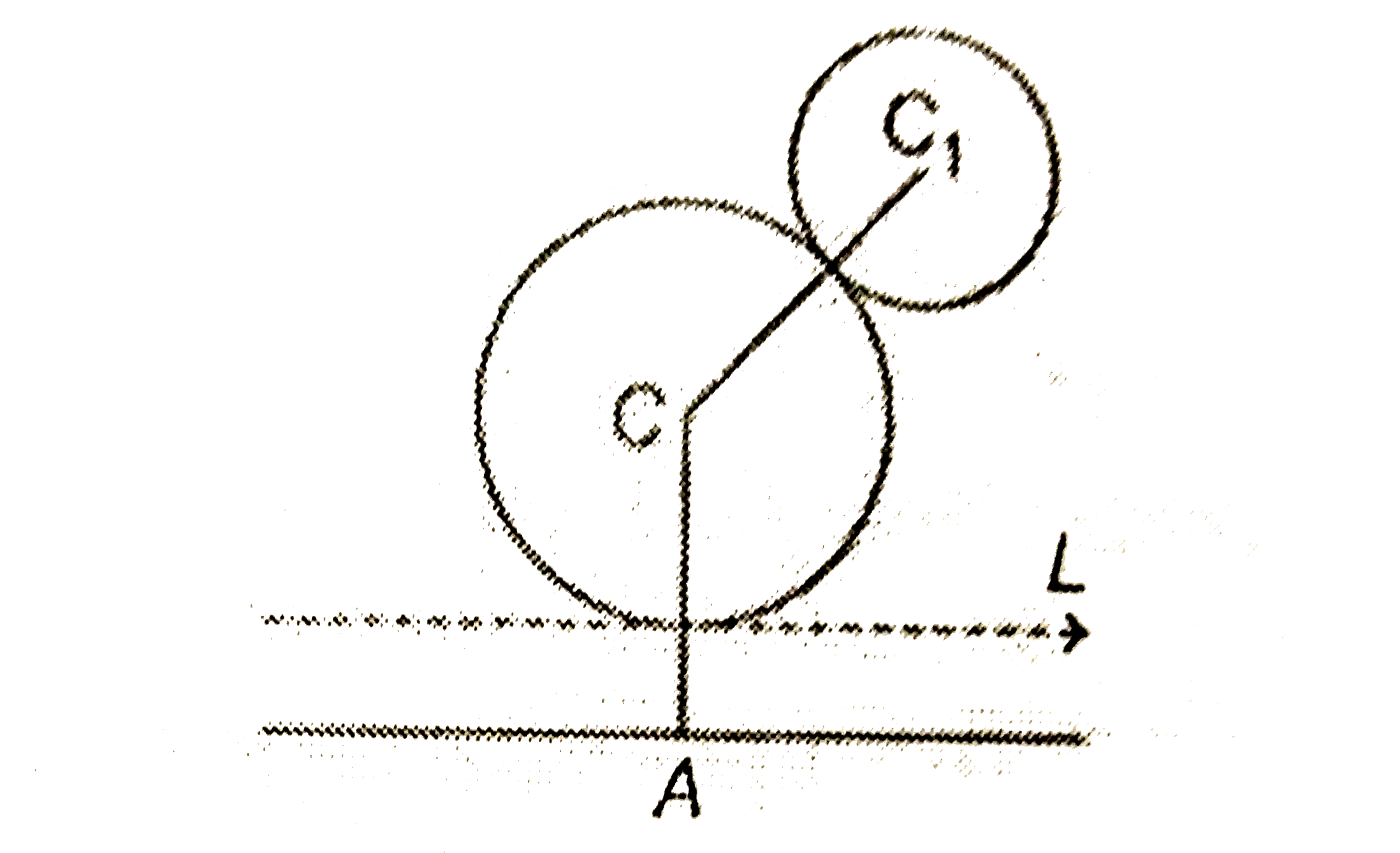 Now, DRAW a line PARALLEL to L at a distance of `r_(1)` (RADIUS of `C_(1)`) from it. Now, `CC_(1) = ACrArr C` lies on a parabola. |
|
| 15. |
(AB)^(-1)=A^(-1)*B^(-1) , where A and B are invertible matrices satisfying commutative property with respect to multiplication. |
|
Answer» |
|
| 16. |
Find the area of the region bounded by an arc of the cycloid x=a (t - sin t), y= a (1- cos t) and the x-axis |
|
Answer» |
|
| 17. |
A function f such thatf'(a)=f''(a)=….=f^(2n)(a)=0 , and fhas a local maximum value b at x=a ,if f (x) is |
|
Answer» `(x-a)^(2n-2)+B` `f(a) = f'(a)= ….= f^(2n) (a)=0` `rArrx=a` is root of f(x) of order (2n+1) or more. Also ,it is given that f(a)=b. Therefore `f(x)=b pm (x-a)^(2n+2)` `If f(x)=b -(x-a)^(2n+2)` then `f(x)=- 2(n-2)(x-a)^(2n+1)` Clearly f'(x) chages its sign from positive to negative in the neighbourhood of x=a Therefore , f(x) attatins a LOCAL maximum at x=a . Hence ,option (c ) is correct |
|
| 18. |
A circle is incribed in an equilateral triangle of side a. Show that the area of the square inscribed in the circle is (a^(2))/6. |
|
Answer» |
|
| 19. |
Prove by induction that {prod_(r=0)^(n)f_(r)(x)}'=sum_(i=1)^(n){f_1(x)f_2(x)....f_(i)'(x)....f_(n)(x)}, where dash denotes derivative with respect to x. |
|
Answer» <P> Solution :Let `P(n):{prod_(r=0)^(n)f_(r)(x)}^(')=sum_(i=1)^(n){f_(1)(x)f_(2)(x).....f_(1)(x)....f_(n)(x)}`Step I For ` n =1` , LHS of EQ. (i) `={prod_(r=1)^(1)f_(r)F(x)}^(')={f_(1)(x)}^(')=f_(1)^(')(x)` RHS of Eq. (i) `=sum_(i=1)^(1){f_1(x)f_(2)(x)...f_(1)^(')(x)... f_(1)(x)}` which is true for `n=1`. Step II Assume it is true for `n=K` , then `P(k):{prod_(r=1)^(k)f_(r)(x)}^(')=sum_(i=1)^(k){f_1(x)f_2(x).....f_1(x)....f_k(x)}` Step III For `n=k+1`, LHS`={prod_(r=1)^((k+1))f_r(x)}={prod_(r=1)^(k)f_r(x).f_(k+1)(x)}^(')` `=prod_(r=1)^(k)f_r(x).f_(k+1)^(')(x)+f_(k+1)(x){prod_(r=1)^(k)f_r(x)}^'` `= prod_(r=1)^(k)f_r(x).f_(k+1)^(')(x)+f_(k+1)(x).sum_(i=1)^(k){f_1(x).f_2(x).....f_(k+1)^(')....f_(k)(x)}` `={f_1(x)f_2(x)....f_k(x)}f_(k+1)^(')(x)+f_(k+1)(x) sum_(i=1)^(k){f_1(x)f_2(x)....f_(i) '(x).....f_(k)(x)}` `= sum_(i=1)^(k+1){f_19x)f_2(x).....f_(i)'(x)....f_(k+1)(x)}=RHS` This shows that the result is true for `n=k+1`. Hence , by the principle of mathematical induction , the result is true for all `n in N`. |
|
| 20. |
Show that f: [-1, 1 ] to R, given by f(x) = (x)/((x + 2)) is one-one. Find the inverse of the function f: [-1, 1] toRange f.( Hint: For y inRange f, y = f(x) = (x)/(x+ 2) , for some x in [-1, 1], i.e., x = (2y)/((1-y))) |
|
Answer» Solution :In `f : [-1, 1] to R , f(x) = (x)/( x+ 2)` LET `x, y in [-1, 1]` and `f(x) = f(y)` `RARR (x)/(x + 2) = (y)/(y +2) rArr xy + 2y = xy = 2y` `rArr2x = 2y rArr x =y ` `therefore f ` is one- one. Let `f(x) = y` where `yin R` `rArr (x)/(x + 2) = y rArr x = xy + 2y ` `rArr x (1 -y) = 2yrArr x = (2y )/(1-y)` `therefore ` RANGE of `f= R- {1}` Let, In `G : ` range of ` f to [-1, 1]` is DEFINED as `g(y) = ( 2y )/(1-y), y ne 1`. Now `(gof) (x) = g [f(x) ] = g((x)/( x+2))` `"" = (2((x)/( x+ 2))) /( 1- ((x)/(x + 2))) = (2x)/(x + 2 - x ) = (2x)/( 2) = x` and `(fog) (x) = f [g(x) ] = f((2x)/( 1-x))` `"" ((2x)/( 1-x))/(( 2x)/(1-x)+ 2)= (2x)/( 2x + 2 - 2x) = (2x)/(2) = x ` `therefore gof= fog = I_R` `rArr f ^(-1) = g` `rArr f^(-1)(y) = (2y)/( 1-y ) , y ne 1` |
|
| 22. |
Find the differentialdy and evaluate dy for the given values of x and dx. |
|
Answer» |
|
| 23. |
Given that ................. |
|
Answer» `t_(3//4)/t_(1//2)=((4)^(n-1)-1)/(2^(n-1)-1)=(2^(2(n-1))-1^(2))/(2^(n-1)-1)=((2^(n-1))^(2)-(1)^(2))/(2^(n-1)-1)` `=((2^(n-1)-1)(2^(n-1)+1))/((2^(n-1)-1))=(2^(n-1) +1)` |
|
| 25. |
Letg(x,y)=2y+x^(2),x = 2r -s,y=r^(2)+2s,r,s inRR. Find (delg)/(delr),(delg)/(dels) |
|
Answer» |
|
| 26. |
(d)/(dx)[tan^(-1)((a-x)/(1+ax))] is equal to |
|
Answer» `-(1)/(1+x^(2))` |
|
| 27. |
Letveca_(r)=x_(r )hati+y_(r )hatj+z_(r ) hatk, r=1,2,3 bethree mutuallyperpendicularunit vectors, then the value of |(x_(1),x_(2),x_(3)),(y_(1),y_(2),y_(3)),(z_(1),z_(2),z_(3))|is equal to : |
| Answer» ANSWER :B | |
| 28. |
If p, q are r are three logical statements, then the truth value of the statement (p^^q)vv (~q rarr r), where p is true, is |
|
Answer» TRUE if Q is false |
|
| 29. |
Show that the function f defined by f (x) = |1 + x - |x|| Where x is any real number, is a continuous function. |
|
Answer» Solution :Define G byg (x) = 1+ x - |x| H by h(x) = |x|, then (hog) (x) = h(g(x)) h ( 1+ x - |x|) = | 1 + x - |x|| = F(x) h(x) is a continuous function. Hence g being a SUM of a polynomial function and modulus function is continuous . But then f(x) beinga COMPOSITE of two continuous functions is continuous. |
|
| 30. |
If a, b and c are three non-zero vectors such that each one of them being perpendicular to the sum of the other two vectors, then the value of |a+b+c|^(2) is |
|
Answer» `|a|^(2)+|b|^(2)+|c|^(2)` `:. a.(b+c) =0`, `b.(a+c) =0` and `c.(a+b) = 0` `rArr a.b+a.c = 0, b.a + b.c = 0` and `c.a + c.b = 0` `rArr 2(a.b+b.c+c.a) = 0` `rArr a.b+b.c+c.a= 0"...."(i)` Now, `|a+b+c|^(2) = |a|^(2) + |b|^(2) + |c|^(2) + 2(a.b+b.c+c.a)` `= |a|^(2) +|b|^(2) +|c|^(2) + 2(0)` [from eq. (i)] `= |a|^(2) +|b|^(2) +|c|^(2)` |
|
| 32. |
{{:(-x^(2)+4x+a","xle3,),(ax+b","3ltxlt4,),(-(b)/(4)x+6","xge4,):}If x=3 is the only point of minima in its neighbourhood and x=4 is neither a point of maxima nor a point of minima , then which of the following true ? |
| Answer» Answer :A | |
| 33. |
Let f(x)=(sinx+3sin3x+5sin5x+3sin7x)/(sin2x+2sin4x+3sin6x), wherever defined. If x_(1)+x_(2)=(pi)/(2), where f(x) is defined at x_(1) and x_(2), then f^(2)(x_(1))+f^(2)(x_(2)) is |
| Answer» Answer :C | |
| 34. |
If a, band c are unit coplanar vectors, then [2a-b, 2b-c, 2c-a] is equal to |
|
Answer» 1 |
|
| 35. |
Simplify the following (sqrt(3)+sqrt(2))^(4)-(sqrt(3)-sqrt(2))^(4) |
|
Answer» |
|
| 36. |
Select the correct match :- |
|
Answer» TERMINAL BRONCHIOLE `rarr` "C" shape ring |
|
| 37. |
In 2015 the populations of City X and City Y were equal. From 2010 to 2015, the population of City X increased by 20% and the population of City Y decreased by 10%. If the population of City X was 120,000 in 2010, what was the population of City Y in 2010? |
|
Answer» 60000 Choice A is incorrect. If the population of City Y in 2010 was 60,000, then the population of City Y in 2015 would have been 60,000(0.90) = 54,000, which is not equal to the City X population in 2015 of 144,000. Choice B is incorrect because 90,000(0.90) = 81,000, which is not equal to the City X population in 2015 of 144,000. Choice D is incorrect because 240,000(0.90) = 216,000, which is not equal to the City X population in 2015 of 144,000. |
|
| 38. |
If therootsof x^4 -2x^3 - 21x^2+ 22 x + 40=0are inA.P then therootsare |
|
Answer» `2/3,-1/2 ,1,2` |
|
| 39. |
Find the area of the figure bounded by the parabola y= -x^(2) + 2x + 3, the line tangent to it at the point M (2, -5) and the y-axis |
|
Answer» |
|
| 40. |
The set of all values of x and the set of all values of a for which the real valued funtion f(x)=sqrt(log_(a)(x-[x])) is defined are respectively |
| Answer» Answer :A | |
| 41. |
Discuss the continuity of the function f given by f(x)= x^(3)+x^(2)-1. |
|
Answer» |
|
| 43. |
If y=ax is one of the lines belonging to the family of lines representing the sides of an equilateral triangle with one vertex at the origin, then the product of the slopes of all the lines of this family is |
|
Answer» `a^(3)` |
|
| 44. |
If the solution of the differential equation y( 1 + 2 xy sec^(2) (x^(2) -y)) dx - (x + y^2 sec^(2) ( x^(2)-y)) dy =0 is f(x,y)=c ( where c is integration constant ) , then f(2,1) is equal to |
|
Answer» `2- TAN 3 ` |
|
| 45. |
Evaluate the definite integrals int_(0)^(pi/4)(sinx+cosx)/(9+16sin2x)dx |
|
Answer» |
|
| 46. |
Evaluate the following integrals : int_(0)^(1)(1-x)/(1+x)dx |
|
Answer» |
|
| 47. |
IF the primitive of sin^(-3//2) x sin^(-1//2)(x+theta) is - 2 cosec theta sqrt(f(x)) +C then |
|
Answer» `f(X)=(SINX)/(SIN(x+theta))` |
|
| 48. |
Find an anti derivative (or integral) of the following functions by the method of inspection. cos 3x |
|
Answer» |
|
| 49. |
If theta denotes the acute angle between the line r=(i+2j-k)+lambda(i-j+k) and the plane r.(2i-j+k)=4, then sintheta+sqrt(2)costheta= |
|
Answer» `1//SQRT(2)` |
|
| 50. |
Show that tan^-11/5 is nearly equal to pi/2 |
|
Answer» |
|