

Saved Bookmarks
This section includes 7 InterviewSolutions, each offering curated multiple-choice questions to sharpen your Current Affairs knowledge and support exam preparation. Choose a topic below to get started.
| 1. |
(dy)/(dx) = 3y cot x = sin 2x, y = 2 when x = (pi)/(2) |
|
Answer» |
|
| 2. |
Let O be the vertex and Q be any point on the parabola ,x^(2) =8y . If the point P divides the line segment OQ internally in the ratio 1: 3 then the locus of P is: |
|
Answer» `X^(2)=y` |
|
| 3. |
In which of the following situations, it is possible to have a DeltaABC ? (All symbols used have usual meaning in a triangle) |
|
Answer» ` (a+c-b) (a-c+b) =4bc` |
|
| 4. |
if O is the point inside the triangle ABC such that /_OBC = A/2, /_OCA = B/2, /_AOB = C/2, then (sin(A - C/2)sin(B - A/2)sin(C - B/2))/(sin""(A)/2 sin""(B)/2 sin""(C)/2) equal : |
|
Answer» `COS""A/2 cos""B/2 cos""C/2` |
|
| 5. |
By rotating the coordinate axes in the positive direction about the origin by an angle alpha, if the point (1, 2) is transformed to ((3sqrt(3)-1)/(2sqrt(2)),(sqrt(3)+3)/(2sqrt(2))) in new coordinate system Then, alpha = |
|
Answer» `(pi)/(3)` |
|
| 7. |
Integrate the following functions: sin^4x |
|
Answer» Solution :`sin^4x = (SINX)^2 = ((1-cos2x)/2)^2` = `1/4(1-2cos 2x +cos^2 2x)` =`1/4(1-2cos 2x +(1+cos 4x)/2)` `=1/8(2-4 cos2x+1+cos4x)` `=1/8(3-4 cos2x+cos4x)` therefore` INT sin^4x dx` `=1/8[3x-4 (SIN2X)/2+(sin4x)/4]+c` `=3/8x- 1/4sin2x + (sin4x)/(32)+c` |
|
| 8. |
If a,b,c in Rthen number of ordered triplet (a,b,c) which satisfy the equations a^(2)+2b=6,b^(2)+4c=-7andc^(2)+6a=-13is |
|
Answer» 0 `impliesa^(2)+b^(2)+c^(2)+2b+4c+6a=-14` `implies(a+3)^(2)+(b+1)^(2)+(c+2)^(2)=0` `impliesa=-3,b=-1,c=-2`, but these VALUES does not SATISFY given equation |
|
| 9. |
Find the shortest distance between the following lines:(x-3)/1=(y-5)/(-2)=(z-7)/1and (x+1)/7=(y+1)/(-6)=(z+1)/1 |
|
Answer» `SQRT(29)` |
|
| 10. |
A function f :R to R is given by f (x) = {{:(x ^(4) (2+ sin ""(1)/(x)), x ne0),(0, x=0):}, then |
|
Answer» F has a continous DERIVATIVE `AA x in R` |
|
| 11. |
If z_(1) and z_(2) are two of the 8^(th) roots of unity such that arg(z_(1)/z_(2)) is last positive, then z_(1)/z_(2) is |
|
Answer» `1+i` ALSO, `n^(th)` roots of unity are given by `z_(R) = (e^(i2rpi)/n),r=0 1,2,…..,(n-1)` `therefore 8^(th)` roots of unity are given by `r=0,1,2,....,7` We know that arg `(z_(1)/z_(2))="arg"(z_(1))-"arg"(z_(2))`. Therefore, arg`((z_(1))/z_(2))` will have least positive value, if `z_(1)` and `z_(2)` represent any two consecutive points on the circle `|z|=1`. Let `z_(1)=z_(r)=e^((irpi)/4)`. Then, `z_(2)=z_(r-1)=e^(i(r-1)pi/4)` `therefore z_(1)/z_(2)=e^(ipi//4)=cospi/4+isinpi/4=(1+i)/sqrt(2)` |
|
| 12. |
The second term of an A.P is (x - y) and fifth term is (x + y), then the first term is |
|
Answer» `X - 1/3y` |
|
| 13. |
The value (int_(0)^(pi//2) (sinx)^(sqrt2+1)dx)/(int_(0)^(pi//2)(sinx)^(sqrt2-1)dx) is - |
|
Answer» `(sqrt2+1)/(sqrt2-1)` `I_(1)=((SINX)^(sqrt2)intsin"x dx")_(0)^(pi//2)-overset(pi//2)underset(0)int(sqrt2(sinx)^(sqrt2-1)COSX intsin"x dx")` `=-(cos x(sinx)^(sqrt2))_(0)^(pi//2)+sqrt2overset(pi//2)underset(0)int(sinx)^(sqrt2-1)(1-sin^(2)x)dx` `(I_(1))/(I_(2))=(sqrt2)/(1+sqrt2)xx((sqrt2-1))/((sqrt2-1))=2-sqrt2` |
|
| 14. |
If f(x) is a polynomial in x(gt0) satisfying the equation f(x)+f(1//x)=f(x).f(1//x) then f(x)= |
| Answer» Answer :B | |
| 15. |
Find the middle term (s) in the expansion of (3x^2 + (5)/(x^3))^12 |
|
Answer» |
|
| 16. |
If f : R to R is defined by f (x) = 2x + 3 , then f^(-1) x |
|
Answer» |
|
| 17. |
Find the odd function f(x) such that the area bounded by the x -axis the curve y = f(x) and the lines x = - 1 and x = 1 is equal to in (t^(2) + 1), AA t ge 0. |
|
Answer» |
|
| 18. |
If f(x)=(|x|)/(x)" for "x ne 0, f(0)=0," then f(x) at x=0 is " |
|
Answer» continuous |
|
| 19. |
i. Mean = a (3 median - mode) II. Mean - Mode = b(Mean - Median) (iii) Median = Mode + c (Mean - mode) |
|
Answer» `a LT C lt B` |
|
| 20. |
Two vertices of an equilateral triangle are (-1,0) and (1,0) then its circumcircle is |
|
Answer» `x^2 + (y - 1/(SQRT3))^2 = 4/3` |
|
| 21. |
Let |bar(a)|=7, |bar(b)|=11, | bar(a)+bar(b)|=10 sqrt(3) What is the angle between (bar(a)+bar(b) and (bar(a)-bar(b))? |
|
Answer» `(pi)/(2)` `cos alpha = ((vec(a)+vec(b))(vec(a)-vec(b)))/(|vec(a)+vec(b)||vec(a)-vec(b)|)` `=((7)^(2)-(11)^(2))/(10sqrt(3)xx2sqrt(10))=((7+11)(7-11))/(20sqrt(3)xxsqrt(10))=(-18)/(5sqrt(30))` `=(-6xx3)/(5sqrt(30))xx(SQRT(30))/(sqrt(30))=-(3sqrt(30))/(25)` `alpha = cos ^(-1)((-3)/(5)sqrt((6)/(5)))` |
|
| 22. |
Integrate the rational functions (3x-1)/((x-1)(x-2)(x-3)) |
|
Answer» |
|
| 23. |
Find derivatives of the following functions.tan^3x |
|
Answer» SOLUTION :`y = TAN^3x = (tan X) dy/dx = 3(tan x)^2. d/dx(tan x) =3tan^2x.sec^2x` |
|
| 24. |
An isosceles triangle of a given perimeter 2p=12 revolves about its base. Write the function V(x), where V is the volume of the solid of revolution thus obtained and x is the length of the lateral side of the triangle. |
|
Answer» |
|
| 25. |
Prove the following overset((pi)/(2)) underset(0) int sin^(3)xdx=(2)/(3) |
|
Answer» |
|
| 26. |
If int (1)/(4 + 5 sin x) " dx "= (1)/(3) log |f (x)| + c then f(x) = |
|
Answer» `(2 TAN ""(x)/(2) -1)/(tan""(x)/(2) +2)` |
|
| 27. |
Find derivatives of the following functions.sin^2 x cos^2 x |
|
Answer» Solution :`y = sin^2 X .cos^2 x = 1/4sin^2 2X dy/dx = 1/4 d/dx(sin2x) = 1/4. 2SIN2X. d/dx(sin2x) =1/2sin2x.cos2x. d/dx(2x) = 1/2 sin2x .cos2x.2 = sin2x. cos2x` |
|
| 28. |
Find the area bounded between the curves y^(2)=4ax , x^(2) = 4by (a gt 0, b gt 0). |
|
Answer» |
|
| 29. |
Statement 1 : Equation of the pair of lines bisecting the angle between the pair of lines ax^2+by^2+2hxy+2gx+2fy+c=0 can be written as x^2-y^2-((a-b)/h) xy +lamdax+muy+c'=0 because Statement 2 : Equation of any pair lines parallel to the lines ax^2+by^2+2hxy=0 is ax^2+2hxy+by^2+Ax+By +c''=0 . |
|
Answer» Statement - 1 is True, Statement -2 is True, Statement -2 is a correct explanation for statement - 1 |
|
| 30. |
A and B each select one number at random from the distinct numbers 1, 2, 3, …., n and the probability that the number selected by a is less than the number selected by B is (1009)/(2019). Now the probability that the number selected by B is the number immediately next to the number selected by A is |
|
Answer» `(2018)/(2019)` |
|
| 31. |
If sum _(x =pi-"" ^(10)C_(r))^(pi + "" ^(10)C _(r))sin x ^(0) =0, then value of r is "_________" |
|
Answer» |
|
| 32. |
veca,vecb,vecc be three vectors such that V_(1)=[(veca, vecb, vecc)]=1and V_(2)=[(vecaxxvecb)xxvecc(vecbxxvecc)xxveca(veccxxveca),vecb)] then the value of sum_(r=1)^(6)V_(1)^(r)+V_(1)V_(2)^(r) is |
|
Answer» 3 |
|
| 33. |
Ifthe chord joining two points whose eccentric angles are alpha and beta cut the major axis of an ellipse (x^(2))/(a^(2))+(y^(2))/(b^(2))=1 at a distancefrom the centre then tan (alpha)/(2).tan (beta)/(2) = |
|
Answer» `(1+e)/(1-e)` |
|
| 34. |
Integral part of the area of figure bounded by the tangents at the end of latus rectum of ellipse (x^(2))/9+(y^(2))/4=1 and directices of hyperbola (x^(2))/9=(y^(2))/72=1is |
|
Answer» So, `A=(1,(9-sqrt(5))/3)` & `B=(0,3)` AREA of figure `OGAB` is `1xx((9-sqrt(5))/3)+1/2xx1xx(3-(9-sqrt(5))/3)` `=(9-sqrt(5))/3+(sqrt(5))/6` `=(18-sqrt(5))/6` Area of required figure is `4{(18-sqrt(5))/6}=(36-2sqrt(5))/3` Integral part of area is `7` 
|
|
| 35. |
Areabounded bythe ellipse(x^2 )/(4)+(y^2)/(16)=4 is ……. |
|
Answer» `64 PI` |
|
| 36. |
Given P=[[2,-3],[-1,2]] . Findthe inverse of P by elementary row operation. |
| Answer» SOLUTION :`A^(-1) = [(2,3),(1,2)]` | |
| 38. |
An oil company has two depots A and B with capacities of 7000L and 4000L respectively. The company is to supply oil to three petrol pumps, D,E and F whose requirements are 4500L,3000L and 3500L respectively. The distances (in km) between the depots and the petrol pumpa is given in the following table: Assuming that the transportation cost of10 litres of oil is Rs. 1 per km, how shold the delivery be scheduled in order that the transportation cost is minimum? What is the minimum cost? |
|
Answer» Solution :Let the supply of petrol from A to D be `x` litres and A to E be `y` litres. So the supply of petrol from A to F will be `(7000-x-y)` litres. Similarly, the supply of petrol from B to D,E,F will be `(4500-x)` litres, `(3000-y)` litres, `(x+y-3500)` litres respectively. THEREFORE, minimum transportation cost. `Z=1/10[7x+5y+3(7000-x-y)+3(4500-x)` `+4(3000-y)+2(x+y-3500)]` `=1/10(3x+y+39500)` and CONSTRAINTS `xge0yge0` `7000-x-yge0impliesx+yle7000` `4500-xge0impliesxle4500` `3000-yge0impliesyle3000` `x+y-3500ge0impliesx+yge3500` First, draw the graph of the lines `x+y=7000, x=4500,y=3000,x+y=3500`. 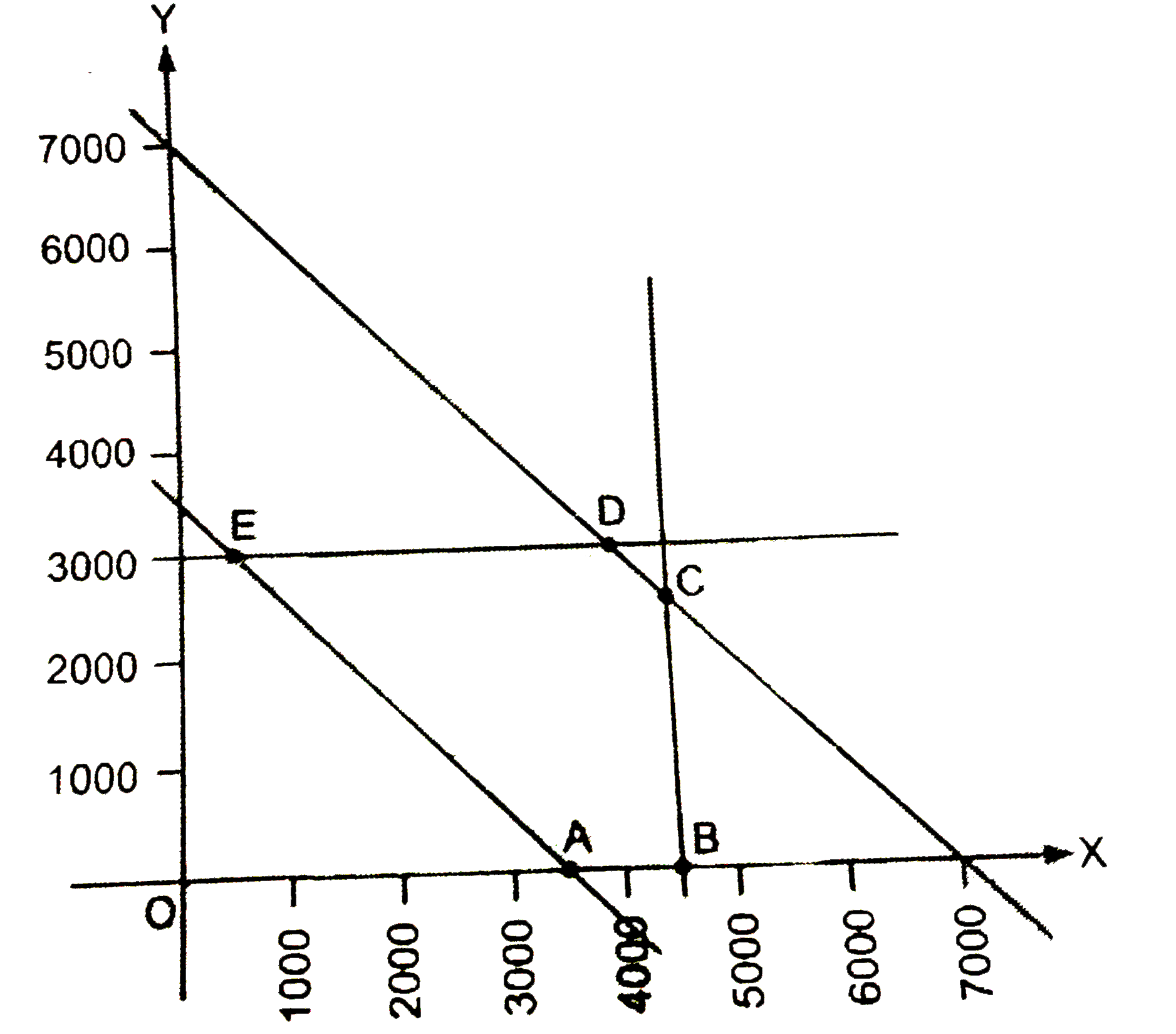 Now, we find the feasible region by constraints `x+yge7000,xle4500,yle3000,x+yge3500,xge0,yge0` and shade it whose VERTICES are `A(3500,0),B(4500,0),C(4500,2500),D(4000,30000,E(500,3000)`. We find the value of `Z` at these vertices. 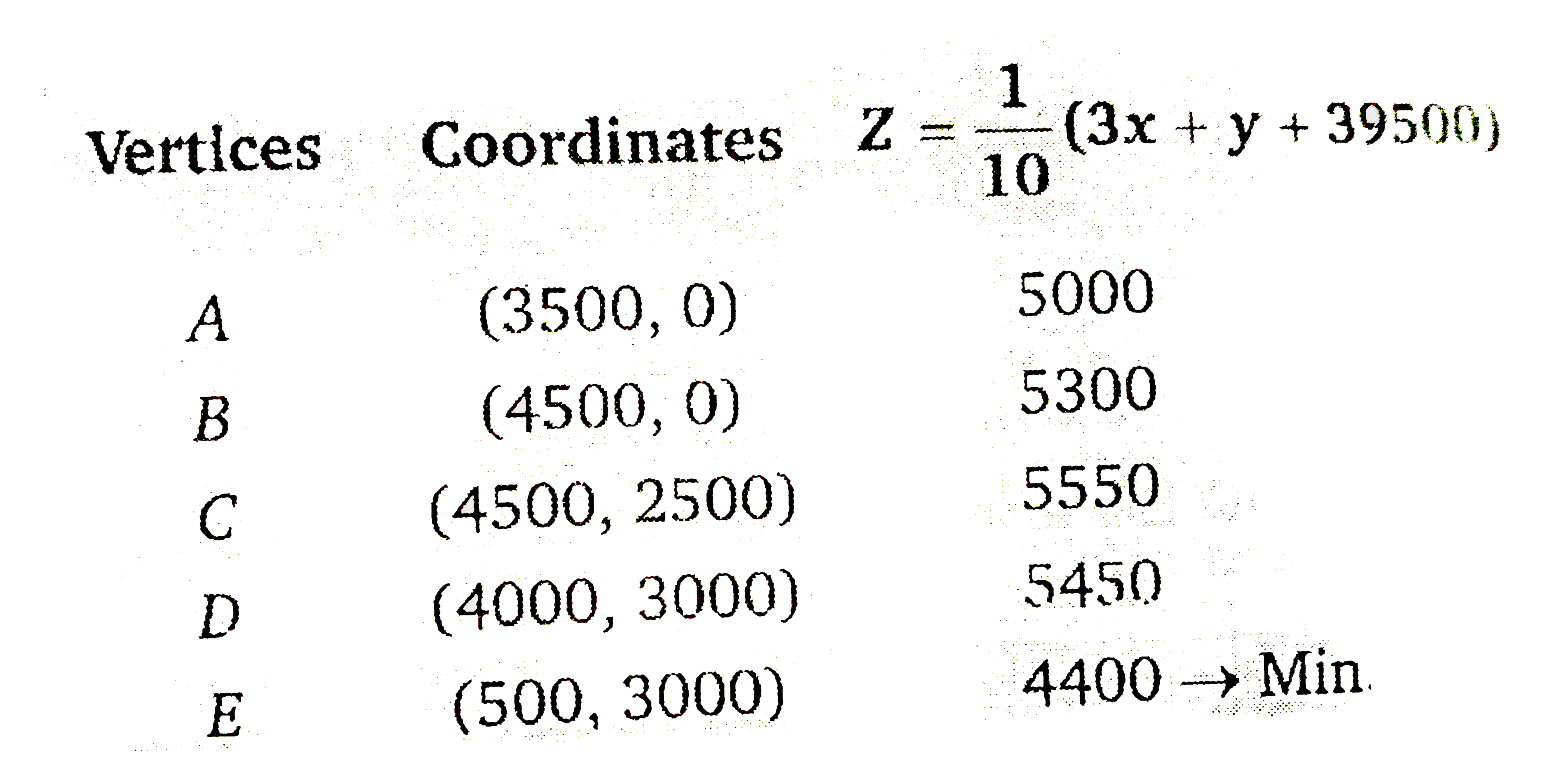 `:. x=500,y=3000` Therefore the supply of petrol form A to D,E,F will be 500 litres, 3000 litres, 3500 litres respectively and from B to D,E,F will be 4000 litres, 0 litres, 0 litres respectively. Minimum transportation cos `=Rs. 4400` |
|
| 41. |
An equilateral triangle with side a revolves about an axis parallel to the base and situated at a distance b gt a from the base. Find the volume of the solid of revolution. |
|
Answer» |
|
| 42. |
Letintsqrt((5-x)/(2+x))dx equal |
|
Answer» `SQRT(x+2)sqrt(5-x)+3sin^(-1)sqrt((x+2)/(3))+C` |
|
| 43. |
Let A = {1, 2, 3}, B { 4, 5, 6} and let f = {(1,4),(2,5)(3,6)} be a functionfrom A to B. Show that f is one-one. |
|
Answer» SOLUTION :F(1) = 4, f(2) = 5, f(3) =6. For distinct IMAGES. `therefore` f is one-one |
|
| 44. |
Choose the correct answer int((10x^(9)+10^(x)log_(e)10) dx)/(x^(10)+10^(x)) equals |
|
Answer» `10^(X)-x^(10)+C` |
|
| 45. |
f(x) is a twice differentiable function such that f"(x)=-f(x) and f'(x)=g(x). If h(x)=(f(x))^(2)+(g(x))^(2) and h(l)=2, then h(2)= |
|
Answer» A.0 |
|
| 47. |
A circle with center (2,1) has a tangent to the circle at (3,6). The equation of the tangent is |
|
Answer» 5y-x=27 |
|
| 48. |
Integration using trigonometric identities : int(1)/(1+sin^(2)x)dx=.... |
|
Answer» `(1)/(SQRT(2))TAN^(-1)(sqrt(2)tanx)+K` |
|
| 49. |
Find the values of k if area of triangle is 4 sq. units and vertices are(k,0),(4,0),(0,2) |
|
Answer» SOLUTION :Given that`Delta=+-4` `implies1/2|[K, 0,1],[4, 0,1],[0, 2,1]|=+-4` `1/2[1/2|[k,1],[4,1]|]=+-4` (on expanding ALONG `C_2`) `implies -(k-4)= +-4` `implies 4-k= +-4 ` `implies k=4overset-+4=4-4` or 4+4=0 or 8 |
|