

Saved Bookmarks
This section includes 7 InterviewSolutions, each offering curated multiple-choice questions to sharpen your Current Affairs knowledge and support exam preparation. Choose a topic below to get started.
| 2. |
Find the asymptotes of the hyperbola 4x^(2)-9y^(2)=36 |
|
Answer» |
|
| 3. |
For any two complex number z_1,z_2 and any real numbers a and b, |az_1-bz_2|^2+|bz_1+az_2|^2=…. |
|
Answer» `=[|a|^2|z_1|^2+b^2|z_2|^2-2ab Re (z_1barz_2)]+[a^2|z_1|^2+a^2|z_2|^2+2abRe(z_1barz_2)]` `=(a^2+b^2)(|z_1|^2+|z_2|^2)` |
|
| 4. |
The points (1, 2, 3), (3, 4, 7), (-3, -2, -5) are |
| Answer» Answer :A | |
| 5. |
Integrate the following functions : int(x-2)sqrt(x^(2)-4x+7)dx |
|
Answer» |
|
| 6. |
((1+sintheta+icostheta)/(1+sintheta-icostheta))^(n) |
|
Answer» `COS((NPI)/(2)-ntheta)+isin((npi)/(2)-ntheta)` |
|
| 7. |
Find the equation of the circle whose centre is (-1,2)and which passes thorugh (5,6) |
|
Answer» |
|
| 8. |
Let the derivative of f(x) be defined as D^(**)f(x)=lim_(hto0)(f^(2)x+h-f^(2)(x))/(h), where f^(2)(x)={f(x)}^(2). If u=f(x),v=g(x), then the value of D^(**)((u)/(v)) is. |
|
Answer» `(u^(2)(D^(**)V)-v^(2)(D^(**)u))/(v^(4))` |
|
| 9. |
int_(-1)^(1)(ax^(3)+bx)dx=0 for |
|
Answer» any VALUES of a and B |
|
| 10. |
I is the incentre of DeltaABC. Forces barP,barQ,barR acting along IA,IB,IC respectively are in equilibrium. Then abs(barP) : abs(barQ) : abs(barR)= |
|
Answer» cos A : cos B : cos C |
|
| 11. |
A manufacturer makes two typesof toys A and B. Three machines are needed for this purpose and the time (in minutes) required for each purpose and the time (in minutes) required for each toy on the machines is given below: Each machine is available for a maximum of 6 hours per day. If the profit on each toy of type A is Rs. 7.50 and that on each toy of type B is Rs. 5, show that 15 toys of type A and 30 of typeB should be manufactured in a day to get maximum profit. |
Answer» Solution :LET the manufacturer PRODUCES `x` toys of type A and `y` toys of type B. Then 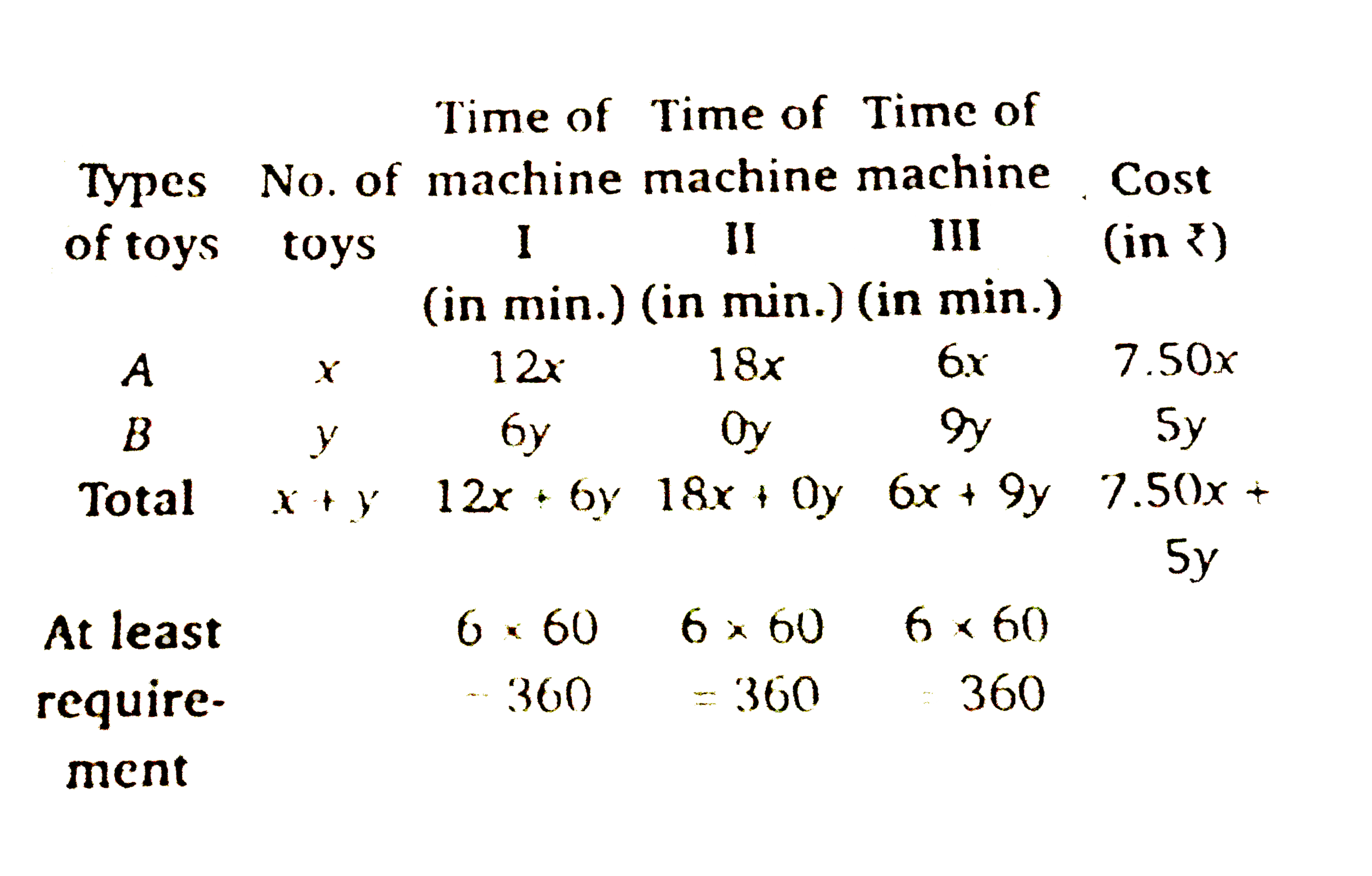 MAXIMISE `Z=7.50x+5y`……………1 and constraints `12x+6yge360implies2x+yle60`…………2 `18xle360impliesxle20`…………….3 `6x+9yle360implies2x+3yle120`.............4 `xge0,yge0`.................5 FIRST, draw the graph of the line `2x+y=60` 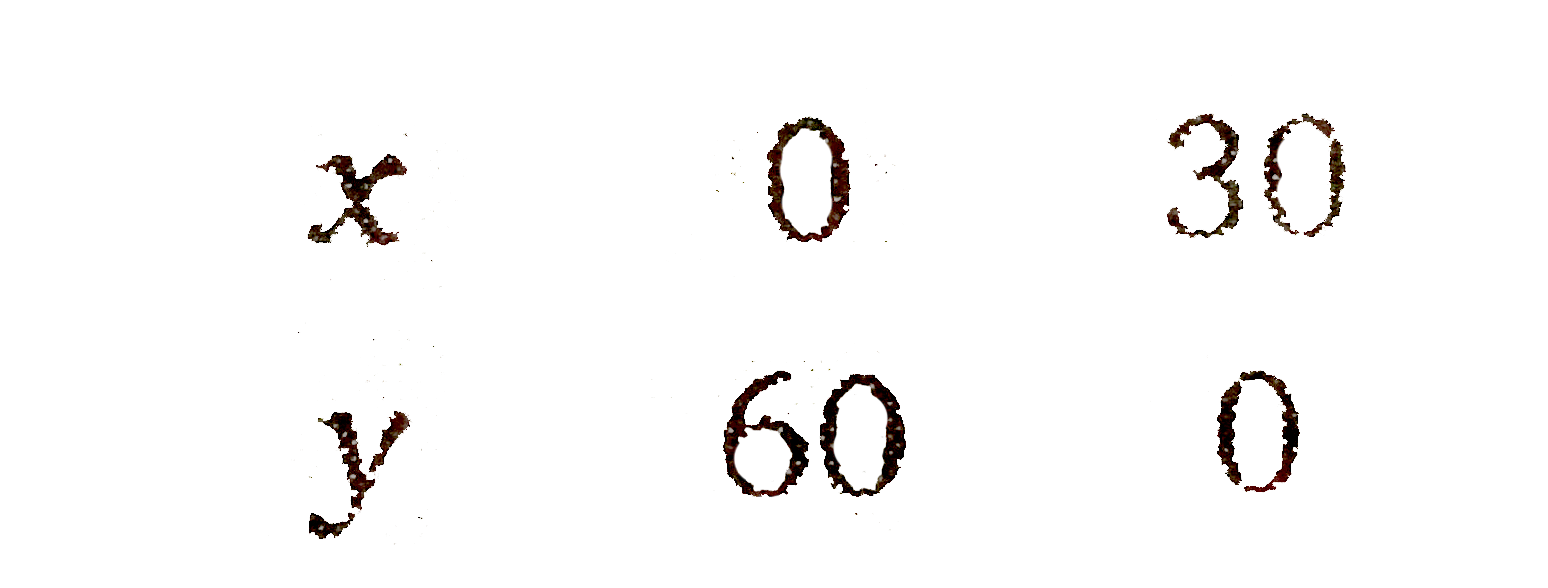 Put `(0,0)` in the inequation `2x+yle60` `2xx0+0le60implies0le60` (True) THUS, the half plane contains the origin. Now draw the graph of the line `2x+3y=120` 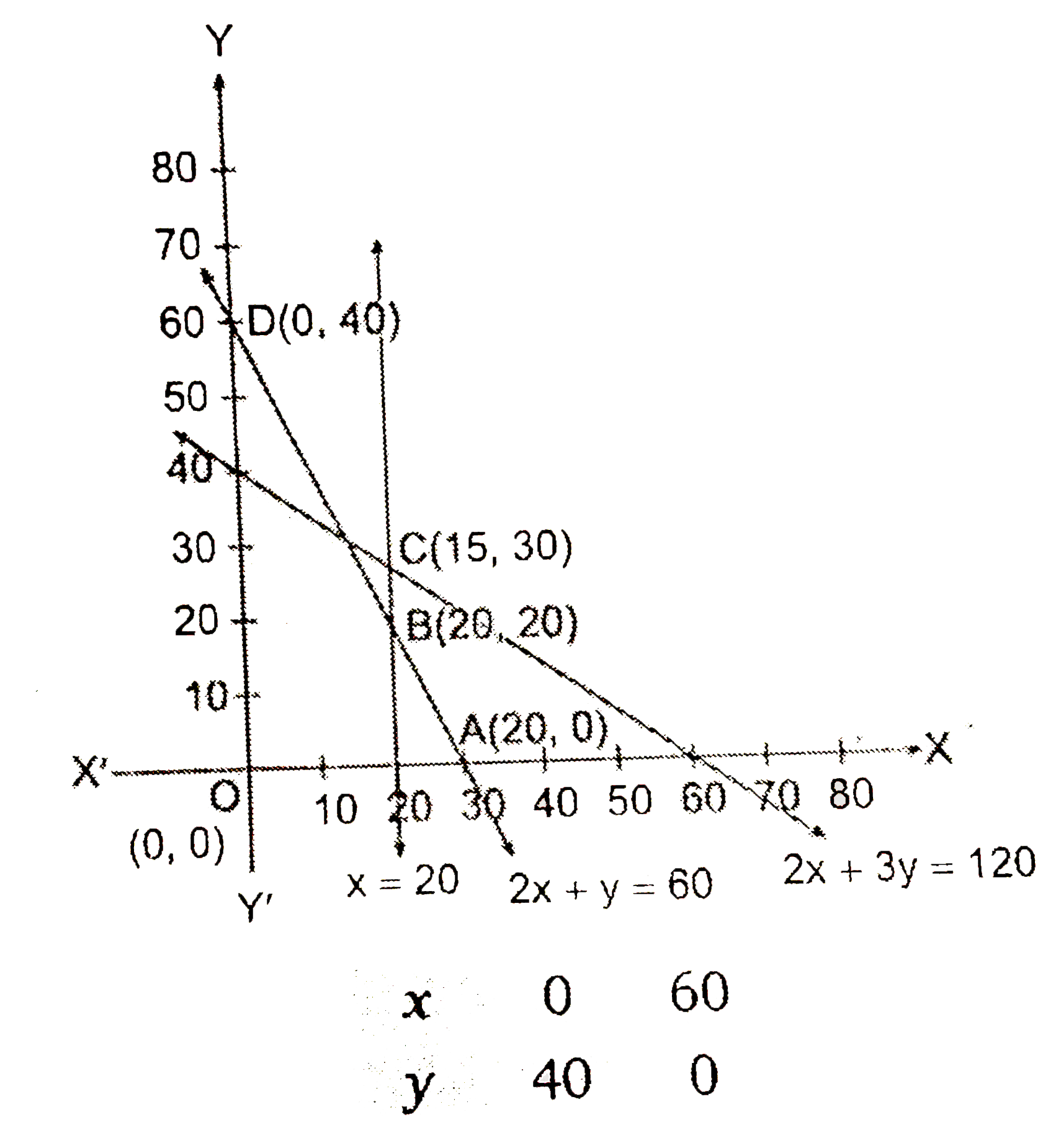 Put `(0,0)` in the inequation `2x+3yle120`, `2xx0+3xx0le120` `=0le120` (True) Thus, the half plane contains the origin. Now, draw the graph oftheline `x=20` Put `(0,0)` in the inequatioins `xle20,0le20` (True) Thus, the half plane contains origin. Since `x,yge0`. So the feasible region will be first quadrant. The point of intersection of the equations `2x+y=60` and `2x+3y=120` is `C(15,30)`. Similarly, the pont of intersection of the equation `x=20` and `2x+y=60` is `B(20,20)`. Thus, the feasible region is OABCDO. The vertices of feasible region are `A(20,0), B(20,20),C(15,30)` and `D(0,40)`. We find the value of Z at these vertices. 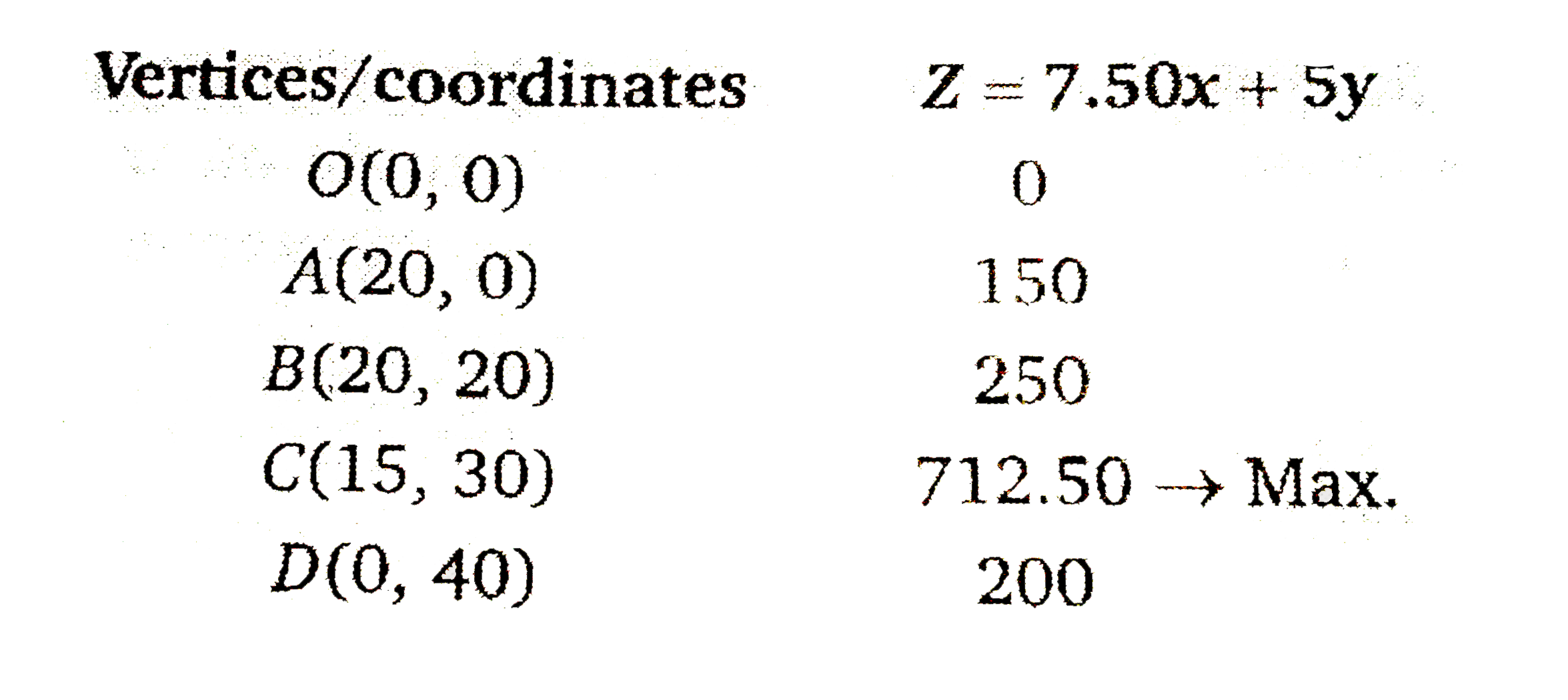 Thus, the maximum value of `Z` is Rs. 712.50 at point `C(15,30)`. Therefore to obtain the maximum cost Rs. 712.50, he makes 15 toys of type A and 30 toys of type B. |
|
| 12. |
If A, B, C are three mutually exclusive and exhaustive events such that 2P(A) = 3P(B) = 4P(C). Find the odds against A uu B. |
|
Answer» |
|
| 13. |
A box contains 2 white balls, 3 black balls and 4 red balls. The number of ways can 3 balls be drawn from the box if atleast one black ball is to be included in the draw is |
|
Answer» 64 |
|
| 14. |
There are three sections in a question paper each containing 4 questions. If a candidate has to answer only 5 questions from this paper without leaving any sections then number of ways the candidate can make the choice of questions is |
|
Answer» 624 |
|
| 15. |
Integrate the following functions (4x+2) sqrt(x^2+x+1) |
|
Answer» Solution :(4x+2)SQRT(x^2+x+1)` =`2(2x+1)sqrt(x^2+x+1)` Put t = `x^2+x+1`. Then DT = (2x+1)DX therefore `INT (4x+2)sqrt(x^2+x+1) dx` =`int 2(2x+1) sqrt(x^2+x+1) dx` =`2intsqrtt dt` =`2 t^(1/2+1)/(1/2+1) +c = 4/3 t^(3/2) +c` =`4/3 (x^2+x+1)^(3/2) +c` |
|
| 16. |
IfC_(0) , C_(1), C_(2), …, C_(n) are the binomial coefficients in the expansion of(1 + x)^(n) , prove that (C_(0) + 2C_(1) + C_(2) )(C_(1) + 2C_(2) + C_(3))…(C_(n-1) + 2C_(n) + C_(n+1)) ((n-2)^(n))/((n+1)!) prod _(r=1)^(n) (C_(r-1) + C_(r)). |
|
Answer» Solution :`LHS = (C_(0) + 2C_(1) + C_(2) )(C_(1) + 2C_(2) + C_(3))…(C_(n-1) + 2C_(n) + C_(n+1))` ` prod _(r=1)^(n) (C_(r-1) +2 ""^(n)C_(r) +C_(r+1))` ` prod _(r=1)^(n) {(""^(n)C_(r-1) +""^(n)C_(r))+ (""^(n)C_(r)+ ""^(n)C_(r-1))}` ` prod _(r=1)^(n) (""^(n+1)C_(r-1) + ""^(n+1)C_(r+1))""` [by PASCAL's rule] ` prod _(r=1)^(n) (""^(n+2)C_(r-1) )= prod_(r=1)^(n) ((n+2)/(r+1)) ""^(n+1)C_(r)[because ""^(n)C_(r)= n/r*""^(n-1)C_(r-1)]` ` prod _(r=1)^(n) ((n+2)/(r+1))(""^(n+2)C_(r-1) )= prod_(r=1)^(n) ((n+2)/(r+1))prod_(r=1)^(n) (C_(r-1)+ C_(r))` ` = ((n+2))/(2) *((n+2))/(3) *((n+2))/(4) ...((n+2))/((n+1)) prod_(r=1)^(n) (C_(r-1) + C_(r))` `((n+2)^(n))/((n+1)!) prod_(r=1)^(n) (C_(r-1) + C_(r))= RHS ` |
|
| 17. |
Equation of a family of circles, such that each member of the gamily psses through the origin and makes an intercept on the line y = 2x which is twice the intercept made on the line x = 2y is (lamda being a parameter) |
|
Answer» `X ^(2) +y ^(2) - 2 LAMDA y =0` |
|
| 18. |
If L_(T')L_(N')L_(ST) and L_(SN) denote the lengths of tangent, normal sub-tangent and sub-normal, respectively, of a curve y = f(x) at a point P(2009, 2010) on it, then |
|
Answer» `(L_(ST))/(2010)=(2010)/(L_(SN))` `L_(T)=|(4sqrt(1+m^(2)))/(m)|.L_(N)=|ysqrt(1+m^(2))|` where `m=(DY)/(dx)` at point `P=(x,y)` on the CURVE `y = f(x)` Now `(L_(ST))/(L_(SN))=(1)/(m^(2))=((L_(T))/(L_(N)))^(2) and L_(ST)L_(SN)=y^(2)` |
|
| 19. |
Which of the following expansion will have term containing x^3 ? |
|
Answer» `(X^(-1//5)+2X^(3//5))^25` |
|
| 20. |
If x is nearly equal to 1 then find the value of (mx^m- nx^n)/(m- n) |
|
Answer» |
|
| 21. |
If A+B+C=180^@ and cis A=x,cis B=y,cis C=z, them xyz= |
|
Answer» -1 |
|
| 22. |
If the circle x^(2)+y^(2)=a^(2) intersects the hyperbola xy=c^(2) in four points (x_(1),y_(1))" for "i=1,2,3 and" 4 then "y_(1)+y_(2)+y_(3)+y_(4) equals |
|
Answer» 0 |
|
| 23. |
If theta is real then the modulus of (1)/(1 + cos theta + isin theta)is |
|
Answer» `(1)/(2) "sec" (THETA)/(2)` |
|
| 24. |
If x^(2) - x + 1 divides the polynomial x^(n+1) - x^(n) + 1, then n must be of the form |
|
Answer» 3K + 1 |
|
| 25. |
Evaluate the following integrals int(dx)/((1+x^(2))sqrt(1-x^(2))) |
|
Answer» |
|
| 26. |
A set of events E_1,E_2,.........E_n are said to be a partition of the sample space, then which of the following conditions is always not true |
|
Answer» <P>`E_1uuE_2uu.......uuuE_n=S` |
|
| 28. |
Find all positive intogers x,y aatisfying (1)/(sqrtx)i(1)/(sqrty)=(1)/(sqrt20). |
|
Answer» |
|
| 29. |
The value of cot[{Sigma_(n=1)^(23){cot^(-1))1+Sigma_(k=1)^(n)2k}] is |
|
Answer» `23/25` `COT^(-1)(1+underset(k=1)overset(N)Sigma 2k)=cot^(-1)1+2underset(k=1)overset(n_Sigmak)=cot^(-1)1+n(n+1)` `=TAN^(-1)(1)/(1+n(n+1)}=(tan^(-1)(n+1)-n)/(1+n(n+1))` `tan^(-1)(n1)-tan^(-1)n` `therefore underset(n=1)overset(23)Sigma(tan^(-1)(n+1)-tan^(-1)n)` `tan^(-1)24-tan^(-1)1` `tan^(-1)(24-1)/(1+24xx1)=tan^(-1)(23)/(25)=cot^(-1)25/23` Hence `cot[underset(n=1)overset(23)Sigma{cot^(-1)(1+underset(k=1)overset(n)Sigma 2k)}]=cot^(-1)25/23=25/23` |
|
| 31. |
Find the differential equation of the curve. (x^(2)-y^(2))=c (x^(2) + y^(2))^(2) |
|
Answer» `(dy)/(dx)= (X^(3) + 3xy^(2))/(y^(3) + 3x^(2)y)` |
|
| 32. |
A rectangular solid consisting of 18 smaller cubes that are identical is positioned in the standard (x,y,z) coordinate system, as shown below . Vertex M has coordinates of (-1,3,0) and point O on the y-axis has coordinates of (0,3,0). What are the coordinates of vertex N ? |
|
Answer» (3,0,2) |
|
| 33. |
Let P be a point in the plane of Delta ABC such that the triangles PAB,PCA all have the same perimeter and the same area. If P lies outside the Delta ABC,then Delta ABC |
|
Answer» MUST be equilateral |
|
| 34. |
Let P be a point in the plane of Delta ABC such that the triangles PAB,PCA all have the same perimeter and the same area. If P lies inside the Delta ABC, then Delta ABC |
|
Answer» must be equilateral |
|
| 35. |
Let P be a point in the plane of Delta ABC such that the triangles PAB,PCA all have the same perimeter and the same area. If P lies outside the Delta ABC, then the quadrialteral formed by A, B, C and P is necessarily |
|
Answer» RECTANGLE |
|
| 36. |
Using the vertices of a polygon having 8 sides a triangle is constructed at random. The probability that the triangle so formed is such that no side of the polygon is side of the triangle is |
|
Answer» `(18)/(55)` |
|
| 37. |
If f(x) = ({x}g(x))/({x}g(x)) is a periodic function with period (1)/(4), where g(x) is differentiable function, then (where {.} denotes fractional part of x). |
|
Answer» g'(x) has exactly THREE roots in `((1)/(4),(5)/(4))` |
|
| 38. |
The tangents at the extremities of the latus rectum of the ellipse 3x^(2)+4y^(2)=12 form a rhombus PQRS. Area (in sq. units) of the rhombus PQRS outside and ellipse is equal to |
|
Answer» `8-2sqrt3pi` |
|
| 39. |
Three cards from a pack of 52 cards are lost. One card is drawn from the remaining cards. If drawn card is heart, find the probability that the lost cards were all hearts |
|
Answer» |
|
| 40. |
Mother, father and son line up at random for a family picture E: son on one end, F: father in middle |
|
Answer» |
|
| 41. |
int(x-x^2)/(x^2-2x-3)dx= |
|
Answer» `X+(1)/(2)log|x^2-2x-3|+log|(x-3)/(x+1)|+C` |
|
| 42. |
Differentiate the functions with respect to x (sin (ax+b))/(cos (cx+d)) |
|
Answer» |
|
| 43. |
If a circle through the point (2, 3) cuts x^2 + y^2 = 8 orthogonally then the locus of its centre is |
|
Answer» 4x+6y-21=0 |
|
| 44. |
If S and S' are the foci of the ellipse (x^(2))/( 25)+ ( y^(2))/( 16) =1, and P is any point on it then range of values of SP.S'P is |
|
Answer» ` 9 le F (theta) le 16` |
|
| 45. |
Let f(x) be a function which satisfy the equation f(xy)=f(x)+f(y) for all xgt0,ygt0 such that f'(1)=2. Find the area of the region bounded by the curves y=f(x),y=|x^3-6x^2+11x-6| and x=0. |
|
Answer» |
|
| 47. |
The position vectors of the vertices A,B,C of a triangleABC are hati-hatj-3hatk,2hati+hatj-2hatk and -5hati+2hatj-6hatk respectively . The length of the bisector AD of the angle angleBAC where D is on the line segment BC, is : - |
|
Answer» `15/2` `rArr |vec(AB)|=sqrt6` and `|vec(AC)|=3sqrt6` CLEARLY , POINT D divides BC in the RATIO AB : AC i.e. 1:3 `therefore` Position vector of D is `((-5hati+2hatj-6hatk)+3(2hati+hatj-2hatk))/(1+3)` `rArr` Position vector of D is `=1/4(hati + 5hatj-12hatk)` `therefore vec(AD) = 1/4(hati+5hatj-12hatk)-(hati-hatj-3hatk)` `vec(AD)=3/4(-hati+3hatj)` `rArr |vec(AD)|=3/4sqrt10` |
|
| 48. |
2.4^((-1)/(4))*8^((1)/(9))*16^((-1)/(16))*32^((1)/(25))*64^((-1)/(36))*……….oo= |
|
Answer» `3^(log3)` |
|
| 49. |
The set A has 4 element and the set B has 5 elements then the number of injective mappings that can be deifned from A to B is |
|
Answer» 144 |
|
| 50. |
If A +B =C then cos ^(2) A+cos ^(2)B + cos^(2)C -2 cos A cos b cos C is equal to |
|
Answer» 1 |
|