

Saved Bookmarks
This section includes 7 InterviewSolutions, each offering curated multiple-choice questions to sharpen your Current Affairs knowledge and support exam preparation. Choose a topic below to get started.
| 1. |
A vector a of length 2 units is making an angle60^@ with each of the x - axis and y - axis . If another vector B of length sqrt(2) units is making an angle 45^@ with each of the y- axis and Z - axis then axxb= |
|
Answer» `(1-sqrt2)HATI-hatj+HATK` |
|
| 2. |
Determine order and Degree(if defined) of differential equations given y'' + 2y' + sin y = 0 |
|
Answer» |
|
| 3. |
IF f : R to R is an even function which is twice differentiable on R and f^(t)(-pi) is equal to |
|
Answer» `-1` |
|
| 4. |
Let A be a 3xx3 matrix with entries from the set of real numbers. Suppose the equation AX =B has a solution for every 3xx1 matrix B with entries from the set of real numbers. Then |
|
Answer» A'Y = B has no soluton |
|
| 5. |
Classify 30km/hr measures as scalar and vector. |
| Answer» SOLUTION :Speed-scalar | |
| 6. |
Let P_(1): x+y+z=0 P_(2)x+2y+3y=0 P_(3): x+3y+5z=0 be three planes L_(1) is theline of intersection of P_(1) & P_(2) LetP(2,1-1) be point on P_(3) If (alpha,beta,lambda) is image of point P in line L_(1) then value of|alpha + beta+ lambda| is |
|
Answer» therefore Line `L_(1):(X)/(1)=(y)/(-2)=(z)/(1)` 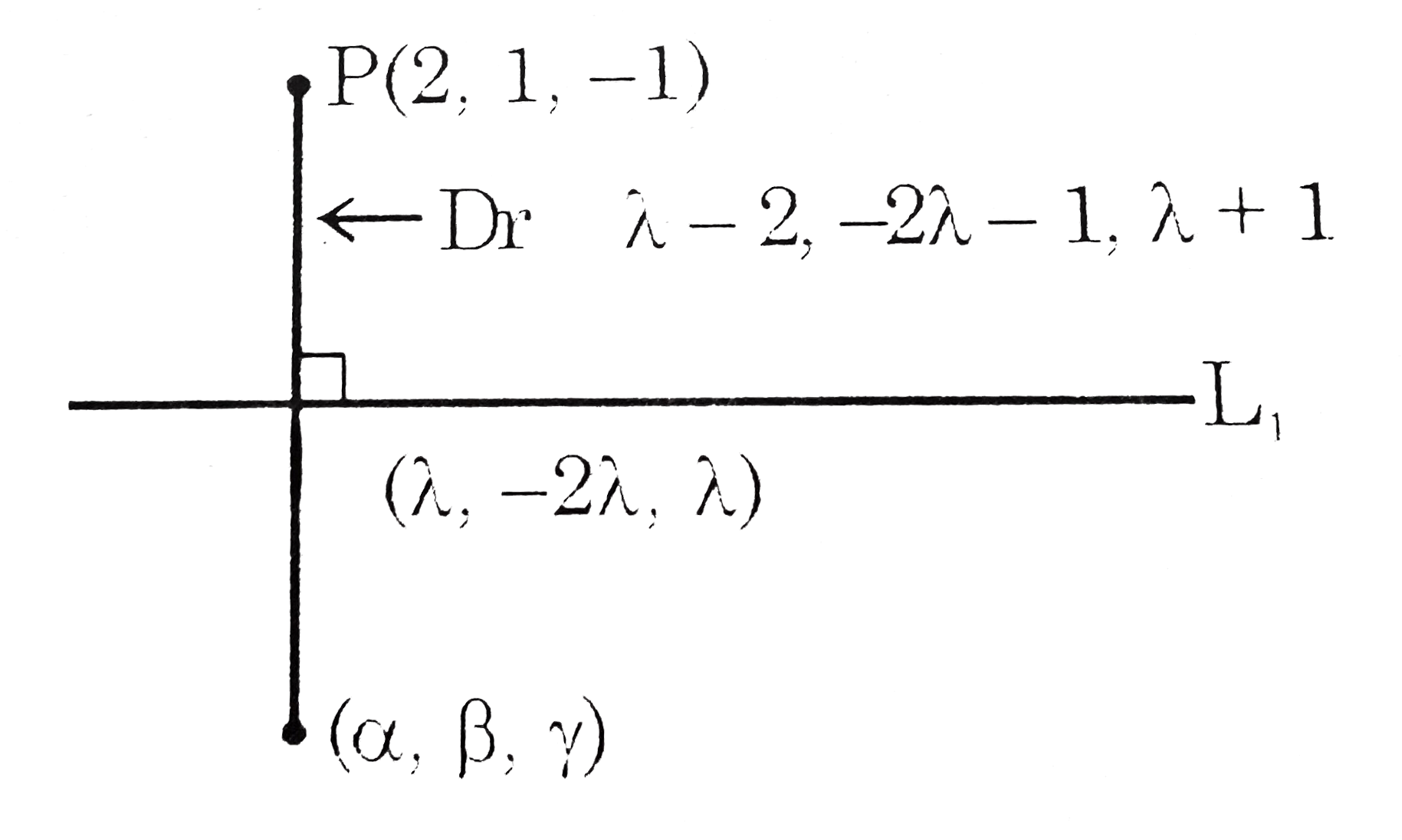 `(LAMBDA-2)-2(-2lambda-1)+(lambda+1)1=0` `6lambda=-1implies lambda=(-1)/(6)` `(alpha+2)/(2)=lambda,(beta+1)/(2)=-2lambda,(lambda-1)/(2)=lambda` `implies alpha+beta+lambda=-2-1+1+2lambda-41+2lambda=-2` |
|
| 7. |
int(dx)/(1-2sinx)= |
|
Answer» `(1)/(2sqrt(3))log|(tan((x)/(2))-2+SQRT(3))/(tan((x)/(2))-2-sqrt(3))|+c` |
|
| 9. |
For any vector vecr = xhati+yhatj+zhatk, prove that vecr = (vecr.hati)hati+(vecr.hatj)hatj+(vecr.hatk)hatk. |
|
Answer» Solution :Clearly `VECR.i` = X, `vecr.j` = y and `vecr.K` = Z therefore `vecr` = xi+yj+zk = (vecr.i)i+(vecr.j)j+(vecr.k)k. |
|
| 10. |
Find the vector equation of the line passing through the point (-1, 0,2) and (3,4,6) |
|
Answer» |
|
| 11. |
S is a set containing n elements. If two subsets A and B of S picked at random from the set of all subset of S. Then the probability that A and B have no common element. |
|
Answer» `(1)/(2^(N))` |
|
| 12. |
Let S(alpha)={(x,y):y^(2) le x, 0 le x le alpha} and A(alpha)is area of the regions S(alpha). " If for " lambda, 0 lt lambda lt 4, A(lambda): A(4)=2:5, then lambda equals |
|
Answer» `2((4)/(25))^((1)/(3))` 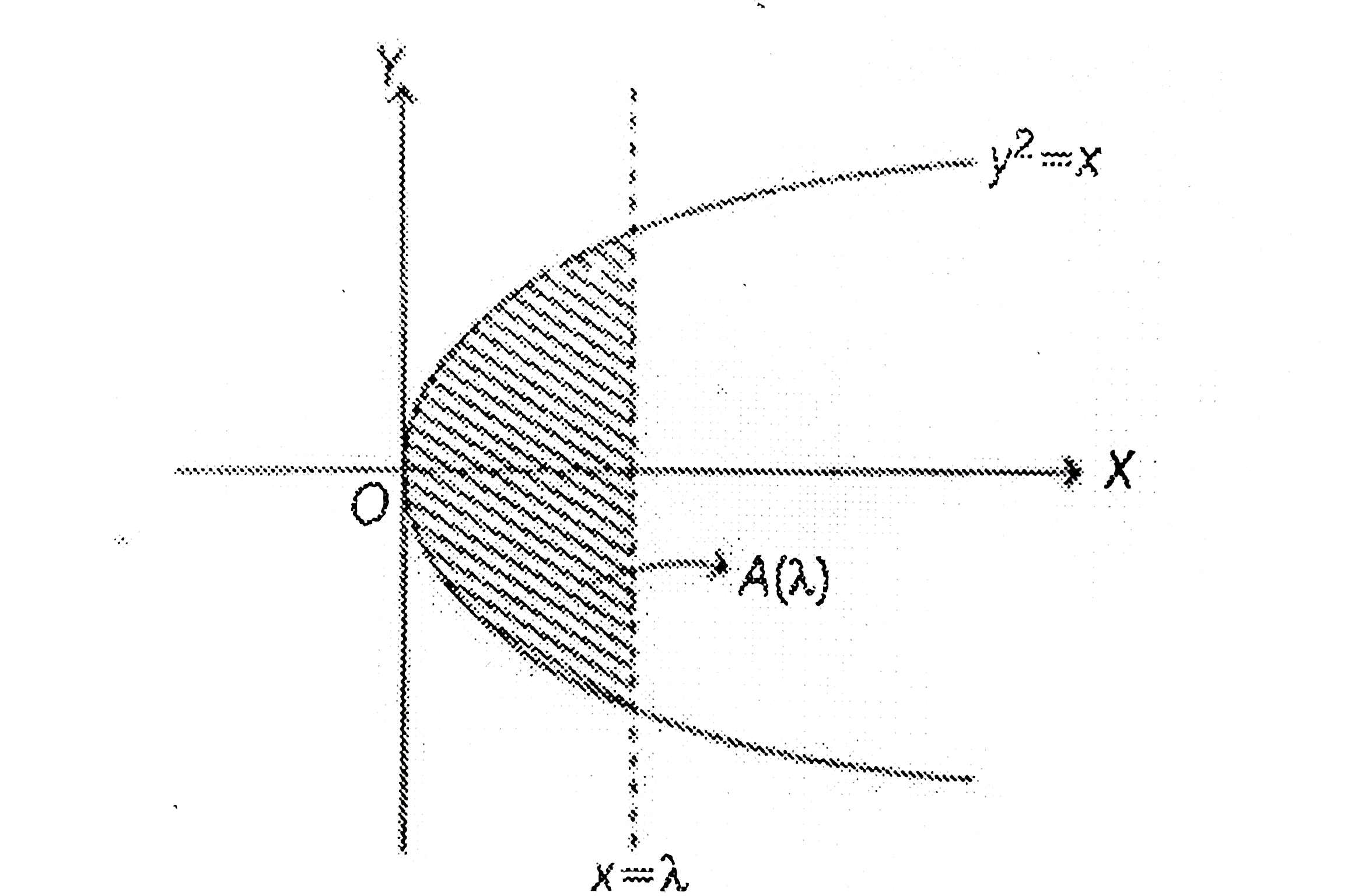 Clearly, `A(lambda)=2int_(0)^(lambda)sqrt(x)dx=2[(x^(3//2))/(3//2)]_(0)^(lambda)=(4)/(3)lambda^(3//2)` Since, `(A(lambda))/(A(4))=(2)/(5),(0 lt lambda lt 4)` `RARR (lambda^(3//2))/(4^(3//2))=(2)/(5) rArr ((lambda)/(4))^(3)=((2)/(5))^(2)` `rArr (lambda)/(4)=((4)/(25))^(1//3) rArr lambda=4((4)/(25))^(1//3)` |
|
| 13. |
Differentiate (x^(2)-5x + 8) (x^(3) + 7x + 9) in three ways mentioned below: By logarithmic differentiation. Do they all give the same answer? |
|
Answer» |
|
| 14. |
|(.^(x)C_(r),.^(x)C_(r+1),.^(y)C_(r+2)),(.^(y)C_(r),.^(x)C_(r+1),.^(y)C_(r+2)),(.^(z)C_(r),.^(z)C_(r+1),.^(z)C_(r+2))|+|(.^(x)C_(4),.^(x+1)C_(r+1),.^(x+2)C_(r+2)),(.^(y)C_(4),.^(y+1)C_(r+1),.^(y+2)C_(r+2)),(.^(z)C_(4),.^(z+1)C_(r+1),.^(z+2)C_(r+2))|= |
|
Answer» 0 |
|
| 15. |
All the values of (-i)^(1//3) are given by |
| Answer» | |
| 17. |
Let A, B, C be three events. If the probability of exactly one event of A and B is 1 - x, out of B and C is 1 - 2x and out of A and C is 1 - x. The probability that the three events occur simultaneously is x^(2) then prove that the probability that atleast one out of A, B, C will occur is greater than (1)/(2). |
|
Answer» |
|
| 18. |
If the Rolle's theorem holds for the function f(x) = 2x^(3) + ax^(2) + bx in the interval [-1,1] for the point c =1/2 , then the value of 2a + b is |
| Answer» ANSWER :B | |
| 19. |
How many points having integer co-ordinates are there in the feasible region of the inequality 3x+4y le 12, x ge 0" and "y ge 1? |
|
Answer» 7 |
|
| 20. |
Let A be the set of all points in a plane and let O be the origin Let R={(p,q):OP=OQ}. then ,R is |
|
Answer» REFLEXIVE and SYMMETRIC but TRANSITIVE |
|
| 21. |
If log(1-x+x^(2))=a_(1)x+a_(2)x^()2)+a_(3)x^(2)+a_(3)x^(3)+…and n is not a mutiple of 3 then a_(n) is equal to |
|
Answer» `(1)/(N)` |
|
| 22. |
Find the probability of getting atmost 3 heads when 4 coins are tossed. |
|
Answer» |
|
| 23. |
State True or False .The planes 2x - y + z -1 = 0 and 6x - 3y + 3z = 1 are coincident. |
|
Answer» |
|
| 24. |
Rectangular hyperbola is the hyperbola whose asymptotes are perpendicularhence its equationis x^(2) - y^(2) = a^(2), if axes are rotated by 45^(@) in clockwise direction then its equation becomes xy = c^(2).Focus of hyperbola xy = 16, is |
|
Answer» `(4sqrt(2), 4sqrt(2))` |
|
| 25. |
Rectangular hyperbola is the hyperbola whose asymptotes are perpendicularhence its equationis x^(2) - y^(2) = a^(2), if axes are rotated by 45^(@) in clockwise direction then its equation becomes xy = c^(2). Directrix of hyperbola xy = 16 are |
|
Answer» `X + y = 4sqrt(2)` |
|
| 26. |
Rectangular hyperbola is the hyperbola whose asymptotes are perpendicularhence its equationis x^(2) - y^(2) = a^(2), if axes are rotated by 45^(@) in clockwise direction then its equation becomes xy = c^(2). Length of minor axis of hyperbola xy = 16 is |
| Answer» Answer :C | |
| 27. |
Evaluate the following definite integrals as limit of sums : int_(a)^(b)cosxdx |
|
Answer» |
|
| 28. |
Let a _(1) , a _(2), ….a _(2n) be an arithmetic progression of positive real numbers with common difference d. Let (i) a _(1) ^(2) + a _(3) ^(2) +…..+ a _(2n -1) ^(2) = x, (ii) a _(2) ^(2 ) + a _(4) ^(2) +….+ a _(2n) ^(2) =y, and (iii) a _(n) + a _(n +1) = z. Express d in terms of x,y,z,n. |
|
Answer» |
|
| 29. |
Prove that sinpix/x(x-1) le 4, when 0 le x le 1. |
| Answer» | |
| 30. |
Find the mean deviation about the meanfor the following data (##VIK_MAT_IIA_QB_C08_SLV_007_Q01.png" width="80%"> |
|
Answer» |
|
| 31. |
Let int_(0)^(oo) (sinx)/x dx=alpha Then match the following lists and choose the correct code. : |
|
Answer» Let `5x=t` `:. dx=1/5dt` `:. I=int_(0)^(oo) (sin(t))/(t//5) . (dt)/5=int_(0)^(oo) (sint)/t dt=alpha` b. `I=int_(0)^(sin^(2)x)dx` `=int_(0)^(oo) (sin^(2)x)(1/(x^(2)))dx` `=[sin^(2)x((-1)/x)]_(0)^(oo) -int_(0)^(oo) (2sinxcosx)xx((-1)/x)dx` `=[(-sin^(2)x)/x]_(0)^(oo) +int_(0)^(oo) (sin2x)/x dx` put `2x=t` `=lim_(XTO oo) [-(sin^(2)x)/x]-lim_(xto oo) [-(sin^(2)x)/x]+alpha` `=0-0+alpha=alpha` c. `I=int_(0)^(oo) (sin^(3)x)/x dx` `I=1/4[3int_(0)^(oo) (sinx)/x dx-int_(0)^(oo) (sin3x)/x dx]` `=1/4[3alpha-alpha]=(alpha)/2` d. `int_(0)^(oo) (sink_(1)xcosk_(2)x)/xdx` `=1/2int_(0)^(oo) (2sink_(1)xcosk_(2)x)/xdx` `=1/2int_(0)^(oo) (sin(k_(1)+k_(2))x+sin(k_(1)-k_(2))x)/x dx` `=1/2 (alpha+alpha)=alpha` `:. int_(0)^(oo) (sin(k_(1)x).cosk_(2)x)/x dx-alpha=0` |
|
| 32. |
The value of xyz is 55 or 343/55 according as the sequence a,x,y,z,b is an H.P or A.P Find the sum (a+b) given that a and b are positive integers |
|
Answer» |
|
| 34. |
lim_(x to 0)( sqrt(1 + x^(2) - sqrt(1 -x+ x^(2))/(3^(x) -1 )is equal to |
| Answer» Answer :C | |
| 35. |
A tangent is drawn at any point (l,m) l, m ne 0 on the parabola y ^(2) = 4 ax and the tangents are drawn from any point on this tangent to the circle x ^(2)+ y ^(2) =a ^(2) (where a gt 0) such that all chords of contact pass through a fixed point (alpha, beta), then |
|
Answer» `alpha l gt 0, beta m LT 0` |
|
| 36. |
Let I = int ((2 sin theta - ) cos theta)/(5 - cos^(2) theta - sin theta) d theta then I is equal to : (where C is a constant of integration ) |
|
Answer» ` 3 log_(E) (2 - cos THETA) + (2)/( 2 - sin theta) + C` |
|
| 37. |
The sum of odd divisors of 360 is |
|
Answer» 70 |
|
| 38. |
There are n urns each continuous (n+1) balls such that the ithurn contains 'I' white balls and (n+1-i) red balls. Let u_(1) be the event of selecting ith urn, i=1,2,3……..n and W denotes the event of getting a white balls. If P(u_(i))=c, where c is a constant, then P(u_(n)//W) is equal to |
|
Answer» `(2)/(n+1)` |
|
| 39. |
If the tangents at t_(1)and t_(2) on y^(2) = 4ax makes complimentary angles with axis then t_(1)t_(2)= |
| Answer» ANSWER :B | |
| 40. |
int e^(-5x).cos 12 x dx = |
|
Answer» `(E^(-5x))/(169) `[ 5 cos 12 x - 12 sin 12 x] + C |
|
| 41. |
If bar(x)=(1,1,-1),bar(y)=(-1,2,2) and bar(z)=(-1,2,-1) then the unit victor perpendicular to both bar(x)+bar(y) and bar(y)-bar(z) is ………… |
|
Answer» `+-(4,0,0)` |
|
| 42. |
If the number of positive integral solutions of u+v+w=n be denoted by P_(n) then the absolute value of |{:(P_(n),P_(n+1),P_(n+2)),(P_(n+1),P_(n+2),P_(n+3)),(P_(n+2),P_(n+3),P_(n+4)):}| is |
|
Answer» `-1` Now, number of solutions of `u+v+w=nimpliesP_(n)=^(n-1)C_(n-3)` Similarly `P_(n+1)=^(n)C_(n-2)`, `P_(n+2)=^(n+1)C_(n-1)`, `P_(n+3)=^(n+2)C_(n)`, `P_(n+4)=^(n+3)C_(n+1)`. Now `Delta=|{:(.^(n-1)C_(n-3),.^(n)C_(n-2),.^(n+1)C_(n-1)),(.^(n)C_(n-2),.^(n+1)C_(n-1),.^(n+2)C_(n)),(.^(n+1)C_(n-1),.^(n+2)C_(n),.^(n+3)C_(n+1)):}|` `=(1)/(8)|{:(((n-1)!)/((n-3)!),(n!)/((n-2)!),((n+1)!)/((n-1)!)),((n!)/((n-2)!),((n+1)!)/((n-1)!),((n+2)!)/(n!)),(((n+1)!)/((n-1)!),((n+2)!)/(n!),((n+3)!)/((n+1)!)):}|` `=(1)/(8)|{:((n-1)(n-2),n(n-1),n(n+1)),(n(n-1),n(n+1),(n+1)(n+2)),(n(n+1),(n+2)(n+1),(n+3)(n+2)):}|` `Delta=(1)/(2)|{:(1,n(n-1),n),(1,n(n+1),(n+1)),(1,(n+2)(n+1),(n+2)):}|` (On applying (first) `C_(3) to C_(3)-C_(2)` and `C_(1)toC_(1)-C_(2)` (and then) `C_(1)toC_(1)+C_(3)`) `=(1)/(2)|{:(1,n(n-1),n),(0,2n,1),(0,2(n+1),1):}|(R_(3)toR_(3)-R_(2) and R_(2)toR_(2)-R_(1))impliesDelta=-1` |
|
| 43. |
The equation of the circle passing through (2a,0) and whose radical axis w.r. to the circlex^(2) +y^(2) = a^(2)isx = a//2 is |
|
Answer» CENTRE of C is `(-a,0)` and C PASSES through `(0,0)and (-a,-a)` |
|
| 44. |
If f : R rarr R be defined by f(x) = 1/(x) , AA x in R .Then , f is ......... |
| Answer» Solution :N/A | |
| 45. |
If z is a complex number such that |z|ge2 ,then the minimum value of |z+1/2| is |
|
Answer» is STRICTLY greater than `5/2` |
|
| 46. |
If the co-ordinates of the vertices of an equilateral trianlg with sides of length 'a' are (x_1,y_1),(x_2,y_2),(x_3,y_3), then Prove that |{:(x_1,y_1,1),(x_2,y_2,1),(x_3,y_3,1):}|^2=(3/4)a^4. |
|
Answer» |
|
| 47. |
For a 2xx2 matrix, A=[a_(ij)], whose elements are given by a_(ij)=(i)/(j), then a_(12)=_________. |
|
Answer» |
|
| 48. |
cos20^(@)cos40^(@)-sin5^(@)sin25^(@)= |
|
Answer» 0 |
|
| 49. |
IF mtan( theta- 30^@) = n tan( theta+ 120 ^2 )thencos2 thetaequals |
|
Answer» `(m+n) /(m-n) ` |
|