

Saved Bookmarks
This section includes 7 InterviewSolutions, each offering curated multiple-choice questions to sharpen your Current Affairs knowledge and support exam preparation. Choose a topic below to get started.
| 1. |
A,B,C are three angles of a triangle and "sin" (A+c/2)= n "sin" C/2 ("sin" C/2)/("cos"A/2 "cos"B/2)= |
|
Answer» `2/(n+1)` |
|
| 2. |
The range of a random variable X is {1, 2, 3, ……..} and P(X=k)=(C^(k))/(lfloork) where k = 1, 2, 3,…. Find the value of C |
|
Answer» |
|
| 4. |
If the quadratic equation a_(1)x^(2)-a-(2)x+a_(3)=0 where a_(1),a_(2),a_(3) in N has two distinct real roots belonging to the interval (1,2) then least value of a_(1) is_______ |
|
Answer» `implies alpha-1, beta-1, 2-alpha, 2-beta epsilon (0,1)` A.M. `ge` G.M. `implies((alpha-1)+(2-alpha))/2 ge sqrt((alpha-1)(2-alpha))` `implies(alpha-1)(2-alpha) le 1/4` SIMILARLY `(beta-1)(2-beta) le 1/4` `0 lt (alpha-1)(2-alpha)(beta-1)(2-beta) lt 1/16` (Both can't equal to `1/4` simultaneously `(alpha !=beta)` `0 lt ((a_(3))/(a_(1))-(a_(2))/(a_(1))+1)(4-(2a_(2))/(a_(1))+(a_(3))/(a_(1))) lt 1/16` `0 lt ((a_(1)-a_(2)+a_(3))(4a_(1)-2a_(2)+a_(3)))/(a_(1)^(2)) lt 1/16` `(a_(1)^(2))/16 gt (a_(1)-a_(2)+a_(3)(4a_(1)-2a_(2)+a_(3))` `(a_(1)^(2))/16 gt f(1).f(2)implies(a^(2))/16 gt 1` `implies` Least integral alue of `a` is 5 |
|
| 5. |
Determine k and solve the equation 2x^3-6x^2+3x+k=0 if one of its roots is twicethe sum of the othertwo roots. |
|
Answer» |
|
| 6. |
If f(x) = |(1,x,x+1),(2x,x(x-1),x(x+1)),(3x(x-1),x(x-1)(x-2),x(x+1)(x-1))|, using properties of determinant, find f(2x) - f(x). |
|
Answer» |
|
| 7. |
Find (i) inte^(x)(tan^(-1)x+1/(1+x^(2)))dx (ii) int((x^(2)+1)e^(x))/((x+1)^(2))dx |
|
Answer» |
|
| 8. |
f (x) = { (sin ^(3) x ^(2))/( {:(""x), ( 0"," x =-0):}), x ne 0 is |
|
Answer» continous but not DERIVABLE at x =0 |
|
| 9. |
A value of b for which the equations :x^(2) + bx - 1= 0, x^(2) + x + b = 0 Have one root in common is : |
|
Answer» `-SQRT(2)` |
|
| 10. |
An endless inextensible string of length 15 m passes around two pins, A and B which are 5 m apart. This string is always kept tight and a small ring, R, of negligible dimensions, inserted in this string is made to move in a path keeping all segments RA, AB, RB tight (as mentioned earlier). The ring traces a path, given by conic. C, then: |
|
Answer» CONIC C is an ellipse with eccentricity `(1)/(2)` |
|
| 11. |
int(dx)/(2sqrt(x)(1+x))=... |
|
Answer» `(1)/(2)TAN^(-1) (SQRT(x))+c` |
|
| 12. |
If z_(1)" and "z_(2) are two complex numbers such that |(z_(1)-z_(2))/(z_(1)+z_(2))|=1 then |
|
Answer» `z_(1)=kz_(2), K in R` |
|
| 13. |
Four fair dicew are rolled and found that the numbers on the dice are in ascending order. Find the probability that one die shows 4. |
|
Answer» |
|
| 14. |
If A = [(0,c,-b),(-c,0,a),(b,-a,0)] and B = [(a^(2),ab,ac),(ab,b^(2),bc),(ac,bc,a^(2))]then AB is : |
|
Answer» A |
|
| 15. |
The volume of a spherical cap of height (a)/(2) cut off from the sphere of radius a is : |
|
Answer» `(2)/(3)pia^3` |
|
| 16. |
The vectors vec(AB) = 3 hati + 5 hatj + 4 hatk and vec(AC) = 5 hati - 5 hatj + 2 hatk are the sides of a triangle ABC. The length of the median through A is |
|
Answer» |
|
| 17. |
By using the properties of definite integrals, evaluate the integrals int_(0)^((pi)/(4))log(1+tanx)dx |
|
Answer» |
|
| 18. |
A committeeconsisting of at least three members is to be formed from a group of 6 boys and 6 girls suchthat it always has a boy and a girl. The number of ways to form such committee is |
|
Answer» `2^(12) - 2^(7) - 13` |
|
| 19. |
A circle passing through the vertex C ofa rectangle ABCD and touching its sides AB and AD at M and N, respectively. If the distance from C to the line segment MN is equal to 5 units, then find the area of the reactangle ABCD. |
|
Answer» <P> Solution :Let us take AB and AD as coordinate axes.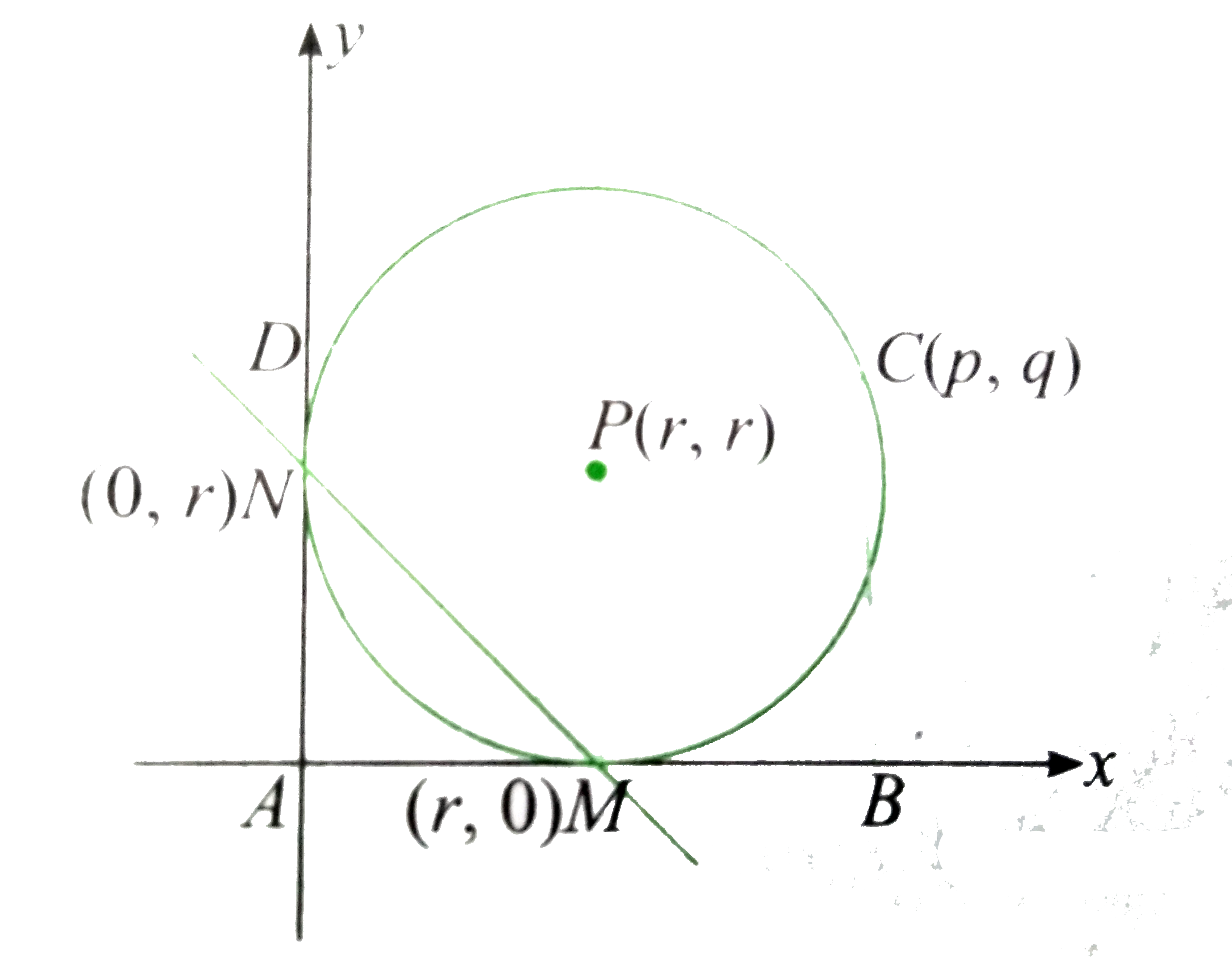 If r is the radius of CIRCLE , then equation of circle touching both the axes is `(x-r)^(2)+(y-r)^(2)=r^(2)` or `x^(2)+y^(2)-2rx-2ry+r^(2)=0` Let point C be (p,q) Equation of line MN is `x+y-r=0` DISTANCE of MN from C is 5 units. `:. (|p+q-r|)/(sqrt(2))=5` `implies (p+q-r)^(2)=50` Since (p,q) lies on the circle , we have `p^(2)+q^(2)-2rp-2rq+r^(2)=0` `implies (p+q-r)^(2)-2pq=0` `implies 50-2pq=0` `implies pq=25` Therefore, area of rectangle `25sq.` units. |
|
| 20. |
Write the inverse trignometric function tan^(-1)(x/sqrt(a^(2)-x^(2)))|x|lta, in simplest form. |
|
Answer» |
|
| 21. |
Equation of the circles |z-1-i|=1 & |z-1+i|=1 touches internally a circle of radius 2. The equation of the circle touching all the circles can be |
|
Answer» `3zbarz+z+barz-1=0` `C_(1)C_(3)=C_(2)C_(3)=1` `"CC"_(3)=2-r` `:.(1+r)^(2)=1^(2)+(2-r)^(2)` `impliesr=2//3` `:.` Centre of described circle is `-1+2/3=(-1)/3` or `3-2/3=7/3`  `:.` Required equation of circle are `|z+1/3|=2/3` & `|z-7/3|=2/3` |
|
| 22. |
A sample space consists of 9 elementary outcomes outcomes E_(1), E_(2),…, E_(9) whose probabilities are:P(E_(1))=P(E_(2)) = 0.09, P(E_(3))=P(E_(4))=P(E_(5))=0.1P(E_(6)) = P(E_(7)) = 0.2, P(E_(8)) = P(E_(9)) = 0.06 If A = {E_(1), E_(5), E_(8)}, B= {E_(2), E_(5), E_(8), E_(9)} then (a) Calculate P(A), P(B), and P(A nnB).(b) Using the addition law of probability, calculate P(A uu B).(c ) List the composition of the event A uu B, and calculate P(A uu B) by adding the probabilities of the elementary outcomes. (d) Calculate P(barB) from P(B), also calculateP(barB) directly from the elementarty outcomes of B. |
|
Answer» <P> Solution :(a) `P(A) = P(E_(1)) + P(E_(5)) + P(E_(8))``=0.09 + 0.1 + 0.06 = 0.25` (b)`P(B) = P(E_(2)) + P(E_(5)) + P(E_(8)) = P(E_(9))` `= 0.09 + 0.1 + 0.06 + 0.06 = 0.31` `P(A UU B) = P(A) + P(B) - P(A NN B)` Now, `A nn B = {E_(5), E_(8)}` `therefore P(A nn B) = P(E_(5)) + P(E_(8)) = 0.1 + 0.06= 0.16` `therefore P(A uu B) = 0.25+ 0.31 - 0.16 = 0.40` (c )`A uu B = {E_(1), E_(2), E_(5), E_(8), E_(9)}` `P(A uu B) = P(E_(1)) + P(E_(2)) + P(E_(5)) + P(E_(8)) + P(E_(9))` `=0.09 + 0.09 + 0.1 +0.06 + 0.06 = 0.40` (d) `because P(bar(B)) = 1- P(B) = 1 - 0.31 = 0.69` and `bar(B) = {E_(1), E_(3), E_(4), E_(6), E_(7)}` `therefore P(bar(B)) = P(E_(1)) + P(E_(3)) + P(E_(4)) + P(E_(6)) + P(E_(7))` = 0.09 + 0.1 + 0.1 + 0.2 + 0.2 = 0.69 |
|
| 23. |
Find (dy)/(dx) in the following : y= sec^(-1) ((1)/(2x^(2)-1)), 0 lt x lt (1)/(sqrt(2)). |
|
Answer» |
|
| 25. |
If y = cos x. Cos 2x . Cos 3x find (dy)/(dx) |
|
Answer» |
|
| 26. |
Iff(x) isis a polynomialofdegreen withrationalcoefficients and 1 +2 I ,2 - sqrt(3)and 5arerootsoff(x)=0then theleastvalueof n is |
|
Answer» 5 |
|
| 27. |
A balanced dice is tossed (2n + 1) times. Find probability of an event that number 1 OR 3 OR 4 comes up at most n times. |
|
Answer» |
|
| 28. |
A insects initially at origin has to move from (0,0) to (6,6). It moves towards +ve x-axis or +ve y-axis. In each step it moves from (x,y) to (x+1,y) or (x,y+1). Find the number of different paths it canfollow to complete it's journey if it does not pass through any of the four points (3,1),(3,2),(4,1) and (4,2). |
|
Answer» |
|
| 29. |
Probability that A speaks truth is (4)/(5). A coin is tossed. A reports that a head appears. The probability that actually there was head is |
|
Answer» `(4)/(5)` |
|
| 30. |
If the two equations x^2 - cx + d = 0 and x^2- ax + b = 0 have one common root and the second equation has equal roots, then 2 (b + d) = |
|
Answer» |
|
| 31. |
If the opposite vertices of a square are (-2, 3) and (8, 5), then the equations ofthe sides of that square are |
|
Answer» `3x-2y+12=0, 3x+2y-14=0, 2x-3y+51=0, 2x+3y-31=0` |
|
| 32. |
If veca=2hati+hatj+4hatk and vecb=3hati-2hatj+hatk then veca.vecb= |
|
Answer» 6 |
|
| 33. |
If area bounded by y=logx, y = x and x^(2)+y^(2)+2xy-k^(2)=0 is sq. units, then area bounded by y=e^(x),y=log x and x^(2)+y^(2)+2xy-k^(2)=0 will be |
|
Answer» a SQ. UNITS |
|
| 34. |
If (sqrt3-i)^n=2^n,b epsilon 1,the set of integers,then n is a multiple of |
|
Answer» 6 |
|
| 35. |
If a=sqrt(2i), then which of the following is correct? |
| Answer» Answer :A | |
| 36. |
If y=(2)/(sqrt(a^(2)-b^(2)))tan^(-1) [sqrt((a-b)/(a+b))tan""(x)/(2)] |
|
Answer» `(d^(2)y)/(dx^(2))""|_(X=(pi)/(2))=` |
|
| 37. |
A and B are independent events P(A cap B)= 0.5 and P(A)= 0.2 then P(B)= ………. |
| Answer» Answer :A | |
| 38. |
{:(,"List-I",,"List-II"),((A),~(p^^q)" equals",(i),~p^^~q),((B),~(pvvq)" equals",(ii),p^^(~q)),((C),pimpliesq=,(iii),~pvv~q),((D),~(pimpliesq)=,(iv),(~p)vvq):} |
|
Answer» |
|
| 39. |
If bar(a)=(1,1,1),bar(b)=(4,-2,3) and bar( c )=(1,-2,1)then the vector of magnitude 6 in the direction of 2bar(a)-bar(b)+3bar( c ) is …………….. |
|
Answer» `((1)/(3),(-2)/(3),(2)/(3))` |
|
| 40. |
Let the tangents drawn from the origin to the circle, x^(2)+y^(2)-8x-4y+16=0 touch it at the points A and B. Then (AB)^(2) is equal to : |
|
Answer» `(3)/(25)` |
|
| 42. |
Some standard forms of integration : intx^(2)sqrt(x^(6)-1)dx=.......+c |
|
Answer» `(1)/(6)(x^(3)SQRT(x^(6)-1)+COS^(-1)x^(3))` |
|
| 43. |
Express the following differential equations in the form (dx)/(dy) = F((x)/(y)) (i) (1+e^((x)/(y)))dx + e^((x)/(y))(1-(x)/(y))dy = 0 (ii) xdy - ydx + y e^(-(2x)/(y)) dy = 0 |
|
Answer» |
|
| 44. |
Find the derivatives w.r.t. x : (5x)/(root(3)(1-x^(2)))+sin^(2)(2x+3) |
|
Answer» |
|
| 45. |
If f(x)={(([x]-1)/(x-1)",",xne1),(0",",x=1):} then f(x) is |
|
Answer» CONTINUOUS as WELL as DIFFERENTIABLE at X = 1 |
|
| 46. |
Find the coordinates of the pole of the straight line (i) x+y+2=0 with respect to the circle x^(2)+y^(2)-4x+6y+2=0 (ii) 3x+4y-45=0 with respect to the circle x^(2)+y^(2)-6x-8y+5=0 (iii) x-2y+22=0 with respect to the circlex^(2)+y^(2)-5x+8y+6=0 (iv) ax+by+c=0 with respect to the circle x^(2)+y^(2)=r^(2) |
|
Answer» <BR> Answer :(i) (-9,-24) (II) (6,8)(III) (2,-3) (iv) `(-(ar^(2))/c,(-br^(2))/c)` |
|
| 47. |
Write the value of intxsec^2xdx. |
| Answer» SOLUTION :`intxsec^2xdx=xtanx-inttanx=xtanx-Insecx+c` | |
| 48. |
If f(x)=(sin^(-1)([x]+x))/"[x]" , [x] ne 0 =0, [x] = 0where [x] denotes the greatest integer less than or equal to x, then lim_(x to 0) f(x) is |
|
Answer» 1 |
|
| 49. |
Let S denote the sum of the infinite series 1+(8)/(2!)+(21)/(3!)+(40)/(4!)+(65)/(5!) + ….. Then |
|
Answer» `S LT 8` |
|