

Saved Bookmarks
This section includes 7 InterviewSolutions, each offering curated multiple-choice questions to sharpen your Current Affairs knowledge and support exam preparation. Choose a topic below to get started.
| 1. |
Why are bag and suitcases provided with broad handles? |
| Answer» SOLUTION :Due to the large surface AREA, PRESSURE EXERTED on the hand will be small. | |
| 2. |
A rectangular tank of base dimension 50 cm xx 50 cm contains a liquid upto a height of Im. The specific heat capacity 's' and the density rho of the liquid varies with depth h below the free surface as s = (100 + 50h) J//kg-^(@)C and rho = (800 + 400h) kgm^(-3) where 'h' is in metre. Find the amount of heat lost, when the temperature of the liquid falls by 20^(@)C. Assume uniform temperature throughout the volume of the liquid. |
|
Answer» |
|
| 4. |
A planet of mass m is revolving around the sun in an elliptical orbit. The minimum and maximum distances of the planet from the sun are s_(1) and s_(2). Derive the relation between time period of the planet in terms of s_(1) and s_(2). |
|
Answer» SOLUTION :LET S is the semi-major axis of the elliptical orbit. `S = (s_(1) + s_(2))/(2)` ACCORDING to Kepler.s LAW `T^(2) prop ((s_(1) + s_(2))/(2))^(3)` `T^(2) prop (s_(1) + s_(2))^(3)` `T prop (s_(1) + s_(2))^(3//2)` |
|
| 5. |
One mole of O_(2) gas having a volume equal to 22.4 litres at 0^(@)C and 1 atmospheric pressure in compressed isothermally so that its volume reduces to 11.2 litres. The work done in this process is |
| Answer» Answer :D | |
| 6. |
What will be the change in temperature of a stretched wire if snaps suddenly? |
|
Answer» |
|
| 7. |
If x pi asin[omega pi pi //6] and x' acosomegat, then what is the phase difference between the two waves? |
|
Answer» `pi/3` `x'=a cosomegat=a SIN(omegat+(pi)/(2))` THEREFORE, PHASEDIFFERENCE `=(pi//2)-pi//6` `=(pi//3)` |
|
| 8. |
The driver of a car travelling at 72 kmph observes the light 300 m ahead of him turning red.The traffic light is timed to remain red for 20 s before it turns green . If the motorist wisher to pass the light without stopping to wait for it t turn green , determine.The speed with which the motorist crosses the traffic light . |
|
Answer» SOLUTION :Given u = 72 KMPH`= 72 xx (5)/(18) ms^(-1)` `= 20 ms^(-1) , s = 300 m, t = 20s, a = ?, v = ?` `v = u + at = 20 - 0 . 5 xx 20` `= 10 ms^(-1)` |
|
| 9. |
One mole of an ideal diatomic gas undergoes a transition from A and B along a path AB as shown in the figure The change in internal energy of the gas during the transition is |
| Answer» Answer :B | |
| 10. |
A block of mass m=1kg moving on a horizontal surface with speed v_(i)= 2ms^(-1) enters a rough patch ranging from x= 0.10 m to x= 2.01m. The retarding force F_(r ) on the block in this range in inversely proportioanl to x over this range. F_(r )= (-k)/(x) for 0. 1 lt x lt 2.01m= 0 " for " x lt 0.1m and x gt 2.01m where k= 0.5J. What is the final kinetic energy and speed v_(f) of the block as it crosses this patch? |
|
Answer» SOLUTION :From WORK energy theorem` K_(r )-K_(i)= int Fdx` `rArr K_(F) = K_(i) + underset(0.1)overset(2.01)int ((-k))/(x) dx = (1)/(20 mv_(1)^(2)- kln (x) |(2.01),(0.1)|` `=(1)/(2) mv_(1)^(2) - k LN (2.01//0.1) = 2- 0.5 log_(e) (20.1)` `=2 - 1.5= 0.5J` `v_(f) = sqrt(2K_(f)//m)= 1ms^(-1)` |
|
| 11. |
A runner moves along the road at 2.0ms^(-1) in still air that is at a temperature of 29.0^(@)C. His surface area is 1.4m^(2), of which approximately 85% is exposed to the air. Find the rate of convective heat loss from his skin at a temperature 35.0^(@)C to the outside air? Coefficient of convection for dry air and bare skin at wind speed 2.0ms^(-1)" is "22W//m^(2)""^(@)C |
|
Answer» Solution :From EQ. `Q/t=hADeltaT` GIVEN h = Coefficient of CONVECTION = `22W//m^(2)""^(@)C`, `DeltaT=35.0^(@)C-29.0^(@)C=6.0^(@)C,` A = 85% of the surface area of the runner = `85/100xx1.4m^(2)=1.2m^(2)`. `thereforeQ/t=22W//m^(2)""^(@)Cxx1.2m^(2)xx6.0^(@)C=160W` |
|
| 12. |
A disc of mass 10 g can remain in air, stationary in a horizontal position, if 10 marbles hit the disc per second from below. Each marble has a mass of 5 g. find the velocity with which the marbles hit the disc. Assume that the marbles hit the disc perpendicularly and rebound from the disc perpendicularly as well. |
|
Answer» |
|
| 13. |
What is simple pendulum? Derive an expression for the time period and frequency of a simple pendulum of length I. What will be the effect on the time period of a simple pendulum if length of the pendulum becomes (a) greater than the radius of the Earth (b) becomes equal to the radius of the Earth? |
|
Answer» Solution :(a) If length of the PENDULUM becomes GREATER than the RADIUS of earth then the TIME period is 84.6 min. (b) 60 min. |
|
| 14. |
A person of mass M=90 kg standing on a smooth horizontal plane of ice throws a body of mass m=10 kg horizontally onte same surface. If the distance between the person and body after 10 seconds is 10 metres, the K.E of the person (in Joules) is |
|
Answer» 0.45 |
|
| 15. |
Four moles of a gas when heated through 20^(@)Cexpand by 6.3 xx 10^(-3) m^(3)under a const-ant pressure of 10^(5) N//m^(2).. If 30 J "mole"^(-1)k^(-1)is C_(v)then the C_(p)in J "mole"^(-1)k^(-1)is, |
|
Answer» 37.9 |
|
| 16. |
A horizontal spring block system of mass 'm' executes SHM of amplitude 'A' and frequency 'n'. When the block passing through its equilibrium position, an object of mass 'm' is put on it and the two move together. Find the new amplitude |
|
Answer» `A SQRT((M)/(M + m))` |
|
| 17. |
The resultant of two forces 1 and P is perpendicular to .1. and equal to 1. What is the value of .P. and angle between the forces |
|
Answer» `sqrt(2)N, 135^(@)` |
|
| 18. |
In kinetic theory of gases, a molecule of mass m of an ideal gas collides with a wall of vessel with velocity V. The change in the linear momentum of the molecule is |
|
Answer» 2mV |
|
| 19. |
A solid cylinder of mass M and radius R is resting on a horizontal platform (which is parallel to the x-y plane) with its axis fixed along y-axis and free to rotate about its axis. The platform is given a motion in the X direction given by x= A cos omegat . There is no slipping between the cylinder and the platform. The maximum torque acting on the cylinder during the motion is |
|
Answer» `(Momega^(2)AR)/3` |
|
| 20. |
A ball dropped from a point P crosses a point Q in t seconds. The time taken by it to travel from Q to R, if PQ=QR |
| Answer» ANSWER :D | |
| 21. |
The compressibility of water is 5xx10^(-10)m^(2)N^(-1). Find the decrease in volume of 1 litof waterunder a pressure of 2xx10^(6)Pa. |
|
Answer» Solution :Caparessibility `=(1)/("BULK modulus")=("volumetric strain")/("volumetric stress")` `:.(5)/(10^(10))=(Delta//V)/(2xx10^(6)): (DeltaV)/(V)=(5)/(10^(10))xx2xx10^(6)` `:.DeltaV=(5)/(10^(10))xx2xx10^(6)XX1=(1)/(10^(3))l` `:.` Decreases of volume of water `=1//10^(3)l or l.c.c` |
|
| 22. |
Three identical particles each of same mass are placed touching each other with their centres on a straight line. Their centres are at A,B and C respectively. Then distance of centre of mass of the system from A is |
|
Answer» `(AB+AC+BC)/(3)` |
|
| 23. |
A body rests on a rough horizontal plane. A force is applied to the body directed towards the plane at an angle theta with the vertical. The body can be moved along the plane |
|
Answer» only if `THETA` is greater than the ANGLE of friction |
|
| 24. |
Which of the following pairs of physical quantities does not have same dimensional formula ? |
|
Answer» Work and torque Torque = force `xx` distance `=[M^(1)L^(2)T^(1)[L^(1)]` (B) Angular momentum `=mvr[M^(1)][L^(1)T^(1)][L^(1)]` `=[M^(1)L^(2)T^(-1)]` Plank.s constant `=(E)/(V) ([M^(1)L^(2)T^(-2)])/([T^(-1)])=[M^(1)L^(0)T^(-2)]` (C) Tension force `=[M^(1)L^(2)T^(-1)]` Surface tension `=("force")/("length")=([M^(1)L^(1)T^(-2)])/([L])=[M^(1)L^(0)T^(-2)]` (d) Impulse =force `xx` time `[M^(1)L^(1)T^(-2)][T]=[M^(1)LT^(-1)]` Momentum = mass `xx` velocity `=[M^(1)][L^(1)T^(-1)]` `[M^(1)L^(1)T^(-1)]` |
|
| 25. |
An object is thrown vertically upward with a speed of 30 m/s. The velocity of the object half-a-second before it reaches the maximum height is |
|
Answer» `4.9m//s` |
|
| 26. |
The three vessels shown in figure have same base area. Equal volumes of aliquid are poured in the three vessels. The force on the base will be |
|
Answer» Maximu in VESSELS A |
|
| 27. |
The angular amplitude of a simple pendulumis theta_(0). The maximum tension in the string is |
|
Answer» `MG(1-theta_(0))` |
|
| 28. |
Two capillary tubes AB and BC are joined end to endat B. AB = 12 cm longand of diameter 4 mm. whereas BC is 3 cm long and of diameter 2mm. The composite tube is heldhorizontally with A connected to a vessel of water giving a constant head of 5 cm and C is open to the air. Find the pressure difference between B and C. |
|
Answer» Solution :Let H cm be the head of pressure at B over C. Then pressure difference between A and B, `p_(1) = (5-h)" cm of "H_(2)O` For tube AB : `L_(1) = 12 cm`, `r_(1) = 2mm -=0.2 cm`, `p_(1) = (5-h)" cm of water"` `= (5-h) xx 1xx 980 dyn e//cm^(2)` Rate of flow of water through AB is `Q_(1) =(pi p_(1)r_(1)^(4))/(8 eta l_(1)) = (pi(5-h) xx 1 xx 980 xx (0.2)^(4))/(8 eta xx 12) cm^(3) s^(-1)` For tube BC: `l_(2) = 3 cm` , `r_(2) 1 mm = 0.1 cm`, `p_(2)" h cm of water "= h xx 1 xx 980 dyn e//cm^(2)` Rate of flowof water through BC is `Q_(2) =(pi p_(2)r_(2)^(4))/(8 eta l_(2)) = (pi xx h xx 1 xx 980 xx (0.1)^(4))/(8 eta xx 3) cm^(3) s^(-1)` As flow through the two tubes in series is steady, so `Q_(1) = Q_(2)` or `(pi(5-h) xx 1 xx 980 xx (0.2)^(4))/(8 eta xx 12) =(pi h xx 1 xx 980 xx (0.1)^(4))/(8 eta xx 3)` `3(5-h) xx 16 = 12 h` On solving, `h = 4" cm of water column"`. |
|
| 29. |
The length and breadth of a rectangular are 25 cm and 10 cm respectively and were measured to an accuracy of 0.1 cm. The percentage error in area is |
|
Answer» `2.8%` |
|
| 30. |
Two racing cars 'A' and 'B' having masses 'M' and '2m' respectively start running from the starting line on a horizontal plane.Both cars 'A' and B' have same speed 'V' which is constant through out the journey. The track of the two cars are the arcs of concentric circle having centres O_(1) and O_(2) as shwon in figure with data. The friction coefficient of the two cars with the road is same. There is a finishing line at the end of the arc. Using these informationssolve the following questions. Which of the following statements is incorrect. |
|
Answer» Both CAR reaches the finishing line at same TIME. When `A` at `A'` then `B` at `A'` When `A` at `B` than `B` at `B'` When `A` at `C` then `B` at `C'` 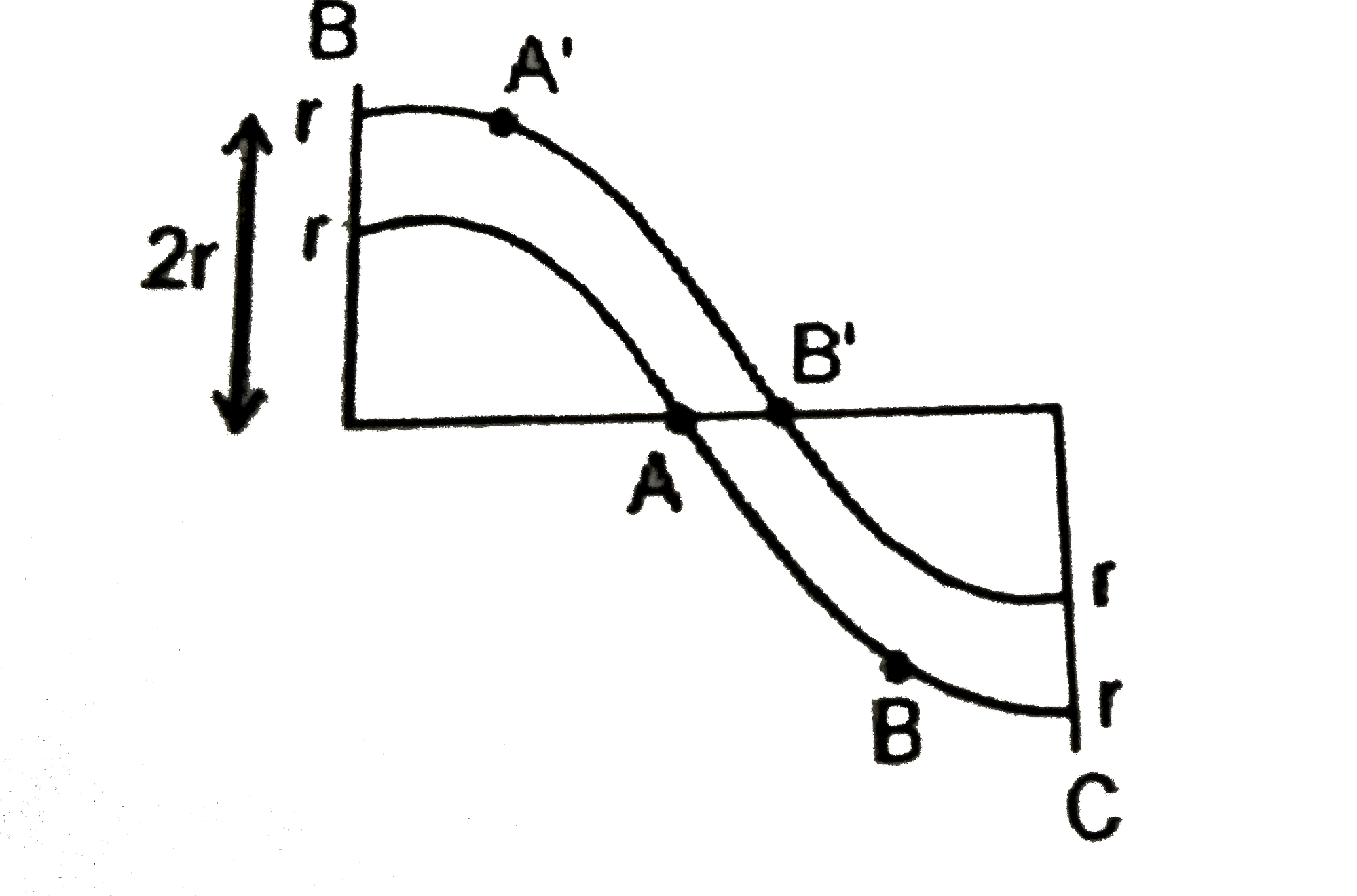 `(B)` FRICTION for always towards centre to PROVIDE sufficient centripetal force `(mv^(2))/(r)` `(C )` From above diagram 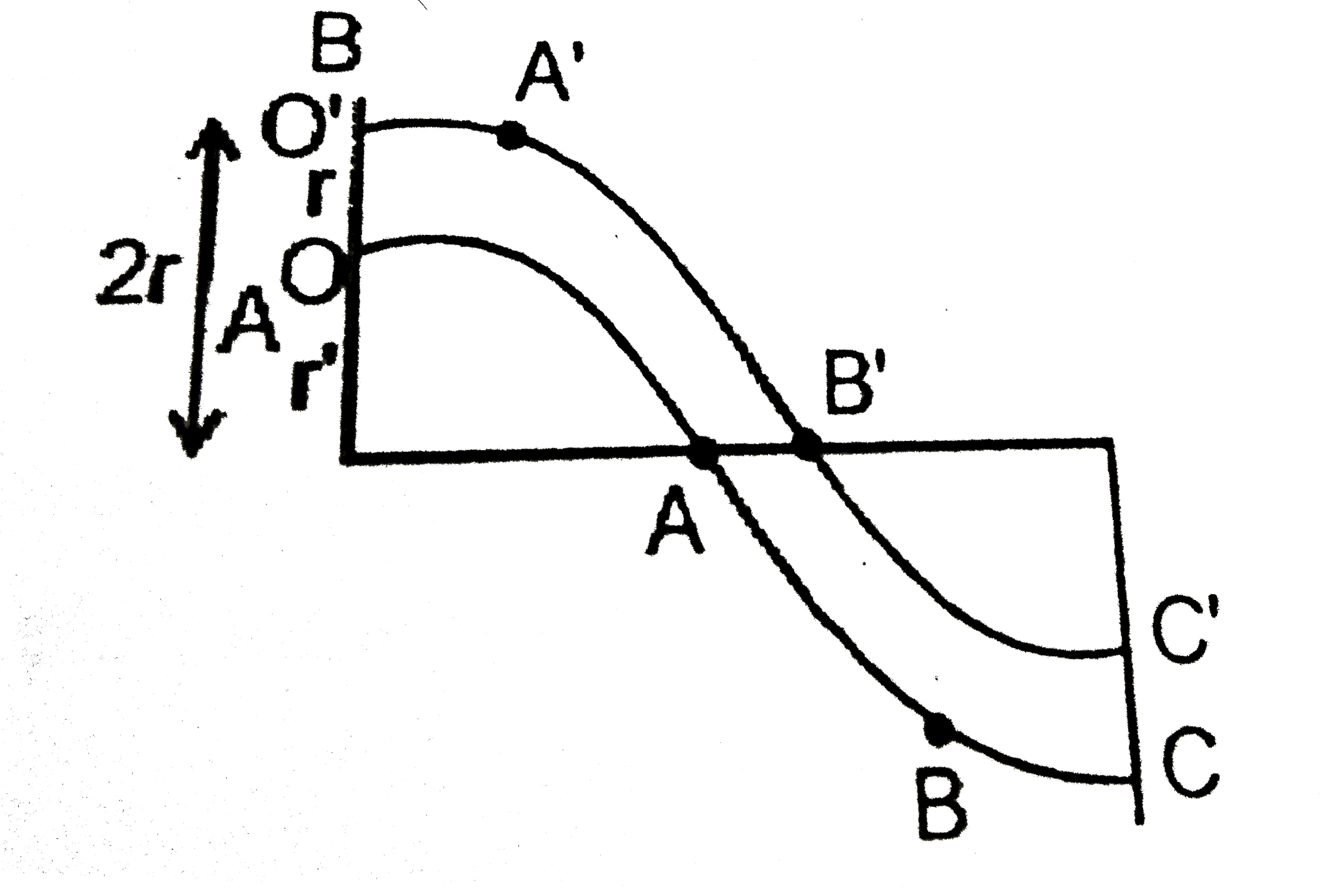 For car `A rarr O'` to `A fs =(mv^(2))/(r)` For car `B rarr O' ` to `B ' fs' =( mv^(2))/(2R)=fs` For `B rarr B'` to `C' =(mv^(2))/(r)=fs'` |
|
| 31. |
a,b are the magnitudes of vectors veca & vecb . If vecaxxvecb=0 the value of veca.vecb is |
| Answer» ANSWER :C | |
| 32. |
A vertical glass capillary tube open at both ends contain some water (T.P). Then the length of water column L = _____ |
|
Answer» Solution :`P_(2)=P_(1)(-2T)/R=P_(0)(-2T)/R` `P_(3)=P_(2)+LPg` `P_(4)=P_(3)-(2T)/RrArrLpg=(4T)/RrArrL=(4T)/(RPG)` here `r=Rcostheta=R` 
|
|
| 33. |
Even when earth receives solar energy, why is it not getting warmed up continuously? |
|
Answer» (ii) LOSS of ENERGY takes place due to radiation absorption and convection currents. |
|
| 34. |
(A) : Collision between two fundamental particles is elastic.(R ) : Fundumental particles lose their shape in collision. |
|
Answer» Both (A) and (R ) are true and (R ) is the CORRECT EXPLANATION of (A) |
|
| 35. |
The PE of a satellite is -U. Its KE is |
|
Answer» U |
|
| 36. |
An ideal gas (lmanda=1.5) is expanded adiabatically. How many times has the gas to be expanded to reduce the root mean square velocity of molecules 2.0 times |
| Answer» Answer :B | |
| 37. |
The K.E. of a body rotating at 300 rpm is 62.8 J Its angular momentum is |
|
Answer» 1 Js |
|
| 38. |
A small mass is suspended by a string from the ceiling of a car. As the car accelerates with an acceleration a horizontal road, the angle made by the string with the vertical is |
|
Answer» `TAN^(-1)g//a` |
|
| 39. |
Calculate the power of an engine which can pull a mass of 500 metric ton up an incline rising 1 in 100 with a velocity of 20 ms^(-1). |
|
Answer» |
|
| 40. |
The product of Avogadro constant and elementary charge is known as ............ constant. |
| Answer» Solution :Faraday | |
| 41. |
A projectile has |
|
Answer» minimum VELOCITY at the point of PROJECTION and MAXIMUM at the maximum height |
|
| 42. |
A particle moving with kinetic energy of 3J makes a head - on collision with a stationary particle which as twice the mass. During the impact, (a) the minimum kinetic energy of the system is 1 J. (b) the maximum elastic potential energy of the system is 2 J (c) momentum and total energy are conserved at every instant. (d) the ratio of kinetic energy to potential energy of the system first decreases and then increases. |
|
Answer» only a, B are TRUE |
|
| 43. |
At the same temperature, the mean kinetic energies of molecules of hydrogen and oxygen are in the ratio of ........... |
|
Answer» `1:1` |
|
| 44. |
When 'n' number of particles each of mass 'm' are at distances x_(1)=1, x_(2)=2, x_(3)=3, ……x_(n)=n units from origin on the x-axis then find the distance of their centre of mass from origin. |
|
Answer» SOLUTION :`x_(cm)=(m(1)+m(2)+m(3)+……+m(n))/(m+m+m+….+m(n"terms"))` `=(m(1+2+3+….+n))/(NM)=(m((n(n+1))/(2)))/(nm)` `x_(c)=(n+1)/(2)` |
|
| 45. |
The work done by the goal keeper to catch the ball coming towards him by applying a forceis |
|
Answer» positive |
|
| 46. |
A force of (hat(i) + 2hat(j) + 3hat(k))N is acting on a body having position vector (3 hat(i) + hat(j) + 2hat(k)) in the same frame of reference In the direction of the moment of force, unit vector is |
|
Answer» `(HAT(i) + 11 hat(j) - 7 hat(K))/(SQRT(171))` |
|
| 47. |
A force of (hat(i) + 2hat(j) + 3hat(k))N is acting on a body having position vector (3 hat(i) + hat(j) + 2hat(k)) in the same frame of reference Considering that the two vectors mentioned in the paragraph are the two sides of a triangle, then the magnitude of area of triangle is |
|
Answer» `5 SQRT3` |
|
| 48. |
State , for each of the following physical quantities , if it is a scalar or vector : Volume , mass speed, acceleration , density , number of moles, velocity , angular frequency, displacement , angular velocity. |
|
Answer» SOLUTION :Scalars: Volume , mass , speed , density, number of MOLES, angular FREQENCY Vectors: Acceleration, velocity , DISPLACEMENT , angular velocity |
|
| 49. |
First law of thermodynamics corresponds to |
|
Answer» CONSERVATION of energy |
|