Saved Bookmarks
This section includes 7 InterviewSolutions, each offering curated multiple-choice questions to sharpen your Current Affairs knowledge and support exam preparation. Choose a topic below to get started.
| 1. |
A boy of mass 36 kg moves from one end to other end of a boat of mass 72 kg on still water. If the length of the boat is 2.7m, the displacement of the boat is |
|
Answer» `2.7 m` |
|
| 2. |
Very low temperatures are measured by |
|
Answer» GAS THERMOMETERS |
|
| 3. |
A ball is projected horizontally with a velocity of 5ms^(-1) from the top of a tower of height 10 m. When it reaches the ground (g=10ms^(-2)) find its velocity? |
|
Answer» |
|
| 4. |
Two particle executing SHM along a straight linehave same amplitude A and time periodT. At t=0 one particle is at a displacement +A and another is at a displacement -A//2 and they are approaching towards each other. They cross each other after a tme. |
| Answer» ANSWER :D | |
| 5. |
We would like to prepare a scale whose length does not change with temperature. It is proposed to prepare a unit scale of this type whose length remains, say 10 cm. We can use a bimetallic strip made of brass and iron each of different length whose length (both components) would change in such a way that difference between their lengths remain constant. If alpha_("iron")=1.2xx10^(-5)//K and alpha_("brass")=1.8xx10^(-5)//K what should we take as length of each strip ? |
|
Answer» Solution :ACCORDING to question, `l_("iron")-l_("brass")=10cm` . . . (1) Constant at all temperature. Suppose LENGTH at `0^(@)C` is `l_(0)` and it becomes l due to INCREASE in temperature `DeltaT` `:.l_("iron")=l_("0iron")(1+alpha_("iron")DeltaT)` and `l_("brass")=l_("0brass")(1+alpha_("brass")DeltaT)` `:.` From equation (1), `l_("0iron")(1+alpha_("iron")DeltaT)-l_("0brass")(1+alpha_("brass")DeltaT)=10cm` But the difference of their LENGTHS remains constant, `:. L_("0iron")alpha_("iron")=l_("0brass")alpha_("brass")` `:.(l_("0iron"))/(l_("0brass"))=(alpha_("brass"))/(alpha_("iron"))=(1.8xx10^(-5))/(1.2xx10^(-5))=3/2` `:.l_("0iron")=3/2l_("0brass")` Now, from equation (1), `3/2l_("0brass")-l_("0brass")=10` `:.1/2l_("0brass")=10` `:.l_("0 brass")=20cm` `:.` Original length of brass scale is 10 cm. Now, again from equation (1), `l_("0iron")-l_("0 brass")=10` `l_("0iron")-20=10` `:.l_("0iron")=30cm` `:.` Original length of iron scale is 30 cm. |
|
| 6. |
Two balls A and B each of mass m are placed on a smooth ground as shown in the figure. Another ball C of mass M arranged to the right of ball B as shown. If a velocity v_(1) is given to ball A in rightward direction, consider two cases. Case-I M gt m and case-II M lt m. Take all the collisions perfectly elastic(e = 1), find the number of collision in case-I and case-II. |
|
Answer» `v_(R)=((m-M)/(m+M))v_(I),v_(C)=((2m)/(m+M))v_(1)` Here as we have `Mltm,ltv_(C)` and both are positive thus both the balls are moving forward and will not collide again, hence there are total two collision. b. If in SECOND collision we have `Mgtm`, we get `v_(B)` negative, so ball `B` moves in backward direction after between collision and will strike again to ball `A` (which is at rest to the left of it) and come to rest and ball `A` will more to the left with speed `v_(B)`. Then now there are total three collision. |
|
| 7. |
If vecAandvecB are the sides of triangle, then area of triangle |
|
Answer» `(1)/(2)|vecA.vecB|` |
|
| 8. |
A quantity X is given byepsilon0L(/_\v)/v , whereisepsilon0 permitivity of free space , L is length , /_\V is p.d. and /_\Vis time interval . The dimensional formula of X is the same as that of |
|
Answer» RESISTANCE |
|
| 9. |
(a) A boy throws several balls out of the window of his house at different angles to the horizontal. All balls are thrown at speedu = 10 m//s and it was found that all of them hit the ground making an angle of 45° or larger than that with the horizontal. Find the height of the window above the ground [take g = 10 m//s^(2)] (b) A gun is mounted on an elevated platform AB. The distance of the gun at A from the edge B is AB = 960 m. Height of platform is OB = 960 m. The gun can fire shells with a velocity of u = 100 m//s at any angle. What is the minimum distance (OP) from the foot of the platform where the shell of gun can reach ? |
|
Answer» |
|
| 10. |
The x-component of the resultant of several vectors (a) is equal to the sum of the x-components of the vecotrs (b) may be smaller than the sum of the magnitudes of the vectors ( c) may be greater than the sum of the magnitudes of the vectors (d) may be equal to the sum of the magnitudes of the vectors |
|
Answer» only a |
|
| 11. |
The speed of an object sliding in an inclined plane at the bottom is |
|
Answer» ` mg COS theta ` |
|
| 12. |
When a wave gets reflected from rarer medium its phase increases by amount pi rad. |
| Answer» SOLUTION :FALSE. (When a WAVE GETS REFLECTED frrom the surface of denser medium, its phase increases by amount `pi` rad. | |
| 13. |
When the relative velocity of two cars v_(A) = v_(B) becomes zero ? |
| Answer» SOLUTION :When two CARS move with same SPEED in same direction, then their RELATIVE velocity becomes ZERO. | |
| 14. |
Two small satellites move in circular orbits around the earth, at distances r and r + Delta r from the centre of the earth. Their time periods of rotation are T and T + Delta T. (Delta r lt lt r, Delta T lt lt T). |
|
Answer» `DELTA T = (3)/(2)T(Delta R)/(r)` |
|
| 15. |
An artificial satellite of the earth releases a packet. If air resistance is negalected, the point where the packet will hit, will be |
| Answer» Answer :D | |
| 16. |
An object of density 12g*cm^(-3) is weighed with some counterpoising weights made of brass with the help of a common balance. Density of brass = 8g*cm^(-3). If the buoyancy of air is neglected in this measurement of mass. Density of air = 1.2xx10^(-3)g*cm^(-3). |
|
Answer» Solution :LET the real WEIGHT of the body be `mgxxg`, real weight of the BRASS weights = m. `gxxg`. Here, apparent weight of the body = apparent weight of the brass weights or, real weight of the body - weight of air DISPLACED by the body = real weight of the brass weights or, `m-m/12xx1.2xx10^(-3)=m.-(m.)/8xx1.2xx10^(-3)` or, `m-mxx10^(-4)=m.-m.xx1.5xx10^(-4)` or, `(m.)/m=(1-10^(-4))/(1-1.5xx10^(-4))` or, `(m.-m)/m=((1.5-1)xx10^(-4))/(1-1.5xx10^(-4))=0.5xx10^(-4)` `therefore"Error"=(m.-m)/mxx100=0.5xx10^(-4)xx100=0.005%`. |
|
| 17. |
Calculate the amount of work done in increasing the diameter of a soap bubble from 2cm to 5cm (Given, surface tension of the soap solution =3 xx 10^(-2) Nm^(-1)) |
|
Answer» Solution :GIVEN `R_(1)=2 xx 10^(-2)m, R_(2)=5 xx 10^(-2)m` `T=3 xx 10^(-2)Nm^(-1)` Increase in S.A. `=4piR_(2)^(2)-4piR_(1)^(2)=4 xx 3.142 (10^(-2))^(2) (25-4)=2.639 xx 10^(-2) m^(2)` WORK done =(2T) (increase in SA) `=2 xx 3 xx 10^(-2) (2.639 xx 10^(-2))=1.5834 xx 10^(-3)J` |
|
| 19. |
A body is suspended from a spring balance kept in a satellite. The reading of the balance is W_1 when the satellite goes in an orbit of radius R and is W_2 when it goes in an orbit of radius 2R. |
| Answer» Answer :A | |
| 20. |
Name two important properties of a material medium responsible for the propagation of waves through it. |
| Answer» SOLUTION :PROPERTIES of ELASTICITY and INERTIA | |
| 21. |
A projectile is fired horizontally with a velocity u . Show that its trajectory is a parabola. Also obtain the expression for Time of flight . |
|
Answer» Solution :Let us consider a PROJECTILE, that is, thrown horizontalwith an initialvelocity `vec(u)`from the topof a tower of height h in the figure . Motion along horizontal direction :The particle has zero acceleration along x direction. So, the initial velocity `u(x)`remains constant throughout the motion. The distance traveled by the projectile at a time t is givenby `x = u_(x) t + (1)/(2) at^(2)` Since a = 0 along x direction, we get `x =u_(x)t "". . . (1)` Motion along downward direction : Here `u_(y) = 0 ` (initial velocity has no downward component), a = g .The distance y at time y is given by `y = u_(y) t + (1)/(2) at ^(2)`, we get `y = (1)/(2) g t^(2) `[u = 0, a = g]. . . (2) Substituting the value of t from equation (1) in equation (2) we have `y = (1)/(2) g""(x^(2))/(u_(x)^(2))= ((g)/(2u_(x)^(2)))x^(2)` `y = Kx^(2) "" . . . (3)` Where `K = (g)/(2u_(x)^(2))` is a constant of proportionality . Equation (3) GIVES the trajectory of the projectile. Thus , the path followed by the projectile is a parabola . Time of Flight:The time taken for the projectile to complete its trajectory . It is ALSO time taken by the projectile to hit the GROUND . Consider a tower and a projectile . Let h be the height of a tower . Let T be the time taken by the projectile to hit the ground, after being thrown horizontally from the tower . We know that`s_(y) =u_(y) t+ (1)/(2) at ^(2)`for vertical motion . Here `s_(y) = h, t = T`(since there is no initial vertical velocity `u _(y) = 0` `:. h = (1)/(2) g T^(2) (or) T = sqrt((2h)/(g))` 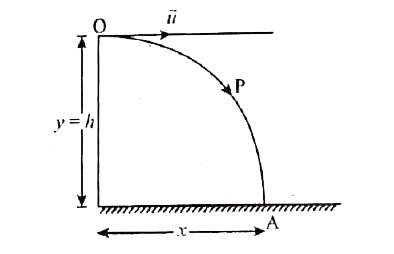
|
|
| 22. |
A projectile is fired horizontally with a velocity u . Show that its trajectory is a parabola. Also obtain the expression for. Horizontal range . |
|
Answer» Solution :Let us consider a projectile, that is, thrown horizontalwith an initialvelocity `vec(u)`from the topof a tower of height h in the figure . MOTION along horizontal DIRECTION :The particle has zero acceleration along x direction. So, the initial velocity `u(x)`REMAINS constant throughout the motion. The distance traveled by the projectile at a time t is GIVENBY `x = u_(x) t + (1)/(2) at^(2)` Since a = 0 along x direction, we get `x =u_(x)t "". . . (1)` Motion along downward direction : Here `u_(y) = 0 ` (initial velocity has no downward component), a = g .The distance y at time y is given by `y = u_(y) t + (1)/(2) at ^(2)`, we get `y = (1)/(2) g t^(2) `[u = 0, a = g]. . . (2) Substituting the value of t from equation (1) in equation (2) we have `y = (1)/(2) g""(x^(2))/(u_(x)^(2))= ((g)/(2u_(x)^(2)))x^(2)` `y = Kx^(2) "" . . . (3)` Where `K = (g)/(2u_(x)^(2))` is a constant of proportionality . Equation (3) GIVES the trajectory of the projectile. Thus , the path followed by the projectile is a parabola . Horizontal range :The horizontal distance coveredby the projectile from the foot of the tower to the point where the projectile hits the ground is called horizontal range.For horizontal motion, we have `s_(x) = u_(x) t + (1)/(2) at^(2)` Here, `s_(x) = R`(range),`u_(x) = u, a = 0 ` (no horizontal acceleration) T is time of flight . Then horizontal range = u T. Since the time of flight T ` = sqrt((2h)/(g))`, we substitute this and we get the horizontal range of the particle as`R = u sqrt((2h)/(g))`. 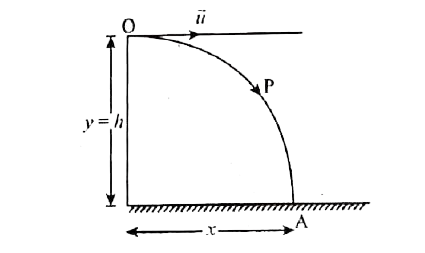
|
|
| 23. |
Which one of the following is a correct pair to list the necessary properties of a medium for the propagation of wave ? |
|
Answer» ELASTICITY and STRESS |
|
| 24. |
Assume that liquid drop evaporates by decreasing in its surface energy so that its temperature remains unchanged. The surface tension of liquid drop is T, density of liquid is P and Lis latent heat of vapouration of liquid. What should be the minimum radius of the drop for this to be possible |
|
Answer» `(T )/( RHO L)` |
|
| 25. |
A tuning fork vibrating with a sonometer having 20 cm wire produces 5 beats per second. The beat frequency does not change if the length of the wire is changed to 21 cm. The frequency of the tuning fork (in Hertz) must be |
|
Answer» 200 |
|
| 26. |
Can two vectors of different magnitudes be combined to give .zero resultant? If not, what is the minimum number of coplannar vectors of different magnitudes which can give zero resultant? |
| Answer» SOLUTION :No. A minimum of three vectors are needed. If three vectors can be represented by the three sides of a triangle TAKEN in the same ORDER, then their resultant will be a NULL vector. | |
| 27. |
At a certain height above the earth's surface, the acceleration due to gravity is 4% of its value at the surface of the earth. Determine the height. |
|
Answer» 2R |
|
| 28. |
Absolute scale of temperature is reproduced in the laboratory by making use of a |
|
Answer» radiation pyrometer |
|
| 29. |
The possible beat frequencies when A and C are sounded together are |
|
Answer» 2 HZ and 7 HZ |
|
| 30. |
In an ideal gas at temperature T, the average force that a molecule applies on the walls of a closed container depends on T as T^q. A good estimate for |
|
Answer» `1/4` |
|
| 31. |
A physical quantity P is related to four observables a, b, c and d as follows P = (a^(3) b^(2) )/( (sqrt( c) d) ). The percentage errors of measurement in a, b, c and d are 1 %, 3%, 4% and 2%, respectively. What is the percentage error in 3) 2.75 and 2.73 4) 2.74 and 2.74 the quantity P? If the value of P calculated using the above relation turns out to be 3.763, to what value should you round off the result? |
|
Answer» `13%, 3.763` |
|
| 32. |
What is angular diameter of the sun and the moon as seen from earth? |
| Answer» SOLUTION :Angular diameter of the sun from EARTH =`0.5^(@) = 30 ` are MINUTE . Angular diameter of the moon from earth is similar to that for the sun `0.5^(@)`. | |
| 33. |
If a hole is bored along a diameter of the earth and a stone is dipped into the hole, it will |
|
Answer» reach the centre of the earth and stop there |
|
| 34. |
A particle is moving in a circular path. The acceleration and momentum vector at an instant of time are veca= 2hat i+ 3 hat j m//sec^(2) and vec p= 6 hat i-4 hatj kg m//sec. Then the motion of the particle is |
|
Answer» Uniform circular MOTION |
|
| 35. |
Two bubbles of radii 2mm and 3mm when touch each other, the radius of curvature of their interface is |
|
Answer» `1.7mm` |
|
| 36. |
Calculate work done to compress isothermally 1g of hydrogen gas at N.T.P. to half its initially volume. Find the amount of heat evolved and change in internal energy. Given R = 8.31 J mol^(-1) K^(-1). |
|
Answer» |
|
| 37. |
At t = 0, a particle of mass m starts moving from rest due to a for vec(F) = F_0 sin (omegat) hati. |
|
Answer» Particle performs SHM about its INITIAL position of rest. |
|
| 38. |
Absolute refractive index of a medium in X Refractive index of same medium w.r.t to air is Y and absolute refractive index of air is Z. Then the relation between them is |
|
Answer» `X=Y//Z` |
|
| 39. |
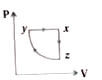
Choose the correct P-V graph of an ideal gas for the given V-T graph |
|
Answer»
`:. In x rarr y` process `V prop T` and for constant V, `y rarr z` `:.` OPTION (A) SATISFIES both the CONDITIONS |
|
| 40. |
A shell flying with velocity v = 500 ms^(-1)bursts into three identical fragments so that the kinetic energy of the system increases eta = 1.5 times. What maximum velocity can one of the fragments obtain? |
|
Answer» |
|
| 41. |
Which of the following is not the unit of length? |
|
Answer» MICRON |
|
| 42. |
Consider the following statements: a) Heat given to an ideal gas under isothermal conditions is used completely to do external work. b) The change in internal energy in a thermodynamic process is independent of the path. |
|
Answer» A and B are TRUE |
|
| 43. |
Two Earth's satallites move in a common plane along circular orbits. The orbitasl radius of one satellite r = 7000 km while that of the other satellite is Delta r = 70 km less. What time interval separates the periodic approaches of the satellites to each other over the minimum distance ? |
|
Answer» Solution :Now for first satellite which is revolving about the earth (mass M and radius r) the orbital speed is `v = SQRT((GM)/(r ))` Let `T_(1)` and `T_(2)` be the TIME period for first and second satellites respectively. Then we know that `T_(1) = (2pi r)/(v) = (2pi r)/(sqrt(GM))r^(3//2)` and `T_(2) = (2pi)/(sqrt(GM))(r-Delta r)^(3//2)` As second satellite is revolving in a radius `(r-Delta r)`. Know the period INTERVAL `(T_(1)-T_(2))` is given by `T_(1)-T_(2)=(2pi)/(sqrt(GM))[r^(3//2)-r^(3//2)(1-(Delta r)/(r ))^(3//2)]` `= (2pi)/(sqrt(GM)) r^(3//2)[1-(1-(3)/(2)(Delta r)/(r ))]` `= (2pi)/(sqrt(GM)) r^(3//2)((3)/(2)(Delta r)/(r ))`. |
|
| 44. |
Obtain the expression of displacement from force law for simple harmonic motion. |
|
Answer» Solution :Force law for SHM `F= -kx (t)` `ma = -m omega^(2) X(t) ""[therefore F= ma(t), K= m omega^(2)]` `therefore a(t) = -omega^(2)x (t)` Integrating w.r.t time t on both sides, `int a(t) DT = -omega^(2) int x (t) dt` `= -omega^(2) int A COS (omega t+ phi) dt` `a(t) XXT = -A omega^(2) int cos (omega t+ phi) dt` `v(t) = -A omega^(2)xx (sin (omega t+ phi))/(omega)` `therefore v(t) = -A omega sin (omega t+ phi)` integrating again w.r.t. time t, `int v(t) dt= -A omega int sin (omega t+phi)dt` `therefore v(t)xxt = -A omega [-(cos (omega t+phi))/(omega)]` `therefore x(t) = -A cos (omega t+phi)` is the expression of displacement. |
|
| 45. |
A thin ring of radius R is made of material of density P and young.s modulus Y. If the ring is rotated about its centre and in its own plane with angular velocity omega find the small increase in its radius. |
|
Answer» |
|
| 46. |
If the maximum acceleration of a S.H.M. is a and the maximum velocity is b then amplitude of vibration is given by |
|
Answer» `b^(2)a` |
|
| 48. |
Half of the uniform rectangular plate of length .L. is made up of material of density d_(1)and the other half with density d_2. The perpendicular distance of centre of mass from AB is: |
|
Answer» `(2d_(1) + 3d_(2))/(d_(1) +d_(2)) xx L/4` |
|
| 49. |
A nail is located below the point of suspension of a simple pendulum of length 'l'. The bob is released from horizontal position. If the bob loops a verticle circle with nail as centre, find the distance of nail from point of suspension. |
|
Answer» Solution :From the PRINCIPLE of conservation of mechanical ENERGY PE at the horizontal POSITION = KE at the lowest position. `mgl = (1)/(20 mv^(2)` To loop the vertical circle `v^(2)= 5G(1-x)` where .x. is the distance of nail from point of SUSPENSION, and .v. is the velocity at lowest point of path. `(mgl = (1)/(2) m.5g (l-x)), l= (5)/(2) (l-x), x= 3l//5` |
|
| 50. |
Three unifonn thin aluminum rods each of length 2m form an equilateral triangle PQR as shown in the figure. The mid point of the rod PQ is at the origin of the coordinate system. If the temperature of the system of rods increases by 50^(@) C, the increase in y-coordinate of the centre of mass of the system of the rods is _mm. (Coefficient of volume expansion of aluminium 12 sqrt(3) xx 10^(-6) k^(-1) ) |
|
Answer» 0.05 |
|