

Saved Bookmarks
This section includes 7 InterviewSolutions, each offering curated multiple-choice questions to sharpen your Current Affairs knowledge and support exam preparation. Choose a topic below to get started.
| 1. |
A body projected vertically up with a velocity of 20 ms^(-1) returns to the ground with a velocity of 18 ms^(-1). The maximum height attained by the body is (g= 10 ms^(-2)) |
|
Answer» `12.1m` |
|
| 2. |
If Young.s modulusof the material of a wireis 1.2xx10^(11) Nm^(-2) , calculatethe work done in stretching the wire of length 3 m and cross-sectional area 4mm^(2) whenit is suspendedvertically and a loadof 8 kg is attached to its lower end. |
|
Answer» SOLUTION :`Y = 1.2 xx 10^11 Nm^(-2) , L = 3m, A = 4mm^2 = 4 xx 10^(-6) m^2 , M = 8 KG ` `Y =1.2 xx 10^11 Nm^(-2) , L = 3m ` , `A = 4mm^2 = 4 xx 10^(-6) m^2 , M = 8 kg ` work done = 1/2 x stretching force x increase in length. But increase in length, `e = (FL)/(AY)` The work done ` = 1/2 xx (F^2L)/(AY) = 1/2 xx ((mg)^2L)/(AY)` ` = 1/2 xx ((8 xx 9.8)^2 xx 3)/(4 xx 10^(-6) xx 1.2 xx 10^11)` ` = 0.0192 J` |
|
| 3. |
Consider a one dimensional elastic collision between a given incoming body A andbody B, initially at rest. How would you choose the mass of B in compariosn to the mass of A in order that B should recoil with (a) greaterst speed (b) greatest momentum ? |
|
Answer» Solution :As in a COLLISION, monentum is always conserved `m_(A)u = m_(A)v_(A) + m_(B) v_(B)` `u=v_(A)+kv_(B)("with" k=m_(B)//m_(A))` `v_(A) = u - kv_(B) "".....(1)` Now as collision is elastic `(1)/(2)m_(A)u^(2)=(1)/(2)m_(A)v_(A)^(2)+(1)/(2)m_(B)v_(B)^(2)` `u^(2)=v_(A)^(2) + kv_(B)^(2)` Subsituting the value of `v_(A)` from Eqn. (1) in (2) `u^(2)=(u-kv_(B))^(2)+kv_(B)^(2)` Which on SOLVING GIVES `v_(B) = (2u)/(i+k) "" .......(3)` (a) So for `v_(B)` to be maximum, k must be MINIMUM, `i.e., k=(m_(B))/(m_(A))rarr0orm_(B)ltltm_(A)` (b) Now `P_(B) = m_(B)v_(B)` In PERFECT elastic collisions, when masses are equal, the total momentum of A is completely transfered to B. i.e., `m_(A) = m_(B)`. |
|
| 4. |
Cooking takes longest time……………. . |
|
Answer» at the sea level |
|
| 5. |
A vessel contains a mixture of one mole of oxygen and two moles of nitrogen at 300K. Find theratio of average rotational kinetic energies per o_2 molecule to per N_2molecule. |
|
Answer» |
|
| 6. |
If x = at + bt^2 , where x is the distance travelled by the body in kilometer while t is the time in second, then the unit of b is |
|
Answer» `km//s` |
|
| 7. |
In the above question, the maximum power delivered by the agent in pulling up the rope is |
|
Answer» `lambda//gv` `(mg)_(max)=(lambdal)g, (DM)/(dt)=lambdav` Hence, `F_(max)=lambdalg+lambdav^2` and `P_(max)=lambdalgv+lambdav^3` |
|
| 8. |
(I) If the frequency of driver (external periodic force) is equal to the frequency of driven (natural frequency) then resonance occurs. (II) A singer maintaining a note at a frequency of a glass and cause it ti shatter pieces is an example of resonance. Which one is correct statement ? |
|
Answer» I only |
|
| 9. |
Four soap bubbles p, q, r, & s have volumes 8cm^(3),27cm^(3),64cm^(3) and 125cm^(3) respectively. Then excess of pressures in them in ascending order will be |
|
Answer» <P>p, s, Q and r |
|
| 10. |
Difference between periodic motion and simple harmonic motion. |
Answer» SOLUTION :
|
|
| 11. |
Assertion: A room can be cooled by opening the door of a refrigerator in a closed room. Reason: Heat flows from lower temperature to higher temperature. |
|
Answer» Both assertion and REASON are TRUE and the reason is the CORRECT explanation of the assertion. |
|
| 12. |
Shown the position time graph of a particle of mass 4 kg What is the force on the particle for t lt 0 , 0 lt t lt4 s motion only . |
|
Answer» Solution :(a) (i) for `t lt 0` the position time graph is AO which means displacement of the particle must be zero (II) for `0 lt t lt 4 s` the position time graph OB has a CONSTANT slope Therefore velocity of the particle is constant in this interval i.e particle has zero acceleration Hence force on the particle must be zero (iii) For `t gt 4 s` the position time graph BC is parallel to time axis Therefore the particle remains at a distance of 3 m from the ORIGIN i.e., it is at rest Hence force on the particle is zero (b) Impulse at `t = 0` We know impulse = change in linear momentum Before t = 0 particle is at rest i.e. u = 0 After t = 0 particle has a constant velocity`upsilon = (3)/(4) = 0.75 m//s ` `:.` Impulse ` = m (upsilon - u ) = 4 (0.75 - 0) = 3 kg ms^(-1)` Impulse at `t = 4 s ` Before t = 4 s particle has a constant velocity `u = 0 .75 m//s ` After t = 4 s particle is at rest i.e., `upsilon = 0` `:.` Impulse ` = m (upsilon - u ) = 4 (0 - 0 .7 5 ) = -3 kg ms^(-1)`. |
|
| 13. |
The area of cross-section of the capillary tube of a mercury thermometer is A_(0) and the volume of the bulb filled with mercury is V_(0) " at " 0^(@)C. Find the length of the mercury column in the capillary tube as the bulb is heated to t^(@)C. Coefficient of linear expansion of glass is alpha and coefficient of volume expansion of mercury is beta. |
|
Answer» Solution :Let `V_(g) " and " V_(m)` be the volumes of the bulb and mercury at `t^(@)C.` `therefore "" V_(g)=V_(0)(1+gamma_(g)t)=V_(0)(1+3alphat)` and `"" V_(m)=V_(0)(1+betat)` Hence, volume of mercury entering the tube is `"" V_(m)-V_(g)=V_(0)(1+betat)-V_(0)(1+3alphat)=V_(0)t(beta-3alpha)` If the area ofcross-section of the capillary tube at `t^(@)C " is " A_(t), " then " A_(t)=A_(0)(1+2alphat)`. If the length of mercury column in the tube is l, then `A_(t) times l=V_(0)t(beta-3alpha)` `therefore "" l=(V_(0)t(beta-3alpha))/(A_(0)(1+2alpha_t))"...(1)"` `""=(V_(0)t(beta-3alpha)(1+2alphat)^(-1))/(A_(0))=V_(0)/A_(0)t(beta-3alpha)(1-2alphat)` `""=V_(0)/A_(0)(beta-3alpha)t "...(2)"` `""` [neglecting `alphabeta " and " alpha^(2)` as they are very SMALL] Both the EQUATIONS (1) and (2), indicate the length of mercury column in the capillary tube at `t^(@)C.` |
|
| 14. |
Two wires of same material and size but with lengths in the ratio 5:3 are stretched by the same force. The ratio of work done in two cases is |
|
Answer» `5:8` |
|
| 15. |
When a constant torque is applied, a wheel is turned from rest through 200 radians in 10 s. What is its angular acceleration. If the same torque continues to act what is the angular velocity of the wheel after 15 s from the start ? |
|
Answer» |
|
| 16. |
A body of mass 12kg is at the bottom of a lake of depth 5m. If the work done in raising the body to the water surface is 350J, the specifice gravity of the body is |
|
Answer» 1.2 |
|
| 17. |
A rigid body can be hinged any point on the x-axis When it is hinged such that the hinge is at x, the moment of inertia is given by 1=2x^(2)-12x+27. The x-coordinate of centres of mass is at x= |
|
Answer» |
|
| 18. |
Is spring constant a dimensional constant ? If yes then write its dimension. |
|
Answer» SOLUTION :Yes, spring constant is a dimensional constant. Spring constant `k=(F)/(x)= ("Restoring force")/("DISPLACEMENT")` `k=(F)/(x)` Dimension of `k=([MLT^(-2)])/([L])= [ML^(0)T^(-2)]` |
|
| 19. |
Find the dimensions of mass in terms of Energy, length and time. |
|
Answer» Solution :Let the dimensions of ENERGY, Length and TIME be [E],[L],[T] RESPECTIVELY. We know that FORCE = mass `xx` acceleration Mass = `("Force")/("acceleration") = ("Work done (or) Energy")/("acceleration" xx "displacement")` `[m] = ("Energy")/(["acceleration"]["displacement"]) = ([E])/([LT^(-2)][L]) = ([E])/([L^(2)T^(-2)]) = [EL^(-2)T^(2)]` |
|
| 20. |
Why convection is not possible in solids whereas it is possible in fluids ? |
| Answer» Solution :CONVECTION is not possible in SOLIDS because there is not much MOVEMENT of particles. In fluids the particles can move EASILY and so convection is possible. | |
| 21. |
A solid cylinder is placed on the end of an inclined plane. It is found that the plane can be tipped at an angle theta before the cylinder starts to slide. When the cylinder turns on its sides and is allowed to roll, it is found that the steepest angle at which the cylinder performs pure rolling is phi. The ratio tanphi//tantheta is |
|
Answer» `3` for no SLIDING `fltf_(L)` `mgsintheta ltmu_(s)mgcostheta` `TANTHETA=mu_(s)`  For rolling friction force `f=(mgsintheta)/(1+(R^(2))/(K^(2)))` `impliesf=(mgsinphi)/3` For pure rolling `(mgsinphi)/3ltmu_(s) mgcosphi` `tanphilt3mu_(s)` ,so `(tanphi)/(tantheta)=3` |
|
| 22. |
Assertion: Rain is falling vertically with a certain speed. A boy holding an umbrella rides a bicycle in east to west direction and does not get wet. Reason: The boy is holding his umbrella (at some angles) with the vertical towards the west. |
|
Answer» |
|
| 23. |
Two engines pass each other in opposite directions with a velocity of 60 kmh^(-1)each . One of them is emitting a note of frequency 540.Calculate the frequencies heard in the other engine before and after they have passed each other.Given velocity of sound =316.67 ms^(-1). |
|
Answer» |
|
| 24. |
Figure below shows two paths that may be taken by a gas to go from a state A to a state C. In process AB, 400 J of heat is added to the system and in process BC 100 J of heat is added to the system. The heat absorbed by the system in the process AC will be ..... |
|
Answer» 380 J `DeltaU_"cyclic"=0` `Q_"cyclic"=W_"cyclic"` `Q_(AB)+Q_(BC)+Q_(CA)` = closed loop area 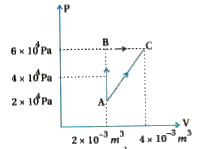 `400+100+Q_(CA)=1/2` BASE x HEIGHT `500-Q_(AC)=1/2xx2xx10^(-3)xx4xx10^4` `500-Q_(AC)=40` `therefore Q_(AC)`=460 J |
|
| 25. |
Define centre of mass. |
| Answer» SOLUTION :The centre of mass of a body is the point where the ENTIRE mass of the body is supposed to be CONCENTRATED. It is known as (C.M.). | |
| 26. |
Two wires A and B of same material have lengths in the ratio 1:2 and diameters in the ratio 2:1. If they are stretched by same force then the ratio of the increase of their lengths will be ---- |
|
Answer» `2:1` |
|
| 27. |
The molar heat capcity of a gas at constantvolume is C_(v). If n moles of the gas undergo DeltaT change is temperature, its internal energy will change by nC_(v)DeltaT |
|
Answer» Only if the CHANGE of TEMPERATURE occursat CONSTANT volume |
|
| 28. |
How the oil lamp produces light through a wick that is lit using a match ? |
| Answer» Solution :The wick of lamp is made from thin fibers of cotton .The PHENOMENA of capillary EXIST through these thin fibers and oil is continuously to GROW and HENCE FLAME of lamp is exist. | |
| 29. |
A foot ball is kicked of with an initial speed of 19.6 m/sec at a projection angle 45^(0). A receiver on the foal line 67.4m away in the direction of the kick starts running to meet the ball at that instant. What musthis speed be if he is to catch the ball before it hits the ground? |
|
Answer» Solution :`R=(u^(2)SIN2THETA)/(g)=((19.6)^(2)xxsin90)/(9.8)` or R=398.2metre. Man must run 67.4m - 39.2m = 28.2m in the TIME taken by the ball to come to ground. Time taken by the ball. `t=(2usintheta)/(g)=(2xx19.6xxsin45^(0))/(9.8)=(4)?SQRT(2)` `t=2sqrt(2) = 2xx1.41 = 2.82` sec. velocity of man =` (28.2m)/(2.82m)=` 10m/sec. |
|
| 30. |
A hollow cylinder of length 1 m is divided by a thin flexible by a thin flexible diaphragm at a distance one-third the length of the cylinder. It is closed by two other flexible diaphragms at the ends. Of the two chambers into which it is divided, the longer one contains hydrogen and the other oxygen. The two end diaphragms are set into vibrations of the same frequency. what are the frequencies of the end diaphragms for which the middle diaphragm will be motionless? Velocity of sound in hydrogen =1100 m s^(-1) and that in oxygen =300 m s^(-1). |
|
Answer» |
|
| 31. |
A needle of length 5 cm is floating on water of surface tension 0.07Jm^(-2) and is not wetted by water. Then the weight of the needle will be |
|
Answer» `7xx10^(-3)`KGWT |
|
| 32. |
The inside and outside temperature of a refrigerator are 273 K and 303 K respectively. Assuming that refrigerator cycle is reversible for every joule of work done, the heat delivered to the surroundings will be |
|
Answer» Solution :As `beta = (Q_(2))/(W) = (T_(2))/(T_(1) - T_(2))` `:. Q_(2) = W(T_(2))/(T_(1) - T_(2)) = 1 xx (273)/(303 - 273) = (273)/(30) ~= 9J` Heat delivered to the SURROUNDINGS, `Q_(1) = Q_(2) + W = 9 + 1 = 10 J` |
|
| 33. |
Three rods AB, BC and BD havingthermal conductivitiesin the ratio 1:2:3and lengthin the ratio 2:1:1 are joined as shown in figure . The ends A , C and Dare at temperature T_(1), T_(2) and T_(3) respectively . Find the temperature of the junctionB . Assume steady state . |
|
Answer» SOLUTION :Let the thermal conductivites of the rods AB, BC be K,2K and 3K respectively . Also, lettheirlengths be 2L ,L and L . IfT be the requied tempertaureof the junctionB and assuming` T_(1) gt T gt T_(2) gtT_(3)` We have `(Delta Q)/(DeltaT)]_(AB) = (DeltaQ)/(Deltat)]_(BC) + (DeltaQ)/(Deltat)]_(BD)` i.e., `(KA(T_(i)-T))/(2L) = (2KA(T-T_(2)))/(L) + (3KA(T-T_(3)))/(L)` (or) `(T_(1)- T)/(2) = 2(T - T_(2)) + 3(T- T_(1)) (or)T = (1)/(11) (T_(1) + 4T_(2) + 6T_(3))` |
|
| 34. |
Two short magnets with pole strengths of 100 ab ampere-cm and 64 ab ampere-cm are placed with their axes in the sarme vertical line, with similar poles facing each other, Each magnet has a length of 1 cm. When separation between the nearer poles is 1 cm, the weight of upper magnet is supported by the repulsive force between the magnets. If g= 1000" cm/s"^(2), then the mass of upper magnet is |
|
Answer» 10g |
|
| 35. |
A rectangular block of mass m and area of cross-section A floats in a liquid of density rho. If it is given a small vertical displacement from equilibrium, it undergoes oscillation with a time period T. |
|
Answer» `Tpropsqrtm` |
|
| 36. |
A bullet is projected upwards from the top of a tower of height 90m with the velocity 30ms^(-1) making an angle 30^(@) with the horizontal. Find the time taken by it to reach the ground is (g=10ms^(-2)) |
|
Answer» |
|
| 37. |
In the figure an ideal liquid flows through the tube, which is of uniform cross section. The liquid has velocities v_(A) and v_(B) and pressures p_(A) and p_(B) at points A and B respectively. a. v_(A)=v_(B) b. v_(B)gtv_(A) c. p_(A)=p_(B) d. p_(B)gtp_(A) |
|
Answer» a and B are correct |
|
| 38. |
A uniform circular disc of radius 50cm at rest is free to turn about an axis which is perpendicular to its plane and passes through its centre. It is subjected to a torque which produces a constant angular acceleration of 2.0 rads^(-2) Its net acceleration in ms at the end of 2.0 s is approximately |
|
Answer» `7.0` |
|
| 39. |
What provides the restoring force in the following cases ? Displacement of water in U-tube. |
| Answer» SOLUTION :WEIGHT of WATER. | |
| 40. |
Explain geometrical repersentation of simple harmonic motion. |
|
Answer» Solution :SUPPOSE as shown in figure, a particle is moving with a CONSTANT angular speed `omega` in an inti-clockwise direction on a circular path having centre O and radius A. At time t=0, particle at position `P_(1)` and its position vector `vec(OP_1)` makes an angle `phi` with positive X-axis. Projection of `OP_(1)` on X-axis is `OP._(1)` At time t=t, particle displaced by angular displacement `omega t`, it REACHES at point `P_(2)` and its position vector `vec(OP_2)` makes an angle `omega t+ phi` with X-axis. Projection of position vector `OP_(2)` on X-axis is `OP._(2)`. As the particle P moving on a circle, its point of perpendicular on X-axis is given by `x(t)= A cos (omega t+ phi)`. It is the X-component of position vector at any time. This equation is the general equation of SHM. From this it is said that the projection of uniform circular motion on a diameter of the reference circle is SHM. The particle moving on uniform circular path is called reference particle and the circular path of reference particle is reference circle. If the projection of reference particle TAKEN on Y-axis, the displacement of particle on Y-axis is `y(t)= A sin (omega t+ phi)`. 
|
|
| 41. |
Consider a one diamensional elastic collision between a given incoming body Aand B, initially at rest. How would you choose the mass of B in comparision to the mass of A in order that B should recoil with (a) greatest speed (b) greatest momentum and (c ) greatest kinetic energy ? |
|
Answer» Solution :As in a collision, momentum is always CONSERVED `m _(A) u = m _(A) v _(A) + m _(B) u _(B) , u = v _(A) + kv _(B)` (with `k = m _(B) // m _(A))…(1)` Now as collision is elastic `1/2 m _(A) u ^(2) = 1/2 m _(A) v _(A) ^(2) + 1/2 m _(B)v _(B) ^(2) (or)u ^(2) = v _(A) ^(2) + kv _(B) ^(2) ""...(2)` Substituging the VALUE of `v _(A)` from Eqn. (1) and (2) `u ^(2) = (u - kv _(B)) ^(2) + kv _(B) ^(2)` which on solving gives `v _(B) = (2u)/(1 +k)""...(3)` (a) So for `u _(B)` to be max, k must be min. `i.e., k = (m _(B))/( m _(A)) to 0 or m _(B) GT gt m _(A)` (b) Now `P _(a) = m _(B) v_(B) ,` But as `k = (m _(B))/( m _(A)) and v_(B) = (2u)/( 1 + k)` (from Eqn. 3) `P_(a) = (2 km _(A) u )/( 1 + k ) = (2m _(A) u )/(1 + ( 1 //k))` So `p _(B)` will be max when (1/k) is min (or) k is max so `k =(m_(B))/( m _(A)) to OO (or) m _(B) gt gt m _(A)` (c ) `K _(B) = 1/2 m _(B) = v _(B) ^(2)` But as `k = (m _(B))/( m _(A)) and v _(B) = ( 2u)/( 1 + k)` (from Wqn. 3) `K _(B) = 1/2 km _(A) =((2u)/( 1 + K )) ^(2) = (2m _(A) u ^(2) k )/((1+ k ) ^(2)) (or ) K _(B) = ( 4 (K _(A) )k )/( (1- K) ^(2) +4k) [as K _(A) = (1//2) m _(A) u ^(2)]` So, KE will be max when `(1-k)^(2)= min =0,i.e., k = (m _(B))/( m _(A)) =1 (or) m _(B) = m _(A)` |
|
| 42. |
A book of weight 20 N is pressed between two hands and each hand exerts a force of 40 N. If book just starts to slide down. Coefficient of friction is |
|
Answer» `0.25` |
|
| 43. |
A circular disc of mass 10 kg is suspended by a wire attached to its centre. The wire is twisted by rotating the disc and released. The period of torsional oscillations is found to be 1.5 s. The radius of the disc is 15 cm. Determine the torsional spring constant of the wire. (Torsional spring constant a is defined by the relationJ=- alpha theta, where J is the restoring couple and the angle of twist). |
|
Answer» Solution :Here m=10kg ,R=15 cm=0.15m,T = 1.5s Moment of INERTIA of disc, `I= (1)/(2)mR^(2)= (1)/(2) xx 10 xx (0.15)^(2) kgm^(2)` Now `T= 2pisqrt((I)/(alpha))` so, `alpha= (4PI^(2)I)/(T^(2))= 4 xx ((22)/(7))^(2)xx (1)/(2) xx (10xx (0.15)^(2))/((1.5)^(2))= 1.97 Nm//"rad"` |
|
| 44. |
A circular disc of mass 10 kg is suspended by a wire attached to its centre. The wire is twisted by rotating the disc and released. The period of torsional oscillations is found to be 1.5 s. The radius of the disc is 15 cm. Determine the torsional spring constant of the wire. (Torsional spring constant alpha is defined by the relation J=-alphatheta, where J is the restoring couple and theta the angle of twist). |
|
Answer» Solution :Moment of inertia `I= (1)/(2)mR^(2)= 0.1125 kgm^(2)` time PERIOD `T= 1.5 SEC` Torsional spring constant `C= (4PI^(2)I)/(T^(2))(T= 2pisqrt((I)/(C)))` `C= 1.9 NM//"rod"` |
|
| 45. |
When will the relative velocity of two moving cars be zero ? |
| Answer» Solution :When both cars are MOVING in one DIRECTION with same velocity, then their RELATIVE velocity become ZERO | |
| 46. |
A particle performs SHM of time period T. Find the time taken by the particle to go directly (i) from its mea position to half the amplitude and (ii) from half the amplitude position to its positive extreme position. |
|
Answer» SOLUTION :When a particle is initially in the mean position. `X=A sin omega t` (i) When the particle travels from mean position to half its AMPLITUDE displacement`x=A//2` `A/2 =A sin omegat` `sin omega t=1/2 impliesomega t=(pi)/6implies(2pi)/T=t=(pi)/6impliest=T/12` (ii) The TIME taken to go from half the amplitude position to its positive extreme position =[Time taken to go from mean to positive extreme position ]-[Time taken to go from MENA to half amplitude position] `=T/4-T/12=T/6` |
|
| 47. |
The period T and mean distance R of a planet from the sun are related by |
|
Answer» `T^2 PROP R^2` |
|
| 48. |
A man whose mass is 50 kg climbs up 20 steps of the stairs with mass of 20 kg on his head .If each step of stair is 0.25 m in height , then work done by a man will be ……… |
|
Answer» Solution :TOTAL mass m = mass of man + mass on head ` = 50 +20` ` = 70 kg ` Height increases = height of one step `xx` total no of STEPS , ` = 0.25 xx20` ` = 5 m ` ` :.` Work W = change in potential energy = mgh ` = 70 xx 9.8 xx 5` = 3430 J |
|
| 49. |
A trolley filled with sand moves on a smooth horizontal surface with a velocity V. A small hole is made at the base of it from which sand is leaking out vertically down at constant rate. As the sand leaks out. (a) the velocity of the trolley remains constant (b) the velocity of the trolley increases (c) the velocity of trolley decreases (d) the momentum of trolley + leaked out sand is conserved |
|
Answer» a & b are correct |
|