Saved Bookmarks
This section includes 7 InterviewSolutions, each offering curated multiple-choice questions to sharpen your Current Affairs knowledge and support exam preparation. Choose a topic below to get started.
| 1. |
Normalhumanbody of thetemperatureis 98.6^(@)F. Duringhighfeverif thetemperatureincreasesto 104^(@)Fwhat is thechange in peakwavelengththatemittedby ourbody ? (Assumehumanbody is ablackbody) |
|
Answer» Solution :Normal human body temperature `(T)=98.6^(@)F` `(F-32)/(180)=(K-273)/(100)` `"So,"T=98.6^(@)F=310K` From Wien.s displacement law Maximum wavelength, `lambda_("max")=(b)/(T )=(2.898xx10^(-3))/(310)=9348xx10^(-9)m` `lambda_("max")=9348nm""(" at "98.6^(@)F)` During high FEVER, human body temperature, `T=104^(@)F=313K` `"Peak wavelength"lambda_("max")=(b)/(T )=(2.898xx10^(-3))/(313)=9259xx10^(-9)m` `lambda_("max")=9259 nm""("at "104^(@)F)` |
|
| 2. |
When a disc rotates with uniform angular velocity, which of the following is not true? |
|
Answer» The sense of rotation remains same |
|
| 3. |
What are audible beats? |
| Answer» Solution :The phenomenon of waxingand WANING of sound as a resuld to superposition of two progressive WAVES differing in their FREQUENCIES SLIGHTLY `( le 10Hz)` is known as beat (audible). | |
| 4. |
In questionnumber91,what willbe the change in the diameter of the rope ? |
|
Answer» `8.8 xx 10^(-9)m` `THEREFORE DeltaD = (sigma D Deltal)/(l) = (0.2 xx 6xx 10^(-3) xx 3.32 xx10^(-5))/(4.5)= 8.8 xx 10^(-9)m` |
|
| 5. |
Statements : a) Position of C.m depends on acceleration due to gavity where as position of C.g independent on aceeleration due to gravity. (b) Centre of gravity of a body is defined to know the amount of stability of the body and the center of mass of the body is defined to describe the nature of motion of the body. |
|
Answer» a is TRUE, B is FALSE |
|
| 6. |
What is the radius of a small oil drop while falling through air acquires a terminal velocity of Imm/s. The density of oil and air are 0.91g//cm^(3) and 1.3g//"lt" respectively and eta=1.8xx10^(-4) poisefor air |
| Answer» Answer :D | |
| 7. |
If temperature scale is changed from centigrade to Fahrenheit, the numerical value of specific heat will |
|
Answer» Increase |
|
| 8. |
A boy is pushing a ring of mass 2 kg and radius 0.5 m with a stick as shown in the figure. The stick applies a force of 2 N on the ring and rolls it without slipping with an acceleration of 0.3 m//s^(2). The coeffecient of friction between the ground and the ring is large enough that rolling always occur and the coefficient of friction between the stick and the ring |
|
Answer» 0.4  As `2-f_(1)=Ma` `f_(1)=2-Ma = 2-2 XX 0.3 = 1.4 N` Taking TORQUE about C `f_(1)R-f_(2)R=I_(C)alpha` `(f_(1)-f_(2))R= MR^(2) a/R``(therefore alpha=a/R)` `f_(1)-f_(2)=Ma` `f_(2)= f_(1) = Ma=1.4 -2 xx 0.3 = 0.8 N` `f_(2) = 2MU` `mu=0.8/2 = 0.4` |
|
| 9. |
If potential energy due to attractive force in circular path of radius r is U=-k/(2r^2), then its total energy = …... . |
|
Answer» `U=-k/(2r^2)RARR(dU)/(dr)=+k/R^3` `:.F=k/r^3` But for circular motion, centipetal force `F=(mv^2)/r` `:.(mv^2)/r=k/r^3` `:. 1/2mv^2=k/(2r^2)` `:. K=k/(2r^2)` `:.` Total ENERGY `E=U+K=-k/(2r^2)+k/(2r^2)=0` |
|
| 10. |
Three stones are projected simultaneously with same speed u from the top of a tower. Stone 1 is projected horizontally and stone 2 and stone 3 are projected making an angle q with the horizontal as shown in fig. Before stone 3 hits the ground, the distance between 1 and 2 was found to increase at a constant rate u. (a) Find theta (b) Find the rate at which the distance between 2 and 3 increases. |
|
Answer» |
|
| 11. |
Three dense point size bodies of same mass are attached at three vertices of a light equilateral triangular frame. Identify the decreasing order of their moment of inertia about following axis. (I)Passing through any side (II) Passing through opposite corners (III) bot^(r) bisector of any side (IV) bot^(r) to the plane and passing through any corner |
|
Answer» `III,IV,I,II` |
|
| 12. |
A solid body rotates about a stationary axis so that its angular velocity depends on the rotational angle (phi)as omega= omega_(0) - kphiwhere omega_(0) and K are positive constant, At the moment t=0, phi= 0, the time depen dence of rotation angle is |
|
Answer» `Komega_(0)e^(-Kt)` |
|
| 13. |
Two smooth spheres, A & B of equals radius, lie on a horizontal table. A is of mass m & B is of mass 3m. The spheres are projected towards each other with velocity vectors 5hat(i) + 2hat(j) and 2hat(i) - 2hat(j) respectively & when they collide, the line joining their centres is parallel to the vector hat(i). If the coefficient of restitution between A and B is 1/3 Their velocities after impact are |
|
Answer» `2HAT(i) + 2hat(J) , 3HAT(i) - HAT(j)` |
|
| 14. |
Two smooth spheres, A & B of equals radius, lie on a horizontal table. A is of mass m & B is of mass 3m. The spheres are projected towards each other with velocity vectors 5hat(i) + 2hat(j) and 2hat(i) - 2hat(j) respectively & when they collide, the line joining their centres is parallel to the vector hat(i). If the coefficient of restitution between A and B is 1/3 The loss in kinetic energy caused by the collision is |
|
Answer» MINIMUM VALUE of V is 2m/s |
|
| 15. |
A massless string is wrapped around a uniform solid cylinder of mass 30 kg and radius 0.20 m. One end of the string is attached to the cylinder and the free end is pulled tangentially by a force that maintains a constant tension of 3.0 N. Find (a) the angular acceleration and (b) the angular speed of th cylinder 2.0 s after the force is applied to the cylinder at rest. |
|
Answer» Solution :(a) We KNOW that `TAU = I ALPHA` `F.r = I alpha F.r =(mr^(2))/(2).rArr alpha = (2F)/(mr)=(2XX3)/(30xx0.2)=1 rad//s^(2)` (b)`omega_(2)-omega_(1)=alpha t therefore omega_(2)=alpha t` angular speed after 2 sec, `omega_(2)=1xx2=2` rad/sec. |
|
| 16. |
A pressure of 100kPa causes a decrease in volume water by 5xx10^(-3) precent. The speed of sound in water is |
|
Answer» <P>`1414ms^(-1)` |
|
| 17. |
A solid sphere, solid cylinder and a disc are allowed to roll down from the top of an incline plane from the same height. Then |
|
Answer» Disc will reach the BOTTOM first |
|
| 18. |
Dimensional formula of angular momentum is.... |
|
Answer» `M^(0)L^(2)T^(-2)` `=M^(1)L^(1)T^(-1)xxL^(1)` `=M^(1)L^(2)T^(-2)` |
|
| 19. |
The efficiency of an engine is found to increase from 0.3 to 0.4 when the temperature of the sink is lowered by 50^(@)C. Calculate the temperature of sink and source. |
| Answer» Solution :`eta =1 - (T _(2) //T _(1)) ,0.3 =1 - (T _(2)// T _(1)), 0.4 = 1 - (T _(2) - 50 // T _(1)), ` solving `T _(1) = 500 K, T _(2) = 350 K` | |
| 20. |
The radius of gyration of a body about an axis passing through its centre of mass is 24cm. Calculate the radius of gyration of the body about a parallel axis passing through a point at a distance of 7cm from its centre of mass. |
|
Answer» Solution :`K_(1)=24CM`, `r=7cm ` `I=I_(G )+MR^(2)`, `I_(G )=MK_(1)^(2)`, `I=MK^(2)` `:.MK^(2)=MK_(1)^(2)+Mr^(2)` `K^(2)=K_(1)^(2)+r^(2)=(24)^(2)+(7)^(2)=576+49=625` `K^(2)=625` `:.` RADIUS of gyration `K=sqrt(625)=25cm` |
|
| 21. |
A small hole is made at a height of ( 1// sqrt2)m from the bottom of a cylindrical water tank. The length of the water column is sqrt(2)m. Find the distance where the water emerging from the hole strikes the ground. |
|
Answer» 4m |
|
| 22. |
A rocket has a mass of 21000 kg of which 15000 kg is fuel. The rocket engine can exhaust fuel at the rate of 190kg/s with an exhaust velocity of 2800 m/s relative to the rocket. If the rocet is fired vertically upward, calculate the thrust of the rocket |
|
Answer» `5.33 XX 10^(5) N` |
|
| 23. |
A car weights 1800 kg. The distance between its front and back axles is 1.8 m. Its centre of gravity is 1.05 m behind the front axle. Determine the force exerted by the level ground oneach front wheel and each back wheel. |
| Answer» Solution :3675 Non each FRONT WHEEL, 5145 N on each back wheel. | |
| 24. |
When we analyse the projectile motion from any accelerated frame O as vecr_(o),vecu_(o) and veca_(o) respectively, express the following terms, vecr_(pO)+veca_(p)-vecr_(O),vecu_(pO)=vecu_(p)-vecu_(O) and veca_(pO)=veca_(p)-veca_(O) where P stands for projectile. Then using the following kinematical equations of the projectile (For constant acceleration) relative to the accelerating frame ,we have vecS_(pO)=vecu_(pO)t+1/2veca_(pO)t^(2),vecv_(pO) =vecu_(pO)+veca_(pO)t and v_(pO)^(2)=u_(pO)^(2)+2veca.vecs_pO Using the above expressions, anwer the following question:A projectile has initial velocity v_(0) realtive to the large plate which is moving with a constant upward acceleration a. Refering to Q.1, velocity of the projectile relative to B ofter some time |
|
Answer» `ltv_(0) "atan angle" thetalttheta_(0)` |
|
| 25. |
When we analyse the projectile motion from any accelerated frame O as vecr_(o),vecu_(o) and veca_(o) respectively, express the following terms, vecr_(pO)+veca_(p)-vecr_(O),vecu_(pO)=vecu_(p)-vecu_(O) and veca_(pO)=veca_(p)-veca_(O) where P stands for projectile. Then using the following kinematical equations of the projectile (For constant acceleration) relative to the accelerating frame ,we have vecS_(pO)=vecu_(pO)t+1/2veca_(pO)t^(2),vecv_(pO) =vecu_(pO)+veca_(pO)t and v_(pO)^(2)=u_(pO)^(2)+2veca.vecs_pO Using the above expressions, anwer the following question:A projectile has initial velocity v_(0) realtive to the large plate which is moving with a constant upward acceleration a. Which of the following remains equal for the observers A and B? |
|
Answer» MAXIMUM height |
|
| 26. |
Position vector of the centre of mass of a system of N particles of total mass M is |
|
Answer» `(SUM^(vecMr)p)/(M)` |
|
| 27. |
Suppose the glass of the previous problem is covered by a jar and air inside the jar is completely pumped out a. What will be the answer to the problem? b.Show that the answers do not change if a glass of different shape is used provided the height, the bottom area and the volume are unchanged. |
|
Answer» a. FORCE exerted on the bottom `=(hrho_ug)xxA` `=(20xx10^-2xx10^-3xx10)20xx10^-4` =4N` b. `mg=hxxrho_wxxgxAxxF_s` `rarr F_s=5-4=1N` `c. If glasses of differet shapes used have the same volume height and area no CHANGE in ANSWER will occur. |
|
| 28. |
A glass marble dropped from a certain height above the horizontal surface reaches the surface in time t and then continues to bounce up and down. The time in which the marble finally comes to rest is (where e is the coefficient of restitution) |
|
Answer» `E^(n)t` After first REBOUND, time taken to rise to height `h_1` and COMING BACK `= 2sqrt((2h_1)/(g)) = 2sqrt((2e^2h)/(g)) = 2e sqrt((2h)/(g))` Time taken in rising to height, `h_2` and coming back = `2e^2 sqrt((2h)/(g))` Total time taken by the glass marble in coming to rest `= sqrt((2h)/(g)) + 2e sqrt((2h)/(g)) + 2e^2 sqrt((2h)/(g)) + .........` `= sqrt((2h)/(g)) + 2e sqrt((2h)/(g)) [1 + e + e^2 + ........]` `= sqrt((2h)/(g)) + 2e sqrt((2h)/(g)) xx 1/(1 - e) = sqrt((2h)/(g)) [1 + (2e)/(1 - e)] = t [(1 + e)/(1 - e)]` . |
|
| 29. |
All harmonics are overtones but all overtones are not harmonics . Explain . |
| Answer» Solution :The OVERTONES with FREQUENCIES that are INTEGRAL multiples of the FUNDAMENTAL are called HARMONICS. Hence all harmonics are overtones. But overtones which are non-integral multiples of the fundamental are not harmonics. | |
| 30. |
Aconveyor belt, run by a motor, is moving at a constant speed of 5 m *s^(-1) . If 5 kg of sand is sprinkled per second on the belt, then what extra power should the motor supply to the belt? |
|
Answer» Solution :The initial horizontal speed fosand before falling on the conveyor belt =0. So, the rate of SUPPLY of kinetic energy of the sand by the belt `=1/2 xx("mass"xx"velocity"^2)/("second")=1/2 xx(5xx5^2)/(1) =62.5 J*s^(-1)` If there is no loss of energy otherwise, then EXTRA power to be supplied to the beltby the motor `=62.5 J*s^(-1) or 62.5 W`. |
|
| 31. |
If mu_(k) is the coefficient of kinetic friction and mu_(s) the coefficient of static friction then generally |
|
Answer» |
|
| 32. |
If the force acting on a body is inversely proportional to its speed, then its kinetic energy is |
|
Answer» linearly RELATED to time where C is the constant of proportionality. `:. ma= C/v " or " m (dv)/(dt) = C/v " or " vdv = (Cdt)/(m)` Integrating both SIDES , we get `(v^2)/v = (Ct)/m " or " 1/2 mv^2 = Ct` KINETIC energy, `K = 1/2 mv^2 = Ct or K prop t` |
|
| 33. |
A body is projected with a certain speed at angles of projectile of theta and 90-theta, The maximum height attained in the two cases are 20m and 10 m respectively. The maximum possible range is |
| Answer» Answer :C | |
| 34. |
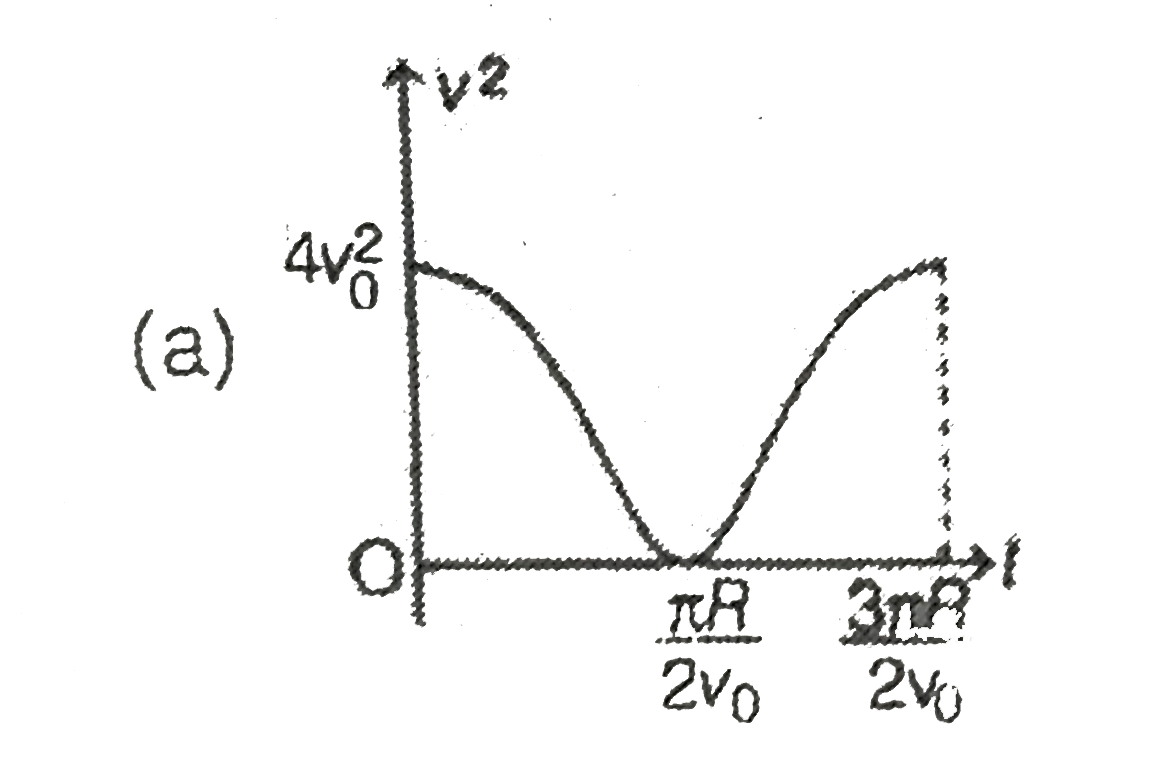
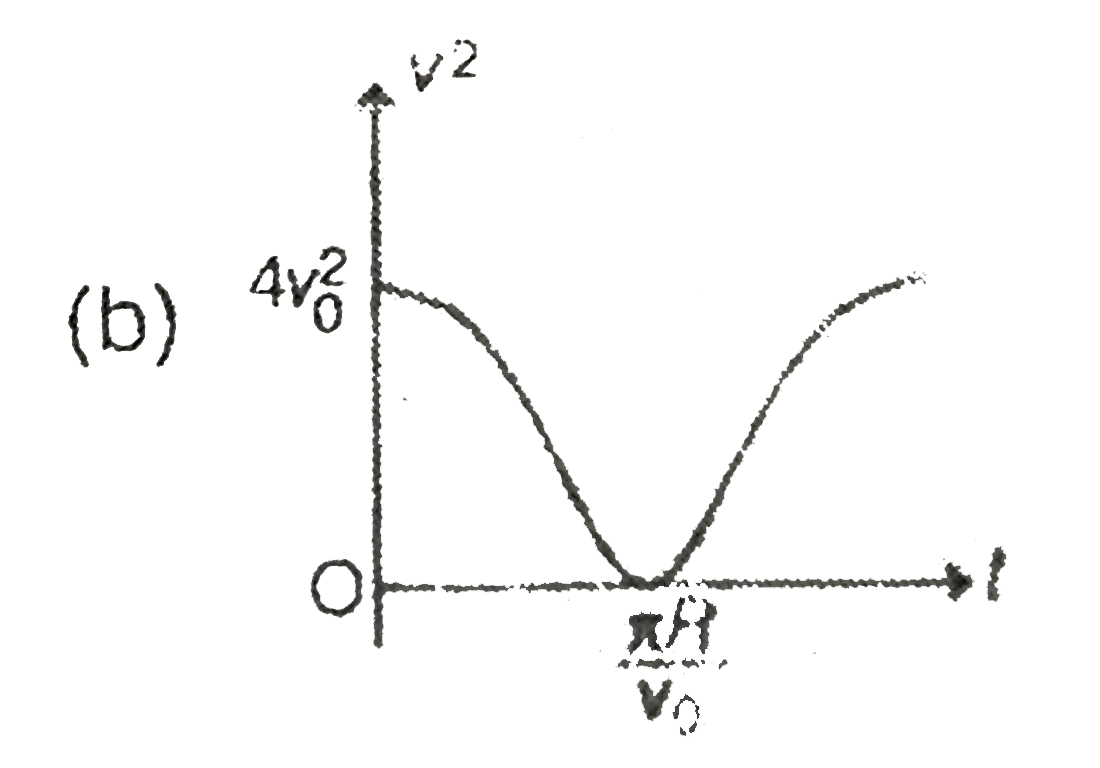
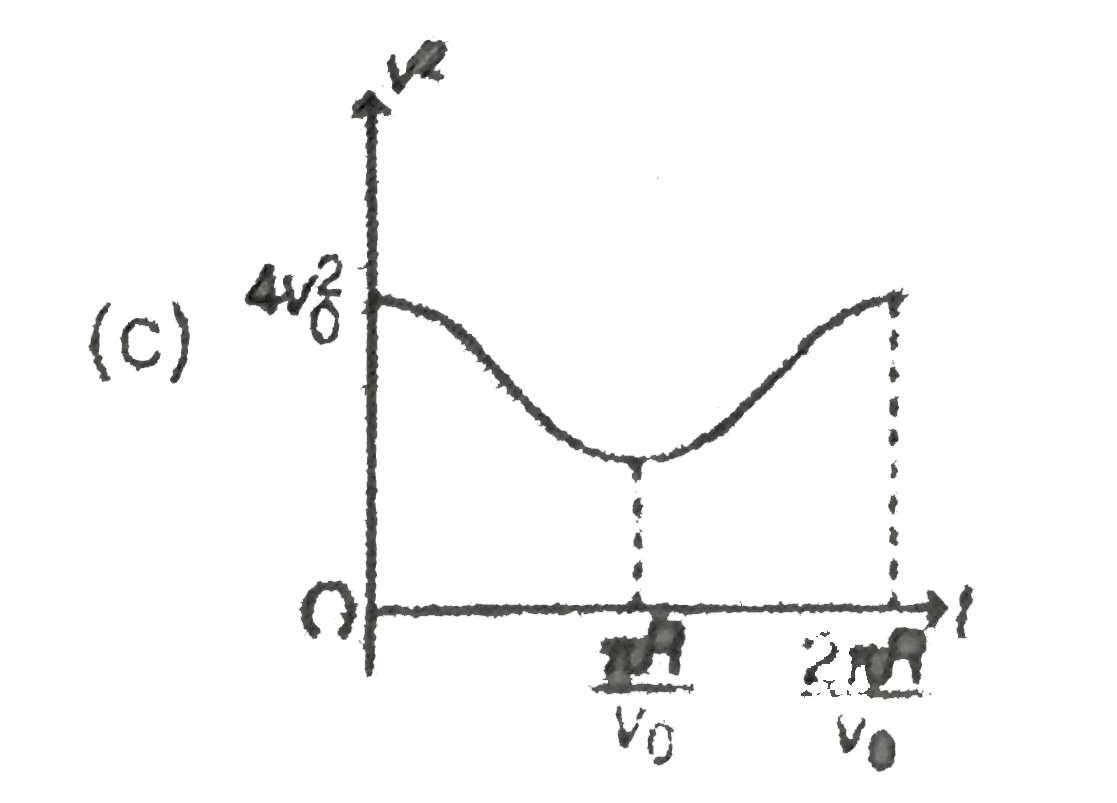
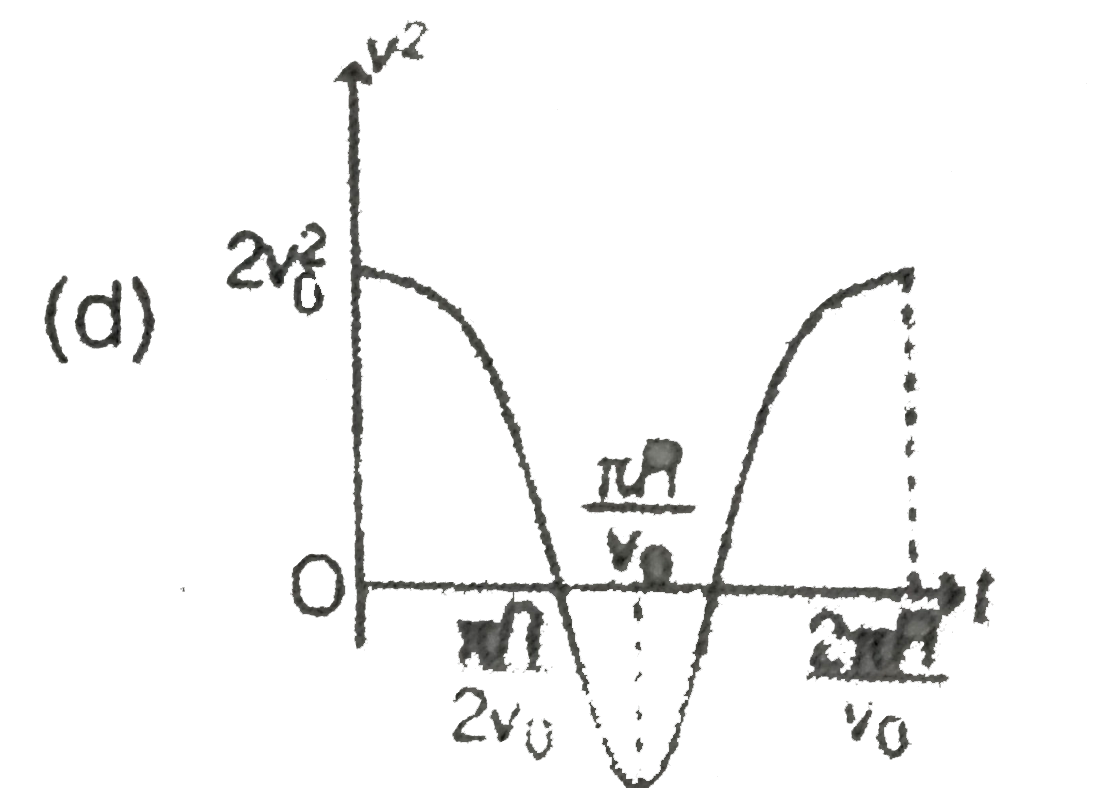
A wheel ios rolling without sliding on a horizontal surface. The centre of the wheelk moves with a constant speed v_(0). Consider a point P on the rim which is at the top at time t=0. The square of speed of point P is plooted against time t. The correct plot is (R is radius of the wheel) |
|
Answer»
|
|
| 35. |
A block of weight 100N is lying on a rough horizontal surface. If coefficient of friction 1//sqrt(3). The least possible force that can move the block is |
| Answer» Answer :D | |
| 36. |
(A): A negative acceleration of a body is associated with a slowing down of a body. (R): Acceleration is vector quantity. |
|
Answer» Both (A) and (R) are true and (R) is the correct EXPLANATION of (A) |
|
| 37. |
A satellite is revolving very close to a planet of density D. The time period of revolution of that planet is |
|
Answer» `SQRT((3PI)/(DG))` |
|
| 38. |
Water on a clean glass surface tends to spread out while mercury on the same surface tends to form drops . (Put differently, water wets glass while mercury does not .) |
|
Answer» Solution :Water on a clean GLASS surface TENDS to spread out. Water WETS glass because FORCE of cohesion of water is much less than the force of adhesion due to glass .Hence water spread out on glass or stick to surface of glass. In case of mercury force of cohesion due to mercury molecules is quite strong as compared toadhesion force due to glass . Consequently , mercury does not wet glass and tends to form drops. |
|
| 39. |
An object of mass 3 kg is at rest. Now a force F = 6t^(2)hatj+2thatj N is applied on the object. Find the velocity of the object at t=3 sec. |
|
Answer» `18veci+3vecj` |
|
| 40. |
A force vec(F) is applied on a square plate of length L. If the percentage error in the determination of L is 3% and in F is 4%, the permissible error in the calculation of pressure is |
|
Answer» 0.13 |
|
| 41. |
NORMAL FORCE |
| Answer» SOLUTION :Frictionalforcewhichalwaysopposethe relativemotionbetweenan OBJECTAND thesurfacewhere it isplaced. | |
| 42. |
The velocity of water in a river is 2 kmph, while width is 400 m. A boat is rowed from a point rowing always aiming opposite point at 8 kmph of still water velocity. On reaching the opposite bank the drift ontained is |
| Answer» ANSWER :D | |
| 43. |
gamma_(A) of liquid is 7/8 of gamma_(R)of liquid. alpha_(g)of vessel is |
|
Answer» `(gamma_(R))/(8)` |
|
| 44. |
A simple pendulum makes 100 oscillation in 25 s. What is the frequency of the pendulum correctto the significant figures? |
|
Answer» |
|
| 45. |
Science, like any knowledge, can be put to good or bad use, depending on the user. Given below are some of the applications of science, Formulate your views on whether the particular application is good, bad or something that cannot be so clearly categorized : (a) Mass veccination against small pox to curbe and finally eradicate this disease from the population. (this has already been successfuly done in india). (b) Televison for eradication of illiteracy and for mass communication of news and ideas. (c ) Prental sex determination. (d) Computers for increase in work efficiency. (e ) Putting artificial stellites into orbits around the Earth. (f) Development of nuclear weapons. (g) Development of new and powerful techniques of chemical and biological warface.(h) Purificiation of water for drinking. (i) Plastic surgery. (j) Cloning. |
|
Answer» Solution :(a) Mass vaccination is good (b) Television for eradication of illiteracy and for mass communciation of news and ides is really good. (c ) Prenaltal SEX determination is not bad. But people are misuing it. They MUST be educated to avoid its misuse in creating IMBALANCE between the male and female population. (d) Computers for increases in work efficiency are good, (e ) Putting artificial satellites in work orbits around the earth is a good development. (F) Development fo nuclear weapons is bad as they are the weapons of mass destruction. (g) Development of new and powerful techniques of chemical and biological warface is real bad us these weapons are for destructio of makind. (h) Purification of water for drinking is good, (i) PLASTIC surgery is good, (j) Cloning is also good. |
|
| 46. |
If the escape velocity on the earth.s surface is 11.2kms^(-1)its value on a planet having double the mass and double the radius that of the earth is |
|
Answer» `5.6 KMS^(-1)` |
|
| 47. |
A uniform force acts on a body of mass 2 kg at rest. If the body makes a displacement of 20 m in 4 seconds what is the force acting on the body ? If the force acts only for 5 seconds, how far will the body move in 3 seconds after the force has ceased to act ? |
|
Answer» |
|
| 48. |
The acceleration of the particle at t = 3 s in the above figure is |
|
Answer» `(3PI)/(2) MS^(-2)` |
|
| 49. |
Answer the following : In Fig.6.13. (i) the man walks 2m carrying a mass of 15kg on his hands. In Fig. 6.13. (ii), he walks the same distance pulling the rope behind him. The rope goes over a pulley, and a mass of 15 kg hangs at its other end. In which case is the work done greater? |
| Answer» SOLUTION :In the SECOND CASE. | |