

Saved Bookmarks
This section includes 7 InterviewSolutions, each offering curated multiple-choice questions to sharpen your Current Affairs knowledge and support exam preparation. Choose a topic below to get started.
| 1. |
A cat is able to land on its feet after a fall. Which principle of physics is being used? Explain |
| Answer» Solution : A CAT is able to land on its feet after a FALL. This is based on law of conservation of angular momentum. When the cat is about to fall, it CURLS its body to decrease the moment of inertia and increase its angular velocity. When it lands it stretches out its LIMBS. By which it INCREASES its moment of inertia and inturn it decreases its angular velocity. Hence, the cat lands safely. | |
| 2. |
A body is liding down an inclined plane have coefficient of friction 0.5. If the normal reaction is twice that of the resultant downward force along the incline, the angle between the inclined plane and the horizontal is |
|
Answer» `90^(@)` |
|
| 3. |
A steel wire of cross sectional area 2 mm^(2)is just stretched horizontally between two fixed points at a temperature of 35^(0)C. The temperature of the wire changed to 25^(0)C. Then (Cofefficient of linear expansionpof steel=11 xx 10^(-6)//""^(0)C : Y_("steel") = 2xx10^(11)Nm^(-2)) |
|
Answer» the THERMAL strain is `11xx10^(-5)` |
|
| 4. |
Find the instantneous axis of rotation of a rod length l when its end A moves with a velocity vecv_(A)=hati and the rod rotates with an angular velocity vecomega=-v/(2l)hatk. |
|
Answer» Solution :Let us choose the POINT `P` as `ICR` in the extended rod. We can say `ICR` is a point of zero VELOCITY. So we can write `vecv_(P)=vecv_(P,A)+vecv_(A)` we have `vecv_(P)=0` Hence `vecv_(P,A)=vecv_(A)=0` 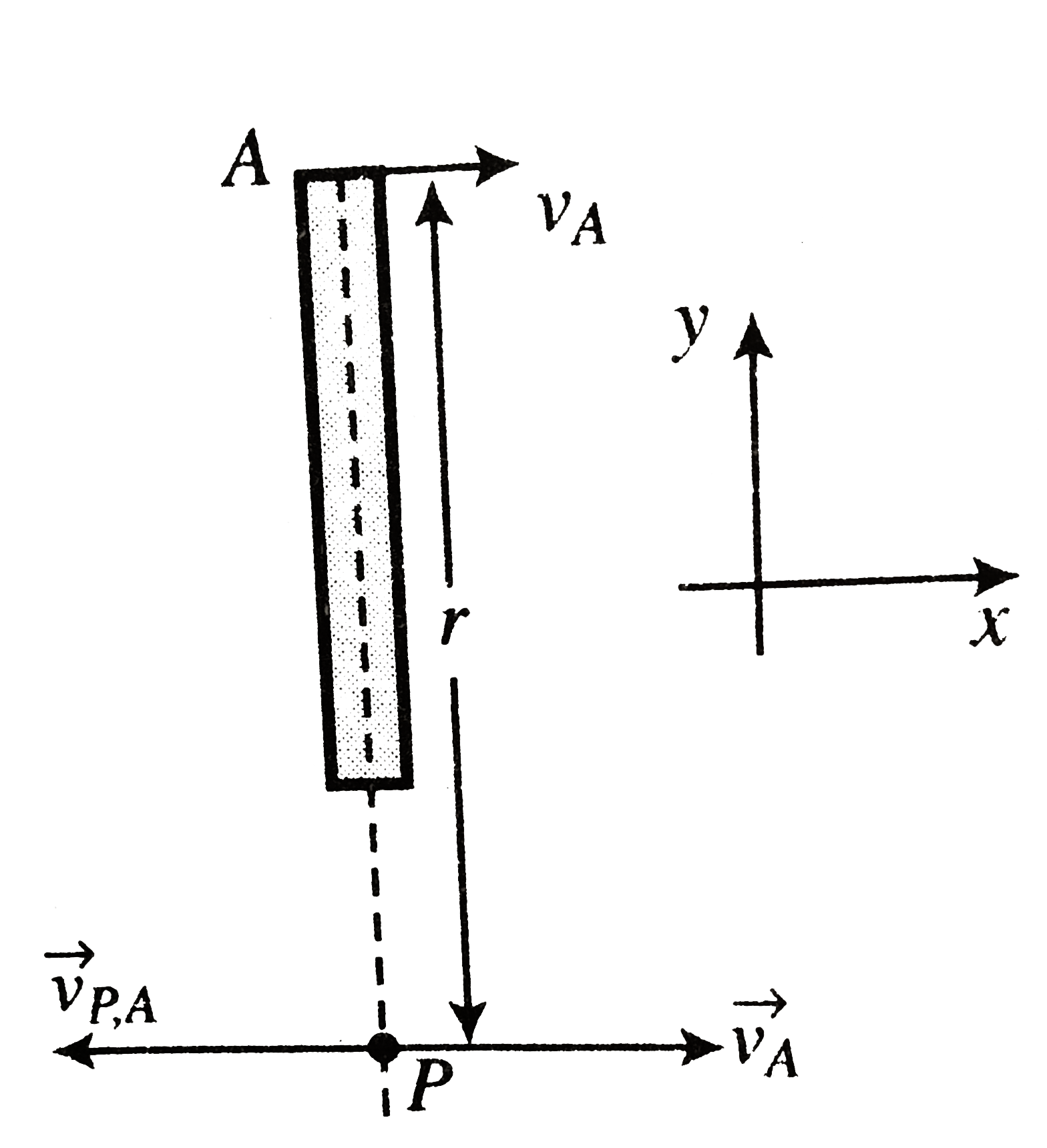 Here `vec_(A)=vhati` and `vecv_(P,A)=-omegahati` Hence `-omegarhati+vhati=0` `implies v=omegar` or `r=v/omega=v/((v/2l))=2l` Hence `ICR` will be LOCATED at a DISTANCE `2l` from `A`. Method 2 The instantaneous centre of rotation will be lie on the perpendicular line at point `A` with `vecv_(A)`. The `ICR` will lie at distance `AP+(|vecv_(A)|)/omega=v/(v/2l)=2l` or at a distance `2l` from point `A`. |
|
| 5. |
A carpet of mass .m. made of inextensible material is rolled along its length in the form of a cylinder of radius .R.and is kept on a rough floor. The carpet starts unrolling without sliding on the floor when a very small push is given to it. Calculate the horizontal velocity of the axis of cylindrical part of the carpet when its radius reduces to R/2. |
|
Answer» Solution :Lose in PE due to unrolling when radius CHANGES from R to `(R)/(2)` is `=MgR-((MgR)/(8))=(7)/(8)(MgR)` The lose in PE is equal to the gain in KE which is `K=K_(T)+K_(R)=(1)/(2)MV^(2)+(1)/(2)Iomega^(2)` If .V. is the velocity when half the CARPET has unrolled then as `V=(ROMEGA)/(2),Mto(M)/(4)ANDI=(1)/(2)((M)/(4))((R)/(2))^(2)` `:.(7)/(8)MgR=(3)/(16)MV^(2)` on SOLVING `V=((14gR)/(3))^(1/2)` |
|
| 6. |
In reference with natural convection, give Langmuir-Lorentz law of cooling. |
| Answer» SOLUTION :For ANSWER SEE Section-A 11.10 INFORMATION | |
| 7. |
The escape velocity of a body on the earth's surface is v_(e). A body is thrown vertically up with a speed of (kV_(e)) (k lt 1), Assuming that the sun and planets do not influence the motion of the body, the the velocity of the body at the infinite distance in |
|
Answer» `v_(e)//sqrt(K^(2)-1)` |
|
| 8. |
The escape velocity of a body on the earth's surface is V_(E). A body is thrown vertically up with a speed of (kV_(e)) (k lt 1). The maximum height reached by the body above the earth is |
|
Answer» `R((K^(2))/(1-k^(2)))` |
|
| 9. |
The apparent depth of water in cylindrical water tank of diameter 2Rcm is reducing at the rate of xcm//mi n ute when water is being drained out at a constant rate. The amount of water drained in c.c per minute is (n_1= refractive index of air n_2= refractive index of water). |
|
Answer» `(xpiR^2n_1)/n_2` |
|
| 10. |
Though the statement quoted above may be disputed, most physicists do have a feeling that the great laws of physics are at once simple and beautiful. Some of the notable physicists, besides Dirac, who have articulated this feeling, are : Einstein, Bohr, Heisenberg, Chandrasekhar and Feynman. You are urged to make special efforts to get access to the general books and writings by these and other great masters of physics. (See the Bibliography at the end of this book.) Their writings are truly inspiring ! |
| Answer» Solution :General BOOKS on Physics make an interesting reading. Students should consult a good Library to go through some of these IMMORTAL works. Surely yout are JOKING. Mr. Feynman by Feynman is one of the books that WOULD assume the students. Some other interesting books are: Physics for the lnquiring Mind by EM Rogers, Physics, Foundations and Frontiers by G. Gamow, Thirty YEARS That Shook Physics by G. Gamow, Physics can Be Fun by Perelman. | |
| 11. |
A river 1 km wides is flowing at 3 km *h^(-1) . A swimmerwhosevelocity in stillwater is 4 km *h^(-1) canswim only for 15 minutes. In what direction should he swim in order to reach the opposite bank in those 15 minutes? What total distance will he swim ? |
|
Answer» |
|
| 12. |
Mean free path of a gas molecule is :(a)Inversely proportional to number of molecules per unit volume(b)Inversely proportionai to diameter of the molecule(c)Directly proportional to the square root of the absoIute temperature(d)Directly proportional to the molecular mass |
|
Answer» Inversely PROPORTIONAL to number of MOLECULES PER UNIT volume |
|
| 13. |
A swimmer's speed in the direction of flow of rivers is 16 km h^-1. The swimmer's speed in still water and the velocity of flow of the river respectively are. |
|
Answer» 4 KM `h^-1`, 12 km `h^-1` |
|
| 14. |
A ball is thrown upward with an initial velocity of 100 ms^(-1). After how much time will it return ? Draw velocity -time graph for the ball and find the maximum height attained by the ball.[Assume, g = - 10 ms ^ { - 2 }] |
|
Answer» Solution :Given : ` u = 100 ms^(-1) , g = - 10 ms^(-2)` At highest point , v = 0 As v = u + g t `:. 0 = 100 - 10 xx t` `:.`Time TAKEN to reach highest point, `t = (100)/(10) = 10 s` The ball will return to the ground at t = 20 s Velocities of the ball at different instants at time will be as follows : At `t = 0, v = 100 - 10 xx 0 = 100 ms^(-1)` At ` t = 5 s, v = 100 - 10 xx 5 = 50 ms^(-1)` At ` t = 10 s, v = 100 - 10 xx 10 = 0` At ` t = 15 s, v = 100 - 10 xx 15 = - 50 ms ^(-1)` At `t = 20 s, v = 100 - 10 xx 20 = - 100ms^(-1)` The VELOCITY - time graph will be as shown in the figure . Height attained after 15 s = AREA of `Delta AOB` + Areaof`Delta BCD` `= 500 +(1)/(2) (15 - 10) xx (-50)` = 500 - 125 = 375 m 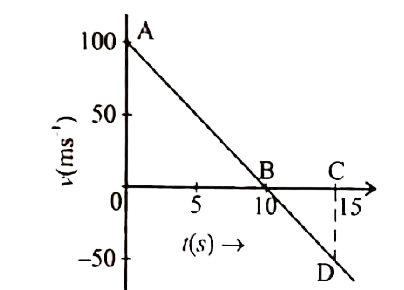
|
|
| 15. |
Two identical spheres are rolling down the slope. One is solid and other is hollow, the ratio of moment of inertia of solid sphere (axis of rotation is diameter) to that of the hollow is ……………. |
|
Answer» `(3)/(5)` |
|
| 16. |
A particle of mass m moving with a velocity (3hat(i) + 2hat(j))m//s collides with sationary body of mass M and finally moves with velocity (-2hat(i) + hat(j))m//s. Then : |
|
Answer» IMPULSE received by `m = m(5hat(i) - 5hat(J))` |
|
| 17. |
A particle has displacementx given by x = 3 cos(5pi t + pi), where x is in metres and in seconds. What are the frequency f and period T of the motion? |
| Answer» SOLUTION :2.5 HZ, 0.4 s | |
| 18. |
A rocket consumes 20 kg fuel per second. The exhaust gases escape at a speed of 1000 ms^(-1) relative to the rocket. Calculate the upthrust received by the rocket. Also calculate the velocity acquired by the rocket, when its mass reduces to (1/100)th of its initial mass. |
|
Answer» |
|
| 19. |
A Brass stopper snuggly fits in the hole of steel plate. To remove the stopper easily, the system |
|
Answer» should be HEATED |
|
| 20. |
Two particles of same mass fall down on to the surface of the earth one from infinity and the other from an attitude 3R. The ratio of velocities on reaching the earth is |
|
Answer» `23` |
|
| 21. |
A solid sphere of radius R is rolled by a force F acting at the topo of the sphere asshown in the figure. There is no slipping and initially sphere is in the rest position, then (CM= centre of mass) |
|
Answer» Work DONE by force F when the CENTRE of mass move a distance S is 2 FS |
|
| 22. |
(A): Absolute zero degree temperature is not zero energy temperatrue. (R) : At absolute zero temperature, the translatinal motion of gas is stopped but other forms of molecular energy may not be zero. |
|
Answer» Both (A) and ( R) are true and (R ) is the CORRECT explanation of (A) |
|
| 23. |
A disc of massm and radius R is placed over placed over of mass m. There is sufficient friction between disc & plank to prevent slipping. A force F is applied at centre of disc then |
|
Answer» Acceleration of plank is `(F)/(2m)` |
|
| 24. |
n orifice of area 10 sq.mm is made at the bottom of a vessel containing water to a height of 10m above the orifice. What is the force on the vessel in N(g=10 ms^(-2))? |
|
Answer» 1 |
|
| 25. |
A closed vessel 10 litres in volume contains a diatomic gas under a pressure of 10^5 N//m^2. What amount of heat should be imparted to the air to increase the pressure in the vessel five times. |
| Answer» SOLUTION :`10^4 J` | |
| 26. |
Obtain the expressions of kinetic energy potential energy and total energy in simple harmonic motion. |
|
Answer» Solution :Kinetic energy : DISPLACEMENT of SHM particle at any instant `x= A COS (omega t +phi)` where A = amplitude, `omega`= angular frequency velocity `v= (d(x))/(dt)= (d)/(dt)[ A cos (omega t+ phi)]` `therefore v= -A omega sin (omega t+phi)` Now kinetic energy, `K= (1)/(2) mv^(2)` `=(1)/(2) mA^(2) omega^(2) sin^(2) (omega t+phi)` `therefore K= (1)/(2) kA^(2) sin^(2) (omega t+phi)"""......"(1) [therefore m omega^(2) = k]` Hence, it is a periodic function of time, being zero when the displacement is maximuml and maximuml when the particle is at the mean position. The period of kinetic energy is `(T)/(2)` Potential energy : Potential energy is possible only for conservative forces and restoring force is the conservative force in SHM. If the restoring force exerted on a particle of SHM from its mean position is x then `F= -KX` The work opposite to restoring force for small displacement dx of a particle is `dW= -F dx` `therefore dW = -kx dx` Now work done for displacement of particle from `x=0` to x=x, `W= int dW` `= int_(0)^(x) -kx dx` `= -k[(x^2)/(2)]_(0)^(x)` `= -(kx^2)/(2)` `= -(1)/(2) kx^(2)` The work done opposite to restoring force is stored as potential energy in particle. Potential energy in displacement x of particle is `U = -W` `=(1)/(2) kx^(2)` `= (1)/(2)m omega^(2) x^(2)` `=(1)/(2) m omega^(2) A^(2) cos^(2) (omega t+ phi)` `therefore U= (1)/(2) kA^(2) cos^(2) (omega t +phi)` Hence, the potential energy of a particle executing simple harmonic motion is also periodic. At mean position potential energy is zero and at extreme points it is maximum. Hence, the period of potential energy is `(T)/(2)`. Total energy : The sum of kinetic and potential energy of SHM is knownf as total energy E. `therefore E= K+U` `therefore E= (1)/(2) kA^(2) sin^(2)( omega t+phi) +(1)/(2) kA^(2) cos^(2) (omega t+phi)` `therefore E= (1)/(2) kA^(2) [sin^(2) (omega t+phi)+ cos^(2) (omega t+phi)]` `=(1)/(2) kA^(2) [therefore sin^(2) (omega t+phi)+ cos^(2) (omega t+phi)=1]` or `E= (1)/(2) m omega^(2) A^(2)` Hence, `E propto m, E propto omega^(2)" and "E propto A^(2)` Thus, mechanical energy is proportional to mass and square of angular frequency and varies directly to the square of amplitude but mechnical energy does not depend on the displacement and time. |
|
| 27. |
A small spherical body of radius r made of material of density rho is dropped into a long column of viscous liquid of density sigmad and coefficient of viscosity eta.The graph of the terminal velocity (v) vs radius (r ) of the body will be |
|
Answer» STRAIGHT line As `v PROP r^2` the GRAPH `v-r` is parabola. |
|
| 28. |
(A) : Water is more elastic than air(R) : Air is more compressible than water |
|
Answer» Both (A) and (R) are TRUE and (R) is the CORRECT EXPLANATION of (A) |
|
| 29. |
How many grams of a liquid A of specific heat capacity 1.2 "J/g" ^(@)C and at a temperature 60^(@)C must be mixed with 80g of a liquid B of specific heat capacity 2.1 "J/g"^(@)C and at 10^(@)C, so that the final temperature of the mixture becomes 40^(@)C ? |
|
Answer» |
|
| 30. |
Two bodies of masses 4kg and 2kg are moving towards each other with 3ms and 2ms! respectively. Then velocity of centre of mass |
|
Answer» `0.5 ms^(-1)` TOWARDS 4KG |
|
| 31. |
A river is flowing from west to east at a speed of 5m/s. A man on the south bank of the river capable of swimming at 10m/s in a still water wants to swim, across the river in a shortest time. He should swim in a direction |
|
Answer» DUE north |
|
| 32. |
a. Find the height from the earth's surface where g will be 25% of its value on the surface of earth (R=6400km). b. Find the percentage increase in the value of g at a depth h from the surface of earth. |
|
Answer» Solution :a. At a height `h` above the earth's surface we have `G'=g(R/(R+h))^(2)impliesg/4=g(R/(R+h))^(2)impliesR/(R+H)=1/2` `implies h=R=6400km` b. At a depth `h` below earth's surface, we have `g'=g(1-h/R)implies(g')/g=1-4/6400` `(g-g')/g=4/6400implies(/_\g)/g=1/16` `:. %` AGE `=(/_\g)/gxx100=1/6%` INCREASE |
|
| 33. |
Three moles of an ideal monoatomic gas undergoes a cyclic process as shown in the figure. The temperature of the gas in different states marked as 1,2,3 and 4 are 400K, by the gas during the process 1-2-3-4-1 is (universal gas constant is R) |
|
Answer» <P> Solution :PROCESS `1rarr2` and `3rarr4` are polytrophic andprocess `2rarr3` and `4rarr1` are isobaric. From the graph `PproprArr(P)/(V)=KrArrPV^(-1)=KrArrx=-1` Work done `W=W_(1rarr2)+W_(2rarr3)+W_(3rarr4)+W_(4rarr1)` `=(nR)/(x-1)(T_(1)-T_(2))+P_(2)(V_(3)-V_(2))+(nR)/(x-1)[T_(3)-T_(4)]+P_(1)[V_(1)-V_(4)]` `(nR)/(x-1)[T_(1)-T_(2)]+nR(T_(3)-T_(2))+(nR)/(x-1)[T_(3)-T_(4)]+nR[T_(1)-T_(4)]` `=(nR)/(x-1)[T_(1)-T_(2)+T_(3)-T_(4)]+nR(T_(3)-T_(3)+T_(1)-T_(4))``=(nR)/(x-1)[T_(1)-T_(2)+T_(3)-T_(4)]+nR(T_(3)-T_(3)+T_(1)-T_(4))` `=(3R)/(-1-1)[400-700+2500-100]` `+3R(2500-700+400-1100)` `=(3R)/(-1-1)[1100]+3R(1100)` `=3R(1100)(1-(1)/(2))=1650R` |
|
| 34. |
Derive the expression for total acceleration in the non-uniform circular motion. |
Answer» Solution :If the SPEED of the object in circular motion is not constant, then we have non-uniform circular motion. For example, when the bob attached to a STRING MOVES in vertical circle, the speed of the bob is not the same at all time. Whenever the speed is not same in circular motion, the PARTICLE will have both centripetal and tangential accelerastion a shown in the figure.  The resultant acceleration is obtained by VECTOR sum of centripetal and tangential acceleration. Since centripetal acceleration `(v^(2))/(r)`. is the magnitude of this resultant acceleration is given by `a_(R)=sqrt(a_(t)^(2)+((v^(2))/(r))^(2))` This resultant acceleration makes an angle `theta` with the radius vector as shown in figure. This angle is given by `tantheta=(a_(t))/((v^(2)//r))` |
|
| 35. |
A star behaves like a perfect Black body emitting radiant energy. The ratio of radiant energy emitted radiant energy. The ratio of radiant energy emitted having 8 times the radius of the former but having Kelvin temperature one fourth of the former is |
|
Answer» `1:4` |
|
| 36. |
Four particles of masses 1 kg, 2 kg, 3 kg and 4 kg are placed at the four vertices A, B, C and D of the square of side 1 m. Find the position of centre of mass of the particles. |
Answer» SOLUTION :ASSUMING A as the origin, AB as X-axis and AD as y-axis we have Co-ordinates of their CM are `X_(CM)=(m_(1)x_(1)+m_(2)x_(2)+m_(3)x_(3)+m_(4)x_(4))/(m_(1)+m_(2)+m_(3)+m_(4))` `= ((1)(0)+2(1)+3(1)+4(0))/(1+2+3+4)=0.5 m` Similarly, `y_(CM)=` `(m_(1)y_(1)+m_(2)y_(2)+m_(3)y_(3)+m_(4)y_(4))/(m_(1)+m_(2)+m_(3)+m_(4))=(1(0)+2(0)+3(1)+4(1))/(1+2+3+4)=0.7 m` `therefore` Co-ordinates of centre of mass `(X_(CM), y_(CM))=(0.5 m, 0.7 m)` |
|
| 37. |
The plane surface of two sheets of different metals are kept in contact with each other. The thickness of sheets 2.5 cm and 3 cm respectively and the ratio of their thermal conductivities in the same order is 5:6. If the outer surfaces of the sheets are at constant temperatures of 100^(@)C and 10^(@)C respectively, calculate the temperature of interface. |
|
Answer» |
|
| 38. |
Two persons of masses 55 kg and 65 kg respectively , are at the opposite ends of a boat . The length of the boat is 3.0 m and weight 100 kg . The 55 kg man walks up to the 65 kg man and sits with him . If the boat is in still water the centre of mass of the system shifts by |
|
Answer» 3.0 m |
|
| 39. |
A body is allowed to fall from a height of 100 m. If the time taken for the first 50 m is t_(1) andfor the remaining 50 m is t_(2) The ratio of times to reach the ground and to reach first half of the distance is |
|
Answer» `SQRT(3):1` |
|
| 40. |
A body is allowed to fall from a height of 100 m. If the time taken for the first 50 m is t_(1) andfor the remaining 50 m is t_(2) which is correct ? |
|
Answer» `t_(1)=t_(2)` |
|
| 41. |
A body is allowed to fall from a height of 100 m. If the time taken for the first 50 m is t_(1) andfor the remaining 50 m is t_(2) The ratio of t_(1) and t_(2) is nearly |
|
Answer» `5:2` |
|
| 42. |
What points to be considered during addition. |
|
Answer» Solution : In addition and subtraction of significant numbers following points should be FOLLOWED. If significant figures are whole numbers then they should be added or subtracted by normal rules of addition and subtraction. For example A = 25 g, B = 2g then A + B = 25 + 2 = 27 g A - B = 25 - 2 = 23g In addition or subtraction, the FINAL result should retain as many DECIMAL places as there in number with the least decimal places. For example, 436.32 g, 227.2 g and 0.301 g is to be added `:.43632g ` `+227.2 g` `(+0.301)/(663.821)=(g)/(g)` In number 227.2 there is only ONE DIGIT after decimal point hence result also should have one digit after decimal point. Hence, 663,821 should be rounded off to 663.8 For example difference of 0.307 m and 0.304 m is to be obtained, `:. 0.307m` `(-0.304m)/(0.003m)` This should be written as `3.00 xx 10^(-3) m`. It can not be written as `3.00 xx 10^(-3)` .In addition or subtraction rule of decimal point should be followed. |
|
| 43. |
Can kinetic energy of a body by negative ? Potential energy be negative ? |
| Answer» SOLUTION :KINETIC energy of a body cannot be NEGATIVE because if velocity in `1/2 MV^(2)` is negative and in potential energy of a body positive or negative . | |
| 44. |
Match Column-I with Column-II : {:("Column-I","Column-II"),("(1) Angular momentum","(a) Scalar"),("(2) Potential energy","(b) Vector"),(,"(c) Unit vector"):} |
|
Answer» |
|
| 45. |
Among the following which are the examples of SHM?Vertical oscillation of a loaded spring |
| Answer» SOLUTION :VERTICAL OSCILLATION of a LOADED SPRING | |
| 46. |
At which temperature does all molecular motion cease ? |
| Answer» Solution :All molecular MOTION CEASE at zero KELVIN. | |
| 47. |
A machine gun is mounted on a flat rail car. The gun is firing bullets at the rate of 10 bullets per second each of mass 10 g. The bullets come out with velocity 500 ms^(-1)from the rear. Calculate the acceleration of the car at the instant when its mas is 200 kg. Also calculate the force at that instant. |
|
Answer» `0.25 m//sec^2 , 100N` |
|
| 48. |
What is the number of significant figures in 0.230 xx 10^(5) |
|
Answer» 2 |
|
| 49. |
A scooter can produce a maximum acceleration of 5ms^(-2).Its brakes can produce a maximum retardation of 10ms^(-2).The minimum time in which it can cover a distance of 1.5 km is? |
Answer» Solution : If v is the maximum VELOCITY attained, then during acceleration ie between A,B `v^(2)-o^(2)=2 xx 5 xx S_(1) rArr S_(1)=v^(2)/(10)`, Also, during retardation `o^(2)-v^(2)=2 xx 10 xx S_(2) rArr S_(2)=(v^(2))/(20)` `S=S_(1)+S_(2) rArr 1500 =(v^(2))/(10)+v^(2)/(20)=(3v^(2))/(20) or v^(2)=(1500 xx 20)/(3)=10000 or v=100ms^(-1)` `v=alphat_(1) rArr t_(1)=(100)/(5)=20 sec` `v=beta t_(2) rArr t_(2)=(100)/(10)=10 sec` `v=beta t_(2) rArr t_(2)=(100)/(10)=10sec` Total time =20+10=30sec. |
|
| 50. |
An iron ball and an aluminium ball of equal diameters are released from the upper surface of water of a deep lake. The bottom of the lake is reached by |
|
Answer» the ALUMINIUM ball earlier |
|