

Saved Bookmarks
This section includes 7 InterviewSolutions, each offering curated multiple-choice questions to sharpen your Current Affairs knowledge and support exam preparation. Choose a topic below to get started.
| 1. |
A homogeneous chain lies in limiting equilibrium on a horizontal table of coefficient of friction 0.5 with part of it hanging over the edge of the table. The fractional length of the chain hanging down the edge of the table is |
|
Answer» `1//2` |
|
| 2. |
Which has more Young's modulus, a thin steel wire or thick steel wire |
|
Answer» thin |
|
| 3. |
A solid copper sphere (density rho and specific heat c) of radius r at an initial temperature 200 K is suspended inside a chamber whose wall are at almost 0K. The time required for the temperature of the sphere to drop to 100 K is |
|
Answer» `9.32rho RC` |
|
| 4. |
As shown in the figuretwo cylindrical vessels A and B are interconnected . Vessel A contains water up to 2m height and vessel B contains kerosene . Liquids are separated by movable, airtight disc C . If height of kerosene is to be maintained at 2m , calculate the mass to be placed on the piston kept in vessel B. Also calulate the force acting on disc C due to this mass. Area of piston =100cm^(2), area of discC=10cm^(2) , Density of water =10^(3)kgm^(-3), specific density of kerosene =0.8. |
|
Answer» Solution :Area of piston`A_(1)=100cm^(2)=10^(-2)m^(2)` Area of disc `A_(2)=10cm^(2)=10^(3)m^(2)` Density of water `rho_(w)=10^(3)KGM^(-3)` `therefore` Specific density of kerosene `=("Density of kerosene")/("Density of water")` `=0.8` `therefore` Density of kerosene `rho_(k)` `=0.8xx` density of water `=0.8xx10^(3)` `=800kgm^(-3)` If heightof kerosene is maintained at 2m , Pressure of water column `=(MG)/(A_(1))+` Pressure of kerosene column. `thereforeh rho_(w)g=hrho_(k)g+(mg)/(A_(1))` `therefore2xx10^(3)=2xx800+(m)/(10^(-2))` `therefore2000-1600=(m)/(10^(-2))` `thereforem=400xx10^(-2)` `thereforem=4KG` Now pressure due to mass m is TRANSMITTED undiminished to disc C . So, pressure due to 4kg mass `=("FORCE on disc C")/("Area of disc C")` `therefore(mg)/(A_(1))=(F_(C))/(A_(2))` `thereforeF_(C)=mg((A_(2))/(A_(1)))=4xx9.8xx((10^(-3))/(10^(-2)))` `F_(C)=3.92N` |
|
| 5. |
According to Newton's third law, |
|
Answer» `F_12 = F_21 ` |
|
| 6. |
A cylindrical tube of cross-sectional area A has two air tight frictionless pistons at its two ends. The pistons are tied with a straight two ends. The pistons are tied with a straight piece of metallic wire. The tube contains a gas at atmospheric pressure P_0 and temperature T_0. If temperature of the gas is doubled then the tension in the wire is |
|
Answer» <P>`4 P_(0) A` |
|
| 7. |
A cylinder of length 20 m is filled completely with water. Velocity of efflux of water through an orific on the wall of the cylinder near its base is [g=10m. s^-2] |
|
Answer» `10m.s^-1` |
|
| 8. |
An ideal gas expands isothermally from a volume V_(1) " to " V_(2) and then compressef to original volume V_(1) adiabatically. Initial pressure is P_(1) and final pressure is P_(3) . The total work done is W. Then what is its value and its conditions. |
Answer» SOLUTION :Slope of adiabatic process at a given state (P,V,T) is more than the slope of isothermal process. The corresponding `P-V` GRAPH for the two processes is as shown in figure.  In the graph, A,B is isothermal and BC is adiabatic. `W_(AB)`= POSITIVE (as volume is increasing) plus, `abs(W_(BC)) gt abs(W_(AB))`, as area under P-V graph gives the WORK done. Hence, `W_(AB)+W_(BC) = W lt 0` From the graph itself, it is CLEAR that `P_(3) gt P_(1)` |
|
| 9. |
A lighter body collides with much more massive body at rest. Prove that the direction of lighter body is reversed and massive body remains at rest. |
|
Answer» Solution :Since the first BODY is very much lighter than the second body `(m_(1)ltltm_(2),(m_(1))/(m_(2))ltlt1)`, the ratio `(m_(1))/(m_(2))~~0` and also if the TARGET is at REST `(u_(2)=0)` Dividing numerator and denominator of EQUATION `v_(1)=((m_(1)-m_(2))/(m_(1)+m_(2)))u_(1)+((2m_(2))/(m_(1)+m_(2)))u_(2)` by `m_(2)`, we get `v_(1)=(((m_(1))/(m_(2))-1)/((m_(1))/(m_(2))+1))u_(1)+((2)/((m_(1))/(m_(2))+1))(0)` `v_(1)=((0-1)/(0+1))u_(1)""[(m_(1))/(m_(2))=0]` `v_(1)=-u_(1)'` Similarly, dividing numerator and denominator of equation `v_(2)=((2m_(1))/(m_(1)+m_(2)))u_(1)+((m_(2)-m_(1))/(m_(1)+m_(2)))u_(2)`, by `m^(2)`, we get `v_(2)=((2(m_(1))/(m_(2)))/((m_(1))/(m_(2))+1))u_(1)+((1-(m_(1))/(m_(2)))/((m_(1))/(m_(2))+1))(0)` `v_(2)=(0)u_(1)+((1-(m_(1))/(m_(2)))/((m_(1))/(m_(2))+1))(0)` `v_(2)=0` |
|
| 10. |
Which of the following statements is false regarding the vectors? |
|
Answer» The magnitude of a vector is ALWAYS a scalar |
|
| 11. |
A horizontal force F is applied through the center of mass of a solid sphere of mass m and radius R which lies on a horizontal rough surface. If the sphere rolls without slipping, the acceleration of the centre of mass of the sphere will be (g = 10 m//s^(2)) |
|
Answer» `(3)/(5)` F/M |
|
| 12. |
Expressthe changein internalenergyin termsof molarspecificheatcapacity . |
| Answer» Solution :When the GAS is heated at constant volume the temperature increases by `DELTAT`. As no work is DONE by the gas, the heat that flows into the SYSTEM will increase only the INTERNAL energy. Let the change in internal energy be `dU.dU=mu omegadT` | |
| 13. |
A satellite of mass 400 kg is in a circular orbit of radius 2R about the earth, where R is radius of the earth. How much energy is required to transfer it to a circular orbit of radius 4R? Find the changes in the kinetic and potential energies? (R = 6.37 xx 10^6m) |
|
Answer» Solution :Initial energy is `-(GMm)/(4R) = E_1` , Final energy is `-(GMm)/(8R) = E_` The change in the total energy is ` Delta E = E_2 - E_1= (GMm)/(8R) ` `Delta E= ((GM)/(R^2)) (mR)/(8) , Delta E = (GMR)/(8) = (9.8 XX 400 xx 6.37 xx 10^6)/(8) = 3.13 xx 10^9 J` Change in K.E ` = K_2 - K_1 = -3.13 xx 10^9 J` Change in P.E ` = U_2 - U_1 = -6.25 xx 10^9 J` |
|
| 14. |
A simple pendulum is of length 50 cm. Find its time period and frequency of oscillation. (g=9.8m//s^(2)) |
|
Answer» 2.419 SEC, 0.8045Hz |
|
| 15. |
(A) : Moment of inertia of a particle changes with axis of rotation.(R ) : Moment of inertia depends on mass and distance of the particle from the axis of rotation. |
|
Answer» Both (A) and (R ) are true and (R ) is the correct EXPLANATION of (A) |
|
| 16. |
Calculate the impulse necessary to stop a 1500 kg car moving at a speed of 25 ms^(-1) |
|
Answer» Solution :USE formula 1 = CHANGE in MOMENTUM = m(v – u) (IMPULSE –37500 NS) |
|
| 17. |
A ship A is moving Westwards with a speed of 10 km/h and a ship B 100 km South of A is moving northwards with a speed of 10 km/h . The time after which the distance between them becomes shortest is |
|
Answer» 0h If we SUPPOSE the x-axis along eastward direction and the y-axis along northward direction , then the positionof ship A after time t, `vecr_A=(-10hati)t` The position of ship B after timet, `vec_B=-100hatj+(10hatj)t` Therefore, position of B with respect to A, `vec_B-vec_A =(10t)hati+(10 t-100)hatj` so, `|vec_B-vec_A| =sqrt((10t)^2+(10t-100)^2)` `=sqrt(100t^2+100t^2-2000t+10000)` `=10 sqrt(2) sqrt(t^2-10t+50)` This DISTANCE becomes the shortest when `(t^2-10t+50)` becomesminimum, i,e., `d/(dt) (t^2-10t+50) =0 or, 2t -10 =0` `therefore t=5 hours` |
|
| 18. |
A weight is suspended from a spring balance and the time period for its vertical oscillatory motion is T. The spring is divided into two equal parts and from any one of them the same weight is suspended. Determine the time period of vertical oscillatory motion of that spring. |
|
Answer» Solution :If the INCREASE in length of the spring is l due to the suspension of the weight, then spring constant, `k=(mg)/l`, i.e., if the weight remains constant, then `kprop1/l`. Now, if the spring is halved and the same weight is suspended, then increase in length is ALSO halved. So the spring constant (k) is doubled. Now, time period, `T=2pisqrt(m/k)or,Tprop1/sqrtk` So, as k is doubled, time period becomes `1/sqrt2` TIMES the original time period, i.e,. the required time period = `T/sqrt2`. |
|
| 19. |
If a simple pendulum makes 10 oscillations in one minute find its frequency and angular frequency. |
|
Answer» Solution :Frequency `=(10)/(1 "MIN") = (10)/(60S) = 0.17 Hz` , Angular frequency `= OMEGA =(2pi)/(T) = (2pi)/(60) = 0.1` rad/sec |
|
| 20. |
A ship A is moving Westwards with a speed of 10 km h^(-1)and a ship B 100 km South of A, is moving Northwards with a speed of 10 km h^(-1). The time after which the distance between them becomes shortest, is : |
|
Answer» 0 hr 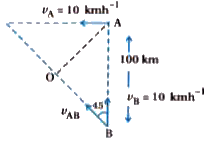 `|vecV _(AB)| = sqrt ( 10 ^(2) + 10 ^(2)) = 10 sqrt2 kmph` distance `OB = 100 COS 45 ^(@) = 50 sqrt2km` Time TAKEN to reach the shortest distance between `A&B = (50 sqrt2)/( |vecV _(BA)|) = (50 sqrt2)/(10 sqrt2)` `t _(SN) = 5 HRS.` |
|
| 21. |
Vectors vec(a) and vec(b) incline an angle theta between then. If (vec(a) + vec(b)) and vec(a) - vec(b) respectively subtend angles alpha and beta with vec(a) then the value of (tan alpha + tan beta) (n ab sin theta)/(a^(n) - b^(n) cos^(2) theta). Find n |
|
Answer» |
|
| 22. |
Consider the flaw of a liquid through p pipe of varying cross section. Write the equation of continuity of flow. |
| Answer» SOLUTION :`A_1v_1=A_2v_2` | |
| 23. |
Which is the most accurate clock? |
| Answer» SOLUTION :CAESIUM CLOCK. For such a clock the uncertainty is LESS than one SECOND in 30,000 years. | |
| 24. |
Gravitational force between masses m_1 and m_2is F. If a third mass m_3is placed near m_2 and m_3 then the force between m_1 and m_2would be |
|
Answer» GREATERTHAN F |
|
| 26. |
A pebble of mass 0.05 kg is thrown vertically upwards. Give the direction and magnitude of the net force on the pebble. [Ignore air resistance](a) during its upward motion(b) during its downward motion(c ) at the highest point where it is momentarily at rest.Do your answer change if the pebble was thrown at an angle of 45^(@) with the horizontal direction ? |
|
Answer» Solution :When a body is THROWN vertically upwards (or) it moves vertically DOWNWARDS, gravitational pull of earth gives it a uniform acceleration `a=+g=+9.8 ms^(-2)` in the downward direction. Therefore, the net force on the pebble in all the three caes is vertically downwards. As m = 0.05 KG and `a=+9.8 m//s^(2)` `therefore` In all the three case, `F=ma=0.05^(@)9.8 =0.49 N`. Verticallydownwards. If the pebble were thrown at an angle of `45^(@)` with the horizontal direction, it will have horizontal and vertical components of velocity. These components do not affect the force on the pebble. HENCE our answers do not alter in any case. However in each case (C ), the pebble will not be at rest. It will have horizontal component of velocity at highest POINT. |
|
| 27. |
Convert the unit of work done from MKS system to CGS system |
|
Answer» Solution :Dimensional formula of energy is `M^(1)L^(2)T^(-2)` LET IJ= N ergs `rArr n= J`/ergs `therefore n_(2)= n_(1) [(M_(1))/(M_(2))]^(1) [(L_(1))/(L_(2))]^(2) [(T_(1))/(T_(2))]^(-2)` `rArr n =[(1kg)/(1g)] [(1m)/(1cm)]^(2) [(1S)/(1s)]^(-2) ((n_(2))/(n_(1))=n)` `rArr n= [(1000g)/(1g)] [(100cm)/(1cm)]^(2) [(1s)/(1s)]^(-2)` `rArr n= [1000] XX [100]^(2) xx[1]^(2)= 10^(7)` `therefore` 1 joule `=10^(7)` ergs |
|
| 28. |
Graphs give the temperature along an x-axis that extends directly through a wall consisting of three layers with different, nonzero and finite coefficient of thermal conductivities. The air temperature on both sides of the wall are different and uniform. Out of the situations as shown by the graph, which is/are impossible? |
|
Answer»
|
|
| 29. |
A particle is executing S.H.M with a frequency ‘f’. The frequency with which its K.E oscillates is |
| Answer» ANSWER :C | |
| 30. |
A body describes simple harmonic motion with an amplitude of 5 cm and a period of 0.2 s. Find the acceleration and velocity of the body when the displacement is (a) 5cm, (b) 3cm , (c) 0 cm. Here, A= 5cm =0.05 cm, T=0.2 s, omega = (2pi)/(T) = (2pi)/(0.2) = 10 pirad/s When displacement is y, then acceleration , a=-omega^2 y , Velocity , V=omega sqrt(A^2 - y^2) |
|
Answer» Solution :Case (a) When y= 5CM = 0.05 m, `A=-(10 pi)^2 xx0.05 =-5pi^2 m//s^2 and V= 10pi SQRT((0.05)^2- (0.05)^2) =0` Case (b) When y= 3 cm = 0.03 m, A `=-(10pi)^2 xx 0.03 =-3pi^2 m//s^2` `V= 10 A sqrt((0.05)^2 - (0.03)^2) = 10 pi xx 0.04 =0.4 pi m//s^(-1)` Case (C) = When `y=0 , A =-(10 pi)^2 xx 0 =0 , V =10pi sqrt((0.05)^2 - (0)^2)) =10pi xx 0.05 =0.5 pi m//s^(-1)`. |
|
| 31. |
Four lenses A, B, C and D of power +100D, -50D, 20D and 5D. Which lenses will you use to design a compound microscope for best magnification ? |
|
Answer» A and C |
|
| 32. |
Define angular momentum. |
|
Answer» Solution :The angular moemntum of a POINT mass is defined as the MOMENT of its linear momentum. Otherwise, the angular momentum Lof a point mass having a linear momentum p at a position R with respect to a point or AXIS is mathematically written as `veccL=vecrxxvecp` |
|
| 33. |
Six identicles particles each of mass 0.5 kg are arranged at the corners of a regular hexagon of side length 0.5 m. If one of the particle is removed, the shift in the centre of mass is |
| Answer» Answer :B | |
| 34. |
Determine the length of the wire which when suspended vertically breaks under its own weight. Bearing stress =s. density =d. |
|
Answer» Solution :Breaking stress `=(F)/(A), Delta=(MG)/(A)=(d,VG)/(A)=(d.L,Ag)/(A) rArr L=(s)/(dg)` Length `=("Breaking stress")/("DENSITY" XX "Acceleration DUE to gravity")` |
|
| 35. |
A ball is thrown vertically upwards from the top of a tower. Velocity at a point .h m vertically below the point of projection is twice the downward velocity at a point .h.m vertically above the point of projection. The maximum height reached by the ball above the top of the tower is |
| Answer» ANSWER :B | |
| 36. |
A ray of light incident on the horizontal surface of a glass slab at an angle of incidence I, just grazes the adjacent vertical surface after reflection. Compute the critical angle and refractive index of glass. |
|
Answer» Solution :By snell.s LAW of refraction, at the HORIZONTAL surface `1 times sin i=mu sin r, mu sin r= sin i`……….(1) Apply snell.s law at vertical surface, `mu sin c= 1 times sin 90^@, sin C=1/mu` From figure in `DELTA BFD` `r+C+90^@=180^@,c=90^@-r` `sin (90^@-r)=1/mu, mu cos r=1`.......(2) From equations 1 & 2 `mu^2 sin^2 r+mu^2+ cos^2 r=1+ sin^2 i` `mu=sqrt(1+ sin^2 i)` Critical angle is DETERMINED from `sin C=1/mu =1/sqrt(1+ sin^2 i)` 
|
|
| 37. |
If vecC = vecA + vecB then |
|
Answer» `VECC` is always greater than `|vecA|` |
|
| 38. |
The pulley arrangements of figures (I) and (II) are identical. The mass of the rope is negligible. In figure (I), the mass m is lifted up by attaching a mass 2m to the other end of the rope. In figure (II), m is lifted up by pulling the other end of the rope with a constant downward force F = 2 mg. Calculate the accelerations in the two cases. |
|
Answer» Solution :In figure (a), for the motion of mass m, `T-mg=ma ""` ……..(1) For motion of mass 2m figure (b) `2mg-T=(2m)a ""` …..(2) Adding EQUATION (1) and (2), we get `2mg-mg=2ma+ma` `mg=3ma RARR a=(g)/(3)` Case II : In figure (C ) `T^(1)-mg = ma^(1)` But `T^(1)=2mg` `therefore 2mg-mg=a^(1)` `therefore a^(1)=g` 
|
|
| 39. |
Two masses m and M are suspended together by a massless spring of force constant 'K'. When the masses are in equilibrium, M is removed with out disturbing the system. The amplitude of oscillation is |
|
Answer» `(MG)/(K)` |
|
| 40. |
According to kinetic theory of gases, at zero kelvin a) Pressure of ideal gas is zero b) Volume of ideal gas is zero c) Internal energy of ideal gas is zero d) Matter exists in gaseous state only |
|
Answer» a & d are TRUE |
|
| 41. |
A light bullet is fired from a heavy gun. Choose the CORRECT |
|
Answer» SPEED of the gun and the BULLET are EQUAL. |
|
| 42. |
A converging lens forms a real image 1 of an object on its principle axis. A rectangular slab of refractive index mu and thickness x is introduced between I and the lens, Imagw I will move |
|
Answer» TOWARDS the LENS by `(mu-1)x` |
|
| 43. |
Passage - I : Materials expansion character depends on them being isotropic or anisotropic. The superficial and cubical expansion coefficients can be arrived at by the addition of linear expansion coefficient in the three dimensions. While studying the expansion of a solid or a liquid one should consider the expansion of the container also. Any hole in a conductor will become larger on getting heated up as one comments expansion is a photographic enlargement. Each liquid has its own characteristics behaviour to change of temperature. Two sphere of radii in the ratio 1: 2 of same material, but the first being solid and the second hollow are heated. On heated to the same temperature the ratio of the change in their volume will be |
|
Answer» `1:1` |
|
| 44. |
Passage - I : Materials expansion character depends on them being isotropic or anisotropic. The superficial and cubical expansion coefficients can be arrived at by the addition of linear expansion coefficient in the three dimensions. While studying the expansion of a solid or a liquid one should consider the expansion of the container also. Any hole in a conductor will become larger on getting heated up as one comments expansion is a photographic enlargement. Each liquid has its own characteristics behaviour to change of temperature. When heated in a copper container ( gamma_(c ) ) a liquid shows an expansion coefficient of C and in a silver container, it shows S. The linear expansion coefficient of the silver container will be |
|
Answer» `( C-S + gamma_(c ) )` |
|
| 45. |
Passage - I : Materials expansion character depends on them being isotropic or anisotropic. The superficial and cubical expansion coefficients can be arrived at by the addition of linear expansion coefficient in the three dimensions. While studying the expansion of a solid or a liquid one should consider the expansion of the container also. Any hole in a conductor will become larger on getting heated up as one comments expansion is a photographic enlargement. Each liquid has its own characteristics behaviour to change of temperature. Two similar containers A and B are filled with alcohol and water at 4°C respectively. On cooling |
|
Answer» Both of them expand |
|
| 46. |
Identify the incorrect odd man out from the following expressions for moment of inertia, |
|
Answer» MOMENT of inertia `I=Mk^(2)` |
|
| 47. |
A spy report about a suspected car reads as follows. ..The car moved 2km towards east, made a perpendicular left turn, ran for 500m, made a perpendicular right turn, ran for 4km and stopped. If the magnitude and direction of the displacement of the car is (12.04)/(n) and Tan^(-1) ((1)/(6n)) find the value of n |
|
Answer» |
|
| 48. |
Two bodies of different temperatures T_1 and T_2 if brought in thermal contact, do not necessarily settle to the mean temperature (T_1 + T_2)//2. Why? |
| Answer» SOLUTION :Because of the VARIATION in their SPECIFIC heat capacity and MASS. | |
| 49. |
A barometer with brass scale, which is correct at 0^(0)C, reads 75.000 cm on a day when the air temperature is 20^(0)C . Calculate correct reading at 0^(@)C. (Coefficient of real expansion of mercury = 0.00018//^(@)C and coefficient of linear expansion of brass= 0.0000189//^(@) C. ) |
|
Answer» Solution :We know `H_(0) = H (1 - (gamma - alpha) t )` . neglecting `gamma alpha ` term In this PROBLEM , H = 75.000 CM , t = `20^(@)` C `gamma = 0.00018 //^(@)C , "" alpha = 0.0000189//^(@) C ` `H_(0) = 75.000 [ 1 - (0.00018 - 0.0000189 ) 20]` `74.758` cm . |
|


