

Saved Bookmarks
This section includes 7 InterviewSolutions, each offering curated multiple-choice questions to sharpen your Current Affairs knowledge and support exam preparation. Choose a topic below to get started.
| 1. |
If the maximum acceleration of a S.H.M is a and the maximum velocity is b then amplitude of vibration is given by |
|
Answer» `b^(2)a` |
|
| 2. |
The total energy of a particle, executing simple harmonic motion is : (x is displacement of the particle) |
|
Answer» `PROP X` |
|
| 3. |
Two absolute scales A and B have triple points of water defined to be 200 A and 350 B. What is the relation between T_(A) and T_(B) ? |
|
Answer» Solution :TEMPERATURE of triple point of WATER on absolute scale A, `(T_(tr))_(A)=200A` and its temperature on absolute scale B, `(T_(tr))_(B)=350B` But its temperature on kelvin scale is `273.16K` `:.` VALUE of 1 A in kelvin `=(273.16)/(200)K` and value of 1 B in kelvin `=(273.16)/(350)K` `:.(T_(tr))_(A)==(273.16)/(200)T_(!)` and `(T_(tr))_(B)=(273.16)/(350)T_(B)` `:.((T_(tr))_(A))/((T_(tr))_(B))=(350)/(200)xx(T_(A))/(T_(B))` But `(T_(tr))_(A)=(T_(tr))_(B)` `:.1=(350)/(200)xx(T_(A))/(T_(B))` `:.(T_(A))/(T_(B))=(200)/(350)` `:.T_(A)=4/7T_(B)` |
|
| 4. |
Coefficient of volume expansion of copper as a function of temperature |
|
Answer»
|
|
| 5. |
Two ideal gas thermometers A and B use oxygen and hydrogen respectively. The following observations are made : What do you think is the reason behind the slight difference in answers of thermometers A and B ? (The thermometers are not faulty). What further procedure is needed in the experiment to reduce the discrepancy between the two readings ? |
|
Answer» Solution :The reason of MINOR difference in answer is that in reality HYDROGEN and oxygen are not ideal gases. To reduce the discrepancy, readings should be taken for lower and lower pressure and plot between TEMPERATURE measured VERSUS absolute pressure of the gas at tripple POINT should be extra ploted to obtain temperature in the limit pressure trends to zero, when the gases approach ideal gas behaviour. |
|
| 6. |
An aeroplane flies along straight line from A to B and backs again to the same point. There is a steady wind speed v. The distance between A and B is l still air speed of the aeroplane is V, then: |
|
Answer» Total time for the ROUND trip, if the wind blows along the line AB, is`(2Vl)/(V^(2)-v^(2)` |
|
| 7. |
A thin rod and a thick rod of same material and same lengthare heated by supplying the same amount of heat to them. How do they expand? |
| Answer» SOLUTION :Then ROD EXPANDS more. | |
| 8. |
A bullet is fired into a huge wooden block. The bullet while moving inside the block loses halfthe velocity when it travels 3 cm inside the block. How far, then would it go inside the block ? Resistive force is constant. |
|
Answer» 1 cm `V ^(2) - v _(0) ^(2) = 2ad` `therefore a = (v ^(2) - v_(0) ^(2))/( 2D) = ((v _(0)/( 2))- v_(0) ^(2))/(2xx3)[because v = (v _(0))/(2) ]` `therefore a =- (v _(0) ^(2))/(8)` Now, for another distance, INITIAL velocity is `(v _(0))/(2) ` and FINAL velocity is ZERO. `therefore d = (v ^(2) - v _(0) ^(2))/( 2a) = ((0)^(2) - ((v _(0))/( 2 )) ^(2) )/( 2 (- (v _(0) ^(2))/( 8 ))) = (- (v _(0) ^(2))/(4))/(- (v _(0) ^(2))/( 4)) =1 cm` |
|
| 9. |
Action and reaction |
|
Answer» ACTS on same object |
|
| 10. |
List the various units for energy and give their equivalent SI values. |
Answer» SOLUTION :
|
|
| 11. |
A car weighs 1800 kg. The distance between its front and back axles is 1.8 m. Its centre of gravity is 1.05 m behind the front axle. Determine the force exerted by the level ground on each front and back wheel. |
|
Answer» Solution : For translational equilibrium of CAR `N_(F)+N_(B)=W=1800xx9.8=17640 N` For ROTATIONAL equilibrium of car `1*05N_(F)=0.75 N_(B)` `1*05 N_(F)=0.75(1760-N_(F))` `1.8N_(F)=13230` `N_(F)=13230//1.8=7350 N` `N_(B)=17640-7350=10290 N` Force on each front wheel `=(7350)/(2)=3675 N` Force on each back wheel `=(10290)/(2)=5145 N` 
|
|
| 12. |
What is non - conservative force ? |
|
Answer» SOLUTION :A force is said to be non - CONSERVATIVE , if work done by aginstthe force in moving a BODY from one position to another ,depends on the path FOLLOWING between thesetwo position . For EXAMPLE : Frictional force |
|
| 13. |
A rigid body acquires angular speed of 100 rad s^(-1) after undergoing angular displacement of 600 rad in 12 s. Then the initial angular speed is ……… rad/s |
|
Answer» `8.33` `THEREFORE 600=((100+omega_(0))/(2))12` `therefore 100=100+omega_(0)` `therefore omega_(0)=0` |
|
| 14. |
Helium gas is heated at constant pressure by 10^(@)C. The percentage of heat energy supplied, which is used in increasing the internal energy of the gas is |
| Answer» ANSWER :A | |
| 15. |
Draw the P-T and V-T diagrams of an isochoric process of n moles of an ideal gas from pressure P_(0), volume V_(0) to pressure 4P_(0),indicating the pressures, and temperatures, of the gas, in the initial and the final stage. |
|
Answer» SOLUTION :Fom the equation of state for an ideal gas `PV=nRT` (a) `P=(nRT)/V i.e., P prop T (:. V= "constant")` At `P=P_(0) and V=V_(0), T=(P_(0)V_(0))/(nR) and P=4P_(0), V=V_(0), T=(4P_(0)V_(0))/(nR)` The graph is a STRAIGHT line (passing through the origin, when produced) shown in figure.  (b) Since, temperature increase from `(P_(0)V_(0))/(nR) "to" (4P_(0)V_(0))/(nR)`, VOLUME REMAINING constant, so, the graph of V-T will be as shown in figure. 
|
|
| 16. |
Is radius of gyration a constant quantity ? |
|
Answer» |
|
| 17. |
A brass wire of length 1m and area of cross section 1 mm^(2) is stretched by applying a force of 20N. then the work done per unit volume of the wire is (Y_("brass")=0.91xx10^(11)Nm^(-2)) |
|
Answer» 2198 J |
|
| 18. |
A mass m is released with a horizontal speed v from the top of a smooth and fixed, hemispherical bowl, of radius r. The angle theta w.r.t the vertical where it leaves contact with the bowl is |
|
Answer» `sin^(-1)((V^(2))/(3rt)+2/3)` |
|
| 19. |
Heat is supplied to a diatomic gas at constant pressure. The ratio of Detla Q: Delta U : Delta Wis: |
|
Answer» `5:3:2 ` |
|
| 20. |
A particle of mass M is placed at the centre a uniform spherical shell of equal mass and radius a. The gravitational potential at a point P at a distance a/2 from the centre. |
|
Answer» `-(GM)/(3A)` |
|
| 21. |
A disc is at rest at the top a rough incined plane. It rolls without. At the bottom of the inclined plane there is a vertical groove of radius 'R'. In order to loop the groove, the minimum height of incline required is |
|
Answer» `(15R)/(4)` |
|
| 22. |
If I is moment of inertia, of a disc about an axis passing through its centre then find change in moment of inertia due to sma,ll change in its temperature Delta(alpha is coefficient of linear expansion ). |
|
Answer» SOLUTION :LET I ` = (MR^(2))/(2) " then " DELTA I = (M)/(2) 2R Delta R ` `(Delta I)/(I) = (MR Delta R )/(MR^(2)//2) = 2 (Delta R)/(R)` But `(Delta R)/(R) = alpha Delta trArr (Delta I )/(I) = 2 alpha Delta T and Delta I = 2I alpha Delta t.` |
|
| 23. |
what is refrigerator ? |
Answer» SOLUTION :It is a device by MEANS of which HEAT is made eto FLOW a BODY at lower temeperatureto a body to higher temeperature with the help of external work by some external agency. 
|
|
| 24. |
Two ideal gas thermometers A and B use oxygen and hydrogen respectively. The following observations are made : What is the absolute temperature of normal melting point sulphur as read by thermometers A and B ? |
|
Answer» Solution :Suppose absolute TEMPERATURE at meting POINT of sulphur is T. For THERMOMETER A : `(T_(A))/(T_(TR))=(P_(A))/(P_(tr))` `:.T_(A)=T_(tr)xx(P_(A))/(P_(tr))` `=(273.16xx1.797xx10^(5))/(1.250xx10^(5))` `=392.69K` For thermometer B : `(T_(B))/(T_(tr))=(P_(B))/(P_(tr))` `:.T_(B)=T_(tr)xx(P_(B))/(P_(tr))` `=(273.16xx0.287xx10^(5))/(0.2xx10^(5))=391.93K` |
|
| 25. |
A car moves up a hill of incline 1 in 50 with a velocity of 15KMPH. The resistance due to friction is 1/25 thof weight of the car. The speed of the car while moving down hill using same power is |
| Answer» ANSWER :C | |
| 26. |
According to Kepler, the period of revolutionof a planet (T) and its mean distance from the Sun (R) are related by the equation |
|
Answer» `T^2R^3` = CONSTANT |
|
| 27. |
A block is released from A on a frictionless track as shown in Fig. 7.2.6. What is the magnitude of radial acceleration and the total acceleration of the block at B ? |
|
Answer» Solution :Let AC = H= 7 m, Radius of the curved portion = r = 3 m Decrease in P.E. of the block in REACHING B = Increase in its K.E.  `mg(H-r) = 1/2 MV^(2)` `v^(2) = g(H-r)` Radial acceleration `=v^(2)/r = (g(H-r))/r` `a_(r) = (9.8 (7-3))/3 = 13.1 m//s^(2)` TANGENTIAL acceleration `=a_(t) = 9.8 m//s^(2)` Total acceleration =a= ? `a= sqrt(a_(r)^(2) + a_(t)^(2))` `=sqrt(13.1^(2) + 9.8^(2))` `=16.36 m//s^(2)` |
|
| 28. |
A massless platform is kept on a light elastic spring, as shown in the figure. When a particle of 0.1kg mass is dropped on the pan from a height of 0.24 m, the particle strikes the pan, and the spring compresses by 0.01 m. From what height should the particle be dropped to cause a compression of 0.04 m ? |
|
Answer» Solution :If the particle is dropped from a height .h. and the SPRING is compressed by y. Loss in PE of the particle will be mg (h+y) while gain in ELASTIC potential energy is `1//2 ky^(2)`. According to conservation of mechanical energy `mg(h+y)=(1)/(2)ky^(2)` As .m. and .K. remain same `(h_(1)+y_(1))/(h_(2)+y_(2))=((y_(1))/(y_(2)))^(2)` `(0.24 + 0.01)/(h_(2)+0.04)=((0.01)/(0.04))^(2),h_(2)=3.96m` 
|
|
| 29. |
A block is placed on a horizontal surface. The block is pushed by applying a force F which acts at an angle of theta with the vertical . How much force will be required to move the block if friction coefficient mu ? Discuss the fact it tan theta lt mu. |
|
Answer» <P> Solution :Normal reaction force , N = (mg+Fcos`THETA`)`:.` Minimum required force (horizontal ) to move the block, `P_("min") = MU(mg +Fcostheta`) Now, `("required force" (P_("min")))/("applied horizontal force (P)")= (mu (mg +Fcos theta))/(Fsin theta)` If `tantheta lt mu` than `(P_("min"))/(P)gt("mgtan"theta+tantheta.Fcostheta)/(Fsintheta)gt(mg)/(Fcostheta)+1gt1` `[because costhetagt0`] i.e., `PltP_("min")` `:.` The block remains STATIC. 
|
|
| 30. |
Equal masses of three different liquids, A, B and C are taken at 10^@C, 15^@C and 20^@Crespectively. The steady state temperature when A and B are mixed, is 13^@Cand when B and C are mixed, is 16°C. Which of the following statements is/are correct? |
|
Answer» RATIO of SPECIFIC heats of A and B is 2/3 |
|
| 31. |
Why does soap or detergent clean the cloths better? |
|
Answer» CHEMICALS of SOAP change |
|
| 32. |
A metal block of base area 0.2 m^2 is connected to a 0.02 kg mass via a string that passes over an idealpulley as shown in figure. A liquid film of thickness 0.6 mm is placed the block and the table. When released the block moves to the right with a constant speed of0.17 m//s . The co-efficient of viscosity of the liquid is |
|
Answer» `3.45xx10^3 PA. s` `therefore`Viscous force, `F=eta A v/x` or, `eta=(MGX)/(AV) =(0.02xx9.8xx(0.6xx10^-3))/(0.2xx0.17)` `=3.46xx10^-3 Pa. s` |
|
| 33. |
Assertion: If hat(i) and hat(j) are unit Vectors along x-axis and y-axis respectively, the magnitude of Vector hat(i)+hat(j) will be sqrt(2) Reason: Unit vectors are used to indicate a direction only. |
|
Answer» |
|
| 34. |
A human heart beats once in 0.8s. How many times it will beat in the life of 70 years of a man? |
|
Answer» Solution :Life span of man =70 years PERIOD of heart BEAT = 0.8s TOTAL number of heart beat `= (70xx365.25xx24xx60xx60)/(0.8)` `=2.76xx10^(9)` TIMES. |
|
| 35. |
Specific heat of water is |
|
Answer» `4.2 J kg^(-1)K^(-1)` |
|
| 36. |
Show that force exerted by rest fluid is perpendicular to its contact surface . |
|
Answer» Solution :When an object is submerged in a fluid at REST, the fluid exerts a force on its surface . This force is always normal to the object.s surface . Because if there were a component of force parallel to the surface ,the object will also EXERT a force on the fluid parallel to it, as a consequence of Newton.s third law.This force will cause the fliud to FLOW parallel to the surface since the fluid is at rest . HENCE ,the force exerted by the fluid at rest has to be perpendicular to the urface in contact with it.  The force exerted by the liquid in the BEAKER on the submerged object or on the walls is normal (perpendicular )to the surface at all points. |
|
| 37. |
A 'thermacole' icebox is cheap and efficient method for storing small quantities of cooked food in summer in particular. A cubical icebox of side 30 cm has a thickness of 5.0 cam if 4.0 kg of ice is put in the box, estimate the amount of ice remaining after 6 h. The outside temperature is 45^(@)C, and coefficient of thermal conductivity of thermacole is 0.01" Js"^(-1)m^(-1)K^(-1). [Heat of fusion of water =335xx10^(3)" Jkg"^(-1) ] |
|
Answer» Solution :Area of cube `A=6l^(2)=6XX(30xx10^(-2))^(2)` `:.A=6xx900xx10^(-4)` `:.A=54xx10^(-2)m^(2)` `dx=5" cm"=5xx10^(-2)m` `t=6` hours `=6xx3600s=21600s` `T_(1)=45^(@)C` and `T_(2)=0^(@)C` Latent heat `L.=335xx10^(3)"J kg"^(-1)` Thermal conductivity `K=0.01" J s"^(-1)m^(-2)K^(-1)` Heat required to melt ice of mass `m.Q.=mL.` br> and heat entering in ice box in time .t., `Q=KA(dT)/(dx)t` `:.Q.=Q` `:." mL.=KA(dT)/(dx)t` `:.m=(KAdTxxt)/(L.xxdx)` `:.m=(0.01xx54xx10^(-2)xx45xx2121600)/(335xx10^(3)xx5xx10^(-2))` `:.m=313.36xx10^(-3)" kg"` `:.m~~0.313" kg"` `:.` Ice REMAINING in box `=M-m` where M = mass of ice in box `=3.687` kg `~~3.7` kg |
|
| 38. |
A particle is moving along a circular track of radius 1m with uniform speed. What is the ratio of the distance covered and the displacement in half revolution? |
|
Answer» SOLUTION :Distance covered by a particle `= pi xx 1 = pi m` DISPLACEMENT covered by a particle `= 2 xx 1` = 2 m Ratio between distance and displacement = `pi/2` |
|
| 39. |
When liquid medicine rho is to be put in the eye, it is done with the help of a dropper. As the bulb on the top of the dropper is pressed, a drop froms at the opening of the dropper. We wish to estimate the size of the drop. We first assume that the drop formed at the opening is osperical becaus ethat requires a minimum increase in its surface energy. To datermine the size., we calculate the net vertical force due to the surface tension T when the radius of the drop is R. When this force become smaller than the wight of the drop, the drop gets detached from the droppr. A glass capillary tube is of the shape of a truncated cone with an apex angle alpha so that its two ends have cross sections of different raddi. When dipped in water verically, water rises in it to a height h, where the radius of its cross section is b. If the surface tension of water is S, its density is rho, and its contact angle with glass is theta, the value of h will be (g is the acceleration due to gravity) |
|
Answer» `(2S)/(brhog)cos(theta-alpha)` Using PRESSURE method : `P_(0) - (2S)/(R_(c)) + hrhog = P_(0)` `RARR H = (2S)/(R_(e)rhog) = (2S)/(brhog)cos(theta + alpha//2)` 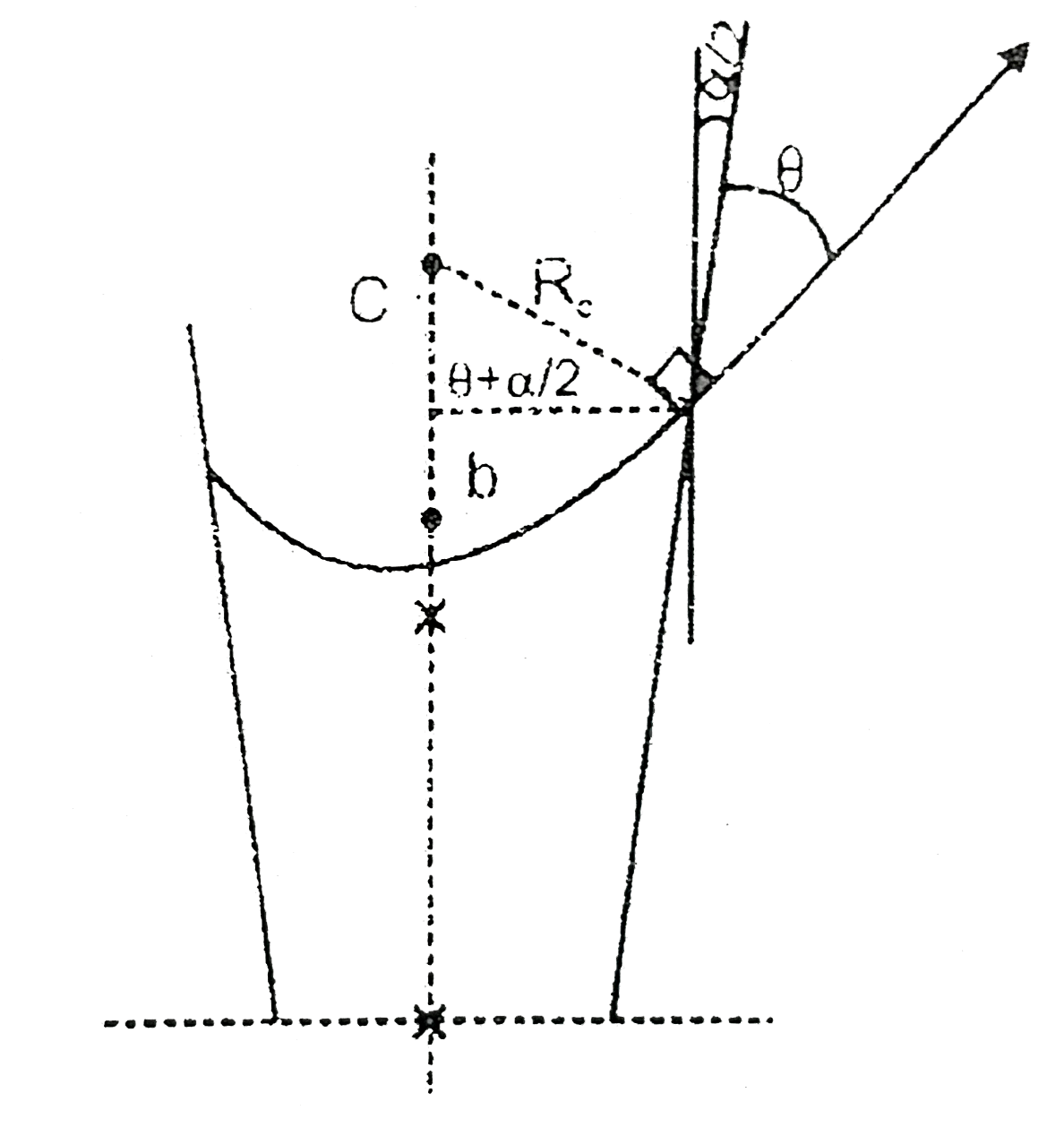
|
|
| 40. |
If the area swept by the line joining the sun and the earth from Feb 1 to Feb 7 is .A., then the area swept by the radius vector from Feb 8 to Feb 28 is |
|
Answer» A |
|
| 41. |
When two samples at different temperatures are mixed, temperature of the mixture can be |
|
Answer» lesser than lower or GREATER than HIGHER temperature |
|
| 42. |
Discuss various modesof heattransfer. |
|
Answer» Solution :There are three modes of heat transfer: Conduction, Convection and RADIATION. Conduction: Conduction is the process of direct transfer of heat through matter due to temperature difference. When two objects are in direct contact with one another, heat will be transferred from the hotter object to the colder one. The objects which allow heat to travel easily through them are called conductors. Convection: Convection is the process in which heat transfer is by actual movement of molecules in fluids such as liquids and gases. In convection, molecules MOVE freely from one place to another. Boiling water in a cooking pot is an example of convection. Water at the bottom of the pot receives more heat. Due to heating, the water expands and the density of water decreases at the bottom. Due to this decrease in density, molecules rise to the top. At the same time the molecules at the top receive less heat and become denser and come to the bottom of the pot. This process goes on continuously. The back and forth movement of molecules is called convection CURRENT. To keep the room warm, we use room heater. The air molecules near the heater will heat up and expand. As they expand, the density of air molecules will decrease and rise up while the higher density cold air will come down. This circulation of air molecules is called convection current. Radiation: When we keep our hands near the hot stove we FEEL the heat even though our hands are not touching the hot stove. Here heat transferred from the hot stove to our hands is in the form of radiation. We receive energy from the sun in the form of radiations. These radiations travel through vacuum and reach the Earth. It is the peculiar character of radiation which requires no medium to transfer energy from one object to another. The conduction or convection requires medium to transfer the heat. Radiation is a form of energy transfer from one body to another by electromagnetic WAVES Example: 1. Solar energy from the Sun. 2. Radiation from hot stove. 
|
|
| 43. |
A turbine generates 1.64 MW. Assuming the efficiency to be 80% and head of water used 1663 m, calculate the rate of flow of water. |
|
Answer» SOLUTION :`P=1.64xx10^(6)W` Gravitational head = 1663 m `eta=80%` available POWER = `0.8xx1.64xx10^(6)W` i.e. `P'=1.312xx10^(6)W=(("mgh"))/(t)` i.e. `(m)/(t)=(1.312xx10^(6))/(gh)=(1.312xx10^(6))/(9.8xx1663)` `(m)/(t)=80.5kgs^(-1)or(V)/(t)=((80.5)/(10^(3)))m^(3)s^(-1)` i.e. `(V)/(t)=80.5xx10^(-3)m^(3)s^(-1)=80.5" LITRES "s^(-1)`. |
|
| 44. |
Comment on Laplace correction to Newton's formula for velocity of sound in air. |
|
Answer» Solution :Newton ASSUMED that the isothermal condition prevails as there is adequate TIME for equalisation of temperature between the disturbed portion of the MEDIUM ( system ) and the rest of the air ( surrounding ) . However Laplace arged that change in pressure and volume in the region of rarefaction and compression is adiabatic as there is inadequate timefor temperature EQUILIBRIUM . `v = SQRT((gamma p)/( rho ))` is Laplace equation for speedof sound in air. |
|
| 45. |
Which of the following are positive and which are negative work done ? Work done by a man in lifting a bucket out of a well by means of a rope tied the bucket. |
| Answer» SOLUTION :POSITIVE | |
| 46. |
A particle is aimed at a mark which is in the same horizonta plane as the of point of projection. If falls 10 m short of the traget when it is projected of an angle75^(@)of and falls 10m ahead of the target when it is projected with an elevation of 45^(@) . The angle of projection for which the particle exactly hits this targetis (g = 10ms^(-1)) |
|
Answer» `1/2 SIN^(-1) (3/4)` |
|
| 47. |
A monoatomic gas initially at 17^(@)C is suddenly compressed to one eigth of its original volume. The temperature after compression is |
|
Answer» 887 K `T_(1)V_(1)^(GAMMA - 1) = T_(2)V_(2)^(gamma - 1)` `:. T_(2) = T_(1)((V_(1))/(V_(2)))^(gamma - 1) = 290 x 8^(2//3) = 290 xx 4 = 1160 K` |
|
| 48. |
When an average velocity of a particle becomes its instantaneous velocity ? |
| Answer» SOLUTION :When its MOTION is with UNIFORM VELOCITY. | |
| 49. |
How much work is done by a coolise walking on a frontal plastikam vidio a load on his head ? Explain |
| Answer» SOLUTION :W=0 as his displacement is along the horizontaldirection and in ORDER to balance the LOAD on his HEAD, he APPLIES force on it in the upward direction equal to its weight. Thus angle between force and displacement is zero | |
| 50. |
A particle is in circular motion with an acceleration alpha=0.2rads^(-2). (a) What is the angular displacement made by the particle after 5 s? (b) What is the angular velocity at 15 s?. Assume the initial angular velocity is zero. |
|
Answer» Solution :SINCE the initial ANGULAR velocity is zero `(omega_(0)=0)`. The angular displacement made by the particle is given by `THETA=omega_(o)t+(1)/(2)alphat^(2)` `theta=(1)/(2)xx2xx10^(-1)xx25=2.5` RAD In terms of degree `theta=2.5xx57.17^(@)~~143^(@)` |
|


