

Saved Bookmarks
This section includes 7 InterviewSolutions, each offering curated multiple-choice questions to sharpen your Current Affairs knowledge and support exam preparation. Choose a topic below to get started.
| 1. |
Particles of masses 1kg and 3kg are at (2i+5j+13 k) m and (-6i+4j-2k) then instantaneous position of their centre of mass is |
|
Answer» `(1)/(4)(-16i+17j+7k)m` |
|
| 2. |
Neglecting the density of air, the terminal velocity obtained by a raindrop of radius 0.3 mmm falling through air of viscosity 1.8xx10^(-5)Nsm^(-2) will be |
|
Answer» `10.9 MS^(-1)` |
|
| 3. |
A man (m_(1)) with a bag (m_(2)) in hand falls freely vertically from a height h above the ground. After falling through a height y_(0), man throws bag horizontally with a velocity u_(0) towards his right. |
|
Answer» Centre of mass is at a height `(h-y_(0))` at the end of time `SQRT(2y_(0)//G)` |
|
| 4. |
A spherical soap bubble of radius 1 cm is formed inside another of radius 3cm. The radius of singlesoap bubble which maintains the same pressure differences as inside the smaller and outside the larger soap bubble is ....cm |
|
Answer» `4//3 ` |
|
| 5. |
Passage-I: Materials expansion character depends on them being isotropic or anisotropic. The superficial and cubical expansion coefficients can be arrived at by the addition of linear expansion coefficient in the three dimensions. While studying the expansion of a solid or a liquid one should consider the expansion of the container also. Any hole in a conductor will become larger on getting heated up as one comments "expansion is a photographic enlargement". Each liquid has its own characteristics behaviour of change of temperature. Two spheres of radii in the ratio 1 :4 of same material, but the first being solid and the second hollow are heated. On heated to the same temperature the ratio of the change in their volume will be |
|
Answer» `1:1` |
|
| 6. |
Passage-I: Materials expansion character depends on them being isotropic or anisotropic. The superficial and cubical expansion coefficients can be arrived at by the addition of linear expansion coefficient in the three dimensions. While studying the expansion of a solid or a liquid one should consider the expansion of the container also. Any hole in a conductor will become larger on getting heated up as one comments "expansion is a photographic enlargement". Each liquid has its own characteristics behaviour of change of temperature. When heated in a copper container ( gamma_( c) ) a liquid shows an expansion coefficient of C and in a silver container, it shows S. The linear expansion coefficient of the silver container is alpha then 3 alpha equal to |
|
Answer» `( C - S + gamma_( c ) )` |
|
| 7. |
Passage-I: Materials expansion character depends on them being isotropic or anisotropic. The superficial and cubical expansion coefficients can be arrived at by the addition of linear expansion coefficient in the three dimensions. While studying the expansion of a solid or a liquid one should consider the expansion of the container also. Any hole in a conductor will become larger on getting heated up as one comments "expansion is a photographic enlargement". Each liquid has its own characteristics behaviour of change of temperature. Two similar containers A and B are filled with water at 4 °C. Vessel A is heated and B is cooled then |
|
Answer» Both of them EXPAND |
|
| 8. |
Which of the following is true for a satellite in a circular orbit (a) it is a freely falling body (b) its speed is constant (c) it suffers no acceleration (d) it does not require energy for motion in the orbit |
|
Answer» a,b and C |
|
| 9. |
A student is performingan experiment unsing a resonance column and a tuning fork of frequency 224 s^(-1) . He is told that the air in the tubehas been replaced by another gas (assume that the column remains filled with the gas) . If the minimum height at which resonace occurs is( 0 . 350 pm 0 . 005)m , the gas in the tube is (using information : 1 sqrt( 167 RT) = 649 J^(-1//2) * mol ^(-1//2) , sqrt(140 RT) = 590 J^(1 //2) * mol ^(-1//2) .The molar masses M in grams are givenin the opeions . take the value ofsqrt((10/(M)) for each gas as given there) |
|
Answer» NEON ` (M = 20, sqrt((10)/(20)) = (7)/(10))` |
|
| 10. |
Describe mercury barometer for measurement of atmospheric pressure.OR Describe Torricelli experiment for measurement of atmospheric pressure. |
|
Answer» Solution :Italian scientist Evangelista Torricelli devised for the first time ,the method for measuring atmospheric pressure. This device is shown in figure  A long glass tube of 1 m CLOSED at one end and filled with mercury is inverted into a trough of mercury . Thumb is kept on open part of tube. If thumb is taken from tube ,level of mercury column slightly decreases. The space above the mercury column in the tube contains only mercury column in the tube contains only mercury vapour whose pressure P is so small that it may be neglected . P=0. ThePressure inside the column at point A = the pressure at point B, which is at the same level. Atmospheric pressure at point A `P_(a)=P+hrhog` `P_(a)=O+hrhog` `thereforeP_(a)=hrhog` ... (1) Where `RHO=` density of mercury ,h= height of the mercury column. In this device height of mercury column at sea level is 79 cm which is equivalent to one atmosphere. `h=76cm=0.76m` `rho=13.6xx10^(3)kg//m^(3)` `g=9.8m//s^(2)` Atmospheric pressure `P_(a)=(0.76)(13.6xx10^(3))(9.8)` `P_(a)=1.013xx10^(5)` Pascal `=1.013xx10^(5)N//m^(2)` In common way of stating pressure is in terms of cm or mm of mercury Hg. |
|
| 11. |
A tank, with a square base of area 1 .0 m^(2)is divided by a vertical partition has a small hinged door of aren 20 cm^(2). The tank is filled with water in one compartment, and an acid (of relative density 1.7) in the other, both to the height of 4.0 m. Compute the force necessary to keep the door closed |
|
Answer» |
|
| 12. |
The only force acting on a 2 kg body as it moves along the positive x-axis has component F_(x) = -6xN, where x is in metre. The velocity of the body at x = 3m is 8 m/s. Find velocity of the body at x = 4m |
|
Answer» |
|
| 13. |
It is rainning vertically downwards. By how many times that a person should increase his velocity in order to change his umbrella position from an angle 30^(@) with vertical to 60^(@) vertical to protect himself from rain. |
|
Answer» 1 |
|
| 14. |
For a body in a uniformly accelerated motion, the distance of the body from a reference point at time 't' is given by x = at + bt^2 + c, where a, b , c are constants. The dimensions of 'c' are the same as those of (A) x "" (B) at "" (C ) bt^2 "" (D) a^2//b |
|
Answer» A |
|
| 15. |
Two blocks of masses m, and m, are connected to the ends of a spring of spring constant k. System is kept at rest on a frictionless horizontal floor with spring in its natural length. Both the blocks are pulled along opposite directions with forces of same magnitude F. Calculate maximum elongation of spring and distances travelled by the blocks during this motion. |
Answer» Solution :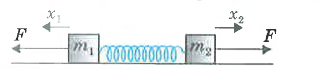 Net force in the horizontal direction is zero hence acceleration of centre of mass is zero. INITIALLY, both the blocks are at rest hence initial velocity of centre of mass is zero. So we can conclude that centre of mass remains at rest and both the blocks come to momentary rest simultaneously at the time of maximum elongation. Let `x_(1) and x_(2)` be the distances travelled by the blocks during this period in opposite directions as shown in figure. We can understand that `(x_(1) + x_(2))` will be maximum elongation of spring Using CONSERVATION of energy we can write the following: Work done by both the forces = Energy stored in spring `Fx_(1)+Fx_(2)=(1)/(2)k(x_(1)+x_(2))^(2)` `x_(1)+x_(2)=(2F)/(K) ""....(1)` Hence 2Fis maximum elongation of the spring, Here we KNOW that displacement of centre of mass is zero so we can write the following equation: `m_(1)x_(1)=m_(2)x_(2)""....(2)` SOLVING the above two equations we can find `x_(1) and x_(2)` `x_(1)=(m_(2))/(m_(1)+m_(2))[(2F)/(K) And x_(2)=(m_(1))/(m_(1)+m_(2))[(2F)/(k)]` |
|
| 16. |
A vessel of volume V contains a mixture of 1 mole of Hydrogen and 1 mole of Oxygen (both considered as ideal). Let f_1 (v)dv, denote the fraction of molecules with speed between v and (v+dv) with f_2(v) dv, similarly for oxygen. Then |
|
Answer» `f_1(v)+ f_2(v)=F(v)` OBEYS the Maxwell.s DISTRIBUTION LAW. |
|
| 17. |
The position vectors of three particles of mass m_(1)=1kg,m_(2)=2kg and m_(3)=4kg are vecr_(1)=(hati+4hatj+hatk)m,vecr_(2)=(hati+hatj+hatk)m, and vecr_(3)=(2hati-hatj-2hatk)m respectively. Find the position vector of their centre of mass. |
|
Answer» SOLUTION :The position VECTOR of centre of mass of the three PARTICLES is given by `vecr_(C)=(m_(1)vecr_(1)+m_(2)vecr_(2)+m_(3)vecr_(3))/(m_(1)+m_(2)+m_(3))` `vecr_(c)=(1(hati+4hatj+hatk)+2(hati+hatj+hatk)+4(2hati-hatj-2hatk))/(1+2+4)` `=((11hati+2hatj-5hatk))/(7)=(1)/(7)(11hati+2hatj-5hatk)m` |
|
| 18. |
A cubical container having each sides as l is filled with a gas having N molecules in the container. Mass of each molecule is m. If we assume that at every instant half of the molecules are moving towards the positive x-axis and half of the molecules are moving towards the negative x-axis.Two walls of the container are perpendicular to the x-axis. Find the net force acting on the two walls given? Assume that all the molecules are moving with speed v_(0). |
|
Answer» |
|
| 19. |
Radius of the circular piston of a hydraulic lift is four times the radius of the other arm. What force should be applied to the narrow arm to lift 100 kg? |
|
Answer» 26.5 N |
|
| 20. |
Two discs of moments of inertia I_(1) " and" I_(2) about their respective axes (normal to the disc and passing through the centre), and rotating with angular speeds omega_(1) " and" omega_(2) are brought into contact face to face with their axes of rotation coincident. (a) What is the angular speed of the two-disc system? (b) Show that the kinetic energy of the combined system is less than the sum of the initial kinetic energies of the two discs. How do you account for this loss in energy? Take omega_(1) ne omega_(2) |
|
Answer» Doesthe lawof conservationofangularmonentum apply to thesituation? Why ? letthe common angularvelocityof thesystemis `omega ` ( A)yes , thelaw of conservation of angularmomentumcan beapplied,Because , THEREIS nonetexternal TORQUE on thesystemof thetwodisc . EXTERNAL forces , gravition and normalreaction,act throughth axisofrotation, henceproduce notorque . 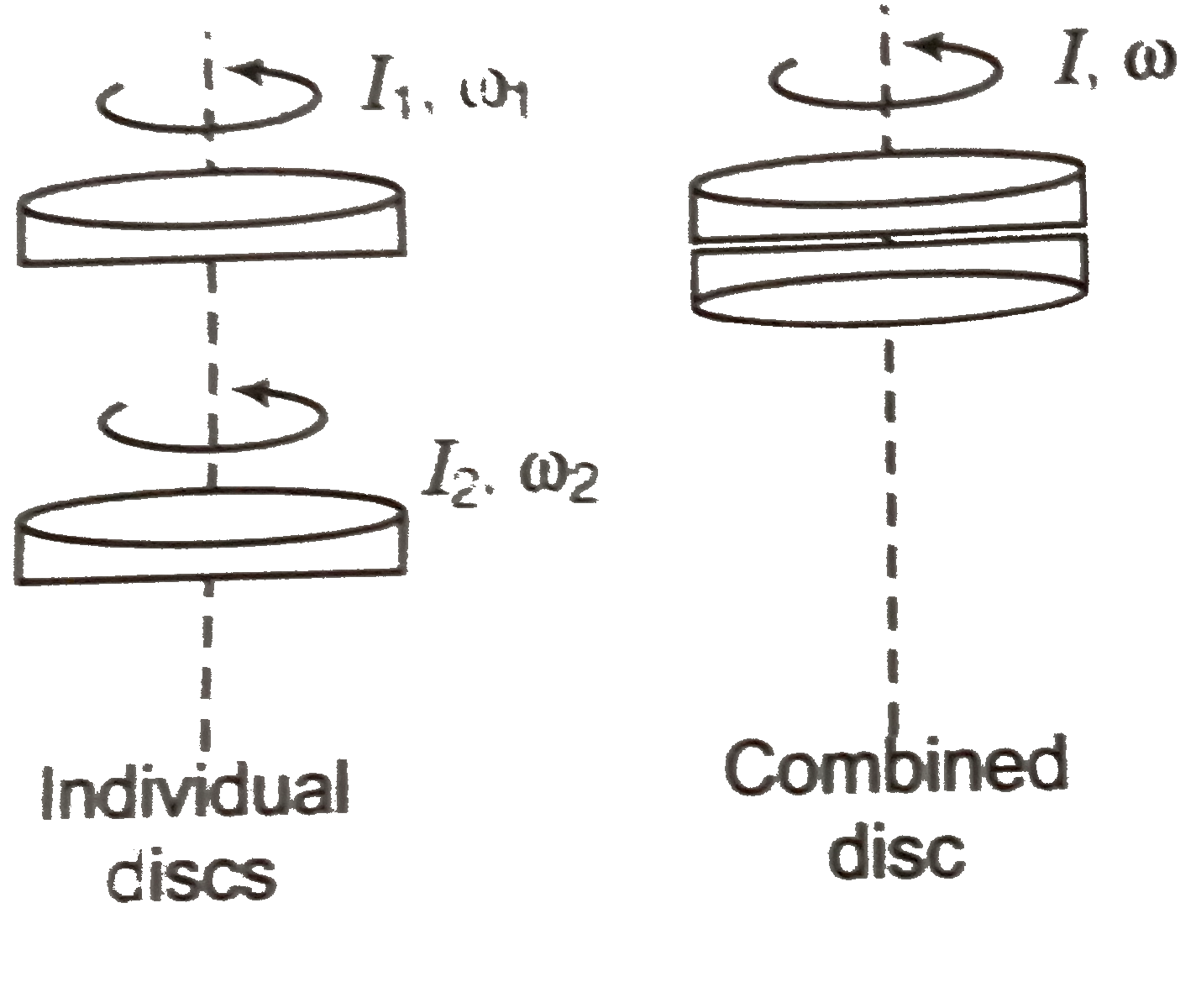 ( B) BYconservation of angularmomentum `L_(f)=L_(j)` `implies Iomega=Iomega_(1)+I_(2)omega_(2)` ` implies omega=(I_(1)+I_(2)omega_(2))/(I)=(I_(1)omega_(1)+I_(2)omega_(2))/(I_(1)+I_(2))""(:' I=I_(1)+I_(2))` `(C)K_(f)=(1)/(2)(I_(1)+I_(2))((I_(1)omega_(1)+I_(2)omega_(2)))/((I_(1)+I_(2)))=(1)/(2)((I_(1)omega_(1)+I_(2)omega_(2)))/((I_(1)+I_(2)))` `k_(f)=(1)/(2)(I_(1)omega_(1)^(2)+I_(2)omega_(2)^(2))` `DeltaK=K_(f)-K_(i)=-(I_(1)I_(2))/(2(I_(1)+I_(2)))(omega_(1)-omega_(2))^(2)lt0` (D)Hencethere is lossin KE of thelossin kinticenergyismainly dueto theworkagainst thefricationbetweenthe twodiscs. |
|
| 21. |
In an experiment of simple pendulum the errors in the measurement of length of the pendulum L and time period T are 3% and 2% respectively. Find the maximum percentage error in the value of acceleration due to gravity. |
|
Answer» |
|
| 22. |
Two gases have the same initial pressure, volume and temperature. They expand to the same finalvolume, one adiabatically and the other isothermally |
|
Answer» The final TEMPERATURE is greater for the isothermal process |
|
| 23. |
A massive ball moving with speed v collides head on with a fine ball having mass very much smaller than the mass of the first ball. The collision is elastic.Then immediately after the impact, the second ball will move with a speed approximately equal to |
|
Answer» V, v, v, v |
|
| 24. |
A ball is vertically projected with an initial velocity of 40ms^(-1) . Find the (i) maximum height it can reach (ii) and the time of descent. |
|
Answer» |
|
| 25. |
200g of water and aequal volume of another liquid of mass 250g are placed in turn in the same calorimeter of mass 100g and specific heat capacity 420J kg^(-1) K^(-1). The liquids which are constantly stirred are found to cool from 60^(@)C and 20^(@)C in 180s and 140s respectively. Find the specific heat capacity of the liquid. The temperature of the surroundings =20^(@)C |
|
Answer» |
|
| 26. |
The wavelength of the spectral line coming from a star is changed by the motion of the star from 6000 Å to 6001 Å. Find the velocity of the star with respect to the earth. (Velocity of light = 3xx 10^(8) m//s) |
|
Answer» |
|
| 27. |
An ideal gas of molecular mass M is located in the uniform gravitational field in which the free-fall acceleration is g. Find the gas pressure as a function of height h, if P is equal P_(0) at h = 0 and the temperature varies with has T=T_(0) (1-ah). where a is a positive constant. |
|
Answer» Solution :We have shown that, `(dP)/P=-(Mg)/(RT)dh` GIVEN `T=T_(0)(1-ah)` `therefore (dP)/P=(Mg)/(RT_(0)(1-ah))dh` Integrating on both SIDES, we GET `int_(po)^(p)(dP)/P=-(Mg)/(RT_(0))int_(0)^(h)(dh)/(1-ah)` `log_(e)(P//P_(0))=-(Mg)/(RT_(0))(log_(e)(1-ah))/((-a))" (or) "log_(e)(P//P_(0))=log_(e)(1-ah)^(n)` where `n=(Mg)/(aRT_(0))" (or) "P/P_(0)=(1-ah)^(n)" (or) "P=P_(0)(1-ah)^(n)=P_(0)(1-ah)^(("RG")/("aRT"))` |
|
| 28. |
If three particles each of mass m are placed at the three corners of an equilateral triangle of side 1, the workdine to increase the side of that triangle 21 is |
|
Answer» `(3GM^(2))/(L)` |
|
| 29. |
For a gas undergoing an adiabatic process, at a certain stage its volume and temperature are V_0, T_0and the magnitude of slope of V - T curve is in |
|
Answer» MOLAR specific capacity at constant volumeis `(RT_0 m)/(V_0)` |
|
| 30. |
The resultant of two equal forces is 141.4N when they are mutually perpendicular. When they are inclined at an angle 120°, then the resultant force will be |
|
Answer» 100N |
|
| 31. |
Two balls are projected simultaneously in same verticle plane from the same point with velocitiesV_(1) andV_(2)with anglestheta_(1) and theta_(2)respectively with the horizonal. If V_(1) Cos theta_(1) = V_(2) Cos theta_(2),the path of one hell as seen from the position of another hall is |
|
Answer» parabola |
|
| 32. |
The minimum and maximum distance of a satellite from the centre of the earth are 2R and 4R, respectively, where R is the radius of the earth ad M is the mass of the earth. Find its maximum and minimum speeds. |
| Answer» SOLUTION :`[ sqrt((2GM)/(3R)) , sqrt((GM)/(6R))]` | |
| 33. |
Two bodies of different masses have same linear momentum. The one having more K.E. is |
|
Answer» LIGHTER BODY |
|
| 34. |
The potential energyof 1kg particle, free tomove allongis givenby U(x) = ((x^(3))/3-(x^(2))/2) I .if its mechanicalenergyis 2J . Itsmaximum speedis …… ms^(-1) |
|
Answer» `sqrt((13)/3)` For maximum kinetic energy( or maximum SPEED ) of a body, its potential energy should beminimum`( : . " On BASISOF lawof conservationofmechanical energy "= U+K= " CONSTANT" )` For minimumvalue of`U = (dU)/(dx) = 0 and (d^(2)U)/(dx^(2)) gt 0 ` Now , `(dU)/(dx) = ((3x^(2))/3 - (2x)/2)` Taking `(dU)/(dx) = 0 ` ` :. 0 = ((3x^(2))/3 - (2x)/3)` `:. 0 = (x^(2) - x)` ` :. x = 0 m ` or we get`x = +1 m ` Now ,`(d^(2)U)/(dx^(2)) ` is `2x-1 ` x=0 m , `(d^(2)U)/(dx^(2)) = 2xx0 - 1 = - 1 lt 0 ` and For`x = + 1 m , (d^(2)U)/(dx^(2)) = 2XX1- 1 = 1 gt 0 ` Hereonlyat ` x = +1 ` m potential energy will beminimum for a body. thereforeminimum potential energy . `U_(min) = ((1)^(3))/3 - ((1)^(2))/2 =1/3 - 1/2 = -1/6` Now , maximum K.E= (Total energymeansmechanical energy ) - (minimum potential energy ) `:. 1/2 mv_(max)^(2) = 2 - (-1/6) = 13/6 J ` ` :.v_(max)^(2) = 13/3 ""( :.m = 1 kg)` ` :. v_(max) = sqrt((13)/3)m//s` |
|
| 35. |
A bomber flying horizontally with constant speed releases a bomb from an aeroplane. (a) The path of bomb as seen by the observer on the ground is parabola (b) The path of the bomb as seen bby a pilot is a straight lline. ( c) The path of the aeroplane with respect to bomb is a straight line (d) The path of the bomb as seen by pilot observed as parabola. |
|
Answer» a is CORRECT |
|
| 36. |
A spring of force constant K is attached with a mass executes with S.H.M has a time period T. It is cut into three equal parts If the spring are attached to the load as shown in figure then effective spring constant is |
| Answer» Solution :Figure | |
| 37. |
A ring of mass M and radius R lies flat on a horizontal table. A light thread is wound around itand its free end is pulled with a constant velocity v. (a) Two small segment A and B (see fig.) in the ring are rough and have a coefficient of friction muwith the table. Rest of the ring is smooth. Find the speed with which the ring moves. (b) Find the speed of the ring if coefficient of friction is mueverywhere, for all points on the ring. |
|
Answer» (B) `(v)/(2)` |
|
| 38. |
The minimum force required to move a body up an inclined plane is two times the minimum force required to prevent it from sliding down the plane. If coefficient of friction between the body and inclined plane is 1/sqrt(3) the angle of inclined plane is, |
|
Answer» SOLUTION :`60^(@)` |
|
| 39. |
A particle of mass 10gm is describing an SHM along a staight line with a time period of 2sec and amplitude 10cm. Then its KE at 2 dm from the equilibrium position is |
|
Answer» `4.8xx10^(-4)J` |
|
| 40. |
A gas has a volume 1000 c.c at 80 cm of mercury pressure. It is expanded adiabatically to 1190 c.c. The pressure falls to 60 cm of Hg. Calculate the work done by the gas. |
| Answer» SOLUTION :`17.53 J` | |
| 41. |
According to second law of thermodynamics a) All heat can be converted into work b) The efficiency of a heat engine is alwayslesser than unityc) It is not possible to transfer heat from lowerto higher temperature by it self |
|
Answer» both a and B are TRUE |
|
| 42. |
A faulty Celsius thermometer reads 1.3^(@)C in melting ice, but reads 98.5^(@)C in the water vapour at a pressure of 747 mm of Hg. When the reading on this faultythermometer is 20^(@)C, what is the corresponding reading on the Fahrenheit scale? Boiling point of water at a pressure of 734 mm of Hg is 99^(@)C. |
|
Answer» |
|
| 43. |
The amplitude of a damped oscillator (1)/( 27) becomes th of its initial value after 6 minutes. What the amplitude after 2 minutes? |
|
Answer» Solution :For damped oscillator `A= A_(0)e^(-BT)` here `(A_(0))/(27) = A_(0)e^(-6b)` that is `e^(-6b)= 1//27` `A_(2)= A_(0)e^(-2B)= A_(0)[e^(-6b)]^(1//3)= A_(0)((1)/(27))^((1)/(3))= A_(0)//3` |
|
| 44. |
In oblique projection time of flight of a projectile is |
|
Answer» `(u^(2)SIN^(2)theta)/(2g)` |
|
| 45. |
A body of mass 20kg is moving on a rough horizontal plane. A block of mass 3 kg is connected to the 20 kg mass by a string of negligible mass through a smooth pulley as shown in the figure. The tension in the string is 27 N. The coefficient of kinetic friction between the heavier mass and the surface is (g=10 m//s^(2)) |
|
Answer» `0.025` |
|
| 46. |
An air champer of volume 'V' has a neck area of cross - section A into which a ball of mass m just fits and can move up and down without any friction. Show that when the ball is pressed down a little and released, it executes SHM. Obtain an expression for the time period of oscillation assuming pressure volume variations of air to to be isothermal. |
|
Answer» <P> Solution :Let E be the bulk modulus of the material of the BALL. Then,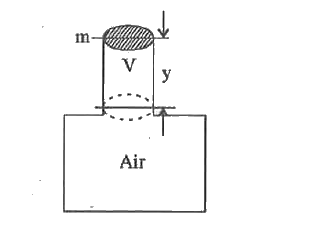 `E=(-PV)/(DeltaV)` `"or"P=(-E DeltaV)/(V)" but "F=PA` `"thereby,"F=(-E DeltaV)/(V)A.` Let .y. be the displacement, Then `DeltaV=Ay.` `"Hence,"F=-E(A^(2)y)/(V).` However using the Newton.s II Law of MOTION, `F=ma =m(d^(2)y)/(dt^(2))` Hence `m(d^(2)y)/(dt^(2))=-(EA^(2)y)/(V)` `"or"(d^(2)y)/(dt^(2))+((EA^(2))/(mV))y=0` Comparing this with `(d^(2)y)/(dt^(2))+omega^(2)y=0`, we get, `omega^(2)=(EA^(2))/(mV)"so that " (4pi^(2))/(T^(2))=(EA^(2))/(mV)` `or T=((2pi)/(A))SQRT((mV)/(E))`. |
|
| 47. |
What is the stopping distance for a vehicle of mass m moving with speed v along a level road, if the co-efficient of friction between the tyres and the road is mu? |
|
Answer» Solution :When the vehicle of mass m is MOVING with velocity v, the kinetic energy of the vehicle `KE=((1)/(2))mv^(2)` and if s is the stopping DISTANCE, then work DONE by FRICTION. `W=fscostheta=mumgscos180^(@)` So by work - Energy theorem, `W=Deltak=k_(f)-k_(i)` i.e., `-mumgs=0-(1)/(2)mv^(2)ors=(v^(2))/(2mug)` |
|
| 48. |
If the maximum vertical height and horizontal ranges of a projectile are same, the angle of proejctile will be |
|
Answer» `45^(0)` |
|
| 49. |
A gas filledballoon remains at rest at a certain height. The balloon is in stable equilibrium',___ true or false? |
|
Answer» |
|
| 50. |
There is a small bubble at one end and bigger bubble at. other end of a pipe. Which among the following will happen? |
|
Answer» remains in EQUILIBRIUM |
|