

Saved Bookmarks
This section includes 7 InterviewSolutions, each offering curated multiple-choice questions to sharpen your Current Affairs knowledge and support exam preparation. Choose a topic below to get started.
| 1. |
A truck starts from rest and accelerates uniformly at 2.0ms^(-2). At t = 10s, a stone is dropped by a person standing on the top of the trunk (6m high from the ground). What are the (a) velocity and (b) acceleration of the stone at t = 11s ? (Neglect air resistance) |
|
Answer» 22.4 m/s at an angle of `TAN^(-1) 1/2` with the HORIZONTAL `10 m//s^2` vertically downwards |
|
| 2. |
A wire of resistorR is bent into a circular ring of radiusr .Equivalent resistance between two pointsX andY on itscircumference, when angle XOY is alpha, can be given by |
|
Answer» `(R alpha)/(4pi^(2)) (2PI - alpha)` |
|
| 3. |
A wire of length 1 m and radius 0.1 mn has a resistance of 100Omega. Find the resistivity of the material. |
| Answer» SOLUTION :`pixx 10^(-5) OMEGA m` | |
| 4. |
The de Broglie wavelength and kinetic energy of a particle is 2000 Å and 1 eV respectively. If its kinetic energy becomes1 MeV, then its de Broglie wavelength is |
|
Answer» 2 Å |
|
| 5. |
A proton and a deuteron, each moving with velocity vecv, enter simultaneously in the region of magnetic field vecB acting normal to the direction of velocity. Trace their trajectories establishing the relationship between the two . |
|
Answer» Solution :We know that when a particle of mass .m. and charge .Q. moving with a VELOCITY `vecv` enters a region of MAGNETIC field `vecB` acting NORMAL to the direction of velocity, it describes a circular path of radius `r = (mv)/(qB)`. As per question `v_("proton") = v_("deuteron")` and charges are also same. But `m_("deuteron") = 2m_("proton") `. As a result, `r_("deuteron") = 2r_("proton")` The trajectories have been traced in fig. 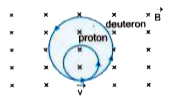
|
|
| 6. |
Two identical-looking iron bars A and B are given, one of which is definitely known to be magnetized. (We do not know which one). How would one ascertain whether or not both are magnetized ? If only one is magnetized, how does one ascertain which one ? [Use nothing else but the two bars A and B] |
| Answer» Solution :Try to bring different ENDS of the magnets closer. A repulsive force in some SITUATIONS establishes that both are magnetised. If it is always attractive, then one of them is not magnetised. To see, which one pick up one SAY A and lower one of its ends, first one of the ends of the other (say B), and then on the middle of B. If you NOTICE that in the middle of B, A experiences no force, then B is magnetised. If you do not notice any CHANGE from the end to the middle of B then A is magetised. | |
| 7. |
A 5.20 g bullet moving at 700 m/s strikes a 700 g wooden block at rest on a frictionless surface. The bullet emerges, traveling in the same direction with its speed reduced to 450 m/s. (a) What is the resulting speed of the block? (b) What is the speed of the bullet-block center of mass ? |
|
Answer» |
|
| 8. |
Assume standard notations used for dispersion and deviation is a prise, in the following formulae: (a) del=del_(gamma) (b) del=(n_(gamma)-1)A ( c)theta=del_(v)-del_(R) (d) theta=(n_(V)-n_(R))A State which option(s) is / are correct. |
|
Answer» a and B are equivalent for a prism of small angle A, IRRESPECTIVE of I |
|
| 9. |
Three charges each equal to +4nC are placed at the three comers of a square of side 2 cm. Find the electric field at the fourth corner. |
|
Answer» Solution :Diagonal BD=(`sqrt2`) (side) i.e. `BD=2sqrt2xx10^(-2)`m we know that ,`E=(1/(4pi in_0))(q/r^2)` HENCE, `E_1=(9xx10^9xx4xx10^(-9))/((2xx10^(-2))^2)=(36xx10^4)/4` `=9xx10^4 Vm^(-1)` ALONG AD `E_2=(9xx10^9xx4xx10^(-9))/((2sqrt2xx10^(-2))^2)=(36xx10^(4))/8` `E_3=(9xx10^9xx4xx10^(-9))/((2xx10^(-2))^2)=9xx10^4Vm^(-1)`along CD RESULTANTOF `E_1` and `E_3` , `E.=sqrt(E_1^2 +E_3^2 +2E_1E_3 cos 90^@)` & `E_1 =E_3`. `therefore E.=sqrt2E_1 = 1.414xx9xx10^4` `=12.726xx10^4 Vm^(-1)`, along `E_2` Hene resultantfieldat D =`E^1 +E_2 =(12.726+4.5)xx10^4 Vm^(-1)` `=17.226xx10^4` `=1.723xx10^5 Vm^(-1)` at `45^@`along `vecE_2` 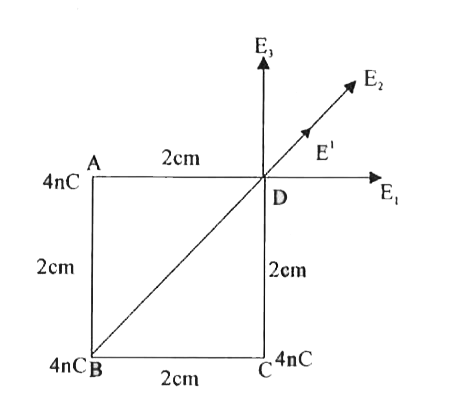
|
|
| 10. |
As the speed of a particle increases, its rest mass |
|
Answer» INCREASES |
|
| 11. |
A radio can tune into any station in the 7.5 MHz to 12 MHz band. What is the corresponding wavelength band ? |
|
Answer» SOLUTION :Frequency of 7.5 MHz belongs to SW band. The corresponding WAVELENGTH is `lambda=(c)/(v)=(3XX10^(8))/(7.5xx10^(6))=40km` Frequency of 12 MHz belongs to HF band, the corresponding wavelength is`lambda=(c)/(v)=(3xx10^(8))/(12xx10^(6))=25km` Corresponding to the GIVEN frequency band, the wavelength band is 25 m - 40 m band. |
|
| 12. |
Using Planck's fromula, derive the approximate expressions for the space spectral density u_(omega) of radiation (a) in the range where h omegalt lt kT (Rayleigh-Jeans fromula), (b) in the range where h omegagt gt kT (Wien's formula). |
|
Answer» Solution :From Planek's formula `u_(omega) = (cancelh omega^(2))/(pi^(2)c^(3))(1)/(c^(homega//k)-1)` (a) In a range `h omega lt lt KT` (long wavelength or high temperature). `u_(omega) rarr (cancel homega^(3))/(pi^(2)c^(3))(1)/((cancelh omega)/(kT))` `= (omega^(2))/(pi^(2)c^(3))kT`, using `e^(x) = 1+x` for small `x`. (B) In the range `cancelh omega gt gtT` (high FREQUENCY ot low temperature): `(cancelh omega)/(kT)gt gt 1` so `e^((cancelh omega)/(kT)) gt gt 1` and `u_(omega) = (cancelhomega^(3))/(pi^(2)c^(3))e^(-cancelh omega//kT)` |
|
| 13. |
A spherical surface of radius of curvature R, separates air (refractive index 1.0) fromglas (refractive index 1.5). The centre of curvature is in the glass. A point object P in air is found to have a real image Q in the glass.The line PQ cuts the surface at a point O and PO =OQ. The distance PO is equal to |
|
Answer» 5R |
|
| 14. |
How are stationary waves formed in closed pipes ? Explainthe various modes of vibrations and obtain relations for their frequencies. |
|
Answer» Solution :A pipe, Whichis closedat one end and the other is opened is called CLOSED pipe. When a sound wave is SENT through a closed pipe, which gets reflected at the closed end of the pipe.Then incident and reflected waves are in same frequency, travelling in the opposition direction are superimposed stationary waves are formed. To form the stationary wave in closed pipe, whichhas atleast a node at closedend and antinode at open end of the pipe, it is knownas first harmonicin closed pipe. Then lengthof the pipe ( l ) is EQUAL to one fourth of the wave length. `:. l = ( lambda_(1))/(4) implies lambda _(1)=4l` If `'v_(1)'` is fundamental frequency then `v_(1)= ( upsilon)/(lambda_(1))` where `'upsilon'`is velocityof sound in air `v_(1)= ( upsilon)/( 4l)= v `...(1) To form the next harmonicin closed pipe, two nodes and two antinodesshould be formed. So that there is possible to form third harmonicin closed pipe. Since one more node and antinode should be INCLUDED. Then length of the pipeis equal to `(3)/(4)` of the wavelength `:. l = ( 3lambda_(3))/(4)` where `' lambda_(3)'` is wavelengthof third harmonic `lambda_(3) = ( 4l)/(3)` If`' v_(3)'`is thirdharmonic frequency( first overtone ) `:. v _(3)=( upsilon)/( lambda_(3))= ( 3upsilon)/( 4l)` `v_(3) = 3v` ...(2) Similarly the next overtone in the close pipe is only fifth harmonic it will have three nodes and 3 antinodes between the closed end and open end. Then length of the pipe is equal to `(5)/(4)` of wave length `( lambda_(5))` `:. l = ( 5 lambda_(5))/(4)` where `'lambda_(5)'` is wave length of fifth harmonic . `lambdad_(5) = ( 4l)/( 5)` If `'v_(5)'` is frequency of fifth harmonic( second overtone ) `v_(5)= ( upsilon) /( lambda_(5)) =( 5upsilon)/(4l)` `v _(5) = 5v` ...(3) `:. ` The frequencies of higherharmonics can be determined by using the same procedure . Therefore from the Eq (1) , (2) and(3)only odd harmonics are formed. Therefore the ratio of the frequencies of harmonics in closed pipe can be written as `v_(1) : v_(3) : v_(5)= v : 3v : 5v ` `v_(1) : v_(3) : v _(5)= 1: 3 : 5 ` 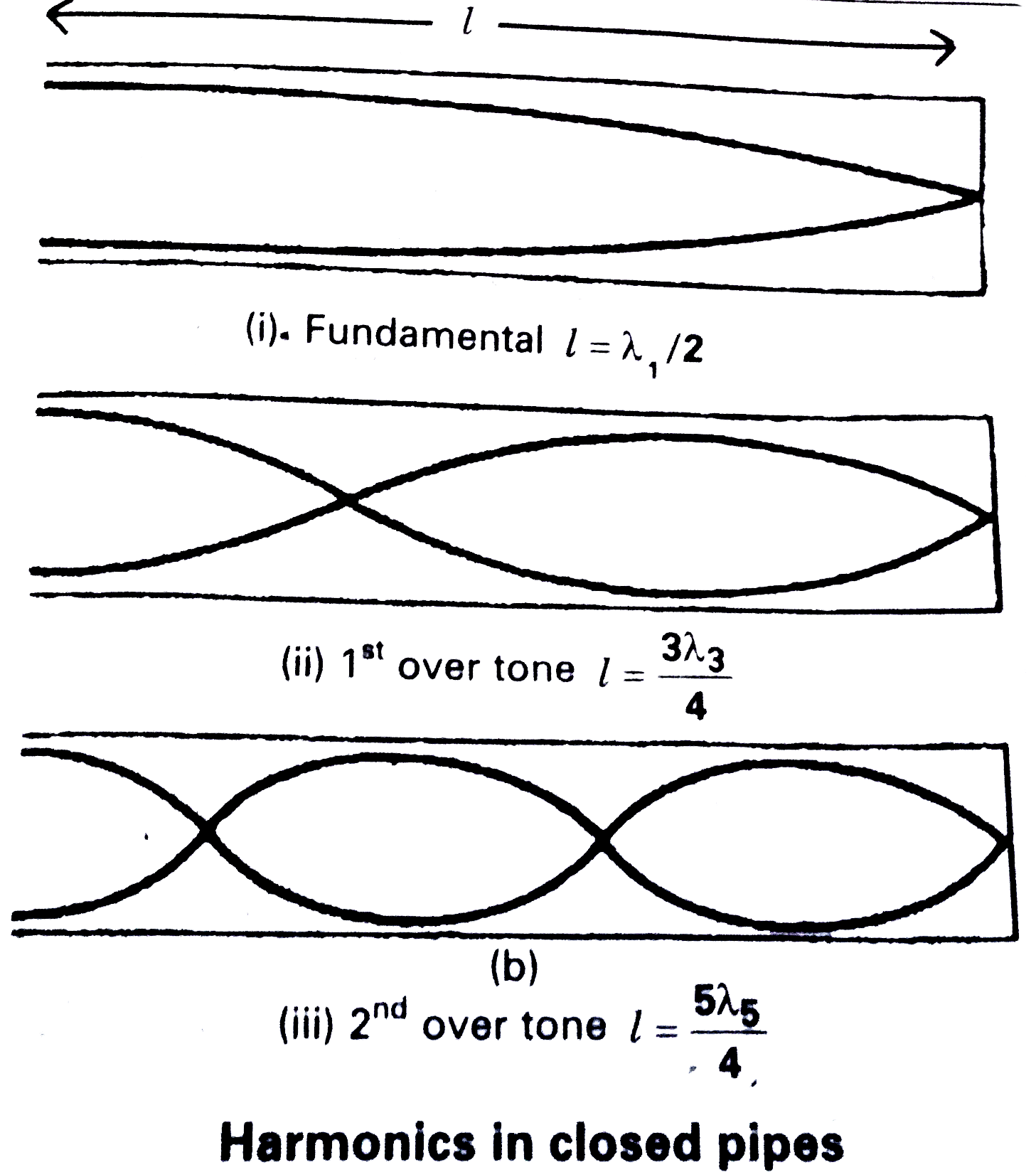
|
|
| 15. |
Must every magnetic configuration have a north pole and a south pole ? What about the field due to a toroid ? |
| Answer» Solution :Not necessarily. True only if the source of the FIELD has a NET NONZERO magnetic moment. This is not so for a toroid or even for a straight infinite CONDUCTOR. | |
| 16. |
Two point charges q_(1)andq_(2) are located at vecrandvecr_(2) respectively in an external electric field E. Obtain the experession for the total work done in assembling this configuration . |
|
Answer» Solution :WORK DONE in briginging the charge `q_(1)` from infinity to position `r_(1)` `W_(1)=q_(1)V(r_(1))` Work done in bringing charge `q_(2)` to the position `r_(2)` `W_(2)=q_(2)V(r_(2))+(q_(1)q_(2))/(4piepsilon_(0)r_(12))` Hence , total work done in assembling the two charges `W=W_(1)+W_(2)` `=q_(1)V(r_(1))+q_(2)V(r_(2))+(q_(1)q_(2))/(4piepsilon_(0)r_(12))` |
|
| 17. |
Two (non-physics) students, A andB living in neighboring hostel rooms, decided to economies by connecting their bulbs in series. They that each would install a 100 W bulb in their own rooms and that they would pay equal shashares of the electricity bill. However, both decided to try to get better lighting at the other's expense, A installed a 200 W bulb and B installed a 50 W bulb. Which student is more likely to fail to end-of--term examinations ? |
|
Answer» <P> |
|
| 18. |
A and B points are present on the axis of a bar magnet of length 3 cm and at 24 cm and 48 cm respectively, from the opposite direction of the centre. The ratio of magnetic fields at these points is ...... . |
|
Answer» `8:1`  The INTENSITY of MAGNETIC field on a axis of small magnet ` B alpha (1)/( z^3)` `therefore (B_1)/( B_2) = ((z_2)/(z_1) )^(3)` `therefore (B_1)/(B_2) = ((48)/( 24))^(3) = (2)^(3)` `therefore (B_1)/( B_2) = (8)/(1)` |
|
| 19. |
Which of the following is the most important component for comparing different countries? |
|
Answer» Population |
|
| 20. |
A series R-C circuit is connected to an alternating voltage source. Consider two situations a) When capacitor is air filled. b) When capacitor is mica filed Current through resistor is i and voltage across capacitor is V then |
|
Answer» `V_(a)=V_(b)` |
|
| 21. |
Justify the output waveform (Y) of the OR gate for the following inputs A and B given in the figure below . |
|
Answer» Solution :At `t LT t_(1) , "" A = 0 , B = 0 , ` Hence Y = 0 For `t_(1)` to `t_(2) , "" A =1 , B = 0` , Hence Y = 1 For `t_(2)` to `t_(3) , "" A = 1 , B = 1,` Hence Y = 1 For `t_(3)` to `t_(4) , "" A = 0 , B = 1` , Hence Y = 1 For `t_(4)` to `t_(5), "" A = 0 , B = 0`, Hence Y = 0 For `t_(5)` to `t_(6) , "" A = 1 , B = 0` , Hence Y = 1 For `t gt t_(6) , "" A = 0 , B = 1` , Hence Y = 1 THEREFORE the waveform Y will be as shown in the FIGURE . 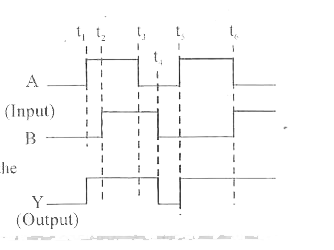
|
|
| 22. |
Suppose the initial charge on the capacitor inis 6 mC. What is the total energy stored in the circuit initially? What is the total energy at later time? |
| Answer» SOLUTION :0.6 J, same at LATER TIMES. | |
| 23. |
A nonconducting ring of radius R has charge Q distributed unevenly over it. If it rotates with an angular velocity omega , the equivalent current will be |
|
Answer» ZERO |
|
| 24. |
A cell in secondary circuit gives null deflection for 2.5 m length of potentiometer having 10 m length of wire. If the length of the potentiometer wire is increased 1 m without changing the cell in the primary, the position of the null point now is |
|
Answer» 3.5 m |
|
| 25. |
A rational number between 1/7 and2/7 is - |
|
Answer» 44210 |
|
| 26. |
Which of the following decides about the contrast between bright and dark fringes in an interference experiment ? |
|
Answer» wavelength |
|
| 27. |
The total number of current careers in intrinsic semiconductor of dimensions 1m×1m×10^(-2)m having number of free electrons n_e=5×10^8 per cubic metre is |
|
Answer» `10^18` |
|
| 28. |
If X=(a^(3)b^(2))/(sqrtc) and percentage changes in a, b and c are 2% increase, 1% decrease and2% decrease respectively then percentage increase or decrease in X is |
|
Answer» `5%` INCREASE |
|
| 29. |
It is hotter at some distance over the fire than in front of it because |
|
Answer» HEAT is radiated upwards only |
|
| 30. |
Two rain drops reach the earth with different terminal velocities having ratio (9:4). Then, the ratio of their volumes is |
| Answer» Answer :D | |
| 31. |
A projectile fired with velocity u at right angle to the slope which is inclined at an angle theta with horizontal. The expression for R is |
|
Answer» `(2u^(2))/(G)TANTHETA` |
|
| 32. |
Color of Copper sulphate solution is.. |
|
Answer» Blue |
|
| 33. |
The average life of an isolated neutron is |
|
Answer» 1500 SEC |
|
| 34. |
A mass m on the surface of the Earth is shifted to atarget equal to the radius of the Earth. If R is the radius and M is the mass of the Earth, then work done in this process is |
|
Answer» `(mgR)/2` `U_(T)=(-GMm)/(2R)` `W=U_(T)-U_(E)=(-GMm)/(2R)+(GMm)/R` = `(GMm)/(2R)=(GR^(2)m)/(2R)=(mgR)/2` |
|
| 35. |
Two coherent point sources S_(1) and S_(2) are separated by a small distance 'd' as shown. The fringes obtained on the screen will be : |
|
Answer» staright lines |
|
| 36. |
What happened in the Kashipur? |
|
Answer» A BABY cried |
|
| 37. |
What name Mahadevi Verma gave to the injured squirrel? |
|
Answer» Gillu |
|
| 38. |
What are near point and normal focusing? |
|
Answer» Solution :Near point focusing The image is formed at near point, i.e.25 cm for normal eye. This distance is also called as least distance D of DISTINCT VISION. In this position, the eye FEELS comfortable BUTTHERE is little strain on the eye. Normal focusing - The image is formed at infinity. In this position the eye is most relaxed to VIEW the image. |
|
| 39. |
What is the order of the drift velocity of electrons? |
|
Answer» few MILLIMETER per second |
|
| 40. |
Three point charges Q,4Q and 16Q are placed on a straight line 9 cm long. Charges are placed in such a way that the system has minimum potential energy. Then |
|
Answer» 4Q and 16Q must be at the ENDS and Q at a distance of 3 cm from the 16Q. |
|
| 41. |
We identify and understand a sound on the basis of certain characteristics, given in column A. These characteristics depend on certain measurable parameters of the sound. These parameters and related units are given in column B. |
|
Answer» |
|
| 42. |
A ray PQ incident on the refracting face BA is refracted in the prism BAC as shown in figure and emerges from the other refracting face AC as RS such that AQ = AR. If the angle, of prism A = 60^@ and mu of material of prism is then find angle theta . |
| Answer» SOLUTION :This is a CASE of MIN. DEVIATION `theta=60^@` | |
| 43. |
An uncharged metal sphere suspended by a silk thread is placed ina uniform external electric field. E. (a) what is the magnitude of the electric field for points inside the sphere ? (b) is your answer changed if the sphere carriers a charge ? |
|
Answer» Solution :(a) E = 0, for points INSIDE the SPHERE (B) No |
|
| 44. |
Which of the following atoms has the lowest ionisation potential? |
|
Answer» `""_(7)^(14)"N"` |
|
| 45. |
At very low temperature, a semi-conductor becomes |
|
Answer» Conductor |
|
| 46. |
Statement I : Young's modulus of a wire made up steel can be increased by increasing its length. Statement II: Young's modulus of a material depends on the dimensions of the material. |
|
Answer» STATEMENT-I is TRUE, Statement-II is true and Statement-II is correct explanation for Statement-I. |
|
| 47. |
Young’s double slit experiment is done in a medium of refractive index 4/3. Light of 600 nm wavelength is falling on the slits having 0.45 pm separation. The lower slit S2 is covered by a thin glass sheet of thickness 10.4 pm and refractive index 1.5. The interference pattern is observed on a screen placed 1.5 m from the slits as shown. (a) Find the location of central maxima (bright fringe with zero I t y path difference) on the y-axis. (b) Find the light intensity at point O relative to the maximum fringe intensity. (c) Now, if 600 nm light is replaced by white light of range 400 to 700 nm, find the wavelengths of the light that from maxima exactly at point O[All wavelengths in this problem are for the given medium of refractive index 4/3. Ignore dispersions.] |
|
Answer» |
|
| 48. |
An ideal heat engine works between source at 127^(@)C and sink 27^(@)C. If 800 J heat is taken from reservoir, the amount of heat rejected to sink is |
|
Answer» Solution :`eta=1-(T_(2))/(T_(1))` `eta=1-(Q_(2))/(Q_(1))=1-(T_(2))/(T_(1))=(300)/(600)=(1)/(2)` `therefore (Q_(2))/(Q_(1))=(T_(2))/(T_(1))` `Q_(2)=(T_(2))/(T_(1))xxQ_(1)=(300)/(400)xx800=600J` |
|
| 49. |
Give the expression for the instantaneous energy stored in an inductor along with the meaning of the symbols used. |
|
Answer» Solution :`U_(m)=(1)/(2)Lq_(0)^(2)omega^(2)sin^(2)(OMEGAT)` where, `U_(m)` - MAGNETIC energy, L - self inductance and `omegat` - PHASE ANGLE. |
|
| 50. |
(a)Obtain the expression for the magnetic energy stored in a solenoid in terms of magnetic field B, area A and length l of the solenoid. (b) How does this magnetic energy compare with the electrostatic energy stored in a capacitor ? |
|
Answer» Solution :(a) Consider a solenoid (or an inductor) of cross-sectional area A, length l, volume V = Al and self INDUCTANCE L. Suppose CURRENT PASSING through it at time t is I and rate of increase of current is `(dI)/(dt)`. At this instant, if magnitude of self induced emf across the inductor is `epsilon`then we have, `epsilon=L(dI)/(dt)` Now, if electrical power in the inductor is P then `P=epsilonI` `therefore P=(L (dI)/(dt))I` `therefore Pdt = LI dI` `therefore dW=LI dI` Above is the work to be done against self induced emf to increase the current by amount dl. This work done gets stored in the magnetic field inside the solenoid in the form of magnetostatic potential energy `dU_B`. Thus, `dU_B=LI dI` If current through the solenoid is increased from 0 to I in time interval from 0 to t then if total magnetostatic potential energy stored in the solenoid is `U_B` then, `int_0^U_B dU_B=L int_0^I I dI` `therefore {U_B}_0^U_B = L{I^2/2}_0^I` `therefore U_B=1/2 LI^2`...(1) Now , magnetic field inside the solenoid, is `B=mu_0 nI=mu_0 (N/l)I` `therefore I=(Bl)/(mu_0N)`...(2) Self inductance of a solenoid is given by `L=(mu_0N^2A)/l` ...(3) (where N=total no. of turns in a solenoid) From equations (1),(2)and (3) `U_B=1/2 ((mu_0N^2A)/l)((B^2l^2)/(mu_0^2N^2))` `=1/2B/mu_0(Al)` `therefore U_B=1/2 B^2/mu_0(V)`....(4) (where V=Al=volume of solenoid) Above equation GIVES required expression of total magnetostatic potential energy (or magneic energy ) stored in the magnetic field , inside a current carrying solenoid having volume V. (b)Magnetostatic potential energy stored in a solenoid (or inductor ) per UNIT volume is called magnetostatic potential energy density , shown by symbol`rho_B`. Thus, `rho_B=U_B/V`...(5) `therefore rho_B=B^2/(2mu_0)` Above equation is analogous to equation orelectrostatic potential energy density `rho_1` (or `U_E`) given as, `rho_E=1/2 in_0 E^2`...(6) |
|