Saved Bookmarks
This section includes 7 InterviewSolutions, each offering curated multiple-choice questions to sharpen your Current Affairs knowledge and support exam preparation. Choose a topic below to get started.
| 1. |
A projectile is thrown from a point in a horizontal plane such that its horizontal and verticaly velocity components are 9.8 and 19.6 m s^(-1) respectively. It strikes the ground after covering a horizontal distance of : |
|
Answer» 39.2 m `ucostheta=9.8,usintheta=19.6` and `R=(2usintheta.ucostheta)/9.8=39.2`m |
|
| 2. |
At 39.2°F , specific volume and density of water are respectively |
|
Answer» MINIMUM and maximum |
|
| 3. |
The number of moles of solute present in the solutions of I, II and III is respectively I. 500 mL of 0.2 MNaOH II. 200 mL of 0.1N H_2SO_4 III. 6g of urea in 1 kg of water |
|
Answer» 0.1,0.01,0.1 `=(0.2 times 500)/1000=0.1 MOL` II. Normality=n. factor `times` molarity Molarity `(H_2SO_4)=0.1/2=0.05M` Moles of `H_2SO_4=(0.1 times 200)/(1000 times 2)=0.01 M` III. Moles `=(Weight of UREA)/(Mol EC u lar weight of urea )` `=6/60=0.1 m` Hence, option (a) is correct. |
|
| 4. |
Angular momentum of the particle rotating with a central force is constant due to : |
|
Answer» Constant linear momentum `THEREFORE tau=0` or `(dL)/(dt)=0` or L is constant |
|
| 6. |
In the above question, R is maximum when : |
|
Answer» h = H `d/(dh){2[hH-h^(2)]^(1//2)}=0` `=2 .1/2(hH-h^(2))^(-1//2).(H-2h)=0` `(H-2h)/([hH-h^(2)]^(1//2))=0rArrH-2h=0` `h=H/2` THUS correct choice is (C). |
|
| 7. |
Ceramics are_____solids. |
|
Answer» |
|
| 8. |
A man is travelling at 10.8 kmph in a topless car on a rainy day. He holds an umbrella at an angle of 37^(@) with the vertical so that he does not wet. If rain drops falls vertically downwards, what is the rain velocity ? |
| Answer» Answer :D | |
| 9. |
A ray of light is incident on a glass slab of thickness t and refractive index mu in such a way that the reflected ray and the refracted ray are at right angles to each other. Calculate the angle of incidence and the lateral displacement of the emergent ray. |
|
Answer» |
|
| 10. |
The K_(alpha) wavelength of an element with atomic number z is lambda_z. The k_(alpha) wavelength of an element with atomic number 2z is lambda_(2z). How are lambda_z and lambda_(2z) related ? |
|
Answer» `lambda_z gt 4lambda_(2Z)` |
|
| 11. |
A carrier wave of 500 W is subjected to 100 % amplitude modulation. Ditermine lower inside bands |
|
Answer» Solution :SINCE Brand Power ,`P_(side)"BAND"=1/3m^2P_"carrier"` `1/2(1)^2xx500=250W` THUS there are 125W UPPER band side and 125W in LOWER side band. |
|
| 13. |
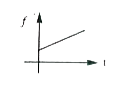
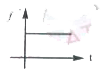
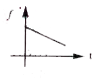
An observer starts moving with uniform acceleration a' towards in stationary sound source of frequency f. As the observer approaches the source, the apparent frequency f' heard by the observer varies with time t as: |
|
Answer»
|
|
| 14. |
Explain why the colour of the sky is blue (Cyan). |
|
Answer» Solution :(a) As per Rayleigh.s law ( scattering `alpha1//lamba^(4)` ) , lights of shorter WAVELENGTHS are scattered more by the ATMOSPHERIC particles. This results in a dominance of bluish COLOURS in the scattered LIGHT. (b) In the visible spectrum, violet light having its shortest wavelength, has the highest REFRACTIVE index. Hence it is deviated the most. |
|
| 15. |
Deduce an expression for the electrostatic energy stored in a capacitance 'C' and having charge Q How will theenergy stored |
|
Answer» Solution :If the space between the plates of capacitor filled with a DIELECTRIC MATERIAL of dielectric constant . K , the CAPACITANCE of capacitor changes to C , where C. = KC `therefore` Energy stored `U. = (Q^(2))/(2C.) = (Q^(2))/(2KC) = (U)/(K)` |
|
| 16. |
Can a particle possess. (i) Zero speed and non zero velocity,. |
| Answer» SOLUTION :(II) YES, if the PARTICLE is at REST | |
| 17. |
An air capacitor is connected to a battery for a long time so that the capacitor is fully charged. Now the battery is disconnected. Then the following actions take place one after another. X - Separation between the plates is increased to double Y - A dielectric slab is inserted to occupy entire space between the plates Z - The battery is connected again |
|
Answer» `{:(P,Q,R,S),(1,2,3,4):}` When the dielectric SLAB is inserted then we know that charge remains constant because the capacitor is still not connected with the battery. Due to insertion of the slab, the capacitance increases. Hence energy stored, which is given by `U=(Q^(2))/(2C)`, decreases due to an increasein the capacitance. Hence energy stored in the capacitor decreases after Y. But after the process Z, when the battery is reconnected, further charge is supplied by the battery due to an increased capacity. Hence, the energy stored in the capacitor increases and this energy comes from work done by the battery. |
|
| 18. |
Deduce an expression for the electrostatic energy stored in a capacitance 'C' and having charge Q How will the electric field inside capacitor be affected when it is completely filled with a dielectric material of dielectric constant K ? |
|
Answer» Solution :The original electric FIELD inside capacitor `E = (sigma)/(in_(0)) = (Q)/(A in_(0))` On introducing dielectric new electric field `E. = (sigma)/(K in_(0)) = (Q)/(K A in_(0)) = (E)/(K)` Thus on introducing the dielectric , both energy stored and electric field are REDUCED by a factor . |
|
| 19. |
What we name technically long sight? |
| Answer» SOLUTION :HYPERMETROPIA | |
| 20. |
State Gauss' law in electrostatic. Using it derive an expression for the electric field due to an infinitely long straight wire of linear charge density lambdaC/m. |
|
Answer» Solution :Consider an infinitely long STRAIGHT charged wire of linear CHARGE desnsity `lambda`. To find ELECTRIC field at a point P situated at a distance R from the wire by using Guass. law consider a cylinder of length l and radius r as the Gaussian surface. From symmetry consideration electric field at each point of its curved surface is `vecE` and is point outwards normally . Therefore, electric flux over the curved surface. ` int vecE hatn ds = E 2 pi r l`  On the side face 1 and 2 of the cylinder normal drawn on the surface is perpendicular to electric field E and hence these surfaces do not contribute towards the total electric flux. `therefore ` Net electric flux over the entire Gaussian surface `phi_E = E. 2pi r l` By Gauss law electric flux `phi_E = 1/(epsi_0)` (charge enclosed)`= (lamdbal)/(epsi_0)` Comparing (i) and (ii) , we have `E. 2 pi rl= (lambdal)/(epsi_0)` `impliesE = (lambda)/(2 pi epsi_0 r)` As `E prop 1/r` , hence E -r shown in fig. 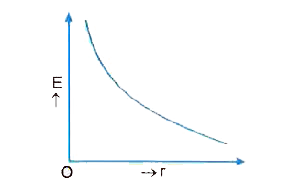
|
|
| 21. |
There are two concentric spherical shells of ratii r and 2r. Intially a charge Q is given to the inner shell. Now switch S_(1)is closed and S_(2) is opned and the process is repeated n times for both the keys altermatively. Find the final potential between the shells. |
|
Answer» `(1)/(4^(n+1))[(Q)/(2piepsilon_(0)r)]` |
|
| 22. |
A body of mass m falls from a height h_1 and rises to a height h_2. The magnitude of the change in momentum during the impact with the ground. |
|
Answer» `mg (h_1 + h_2)` |
|
| 23. |
If R is universal gas constant, then the amount of heat needed to raise the temperature of 2 moles of an ideal monoatomic gas from 273 K to 373 K when no work is done is |
|
Answer» 500R |
|
| 24. |
In the given arrangements the charges given to the metallic plates A,B and D are Q_(0), Q_(0) and 2Q_(0) respectively, the metal plate C is neutral (separation distance between the plates is d. (d is very small when compared to plate area dimensions) When all the switches are closed. The amount of the charge passing through the switch SI is |
|
Answer» `(Q_(0))/(3)` |
|
| 25. |
The refractive indices of violet and red light are 1.54 and 1.52 respectively. If the angle of prism is 10^@, then the angular dispersion is |
|
Answer» 0.02 |
|
| 26. |
Which of the following qualities are best suited for a cooking utensil ? |
|
Answer» High specific heat and low thermal conductivity CORRECT choice is (d). |
|
| 27. |
C,Si and Ge have same lattice structure.Why is C insulator while Si and Ge instinsic semiconductors? |
| Answer» Solution :The 4 bonding electronsof C, SI or Gelie, RESPECTIVELY,in the SECOND , third and fourth orbit . Hence , energy REQUIRED to take out and electron from these atoms (i.e., ionisation energy `E_(g ) `)will be LEAST for Ge,following by Si and highest for C. Hence, number of free electrons for conduction in Ge and Si are significant but negligiblesmall for C. | |
| 28. |
If vecP=hati+2hatj+6hatk tits direction cosines are |
|
Answer» `(1)/(41), (2)/(41) and (6)/(41)` |
|
| 29. |
Tow charges pm10 mu C are placed 5.0 mm apartdeterminethe electric field at (a)a pointp onthe axisof the dipole15 cm away from its centre o ont the side of the positivecharge as(a) and (b)a point q 15 cm away from o on a line passing through o and normal to the axis of the dipole as |
|
Answer» Solution :(a) fieldat p due to CHARGE + 10 `muc` `=(10^(-5) c)/(4pi(8.854 xx10^(-12)C^(2)N^(-1)m^(-2)))xx(1)/((15+0.25)^(2)xx10^(-4)m^(2))` `=3.86 xx10^(6) NC^(-1)` along PA in thisexamplethe ratios OP/OB is quite large (=60)thuis we can expect to get approximately the saem result as above by directly using field at a distance r form the centreon the axis of the dipolehas a magnitude field at Q dueto charge =-10 `muc`at a clearlythe COMPONENTS of thesetwo forces with equal magnitudes cancel alongthe directionOQbut add up along the direction parallel to BA thereforethe resultant electric fieldat Q due to the two charges at A and B is `=1.33xx10^(5) NC^(-1)` along BA as in (a) we can expectto get approximately the same result by directly using the formula for dipolefieldat a pointon the normal to the axis of thedipole `E=(P)/(4pi epsilon_(0)r^(3))` `=1.33 xx10^(5) NC^(-1)` The directionof electric fieldin the this case is opposite to the direction of the DIPOLE maoment vector again the result agrees with that OBTAINED before |
|
| 30. |
3D षट्कोणीय निबिड़ संकुल में C.N. कितना है - |
|
Answer» 4 |
|
| 31. |
Take A and B input waveforms similar to that in Example. Sketch the output waveform obtained from AND gate. |
Answer» Solution : Based on the above, the OUTPUT WAVEFORM for AND GATE can be DRAWN as given below: 
|
|
| 32. |
Electric field and electric potential inside a hollow conducting sphere of radius 'r' carrying a charge 'q' are respectively. |
|
Answer» 0,0 |
|
| 33. |
A black body at 1227^(@)C emits radiations with maximum intensity at wavelength of 5000 Å. If temperature of the body is increased by 1000^(@)C, the maximum intensity will be observed at : |
|
Answer» `3000Å` `lamda_(2,)=(lamda_(1m)*T_(1))/(T_(2))=(5000xx1500)/(2500)=3000Å` CORRECT choice is (a). |
|
| 34. |
How do we determine the electric field due to a continuous charge distribution ? Explain. Electric field due to continous charge distribution |
Answer» SOLUTION :The electric charge is quantized microscopically . The expressions of Coulomb.s Law , superposition principle force and electric field are applicable to only point charges . While dealing with the electric field due to a charged sphere or a charged wire etc. it is very difficult to look at individual charges in these charged bodies . Therefore it is assumed that charge is distributed continuously on the charged bodies and the discrete nature of charges is not considered here. The electric field due to such continuous charge distributions is found by invoking the method of calculus. Consider the FOLLOWING charge object of irregular shape . The entire charged object is divided into a large number of charge elements `Deltaq_(1),Delta_(2),Delta_(3)......Deltaq_(n),......` and each charge element `Delta_(q)` is taken as a point charge . The electric field at a point P due to a charged object is approximately given by the sum of the fields at P due to all such charge elements .  ` <br> `vecE~~(1)/(4piepsilon_(0))((Deltaq_(1))/(r^(2))hatr_(1p)+(Deltaq_(2))/(r^(2))hatr_(2p)+cdots+(Deltaq_(n))/(r_(nP)^(2))hatr_(nP))~~(1)/(4piepsilon_(0))sum_(i-1)^(n)(Deltaqhati)/(r_(iP)^(2))hatr_(iP)`<br> Here `Delta qi` is the `i^(th)` charge element `r_(iP)` is the distance of the point P from the `i^(th)` charge element and `hatr_(iP)` is the unit vector from ith charge element to the point P. However the equation is only an approximation . To incorporate the continuous distribution of charge we take the limit `Deltaq rarr 0 (=dq)` . In this limit the summation in the equation becomes an integration and takes the following form <br> `vecE=(1)/(4piepsilon_(0))int(dq)/(r^(2))hatr` <br> Here r is the distance of the point P from the <klux>INFINITESIMAL</klux> charge dq and `hatr` is the unit vector from dq to point P. Even though the electric fiel for a continuous charge distribution is difficult to evaluate the force experienced by some test charge q in this electric field is still is still given by `vecF=qvecE`. <br> (a) Line charge distribution : If the charge Q is uniformly distributed along the wire of length L, then linear charge density ( charge <klux>PER</klux> unit length ) is `lambda=(Q)/(L)` . Its unit is coulomb per meter `(Cm^(-1))` . The charge present in the infinitesimal length dl is dq `= lambdadl` <br> <img src=) The electric field due to the line of total charge Q is given by `vecE=(1)/(4piepsilon_(0))int(lambdadl)/(r^(2))hatr=(lambda)/(4piepsilon_(0))int(dl)/(r^(2))hatr` (b) Surface charge distribution : If the charge Q is uniformly distributed on a surface of area A then surface density ( charge per unit area ) is `sigma=(Q)/(A)` . Its unit is coulomb per square meter `(Cm^(-2))` .The charge present in the infinitesimal area dA is dq = `sigmaA`. The electric field due to a of total charge Q is given by `vecE=(1)/(4piepsilon_(0)) int(sigmada)/(r^(2))=(1)/(4piepsilon_(0)) sigma int(da)/(r^(2))hatr ` (c ) Volume charge distribution : If the charge Q is uniformly distributed in a volume V then volume charge density ( charge per unit volume ) is given by `rho=(Q)/(V)` . Its unit is coulomb per cubic meter `(Cm^(-3))` The charge present in the infinitesimal volume element dV is dq = `rhodV`. The electric field due to a volume of total charge Q is given by `vecE=(1)/(4piepsilon_(0))int (rhodV)/(r^(2))=(1)/(4piepsilon_(0))rho int (dV)/(r^(2))hatr`. |
|
| 35. |
Show that two waves interfere destructively when the path difference between them is an odd multiple of half wavelength. |
|
Answer» Solution :Let `Y_1=A sin (omega t-phi_1) and Y_2 = A sin (omega t-phi_2)` represent two interfering WAVES. Their resultant displacement `Y=A sin (omega t-phi)` where, `A=sqrt(A_1^2+A_2^2+2A_1 A_2 cos (phi_1-phi_2))` `phi=tan^(-1)((A_1 sin phi_1+A_2 sin phi_2)/(A_1 cos phi_1+A_2 cos phi_2))` For a destructive interference, `A=A_("min") and cos (phi_1-phi_2)=-1` so that `A=A_1-A_2` i.e., `phi_1-phi_2=1pi,3pi,5pi,..........(2n+1)PI` or `phi_1-phi_2=(2n+1)pi` where `n=0,1,2,3,..........` In terms of path difference, `delta=(lambda)/(2pi)(2n+1) pi ` so that `delta =(2n+1)(lambda)/(2)` For a constructive interference `delta =2n((lambda)/(2))` and for a destructive interference path difference between the waves `delta=(2n+1)(lambda)/(2)` |
|
| 36. |
Suppose that the particlein Q.33 is an electron projectedwith velocity v_(x) = 2.0xx10^(6) ms^(-1). If E between the platesseparatedby 0.5 cm is 9.1xx10^(2) N//C, where will the electron strike the upperplate ? (|e| = 1.6xx10^(-19) C,m_(e) = 9.1xx10^(-31) kg). |
|
Answer» Solution :Here,`v_(x) = 2.0xx10^(6) ms^(-1), E = 9.1xx10^(2) N//C,d = 0.5 cm = 5xx10^(-3)m` `q = e = 1.6xx10^(-19) C, m_(e) = 9.1xx10^(-31) kg` The electron will strikethe upperplate at its other endat `x = L` is SOON as itsdeflection `y = (d)/(2) = (5xx10^(-3))/(2) = 2.5xx10^(-3) m` From `y = (qE L^(2))/(2 mv_(x)^(2))` `L = sqrt((2my)/(qE)) xx v_(x) = sqrt((2xx9.1xx10^(-31)xx2.5xx10^(-3))/(1.6xx10^(-19)xx9.1xx10^(2))) xx2xx10^(6) = 1.12xx10^(-2) m = 1.12 cm` Hence the electronwill strikethe upperplateat itsother end, if length of plate is 1.12 cm. |
|
| 37. |
A circular coil of wire has 25 turns and has a radius of 0.075 m. The coil is located in a variable magnetic field whose behavior is shown on the graph. At all times, the magnetic field is directed at an angle of 75° relative to the normal to the plane of a loop. What is the average emf induced in the coil in the time interval from t = 5.00 s to 7.50 s? |
|
Answer» `-18mV` |
|
| 38. |
Two balls are dropped from the same height at two different places A and B where the acceleration due to gravities are g_(A) and g_(B).The body at 'B' takes 't' seconds less to reach the ground and strikes the ground with a velocity greater than at 'A'' by upsilon m/s.Then the value of 'upsilon//t' is |
|
Answer» `(1)/(SQRT(g_(A)g_(B)))` |
|
| 40. |
Heavy stable nuclei have more neutrons then protons this is because of…. |
|
Answer» neutrons are heavier than proton |
|
| 41. |
(a) Explain the principleof working of a potentiometer. (b) In a potentiometer, a standard source of emf 5 V and negligible internal resistance maintains a steady current through the potentiometer wire of length wire of length 10 m. Two primary cells of emf E_1 and E_2 are joined together in a series with (i) same polarity and (ii) opposite polarity. The combination is connected to the potentiometer circuit in each case. The balancing length of the wire in the two cases are found to be 700 cm and 100 m , respectively . Find the values of emf of the two cells. |
|
Answer» Solution :(a) Let a battery of emf `epsilon_0` us connected across a potentiometer wire of length L and resistance R and an external series resistance R.. Then constant current flowing through the potentiometer wire is `I=(epsilon_0)/((R+R.))` `:.` Fall in potential along the potentiometer wire `= IR = (epsilon_0R)/((R+R.)L)` , and the fall in potential per (i.e., the potential GRADIENT)`K= (epsilon_(0)R)/((R+R^(.)L))`which is a constant. Thus, potential drop across a length l of potentiometer wire V = kl , which is the BASIC, working principle of the potentiometer . Here emf of driver cell E = 5 V, length of of potentiometer wire L = 10 m = 100 cm `:.` Potential gradient k `E/L=(5V)/(100 cm ) = 0.005V cm ^(-1)` (i) When cells of emf `E_1 and E_2` are joined together in series with same polarity then balancing length `l_1 = 700 cm ` and we have `E_1 +E_2 =krho_(1) = 0.005xx700= 3.5 ""...(i)` (ii) When the same cells are joined in series with opposite polarity , the balancing length `l_2=100 cm` and we have `E_1 -E_(2)=krho_(2)=0.005xx100=0.5 ""...(ii)` From (i) and (ii) , on solving , we GET `E_1 = 2.0 V and E_2 = 1.5 V` 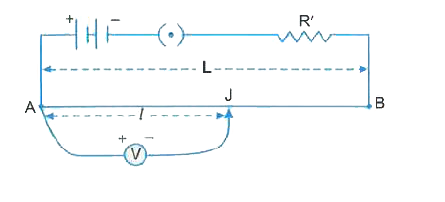
|
|
| 42. |
In the given circuit diagram if each resistance is of 10 Omega, then the current in arm AD will be |
|
Answer» `(i)/(5)` |
|
| 43. |
In an A.C. circuit maximum voltage and maximum currents are 200 V and 2.2A respectively. Calculate power and power factor in the circuit. (Here X_C=60 Omega and R=80 Omega ) |
|
Answer» <P> SOLUTION :Here, `V_m`=200 V, `I_m`=2.2A , `X_C=60Omega,R=80 Omega``|Z|=sqrt(R^2+X_C^2)` `=sqrt((80)^2+(60)^2)=sqrt(6400+3600)` `=sqrt10000` `therefore |Z|=100 Omega` power factor `cosdelta=R/"|Z|"=80/100` `therefore cos delta=0.8` `therefore` Power consumed in the circuit `P=V_m/sqrt2. I_m/sqrt2 "cos" delta` `therefore P=(V_mI_m)/2 "cos" delta` `therefore P=(200xx2.2xx0.8)/2 therefore` P=176 W |
|
| 44. |
A stick o fmas density lamda=8kg//m rests on a disc of radius R=20cm as shown in the figure. The stick makes an angle theta=37^(@) with the horizontal and is tangent to the disc at its upper end. Friction exists at all point of contact and assume that it is large enough to keep the system at rest. Find the friction force (in Newton) between the ground and the disc. (take g=10m//s^(2)) |
|
Answer» `N=(Mg)/2 COS theta` For disc, `N sintheta=f+fcostheta` `:.f=(Nsintheta)/(1+costheta)=(Mgsinthetacostheta)/(2(1+costheta)` `M=lamdaL` and `L=R/("TAN"(theta)/2)` `f=1/2 lamda R cos theta` `=1/2 xx8xx10xx2/10xx4/5` `=32/5=6.40N` 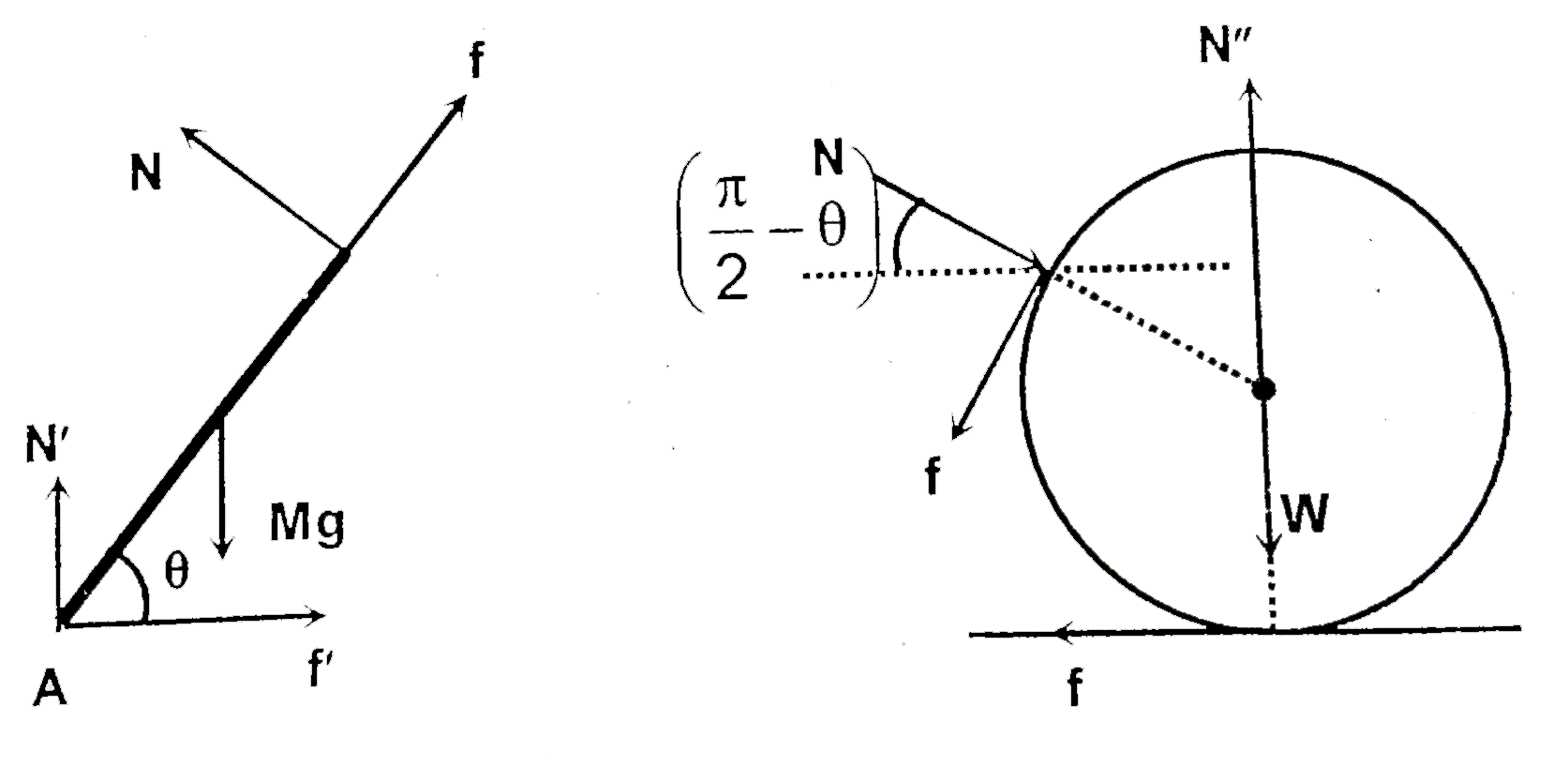
|
|
| 45. |
Fig. shows the plot of the function y(x) representing a fraction of the total power of thermal radiation falling within the spectral interval from 0 to x. Here x = lambda//lambda_(m)(lambda_(m) is the wavelength corresponding to the maximum of spectral radiation density). Using this plot, find: (a) the wavelength which divides the radiation spectrum into two equal (in terms of energy) parts at the temperature 3700K, (b) the fraction of the total radiation power falling within the visible range of the spectrum (0.40-0.76 mu m) at the temperature 5000K, (c) how manu times the power radiated at wavelengths exceeding 0.76mu m will increase if the temperature rises form 3000 to 5000K. |
|
Answer» Solution :(a) From the CURVE of the FUNCTION `y(x)` we see that `y = 0.5` when `x = 1.41` Thus `lambda = 1.41 xx (0.29)/(3700)cm = 1.105mum` (b) At `5000K` `lambda = (0.29)/(5)xx10^(-6)m = 0.58mu m` So the VISIBLE range `(0.40` to `0.70)mu m` corresponds to a range `(0.69` to `1.31)` of `x`. From the curve `y(0.69) = 0.07` `y(1.31) = 0.44` so the fraction is `0.37` (c ) The value of `x` corresponding to `0.76` are `x_(1) = 0.76//(0.29)/(0.3) = 0.786` at `3000K` `x_(2) = 0.76//(0.29)/(0.5) = 1.31` at `5000K` The requisite fraction is then `((P_(2))/(P_(1))) = underset("ratio of t otal POWER")underset(uarr)(((T_(2))/(T_(1)))^(4))xxunderset("ratio of the fra ction of required wavel eng ths i n the radiated power")underset(uarr)((1-y_(2))/(1-y_(1)))` `= ((5)/(3))^(4) xx(1-0.44)/(1-0.12) = 4.91` |
|
| 46. |
A string under tension tau_(1) oscillates in the third harmonic at frequency f_(3), and the waves on the string have wavelength lambda_3, If the tension is increased to tau_(f)= 8tau_(i), and the string is again made to oscillate in the third harmonic, what then are (a) the frequency of oscillation in terms of f_3 and (b) the wavelength of the waves in terms of lambda_(3)? |
|
Answer» |
|
| 47. |
(i)State the principle of working of a metre bridge.(ii) In a metre bridge balance point is found at a distance l_1with resistances R and S as shown in the figure.When an unknown resistance X is connected in parallel with the resistance S, the balance point shifts to a distance l. Find the expression for X in terms of l_1 ,l_2and S. |
|
Answer» SOLUTION :(i) A metre bridge is a practical form of Wheatstone.s bridge. Generally in the left gap of metrebridge a known RESISTANCE R is CONNECTED and in the right gap an unknown resistance X is connected. If on sliding the jockey null point is obtained at a distance l from ZERO END of bridge wire, then `X = R . ((100 - l))/(l)` (ii) Applying the formula for balanced metre bridge in first case, we have ` R/S = (l_1)/((100 - l_1))`...(i) In second case in right gap S and X are arranged in parallel and have a net resistance of`((SX)/(S+X))` ` therefore (R )/((SX)/(S + X))= (l_2)/((100 - l_2))`....(ii) Dividing (ii) by (i) , we have `(S+X)/(X) =l_2/l_1.((100 - l_2))/((100 - l_2)) ` or`S/X+ 1 = l_2.l_1 ((100 - l_1))/((100 -l_2))` ` rArr X = (S)/(l_2/l_1. ((100 - l_1)/(100 - l_2)) - 1)` |
|
| 48. |
Draw field lines on a bar magnet, a current carrying finite solenoid and electric dipole. |
Answer» Solution : In FIGURE, the field lines of (a) a bar MAGNET, (b) a current carrying finite SOLENOID and (c) electric DIPOLE are shown. Field lines represents the picturetorial REPRESENTATION of the field.s existance. |
|
| 49. |
The type of modulation which are possible, are: |
|
Answer» ONE only |
|
| 50. |
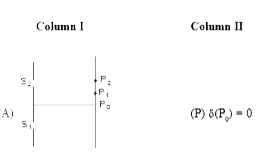
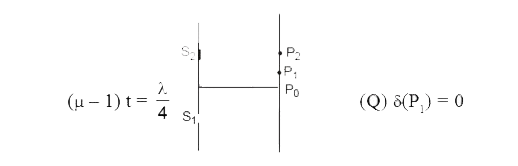
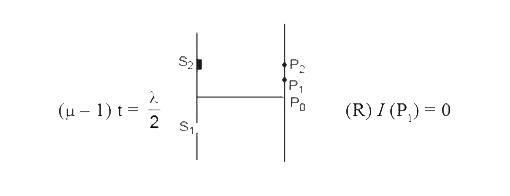
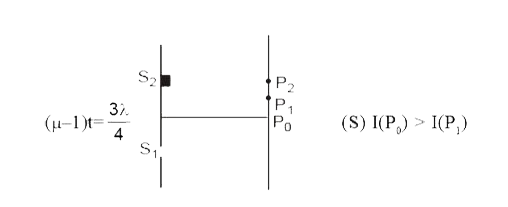
Column I shows four situations of standard Young’s double slit arrangement with the screen placed far away from the slits S_(1) and S_(2) . In each of these cases S_(1)P_(0)=S_(2)P_(0), S_(1)P_(1)-S_(2)P_(1)=lambda//4 and S_(1)P_(2)-S_(2)P_(2)=lambda//3, where lambda is the wavelength of the light used. In the cases B,C and D, a transparent sheet of refractive index mu and thickness t is pasted on slit S_(1) . The thicknesses of the sheets are different in different cases. The phase difference between the light waves reaching a point P on the screen from the two slits is denoted by delta (P) and the intensity by I(P). Match each situation given in Column I with the statement(s) in Column II valid for that situation. |
|
Answer»
|
|