Saved Bookmarks
This section includes 7 InterviewSolutions, each offering curated multiple-choice questions to sharpen your Current Affairs knowledge and support exam preparation. Choose a topic below to get started.
| 1. |
Derive an expression for the impedance of an a.c. circuit consisting of an inductor and a resistor. |
|
Answer» Solution :Consider a circuit having an inductance L and a RESISTANCE R, joined in series, to an a.c. supply. Let voltage provided by a.c. supply be `V= V_(m) sin omega t`. Let an instantaneous CURRENT I flows through the coil. Then instantaneous values of potential drops across inductance and resistance are given by:  `vecV_(L) =I X_(L)` and `vecV_(R) = IR`, where `X_(L) = omega L` is the reactance due to the inductance. Moreover phasor `vecV_(R)` and `vecV_(L)` be represented by OA and OB in a phasor diagram.  Then RESULTANT voltage `vecV` will be given by the phasor OC. Hence, `V = OC = sqrt(OA^(2) + OB^(2))` `=sqrt(V_(R)^(2) + V_(L)^(2))= Isqrt(R^(2) + X_(L)^(2))` `therefore` Impedance of the coil `Z = V/I = sqrt(R^(2) + X_(L)^(2)) = sqrt(R^(2) + L^(2) omega^(2))` Moreover, the circuit voltage V is ahead in phase as compared to circuit current I (or current I is lagging behind the source voltage V) by a phase angle `phi` , where `tan phi = (AC)/(OA) = (OB)/(OA) = (IX_(L))/(IR) =X_(L)/R = (Lomega)/R` |
|
| 2. |
Sirius A and Sirius B are two components of Sirius binary. The distance between the two components is 20.3AUand the period of revolution about their common centre of mass is 49.9 years. If the ratio of the masses of two components os 2.356, find the mass of the two components. |
|
Answer» |
|
| 3. |
Masses of three wires of copper are in the ratio 1 : 3 : 5and their lengths are in the ratio 5 : 3 : 1 The ratio of their electrical resistance are |
|
Answer» `1:15: 125 ` ` R ALPHA(1)/(A ), alpha (I^2)/(m)` |
|
| 4. |
Two metallic plates P (collector) and Q (emitter) are separated by a distance of 0.10 meter. These are connected through an ammeter without any cell. A magnetic field B exists parallel to the plates. Light of wavelength between 4000Å and 6000Å fall on the plate whose work function is 2.39eV. Calculate the minimumvalue of B for which the current registered with ammeter is zero. Use, h=6.6xx10^(-34)Js, e=1.6xx10^(-19)C |
|
Answer» Solution :Energy of the incident photon of light of wave length `6000Å` is `E=(hc)/lambda=((6.6xx10^(-34))xx(3xx10^(8)))/(6000xx1.6xx10^(-19))eV=2.01eV` Since this value of energy is less than work function `(=2.39eV)` of the metal, hence no photoelectron is emitted for light of wavelength `6000Å` Since the energy of photon of light of wavelength `4000Å` is greater than 2.39 eV , so photoelectric emission takes place with its helt. Maximum K.E. of the emitted photoelectron is `K_(max)=1/2mv_(max)^(2)=(hc)/lambda-phi_(0)= ((6.6xx10^(-34))xx(3xx10^(8)))/(4000xx10^(-10)xx1.6xx10^(-19))-2.39eV` `=3.1-2.39=0.71 eV=0.71xx1.6xx10^(-19)J` `v_(max)=[(2xx0.71xx1.6xx10^(-19))/(9.1xx10^(-31))]^(1//2)=5XX10^(5)m//s` For zero constantl,`(MV^(2))/r=evB or B=(mv)/(er)=((9.1xx10^(-31))xx5xx10^(5))/((1.6xx10^(-19))xx0.1)=2.86xx10^(-5)T` |
|
| 5. |
What happened to the author's body when he managed to reach the deck? |
|
Answer» His head smashed again |
|
| 6. |
A device in which P and N-type semiconductors are used is more useful then a vacuum type because |
|
Answer» POWER is not neccesaryto HEAT the FILAMENT |
|
| 7. |
What are the advantages of using a potentiometer? |
| Answer» Solution :Potentiometer can be used to measure e.m.f. of a cell, when the cell connected in the SECONDARY circuit does not DRAW any current. Hence, its e.m.f is measured against, balanced wire. No other instrument measure e.m.f of a cell EXCEPT ammeters and VOLTMETERS. | |
| 8. |
What is meant by de Broglie waves ? |
| Answer» Solution :According to de Broglie hypothesis, all MATTER PARICLE like electrons, PROTONS, neutrons in motion are ASSOCIATED with waves.These waves are CALLED de Broglie waves or matter waves. | |
| 9. |
A projectionis firedwith a velocityu at rightanglesto the eslope, whichis inclined at an angle theta with the horizontal . Derive an expressionfor the distanceR to thepointof impact. |
| Answer» Solution :`R = (2U^(2))/(G) tanthetasec THETA ` | |
| 10. |
The angle of dip at a place where horizontal and vertical components of earth's magnetic field a equal is |
| Answer» ANSWER :A | |
| 12. |
Which of the following frequencies will be suitable for beyond the horizon communication using sky waves? |
| Answer» Solution :Frequency of 10 KHz will require very large radiating antenna while FREQUENCIES 1GHZ and 1000 GHz will penetrate the ionosphere and cannot be reflected by it. | |
| 13. |
A total charge Q is distributed uniformly along a metallic ring of radius R. Two small elemental lengths each dx are removed at an angular separation 2theta, relative to the centre O. Find the electric field intensity at O. |
|
Answer» |
|
| 14. |
Which one of the two, an ammeter or a milliammeter, has a higher resistance and why? |
| Answer» SOLUTION :MILLIAMMETER. Toproducelargedeflectiondue tosmallcurrentweneedalargenumberofturnswe needa largenumberoftrunsin ARMATURE COIL ` RARR ` Resistanceincreases. | |
| 15. |
A hot liquid kept in a beaker cools from 80^(@)C to 70^(@)C in two minutes. If the surrounding temperature is 30^(@)C then the time of cooling of the same liquid from 60^(@)C to 50^(@)C is : |
|
Answer» 240 s `(theta_(1)-theta_(2))/(t)=K[(theta_(1)+theta_(2))/(2)-theta_(0)]` where `theta_(0)` is temperature of currounding. `:.(80-70)/(2)=K[(80+70)/(2)-30]` . . . (i) Also `(60-50)/(t)=K[(60+50)/(2)-30]`. . . (II) DIVIDING (i) by (ii) we have : `t/2=(75-30)/(55-30)rArr(t)/(2)=(45)/(25)` `rArrt=(45)/(25)xx2=(90)/(25)=(18)/(5)=3*6` minutes. `=216` seconds correct CHOICE is (d). |
|
| 16. |
Which of the following statements is true concerning phase changes? |
|
Answer» When a liquid freezes, it releases THERMAL energy into its immediate environment. |
|
| 17. |
The linear speed of the electron in the nth Bohor orbit of the hydrogen atom is proportional to……… |
|
Answer» n `impliesv=(nh)/(2pi)xx(1)/(MR)` For H atom `R=(n^(2)h^(2)epsi_(0))/(pie^(2)m)` `impliesv=(nh)/(2pi)xx(pie^(2)m)/(n^(2)h^(2)epsi_(0)m)=((e^(2))/(2hepsi_(0)))xx(1)/(n)` `impliesv=(nh)/(2pi)xx(pie^(2)m)/(n^(2)h^(2)epsi_(0)m)=((e^(2))/(2hepsi_(0)))xx(1)/(n)` |
|
| 18. |
A particle is executing S.H.M.if v1 and v2 are the velocities of the particle at distances X1 nad X2 from mean position respectively , then time period of oscillation is |
|
Answer» `2πsqrt(((x_2^2+x_1^2))/((V_1^2+V_2^2)))` |
|
| 19. |
Circular part in the centre of retina is called |
|
Answer» BLIND SPOT |
|
| 20. |
What is the effect of metallic core on self inductance? |
| Answer» SOLUTION :It INCREASES the SELF INDUCTANCE | |
| 21. |
In a high-energy collision between a dcosmic-oray particle and a particle near the top of Earth's atmosphere, 120 km above sea level, a pion is created. The pion has a total energy E of 4.00xx10^(5) MeV and is traveling vertically downward. In the pion's rest frame, the pion decays 35.0 ns after its creation. At what altitude above sea level, as measured from Earth's reference frame, does the decay occur? The rest energy of a pion is 139.6 MeV. |
|
Answer» |
|
| 22. |
An electron of mass 'm' and charge 'e' accelerated from rest through a potential of V volt , then its final velocity is |
|
Answer» `sqrt((V_(E ))/( m ))` |
|
| 23. |
Whena viscousliquid flows , adjacentlayersopposetheir relativemotion by applyinga viscousforcegiven by F = - eta A (dv)/(dz) where , ete= coefficientof viscosity, A = surface areaof adjacentlayers in contact, (dv)/(dz) = velocity gradient Now , a viscous liquid havingcoefficient of viscosityetais flowingthrough a fixedtube of lengthl and radiusR undera pressure difference P between the two ends of the tube . Nowconsider a cylindrical vloumeof liquidof radius r . Dueto steadyflow ,net forceon the liquidincylindricalvloumeshouldbe zero .- eta 2pirl (dv)/(dr) = Ppir^(2) - int _(v)^(0),dv = P/(2 eta l) int_(tau)^(R) rdr( :'layerin contactwith the tube is stationary )v = v_(0)(1- (r^(2))/(R^(2))), wherev_(0) = (PR^(2))/(4nl):."" Q = (piPR^(4))/(8sta l) Thisis calledPoisecuille'sequation . The volumeof the liquid flowing per secacross the cross - section of the tubeis . |
|
Answer» `piR^(2)v_(0)` |
|
| 24. |
Three infinitely long thin conductors are joined at the origin of coordinates and lie along the x-y- and z-axes. A current i flowing along the conductor lying along the x-axis divides equally into the othere two at the origin. The magnetic field at the point (0,-a,0) has magnitude |
|
Answer» `(mu_(0)i)/(4pia)` |
|
| 25. |
Whena viscousliquid flows , adjacentlayersopposetheir relativemotion by applyinga viscousforcegiven by F = - eta A (dv)/(dz) where , ete= coefficientof viscosity, A = surface areaof adjacentlayers in contact, (dv)/(dz) = velocity gradient Now , a viscous liquid havingcoefficient of viscosityetais flowingthrough a fixedtube of lengthl and radiusR undera pressure difference P between the two ends of the tube . Nowconsider a cylindrical vloumeof liquidof radius r . Dueto steadyflow ,net forceon the liquidincylindricalvolumeshouldbe zero .- eta 2pirl (dv)/(dr) = Ppir^(2) - int _(v)^(0),dv = P/(2 eta l) int_(tau)^(R) rdr( :'layerin contactwith the tube is stationary )v = v_(0) (1- (r^(2))/(R^(2))) , wherev_(0) = (PR^(2))/(4nl):."" Q = (piPR^(4))/(8sta l) Thisis calledPoisecuille'sequation . The velocityof flowof liquidat r = R/2 is |
|
Answer» `(3PR^(2))/(16etal)` |
|
| 26. |
A T V transmitting antenna is 80 m tall. If the receiving antenna is on the ground The service area is |
|
Answer» `12pi` SQ KM |
|
| 27. |
An example of a non-ohmic device is |
|
Answer» COPPER wire |
|
| 28. |
(a) (i) 'Two independent monochromatic sources of light cannot produce a sustained interference pattern'. Give reason. (ii) Light waves each of amplitude "a" and frequency "omega", emanating from two coherent light sources superpose at a point. If the displacements due to these waves is given by y_(1)=acosomegat and y_(2)=acos(omegat+phi), where phi is the phase difference between the two, obtain the expression for the resultant intensity at the point. (b) In Young's double slit experiment, using monochromatic light of wavelength lambda, the intensity of light at a point where path difference is lambda//3. |
|
Answer» Solution :(a) (i) Light WAVES, originating from two independent monochromatic sources, will not have a constant phase difference. Therefore, these sources will not be coherent and, therefore, would not produce a sustained interference pattern. `(II)` `y=y_(1)+y_(2)` `=acosomegat+acos(omegat+phi)` `=2acos.(phi)/(2).cos(omegat+(phi)/(2))` Amplitude of resultant displacement is `2acos.(phi)/(2)` `:.` Intensity , `I=4a^(2)cos^(2).(phi)/(2)` (b) A path difference of `LAMBDA`, corresponds to a phase difference of `2PI` `:.` The intensity, `K=4a^(2)impliesa^(2)=(K)/(4)` A path difference of `(lambda)/(3)`, corresponds to a phase difference of `(2pi)/(3)` `:.` Intensity `=4a^(2)cos^(2)phi//2` `=4xxa^(2)xxcos^(2).(2pi//3)/(2)` `=4xx(K)/(4)xx((1)/(2))^(2)=(K)/(4)` |
|
| 29. |
Suppose the sphere A and B in Question 1.12 have identical sizes.A third sphere of the same size but uncharged is brought in contact with the first ,then brought in contact with the second, and finally removed from both. What is the new force of repulsion between A and B? |
|
Answer» Solution :Since all the spheres are of same SIZE, their capacities are equaland they EQUALLY share their charges when brough in contact. On bringing 3rd sphere C in contact with ` A, q_C =q_A. =(q_A)/(2)= ( 6.5 xx10^(-7))/(2)C.` Then bringing C in contact with the B , we have ` q_C. =q_B. =(q_C+q_B) /(2)=(1)/(2)[(6.5xx 10^(-7))/(2) +6.5 xx10 ^(-7) ] =(9.75xx10^(-7))/(2) C ` ` therefore ` New forces of repulsion between A and `F=(1)/( 4pi in _0).(q_A.q_B.)/(r^(2)) =9xx10 ^(9) xx((6.5xx10^(-7))/(2)xx (9.75xx10^(-7))/(2))/((0.5)^(2) ) = 5.7xx10 ^(-3)N` |
|
| 30. |
The human eye has an approximate angular resolution of phi= 5.8 xx 10^(-4) rad and a typical photo printer prints a minimum of 300 dpi (dots per inch, linch =2.54 cm). At what minimum distance z (in cm) should a printed page be held so that one does not see the individual dots? |
|
Answer» `37.3` |
|
| 31. |
In Question (14), if the charge density at each small drop be sigma, then charge density in the larger drop is____________ |
| Answer» SOLUTION :`[N^(1//3)SIGMA]` | |
| 32. |
Two bodies and having masses in the ratio of 1:4 have K.E. in the ratio of 4: 1. The ratio of linear momentum of P&Q is : |
| Answer» SOLUTION :`(p_(1))/(p_(2))=sqrt((2m_(1)E_(1))/(2m_(2)E_(2)))=sqrt((1xx4)/(4xx1))=1`. | |
| 33. |
The binding energy of ""_(10)^(20)Neis 160.6 MeV. Find atomic mass . Given that mass of ""_1^1H = 1.007825 a.m.u mass of ""_0^1n = 1.008665 a.m.u |
|
Answer» |
|
| 34. |
What is polarisation ? |
|
Answer» |
|
| 35. |
A telescope, consisting of an objective of focal length 60 cm and a single eye lens of focal length 15 cm is focused on a distant object in such a way that parallel rays comes out from the eye lens. If the object subtends an angle 2° at the objective, the angular width of Che image is |
|
Answer» `10^(@)` |
|
| 36. |
Figure shown a uniform magnetic field B confined to a cylindrical volume and is increasing at a constant rate. The instantaneous acceleration experienced by an electron placed at P is |
|
Answer» zero, since charge on electron in constant 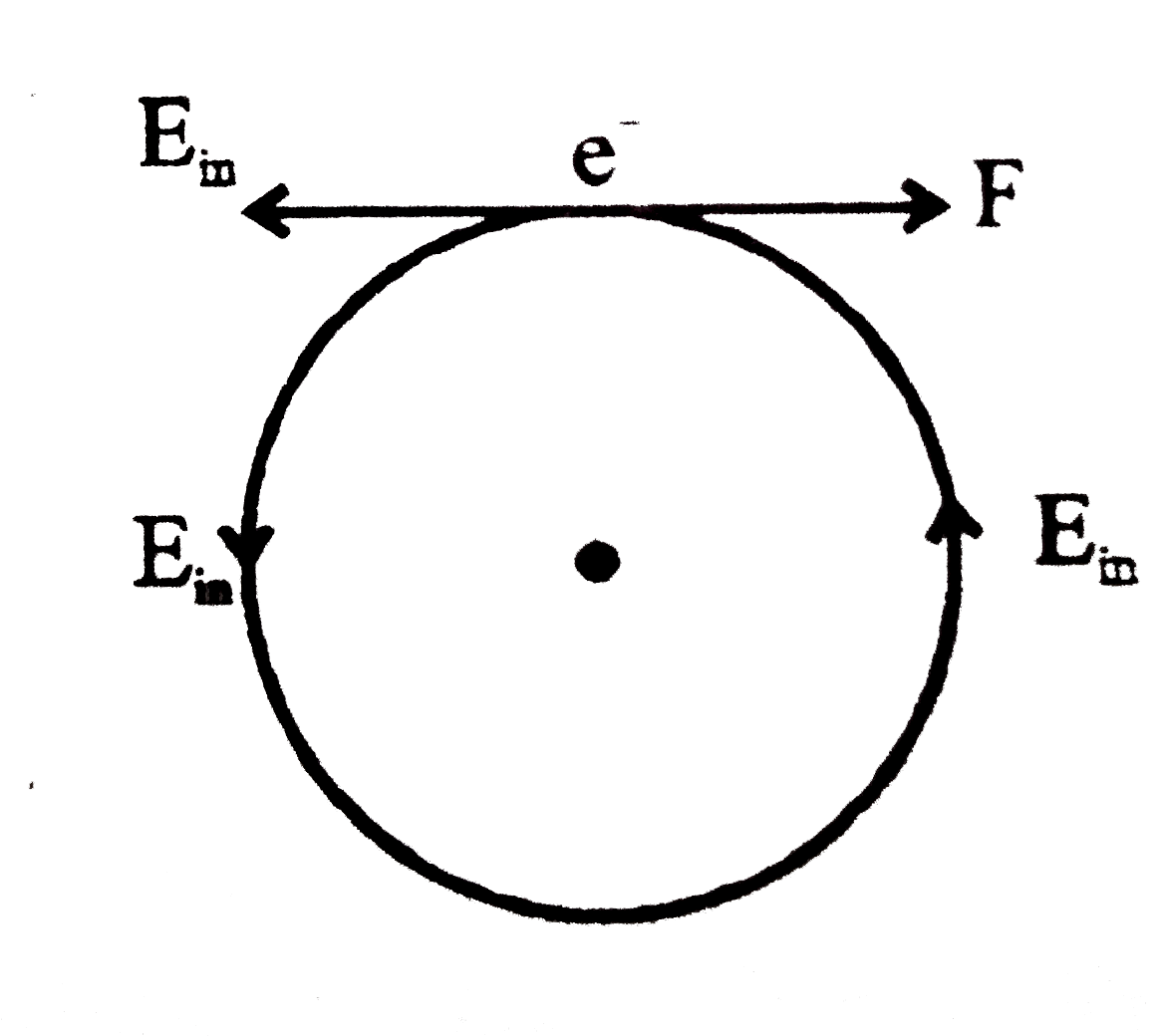 acceleration towards right. |
|
| 37. |
Which one of the following is used in TV transmission? |
| Answer» Solution :Space wave | |
| 38. |
If Foucoult's method for determining the velocity of light in air, the distance between the concave mirror and the rotating mirror was 5 km. The speed of rotation of the rotating mirror was 300 rev//s. If the reflected ray is displaced through pi/60 radian, the velocity of light in air |
|
Answer» `3 xx 10^(3)km//s` Velocity of LIGHT in air, `C=(4pinr)/300` `c =(4pi xx 300)/(pi/60) xx5xx10^(3)=4 xx 300 xx 60 xx 5 xx 10^(3)` `= 36 x 10^(7) m//s` |
|
| 39. |
A solid cube of side a and another solid cube of same material and dimension, having spherical cavity of radius (b lt a), are heated to same temperature and allowed to cool. Then |
|
Answer» initial heat loss rate will be same for both the cubes Radiation loss `PROP (T^(4)-T_(0)^(4))` |
|
| 40. |
What we call the radiowaves from the transmitting antenna when they reach the receiving antenna directly or after relectin from troposphere? |
| Answer» SOLUTION :SPACE WAVE PROPAGATION | |
| 41. |
The area of parallel plates of an air-filled capacitor is 0.20 m^(2) and the distance between them is 0.01 m. The potential difference across the plates is 3000 V. when a 0.01 m thick dielectric sheet is introduced between the plates, then the potential difference decreases to 1000 V. Now, match the two columns (all in SI units). |
|
Answer» <P> |
|
| 42. |
A straight wire of length pi//2 m is bent into a circular shape. O is the centre of the circle formed and P is a point on its axis which is at a distance of 3 times the radius from O. A current of 1 A is passed throught it. Calculate the magnitude of the magnetic field at the point O and P . |
|
Answer» Solution :CIRCUMFERENCE `C=pi/2 m rArr 2pi r = pi/2 rArr r = 1/4 m = 0.25 m` `i=1A, n=1` `B=(mu_(0))/(4pi) (2 pi n ir^(2))/((r^(2)+x^(2))^(3//2))` At O, `x=0` `B=2.5xx10^(-6)T` At, `P, x=3r = 3/4 m = 0.75m` `B=0.079 XX 10^(-6)T` |
|
| 43. |
The power of combination of two lenses o powers + 1.5 D and - 2.5 D is ....... |
|
Answer» `-1.0 D` `=-2.5 D+1.5 D=-1.0 D` |
|
| 44. |
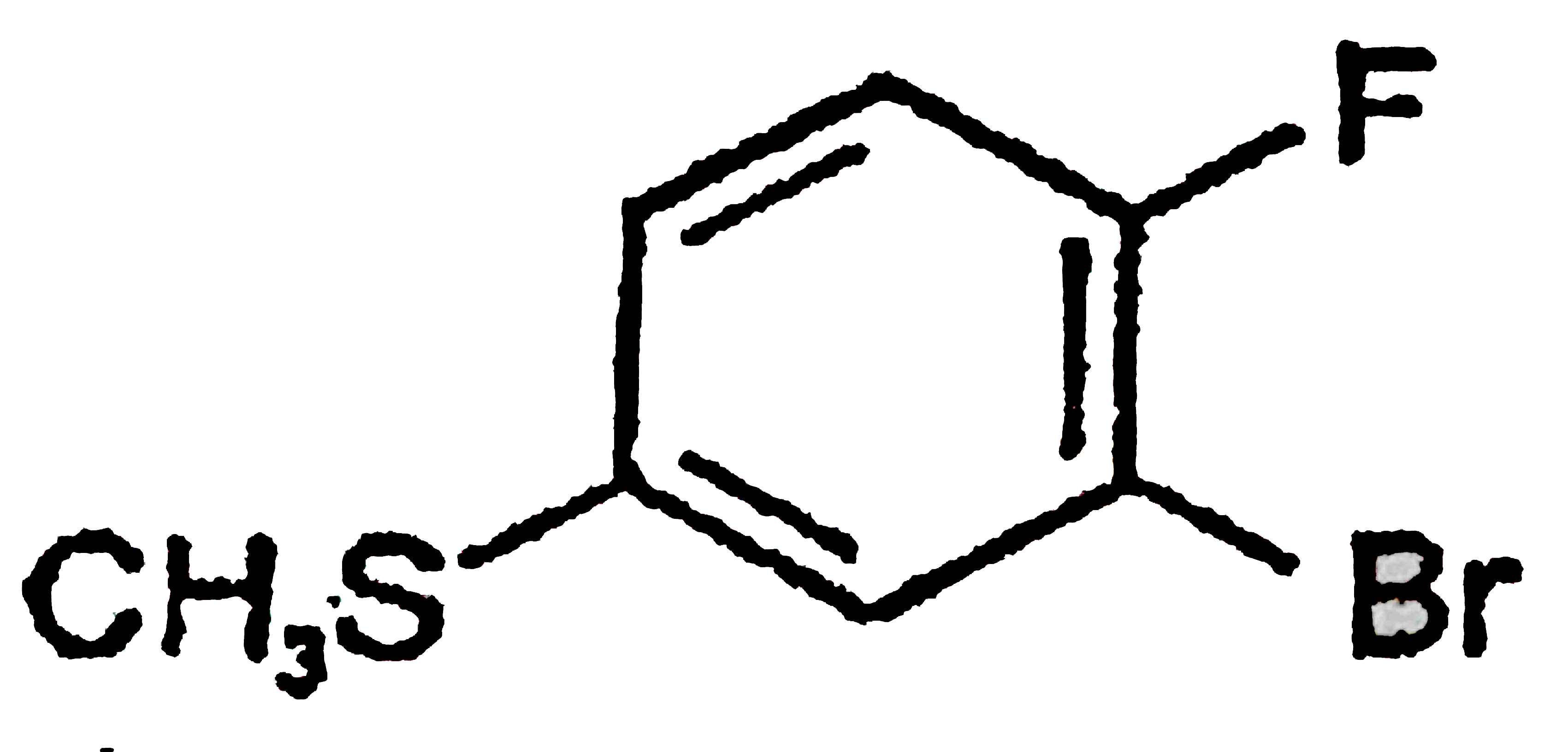
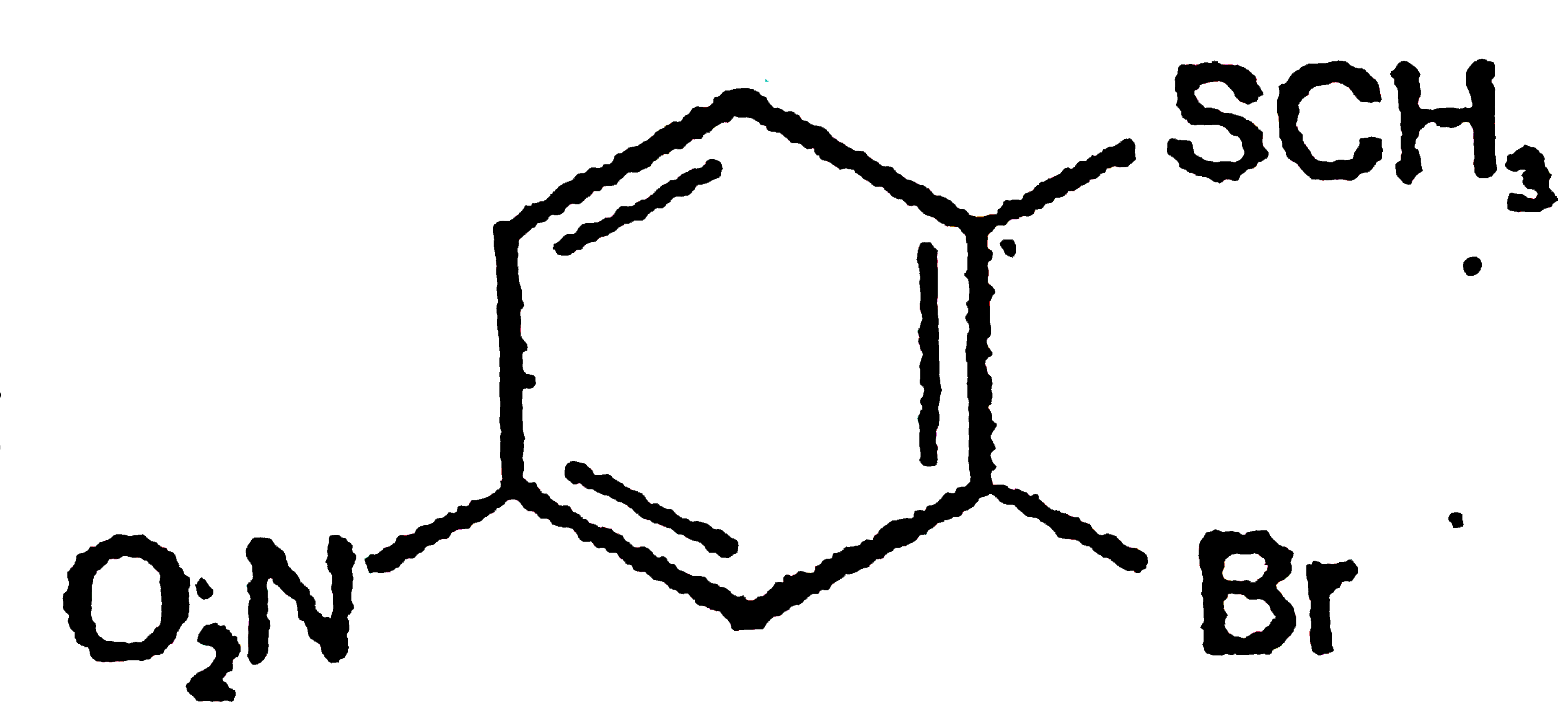
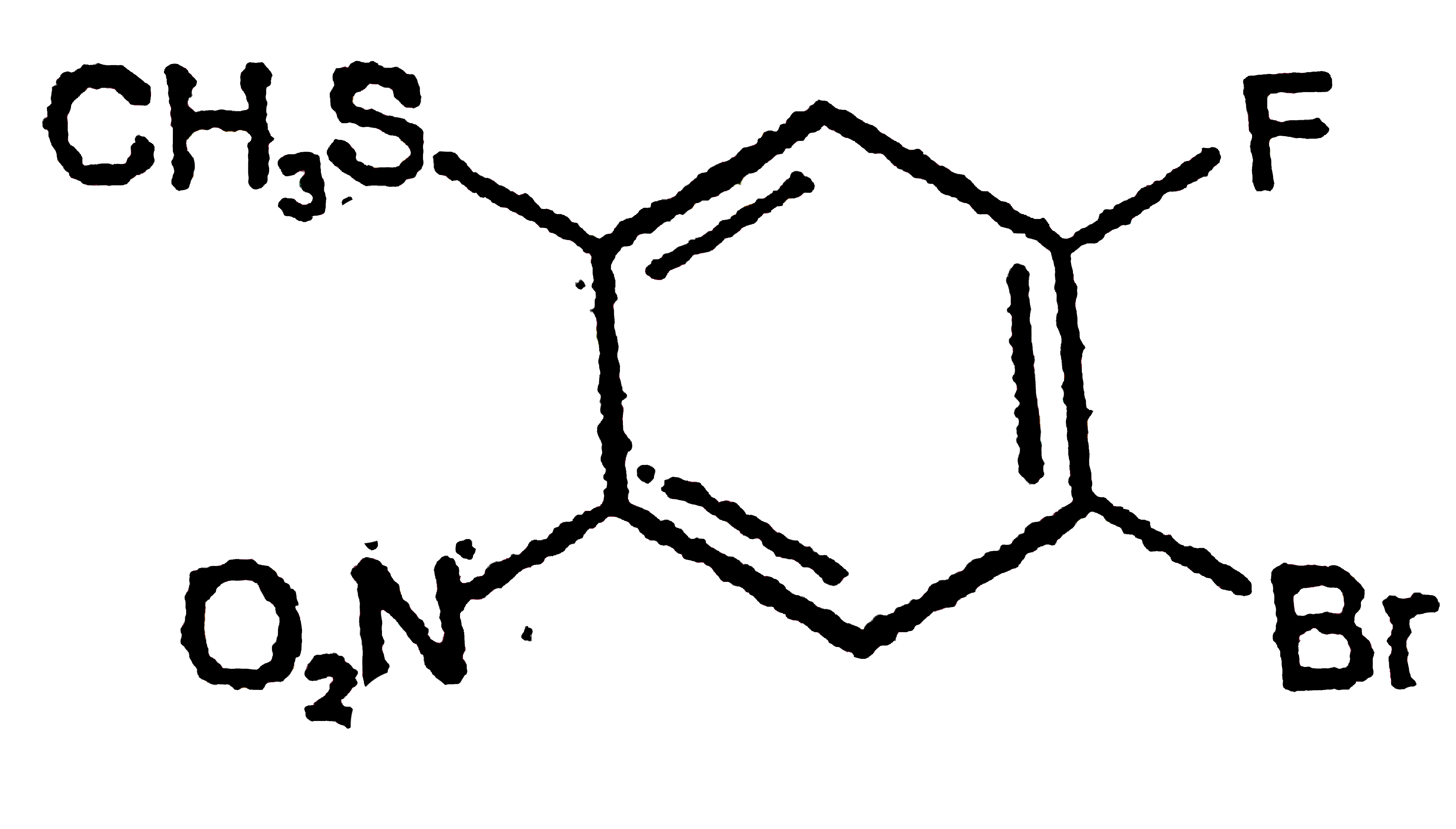
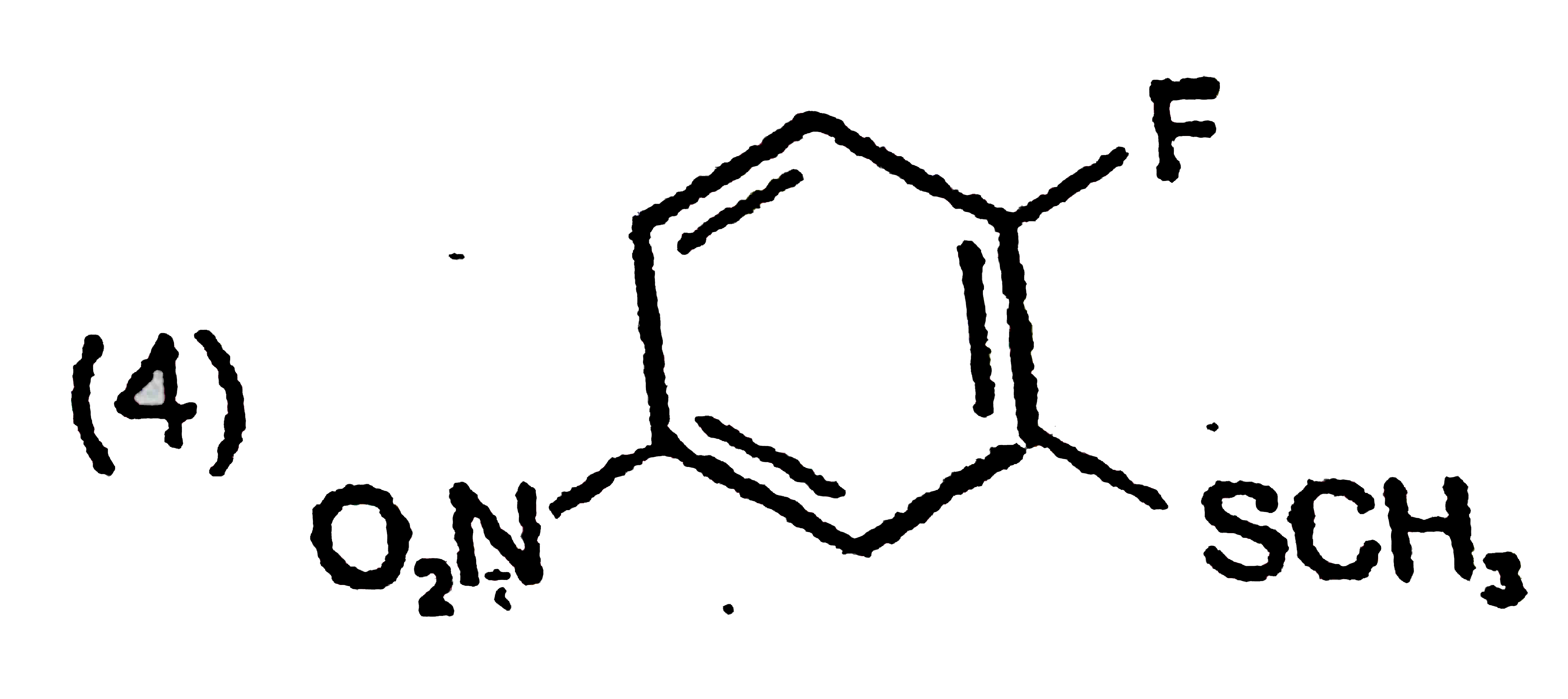
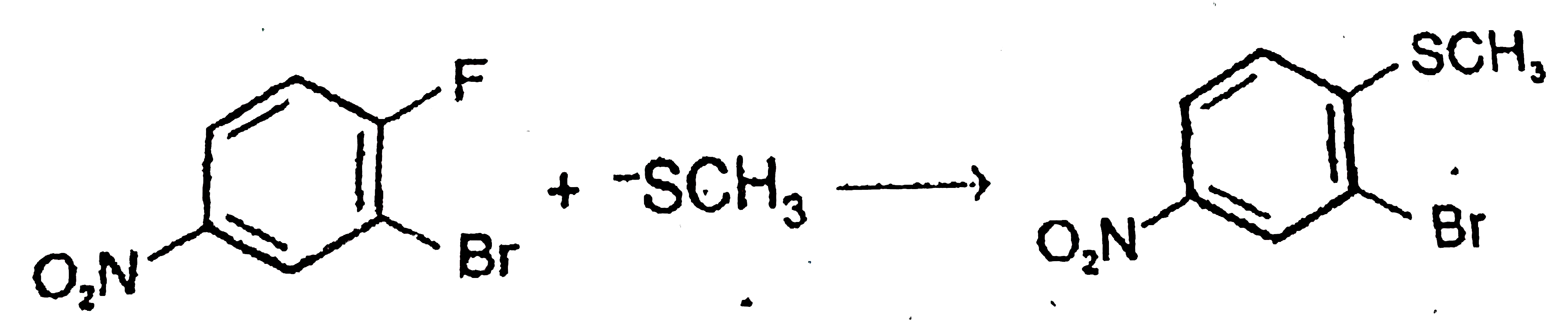
Identify the principal product of the following reaction , +NaSCH_(3)rarrproduct |
|
Answer»
|
|
| 45. |
Three tortoises are located at the verties of an equilateral triangle whose side equals a.They all start moving simultaneously with velocityv constant in modulas with first tortise heading continually for the second,the second for the third and third for the first .They will meet after time |
| Answer» SOLUTION :`(2)/(3)(a)/(V)` | |
| 46. |
In a periodic table, the average atomic mass of magnesium is given as 24,312 u. The average value is based on their relative natural abundance on earth. The three isotopes and their masses are " "_(12)^(24)Mg (23.98504 u), " "_(12)^(25)Mg (24.98584 u) and " "_(12)^(26)Mg (25.98259 u). The natural abundance of " "_(12)^(24)Mg is 78.99% by mass. Calculate the abundances of the other two isotopes. |
|
Answer» SOLUTION :It is given that abundance of `" "_(12)^(24)Mg` (23.98504 u) is 78.99%. Let abundance of `" "_(12)^(26)Mg` (25.98259 u) be X%. Then abundance of `" "_(12)^(25)Mg` (24.98584 u) will be `[100 - (78.99 + x)]% or (21.01 - x)%`. `therefore` Average atomic mass `24.312=(23.98504 xx 78.99 + 24.98584 (21.01 - x) + 25.98259 (x))/100 implies 2431.2 = 1894.5783 + 524.9525 + 1.0006 x implies x= (2431.2 - 1894.58 -524.95)/1.0006=11.7 %`. Hence, the abundance of `" "_(12)^(26)Mg` is 11.70% and that of `" "_(12)^(25)Mg` is (21.01 - 11.70) =9.3%. |
|
| 47. |
Saalumarada Thimmakka won which prestigious award ? |
|
Answer» NATIONAL CITIZEN’s AWARD of India |
|
| 48. |
Two plane mirros A and B are aligned parallel to each other, as shown in figure. A light ray is incident at an angle of 30^(@) at a point just inside one end of A. The plane of incidence coincides with the plane of the figure. The maximum number of times the ray undergoes reflection (includeing the first one) before it emerges out is |
|
Answer» 28 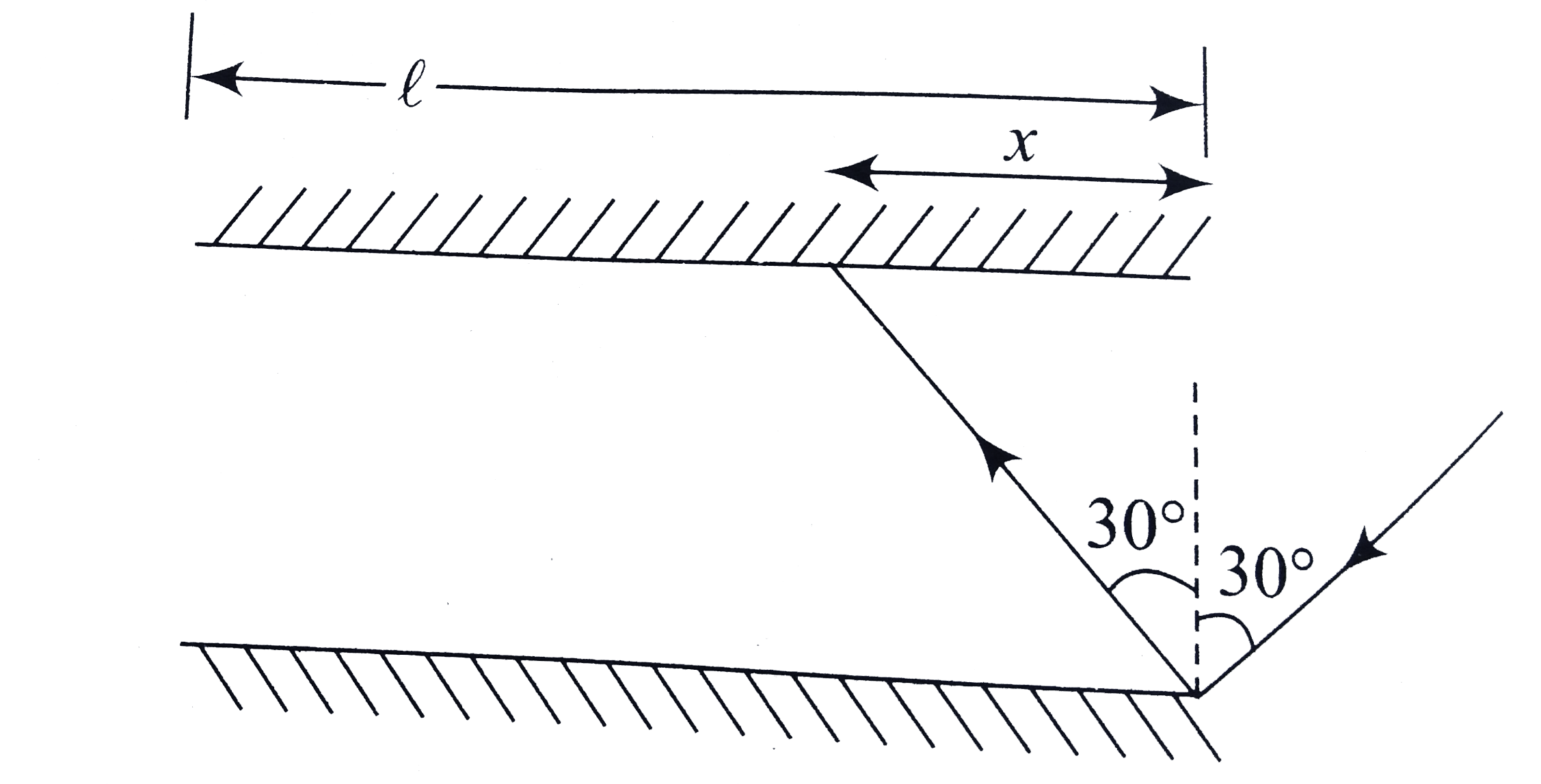
|
|
| 49. |
In figure. ABCDA is a uniform circular wire of resistance 2Omega,AOC and BOD are two wires along two perpendicular diameters of the circle, each having ame resistance 1Omega. A battery of emf epsi and internal resistance r is connected between the point A and D. Calculate the equivalent resistance of the network |
|
Answer» |
|
| 50. |
Figure shows a snapshot ofasinusoidaltravelling wave taken at t =0.35. The wavelength is 7.5 cm and the amplitude is 2cm. Ifthe crest P was at x = 0 at t = 0, write the equation ot travelling wave. |
|
Answer» Solution :GIVEN, `A=2cm, lambda= 7.5 cm` `:. K =(2pi)/lambda = 0.84 cm^(-1)`  The WAVE has TRAVELLED a distance of 1.2 cm in 0.3s. Hence, SPEED ofthe wave, ` v =1.2/0.3 = 4 cm//s` `:.` Angular frequency `omega =(v)(k) = 3.36 red//s` Since the wave is travelling along positive x-direction andcrest (maximum displacement) is at x = 0 at t = 0, we can WRITE the wave equation as, `y = A sin (kx - omegat + pi/2) (or ) y (x,t) = A cos (kx- omegat)` `y (x,t) = (2 cm) cos [0.84cm^(-1)x -(3.36 rad//s)t] cm` |
|