

Saved Bookmarks
This section includes 7 InterviewSolutions, each offering curated multiple-choice questions to sharpen your Current Affairs knowledge and support exam preparation. Choose a topic below to get started.
| 1. |
When a small uncharged conducting ball of radius a = 1 cm and mass m = 50 g is dropped from a height h above the center of another large conducting sphere of radius b( = 1 m) having charge Q( =(100 mu C). It rises to a height h_1 (= 2 m) after the collision. Find the value of h. Assume that during the impact there is no dissipation of energy. . |
|
Answer» When SMALL ball COMES in contact with bigger, their potentials will become same. So `(k q)/a = (k (Q - q))/b` Neglecting q in comparision to Q, we get `q = (Q a)/b = 1 mu C` Apply conservation of energy after collision `(1)/(2) m (sqrt(2 g h))^2 + ( k qQ)/b = mg h_1 + ( kq Q)/(b + h_1)` or `h = (4)/(5) m`. |
|
| 2. |
The velocity of sound in air at 20 °C and 1 atm pressure is 344.2 m/s. At 40 °C and 2 atm pressure, the velocity of sound in air is approximately |
|
Answer» 250 m/s For a given medium, `v PROP sqrt(T)` `v_(1)/v_(2) = sqrt(T_(1)/T_(2))` Here, `v_(1) = 344.2 ms^(-1), T_(1) = 20^(@) C = 293 K` `T_(2)= 40^(@) C = 313 K` `therefore v_(2) =v_(1) sqrt(T_(2)/T_(1)) = (344.2) xx sqrt(313/293) = 355.75 = 356 ms^(-1)` |
|
| 3. |
A stone is thrown at an angle of 45^@ to the horizontal. It rise to a maximum height of 10m. It's horizontal range is _____. |
|
Answer» |
|
| 4. |
If maximum velocity with which an electron can be emitted is (mass of electron=9xx10^(-31) kg) |
|
Answer» 30 VOLT |
|
| 5. |
Define the term decay constant of a radioactive substance. |
|
Answer» SOLUTION :As per law of radioactive DECAY, we know that Rate of decay R `(or - (dN)/(dt)) = lambda` N Here `lambda`is KNOWN as the decay constant of that radioactive substance and is defined as the ratio of decay rate of substance and the total number of radioactive nuclides of that substance present at that TIME. |
|
| 6. |
A radionuclide with disintegration constant lamdais produced in a reactor at a constant rate alphanuclei per second. During each decay energy E_0is released. 20% of this energy is utilized in increasing the temperature of water. Find the increase in temperature of m mass of water in time t. Specific heat of water is s. Assume that there is no loss of energy through water surface. |
|
Answer» |
|
| 7. |
What is the relation magnifying power and solving power of a telescope ? |
| Answer» Solution :MAGNIFYING POWER = (Resolving powert of the EYE )/ (Resolving power pf telescope) | |
| 8. |
A rod AB oriented along the x axis of the reference frame K moves in the positive direction of the x axis with a constant velocity v. The point A is the forward end of the rod, and the point B its near end. Find: (a) the proper length of the rod, if at the moment t_A the coorniate of the point A is equal to x_A, and at the moment t_B the coordinate of the point B is equal to x_B, (b) what time interval should separate the markings of coordinates of the rod's ends in the frame K for the difference of coordinates to become equal to the proper length of the rod. |
|
Answer» SOLUTION :(a) In the REFERENCE FRAME K with respect to which the rod is moving with VELOCITY v, the COORDINATES of A and B are `A: t, x_A+v(t-t_A),0,0` `B: t, x_B+v(t-t_B), 0,0` Thus `l=x_A-x_B-v(t_A-t_B)=l_0sqrt(1-beta^2)` So `l_0=(x_A-x_B-v(t_A-t_B))/(sqrt(1-v^2//c^2))` (b) `+-l_0-v(t_A-t_B)=l=l_0sqrt(1-v^2//c^2)` (since `x_A-x_B` can be either `+l_0` or `-l_0`.) Thus `v(t_A-t_B)=(+-1-sqrt(1-v^2//c_2))l_o` i.e. `t_A-t_B=l_0/v(1-sqrt(1-v^2/c^2))` or `t_B-t_A=l_0/v(1+sqrt(1-v^2//c^2))` 
|
|
| 9. |
Derive equation of missing term in Ampere circuital law. Write its definition and unit. |
|
Answer» Solution :1. There is an alternative and appealing way in which the Biot-Savart.s law may be expressed. 2. As shown in figure, Ampere.s circuital law considers an OPEN surface with a boundary.  3. The surface has current passing through it. We consider the boundary to be made up of a number of small line elements. Consider ONE such element of length dl. 4. We take the value of the tangential component of the magnetic field `B_(T)` at this element and MULTIPLY it by the length of that element dl, `B_(T)dl=vecB*vec(dl)` = `B_(T)dlcos0^(@)` = `B_(T)dl` 5. The sum then tends to an integral. 6. Ampere.s circuital law : The line integral of magnetic induction over a closed loop in a magnetic field is equal to the product of algebric sum of electric currents enclosed by the loop and the magnetic permeability. `thereforeointvecB*vec(dl)=mu_(0)sumI` 7. Where `sumI` is the total current through the surface. 8. Let L be the length of the loop for which `vecB` is tangential and `I_(e)` be the current enclosed by the loop. `thereforeointvecB*vec(dl)=BLandsumI=I_(e)` `therefore` According to Ampere.s circuital law BL = `mu_(0)I_(e)` 9. The boundary of the loop chosen is a circle and magnetic field is tangential to the circumference of the circle, then Ampere.s law, `Bxx2pir=mu_(0)I` `thereforeB=(mu_(0)I)/(2pir)` 10. The Ampere.s law INVOLVES a sign-convention given by the right hand rule. 11. Let the fingers of the right hand be curled in the sense the boundary is traversed in the loop integral `ointvecB*dvecl`. 12. Then the direction of the thumb gives the sense in which the current I is regarded as positive. |
|
| 10. |
In npn transistor the collector current is 10 mA. If90%of electrons emitter reach the collector, the emitter current (I_E) and base current (I_B)are given by |
|
Answer» `I_E=-1mA,I_B=9mA` |
|
| 11. |
The electron drift arises due to the force experienced by electrons in the electric field inside the condcutor. But force should cause acceleration. Why then do the electrons acquire a steady average drift speed? |
| Answer» Solution :Each free electron does accelerate increasing its DRIFT speed after collision but STARTS to accelerate and increases its drift speed again only to suffer a collision again and so on on the AVERAGE, thereofre electrons ACQUIRE only a drift speed. | |
| 12. |
A cell of e.m.f E is connected to a resistance R_(1) for time t and the amount of heat generated in it is H. If the resistanceR_(1) is replaced by another resistance R_(2) and is connected to the cell for the same time t, the amount of heat generated in R_(2) is 4H. Then the internal resistance of the cell is |
|
Answer» `(2R_(1)+R_(2))/(2)` |
|
| 13. |
लैंगिक जनन को अलैंगिक जनन की तुलना में अधिक लाभकारी माना जाता है, क्योंकि |
|
Answer» यह प्रतिकूल वातावरणीय परिस्थितियों द्वारा प्रभावित नहीं होता है |
|
| 14. |
In a double helix if one strand is on 5' to 3', what will be arrangement of other strand? |
| Answer» Solution :Work done =Force `x` displacement of `W =fs COSTHETA`.Hear ANGLE between force of gravity and displacement is `90^@`. HENCE, work done is zero. | |
| 15. |
Match list I with list II for a projectile. {:("List-I", "List-II"),((A)"For two angles " theta and (90- theta) "with same magnitude of velocity of projection",(e)(PhatiPhati)/(g)),((b)"Equation of parabolaof projectile" y=Px-Qx^(2), (f)"Maximum height" =25% (P^(2))/(Q)),((C)"Radius of curvature of path of projectile projected with a velocity"(Phati+Qhatj) ms^(-1)"at highest point",(g)"Range = Maximum height"),((d)"Angles of projection" theta =Tan^(-1)(4),(h)"Range is same"):} |
|
Answer» |
|
| 16. |
The magnetic field out of the parallel plates of capacitors in maximum: |
|
Answer» along a WIRE |
|
| 17. |
The magnetic field lines are by a diamagnetic substance. |
|
Answer» |
|
| 18. |
An N-type silicon sample of width 4xx10^(-3)m thickness and, length 6xx10^(-2)m carries a current of 4.8 mA when the voltage is applied across the length of the sample. What is the current density? If the free electron density is 10^(22)m^(-3), then find how much time it takes for the electrons to iravel the full length of the sample. |
|
Answer» Solution :The CURRENT density J is given by `J=(i)/(A)=(4.8xx10^(-3))/((4xx10^(-3))(25xx10^(-5)))=(4.8xx10^(-3))/(10^(-6))` The drift velocity `v_(d)` is given by `V_(d)=(J)/(n E)=(4800)/(10^(22)xx1.6xx10^(-19))=3m//s` The time takent is given by `t=(L)/(u_(d))=(6xx10^(-2))/(3)="0.02 SEC"` |
|
| 19. |
A short bar magnet of magnetic moment 5.25xx10^(-2)JT^(-1) is placed with its axis perpendicular to the earth's field 's field direction . At what distance from the centre of the magnetthe resultant field is inclined at 45^@ with earth's field on (a) its normal bisector and (b) its axis. Magnitude of te earth's field at the place is given to be 0.42 G, Ignore the length of the magnet in comparison to the distance involved. |
|
Answer» SOLUTION :`m=5.25xx10^(-2)JT^(-1),theta=90^@` `B_E=0.42G=0.42xx10^(-4)T` Since RESULTANT at P makes `45^@, tan 45 = (B_("axial")/(B_E))` i.e., `l=(B_("axial")/B_E) "":.B_("axial")=B_E` But `B_("axial")=10^(-7)xx(2M)/d^3:. (10^(-7)xx2m)/d^3=B_E` or `d^3=(10^(-7)xx2m)/B_E=(10^(-7)xx2xx5.25xx10^(-2))/(0.42xx10^(-4))` `:.d=[(10^(-3)xx2xx5.25)/42]^(1/3)=10^(-1)xx((5.25)/21)^(1/3)=10^(-1)xx0.63m=6.3cm` Similarly `10^(-7)xxm/(d.3)=B_E" or "d.^3=(10^(-7)xxm)/B_E" or " d.=(6.3)/(2^(1/3))=5.0cm` 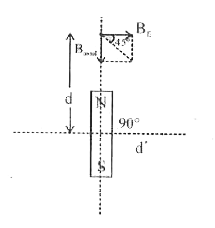
|
|
| 20. |
We produce a diffraction pattern on a viewing screen by means of a long narrow slit illuminated by blue light. Does the pattern expand away from the bright center (the maxima and minima shift away from the center) or contract toward it if we (a) switch to yellow light or (b) decrease the slit width? |
| Answer» SOLUTION :(a) EXPAND, (B) expand | |
| 21. |
Calculate the frequency of red light when the wavelength of light is 7500A^@. |
| Answer» SOLUTION :V=`C/lamda`=`3xx10^8`/`7500xx10^-10`=`4xx10^4Hz` | |
| 22. |
The equation for the displacement of a particle executing SHM is x = 0.6 sin (10t + pi//3), where x is in m, and t in s. The speed of the particle in ms^(-1) at the end of pi//2 S from the start is |
| Answer» ANSWER :C | |
| 23. |
The velocity vecv of a particle moving in the xy plane is given by vecv=(6.0t-4.0t^(2))hati+8.0hatj, with vecv in meters per second and t(gt0) in seconds. (a) What is the acceleration when t = 2.5 s? (b) When (if ever) is the acceleration zero ? (c) When (if ever) is the velocity zero? (d) When (if ever) does the speed equal 10 m/s? |
| Answer» Solution :(a) `(-14m//s^(2))hati,` (B) 0.75 s, ( C) it is never ZERO, (d) 2.2 s | |
| 24. |
An experimental setup of verification of photoelectric effect is shown if Fig. The voltage across the electrodes is measured with the help of an ideal voltmeter, and which can be varied by moving jockey J on the potentiometer with wire. The battery used in potentiometer circuit is of 20 V and its internal resistance is 2 Omega. The resistance of 100cm long potentiometer wire is 8 Omega. The photocurrent is measured with the help of an ideal ammeter. Two plates of potassium oxide of area 50 cm^2 at separation 0.5mm are used in the vacuum tube. Photocurrent in the circuit is very small, so we can treat the potentiometer circuit as an independent circuit. The wavelength of various colors is as follows: Q. Which of the following colors may not give photoelectric effect for this cathode? |
|
Answer» Green |
|
| 25. |
An experimental setup of verification of photoelectric effect is shown if Fig. The voltage across the electrodes is measured with the help of an ideal voltmeter, and which can be varied by moving jockey J on the potentiometer with wire. The battery used in potentiometer circuit is of 20 V and its internal resistance is 2 Omega. The resistance of 100cm long potentiometer wire is 8 Omega. The photocurrent is measured with the help of an ideal ammeter. Two plates of potassium oxide of area 50 cm^2 at separation 0.5mm are used in the vacuum tube. Photocurrent in the circuit is very small, so we can treat the potentiometer circuit as an independent circuit. The wavelength of various colors is as follows: Q. It is found that ammeter current remains unchanged (2muA) even when the jockey is moved from the end P to the middle point of the potentiometer wire. Assuming that all the incident photons eject electrons and the power of the light incident is 4xx10^(-6) W. Then, the color of the incident light is |
|
Answer» Green Where `n=` no. of photons incident per unit time. Also, `I="ne"` `impliesP=(IHC)/(elamda)` `lamda=((2xx10^(-6))(6.6xx10^(-34))(3xx10^(8)))/((4XX10^(-6))(1.6xx10^(-19)))` `=(9.9)/(1.6)xx10^(-7)m=(9900)/(1.6)A` `=6187A` Which is in the range of orange light. |
|
| 26. |
An experimental setup of verification of photoelectric effect is shown if Fig. The voltage across the electrodes is measured with the help of an ideal voltmeter, and which can be varied by moving jockey J on the potentiometer with wire. The battery used in potentiometer circuit is of 20 V and its internal resistance is 2 Omega. The resistance of 100cm long potentiometer wire is 8 Omega. The photocurrent is measured with the help of an ideal ammeter. Two plates of potassium oxide of area 50 cm^2 at separation 0.5mm are used in the vacuum tube. Photocurrent in the circuit is very small, so we can treat the potentiometer circuit as an independent circuit. The wavelength of various colors is as follows: Q. When radiation falls on the cathode plate, a current of 2muA is recorded in the ammeter. Assuming that the vacuum tube setup sollows Ohm's law, the equivalent resistance of vacuum tube operating in this case when jockey is at end P is |
|
Answer» `8XX10^(8)Omega` `R=(V)/(1)=(16V)/(2xx10^(-6)A)` `=8xx10^(6)Omega` |
|
| 27. |
If a wire of uniform cross sectional area is cut equally into two parts the resistivity part |
|
Answer» is halved |
|
| 28. |
An experimental setup of verification of photoelectric effect is shown if Fig. The voltage across the electrodes is measured with the help of an ideal voltmeter, and which can be varied by moving jockey J on the potentiometer with wire. The battery used in potentiometer circuit is of 20 V and its internal resistance is 2 Omega. The resistance of 100cm long potentiometer wire is 8 Omega. The photocurrent is measured with the help of an ideal ammeter. Two plates of potassium oxide of area 50 cm^2 at separation 0.5mm are used in the vacuum tube. Photocurrent in the circuit is very small, so we can treat the potentiometer circuit as an independent circuit. The wavelength of various colors is as follows: Q. When other light falls on the anode plate, the ammeter reading remains zero till jockey is moved from the end P to the middle point of the wire PQ. Thereafter, the deflection is recorded in the ammeter. The maximum kinetic energy of the emitted electron is |
|
Answer» 16 eV and `KE=eV_(S)` `KE=8eV` |
|
| 29. |
How does the mutual inductance of a pair of coils change when: Number of turns in the coils is increased? |
| Answer» SOLUTION :DECREASES in both the CASES. | |
| 30. |
Bright colours exhibited by spider.s web, exposed to sunlight are due to |
|
Answer» interference |
|
| 31. |
Figure shows a solid sphere positioned just below the surface of a fluid and held there. Let the density of the fluid be sigma, force applied by fluid on the upper half of the sphere be F_(1) and the force on lower half be F_(2) (excluding the contribution due to atmospheric pressure). Pick correct option (s): |
|
Answer» `F_(1)=1/3pir^(3)sigmag` `impliesF_(1)=1/3 pir^(3) sigma g` THUS, `F_(2)=5/3 pir^(3)g` 
|
|
| 32. |
The resistance of a circular coil is 50 turns & 10cm diameter is 5 Omega What must be the potential difference across the ends of the coil so as to multify the horizontal component of the earth's magnetic field [(B_(H)=pixx10^(-5)T] at the centre of the coil? How should the coil be placed to achieve this result? |
|
Answer» `0.5` V with PLANE of COIL NORMAL to the magnetic meridian |
|
| 33. |
A galvanometer has a resistance of 98 Omega. If 2 % of the main current is to be passed through the meter , what should be the value of the shunt ? |
|
Answer» SOLUTION :`G = 98 OMEGA , (i_g)/(I) = 2 %` `s= (G)/(((i)/(i_g)-1)) , therefore i/(i_g) = 100/2 = 50` `thereforeS = (98)/((50-1)) = 2 Omega` |
|
| 34. |
The atoms of an elements having same atomic number but different atomic mass number is called______. |
| Answer» SOLUTION :ISOTOPES | |
| 35. |
A horizontal straight wire 10 m long extending from east to west is falling with a speed of 5.0ms^(-1), at right angles to the horizontal component of the earth's magnetic field, 0.30xx10^(-4)Wbm^(-2). a. What is the instantaneous value of the emf induced in the wire? b. What is the direction of the emf? c. Which end of the wire is at the higher electrical potential? |
|
Answer» Solution :a. `varepsilon=Blv=0.3xx10^(-4)xx10xx5=1.5mV` B. WEST to east C. Eastern END |
|
| 36. |
As a rock of mass 4 kg drops from the edge of a 40-meter-high cliff, it experiences air resistance, whose average strength during the descent is 20 N. at what speed will the rock hit the ground? |
|
Answer» 8m/s `K_(i)+U_(i)+W_(r)=K_(f)+U_(f)` `0+mgh-F_(r)h=(1)/(2)mv^(2)+0` `v=sqrt((2h(mg-F_(r)))/(m))` `sqrt((2(40m)[(4kg)(10N//kg)-20N])/(4kg))` `=sqrt((2(40m)[20N])/(4kg))` `=sqrt(2(10)(20)(m^(2))/(s^(2)))` `=20m//s` Again, `W_("total")=DeltaK` COULD also be used. |
|
| 37. |
Can charge lie on a Gaussian surface? |
| Answer» SOLUTION :CHARGE cannot LIE on a GAUSSIAN SURFACE. | |
| 38. |
Two point charges Q and -3Q are placed at some distance apart. If the electric field at the location of Q is vec (E ), the field at the location of - 3Q is |
|
Answer» `VEC(E )` |
|
| 39. |
Positronium is just like a H-atom with the proton replaced by the positively charged antiparticle of the electron (called the positron which is as massive as the electron). What would be the ground state energy of positronium? |
|
Answer» Solution :Here, positronium atom is a binary system, made up of POSITRON and electron. In this system, both of these particles revolve around their common centre of mass. Now, if above system is to be replaced by a single particle then mass of this single particle is to be taken equal to reduced mass of a binary system. In the present case, its value is `mu=(m_(1)m_(2))/(m_(1)+m_(2))=(m_(e)xxm_(e))/(m_(e)+m_(e))=(m_(e))/(2)=(m)/(2)....(1)` (where `m_(e)=m` mass of electron) `rArr` Now, ground state ENERGY of electron in H-atom, `E_(1).=((mu)e^(4))/(8 epsi_(0)^(2)h^(2))=-(((m)/(2))e^(4))/(8 epsi_(0)^(2)h^(2))( :. "Here" mu=(m)/(2))` `:.E_(1).=(1)/(2)(E_(1))=(1)/(2)(-13.6eV)=-6.8eV` |
|
| 40. |
A mass of M kg is suspended by a weightless string. The horizontal force required to displace it until string makes an angle of 45^@ with the initial vertical direction is: |
|
Answer» `(Mg)/(sqrt2)` `:. W_("total") = Delta K` `W_(F) + W_("gravity") + W_(T) = (K_("FINAL") - K_("INITIAL")) = (0-0) = 0` Work done by `F , W_(F) = F xx l SIN 45^@ = (F1)/(sqrt(2))` Work done by gravity , `W_("gravity") = -Mg(1 - l cos 45^@) = - M gl(1 - 1/(sqrt2))` Work done by TENSION = 0 `:. (F1)/(sqrt2) + (- (Mgl(sqrt(2) - 1))/(sqrt(2))) = 0 "or" F = Mg(sqrt(2) - 1)` . 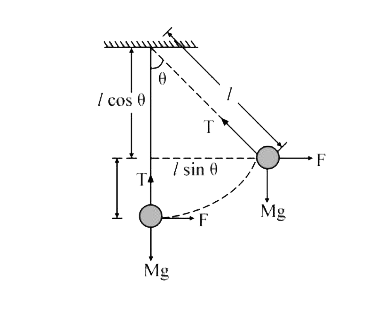
|
|
| 41. |
What are overtones? What is the meaning of first overtone ? |
|
Answer» SOLUTION :The higher allowed HARMONICS above the first HARMONIC or FUNDAMENTAL are called overtones. The first overtoneis the higher allowed harmonic immediately above the first harmonic. |
|
| 42. |
(a) State Bio-Savart's law in vector form expressing the magnetic field due to an element vecdl carrying current I at a distance r from the element. (b) Write the expression for the magnitude of the magnetic field at the centre of a circular loop of radius 'R' carrying a steady current I. Draw the field lines due to the current loop. |
|
Answer» SOLUTION :(b) The magnitude of magnetic field is GIVEN as `B = (mu_0 I)/(2R)` Field lines have been DRAWN in fig. |
|
| 43. |
Escape velocity Ve ( with usual notation) is given by |
|
Answer» `Ve= SQRT(RG)` |
|
| 44. |
Which of the graph between potential energy and time is correct ? |
|
Answer» A |
|
| 45. |
The length of a metallic sheet is measured as 10.0 cm using a metre scale of L.C. 0.1cm and its breadth is, measured as 1.00 cm using a vernier callipers of L.C. 0.01 cm, the error in area is |
|
Answer» `PM 0.01 CM^(2)` |
|
| 46. |
What is the terminal voltage of a cell ? When it will be equal to the emf of the cell? |
| Answer» Solution :The POTENTIAL difference ACROSS the terminals of a CELL in an OPEN CIRCUIT is called its emf `epsi`. | |
| 47. |
An electromagnetic wave of intensity I falls on a surface kept in vacuum and exerts radiation pressure P on it. Which of the following statements are true? I. Radiation pressure is I/c if the wave is totally absorbed. II. Radiation pressure is I/c if the wave is totally reflected. III. Radiation pressure is 2 I/c if the wave is totally reflected. |
|
Answer» I and II |
|
| 48. |
A equilateral glass prism has a refractive index sqrt2 . A light ray is incident at 45^@ on one face. Total deviation of ray is n xx 15^@where 'n' is |
|
Answer» |
|
| 50. |
The mirror formula is given by |
| Answer» SOLUTION :`1/v+1/u=1/f` | |