

Saved Bookmarks
This section includes 7 InterviewSolutions, each offering curated multiple-choice questions to sharpen your Current Affairs knowledge and support exam preparation. Choose a topic below to get started.
| 1. |
Employing Eq.(6.2e), find the probability D of an electron with energy E tunneling through a potential barrier of width l and height U_(0) provided the barrier is shaped as shown: (a) In fig 6.4 (b) in figure 6.5. |
|
Answer» Solution :The formula is `D~~exp[-(2)/( ħ)int_(x_(1))^(x_(2))SQRT(2m(V(x)-E)dx)]` Here `V(x_(2))=V(x_(1))=E` and `V(x)gtE` in the region `x_(2)gt xgt x_(1)`. (a) For the problem, the intergral is trivial `D~~exp[-(2L)/( ħ)sqrt(2m(U_(0)-E))]` (b) We can without loss of GENERALITY take `x=0` at the point the potential begins to CLIMB. Then `U(x)= ,{{:(0x,LT,0,,),(U_(0),(x)/(l),0 x lt l,,),(0,xgtl,,,):}` Then `D~~exp[-(2)/ (ħ)int_(l(E)/(U_(0)))^(l)sqrt(2m(U_(0)(x)/(l)-E)dx)]` `=exp[-(2)/ (ħ)sqrt((2mU_(0))/(l))^(l)int_(x_(0))^(l)sqrt(x-x_(0))dx]x_(0)=l(E )/(U_(0))` `=epx[-(2)/( ħ)sqrt((2mU_(0))/(l))(2)/(3)(x-x_(0))^(3//2):|_(x_(0))^(l)]` `=exp[-(4)/(3 ħ)sqrt((2mU_(0))/(l))(l-l(E )/(U_(0)))^(3//2)]` `= exp[-(4l)/( 3ħU_(0))(U_(0)-E)^(3//2)sqrt(2m`)] |
|
| 2. |
If properly modulated carrier wave is transmitted through antenna, then rate of energy dissipated at the antenna |
|
Answer» REMAINS same for AM wave |
|
| 3. |
The circuit arrangement given shows that when an a.c. passes through the coil, the current starts flowing in the coil B. (i) State the underlying principle involved. (ii) Mention two factors on which the current produced in the coil depends. |
|
Answer» SOLUTION :The underlying principle is the principle of mutual induction. The principle states that whenever current passing through one coil changes, an induced current is also set up in the second coil DUE to their mutual induction. (i) The current produced in the second coil depends on the NUMBER of turns in TWO coils, their separation and their cross-section areas ETC. 
|
|
| 4. |
A spherical body of density rho is floating half immersed in liquid of density d, if alpha is the surface tension of the liquid, then the diameter of the body is |
|
Answer» `sqrt((3alpha)/(g(2rho-d)))` 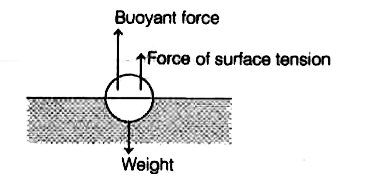 WEIGHT of body = BOUYANT force + Force of suface TENSION `(4)/(3)pi r^3 rho xx g = 2/3 pi r^3 DG + 2 pi r delta ` `2/3 pi r^3 g (2 rho -d)=2 pi alpha` `So, r^2= (3 alpha)/(g(rho2p-d)` So, `r = sqrt(3 alpha)/(g(2rho -d))` |
|
| 5. |
(A) : Sky wave is reflected by ionosphere (R) : The reflected wave is out of phase of incident waveand reach the receiving antenna along with the direct wave from transmitting antenna causes in interference. |
|
Answer» Both 'A' and 'R' are TRUE and 'R' is the CORRECT explanation of 'A'. |
|
| 6. |
A wire of length 5 cm is placed inside the solenoid near its centre such that it makes an angle of 30^@ with the axis of the solenoid The wire carries a current of 5A and the magnetic field due to solenoid is 2.5 xx 10^(-2)T Calculate the force on the wire. |
| Answer» SOLUTION :`3.125 XX 10^(-3)N` | |
| 7. |
(A) : The D.C. and A.C. both can be measured by a hot wire instrument. (R): The hot wire instrument is based on the principle of magnetic effect of current. |
|
Answer» Both 'A' and 'R' are true and 'R' is the correct explanation of 'A'. |
|
| 8. |
In above question the retardation of rocket is:- |
|
Answer» `50ms^(-2)` `=tan theta=(1000)/((120-20))=(1000)/(100)=10 m//s^(2)` |
|
| 9. |
What is the use of Gaussian surface ? |
| Answer» SOLUTION :For FINDING electric field due to a charge DISTRIBUTION by applying Gauss.s theorem ONE is required to evaluate a surface integral. The surface integral can be evaluated easily by choosing a SUITABLE Gaussian surface for the charge distribution. | |
| 10. |
A dipole of dipole moment vec(P)=2hat(i)-3hat(j)+4hat(k) is placed at point A (2, -3, 1). The electric potential due to this dipole at the point B (4, -1, 0) is equal to (All the parameters specified here are in S.L. units) ____xx 10^(9) volts |
|
Answer» |
|
| 11. |
If the length of second's pendulum is increased by 2%, how many seconds will it lose per day? |
|
Answer» 3600 s |
|
| 12. |
There is a uniform electric field of intensity E which is as shown. How many labelled points have the same electrial as the fully shaded point ? |
|
Answer» 2 |
|
| 13. |
An infinitely long wire carrying current I is bent to from a L shaped wire. Let the bend be the origin and the two arms be along x and y direction (see figure). Calculate the magnitude of magnetic field at point P (in first quadrant) whose co-ordinates are (x, y). |
|
Answer» |
|
| 14. |
A polarizer and an analyzer are oriented so that the maximum amount of light is transmitted. To what fraction of its maximum value is the intensity of the transmitted light reduced when the analyzer is rotated through (a) 30^@,(b) 45^@ , ( c) 60^@ ? |
| Answer» SOLUTION :(a) 0.375, (B) 0.25, (C) 0.125 | |
| 15. |
The energy stored in 5uF and 8uF capacitors are |
|
Answer» ` 250 xx 10^(-6), 36 xx 10^(-4)` |
|
| 16. |
(a) State Kirchhoff's rules for an electric network. Using Krichhoff's rules, obtain the balance condition in terms of the resistances of four arms of Wheatstone bridge,(b) In the meterbridge experimental set up, shown inthe Fig., the null point 'D' is obtained at a distance of 40 cm from end A of the meterbridge wire. If a resistance of 10Omegais connected in series with R_1, null point is obtained at AD = 60 cm. Calculate the values of R_1 and R_2 |
|
Answer» Solution :(b) As per question `R_1/R_2 = (40)/((100 - 40)) = 40/60 = 2/3` ` RARR R_2 = 3/2 R_1` Again on joining a RESISTANCE of `10 OMEGA` in series with `R_1` , we have ` rArr (R_1 + 10)/(R_2) = (60)/((100 - 60)) = 60/40 = 3/2` ` rArr R_2= 2/3 (R_1 + 10)` Comparing (i)and (ii) , we get ` 3/2 r_1 = 2/3 (R_1 + 10) rArr r_1 = 8 Omega` ` therefore R_2 = 3/2 R_1 = 3/2 xx 8 = 12 Omega` |
|
| 17. |
The energy states A, B and C having energy E_(A)ltE_(B)ltE_(C). If the transition CtoB,BtoA and CtoAhave the corresponding wavelength lamda_(1),lamda_(2) and lamda_(3) espectively, then which of following relationship is obtained ? |
|
Answer» `lamda_(1)+lamda_(2)+lamda_(3)=0`  For TRANSITION `CTOB` `E_(C)-E_(B)=(hc)/(lamda_(1))"".......(1)` For transition `BtoA` `E_(B)-E_(A)=(hc)/(lamda_(2))"".......(2)` Adding equation (1) and (2), `E_(C)-E_(A)=(hc)/(lamda_(1))-(hc)/(lamda_(2))"".......(3)` Now for transition `CTOA`. `E_(C)-E_(A)=(hc)/(lamda_(3))"".......(4)` `:.` From equation (3) and (4), `(hc)/(lamda_(3))=(hc)/(lamda_(1))+(hc)/(lamda_(2))` `:.(1)/(lamda_(3))=(1)/(lamda_(1))+(1)/(lamda_(2))` `:.lamda_(3)=(lamda_(1)lamda_(2))/(lamda_(1)+lamda_(2))` |
|
| 18. |
Explain the refraction of a plane wavefront with a thin convex mirror. |
Answer» Solution : Figure shows the PLANE wavefront XY of a parallel BEAM of light incident to a thin convex lens and rays coming out through the thin convex lens is shown to be concentrated at second focus point. To draw a wavefront corresponding to these rays, the circles should be drawn by accepting second focus as a centre. The arc X.Y. of such circles is shown in the figure. This arc is the wavefront corresponding to the refracted rays at some instant. Here the distances from A to a and C to care greater then B to b. So the light has taken more DISTANCE in the lens going for B to b and the velocity of light in the material of lens is less. Hence, the point b on the wavefront LAGS behind a and c. |
|
| 19. |
To enhance the sensitivity, an Ammeter is to be designed with two kinds of graduation on its scale — 0 to 10 A and 0 to 1 A. for that a galvanometer of resistance 50 Omega and full scale deflection current 1 mA was used along with two resistances R_(1) and R_(2) as shown. Either of T_(1) or T_(2) is to be used as negative terminal of the Ammeter. (a) When measuring a current of the order of 0.1 A, which shall be used as negative terminal — T_(1) or T_(2) ? (b) find the values of R_(1) and R_(2). |
|
Answer» (b) `R_(1)=(5)/(999)Omega` `R_(2)=(5)/(111)Omega` |
|
| 20. |
Instrument whichmeasures alternating current is based on |
|
Answer» JOULE's effect |
|
| 21. |
Name the physical principle on which the working of optical fibres is based. |
| Answer» SOLUTION :The PHENOMENON of TOTAL INTERNAL reflection of light | |
| 22. |
Draw graph of number of scattered particles to scattering angle in Ratherford's experiment. |
| Answer» | |
| 23. |
What is the effective capacitance between A and B in the arrangement shown here? |
|
Answer» `1 mu F` |
|
| 24. |
The wave fucnction of an electron of a hydrogen atom in the ground state takes the from Psi(r )=Ae^(-r//r_(1)), where A is a certain constant, r_(1) is the first Bohr radius. Find: (a) the most probable distance between the electron and the nucleus. (b) the mean value of modulus of the Coulomb force acting on the electron (c )the mean value of the potential energy of the electron in the field of the nucleus. |
|
Answer» Solution :we first find `A` by normalization `1=int_(0)^(oo)4piA^(2)e^(-2r//r_(1))r^(2)dr=(piA^(2))/(2)r_(1)^(3)int_(0)^(oo)e^(-X)DX=piA^(2)r_(1)^(3)` since the intergal has the value 2, Thus `A^(2)=(1)/(pir_(1)^(3)) or A=(1)/(sqrt(r1^(3)pi))` (a) The most PROBABLE distacne `r_(pr)` is that value of `r` for which `P(r )=4pir^(2)|Psi(r )|^(2)=(4)/(r_(1)^(3))r^(2)e^(-2r//r_(1))` is maximum. Thus requires `(p')(r )=(4)/(r_(1)^(3))[2r-(2r^(2))/(r_(1))]e^(-2r//r_(1))=0` or `r=r_(1)=r_(pr)` (b) The coulomb firce being given by `-e^(2)//r^(2)`, the mean value of its modules is `LT F ge int_(0)^(oo)4pir^(2)(1)/(pir_(1)^(3))e^(-2r//r_(1))(e^(2))/(r^(2))dr` `=int_(0)^(oo)(4e^(2))/(r_(1)^(3))e^(-2r//r_(1))dr=(2e^(2))/(r_(1)^(2))int_(0)^(oo)xe^(-x)dx= -(e^(2))/(r_(1))` In `MKS` units we should read `(e^(2)//4PI epsilon_(0))` for `e^(2)` (c ) `lt U geint_(0)^(oo)4pir^(2)(1)/(pir_(1)^(3))e^(-2r//r_(3))(-e^(2))/(r )dr= -(e^(2))/(r_(1))int_(0)^(oo)xe^(-x)dx= -(e^(2))/(r_(1))` In MKS units we should read `(e^(2)//4piepsilon_(0))` for `e^(2)`. |
|
| 25. |
When does the impedance of a series L-C-R (AC) circuit become minimum ? |
|
Answer» when the RESISTANCE is equal to zero |
|
| 26. |
Three charges each of +4mu C are the corners B, C, D of a square ABCD of side 1m. The electric field at the centre .O. of the square is |
|
Answer» `7.2 XX 10^(4) N//C` TOWARDS A |
|
| 27. |
What will be the resistance of a semi circle shown in fig., between its two end faces. Given that radial thickness is 3cm, axial thickness is 4 cm, inner radius is 6 cm and specific resistance is 4xx10^(-6)" ohm "-cm |
|
Answer» Solution :`R=(rhol)/(A)=(rho pi((r_(1)+r_(2)))/(2))/(A)` `R=(4xx10^(-6)(pi((6+9)/(2))))/(12)` `R=(4xx10^(-6)(pi(7.5)))/(12)=7.85xx10^(-6)OMEGA` 
|
|
| 28. |
In a cathode ray tube a potential difference of 3000 volt is maintained between the electrodes 2 cm apart. A magnetic field of 2.5xx10^(-4) Wb//m^(2) at right angles to the electric field gives no deflection of the electron beam which received an initial acceleration by a potential difference of 1000 volt. Calculate e//m. |
|
Answer» |
|
| 29. |
Electric force is exerted between two separated charges because electric charge is ...... Of matter. |
|
Answer» external |
|
| 30. |
In 1654 Otto von Guericke, inventor of the air pump, gave a demonstration before the noble-men of the Holy Roman Empire in which two teams of eight horses could not pull apart two evacuated brass hemispheres. (a) Assuming the hemispheres have (strong) thin walls, so that R in Fig. 14-63 may be considered both the inside and outside radius, show that the force vecF required to pull apart the hemispheres has magnitude F = pi R^(2) Deltap, where Deltap is the difference between the pressures outside and inside the sphere, (b) Taking R as 40 cm, the inside pressure as 0.10 atm, and the outside pressure as 1.00 atm, find the force magnitude the teams of horses would have had to exert to pull apart the hemispheres. (c) Explain why one team of horses could have proved the point just as well if the hemispheres were attached to a sturdy wall. |
| Answer» SOLUTION :(B) `4.6 xx 10^(4)` N (c) One team of horses COULD be used if one half of the SPHERE is ATTACHED to a sturdy wall . The force of the wall on the sphere would balance the force of the horses. | |
| 31. |
An LR circuit constainsan inductor of 500 mH,a resistor of 25.O Omega and an emf of 5.00 Vin series. Find the potential difference across the resistor at t =(a) 20.0 ms, (b) 100 ms and ( c) 1.00 s. |
|
Answer» SOLUTION :Here `L=500mH, R=25 Omega, E=5V` `(a) For t=20 ms` ` i=i_0(1-e^(-tR//L)` `=(E/R)(1-e^(-tR//L))` `=(5/25)(1-e^(-(2xx10^(-3)xx25)//(500xx10^(-3))` `=1/5(1-e^(-1)=(1/5)(1-0.3678)` `=(0.632)/(5)=0.1264`.` `POTENTIAL difference ` `=iR=C.1264xx25` `=3.1606V=3.16V` `(b) Here t=100ms` `i-i_0(1-e^(-tR//L))` `=(5/25)(1-r^(-100)xx10^(-3)xx25//500xx10^(-3))` `=1/5(1-e^(-50)` =(1/5)(1-0.0067)` `=(0.9932)/5=0.19864` potential difference iR `0.19864xx25xx4.9665=4.97 V.` ` (c ) Here t=1 SEC.` `i=(5/25)(1-e^(-1xx(25/100)xx10^(-3))` `=(1/5)(1-e^(-50))` `=1/5xx1=(1/5)A` potential difference ` `=(1/5 xx25)V=5V.` |
|
| 32. |
Assertion (A) : A changing magnetic flux may produce an induced emf. Reason (R) : Faraday experimentally demonstrated the induced emf. |
|
Answer» If both assertion and REASON are true and the reason is the correct EXPLANATION of the assertion. |
|
| 33. |
The mechanical advantage in case of a hydraulic press is given by |
|
Answer» m=A/a*y/x |
|
| 34. |
Classify metals, semiconductors and insulators on the basis of energy bands. |
Answer» Solution :Formation of ENERGY Bands : In case of isolated atoms, the energy levels will be discrete. When atoms are very close to each other as in SOLIDS, nucleus of each atom interacts with the electrons of the neighbouring atoms. This splits each energy level into number of CLOSELY placed energy levels which appear as bands. The energy band corresponding to the valence electrons from valence band (VB) and the energy band above valence band forms conduction band (CB). The gap between the top of VB and bottom of CB is the energy band gap(`E_g`). 
|
|
| 35. |
Figure (A) shows potential energy as a function of x for a particle that is moving in the x-direction under a coriservative force. Figure (B) shows potential energy as a function of x for another particle that is moving in the x-direction under a conservative force. Figure (C ) shows interaction potential energy as a system of two particles that could move in the x-direction under the mutual conservative force. |
|
Answer» <P> SOLUTION :`(A) rarr (q,s), (B) - (p, R) (C ) - (q, s) (D) -(q, s)` |
|
| 36. |
An electric dipole of moment p is placed with its centre at the origin along the x-axis. The electric field at a point P, whose position vector makes an angle theta with the x-axis, will make an angle ....... with the x-axis, when tan a =(tan theta)//2 |
|
Answer» `ALPHA` |
|
| 37. |
1 gm of helium having rms velocity of molecules 100 m/s and 4 gm of oxygen having rms velocity of molecules 1000 m/s are mixed in a container which is thermally isolated. What are the rms velocities of helium and oxygen molecules after equilibrium is attained ? |
|
Answer» Solution :Given that rms velocity of He molecules is 1000 m/s. If gas is at temperature T, we have `v_("rms")=sqrt((3RT)/(M_(1)))` or `""1000=sqrt((3xx8.314xxT_(1))/(2xx10s^(-3)))` or `""T_(1)=(2xx10^(-3)xx10^(6))/(3xx8.314)=80.186` K It is given that rms velocity of oxygen molecules is also 1000 m/s. If temperature of this gas is `T_(2)`, we have `v_("rms")=sqrt((3RT_(2))/(M_(2)))` or `""1000=sqrt((3xx8.314xxT_(2))/(32xx10^(-3)))` or `""T_(2)=(32xx10^(-3)xx10^(6))/(3xx8.314)=1282.976" K"` It is given that 1 GM of He and 4 gm of `O_(2)` is mixed. If their NUMBER of moles are `n_(1)` and `n_(2)` then `n_(1)=(1)/(2)" and "n_(2)=(4)/(32)=(1)/(8)` We know that gases at different temperature are mixed at constant volume (or in a container), the total internal energy of system remains constant before and after mixing. If in this CASE final temperature of mixture is `T_(f)` then we have `T_(f)=(f_(1)n_(1)T_(1)+f_(2)n_(2)T_(2))/(f_(1)n_(1)+f_(2)n_(2))` Here we have `f_(1)=3,f_(2)=5,n_(1)=(1)/(2),n_(2)=(1)/(8),T_(1)80.186` and `T_(2)=1282.76` Thus final temperature of mixture is given as `T_(f)=(3xx(1)/(2)xx80.186+5xx(1)/(8)xx1282.76)/(3xx(1)/(2)+5xx(1)/(8))` `=(120.28xx801.725)/(2.125)=433.89" K"` Thus final rms velocity of He gas molecules is `v_("rms")=sqrt((3RT_(f))/(M_(1)))` `=sqrt((3xx8.314xx433.89)/(2xx10^(-3)))=2326.17" m"//"s"` Final rms velocity of `O_(2)` gas molecules is `v_("rms")=sqrt((3RT_(f))/(M_(2)))` `=sqrt((3xx8.314xx433.89)/(32xx10^(-3)))=581.54" m"//"s"` |
|
| 38. |
Ground waves are the _____ which propagate along the surface of the earth. |
| Answer» SOLUTION :RADIOWAVES | |
| 39. |
32 cells, of emf 3V are connected in series and kept in a box. Externally, the combination shows an emf of 84V. The number of cells reversed in the connection is: |
|
Answer» 0 |
|
| 40. |
A Young's double-slit interference arrangement with slits S_1 and S_2 is immersed in water (refractive index = 4/3) as shown in the figure. The positions of maxima on the surface of water are given by x^2 = p^2m^2lambda^2 - d^2, where lambda is the wavelength of light in air (refractive index = 1), 2d is the separation between the slits and m is an interger. The value of p is {:(0,1,2,3,4,5,6,7,8,9):} |
|
Answer» `mu sqrt(d^2 + x^2) - sqrt(d^2 + x^2) = m lambda` `IMPLIES (mu - 1) sqrt(d^2 + x^2) = m lambda` `implies (4/3 - 1) sqrt(d^2 + x^2) = m lambda` `implies d^2 + x^2 = 9 m^2 lambda^2` On comparing with the given result we GET p = 3. |
|
| 41. |
A railway track is banked for a speed v, by making the height of the outer rail h higher than that of the inner rail. The distance between the rails is d. The radius of the curvature of the track is r |
|
Answer» `(h)/(d)=(v^(2))/(rg)` |
|
| 42. |
The resistance of a platinum wire at a point0 ^@C is 5.00 ohm anditsresistanceatsteampoint is 5.40Omega . When the wire is immersed in a hot oil bath, the resistance becomes5.80 Omega. Calculatethe temperatureofthe oil bathandtemperaturecoefficientof resistanceof platinum. |
| Answer» SOLUTION :` a = 0.0008 ^@ C , T = 200 ^@ C ` | |
| 43. |
The electric intesnity due to a dipole of length 10cm and having a charge of 500mu C, at a point on the axis at a distance 20cm from one of the charges in air, is |
|
Answer» `6.25 XX 10^(7) N//C` |
|
| 44. |
Figure 5.5 shows a small magnetised needle P placed at a point O. The arrow shows the direction of its magnetic moment. The other arrows show different positions (and orientations of the magnetic moment) of another identical magnetised needle Q. (a) In which configuration the system is not in equilibrium? (b) In which configuration is the system in (i) stable, and (ii) unstable equilibrium? (c) Which configuration corresponds to the lowest potential energy among all the configurations shown? |
|
Answer» Solution :Potential energy of the configuration arises due to the potential energy of one dipole (say, Q) in the magnetic field due to other (P). Use the result that the field due to P is given by the expression [Eqs. (5.7) and (5,8)] `B_(P)=-(mu_(0)m_(p))/(4pi R^(3))` (on the normal BISECTOR) `B_(p)=(mu_(0)2)/(4pi) (m_(p))/(r^(3))` (on the axis) where `m_(p)` is the magnetic moment of the dipole P. Equilibrium is stable when `m_Q` is parallel to `B_p` and unstable when it is anti parallel to `B_P`. For INSTANCE for the configuration `Q_(3)`, for which Q is along the PERPENDICULAR bisector of the dipole P, the magnetic moment of Q is parallel to the magnetic field at the position 3. Hence Q, is stable. Thus (a) `PQ_(1) and PQ_(2)` (b) (i) `PQ_(3), PQ_(6) ("stable") (ii) PQ_(5), PQ_(4) ("unstable")` (c) `PQ_(6)` |
|
| 45. |
Derive an expression for the force per unit length between two infinitely long straight parallel current carrying wires. Hence, define one ampere (A). |
|
Answer» Solution :1. Two wires are parallel and at d distance from each other carrying current `I_(a)andI_(b)`. 2. Magnetic force on L length of b due to a is given by, `F_(ba)=(mu_(0)I_(a)I_(b)L)/(2pid)""...(1)` 3. Force per unit length (L = 1 unit) is given by `f_(ba)` which is represented as, `f_(ba)=(mu_(0)I_(a)I_(b))/(2pid)""...(2)` 4. This formula is applicable to detect SI unit of current and its SI unit is from above equation, `I_(a)=I_(b)=1A` d = 1M `mu_(0)=4pixx10^(-7)(T*m)/A` Taking all these we get, `f_(ba)=2XX10^(-7)N` 5. Definition of one ampere.s : The ampere is the value of that steady current which when maintained in each of the two very long, straight, parallel conductors of negligible cross section and placed one meter apart in vacuum would produced on each of these conductors a force equal to `2xx10^(-7)N` per unit meter of length. 6. An instrument called the current balance is used to measure this mechanical force. |
|
| 47. |
Equipotential at a great distance from a collection of charges whose total sum is not zero are approximately |
|
Answer» spheres The electric potential due to point charge is`V(R) = (kq)/(r)` . It MEANS electric potential due to point charge is samefor all equidistant points which is known as equipotential SURFACES and it is three dimensional spheres. |
|
| 48. |
Howcan youchargea metal sphere positivelywithouttouching it |
Answer» Solution :Shows an unchaged metallic spere on an inlsulating metal stand brign a negatively chaged rod close to themetallic spereas therodis brought closedistrubution sptopswhen the net FORCE on the free electronsinside the metal is zero connect the spere to the ground by a conducting the negative CHAGES one the rodheld at the NEAR endremove the electrifield rod the postive charge will spread uniformly over the sphereas 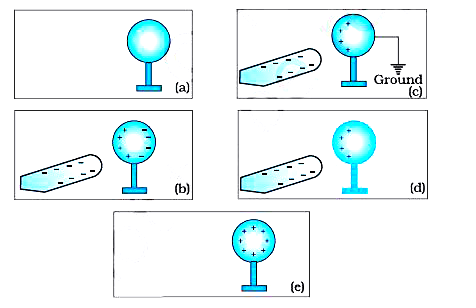 in this experiment the metal sphere GETS charged by the process of induction and the rod does not lose any of its chargeby induction by bringing a psotiviely charged rod near it in thisspereh is CONNECTED tothe ground with a wire can you explainwhy |
|
| 49. |
In the arrangement of resistances shown here, theeffective resistance between the points A and B is |
| Answer» Answer :A | |
| 50. |
The center of frequency is extremely stable in ___________ modulated wave. |
|
Answer» amplitude |
|