Saved Bookmarks
This section includes 7 InterviewSolutions, each offering curated multiple-choice questions to sharpen your Current Affairs knowledge and support exam preparation. Choose a topic below to get started.
| 1. |
A straight current carrying wire has current I directed into the plane of the fig. There is a line AB of length 2a at a distance a from the wire (see fig.). Find the value of lineintegralint_(A)^(B)vec(B).vec(dl)where vec(B) represents magnetic field at a point due to current I. Will the value of integral change if a is changed? Length of line AB is always double that of a. |
|
Answer» |
|
| 2. |
The graph shows the variation of photoelectric current with accelerating potential of different intensities. a. What conclusion do you arrive from the graph? b. Photoelectric current is not zero even if the accelerating voltage is zero. Justify your answer. c. Why two curves meet at one point on the retarding potentialaxis ? |
|
Answer» Solution :a. As intensity increases, intensity of photocurrent also increases. B. Because all ELECTRONS are not ejected with same KE. When ACCELERATION voltage is zero, these electrons are ejected with same velocity and can reach the collecting ELECTRODE, c. The frequency of incident light is the same for `I_(1) and I_(2)`. |
|
| 3. |
If the speed of rotation of the armature of a genrator is doubled,how would it affect the maximum of emf produced? |
| Answer» SOLUTION :MAXIMUM emf, `epsilon_0=NBA omega`, If `omega` is DOUBLED ,`Epsilon_0` ALSO gets doubled. | |
| 5. |
On the middle one of three thin concentric spherical metal shells of radius R there is electric charge of magnitude Q. The inner spherical shell of radius R/2 and the outer spherical shell of radius 3R/2 are earthed. (a) What is the amount of the electric charge on the earthed spherical shells? (b) Plot the electric field strength versus the distance from the center. |
| Answer» SOLUTION :(a) `(-Q)/(4),` (B) `(-3Q)/(4)` | |
| 6. |
What did Bhagat Singh become to the rest of the Indians? |
|
Answer» A PERSON of interest |
|
| 7. |
In the uniform electic field of E=1 xx 10^(4), NC^(-1), an electron is accelerated from rest. The velocity of the electron when it has travelled a distance of 2 xx 10^(-2)m is nearly (e/m" of electron " approx 1.8 xx 10^(-11)Ckg^(-1)) |
|
Answer» `8.5 xx 10^(6) ms^(-1)` Work done by electric FIELD =Change in KE of electron or `q Ex =1/2 mv^(2)` `or v=sqrt((2qEx)/(m))` `=sqrt(2 xx 1.8 xx 10^(11) xx 1 xx 10^(4) xx 2 xx 10^(-2))` `=8.5 xx 10^(6)ms^(-1)`. |
|
| 8. |
A light bulb is rated at 100W for a 220 V supply. Find (a) the resistance of the bulb, (b) the peak voltage of the source, and (c) the rms current through the bulb. |
|
Answer» <P> Solution :(a) We are given P = 100 W and V = 220 V. The resistance of the bulb is`R=(V^(2))/(P)=((220V)^(2))/(100W)=484Omega` (b) The peak voltage of the source is `v_(m)=sqrt(2)V=311V` (c) Since, P = I V `I=(P)/(V)=(100W)/(220V)=0.454A` |
|
| 9. |
A double convex lens forms a real image of an object on a screen which is fixed. Now the lens is given a constant velocity 1 m/s along its axis and away from the screen. For the purpose of forming a sharp image always on the screen, the object is also required to be given an appropriate velocity The velocity of the object at the instant the size of the image is half the size of the object. |
|
Answer» 1m/s |
|
| 10. |
Find the wavelength of electromagnetic waves of frequency 5xx 10^(19) Hz in free space. Give its two applications. |
|
Answer» SOLUTION :`LAMBDA = c/v = (3xx 18^(18))/(5xx10^(19))= 6xx10^(-12) m = 0.06 Å` This WAVELENGTH corresponds to X - rays which are used : (i) as a diagnostic tool. (ii) as a treatment for certain forms of cancer. |
|
| 11. |
If the amplitude ratio of two sources producing interference is 3.5, the ratio of intensities of maxima and minima is |
| Answer» ANSWER :C | |
| 12. |
Three concentric charged metallic spherical shells A, B and C have radii a,b and c, charge densities sigma,-sigma and sigma and potentials V_A,V_B and V_C respectively. Then which of the following relations is correct? |
|
Answer» `V_A=((a+B+c)SIGMA)/epsilon_0` |
|
| 13. |
State the basic postulates of Bohr's theory of atomic spectra. Hence obtain an expression for the radius of orbit and the energy of orbital electron in a hydrogen atom. |
|
Answer» Solution :a) Basic postulates of Bohr's theory are 1) The electron revolves round a nucleus is an atom in various orbits known as stationary orbits. The electrons can not emit radiation when MOVING in their own stationary levels. 2) The electron can revolve round the nucleus only in allowed orbits whose angular momentum is the integral multiple of `(h)/(2pi)` i.E., `mv_(n)r_(n)=(nh)/(2pi)""rarr(1)` where n=1,2,3.... 3) If an electron jumps from higher ENERGY `(E_(2))` orbit to the lower energy `(E_(1))` orbit, the difference of energy is radiated in the form of radiation. i.e., `E=hv=E_(2)-E_(1)rArr v=(E_(2)-E_(1))/(h)" "rarr(2)` b) Energy of emitted radiation : in hydrogen atom, a single electron of charge-e, revolves around the nucleus of charge e in a CIRCULAR orbit of radius `r_(n)`. 1) K.E. of electron : For the electron to be in circular orbit, centripetal force = The electrostatic force of attraction between the electron and nucleus From Coulomb's law, `(m v_(n)^(2))/(r_(n))=(K e^(2))/(r_(n)^(2))" "rarr(3)` where `K=(1)/(4 pi epsi_(0))""rarr(4)` `mv_(n)^(2)=(Ke^(2))/(r_(n))" "rarr(5)` `mv^(2)r_(n)=Ke^(2)""rarr(6)` Dividing (5) by (1), `v_(n)=Ke^(2)xx(2pi)/(nh)` From (3), kinetic energy `K=(1)/(2) mv_(n)^(2)=(Ke^(2))/(2r_(n))` 2) Potential energy of electron : P.E. of electron, `U=(Ke)/(r_(n))xx-e""[because W=(1)/(4 pi epsi_(0))(q)/(d)xx-Q]` `therefore U =(-Ke^(2))/(r_(n))` 3) Radius of the oribit : Substituting the value of (6) in (2). `(m)/(r_(n)) ((n^(2)h^(2))/(4pi^(2)r_(n)^(2)m^(2)))=(Ke^(2))/(r_(n)^(2))` `r_(n)=(n^(2)h^(2))/(4 pi ^(2) m K e^(2))" "rarr(1)` `therefore " "r_(n)=0.53 n^(2)` 4) Total energy `(E_(n))` : Revolving electron posses K.E. as well as P.E. i.e., `E_(n)=K+U=(K e^(2))/(2t)-(Ke^(2))/(t)=(-K e^(2))/(2r)` `rArr E_(n)=(-K e^(2))/(2n^(2)h^(2))xx4pi^(2) m K e^(2)" "[therefore " from (7)"]` But `K=(1)/(4pi epsi_(0))` `therefore E_(n)=(-"me"^(4))/(8epsi_(0)^(2)n^(2)h^(2))` 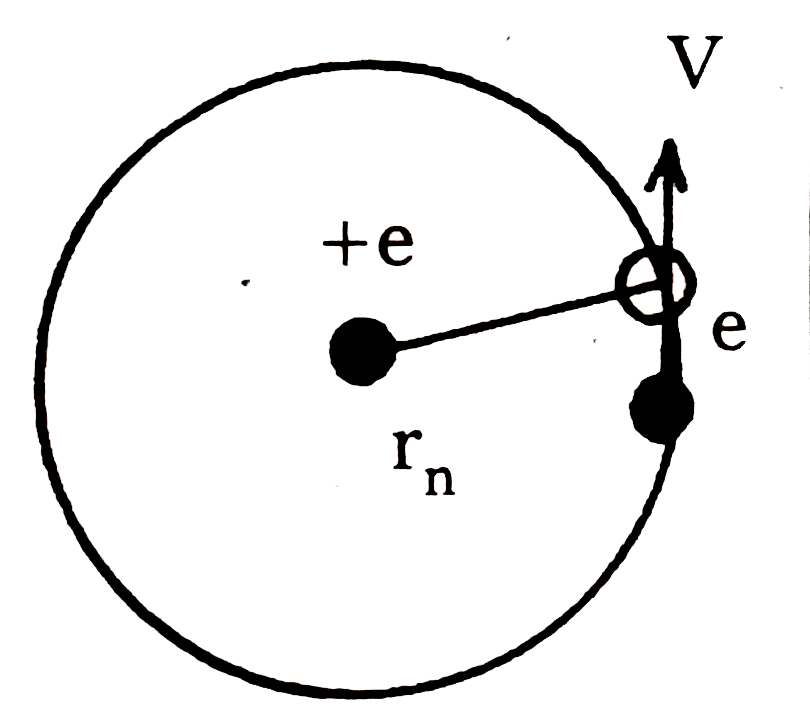
|
|
| 14. |
A system is created by adjusting the five polaroids to touch each other. The polaroid rotates one by one about its axis to 60^(@). Then intensity of emergent light emitted from the last polaroid will be the ...... part of intensity of incident light. |
|
Answer» `(I_(0))/(64)` The intensity of light emergent from polaroid is, `I_(1)=(I_(0))/(2)` The intensity of light emergent from second polaroid is `I_(2)=(I_(0))/(2)cos^(2)60^(@)` `=(I_(0))/(8) "" [ :. 60^(@)=(1)/(2)]` The intensity of light emergent from third polaroid is, `I_(3)=(I_(0))/(8)cos^(2)60^(@)` `=(I_(0))/(32) ""[ :. cos60^(@)=(1)/(2)]` The intensity of light emergent from fourth polaroid is, `I_(4)=(I_(0))/(32)cos^(2)60^(@)=(I_(0))/(128)` The intensity of light emergent from fifth polaroid is `I_(5)=(I_(0))/(128)cos^(2)60^(@)=(I_(0))/(512)` By short method: `I_(5)=(I_(0))/(2)(cos^(2)60^(@))^(4)=(I_(0))/(2)((1)/(4))^(4)=(I_(0))/(512)` |
|
| 15. |
n identical cells, each of emf epsilon and iternal resistance r, are joined in series to form a closed circuit. The potential difference across any one cell is |
|
Answer» ZERO |
|
| 16. |
During charging process of a capacitor _________ current is set-up between the plates of capacitor. |
| Answer» SOLUTION :DISPLACEMENT | |
| 17. |
Two loudspeakers are located 3 m apart on the stage of an auditorium. A listener at point P is seated 29.0 m from one speaker and 25.0 m from the other. A signal generator drives the speakers in phase with the same amplitude and frequency. The wave amplitude at P due to each speaker alone is A. The frequency is then varied between 20 Hz and 300 Hz. The speed of sound is 343 m/s.Determine the value of the maximum amplitude in terms of A. |
|
Answer» 2.0A |
|
| 18. |
The average magnetic energy density of an electromagnetic wave of wavelength travelling in free space is given by |
|
Answer» `(B^(2))/(2lambda)` |
|
| 19. |
Two loudspeakers are located 3 m apart on the stage of an auditorium. A listener at point P is seated 29.0 m from one speaker and 25.0 m from the other. A signal generator drives the speakers in phase with the same amplitude and frequency. The wave amplitude at P due to each speaker alone is A. The frequency is then varied between 20 Hz and 300 Hz. The speed of sound is 343 m/s.At what frequency or frequencies will the listener at P hear a maximum intensity? |
|
Answer» 170 HZ only |
|
| 20. |
For light diverging from a point source |
|
Answer» the wavefront is spherical.  Wavefront Wavefronts emitted from point like source and then propagating in three dimensional, homogeneous isotropic medium are found to be spherical in shape as shown in the figure (because at a given instant of time, phases of OSCILLATIONS of light vectors are same at all the points on such spherical surface and so according to definition such a surface becomes sphercial wavefront). Thus option (A) is CORRECT. Here since power of a given source is constant, we have P = IA = constant `:.Iprop(1)/(A)` `:.Iprop(1)/(r^(2))` ( `:.` Area of spherical surface is `A=4pir^(2)` ) Option (B) is ALSO correct. |
|
| 21. |
If the mass of earth reduces to half its present value with no change in size, how much will be the escape velocity, |
|
Answer» SOLUTION :`W=mg=(MGM)/R^2 W^1=(GMM)/(2R)^2=1//_4[(GMm)/R^2]=1//4W thereforeW'=80//4=20kg WT`. |
|
| 22. |
What is so special about the combination e/m ? Why do we not simply talk of e and m separately ? |
|
Answer» Solution :When we study energy of electron ACCELERATED by an accelerating voltage V, then we find that `K=(1)/(2)mv^(2)=eV implies v^(2)=(2e)/(m)V` . . (i) When we study MOTION of an electron beam ALONG an electric FIELD `vecE`, we find that `vecF=-evecE=mveca` or Acceleration of electron `veca=-(e)/(m)vecE`. . (ii) Again when consider motion of an electron beam in a magnetic field acting normally, the radius of electron path is given by `r=(mv)/(eB)`. . . . (iii) All the three relations given above and many more such relations show that dynamics of electrons is governed by its specific charge `((e)/(m))`. |
|
| 23. |
What type of semiconductor will be made if Boron is added to Silicon ? |
| Answer» Answer :A | |
| 24. |
The charge on 1 microgram (g) electron will be......(mass of an electron = 9.11 xx 10^(-31)kg) |
|
Answer» `1.76 XX 10^(-3)` C Charge on `10^(-9)` kg - ? `Q=(1.6 xx 10^(-19) xx 10^(-9))/(9.11 xx 10^(-31))` `THEREFORE Q = 176 C` |
|
| 25. |
In an electromagnetic wave, the direction of propagation is in the direction of |
|
Answer» `vec(E)` |
|
| 26. |
A battery of internal resistance 4Omegais connected to the network of resistances as shown in the fig. In order that the maximum power can be delivered to the network, the value of R in Omegashould be |
| Answer» ANSWER :B | |
| 27. |
In the previous question what will be the terminal potential difference for the cells, which are connected with forward polarity? |
|
Answer» `((n+1) NE-4)/(n)` `V= E-r = nE- ((nE-4)/(nr)) r= (n^(2)E- nE + 4)/(n)` `= ((n-1) nE + 4)/(n)` Hence, option (d) is correct |
|
| 28. |
A point charge +q is placed at the midpoint of a cube of side l. the electric flux emerging from the cube is |
|
Answer» `(Q)/(epsilon_(0))` |
|
| 29. |
When a ferromagnetic material goes through a hysteresis loop, the magnetic susceptibility |
|
Answer» has a fixed value |
|
| 30. |
A small particle is dropped from a height R in front of a narow tunnel dug inside the earth (along a diameter). Let M be the mass of earth, R be radius of earrth. Let v_(0), T be speed of particle when it reaches A and time taken by particle to go from A to B respectively. Assuming mass of particle to be negligible as compare to mass of earth, pick the correct option(s) |
|
Answer» `V_(0)=SQRT((GM)/(2R))` `impliesv_(0) =sqrt((GM)/R)` while in the tunnel, `(d^(2)X)/(dt^(2))=-((GM)/(R^(3)))x` `v_(0)^(2)=(GM)/R=omega^(2)(a^(2)-R^(2))impliesa=sqrt(2)R` `implies T_(ATOB)=1/4xx2pisqrt((R^(3))/(GM))` 
|
|
| 31. |
Fraunhoffer diffraction experiment at a single slit light of wavelength 400 nm, the first minimum is formed at an angle of 30^(@). The direction theta of the secondary maximum is |
|
Answer» `SIN^(-1)(3//2)` |
|
| 32. |
The electromagnetic waves of frequency 80 MHz and 200 MHz |
|
Answer» can be REFLECTED by TROPOSPHERE |
|
| 33. |
The rate of increase of thermo emf with temperature at the neutral temperature of a thermocouple: |
|
Answer» is positive |
|
| 34. |
Draw a graph showing variation of current with changing frequency of applied voltage in a series LCR circuit for two different values of resistance R_(1)&R_(2)(1_(1)gt1_(2)) fr - resonant frequency. |
Answer» Solution :The maximum CURRENT at series resonance is limited by the resistance of the CIRCUIT. For smaller RESITANCE, lager current with sharper curve is obtained and VICE versa. 
|
|
| 35. |
Show mathematically that the potential at a point on the equatorial line of an electric dipole is zero. |
|
Answer» <P> Solution :Consider a point P situated on the equatorial line of the electric dipole at a distance r from mid-point of dipole.Now electric potential at P is GIVEN by `V = V_A + V_B = (-Q)/ (4 pi epsi_0 sqrt(r^2 + a^2)) + q/(4PI epsi_0 sqrt(r^2 + a^2)) = 0` . hus, potential at any point on equatorial line of an electric -9. dipole is ZERO irrespective of the position of that point. |
|
| 37. |
In Fig. a "semi-infinite" nonconducting rod (that is, infinite in one direction only) has uniform linear charge density lambda. (a) show that the electric field vec(E)_(p)at point P makes an angle 45^(@) with the rod and that this result is independent of the distance R. (Hint : Separetly find the component of vec(E)_(p) parallel to the rod and the component perpendicular to the rod.) (b) Find the the field magnitude for linear charge density 4.52 nC/m and R = 3.80 cm. |
| Answer» SOLUTION :(B) `1.51 XX 10^(3)N//C` | |
| 38. |
A pointchargeof 2.0 mu cis at thecentreof a cubic gaussian surface 9.0 cm on edge what is the net electricflux throughthe surface |
| Answer» SOLUTION :`2.2 xx10^(5) N m^(2) //C` | |
| 39. |
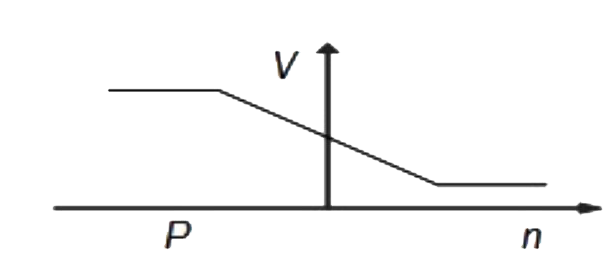
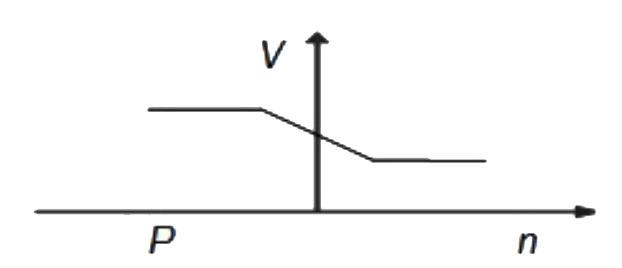
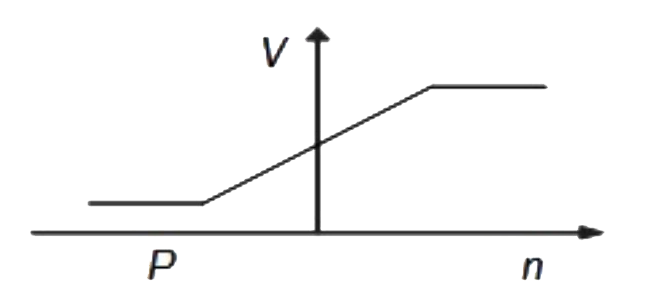
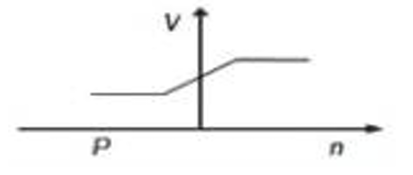
In a forward biased PN- junction diode, the potential barrier in the depletion region is of the from... |
|
Answer»
|
|
| 40. |
A progressive wave has a shape (or waveform) given by the equation, y = 2/(x^(2) -6x +14)^(3//2) , at the instant rime t = 1. Express the wave equation in terms of time t, |
|
Answer» `y = 2/[5 + (x-3T)^(2)]^(3//2)` |
|
| 41. |
A particle moves with constant acceleration a and v_1 v_2 v_3 . are its average velocities in the three successive intervalst_1 t_2 and t_3 is of time. Then which relation out of the following holds good for its motion ? |
|
Answer» `(v_1 -v_2)/(v_2 -v_3) =(t_1 +t_2)/(t_2+t_3)` Also `v_(2)((u+at_(1))+[u+a(t_1 +t_2)])/(2)` `u+(2at_(1))/(2) +(1)/(2)at_(2)` `:.v_2=u+at_(1)+(1)/(2)at_(2)` Hence `(v_1 -v_2)/(v_2 -v_3)=(t_1 +t_2)/(t_2 +t_3)` |
|
| 42. |
104^(@)F correspondsto what temperatureon Kelvin scale ? |
|
Answer» 313 |
|
| 43. |
The Q value of a nuclear reaction A + b to C + d is defined by Q = [m_A + m_b - m_C - m_d]c^2, where the masses refer to the respective nuclei. Determine from the given data the Q-value of the following reactions and state whether the reactions are exothermic or endothermic. i. ""_1^1H + ""1^3Hto ""1^2H + ""1^2H ii. ""_6^12C + ""6^12C to ""10^20Ne + ""_2^4He Atomic masses are given to be m(""_1^2H) = 2.014102u m(""_1^3H) = 3.016049 u m(""_6^12C) = 12.000000u m_(""_10^20Ne) = 19.992439 u. |
|
Answer» Solution :`i. ""_1^1H + ""_1^3H to ""1^2H + ""_1^2H` `Q = [{m(""1^2H) + m(""_1^3H)}-{m(""_1^2H) + m(""_1^2H)}]c^2` `=(4.02387 - 4.028204)931` `= -4.033 MEV` (Negative sign SHOWS that the REACTION is endothermic) II. `Q = [2m(""_6^12C) - {m(""10^(20)Ne) + m(""_2^4He)}]c^2` `={2 xx 12 -(19.992439 + 4.002603)}931` `=4.618 MeV` (exothermic reaction) |
|
| 44. |
Draw the typicalinputand output characterisitics of an n-p-n transistor in CE configurtion . Showhow these characteristic can be used to determine (a) theinputresistance(r_(1)) and(b)currentamplificationfactor (beta). |
|
Answer» Solution :Characteristics ofTransistorin C- E configuration: InputCharacteristics: I/P CH in C - E configuration as shown. It is thecurvebetweeninputcurrent`I_(B)`base currentand theI/P voltage `V_(BE)` (Bare Emitter voltage ) at constantcallector emitter voltage`(V_(LE))` InputResistance :`r_(i) = (DeltaV_(BE))/(DeltaI_(B))|V_(CE)`= constant DYNAMIC I/P resistance `r_(i)`is verysmall in CE configuration due to this after the cut in voltagebase CURRENT`I_(B)`increase rapidly with small increase on base-emittervolt. `V_(BE)` 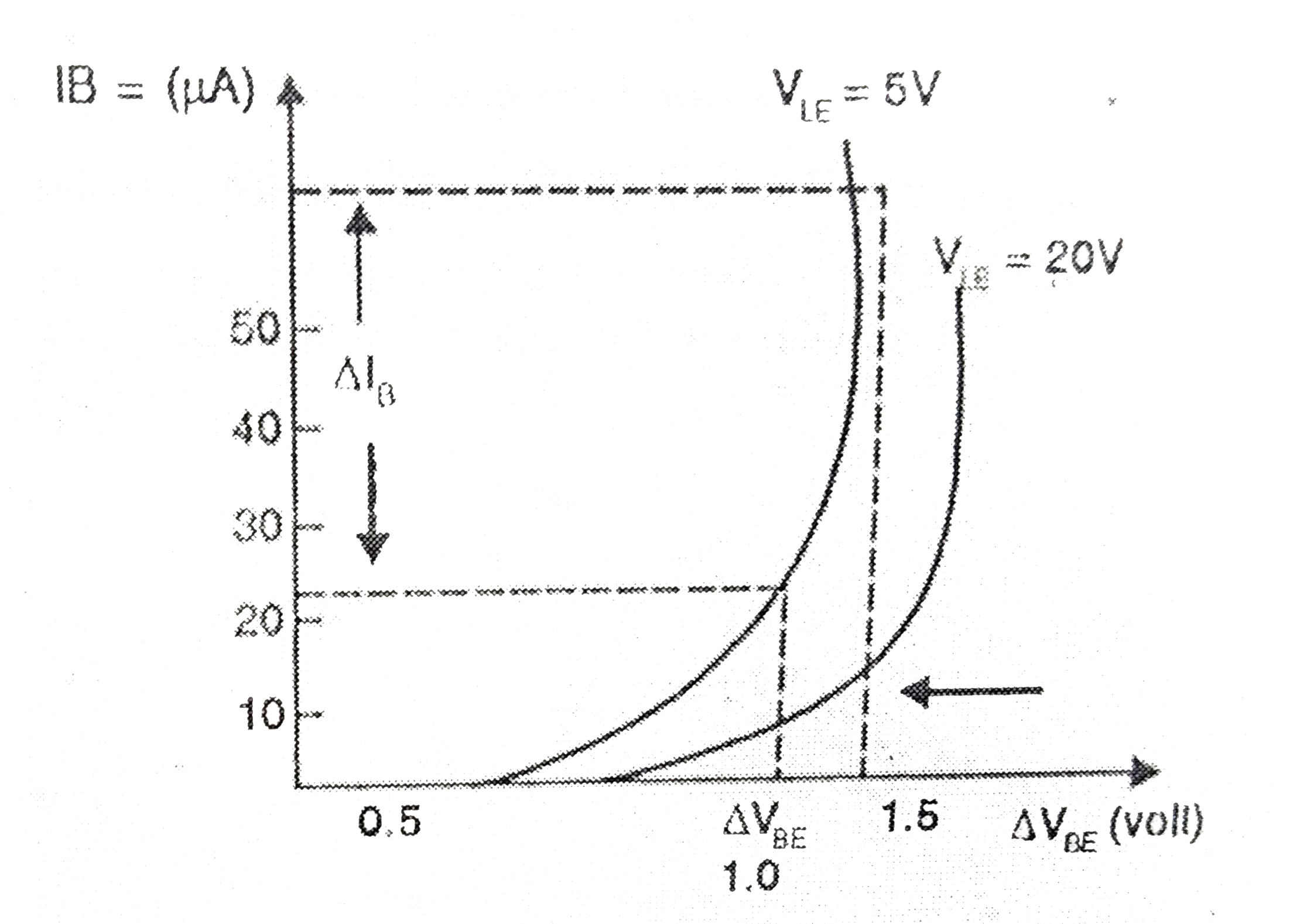 Output Characteristic: Outputcharacetristic is a platebetween the collectorcurrentIC andcollector volt. `V_(CB)`usingbasecurrent`I_(B)` as constant. `B_(dc)` and `B_(ac)`: We knowthat , `B_(dc) = (I_(C))/(I_(B))` a.c Beta isobtained. `B_(ac) = (DeltaI_(C))/(DeltaI_(B))` 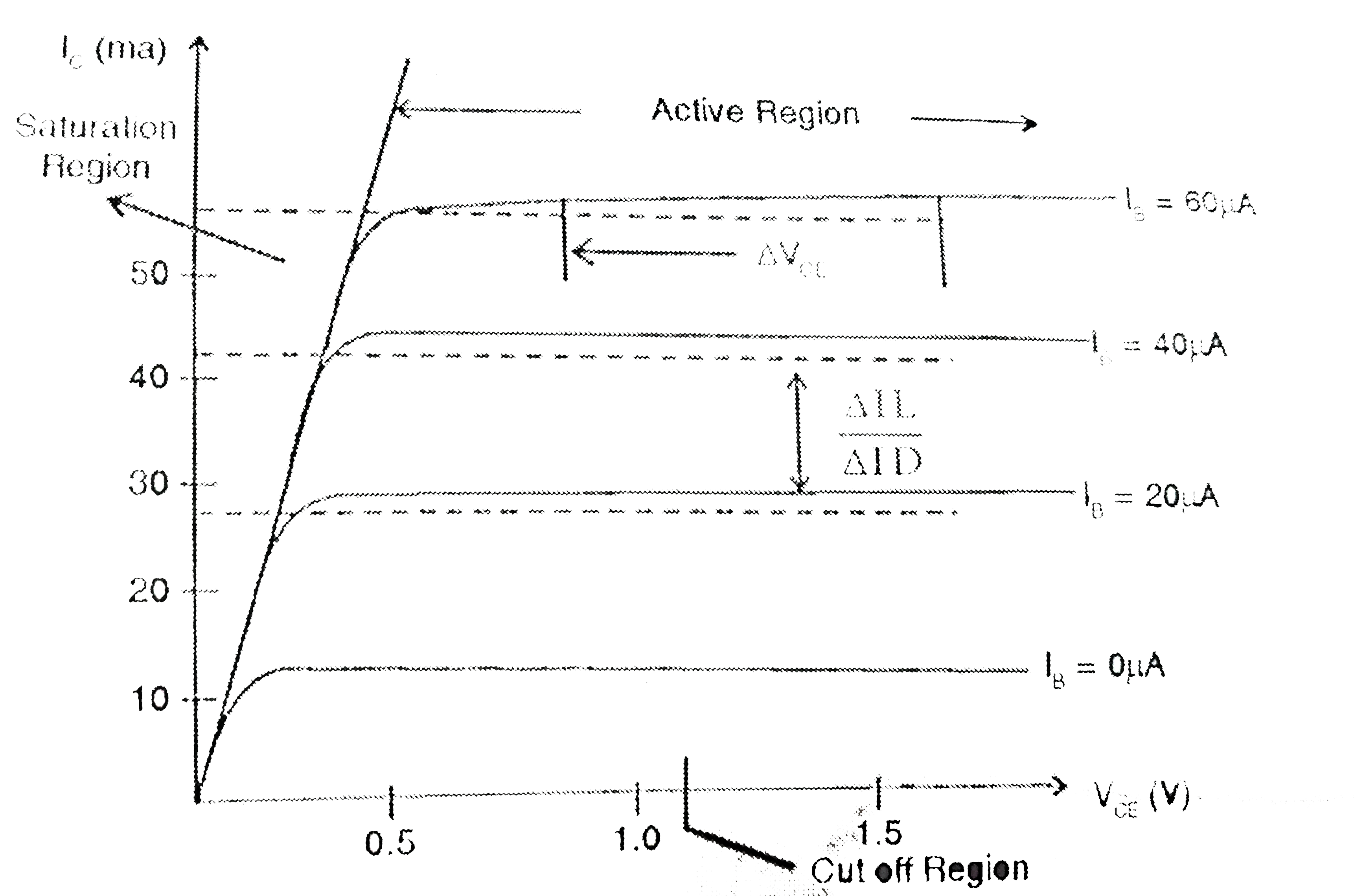
|
|
| 45. |
Two soap bubble are combined isothermally to form a big bubble of radius R. If DeltaV is change in volume, DeltaS is change in surface area and P_(0) is atmospheric pressure then show that 3P_(0)(DeltaV)+4T(DeltaS)=0 |
|
Answer» `4pV+3SA=0` |
|
| 46. |
An object of mass 5 kg is acted upon by exactly four forces,, each of magnitude 10 N. which of the following could NOT be the resulting acceleration of the object? |
|
Answer» `0m//s^(2)` |
|
| 47. |
(A): When the magnetic flux through a loop is maximum, induced emf is maximum (R): When the magnetic flux through a loop is minimum, induced emf is minimum. |
|
Answer» Both A and R are true and R is the correct explanation |
|
| 48. |
There is a uniform sphere of mass M and radius R. Find the strength G and the potential var phi of the gravitational field of this sphere as a function of the distance r from its centre (with r lt R and r gt R). Draw the approximate plots of the functions G(r) and varphi(r). |
|
Answer» Solution :We have obtained `varphi` and G due to a uniform sphere, at a DISTANCE r from it's centre outside it. `varphi=-(gammamM)/(r)` and `vecG=-(gammaM)/(r^3)vecr` (A) Accordance with the Eqs. (1) of the solution, potential due to a SPHERICAL shell of radius a, at any point, inside it becomes `varphi=(gammaM)/(a)=Const.` and `G_r=-(deltavarphi)/(deltar)=0` (B) For a point (say P) which lies inside the uniform solid sphere, the potential `varphi` at that point may be represented as a sum. `varphi_(i NSIDE)=varphi_1+varphi_2` where `varphi_1` is the potential of a solid sphere having radius r and `varphi_2` is the potential of the layer of radii r and R. In accordance with equation (A) `varphi_1=-(gamma)/(r)((M)/((4//3)piR^3)4/3pir^3)=-(gammaM)/(R^3)r^2` The potential `varphi_2` produced by the layer (thick shell) is the same at all points inside it. The potential `varphi_2` is easiest to calculate, for the point positioned at the layer's centre. Using Eq. (B) `varphi_2=-gammaunderset(r)overset(R)INT(dM)/(r)=-3/2(gammaM)/(R^3)(R^2-r^2)` where `dM=(M)/((4//3)piR^3)4pir^2dr=((3M)/(R^3))r^2dr` is the mass of a thin layer between the radii r and `r+dr`. Thus `varphi_(i nside)=varphi_1+varphi_2=((gammaM)/(2R))(3-(r^2)/(R^2))` (C) From the Eq. `G_r=(-deltavarphi)/(deltar)` `G_r=(gammaMr)/(R^3)` or `vecG=-(gammaM)/(R^3)vecr=-gamma4/3pirhovecr` (where `rho=(M)/(4/3piR^3)`, is the density of the sphere) (D) The plots `varphi(r)` and `G(r)` for a uniform sphere of radius R are shown in figure of ansersheet. Alternate: Like Gauss's theorem of electrostatics, one can derive Gauss's theorem for gravitation in the form `oint vecG*dvecS=-4pigammam_(i nclosed)`. For calculation of `vecG` at a point inside the sphere at a distance r from its centre, let us CONSIDER a Gaussian surface of radius r, Then, `G_r4pir^2=-4pigamma((M)/(R^3))r^3` or, `G_r=-(gammaM)/(R^3)r` Hence, `vecG=-(gamma*M)/(R^3)vecr=-gamma4/3pirhovecr` (as `rho=(M)/((4//3)piR^3)`) So, `varphi=underset(r)overset(oo)intG_rdr=underset(r)overset(R)int-(gammaM)/(R^3)rdr+underset(R)overset(oo)int-(gammaM)/(r^2)dr` Integrating and summing up, we get, `varphi=-(gammaM)/(2R)(3-(r^2)/(R^2))` And from Gauss's theorem for outside it: `G_r4pir^2=-4pigammaM` or `G_r=-(gammaM)/(r^2)` Thus `varphi(r)=underset(r)overset(oo)intG_rdr=-(gammaM)/(r)` |
|
| 49. |
Consider a spectral line resulting from the transition n = 5 to n = 1, in the atoms and ions given below. The shortest wavelength is produced by |
|
Answer» HELIUM atom |
|
| 50. |
Unpolarized light of intensity I_0is incident on a polarizer and the emerging light strikes a second polarizing filter with its axis 45° to that of the first. Determine (a) the intensity of the emerging beam and (b) its state of polarization. |
| Answer» SOLUTION :`(a) I_(0)// 4`,(b) parallel to TRANSMISSION axis of second POLARIZER | |