

Saved Bookmarks
This section includes 7 InterviewSolutions, each offering curated multiple-choice questions to sharpen your Current Affairs knowledge and support exam preparation. Choose a topic below to get started.
| 1. |
A U^(238) preparation of mass 1.0g emits 1.24.10^(4) alpha particles per second. Find the life of this nuclide and the activity of the preparatio. |
|
Answer» SOLUTION :Here `N_(0)=(1)/(238)xx6.023xx10^(23)` `= 2.531xx10^(21)` The activity is `A= 1.24xx10^(4) dis//sec` ltbr4gt Then `lambda=(A)/(N_(0))= 4.90xx10^(-18) per sec`. Hence the HALF life is `T_(1/2)=(In2)/(lambda)= 4.49xx10^(9) YEARS` |
|
| 2. |
TwoSHW are represented by the equationsx_1 = 20 sin [5pit +pi/4] and x_2 = 10 (sin5pit+sqrt(3) cos 5 pit] . The ratio of the amplitudes of the two motions is |
|
Answer» 0.5 |
|
| 3. |
What are the directions of electric and magnetic field vectors relative to each other and relative to the direction of propagation of electromagnetic wave. |
| Answer» Solution :In electromagnetic waves electric and MAGNETIC fields oscillate in mutually PERPENDICULAR directions as well as perpendicular to the DIRECTION of PROPAGATION of e.m. wave. | |
| 4. |
A stone is dropped into a well of 20 m deep.Another stone is thrown downward with velocity 'v' one secnd later.If both stones reach the water surface in the well simultaneously ,y equal to (g=10 ,s^(-2)) |
|
Answer» `30 ms^(-1)` |
|
| 5. |
जीवाणु में,माइटोकॉन्ड्रिया के समावृत्ति अंग (analogous organs) को कहते है : |
|
Answer» राइबोसोम |
|
| 6. |
A block of mass m and positive charge q is placed on an insulated frictionless inclined plane as shown in the figure. A uniform electric field E is applied parallel to the inclined surface such that the block is at rest. Calculate the magnitude of the electric field E. |
|
Answer» Solution :There are three forces that acts on the massm: (i) The downward gravitational force EXERTED by the Earth (mg) (ii) The normal force exerted by the INCLINED surface (N) (III) The Coulomb force given by uniform electric field (qE) The free BODY diagram for the mass ma is drawn below . A convenient INERTIAL of the mass m is drawn below. A convenient inertial coordinate system is located in the inclined surface as shown in the figure. The mass m has zero net acceleration both in x and y -direction. Along x-direction applying Newton.s second law we have `mg sin thetahati-qEhati=0` `mg sin theta-qEhati=0` or ,` E=(mg sin theta)/(q)` 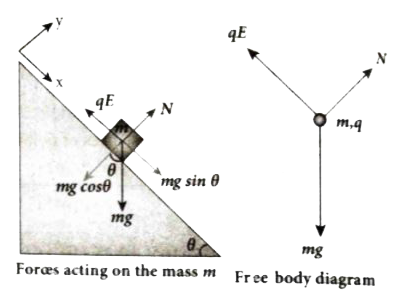 Note that the magnitude of the electric field is drectly proportional to the mass m and inversely proportional to the charge q . It implies that if the mass is increased by keeping the charge constant then a strong electric field is required to stop the object from sliding . If the charge is increaed by keeping the mass constant then a weak electric field is sufficient to stop the mass from sliding down the plane . The electric field also can be expressed in terms of height and the length of the inclined surface of the plane `E=(mgh)/(qL)` |
|
| 7. |
An object is placed in front of a convex mirror at a distance of 50 cm. A plane mirror is introduced covering the lower half of the convex mirror. If the distance between the object and the plane mirror is 30 cm, it is found that there is no gap between the images formed by the two mirrors. The radius of the convex mirror is : |
|
Answer» 12.5cm |
|
| 8. |
A hollow conducting sphere of radius R has a charge (+Q) on its surface. What is the electric potential within the sphere at a distance r=R/3 from it's centre : |
|
Answer» ZERO |
|
| 9. |
The nucleus of an atom of tritium in its ground state undergoes radioactive decay according to ""_(1)H^(3) rarr ""_(2)He^(3), yielding an ion of He^(3). In this case which of the following is not correct. |
|
Answer» The RADIUS of the bohr ORBIT of the ELECTRON increases |
|
| 10. |
Find the distance of image from convex lens. |
|
Answer» 24 CM `1/v-((1)/(-20))=1/40` `V=-40cm` For CONCAVE lens `u=-60cm` `1/v-((1)/(-60))=(1)/(-40)` `v=-24` cm from concavve lens So from convex lens image is at `24-(20)=4` cm |
|
| 11. |
Explain the formation of PN junction diode. Discuss its V-I characteristics. |
|
Answer» Solution :Formation of depletion layer: Ap-n junction is formed by joining n-type and p-type semiconductor materials as shown in figure (a). Since the n-REGION has a high electron concentration and the p-region a high hole concentration, electrons diffuse from the n-side to the p-side. This causes diffusion current which exists due to the concentration difference of electrons. The electrons diffusing into the p-region may occupy holes in that region and make it negative. The holes left behind by these electrons in the n-side are equivalent to the diffusion of holes from the p-side to the n-side. If the electrons and holes were not charged, this diffusion process would continue until the concentration of electrons and holes on the two sides were the same, as happens if two gasses come into contact with each other.  But, in a p-n junction, when the electrons and holes move to the other side of the junction, they leave behind exposed charges on dopant atom sites, which are fixed in the crystal lattice and are unable to move. On the n-side, positive ion cores are exposed and on the p-side, negative ion cores are exposed as shown in Figure (b). An electric field E forms between the positive ion cores in the n-type material and negative ion cores in the p-type material. The electric field sweeps free carriers out of this region and hence it is called depletion region as it is depleted of free carriers. A BARRIER potential V, due to the electric field E is formed at the junction as shown in Figure (C). As this diffusion of charge carriers from both sides continues, the negative ions form a layer of negative space charge region along the p-side. Similarly, a positive space charge region is formed by positive ions on the n-side. The positive space harge region attracts electrons from P-side to n-side and the negative space charge region attracts holes from n-side to p-side. This moment of carriers happen in this region due to the formed electric field and it constitutes a current called drift current. The diffusion current and drift current flow in the opposite direction and at one instant they both become equal. Thus, a p-n junction is formed. V-I characteristics of a junction diode Forward characteristics It is the study of the variation in current through the diode with respect to the applied voltage across the diode when it is forward biased. An external resistance (R) is used to limit the flow of current through the diode. The voltage across the diode is varied by varying the BIASING voltage across the de power supply. The forward bias voltage and the corresponding forward bias current are noted. A graph is plotted by taking the forward bias voltage (V) along the X-axis and the current (1) through the diode along the y-axis. This graph is called the forward V-I characteristics of the p-n junction diode. Three inferences can be brought out from the graph:  (i) At room temperature, a potential difference equal to the barrier potential is required before a reasonable forward current starts flowing across the diode. This voltage is known as threshold voltage or cut-in voltage or knee voltage `(V_(th))`. It is approximately 0.3 V for Germanium and 0.7 V for Silicon. The current flow is negligible when the applied voltage is less than the threshold voltage. Beyond the threshold voltage, increase in current is significant even for a small increase in voltage. (ii) The graph clearly infers that the current flow is not linear and is exponential. Hence it does not obey Ohm.s law. (iii) The forward resistance `(r_(f))` of the diode is the ratio of the small change in voltage `(DeltaV)`tothe small change in current `(DeltaI),r_F=(DeltaV)/(DeltaI)` .  However, if the applied voltage is increased beyond a rated VALUE, it will pro extremely large current which may destroy the junction due to overheating. This as the breakdown of the diode and the voltage at which the diode breaks down is breakdown voltage. Thus, it is safe to operate a diode well within the threshold valt the breakdown voltage. Reverse characteristics In the reverse bias, the p-region of the diode is connected to the negative terminal and n-region to the positive terminal of the dc power supply. A graph is drawn between the reverse bias voltage and the current across the junction, which is called the reverse characteristics of a p-n junction diode. Under this bias, a very small current in `muА`, flows across the junction. This is due to the flow of the minority charge carriers called the leakage current or reverse saturation current.Besides,the current is almost independent of the voltage. The reverse bias voltage can be increased only up to the rated value otherwise the diode will enter into the breakdown region. 
|
|
| 12. |
The output of an OR gate is connected to both the inputs of a NAND gate . The combination will serve as |
|
Answer» AND gates |
|
| 13. |
Electric dipole consists of _____ charges and the electric dipole moment is _____ quantity. |
| Answer» SOLUTION :TWO, VECTOR | |
| 14. |
The temperature at which the root mean square velocity of a molecules will be double of its value at 100^(@)C is |
|
Answer» `1492^(@)C` `T_(1)=(273+100)K` `T_(2)=(273+100)(2)^(2)=1492K` `=(1492-273)=1219^(@)C` |
|
| 15. |
What happens to a conductor when some charges are given to it? |
| Answer» SOLUTION :POTENTIAL INCREASES | |
| 16. |
In classical mechanics, mass of a moving body is "_____________". |
| Answer» Answer :A | |
| 17. |
A particle travels half the distance with a velocity of 6 ms. The remaining half distance is covered with a velocity of 4 ms for half the time and with a velocity of 8 ms for the rest of the half time. What is the velocity of the particle averaged over the whole time of motion? |
|
Answer» `(V_0+v_1+v_2)/(3)` |
|
| 18. |
Discuss characteristic of induced emf in AC generator. |
|
Answer» Solution :Formula of induced EMF in AC generator is, `epsilon=epsilon_0 sin omegat=epsilon_0 sin (2pivt)`….(1) Note the Eq.(1) give the instantaneous value of the emf and e varies between `+epsilon_0` and `-epsilon_0` PERIODICALLY. In the figure different stage of generator is given ALONG with emf `to` time GRAPH. 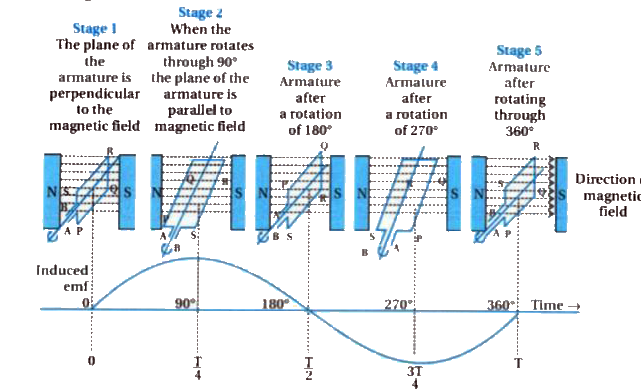 emf produced at different interval of time can be found as follow: Stage 1: When `omegat=0^@`, the plane of the coil is perpendicular to `vecB, sin omegat=sin0^@=0`, so that `epsilon=0` Stage 2: When `omegat=pi/2` the plane of the coil is parallel to field `vecB, sin omegat = "sin"pi/2=1`, so that `epsilon=epsilon_0` . Stage 3: When `omegat=pi` , the plane of the coil is again perpendicular to B, `sin omegat=sinpi=0`, so that `epsilon=0` State 4: When `omegat=(3pi)/2` the plane of the coil is again parallel to `vecB`, `sin omegat = "sin" (3pi)/2=-1`, so that `epsilon=-epsilon_0` Stage 5: When `omegat=2pi`, the plane of the coil again becomes perpendicular to `vecB` after COMPLETING one rotation, `sinomegat=sin2pi=0`, so that `epsilon=0` |
|
| 19. |
As shown in following figure, one network is connected to a battery of 16 V emf and internal resistance 1 Omega. Find (a) equivalent resistance of network. (b) current through each resistance. (c) voltage drops of V_(AB), V_(BC) , V_(CD), |
|
Answer» Solution :(a) 3 `OMEGA ` , (b) Current through 3 `Omega` is 2 A , current through BC is 1 A and currrent through CD = ` 1 A , (C) V_(AB) = 6 ` VOLT |
|
| 20. |
(A ): The light can travel in vacuum but sound cannot do so (R) : Light is an electromagnetic wave and sound is a mechanical wave |
|
Answer» Both 'A' and 'R' are TRUE and 'R' is the CORRECT EXPLANATION of 'A'. |
|
| 21. |
An electrons enters perpendicularly into uniform magnetic field having magnitude 0.5xx10^(-4)T.If it moves on a circular path of radius 2mm,its de-Broglie wavelength is…..A |
|
Answer» 3410 For electron ENTERING perpendicular to magnetic field. `(mv^(2))/(r )=BeV` `therefore mv=p=Ber` `lambda=(h)/(p)=(h)/(Ber)` `=(6.62xx10^(-34))/(0.5xx10^(-4)xx1.6xx10^(-19)xx2xx10^(-4))` `=(6.62xx10^(-34))/(1.6xx10^(-27))` `=4.14xx10^(-7)` m `therefore lambda=4140 Å` |
|
| 22. |
Using Gauss’s theorem, it can be proved that the strength of electric field, at any point, inside a spherical shell is zero. What about the potential at a point ? |
| Answer» SOLUTION :Since E=0 dV=E DL =0 Difference of potential between any two points is zero. The POTENTIALS at all the points inside the spherical shell is same and its VALUE is equal to that on the surface of shell. | |
| 23. |
Half life of U-238 undergoing alpha decay is 4.5 xx 10^(9) years. What is the activity of one gram of U-238 sample ? |
|
Answer» Solution : GIVEN ` T = 4.5 xx 10^(9) " YEAR1 year"=365.25 xx 8.64 xx 10^(4) s ` ` i.e,1 " year" = 3.156 xx 10^(7)_(s)` HENCE` T = 4.5 xx 10^(9) xx 3.156 xx 10^(7) s ` ` T = 14.202 xx 10^(16) s ` 238 g of Uranium consists of ` 6.023 xx 10^(23)`atoms 1 g ofUraniumconsists of ` ( 6.023 xx 10^(23))/238 ` atoms `i.e, N =0.0253 xx 10^(23)` atoms But activity A = ` lamda N " where"lamda = ( 0.693)/ T ` Hence `A =( 0.693 xx 0.0253 xx 10^(23))/(14.202 xx 10^(16))" dis.s"^(-1)` i.e, `A = 0.122 xx 10^(5) " dis.s"^(-1)` In terms of curie` A = ( 0.122 xx 10^(5))/(3.7 xx 10^(10)) Ci ` i.e, ` A = 0.03297 xx 10^(-5) Ci` `orA = 3.297 xx 10^(-7) C i` |
|
| 24. |
The particle P shown has amass of 10mg and a charge of -0.01muC.Each plate has a surface area |
|
Answer» Solution :Electerical force is blanced by the weight of the MASS ` mg = qEE = elecrtric field ` or `mg= q. V.C / eplision _0 A` (:. Eplision_0 A / d = C :. 1 / d = C / eplision_0 A)` V = mg eplision_0 A / q.C ` `= 10^(-6) xx 9.8 xx 8.88 xx 10^(-12) xx 100 xx 10^(-4) / 10 xx 10^(-8) xx 0.04 xx 10^(-6)` `V = 43 m V`. |
|
| 25. |
If a monochromatic source of light is replaced by white light, what change would you observe in the diffraction pattern ? |
|
Answer» Solution :When source is EMITTING white light, the DIFFRACTION pattern is COLOURED. ALTERNATIVELY, The central maximum is white, but other bands are coloured. |
|
| 26. |
A string under a tension of 129.6N produces lObeats/sec when it is vibrated along with a tuning fork. When the tension in the string is increased to 160N, it sounds in unision with the same fork. Calculate the fundamental frequency of the tuning fork. |
|
Answer» 88 Hz |
|
| 27. |
Find the internal contact potential difference between aluminium and copper, between copper and zinc oxide. |
|
Answer» |
|
| 29. |
Find the mean free path of phonons in carbon tetrachloride. |
|
Answer» `A=(3K)/(aC)=(3K)/(arhoc)` |
|
| 30. |
What is the frequency of an ac signal having a time period of 50 nanosecond ? |
|
Answer» 20 KHz |
|
| 31. |
The coefficient of self-inductance, if the induced e.m.f. is 5V and change in current per second is 2A/sec is: |
|
Answer» 0.25 H |
|
| 32. |
Match the following{:("List - I ","List - II "),("a) Interference","e) Thamos young "),("b) Polarisation by ","f) Bartholinus reflection"),("c) Diffraction ","g) Grimaldi "),("d) Polarisation by ","h) Malus refraction"):} |
|
Answer» `a - E, B - g, c - f, d - h` |
|
| 33. |
Binding energies of ._1H^2 , ._2He^4 , ._26Fe^56 and ._92U^235 nuclei are 2.22Mev, 28.4Mev, 492Mev and 1786MeV respectively which one of the following is more stable? |
|
Answer» `._1H^2` |
|
| 34. |
Two identical rings are moving with equal kinetic energy One ring rolls without slipping and other ring is in pure translational motion. The ratio of their respective speeds of centre of mass is |
|
Answer» ` 1 : SQRT(2)` |
|
| 35. |
Two rods of material X sandwich another rod of material Y as shown in figure. At temperature t, the three rods are in a state of zero strailn and of length L and riveted to each other in thisstate. If the temperature of the system increases to T+DeltaT, find the final length of the system of the three rods. Given that the coefficients of linear expansions of the roods and their Young's modulus for material X and Y are alpna_(x), alpha_(y), Y_(x) and Y_(y) respectively. Consider alpha_(y)gtalpha_(x). |
|
Answer» |
|
| 36. |
There are 10 condensers each of capacity 10muF. The ratio between maximum and minimum capacity from these condensers will be |
|
Answer» `1:10` |
|
| 37. |
What is the relation between birds and trees? |
|
Answer» Intimate |
|
| 38. |
If phi is lattitude and del is dip at a place then |
|
Answer» `tan PHI = (tan DEL)/(2)` |
|
| 39. |
Two soap bubbles, each with a radius 'r' coalesce in a vacuum under isothermal conditions to form a bigger bubble of radius R. Then R is equal to : |
|
Answer» `2^(-1//2)r` `therefore4pir^(2)+4pir^(2)=4piR^(2)` `rArrR=sqrt2r` HENCE the correct choice is (c). |
|
| 40. |
A spsrk passes though airwhen the potential gradient at the surface of a chaged conductor is 3xx10^(6) VM ^(-1) What must be the radius of a metal sphere (insulated ) which may be raisid to a pottential of 2xx10^(6) voits before spking occurs? How much energy will be bestored just before there ios a spark? |
|
Answer» |
|
| 41. |
Which one of the following is an equation of magnetic energy density? |
|
Answer» `1/2 mu_0B^2` |
|
| 42. |
The number of dead centres per cycle for a steam engine is : |
|
Answer» 1 THUS, correct choice is (b). |
|
| 43. |
Three point charges 3 nC , 6 nC and 9 nC are placed at the corners of an equilateral triangle of side0.1 m . The potentialenergy of the systemis |
|
Answer» 8910J `rArr U= (9 xx 10^(9))/(0.1) [3 xx 6+ 6 xx 9 + 3 xx 9] xx 10^(-18) = 8910 xx 10^(-19)J= 8.9 1MU J` (All options in the question are wrong, the right solution is given here) |
|
| 44. |
A radioactive element X with half life 2 h decays giving a stable element Y. After a time t, ratio of X and Y atoms is 1:16 .Time t is |
|
Answer» Solution :`N/N_0=(1/2)^n=1/16` `THEREFORE` n=4 `t=nT_(1//2)=4xx2`=8 h |
|
| 45. |
Compute the speed of the electromagnetic wave in a medium if the amplitude of electric and magnetic fields are 3 xx 10^(4) N C^(-1) and 2 xx 10^(-4)T, respectively. |
|
Answer» Solution :The AMPLITUDE of the electric FIELD, `E_(0)=3 xx 10^(4) NC^(-1)`. The amplitude of the magnetic field, `B_(0)=2 xx 10^(4) T`. Therefore, speed of the electromagnetic wave in a medium is `v=(3 xx 10^(4))/(2 xx 10^(-4))=1.5 xx 10^(8) ms^(-1)` |
|
| 46. |
The potentiometer wire AB shown in figure. Is 40 cm long. Where should the free end of the galvanometer be connected on AB so that the galvanometer may show zero deflection? |
|
Answer» |
|
| 47. |
Two vibrating tuning forks produce progressive waves given by y_(1)= 4 sin 500 pi t and y_(2)= 2 sin 506 pi t. Number of beats produced per minute is |
|
Answer» 3 beats/s with intensity RATIO between maxima and MINIMA equal to 2 |
|
| 48. |
In the given circuit if the internal resistance of the batteries are negligible, then for what value of resistance R("in" Omega) will the thermal power generated in it be maximum. |
|
Answer» <P> Solution :GIVEN circuit can be simplified as dotted part can be replaced as`epsilon=_(eq)=(6/3+0/6)/(1/3+1/6)=4V``1/r_(eq)=1/3+1/6 rArr r_(eq)=2Omega` then current `I=(10-4)/(2+R)=6/(2+R)` POWER in R, `P=(6/(2+R))^2R=(36R)/((2+R)^(2))` for P to be maximum `(dP)/(dR)=0` on solving `R=2Omega` 
|
|
| 49. |
Reverse bias applied to a junction diode …… |
|
Answer» increase minority carrier current. In reverse BIAS, at p-n JUNCTION flow is not by to majority carriers, but flow due to minority carriers. (If battery.s volt is HIGH). As the size of the deplection barrier increases, the potential barrier ALSO increases. |
|
| 50. |
A convex lens (of focal length 20 cm) and a concave mirror, having their principal axes along the same lines, are kept 80 cm apart from each other. The concave mirror is to the right of the convex lens. When an object is kept at a distance of 30 cm to the left of the convex lens, its image remains at the same position even if the concave mirror is removed. The maximum distance of the object for which this concave mirror, by itself would produce a virtual image would be : |
|
Answer» 20 cm `(1)/(v)-(1)/(u)=(1)/(f)` `rArr""(1)/(v)-(1)/(-30)=(1)/(20)` `rArr""(1)/(v)=(1)/(20)-(1)/(30)rArr v=+60cm` `f=20cm` 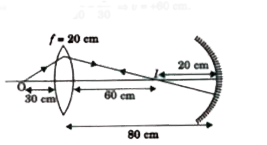 It is give that location of image does not change even if MIRROR is removed. It means image formed by lens must be at the centre of CURVATURE of mirror as shown in the figure. Hence radius of curvature of mirror can be written as follows. `R=80-60=20cm`, So focal length of mirror becomes 10 cm. We should know that concave mirror forms virtual image when object is placed betweendistance of object from concave mirror to FORM virtual image is 10 cm. So option (b) is correct. |
|