

Saved Bookmarks
This section includes 7 InterviewSolutions, each offering curated multiple-choice questions to sharpen your Current Affairs knowledge and support exam preparation. Choose a topic below to get started.
| 1. |
The dipole moment of a short bar magnet is 1.25 A m^2 . The magnetic field vec(B) on its axis at a distance of 0.5 m from the centre of magnet has a magnitude. |
|
Answer» `1.0 XX 10^(-4) T` |
|
| 2. |
Monochromatic light incident on a metal surface emits electron with K.E. from zero to 2.6 eV. What is the least energy of incident light, if the tightly bound electron in the metal needs 4.2ev to be removed |
|
Answer» 4.2 eV |
|
| 3. |
Mass of a photon is given by : |
|
Answer» `(hv)/(c^(2))` |
|
| 4. |
In a car spark coil, e.m.f 40 kV is induced in the secondary when the primary current changes from 4A to 0 in 10mu s . Find the mutual inductance between the coils |
| Answer» SOLUTION :0.1 HENRY | |
| 5. |
A particle of mass 2 kg starts motion at time t = 0 under the action of variable force F = 4t (where F is in N and t is in s). The work done by this force in first two second is |
|
Answer» 16 J |
|
| 6. |
निम्न मे से 1 और 2 के बीच कौन सी परिमेय संख्या है |
|
Answer» 44230 |
|
| 7. |
In series LCR circuit, the plot of I_(max) vs omega is shown in fig. Find the bandwidth and mark in the figure. |
|
Answer» Solution :As is KNOW for theory, bandwidth = FREQUENCY range at which `I = (1)/(sqrt2) I_(MAX) = 0.7 I_(max)`. In Fig. BAND width, `Delta OMEGA 1.2 - 0.4 rad//s`. 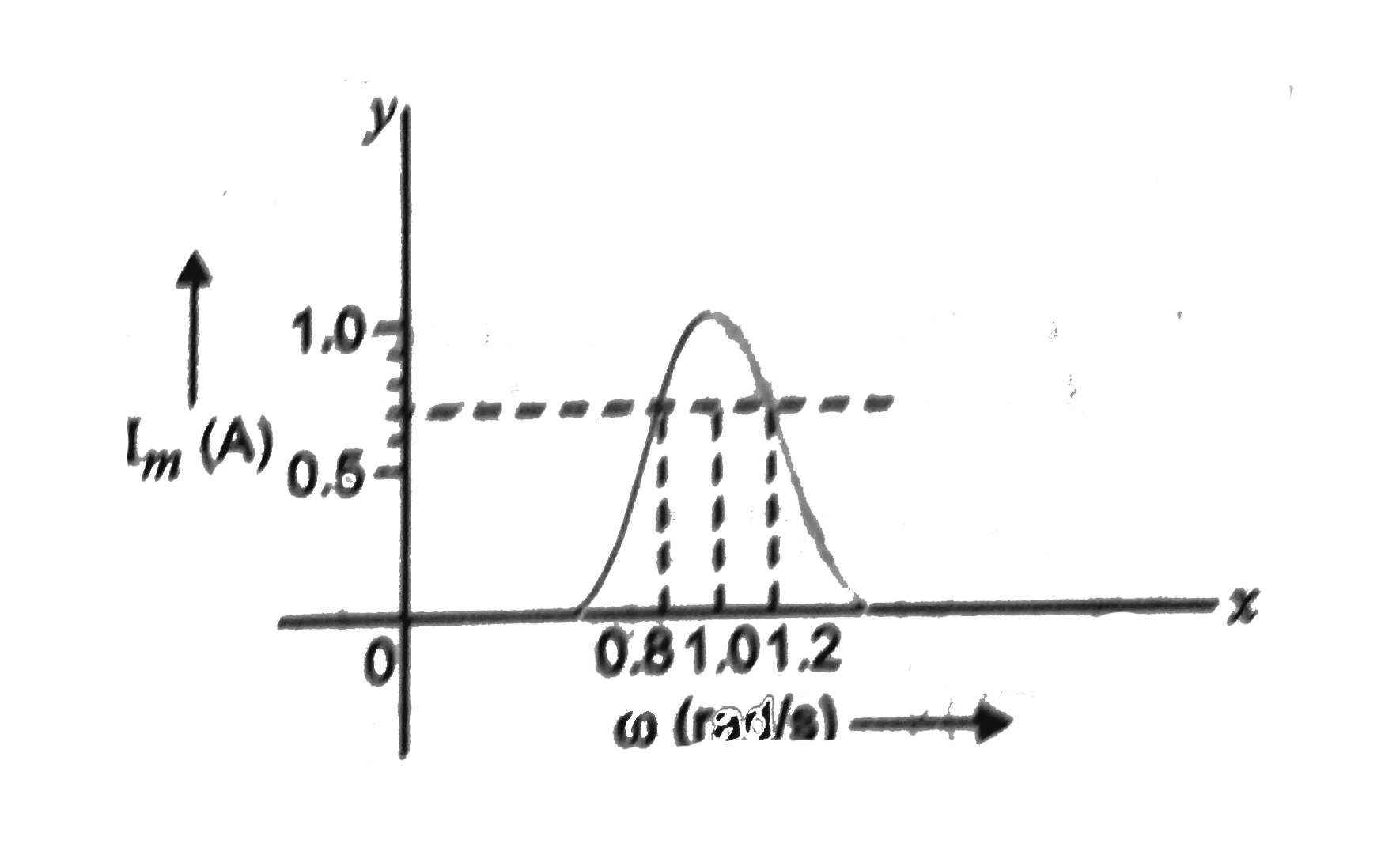
|
|
| 8. |
Which has greater ionizing power: alpha particles or beta particles? |
| Answer» SOLUTION :ALPHA PARTICLES have greater ionising power than BETA particles. | |
| 9. |
The .capacity of parallel plate condenser depends on |
|
Answer» The TYPE of METAL used |
|
| 10. |
Identify the mathematical expression for amplitude modulated wave |
|
Answer» `A_(c)sin[{omega_(c)+K_(1)V_(m)(t)}+phi]` |
|
| 11. |
In a cube of edge length a sits with one corncr at the origin of an xyz coordinate system. A body diagonal is a line that extends from one corner to another through the center. In unit-vector , what is the body diagonal that extends from the corner at (a) corrdianates (0,0,0), (b) corrdinates (a,0,0) (c ) coordinates (0,a,0) and (d) coordinates (a,a,0)? (e) Determine the angles that the body diagonals make with the adjacent edges . (f) Determine the length of the boedy diagonals in terms of a. |
| Answer» SOLUTION :`(a) a HATI + a HATJ + ahatk, (b) - ahati + ahatj + ahatk(C ) a hati - a hatj +ahatk , (e) 54.7^(@)(F) a sqrt3` | |
| 12. |
A process 1rightarrow2 using monoatomic gas is shown on the P-V diagram on the right P_(1)=2P_(2)=10^(6)N//m^(2),V_(2)=4V_(1)=0.4m^(3)The heat ansorbed by the gas |
|
Answer» 350kJ `W=3/2P_(0)v_(0)+3v_(0)P_(0)` `W=a/2P_(0)v_(0)` `DeltaU=nC_(v)DeltaT=n((3R)/2)(T_(F)-T_(i))` `DeltaU= 3/2nR (T_(f)-T_(i))=3/2[P_(f)V_(f)-P_(i)V_(i)]` `DeltaU-3/2[4P_(0)V_(0)-2P_(0)V_(0)]` `DeltaU=3P_(0)V_(0)` `DeltaQ=DeltaU+W=9/2P_(0)V_(0)+3P_(0)V_(0)=15/2P_(0)V_(0)` `P_(0)=10^(6)/2 , V_(0)=0.1` `DeltaQ=15/2xx10^(6)/2xx0.1=375000J` `DeltaQ=375kJ` 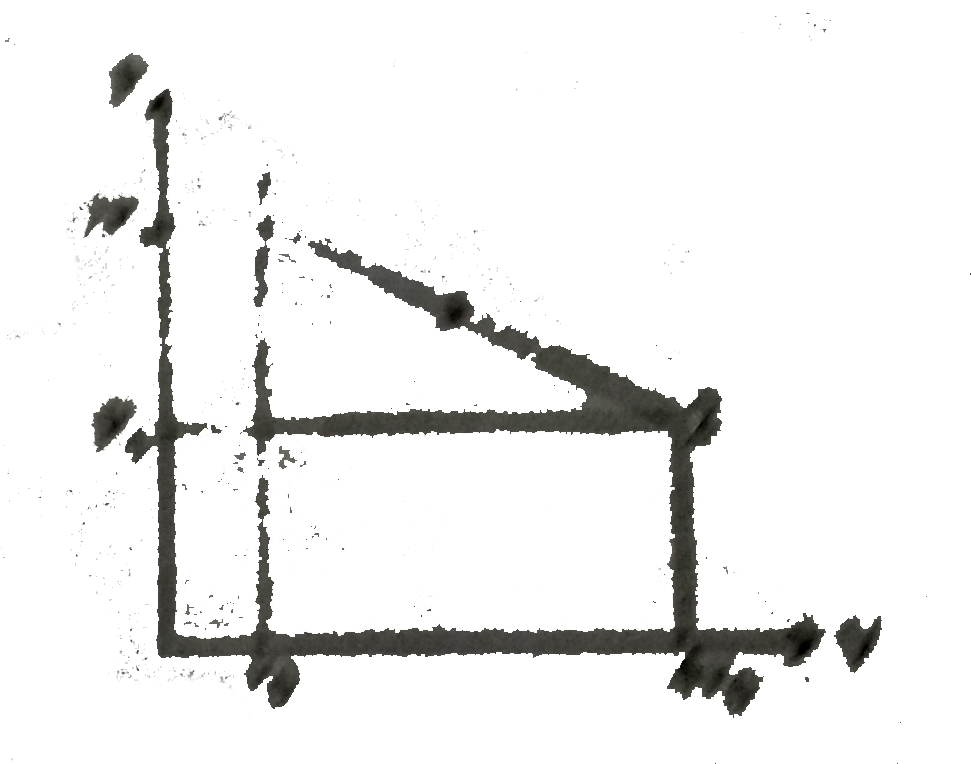
|
|
| 13. |
The Brewster angle for the glass - air interface in 54.74^@. If a ray of light going from air to glass strikes at an angle of incidene 45^@, then the angle of refraction is : |
| Answer» ANSWER :B | |
| 14. |
A positive charge +q_1 is located to the left of a negative charge -q_2. On a line passing through the two charges, there are two places where the total potential is zero. The reference is assumed to be at infinity.The first place is between the charge and is 4.00 cm to the left of the negative charge. The second place is 7.00 cm to the right of the negative charge. If q_2 = -12muC and q_1 = 11 xx xmuC, what is the value of x. |
Answer» Solution : `(q_(1))/(x-4)-(q_(2))/(4)=0""(q_(1))/(x+7)-(q_(2))/(7)=0` or `(q_(1))/(q_(2))=(x-4)/(4)""(q_(1))/(q_(2))=(x+7)/(7)` `therefore(x-4)/(4)=(x+7)/(7)` or `7x-28=4x+28` or `3x=56` or `x=(56)/(3)` or `(q_(1))/(q_(2))=((56)/(3)+7)/(7)=(11)/(3)` or `|q_(2)|=+12muc` or `q_(1)=12xx(11)/(3)=44muC=11xx4muC` |
|
| 15. |
The substance which are transparent to thermal radiations are |
|
Answer» athermanous |
|
| 16. |
A convex glass lens ( mu= 1.5 ) produces a real image of an object. The size of the image equals the size of the object. When the air surrounding the lens is replaced by a liquid, the size of the image is found to be twice that of the object. Find the refractive index of the liquid. |
| Answer» SOLUTION :`(12)/(11)` | |
| 17. |
A 220 V input is supplied to a transformer. The output circuit draws a current of 2.0 A at 440 V. If the efficiency of the transformer is 80%, the current drawn by the primary windings of the transformer |
|
Answer» 3.6 A |
|
| 18. |
The ratio of maximum wavelength of Lyman and Balmer series in hydrogen emission spectra will be ...... |
|
Answer» `(9)/(31)` `(1)/(lambda_(L))=R[(1)/(1^(2))-(1)/(N^(2))]` `(1)/(lambda_(L))=R[(1)/(1^(2))-(1)/(2^(2))]`For maximum wavelength n=3 `(1)/(lambda_(L))=R[(1)/(1)-(1)/(4)]=(3R)/(4)` `:.lambda_(L)=(4)/(3R)....(1)` For Balmer series `(1)/(lambda_(B))=R [(1)/(2^(2))-(1)/(3^(2))]` For maximum wavelength n = 3 `(1)/(lambda_(B))=R[(1)/(4)-(1)/(9)]=(5R)/(36)` `:.lambda_(B)=(36)/(5R) .....(2)` `:.(lambda_(L))/(lambda_(B))=(4)/(3R)XX(5R)/(36)=(5)/(27)` |
|
| 19. |
The displacement 'y' in cm. is given in terms of time t sec by the following equation y=3 sin314t+4 cos314t, the amplitude of S.H.M. is |
|
Answer» 1 cm |
|
| 20. |
What was Gafur's condition when Tarkratna visited his house? |
|
Answer» He was SHIVERING with HIGH fever |
|
| 22. |
If the electric flux entering and leaving an enclosed surface are phi_1 and phi_2respectively, then the electric charge present within the surface is |
|
Answer» `(1)/(in_0)(phi_1+phi_2) ` |
|
| 23. |
Bodies in inertial frames obey "____________" |
|
Answer» Newtonaian mechanics |
|
| 24. |
The frequency of LC oscillations is proportional to |
|
Answer» LC |
|
| 25. |
Under the influence of a uniform magnetic field a charged particle is moving in a circle of indius R with constant speed v. The time period of the motion. |
|
Answer» DEPENDS on both R and V |
|
| 26. |
Professor C.V Raman surprised his students by suspending freely a tiny light ball in a transparent vacuum chamber by shining a laser beam on it. Which property of EM waves was he exhibiting ? Give one more example of this property. |
|
Answer» Solution :Just like another WAVES electromagnetic waves possess energy and momentum. Due to this momentum they exert radiation pressure. By using laser beam C.V. Raman suspended a tiny light ball shining in a TRANSPARENT vacuum chamber. In another EXAMPLE talls of comet also shine due to radiation pressure. In photoelectric effect electron are emitted due to radiation emitted on photosensitive surface. This radiation possess energy and momentum. |
|
| 27. |
Draw the intensity pattern for single-slit diffraction and double-slit interference. Hence, state two differences between interference and diffraction pattern. |
Answer» SOLUTION :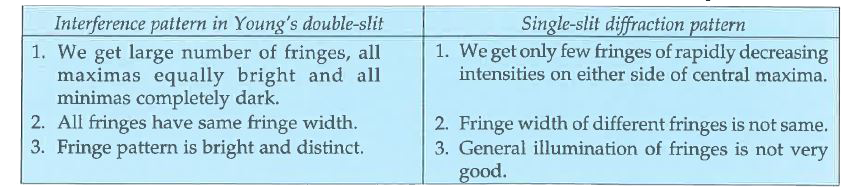
|
|
| 28. |
In the shown figure the conductor is uncharfed and a charfe q is placed inside a spherical cavity at adistance a from its centre C. Point P and charge+Q are as showna, b, c, d are known - . {:("Column I",,"Column II"),("Electric field due to induced charge on the inner surface of cavity at point P",,"zero"),("Electric potential due to charges on the inner surface of cavity and q at P",,"non-zero"),("Electric field due to induced charges on the outer surface of conductor and Q at C",,"value can be stated with the given data"),("Electric potential due to induced charges on the inner surcface of cavity at C",,"value cannot be stated from the given data"):} |
|
Answer» (A) `ointvec E vec (dA) = (sumq)/(in_0)` If consider induced CHARGE only in Gaussian surface then if FIELD ` !=0` at `P` `A rarr Q,S` (B) If we consise induced charge `q'` and charge `q` the `q+q'=0`. then field will be ZERO so `V=0` (C) From Gauss THEOREM ` Q'' +Q rArr E =0` ` C rarr P,R` (D) `V= (Kq)/a D rarr Q,R` 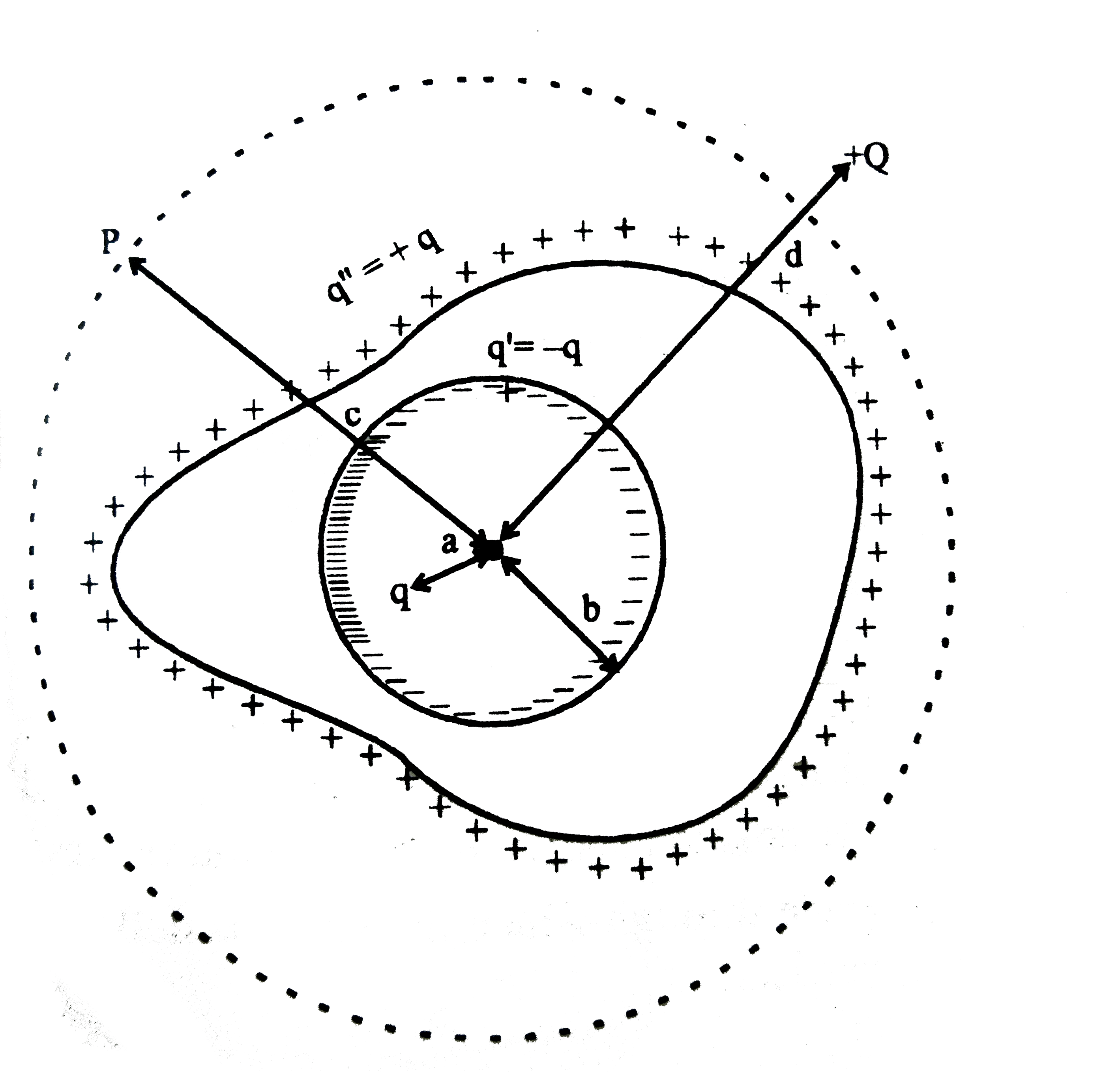 . .
|
|
| 29. |
Explain the advantage of a high frequency transmission for the above case |
| Answer» SOLUTION :1) Effective POWER radiation 2) Size of antenna reduces and transmission beomes practical | |
| 30. |
How will the frequency of small oscillation of a simple pendulum changes. If it moves vertically upward with an acceleration 'a' |
| Answer» SOLUTION :INCREASES | |
| 31. |
The value of 117.4 xx 0.0025 is |
|
Answer» `0.2935` |
|
| 32. |
A coil of inductance L and resistance R is connected to an A.C. source of V volt. If the angular frequency of the A.C. source is equal to omega"rads"^(-1), then the current in the circuit will be……… |
|
Answer» `V/R` `THEREFORE I=V/sqrt(R^2+omega^2L^2)` |
|
| 33. |
The half life of radioactive Radon is 3.8 days . The time at the end of which (1)/(20) th of the radon sample will remain undecayed is (givenlog e = 0.4343 ) |
|
Answer» 3.8 DAYS |
|
| 34. |
A body of mass 5 kg moves along X-axis with 2ms^(-1) A second body of mass 10 kg moves along y-axis with velocity sqrt3 ms^(-1). They collide at the origin and stick together. The velocity of the combined mass is : |
|
Answer» `(4)/(3) ms^(-1)` Similarly `p_(2)=m_(2)u_(2)=10sqrt3 kg ms^(-1)` According to conservation of momnetum, `(m_(1)+m_(2))V=20` `implies v=(20)/(15)=(4)/(3) ms^(-1)` |
|
| 35. |
Using Bohr's postualtes , derive the expression for the frequencyof radiationemitted when electron in hydrogen atom undergoes transition fromhigherenergy state ( quantum numbern_(i) ) tothelowerstate (n_(f)) . Whenelectron in hydrogenatom jumpsfrom energystate n_(i)= 4ton_(f) = 3,2,1identifythespectral series to whichthe emissionlinesbelong . |
| Answer» Solution :FIRST giveanswerin Short AnswerQuestionNumber32and obtainn expressionfor theenergyof an electron `E =- ( me^(4))/(8in_(0)^(2) N^(2) H^(2))` . After thatwritethe answer give in Short Answer QUESTIONS Number34for frequency of spectral lines and spectral series of hydrogenspectrum . | |
| 36. |
A marble A is dropped vertically. Another indentical marble is projected horizontally from the same point at the same instant. Both A and B will reach the ground at_____. |
|
Answer» |
|
| 37. |
Two blocks A and B of masses m and 2m respectively, attached at opposite ends of a spring of constant K, placed on a smooth horizontal surface. Spring is initially at its natural length l. A is given a velocity 2V_(0) and B given velocity V_(0) as shown. Maximum separation between m and centre of mass of the system will be : |
|
Answer» `(l)/(3)+sqrt((8mV_(0)^(2))/(3K))` |
|
| 38. |
When a conducting wire is connected in the left gap and known resistance in the right gap, the balance length is 75cm. If the wire is cut into 3 equal parts and one part isconnected in the left gap, the balance length |
|
Answer» SHIFTS LEFT by 25cms |
|
| 39. |
Theperiod of oscillation of the mass m suspended by a massless spring, when slightly displaced and letgo, is T. The period will be morethan T if : |
|
Answer» Theabove EXPERIMENT is PERFORMED on the moon TIME period will INCREASE only when mass m is increased. Hence correct choice is ( C ). |
|
| 40. |
The refracting edge of the biprism should be: |
|
Answer» PERPENDICULAR to the slit |
|
| 41. |
The length of thin wire required to manufacture a solenoid of inductance L and length l. (if the cross-sectional diameter is considered less than its length) is |
|
Answer» `sqrt((PILL)/(2mu_(0)))` |
|
| 42. |
State Boolean laws.Elucidate how they are used to simplify Boolean expressions with suitable example, |
|
Answer» Solution :Laws of Boolean Algeebra :The NOT ,OR and AND operations are `overlineA,A+B,A,B` are the Boolean operations.The results of these operations can be summarised as Complement LAW 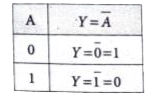 The com-plementlaw can be released as A=A OR laws 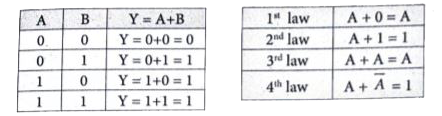 AND L:AWS The AND lawscan be realised as 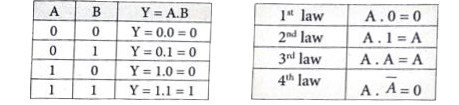 The Boolean operations Obey the following laws A+B=B+A Associative laws A+(B+C)=(A+B)+C A.(B.C)=(A.B).C DISTRIBUTIVE laws A(B+c)=AB+AC A+BC=(A+B)(A+C) The above laws are used to simplify COMPLICATED expression and to simplify the logic circuiry . |
|
| 43. |
Energy of ground state of hydrogen atom is - 13.6 eV. What is its ionisation potential? |
| Answer» SOLUTION :Ionisation energy is the minimum energy REQUIRED to FREE the ELECTRON from the ground state of atom. The ionisation of energy of hydrogen atom = 13.6 EV | |
| 44. |
Discuss analytically the composition of two linear SHMs of the same period and along the sameline. Find the resultant amplitude when the phase difference is (1)zero (2) (pi)/(3) (3) (pi)/(2)rad (4) pi rad |
|
Answer» Solution :Let a particle be SUBJECTED to two linear SHMs of the same period, along the same line and having the same mean positon, represented by `x_(1)=A_(1) SIN (omegat-alpha)` and `x_(2)=A_(2) sin (omega+beta)`, where `A_(1)` and `A_(2)` are the amplitudes and `alpha` and `beta` are the initial phases of the two SHMs. According to the principle of superposition, the resultant DISPLACEMENT of the particle at any instant t is the algebraic sum `x=x_(1)+x_(2)`. `:. x=A_(1) sin (oemgat+alpha)+A_(2) sin (omega+beta)` `=A_(1) sin omegat cos alpha+A_(1) cos omegat sin alpha+A_(2) sin omegat cos beta+A_(2) cos omegat sin beta` `=(A_(1) cos alpha+A_(2) cos beta) sin omegat+(A_(1) sin alpha+A_(2) sin beta) cos omegat` Let `A_(1) cos alpha+A_(2) cos beta=R cos delta""`.....(1) and `A_(1) sin alpha+A_(2) sin beta=R sin delta""`.......(2) Equation (3), which gives the displacement of the particle, shows that the resultant motion is ALSO linear simple harmonic, along the same line as the SHMs superposed, with amplitude |R| and inital phase `delta` but having the same mean position and the same period as the individual SHMs. Amplitude of the resultant motion : `R^(2)=R^(2) cos^(2)delta+R^(2) sin^(2)delta` From Eqs. (1) and (2), `R^(2)=(A_(1) cos alpha+A_(2) cos beta)^(2)+(A_(1) sin alpha+A_(2) sin beta)^(2)` `=A_(1)^(2) cos^(2)alpha+A_(2)^(2) cos^(2)beta+2A_(1)A_(2) cos alpha cos beta+A_(1)^(2) sin^(2)alpha+A_(2)^(2) sin^(2) beta+2A_(2)A_(2) sin alpha sin beta` `=A_(1)^(2)(cos^(2)alpha+sin^(2)alpha)+A_(2)^(2)(cos^(2)beta+sin^(2) beta)+2A_(1)A_(2)(cos alpha cos beta+sin alpha sin beta)` `:. R^(2)=A_(1)^(2)+A_(2)^(2)+2A_(1)A_(2)cos(alpha-beta)` `:. |R|=sqrt(A_(1)^(2)+A_(2)^(2)+2A_(1)A_(2) cos (alpha-beta))""`......(4) Initial phase of the resultant motion : From Eqs. (1) and (2), `(R sin delta)/(R cos delta)=tan delta=(A_(1) sin alpha+A_(2) sin beta)/(A_(1) cos alpha+A_(2) cos beta)` `:. tan^(-1)((A_(1) sin alpha+A_(2) sin beta)/(A_(1) cos alpha+A_(2) cos beta))""`......(5) Now, consider Eq. (4) for |R|. Case (1) : Phase difference, `alpha-beta=0^(@)` `:. cos (alpha-beta)=1` `:. |R|=sqrt(A_(1)^(2)+A_(2)^(2)+2A_(1)A_(2))=A_(1)+A_(2)` Case (2) : Phase difference, `alpha-beta=pi//3` RAD `:. cos (alpha-beta)=(1)/(2)"" :. |R|=sqrt(A_(1)^(2)+A_(2)^(2)+A_(1)A_(2))` Case (3) : Phase difference, `alpha-beta=pi//2` rad `:. Cos (alpha-beta)=0` `:. |R|=sqrt(A_(1)^(2)+A_(2)^(2))` Case (4) : Phase difference, `alpha-beta=pi` rad `:. cos (alpha-beta)=-1` `:. |R|=sqrt(A_(1)^(2)+A_(2)^(2)-2A_(1)A_(2))"" :. |R|=|A_(1)-A_(2)|` |
|
| 45. |
Assume that a honeybee is a sphere of diameter 1.000 cm with a charge + 60.0 pC uniformly spread over its surface . Assume also that a spherical pollen grain of diameter 40.0 mu Cis electrically held on the surface of the bee because the bee's charge induces a charge of 1.00 pC on the near side of the grain and a charge of 1+1.00 pC on the far side. (a) what is the magnitude of the net electrostatic force on the grain due to the bee ? Next, assume that the bee brings the grain to a distance of 1.000 mm from the tip of a flower's stigma and that the tip is a particle of charge -60.0 pC. (b) What is magnitude of the net electrostatic force on the grain due to the stigma ? (c ) Does the grain remain on the bee or move to the stigma ? |
| Answer» SOLUTION :(a) `3.4 xx 10^(-10)N`, (b) `4.1 xx 10^(-8)N`, (c ) moves to STIGMA | |
| 46. |
If the combinationis connected to a battery of emf 12 V and negligible internal resistance, obtain the potential drop across each resistor. |
|
Answer» SOLUTION :Current through the circuit `I = V//R_(s) = 12//6 = 2A` `:.` Potential DROP across `R_(1) = IR_(1) = 2 xx 1 = 2V` Potential drop across `R_(2) = IR_(2) = 2 xx 2 = 4V` Potential drop across `R_(3) = IR_(3) = 2 xx 3 = 6 V` |
|
| 47. |
A small spherical ball of mass m is projected from lowest point (point P) in the space between two fixed, concentric spheres A and B (see figure). The smaller sphere A has a radius R and the space between the two spheres has a width d. The ball has a diameter very slightly less than d. All surfaces are frictionless. Speed of ball at lowest point is v. NA and NB represent magnitudes of the normal reaction force on the ball exerted by the spheres A and B respectively. Match the value of v given in column–I with corresponding results in column–II. |
|
Answer» `{:("Column-I",,"Column-II"),((A)v=sqrt(gR),,(p)"maximum value of " N_(A)=0):}` `N=mg+(mv^(2))/R` |
|
| 48. |
A charged oil drop is suspended in uniform field of 3 xx 10^4 V/m so that it neither falls nor rises. The charge on the drop will be take the mass of the charge = 9.9 xx 10^(-13) kg & g =10 m//s^2) |
|
Answer» `3.3 XX 10^(-18)C` |
|
| 49. |
A sample of paramagnetic material is placed in an external magnetic field to get magnetized. Intensity of external magnetic field is slowly increased to a value that magnetization in sample of material becomes constant. Now temperature of this magnetized sample is decreased. What will be the effect on magnetization of sample due to decrease in temperature? |
|
Answer» Magnetization will INCREASE |
|