

Saved Bookmarks
This section includes 7 InterviewSolutions, each offering curated multiple-choice questions to sharpen your Current Affairs knowledge and support exam preparation. Choose a topic below to get started.
| 1. |
Tyres are made circular because |
|
Answer» they can be inflated |
|
| 3. |
In a p-n junction diode, holes diffuse from p-region to n- region because |
|
Answer» <P>there is a large concentration of HOLES in p region as compared to N regions |
|
| 4. |
Choose the correct statement : |
|
Answer» KINETIC energy of the PARTICLE is maximum at outer part of the spiral |
|
| 5. |
(a) The peak voltageof an acsupply is 300V. What is the rms voltage ? The rms value of current in an circuit is 10V. What is the peak current ? |
|
Answer» SOLUTION :(a) `V_(RMS ) = ( V_(m))/( SQRT(2))` `= ( 300)/( 1.414)` 212.2 Volt (b) (b) `I_(rms) = (I_(m))/(sqrt(2))` `:. I_(m) = sqrt( 2) I_(rms)` `= ( 1.414) ( 10)` `:. I_(m) = 14.14A` |
|
| 6. |
In differation angle of first minima of Fraunhoffer diffraction is (pi)/(6) width of slit d =...... |
|
Answer» `lambda` `:. D=((1) lambda)/("sin" (pi)/(6))=( lambda)/((1)/(2))"" :. d=2lambda` |
|
| 7. |
A thin flexible wire of length L is connected to two adjacent fixed points and carries a current I in the clockwise direction, as shown in the figure. When the system is put in a uniform magnetic field of strength B going into the plane of the paper, the wire takes the shape of a circle. The tension in the wire is |
|
Answer» IBL |
|
| 8. |
A parallel plate capacitor is to be designed with a voltage rating 1 kV, using a material of dielectric constant 3 and dielectric strength about 10^(7) Vm^(-1). (Dielectric strength is the maximum electric field a material can tolerate without breakdown, i.e., without starting to conduct electricity through partial ionisation.) For safety, we should like the field never to exceed, say 10% of the dielectric strength. What minimum area of the plates is required to have a capacitance of 50 pF? |
|
Answer» SOLUTION :Potential rating of a PARALLEL plate capacitor with dielectric = 1 kV = `10^(3)`V For safety the field INTENSITY never exceeds 10 % of the dielectric strength. Hence ELECTRIC field intensity = 10 % of `10^(7)` `= 10(7) xx(10)/(100)` `=10^(6) Vm^(-1)` The minimum necessary distance between two plates `E = (V)/(d) implies d =(V)/(E) = (10^(3))/(10^(6))= 10^(-3)` m Capacitance of parallel plate capacitor `C = (kin_(0)A)/(d)` `:. A = (Cd)/(KE_(0))=(50xx10^(-12)xx10^(-3))/(3xx8.85xx10^(-12))` `:. A = 18.8 xx10^(-4) m^(2)` `:. A = 19 cm^(2)` |
|
| 9. |
The displacement equation of a traveling wave pulse, moving along X axis is given by y=(8)/((4+x^(2))^(2)) at t=0 and y=(8)/((x^(2)-10x+29))What is the speed and direction of the prelse? |
|
Answer» Solution :The given equation corresponding to t= 1 can be rewritten as, `y=(8)/((x^(2)-10x+25)+4)=(8)/(4+(x-5)^(2))=(8)/(4+[x-5(1)]^(2))` since the displacement equation of a wave is necessarily a function of (x + v), so the above equation can be rewritten `y=(8)/(4+[x-5(1)^(2)])` Evidently factor (x-5t) reveals that the wave is MOVING along POSITIVE X-axis, and its speed is 5 UNITS. |
|
| 10. |
A car is travelling at a velocity "10 km h"^(-1) on a straight road. The driver of the car throws a parcel with a velocity 10sqrt2km h^(-1) with respect to the car, when the car is passing by a man standing on the side of the road. If the parcel is to reach the man, the direction of throw makes the following angle with the direction of motion of the car |
|
Answer» `135^(@)` |
|
| 11. |
A closely wound solenoid of 2000 turns and area of cross-section 1.6 xx 10^(-4) m^2, carrying a current of 4.0 A, is suspended through its centre allowing it to turn in a horizontal plane. (a) What is the magnetic moment associated with the solenoid ? (b) What is the force and torque on the solenoid if a uniform horizontal magnetic field of 7.5 xx 10^(-21) T is set up at an angle of 30^@with the axis of the solenoid ? |
|
Answer» `1.28Am^2,0.042Nm` |
|
| 12. |
The radius of our galaxy is about 3 xx 10 ^(20)m.With what speed should a person travel so that he can reach from the centre of the galaxy to its edge in 20 years of his lifetime ? |
|
Answer» SOLUTION :LET the speed of the person be v . As seen by the person, the edge of the galaxy is coming towards him at a speed v. In 20 years (as measured by the person ), the edge moves (20 y ) v and reaches the person. The radisu of the galaxy as measured by the person is , therefore , (20 y)v . The rest LENGTH of the radius of the galaxy is ` 3 xx 10^(20)m. ` Thus , ` (20y )v = (3 xx 10^(20)m) (sqrt 1 - v ^(2)/ c^(2) ` or, (6 .312 xx 10 ^(8) s ) ^(2) v^(2) = (9 xx 10 ^(40) m ^(2)) (1- v^(2) / c^(2) )`. Solving this, v =0.9999996 c. |
|
| 13. |
A block of mass m is placed behind in contact with vertical side of M as shown in the figure. The coefficient of static friction between m and M in mu. The least horizontal force with which m can be pushed so that the two blocks move together is (neglect friction between M and ground). |
Answer» SOLUTION :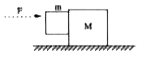 ACCELERATION of be system `a=(F)/(m+M)` Normal reaction between the blocks is `N=(MF)/(M+m)` When .. is in equilibrium `mg LE mu N` `mg le mu (MF)/((M+m)) RARR F GE (mg(M+m))/(mu M)` The minimum force `F=(mg(M+m))/(mu M)` |
|
| 14. |
The voltage applied to the Coolidge X-ray tube is increased by 25%. As a result the short wave limit of continuous X-ray spectrum shifts by Delta lambda. The initial voltage applied to the tube is |
|
Answer» `(HC)/(4E DELTA lambda)` |
|
| 15. |
What is the minimum length of a plane mirror required for a person of height 2m to see his full image? Is there any restriction on the position of the top edge of the mirror? |
|
Answer» Solution :The man can view his entire image if the light RAYS from the top of his head and from his feet reach his eye. Let AB be the mirror. PQ represents the man of height h and R is the position of his eyes. Light rays from P gets reflected at A and reach his eyes. Light from Q gets reflected at B and reaches his eyes. AM and BN are NORMALS to the mirror AB. Now, AB=MN=MR+ RN Hence the LENGTH of the mirror =`h/2=1m` 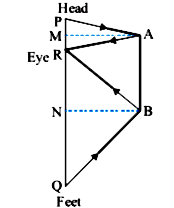 |
|
| 16. |
A neuron having mass 1.67x10^-27 kg and moving at 10^8m/s collides with a deuteron at rest and stick to it. If the mass of the deuteron is 3.34x10^-27 kg find the speed of the combination |
|
Answer» `0.333x10^8 m / s` |
|
| 17. |
The distance covered by a body in time (5.0 +- 0.6)s is (40.0 +- 0.4)m. The percentage error in the speed is |
| Answer» ANSWER :A | |
| 18. |
ML^2T^0 is dimensional formula for |
|
Answer» Inertia |
|
| 19. |
A double slit interference pattern is produced on a screen, as shown in the figure, using momochromatic light of wavelength 500 nm. Point P is the location of the central bright fringe, that is produced when light waves arrive in phase without any path difference. A choice of the three strips A, B and C of transparent materials with different thickness and refractive indices is available, as shown in the table. These are placed over one or both of the slits, singularly or in conjunction causing the interference pattern to be shifted across the screen from the original pattern. In the Column - I, how the strips have been placed, is mentioned whereas in the Column-II, order of the fringe at point P on the screen that will be produced due to the placement of the strip(s), is shown. Correctly match both the column. |
|
Answer» |
|
| 20. |
C_P and C_V are molar specific heats of a gas and R is a gas constant. N moles of this gas are heated at constant pressure so that its temperature rises by dT. External work done will be |
|
Answer» R |
|
| 21. |
An electron and a proton are moving in the same direction and possess same kinetic energy. Find the ratio of de-Broglie wavelengths associated with these particles. |
|
Answer» <P> Solution :We KNOW that de-Broglie wavelength `lamda=(h)/(MV)=(h)/(sqrt(2mK))`, where K is the kinetic energy. As `m_(p)gtm_(e)`, hence it is clear that for same kinetic energy.`(lamda_(e))/(lamda_(p))=sqrt((m_(p))/(m_(e)))`. `implies lamda_(e) lamda_(p)` i.e, de-Broglie wavelength of electron will be GREATER than that of PROTON. |
|
| 22. |
What is intensity division? |
|
Answer» Solution :(i) Light is allowed to pass through a partially silvered MIRROR (beam SPLITTER), both reflection and refraction TAKE place simultaneously. (ii) As the two light beams are obtained from the same light SOURCE, the two divided light beams will be coherent beams. (iii) They will be differences in EITHER in-phase or at constant phase. Instruments like Michelson's interferometer, Fabray-Perrot etalon work on this principle. |
|
| 23. |
Write down the condition of constructive interference. |
Answer» SOLUTION :Constructive interference :  According to figure (a) suppose at`S_(1)Q=7lamda` and `S_(2)Q=9lamda` distance Q is the POINT. `:.S_(2)Q-S_(1)Q=9lamda-7lamda=2lamda` Hence, the waves emanating from `S_(1)` will arrive exactly two cycles earlier than the waves from `S_(1)` and will again be in phase. Thus, if the displacement produced by `S_(1)`is given by `y_(1)=acosomegat` then the displacement produced by `S_(2)` will be given by `y_(2)=acos(omegat-4pi)` [ `:.` Path difference `2lamda` equivalent phase difference `=2xx2pi=4pi`] `[:.lamda=2PI]` `:.y_(2)=acosomegat` `[:.cos(theta-4pi)=costheta]` Hence, both waves will be in phase together. Here distance between `S_(1)` and `S_(2)` is d and the distance `S_(1)Q` and `S_(2)Q` are much greater than `theta`. So that although `S_(1)Q` and `S_(2)Q` are not equal the amplitude of the displacement produced by each wave very NEARLY the same. Hence intensity due to constructive interference at point P will be `4I_(0)`, where `I_(0)` is the intensity of each wave. Here path difference, `S_(2)Q-S_(1)Q=nlamda""` [where n=0, 1, 2, 3, .......,] Conditions of constructive interference : That is if the path difference between superimposed waves at a point is `nlamda`, where n=0, 1, 2, 3, ......... hen the intensity at this point is maximum `(4I_(0))` and constructive interference will be formed. Now we know that `lamda` path difference = `2pi` rad. `:.` If the phase difference between superimposing waves is 2nt, where n = 0, 1, 2, 3, ... then the intensity will be maximum and constructive interference will be formed. Now,  According to figure `S_(1)R=9.75lamdaandS_(2)R=7.25lamda` `:.S_(1)R-S_(2)R=9.75lamda-7.25lamda` `=2.5lamda` Thus, the waves emanating from `S_(1)` will arrive exactly 2.5 cycles later than the waves from `S_(y)` Thus if the displacement produced by `S_(1)` is given by `y_(1)=acosomegat` then the displacement produced by `S_(2)` will be given by `y_(2)=acos(omegat+5pi)""[:.2.5lamda=5pirad]` `:.y_(2)=-acosomegat` [where `cos{(2n+pi)+theta}=-costheta`] he displacements of this both waves is in the opposite phase of each other hence resultant displacement will be zero and intensity will get zero. This is called destructive interference. Thus, the path difference between waves emanating from `S_(1)` and `S_(2)` at point R is, `S_(1)R-S_(2)R=(n+(1)/(2))lamda` where n=0, 1, 2, 3,........, Conditions of destructive interference : If the path difference between superposed waves at a point is `(2n+1)(lamda)/(2)` where n=0, 1, 2, 3, ......, then the intensity of light at that point will be zero. This is called destructive interference. If the phase difference between superpose waves at a point is `(n+(1)/(2))pior{(2n+1)pi}` where n = 0, 1, 2, 3, ..., then the intensity of light at that point will be zero. This is called destructive interference. |
|
| 24. |
(A) :The area to be covered for T.V. telecast is doubled, then the height of trans - mitting antenna will have to be doubled (R) : For T.V. signal propulation covered is equal to product of population density abd area covered |
|
Answer» Both 'A' and 'R' are TRUE and 'R' is the correct explanation of 'A'. |
|
| 25. |
Two capacitor each of capacitance C = 1 muF each charged topotential 100 V and 50 V respectively and connected across a uncharged capacitor 'C' = 1muF as shown in the figure if switch 'S' is closed then charge in the uncharged capacitor at equilibrium will be |
|
Answer» `50/3muC` |
|
| 26. |
To observe morality is to attain mastery over |
|
Answer» ECONOMIC growth |
|
| 27. |
A small sphere of radius r_1 and charge q_1 is enclosed by a spherical shell of radius r_2 and charge q_2. Show that if q_1 is positive, charge will necessarily flow from the sphere to the shell (when the two are connected by a wire) no matter what the charge q_2, on the shell is. |
| Answer» Solution :The potential inside the SHELL is constant and is equal to that on its surface. The potential DIFFERENCE then DEPENDS only on `q_1`. Potential is highest on A. Hence charge flows from A to E irrespective of the value of `q_2`. | |
| 29. |
Which of the following radiations alpha,beta and gamma are : similar to x-rays ? |
| Answer» SOLUTION :SIMILAR to x-RAYS -`GAMMA`-rays. | |
| 30. |
To double the torque acting on a coil of n-turns, when placed in a magnetic field |
|
Answer» AREA of the coil and the MAGNETIC induction should be doubled |
|
| 31. |
Match Column - I against Column - II referring to the adjacent figure. |
|
Answer» <P> |
|
| 32. |
A physical quantity P is described by the relation P=a1/2b2cd. If the relative errors in the measurement os a, b, c and d respectively, are 2%, 1%, 3%, and 5%, then the relative error in P will be : |
| Answer» Answer :D | |
| 33. |
When sunlight is incident on water at an angle of 53^(@), the reflected light is found to be completely plane-polarised. Determine (i) angle of refraction of light and (ii) refractive index of water. |
|
Answer» |
|
| 34. |
Which of the following statement(s) is/are true about the magnetic susceptibility X_(m) of paramagnetic substance? |
|
Answer» Value of `X_(m)` INVERSELY PROPORTIONAL to the absolute temperature of the substance. |
|
| 35. |
A magnet of polestrength m is divided into fiour equal parts so sthat the lengthas wellthen the polestrength of each is |
|
Answer» `(m)/(4)` |
|
| 36. |
A cell is connected between two points of a uniformly thick circular conductor and i_1 and i_2 are the currents flowing in two parts of the circular conductor of radius aThe magnetic field at the centre of the loop will be |
|
Answer» zero  The resistance of the portion PSQ will be `R_2 = l_2 rho` pot diff across P and ` Q = I_1 , R _1 = I_2 R_2` `I_1 l_1 rho = I_2 rho ` or `I_1 l_1 =I_2 l_2 ""....(1)` Magnetic field induction at the centre O DUE to currents through circular conductors PRQ and PSQ will be `=B_1 -B_2 =(mu_0)/2 (I_1l_1sin 90^@)/(r^2)-(mu_0)/(4pi)(I_2l_2sin 90^@)/r^2=0` |
|
| 37. |
A very small magnet is placed in the magnetic meridian with its S-pole pointing north. The null point is obtained 20 cm away from the centre of the magnet. What is the magnetic moment of the magnet if earth's field is 0.3xx 10^(-4) T? |
|
Answer» Solution :As magnetic dipole is placed with its S-pole pointing north and at neutral POINT the field of dipole `(B_M)` is cancelled by earth.s field `B_H` , the neutral point will be on the axis of the dipoleas shown inFig. And as for an axial point , `B_M = (mu_0)/(4pi) (2M)/(R^(3))` , so the neutral point , ` (mu_0)/(4pi)(2M)/(r^(3)) = B_H` i.e.` M=(B_H xx r^3 )/(2 xx 10^(-7))[ as (mu_0)/(4pi) = 10^(-7)]`  So `, M = (0.3 xx 10^(-4) xx (0.2)^3)/(2) xx 10^(7) = 1.2 A-m^(2)` |
|
| 38. |
The core of transformer is laminated to reduce energy losses due to |
| Answer» Answer :A | |
| 39. |
The energy flux of sunlight reaching the surface of the earth is 1.388 xx10^(3) "W/m"^(2) . How many photons (nearly ) per square metre are incident on the Earth per second ? Assume that the photons in the sunlighthave an average wavelength of 550 nm. |
|
Answer» `2.51xx10^(31)` |
|
| 40. |
A stationary wave is given by y = 5 sin (pix)/3 cos 40 pit, where x and y are in cm and t in seconds. What is the distance between two successive nodes: |
|
Answer» 0.01 m |
|
| 41. |
A stationary wave is given by y = 5 sin (pix)/3 cos 40 pit, where x and y are in cm and t in seconds. What is the velocity of a particle of the string at the position x = 1.5 cm When t = 9/8 s |
| Answer» Answer :A | |
| 42. |
A stationary wave is given by y = 5 sin (pix)/3 cos 40 pit, where x and y are in cm and t in seconds. What are the amplitude and velocity of the component waves superposition can give this vibration. |
|
Answer» 2.5 CM, `1.2 MS^(-1)` |
|
| 43. |
Application of a forward bias to a p-n junction ……… |
|
Answer» WIDENS the depletion zone.  The number of donor will be HIGHER as the electrons move from NEGATIVE terminal to the n-side and the number of pentavalent ions DECREASES. HENCE potential barrier also decreased. The neutral pentavalent atom will give electron again. |
|
| 44. |
Which one of the following parameters does not represent thermodynamic state of a gas ? |
|
Answer» Work |
|
| 45. |
What is the fate of a free neutron? |
| Answer» Solution :A FREE neutron is an UNSTABLE PARTICLE, it DECAYS into proton, electron and antineutrino. | |
| 46. |
For every 10^6 atoms of radium in a sample today, find the number of atoms that will be left after 3200 years. Assume half-life of radium to be 1600 years. |
|
Answer» |
|
| 47. |
A bar magnet of magnetic moment 6 J/T is aligned at 60^@ with a uniform external magnetic field of 0.44 T. Calculate (a) the work done in turning the magnet to align its magnetic moment (i) normal to the magnetic field, (ii) opposite to the magnetic field, and (b) the torque on the magnet in the final orientation in case (ii). |
|
Answer» Solution :Here MAGNETIC moment of bar magnet m = 6 J/T , uniformexternal magnetic field B = 0.44 T and `theta_1 = 60^@` . (a) (i) The work done in turning the magnet to ALIGN its magnetic normal to the magnetic field [i.e. , `theta_2 =90^@`) will be W = mB `[cos theta_1 - cos theta_2] =6xx 0.44 XX [ cos 60^@ - cos 90^@] =6xx0.44 xx[1/2-0]` (ii) The work done in turning the magnet to align its magnetic moment opposite to the magentic field i.e., `THETA=180^@`] will be `W= mB [ cos theta_1 - cos theta_2] = 6 xx 0.44 [cos 60^@ - cos 180^@] = 6 xx 0.44 xx[1/2 -(-1)]=3.96 J` (b) The torque on the magnet in the final orientation in case (ii) [i.e. , when `theta=180^@`] `tau= mB sib theta =6 xx0.44 xx sin 180^@=0` |
|
| 48. |
Two heater coils separately take 10 minutes and 5 minutes to boil a certain amount of water. Find the time taken by both the coils connected in series to boil the same amount of water . |
|
Answer» Solution :`t_1 = 10` min `=t_1 = 5 ` min `implies 1/R=` constant `(t_1)/(t_2) =(R_1)/(R_2) implies(10)/5 =(R_1)/(R_2)` `therefore R_1 : R_2 = 2:1` Resultant resistance `R= R_1 + R_2 = 2R+R = 3R`. If 2R heater TAKES 10 minutes then 3R heater takes 15 minutes for heating purpose |
|
| 49. |
Galaxy A is reported to be receding from us with a speed of 0.45c. Galaxy B, located in preciselythe opposite direction, is also found to be receding from us at this same speed. What multiple of c gives the recessional speed an observer on Galaxy A would find for (a) our galaxy and (b) Galaxy B? |
|
Answer» |
|
| 50. |
In Ferris perfectly black body, the black body is |
|
Answer» aperture |
|