

Saved Bookmarks
This section includes 7 InterviewSolutions, each offering curated multiple-choice questions to sharpen your Current Affairs knowledge and support exam preparation. Choose a topic below to get started.
| 1. |
Which of the following is based on photo electricity |
|
Answer» EXPOSURE meter |
|
| 2. |
If three vectors along coordinate axis represent the adjacent sides of a cube of length b, then the unit vector along its diagonalpassing through the origin will be |
|
Answer» `(hat(i)+hat(j)+hat(K))/(sqrt(2))` ` "or"A=sqrt(b^(2)+b^(2)+b^(2))=sqrt(3)b` `:.A=(A)/|A|=(hat(i)+hat(j)+hat(k))/(sqrt(3))` |
|
| 3. |
A hemispherical bowl of radius R is set rotating about its axis of symmetry which is kept vertical. A small block kept in the bowl rotates with the bowl without slipping on its surface. If the surface of bowl is smooth, and the angle made by the radius through the block with the vertical is theta, the angular speed at which the bowl is rotating is |
|
Answer» `sqrt(g/(R cos THETA))` |
|
| 4. |
There is a sample of diatomic gas in a container (whose volume is constant). The temperature of this gas was increased greatly so some molecules fell into atoms (dissociated). The pressure of the gas increased by a factor of 6 and the internal energy of the gas increased to a value of 4.4 times the original internal energy. By what factor did the temperature of the gas (measured in Kelvin) increases? |
|
Answer» |
|
| 5. |
In an LC circuit, which of the following has the dimensions of frequency? |
| Answer» ANSWER :D | |
| 6. |
Small identical balls with equal charge are fixed at the vertices of a reggular hexagon after of N sides ,each of lengtha At a certain instant one of the ball is releases and after a sufficiently long time the adjacent ball is released .The kinetic energies of the two releases balls differ by k at a sufficenlty long distance from the polygon . Determine the charge on each ball. |
|
Answer» |
|
| 7. |
Two identical capacitors are charged to different potentials φ_(1) and φ_(2) relative to the negative earthed electrodes. The capacitors are then connected in parallel (Fig. 24.21). Find the potential of the battery after the connection was made and the change in the energy of the system. |
|
Answer» Solution :Before the connection is made there is a charge `q_(1)=C varphi_(1)` on the first capacitor, and `q_(2)=C varphi_(2)`, on the SECOND. After the upper plates of the capacitors are connected, the charge `q=q_(1)+q_(2)` is equipartitioned between them. The potential of the unearthed plates is `varphi_("sys")=(q)/(C_("sys"))=(q_(1)+q_(2))/(2C)=(varphi_(1)+varphi_(2))/(2)` The energy of the system before the connection is `W_("sys")=(C_(SVS) varphi_("sys")^(2))/(2)=(2C(varphi_(1)+varphi_(2))^(2))/(2xx4)=(C(varphi_(1)+varphi_(2))^(2))/(4)` This is less than before the connection. The lost energy is transformed into other types of energy (heating the conductors, forming a SPARK, electromagnetic radiation, etc.) |
|
| 8. |
The twinkling of stars is due to : |
|
Answer» discontinuous emission of light by the STARS |
|
| 9. |
In a potenliomcter experiment, it is found thatno current passes through the galvanometer when the terminals of the cell are connected across 52 cm of the potentiometer wire. If the cells is shunted by a resistance of 5 Omega, a balance is found when the cells is connected across 40 cm of the wire. Find the internal resistance of the cell. |
|
Answer» `1 Omega` Equation of INTERNAL resistance R, r = `((E)/(V)- 1)` R `= ((sigma l_(1))/(sigma l_(2)) - 1) ` R ` = ((l_(1))/(l_(2)) - 1)`R `((l_(1) - l_(2))/(2) )`R ` = ((52 - 40)/(40) ) xx 5 ` `= (12)/(40) xx 5 = 1.5Omega` |
|
| 10. |
Find the recoil speed of a hydrogen atom after it emits a photon in going from n= 5 state to n= 1 state (R= 1.097 xx 10^7 m^(-1)): |
|
Answer» `2.4 ms^(-1)` `1/lambda=1.097 xx 10^(7) [1/1^(2)-1/5^(2)]` `=1.097 xx 10^(7) xx (24)/(25) m^(-1)` As EXTERNAL force is zero, so linear momentum remains constant i.e. `P_("ATOM")+P_("photon")=0` `P_("atom")=-P_("Photon")=-h/lambda` `mv=-h/lambda, v=-(h)/(m lambda)=(-h)/(m). 1/lambda` `rArr v=(6.63 xx 10^(-34))/(1.67 xx 10^(-27))xx 1.097 xx 10^(7) xx (24)/(25)` `=4.18mm` |
|
| 11. |
निम्न में से कोनसा गुण क्रिस्टलीय ठोस द्वारा प्रदर्शित नहीं किया जाता |
|
Answer» आइसोट्रॉपिक |
|
| 12. |
A particle of mass 2 gm and charge 1 mu C is held at rest on a frictionless horizontal surface at a distance of 1m from the fixed charge of 1 milli coulomb. If the particle is released it will be repelled. The speed of the particle when it is at a distance of 10m from the fixed charge is: |
| Answer» Answer :B | |
| 13. |
Focal length of concavo-convex lens A concavo-convex lens has radii of its faces 20cm and 60cm. If the refractive index of the material of the lens is 1.5, find its focal length. |
|
Answer» Solution :Here we should be careful to see what values `R_(1)` and `R_(2)` will have. Using Fig. 34-31c, `R_(1)=+20cm` and `R_(2)=60cm`. Calculation : Surroundings have a refractive INDEX of 1. So, the lens maker.s formula yeilds `(1)/(f)=((n_(2))/(n_(1))-1)((1)/(R_(1))-(1)/(R_(2)))` `=((1.5)/(1)-1)((1)/(20)-(1)/(60))` Therefore, `f=60cm`. Here note that sign convention is very important. As can be seen in Fig. 34-31, `R_(1)` and `R_(2)` are both positive because light is incident from the left and both the surfaces have center of curvature to the right of the optical center. Let us now assume that light is now incident from the right so that light is first incident on the surface of radius of curvature 60cm. As can be seen from Fig. 34-31c, the side to the left of the optical center BECOMES the positive side. So, now both the surfaces have their center of curvature on the negative sides. So, now `R_(1)=-60` (light is first incident on it) and `R_(2)=-20cm`. SUBSTITUTING the values, we get `(1)/(f)=((1.5)/(1)-1)((1)/(-60)-(1)/(-20))=(1)/(60)` We can see that the FOCAL length remains the same in both the cases. |
|
| 14. |
An electron makes a transition from orbit n=4 to an orbit n=2 of a hydrogen atom.What is the wavelength of the emitted radiation? |
|
Answer» 16//4R |
|
| 15. |
At what angle must the two forces (x + y) and (x - y) act so that the resultant may be (x^(2) + y^(2))^(1//2): |
|
Answer» `COS^(-1)[(-x^(2)-y^(2))/(2(x^(2)-y^(2)))]` `implies (x^(2) + y^(2))=(x+y)^(2) + (x-y)^(2) + 2(x^(2)-y^(2)).COSTHETA` `x^(2) + y^(2) =2(x^(2) + y^(2)) + 2(x^(2)-y^(2)).costheta` `implies costheta=(-(x^(2) + y^(2)))/(2(x^(2) - y^(2)))` `implies theta=cos^(-1)((-x^(2)-y^(2))/(2(x^(2) + y^(2))))` |
|
| 16. |
A spherical capacitor has an inner sphere of radius 12 cm and an outer sphere of radius 13 cm. The outer sphere is earthed and the inner sphere is given a charge of 2.5 µC. The space between the concentric spheres is filled with a liquid of dielectric constant 32. (a) Determine the capacitance of the capacitor. (b) What is the potential of the inner sphere? (c) Compare the capacitance of this capacitor with that of an isolated sphere of radius 12 cm. Explain why the latter is much smaller. |
|
Answer» SOLUTION :(a) `5.5 xx 10^(-9) F` (B) `4.5 xx 10^(2)` V ( c) `1.3 xx 10^(-11)` F |
|
| 17. |
A bar magnet of magnetic moment 6 J//T is aligned at 60^(@) with a uniform external magnetic field of 0.44 T. Calculate (a) the work done in turning the magnet to align its magnetic moment (i) normal to the magnetic field, (ii) opposite to the magnetic field, and (b) the torque on the magnet in the final orientation in case (ii). |
|
Answer» Solution :WORK done = mB `( cos theta _ 1 -cos theta _2) ` ( i) ` theta _ 1 =60^(@) , theta _2 = 90^(@) ` `therefoe ` work done ` ( cos 60^(@) -0^(@)) ` `= mB ( (1)/(2) - 0) =(1)/(2) mB ` `= (1)/(2) xx 6XX 0.44J= 1.32J` ( ii) ` theta _1=60^(@), theta _2 =180^(@) ` ` THEREFORE ` work done `=mB ( cos 60^(@) -cos 180^(@) ) ` `mB ((1)/(2) - (-1) ) =(3)/(2) mB ` `= (3)/(2) xx 6xx 0.44J =3.96J` [Also sccept calculations done through changes in POTENTIALENERGY.] |
|
| 18. |
Two object A and B are moving each with velocities 10 m/s. A is moving towards East and B is moving towards North from the same point as shown. Find velocity of A relative to B (vecV_(AB)). |
Answer» Solution : 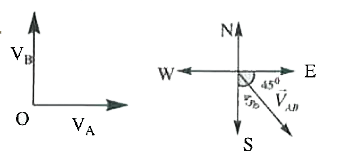 `vecV_(AB)=vecV_(A)-vev_(B)=10i-10 j` `|vecV_(AB)|=SQRT(10^(2)+10^(2))=10 sqrt(2)ms^(-1)` ALONG SE |
|
| 19. |
Obtain the resistant frequency omega_r of a series LCR circuit. with L = 2.0 H, C = 32 muF and R = 10 Omega what is Q value for the circuit ? |
|
Answer» Solution :RESISTANT angular frequency `OMEGA = 1/sqrt(LC)` or `omega = 1/sqrt(2.0 xx 32 xx 10^(-6))` rad `s^(-1)= 10^3/8` rad `s^(-1)` = 125 rad `s^(-1)` Q value = Q = `(omega _0 L)/R = (125xx 2.0)/10 = 25` |
|
| 20. |
Two large identical plates are placed in front of each other at x = d and x = 2d as shown in the figure. If charges on plates are Q and -5Q, the potential versus distance graph for region x = 0 to x = 3d is (d is very small and potential at x = 0 is v_0) |
|
Answer»
For `dltxlt2d,E_("net")=6sigma//epsilon_(0)` toward right, so potential decreases as we move from `x=d` to `x=2d`. For `2dltxlt3d,E+("net")=4sigma//epsilon_(0)` toward LEFT, so potential increases as we move from `x=2d` to `x=3d`, |
|
| 21. |
A fluid of densityrhoand viscosityetais keptin a container.The containeris acceleratingin horizontaldirectionwithaccelerationa . A Smallsolidsphere of radiusr and densityrho//2is held at the base of the container and releasedThe distancetravelledby the sphere in attaining half the terminalvelocity iss = (rho r^(2) v_(tau))/(k eta) [ In (2) - 1/2 ]. Find the value of k . |
|
Answer» |
|
| 22. |
A series high resistance is preferable than shunt resistance in the galvanometer circuit of potentiometer. Because |
|
Answer» shunt resistances are costly |
|
| 23. |
Resistivity of copper,constantan and silver are 1.7xx10^(-8)Omega, 3.91xx10^(-8)Omega and 1.6xx10^(-8)Omegamrespectively. Which has best conductivity ? |
| Answer» SOLUTION :Conductivity =1/RESISTIVITY. As silver has the lowest resistivity, it HA STHE best conductivity. | |
| 24. |
Which of the following is not a conductor of electricity? |
| Answer» ANSWER :A | |
| 25. |
A particle is moving along a straight line path according to the relations s^(2)=at^(2)+2bt+c represent the distance travelled in t seconds and a, b, c are constant. Then the acceleration of the particle varies as: |
|
Answer» `s^(-3)` Diff.both sides `2d(ds)/(dt)=2a+2b` or `v=(ds)/(dt)=(2(at+b))/(2S)=(at+b)/(s)` `f=([as-(at+b)][at+b])/(s^(3)` or ` FPROP s^(-3)` |
|
| 26. |
In javeline throw, a person who throws at an angle of 45^@ of the ground has greater probability of _____ |
|
Answer» |
|
| 27. |
Consider a thin target (10^(-2) m square ,10^(-3) m thickness) of sodium ,which produces a photocurrent of 100 muA when a light of intensity 100W//m^(2) (lambda=660nm) falls on it.Find the probability that a photoelectron is produced when a photon strikes a sodium atom. [Take density of Na=0.97 kg//m^(3)]. |
|
Answer» Solution :If total no. of sodium atoms in N. in a given layer of sodium then no.of moles of this number is `mu=(N.)/(N_(A))=(M)/(M_(0))` Here for sodium molar mass of mass is `m_(0)`=23g/mol `therefore N.(MN_(0))/(M_(0))` `=0.254xx10^(-7+23+3)` `N=2.54xx10^(18)` atoms ........(1) Now ,INTENSITY of incident radiation, `I=(E_(n))/(At)=(nhf)/(At)=(nhc)/(Atlambda)` `implies` No.of PHOTONS made incident on given layer per unit time. `((n)/(t))=(IAlambda)/(hc)` `=((100)(10^(-4))(660xx10^(-9)))/((6.625xx10^(-34))xx(3xx10^(8))` `=3.321xx10^(16)` PHOTON /second ........(2) If no. of photoelectrons emitted from given layer in unit time is N then probability (P) of emission of photoelectron from this layer can be found out by its definition given below. `P=(N)/(nxxN.)=("total no. of photoelectrons emitted")/(("total no. of incident photons")("Total no.of sodium atoms"))` `therefore P=(N//t)/((n//t)xxN.)` `therefore (N)/(t)=6.25xx10^(14)` Photoelectron/second.......(4) From equation (1),(2),(3),(4), `P=(6.25xx10^(14))/(3.321xx10^(16)xx2.54xx10^(18))` `therefore P=7.41xx10^(-21)` Thus ,above probabnility is nearly zero .It means that if one photon interacts with only one atom then we would get photoelectric CURRENT almost zero.But here we get it 100 `muA`. This means that each incident photon must be interacting with each electron inside the atom.Afterwards,whichever electron absorbs energy from incident photon ,more than its binding energy will get emitted .In this later case,we obtain quite high probability of emission of electrons which is quite consistent with experiment observation. |
|
| 28. |
An air bubble inside water behavies as |
|
Answer» CONCAVE lens |
|
| 29. |
A coil of shape as shown in the figure is placed in a horizontal magnetic field of 1.956 T esla perpendicular to field 0.01 amp. Current in flowing in the coil. It is free to rotate about axis AB. Mass per unit length of straight wires is lambda and that of circular part is lambda//2 where lambda=2.805gm/cm. What will be its magnitude of angular acceleration at t =0 . |
|
Answer» Solution :`tau ="iAB SIN" 90^(@)` `= 10^(-4)` N-m Inertia of the frame about AB `=[(1)/(2) (LAMBDA)/(2)piR(R^(2))+(1)/(3)5lambda(4^(2))+5lambda(4)^(2)+(1)/(3)4LAMBDA(4)^(2)]xx10^(-7)` Where `lambda` will be in gm /CM `= lambdaxx178xx24xx10^(-7)=500xx10^(-7)` So `alpha=2 "RAD"//s^(2)` |
|
| 30. |
In Thomson's mass spectrograph, the velocity of the positive ions so that they may strike the vertex of the parabola is : |
| Answer» Answer :A | |
| 31. |
Holes are charge carriers in |
|
Answer» INTRINSIC semiconductor |
|
| 32. |
If the velocities of light wave in two media d and int are 2.25xx10^8 m/s and 2xx10^8 m/s respectively then the R.I. of medium int with respect to d is: |
|
Answer» 1.125 |
|
| 33. |
What were Saheb and his family looking for in Delhi? |
|
Answer» dollars |
|
| 34. |
When we apply an external magnetising field to a material , what will be the resultant magnetic field inside it ? |
|
Answer» SOLUTION :Resultant FIELD = external field + field MATERIAL `B = mu_0 H + mu_0M` |
|
| 35. |
The poet depicts(sketches)... |
|
Answer» CONFLICTS(clash) in life |
|
| 36. |
(i) How does one explain the emission of electron from a photosensitive surfacewith te help ofEinstein's photoelectric equation ? (ii) The work function of the following metalsis given: Na = 2.75 eV, K = 2.3 eV, Mo = 4.17 eV and Ni = 5.15 eV. Whichof these metals will not cause photoelectricemission for radiation of wavelength 3300 Å from a laser source placed 1 m aways from these metals ? What happens if thelaser source is broughtnearer and placed50 cm away ? |
|
Answer» Solution :IDENTIFICATION of metals/s which does/do not CAUSE photoelectric effect Photoelectric EMISSION. Effect produced `E=(hv)/(lamda)=(6.63xx10^(-34)xx3xx10^(8))/(3.3xx10^(-7)xx1.6xx10^(-19))eV` `=3.77eV` The work function of Mo and NI is more than the energy of the incident photons, so photo-electric emission WIL not take place from these metals. Kinetic energy of photo electrons will not change, only photoelectric current will change. |
|
| 37. |
Calculate the net flux emerging from given enclosed surface -Nm^(2) C^(-1) |
|
Answer» `4.5 xx 10^(11)` |
|
| 38. |
A particle is moving around a circular path with uniform angularspeed(x) . The radius ofthe circular path is (r). The acceleration of the particle is: |
|
Answer» `(X2)/(R )` |
|
| 39. |
A solenoid of length 1 m and 0.05 m diameter has 500 turns. If a current of 2A passes through the coil, calculate (i) the coefficient of self induction of the coil and (ii) the magnetic flux linked with the coil. Data : l=1m, d=0.05 m, r=0.025m, N= 5000, I=2A, (i) L=? (ii) phi = ? |
|
Answer» SOLUTION :(i) `L=(mu_(0)N^(2)A)/(l) = (mu_(0)N^(2)pi r^(2))/(l)` `= (4 pi xx 10^(-7) xx (5xx10^(2))^(2)xx3.14(0.025)^(2))/(1)` `=0.616xx10^(-3)` `:.L=0.616 mH` (ii) Magnetic flux `phi=LI` `=0.616xx10^(-3)xx2 = 1.232 xx 10^(-3)` `phi=1.232` MILLI weber |
|
| 40. |
In a biprism experiment, the distance between the second and the eight h dark fringes on the same side of central bright fringe is 3 mm. The fringe width is : |
|
Answer» 1 mm |
|
| 41. |
Explain how you can identify a telescope and a microscope from their appearance. |
| Answer» Solution :The aperture of the objective telescope is made large in comparison to its eyepiece to get SUFFICIENT LIGHT from distant objects. On the other hand , the aperture of the objective of a microscope is madesmall in comparison to itseyepiece .so, by observing the size of the objective and the eyepieces of the TWO instrument we can identify them . MOREOVER , for large MAGNIFICATION the length of the tube of a telescope is large than that of microscope . | |
| 42. |
A glass prothole is made at the botton of a ahip for observing sea life. The hole diameter D is much larger than the thickness of the glass. Determine the area S of the field of vision at the sea botton for the porthole of the refractive index of water is mu_(w) and the sea depth is h. |
|
Answer» `rArr tani =(1)/(sqrt(mu_(w)^(2)-1))=(X)/(h)` `rArr x = (h)/(sqrt(mu_(w)^(2)-1))` Hence required area `s=pi(x+(D)/(2))^(2)` `=pi[(h)/(sqrt(mu_(w)^(2))-1)+(D)/(2)]^(2)` 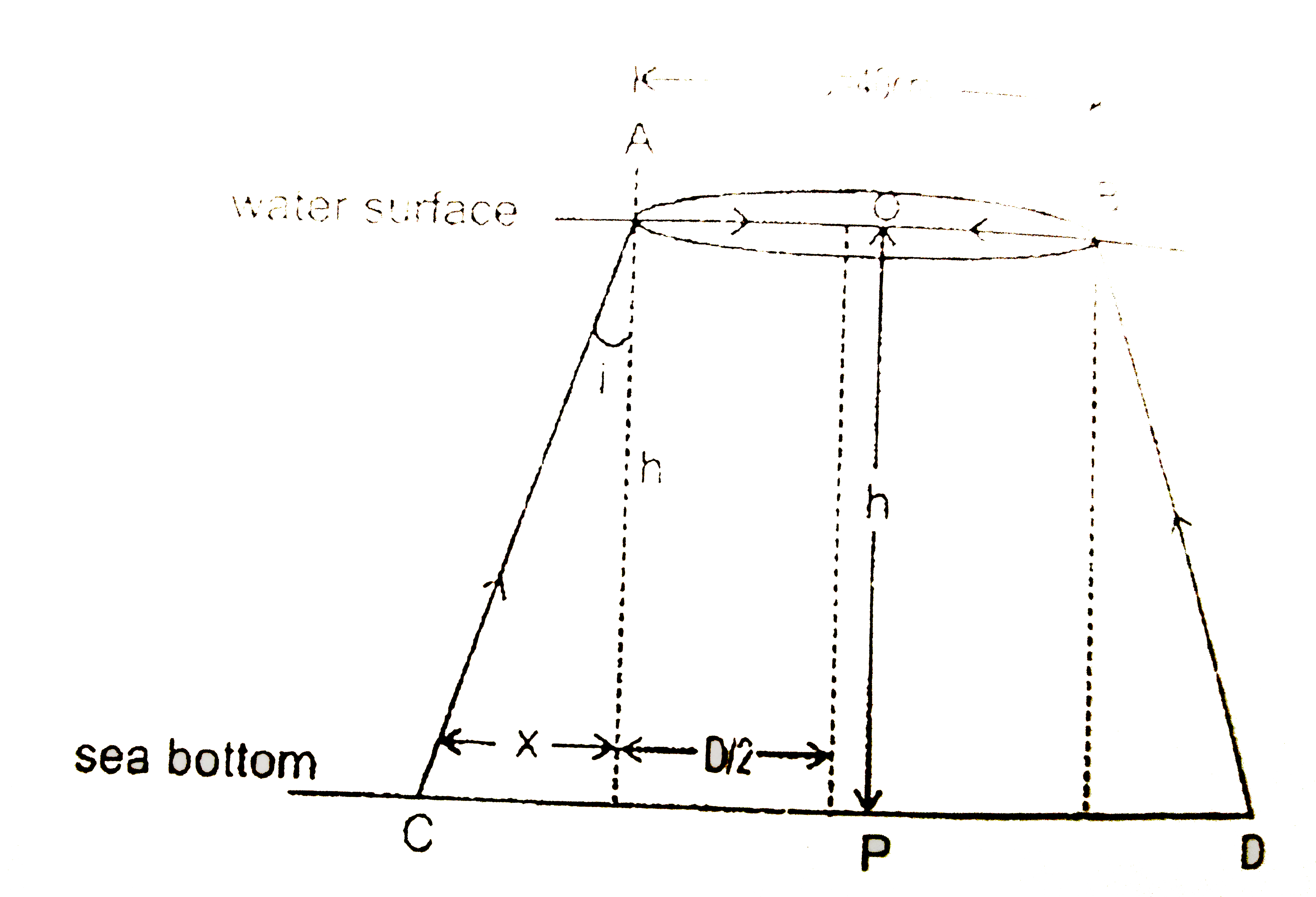
|
|
| 43. |
Photo electric current |
|
Answer» Does not obey Ohm.s law |
|
| 44. |
Two coils 1 and 2 are placed close to each other. On changing current flowing through coil 1 an induced emf is set up in coil 2 and vice-versa. What is the relation between mutual inductance of coil 1 due to change in current in coil 2 and the mutual inductance of coil 2 due to change in current in coil 1? |
|
Answer» Solution :If `M_(12)` is the mutual INDUCTANCE of coil 1 due to change in current FLOW in coil 2 and `M_(21)`, the mutual inductance of coil 2 due to change in flow of current in coil 1, then `M_(12) = M_(21)`. |
|
| 45. |
If a body of mass 1 kg is revolving on a circular path of diameter 2.0 meters at the rate of 2 rad\sec.Then angular momentum of the body will be |
|
Answer» `(2 kgm^2)/s` |
|
| 46. |
In the arrangement shown in the figure the elevator is going up with an acceleration of g/10. If the pulley and the string are light and the pulley is smooth, the tension in the string AB is |
|
Answer» `(44)/(15)MG` |
|
| 47. |
A cylindrical bar magnet is placed along the axis of a circular coil. If the magnet is rotated about that axis, will any current be induced in the coil? |
| Answer» SOLUTION :SINCE the bar magnet is cylindrical, its lines of force remain symmetric about its own axis. As a result, if the bar magnet is rotated about its own axis, i.e., with RESPECT to the axis of thecoil, the number of MAGNETIC lines of force i.e., magnetic flux linked with the coil remains unchanged. So, no current will be INDUCED in the coil. | |
| 48. |
A man of mass m is standing on a plank kept on ground having mass m. There is no friction betweenthe plank and the ground. If the man walks with an acceleration a w.r.t. the plank when calculate the acceleration of the plank w.r.t. the ground. Also calculate frictionalforce exerted by the plank on man. |
|
Answer» |
|
| 49. |
Who is author of this chapter? |
|
Answer» KHUSHI Singh |
|
| 50. |
There is a non-conducting disc of mass 4kg and radius 1m placed on a rough non conducting surface. A conducting ring of same mass is tightly fixed around the disc. There exists a magnetic field vecB=4hati+4t^(2)hatj. The resistance of the ring is 8Omega. Find the time after which the system will start toppling. |
|
Answer» `|bar(tau)|=|barMxxbarB|=2mgr` `(pir^(2))/R (dB)/(dt).pir^(2).4=2mg.r` `4(PI^(2)r^(4))/R.8t=2mg.r` `t=2`SEC |
|


