Saved Bookmarks
This section includes 7 InterviewSolutions, each offering curated multiple-choice questions to sharpen your Current Affairs knowledge and support exam preparation. Choose a topic below to get started.
| 1. |
What is the relevance of large value of K(=81) for H_2O ? |
| Answer» Solution :It makes WATER GREAT solvent. This is because BINDING force of ATTRACTION between oppositely charged ions of the substance in water BECOMES 1/81 of the force between these ions in air. | |
| 2. |
A steel boiler whose thickness is 3 cm is placed on a plate of area 1m^(2). The temperature of the plate is 300^(@)C and that of the boiling water in the boiler is 100^(@)C. How much water will evaporate per minute? (Conductivity of steel = 63.0Js^(-1) m^(-1) K^(-1) and sp. latent heat of vaporisation of water =2251.2 xx 10^(3) Jkg^(-1).) |
|
Answer» |
|
| 3. |
When a junction transistor is used as an amplifier, its emitter-base junction is |
|
Answer» UNBIASED |
|
| 4. |
A parallel monochromatic beam of light is incident normally on a narrow slit. A diffraction pattern is formed on a screen placed perpendicular to the direction to the incident beam. At the first minimum of the diffraction pattern, the phase difference between the rays coming from the two edges of slit is : |
|
Answer» `0` |
|
| 5. |
An ideal gas is expanded so that the amount of heat given is equal to the decrease in internal energy of the gas. The gas undergoes the process PV^((6)/(5))= constant. The gas may be |
|
Answer» `He` |
|
| 6. |
The angular width of the central maximum in a single slit diffraction pattern is 60^(@). The width of the slit is 1 mu m The slit is illuminated by monochromatic plane waves. If another slit of same width is made near it. Young's fringes can be observed on a screen placed at a distance 50 cm from the slits. If the observed fringe width is 1 cm, what is slit separation distance ? (i.e. distance between the centres of each slit) |
|
Answer» `25 MU m` `:. theta=30^(@)` For fringe of first order minimum `d sin theta= lambda` `:. d sin 30^(@) lambda,` `:. Dxx(1)/(2)= lambda` `:. lambda=(d)/(2)` WIDTH of fringe `beta=(lambdaD)/(d.)` `d.=(lambdaD)/(beta)` `=(d)/(2)XX(D)/(beta)` `=(10^(-6))/(2)xx(50xx10^(-2))/(1xx10^(-2))` `=25xx10^(-6)m` `:.d.=25 mum` |
|
| 7. |
Give an explanation of superconductor a diamagnetism. |
|
Answer» SOLUTION :Superconductors are DIFFERENT types of diamagnetic substances. The metals of superconductor are cooled at very low temperature which exhibits both perfectconductivity and perfect diamagnetism. A superconductor, when it is cooled below the critical temperature, expelled the magnetic field and doesn.t ALLOW the magnetic field to penetrate inside it. This phenomenon is called Meissner effect. For these conductors (metals) `chi = 1 and mu_r = 0. ""[because mu_r = 1 + chi]` Magnet repel the superconductor and it is repel by magnet. Superconductor magnets are USEFUL in high speed superfast trains that run high by a magnet. |
|
| 8. |
The equation of an alternating current is I = 20 sin 300 pi t. Calculate the frequency and r.m.s value of current. |
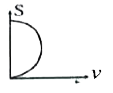
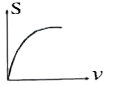
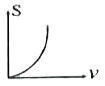
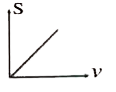
|
Answer» Solution :Here `I = 20 sin 300 pi t` (i) Compare it with standard EQUATION `I = I_(0)sin omega t = I_(0) sin 2 pi vt` we get `I_(0) = 20 A` and `2pi vt = 300 pit` or `V = 150 Hz` (II) We know, `I_(rms) = (I_(0))/(sqrt(2))` `therefore I_(rms) = (20)/(sqrt(2)) = 14.14 A`. |
|
| 9. |
The electrostaticforce on a small of charge0.4 mu C in air is 0.2N. (a) What is the distance between the two spheres ? (b) What is the force on the secondspheredue to the first ? |
|
Answer» Solution :Here `q_(1) = 0.4 mu C = 0.4xx10^(-6) C, q_(2) = -0.8 mu C = -0.8 mu C = -0.8xx10^(-6) C, F = 0.2N , R = ?` As `F = (q_(1) q_(2))/(4pi in_(0) r^(2)) :. r^(2) = (q_(1) q_(2))/(4pi in_(0) F) or r^(2) = ((0.4xx10^(-6)) (0.8xx10^(-6))xx9xx10^(9))/(0.2)` `r^(2) = 16xx9xx10^(-4) or r = 4xx3xx10^(-2) m = 0.12 m` Force on secound sphere due to the firstis the same, i.e., 0.2N |
|
| 10. |
Determine the mass of Na^(22) which has an activity of 5mCi. Half life of NA^(22) is 2.6 years. Avogadro number =6.023xx10^(23) atoms. |
|
Answer» SOLUTION :Activity of `Na^(22) , A= (dN)/( dt) =5 m Ci` `A= 5 XX 10^(-3) xx 3.7 xx 10^(10)` `A=1.85 xx 10^(+7)` disintegration per second Disintegration constant `lambda = (0.693)/(T)= (0.693)/( 2.6 xx 365 xx 24 xx 60 xx 60)` `lambda = 8.453 xx 10^(-9) s^(-1)` Activity, `(d N)/( dt) = lambda N` `N= (1)/( lambda) (dN)/( dt)` `N= 2.189 x 10^(16)` atoms According to Avagadro.s hypothesis `6.023 xx 10^(23)` atoms of `Na^(22)` weigh 22 gm `2.189 xx 10^(16)` atoms weigh `= (22 xx 10^(-3))/( 6.023 xx 10^(23)) xx 2.189 xx 10^(16)` `=7.996 xx 10^(-10)` kg |
|
| 11. |
As in the figure, if a capacitor of capacitance 'C' is charged by connecting it with resistance R, then energy given by the battery will be |
|
Answer» `(1)/(2) CV^(2)` |
|
| 12. |
Mid way between the two equal and similar charges, we placed the third equa and similar charge Which of the following statements is correct, concerned to the equilibrium along the line joining the charges ? |
|
Answer» The third CHARGE experienced a net force INCLINED to the line joining the CHARGES |
|
| 13. |
In a frequency modulated wave : |
|
Answer» AMPLITUDE varies with TIME |
|
| 14. |
A thin concavo-convex lens ha two surface of radii of curvature R and 2R. The mateial of the lens has a refractive index mu. When kept in air, the focal length of the lens |
|
Answer» wil depend on the DIRECTION from which light is incident on it |
|
| 15. |
Due to economic reasons , only the upper sideband of an AM wave is transmitted , but at the receivingstation , there is a facility for generating the carrier . Show that if a device is available which can multiply two signals , then it is possible to recover the modulating signal at the receiver station . |
|
Answer» Solution :Let `omega_(c)` be the angular frequency of CARRIER waves & `omega_(m)`be the angular frequency of signal waves . Let the signal received at the receiving station be `e = E_(1)* cos(omega_(c) + omega_m)t` Let the instantaneous voltage of carrier WAVE `e_(c) = E_(0) cos omega_(c) t` is available at receiving station . Multiplying these two signals , we GET `e xx e_(c) = E_(1) E_(c)cos omega_(c) t . cos (omega_(c) + omega_(m))t` `E = (E_(1) E_(c))/(2)* 2 . cos omega_(c) t . cos (omega_(c) + omega_(m)) t "" ("Let" e xx e_(c) = E)` `=(E_(1)E_c)/(2) [ cos (omega_(c) + omega_(c) + omega_(m)) t + cos (omega_(c) + omega_(m)- omega_(c))t]` `because 2[ cos A cos B = cos (A + B) + cos (A - B)]` `(E_(1) E_(c))/(2) =[cos (2omega_(c) + omega_(m))t + cos omega_(m) t]` Now , at the receiving END as the signal passes through filter , it will PASS the high frequency `(2omega_(c) + omega_(m))` but obstract the frequency `omega_(m)` . so we can record the modulating signal `(E_(1) E_(c))/(2) ""cos omega_(m) t` which is a signal of angular frequency `omega_(m)`. |
|
| 16. |
The band diagrams of three semiconductors are given in the figure. From left to right they are respectively. |
|
Answer» n-intrinsic-p |
|
| 17. |
Which of the following organisms does not reproduce ? |
|
Answer» Mule |
|
| 18. |
A beam of light coming from infinty is passing through a biconvex lens having radius of curvature R=20cm of each surface, if focused at a certain distance from lens. Find the radius of curvature of emergent wave front from lens : (mu lens =1.5) |
|
Answer» `10cm` |
|
| 19. |
What type of cell should be filled in the main circuit of the potentiometer and why ? |
| Answer» SOLUTION :Leclanche CELL, is useful when the CURRENT is drawn for a SMALL time. | |
| 20. |
Two cells of emf E_(1) and E_(2)(E_(1)gtE_(2)) are connected as shown in the figure below. When a potentiometer is used to measure potential difference between the points A and B, the balancing length of the potentiometer wire is 300 cm. But the same potentiometer for the potential difference between points A and C, gives the balancing length 100 cm. Find (E_(1))/(E_(2)). |
|
Answer» Solution :POTENTIAL difference between the POINTS A and B is `E_(1)` and potential difference between the points A and C is `(E_(1) - E_(2))`. So as PER question: `E_(1)=kxx300` and `(E_(1)-E_(2))=kxx100` `rArr(E_(1)-E_(2))/(E_(1))=100/300=1/3rArr(E_(1))/(E_(2))=3/2` |
|
| 21. |
If a radio receiver amplifies all the signal frequencies equally well, it is said to have high |
|
Answer» fidelity |
|
| 22. |
Consider a simple RC circuit as shown in figure 1. Process 1 : In the circuit the switch S is closed at t=0 and the capacitorif fullycharged to voltage V_(0) (i.e., charging continuesfor time T gt gt RC). In the process some dissipation(E_(D)) occurs across the resistance R. The amountof energyfinally stored in the fully charged capacitor is E_(c). Process 2 : In a different process the voltage is first set to (V_(0))/(3) and maintainedfor a charging time T gt gt RC. Then the voltage is raised to (2C_(0))/(3) without dischargingthe capacitorand again maintainedfor a time T gt gt RC. The process is repeated one more time by raising the voltage to V_(0) and the capacitor is charged to the same final voltage V_(0) as in Process 1. These two processesare depictedin figure 2. In process2, total energy dissipatedacross the resistance E_(D) is : |
|
Answer» `E_(D)=3((1)/(2)CV_(0)^(2))` |
|
| 23. |
Consider a simple RC circuit as shown in figure 1. Process 1 : In the circuit the switch S is closed at t=0 and the capacitorif fullycharged to voltage V_(0) (i.e., charging continuesfor time T gt gt RC). In the process some dissipation(E_(D)) occurs across the resistance R. The amountof energyfinally stored in the fully charged capacitor is E_(c). Process 2 : In a different process the voltage is first set to (V_(0))/(3) and maintainedfor a charging time T gt gt RC. Then the voltage is raised to (2C_(0))/(3) without dischargingthe capacitorand again maintainedfor a time T gt gt RC. The process is repeated one more time by raising the voltage to V_(0) and the capacitor is charged to the same final voltage V_(0) as in Process 1. These two processesare depictedin figure 2. In process 1, the energy stored in the capacitorE_(c) and heatdissipated across resistanceE_(D) are related by : |
|
Answer» `E_(c)=(1)/(2)E_(D)` |
|
| 24. |
Electrostatic potential is ...... physical quantity. |
|
Answer» SCALAR and DIMENSIONLESS |
|
| 25. |
A circular platform is free to rotate in a horizontal plane about a vertical axis passing through its centre. A tortoise is sitting at the edge of the platform. Now, the platform is given an angular velocity omega_(0) . When the tortoise moves along a chord of the platform with a constant velocity (with respect to the platform), the angular velocity of the platformwill vary with time t as |
|
Answer»
Let the tortoise move ALONG the chord PQ. When the tortoise MOVES from P to M its distance from axis point O decreases and so the moment of inertia decrease as `I=mr^(2)`, where r = distance of tortoise from O. When the tortoise moves from M to Q the distance r increases and so I also increases. `I_(P) = mR^(2) + (MR^(2))/2`..........(i) `I_(N) = mr^(2) + (MR^(2))/2`.......(ii)  By geometry, `r^(2) =d^(2) + [sqrt(R^(2) -d^(2))-vt]^(2)`........(iii) Angular momentum is conserved `I_(p)omega_(0) = I_(N)omega(t)` or `omega(t) =(I_(p)omega_(0))/I_(N)`.........(iv) `omega(t)` DEPENDS on `I_(N'), I_(N)` depends on r and r depends on time t. The function of t is non-linear. HENCE, `omega(t)` is a non-linear function of t. `omega` increases when tortoise from P to M and `omega` decreases when tortoise travels from M to Q. First increases and then decrease of `omega` is revealed in graph (b) and (d). But `omega(t)`is a non-linear function of t, hence graph (b) represents the variation of `omega`(t) w.r.t. time. |
|
| 26. |
Antioxidants are often added to fat containing foods to prevent........... Due to oxidation |
|
Answer» Rancidity |
|
| 27. |
An ant, crazed by the Sun on a hot Texas afternoon, darts over an xy plane scratched in the dirt. The x and y components of four consecutive darts are the following, all in centimeters: (30,0,40.0) , (b _(x') - 70.0), (-20.0, c _(y)), (-80.0,-70.0). The overall displacement of the four darts has the xy components ( -140, - 20.0). WHat are (a)b _(x) and (b ) c _(y) ? What are the (c ) magnitude and (d) angle (relative to the positive direction of the x axis) of the overall displacement ? |
| Answer» Solution :`(a) - 70.0cm, (B) 80.0cm, (C ) 141 cm, (d) - 172^(@)` | |
| 28. |
Which of the following statements is incorrect about hysteresis? |
|
Answer» The effect is common to all ferromagnetic substances. |
|
| 29. |
Determine the load resistance for which the power delivered to the circuit is a maximum. Graph the dependence of the power on the load resistance. |
|
Answer» <P> Solution :The power `R_("tot")=epsi^2//(R+r)` is at its maximum in CONDITIONS of short-circuit (R =0). The short circuit power is `R_("sh.e")=epsi^2//r`.The power in the external circuil is at its maximum when R = r. To CHECK this consider the extremum of the expression `P_(ex)=(epsi^2)/(r). (Rr)/((R+r)^2=(epsi^2)/(ry)` We have `y=((R+r)^2)/(Rr)=R/r+2+r/R=R/r-2+r/R+r=` `=(sqrt(R/r)-sqrt(r/R))^2+4` Obviously, y= 4 for R = r is minimum value. In this case the power in the external circuit is maximum. The CORRESPONDING graphs are shown in Fig. 26.13. 
|
|
| 30. |
1 Litre is equal to... |
|
Answer» `1dm^3` |
|
| 31. |
An alternating current generator has an internal resistance R_g and an internal reactance X_g. It is used to supply power to a passive load consisting of a resistance R_g and a reactance X_L. For maximum power to be delivered from the generator to the load, the value of X_L is equal to |
|
Answer» 0 `THEREFORE X_"int"=X_"EXT"` `therefore X_g=(X_L)=-X_L` `therefore X_L=-X_g` Reactance of external CIRCUIT. |
|
| 32. |
You have been provided with four 100 ohm resistors each with a tolerance of 2%. The number of ways in which these can be combined to have different equivalent resistance is |
|
Answer» seven DIFFERENT COMBINATIONS and seven different EQUIVALENTS |
|
| 33. |
If there is only one type of charge in the universe, thenvec( E)rightarrow Electric field , vec(ds)rightarrow Area vector |
|
Answer» `ointvecE.vec(DS)ne0` on any surface If charge is outside the surface, incoming flux = OUTGOING flux. Net flux through surface = 0 If charge is inside, flux only goes one way. |
|
| 34. |
In the circuit shown, all capacitors are identical. Initially, the switch is open and the capacitor marked C_1 is the only one charged to a value Q_0. After the switch is closed and the equilibrium is reestablished, the charge on the capacitor marked C_1 is Q. Find the ratio initial change to final charge in capacitor C_1. |
Answer» SOLUTION :We BEGIN with the circuit GIVEN, assigining names to each identical capacitor. `C_(1)` begins with an unknown initial charge `Q_(0^(3))` and achieves a charge `Q` after the circuit is connected and has re-established equilibrium.  As `C_(3)` is clearly shorted, the potential difference across its plates is `0`, and as such the capacitor will contain no charge and will not afect the circuit We can therefore remove it from the schematic. This simplified circuit can be broken down into even simpler equivalne tcircuits. Leaving `C_(1)` where it is, and recognizing `C_(3)` and `C_(4)` in series with each other *yielding an equivalent capacitance of `1//2C`), and together in PARALLEL with `C_(4)`, Acknowledging the combined capacitors are equal, `C_(456)` must have an equivalent capacitance of `3//2C`, As `C_(456)` is simply in series with `C_(2)`, the resultant equivalent circuit has simply one capacitor `(C_(2456))` in series with `C_(1)`, where `C_(456)` must have an equivalent capacitance of `3//5C`, Since `Q=CV, V_(1)=Q//C` where `V_(1)` is the potential difference across `C_(1),V_(2456)` is the potential difference across `C_(2456)`, and `Q` is the charge on `C_(2456)` For equilibrium conditions, `V_(1)=V_(2)`. Therefore, `Q//C=5Q//C, 3CQ=5CQ` `Q=(3//5)Q` by the conservation of charge, `Q_(0)=Q+Q=Q+(3//5)Q=(8//5)Q`. The initial charge on the capacitor was `8//5` of the final charge on the capacitor after the switch was closed. 
|
|
| 35. |
In a Michelson experiment for measuring speed of light, the distance travelled by light between two reflections from the rotating mirror is 4.8 km. The rotating mirror has a shape of a regular octagon. At what minimum angular speed of the mirror (other than zero) the image is formed at the position where a nonrotating mirror forms it ? |
|
Answer» `D=4.8km=4.8xx10^3m` We know `C=D(OMEGAN)/(2pi)` `rarr w=(2pic)/(DN) rad/sec` `=c/(DN) rev/sec` LTBR. `=(3xx10^8)/((4.8xx10^3xx8)` `=(7.8)xx10^3 rev/sec` |
|
| 36. |
Two charges Q_(1) and Q_(2) Coulombs are shown in fig. A third charge Q_(3) coulomb is moved from point R to S along a circular path with P as centre Change in potential energy is |
|
Answer» `(1)/(4piepsilon_(0))Q_(1)Q_(2)Q_(3)` |
|
| 37. |
An object is moving with a uniform acceleration which is parallel to its instantaneous direction of motion.The displacement (velocity (v) graph of this object is ) |
|
Answer»
|
|
| 38. |
An iron core solenoid of length l and cross-sectional area A having N turns on it is connected to a battery through a resistance as shown in the figure. At instant t=0, the iron rod of permeability mu from the core is abruptly removed. Find the current as a function of time. |
|
Answer» `L=(mu_(0)muN^(2)A)/(l)` and initial current `i_(0)=(epsilon)/(R )` because circuit is in the steady state. When iron ROD is abruptly removed from the CORE the number of flux linkages abruptly do no change. `Nphi=Li_(0)=L'i_(0)'` `((mu_(0)muN^(2)A)/(l))i_(0)=((mu_(0)N^(2)A)/(l))i'_(0)` `:. ` Just after `t=0`, initial current `i_(0)'=mu i_(0)=mu((epsilon)/(R ))` At INSTANT, if the current in the circuit is `i`, then apply `KVL` in the loop, we get `L(di)/(dt)+iR=epsilon` `-L(di)/((epsilon-iR))=dt` On integration we get, `(L)/(-R) ln(epsilon-iR)=t+c_(1)` At `t=0`, `i=i_(0)'=(mu(epsilon)/(R ))` `rArr ((L)/(-R))ln(epsilon-i_(0)'R)=C_(1)` `:. ln((epsilon-iR)/(epsilon-i_(0)'R))=-(tR)/(L)rArr((epsilon-iR)/(epsilon-i_(0)'R))=E^(-(t R)/(L))` `rArr((epsilon-iR)/(epsilon-(mu(epsilon)/(R))R))=e^(-(tR)/(L))` On rearraging the equation, we get `i=(epsilon)/(R )[1+(mu-1)e^(-tR//L)]` 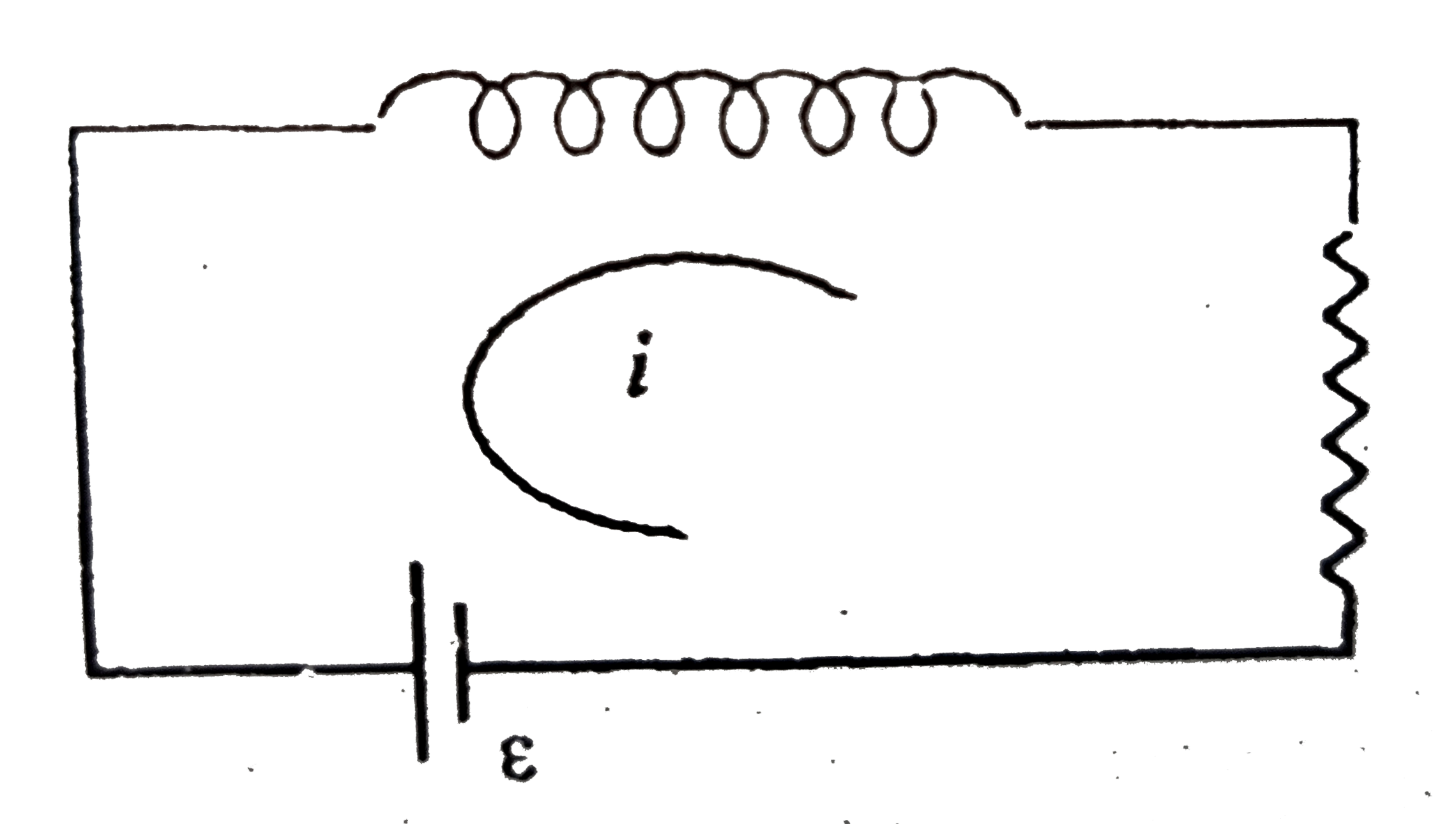
|
|
| 39. |
The nucleus ""_(10)^(23)Ne decays by beta^(-)– mission. Write down the beta-decay equation and determine the maximum kinetic energy of the electrons emitted. Given that: m (""_(10)^(23)Ne ) = 22.994466 u m (""_(11)^(23)Na ) = 22.989770 u. |
| Answer» Solution :`""_(10)^(23)Ne to ""_(11)^(23)Na + E^(-) + bar(V) + Q , Q = [m_N (""_(10)^(23)Ne) - m_N (""_(11)^(23)Na) - m_(e)] c^2`, where the masses used are masses of nuclei and not of atoms as in Exercise . USING atomic masses `Q = [m (""_(10)^(23)Ne) - m(""_(11)^(23)Na)]c^2`. Note `m_e` has been cancelled. Using given masses, `Q = 4.37 MeV`. As in Exercise , maximum kinetic energy of the ELECTRON (max `E_e) = Q = 4.37 MeV`. | |
| 40. |
In above problem show that the change in frquency of rotation caused by the magnete field is given approximately by Deltav=pm(Be)/(4pim). Such frequency shifts were actually observed by Zeeman in 1896. |
| Answer» SOLUTION :`PM(QB)/(4pim)` | |
| 41. |
The initial shape of the wavelenght of the beam is |
|
Answer» plannar |
|
| 42. |
There was a large colony of monkeys in..jail. |
|
Answer» Bareilly |
|
| 43. |
If a charge q is placed at centre of cube, then flux associated with each edge is ....... |
|
Answer» `q/epsilon_(0)` `phi. = q/epsilon_(0)` `THEREFORE` Flux through each other `phi =(phi.)/(12) = q/(12epsilon_(0))` |
|
| 44. |
A nuclide of " "_(90)^(232)Th decays successively in a number of steps and finally we get " "_(82)^(208)Pb. The number of alpha and beta particles emitted in the process are |
|
Answer» `alpha=3, beta=3` |
|
| 45. |
A thin and uniform rod of mass M and length L is held vertical on floor with large friction. The rod is released from rest so that is falls by rotating about is contact-point with the floor without slipping. Which of the following statement(s) si/are correct. When the rod makes an angle 60^(@)with vertical? [g is the acceleration due to gravity] |
|
Answer» TheNormal REACTION force from the floor onthe rod will be `(Mg)/(16)` |
|
| 46. |
The kinetic energy of uniformly rotating disc is 31.56 J. calculate its M.I. If it performs 120 rotations per minute. |
|
Answer» `0.2kgm62` |
|
| 47. |
The minimum deviation produced by a hollow prism filled with a certain liquid to be 30^(@). The light ray is also found to be refracted at angle 30^(@). The refractive index of the liquid is |
|
Answer» `SQRT(2)` |
|
| 48. |
radioactive nucleus X undergoes a series of decays corroding to the scheme X oversetalphararrX_1overset(beta^(-))rarrX_2overset(alpha)rarrX_3overset(gamma)rarrX_4 If the mass number and atomic number of X are 180 and 72 respectively, the corresponding numbers for X_4 are |
|
Answer» 17.6 ,69 |
|
| 49. |
X-rays, gamma rays and microwaves travelling in vacuum have : |
|
Answer» same velocity and same frequency |
|
| 50. |
For circuits used for transporting electric power , a low power factor implies a large power loss in transmittion. Why ? |
|
Answer» Solution :Average power `barP=V_rmsI_rms,cosphi, I_rms=barP/V_rmscosphio` To supply a GIVEN power at a given voltage, if the power FACTOR `cosphi` is LOW , the circuit current will be high . So the ENERGY LOSS `L_rms^2` R will be high . |
|