

Saved Bookmarks
This section includes 7 InterviewSolutions, each offering curated multiple-choice questions to sharpen your Current Affairs knowledge and support exam preparation. Choose a topic below to get started.
| 1. |
A molecule of perfect gas travels, between two successive collisions along a: |
|
Answer» Zig-Zag path |
|
| 2. |
Maxwell's modified form of Ampere's circuital law is: |
|
Answer» `ointvecB.vecdl = O` |
|
| 3. |
Ina double slit experiment the angular width of a fringe is found to be 0.2^(@) on a screen placed 1m away.The wavelength of light is 600 nm. What will be the angular width of the fringe if the entire experimental apparatus is immersed in water? Take refractive index of water of be4/3 |
|
Answer» Solution :ANGULAR size `THETA= (lamda)/d` is INDEPENDENT of D. `:. (theta.)/(theta)=(lamda.)/(lamda)` but `lamda. =(lamda)/n` where n is the REFRACTIVE INDEX `:. Theta.=(theta)/(lamda.)xx(lamda.)/n=(theta)/n=(0.2^(@))/((4//3))=0.15^(@)` |
|
| 4. |
An inductance of 1 mH and a charged capacitor capacitance of 10muF are connected across each other, The resonating angular frequency of circuit is |
|
Answer» `10^(5)rad//s` |
|
| 5. |
Acceleration of a particle at any time t is veca=(2thatj+3t^(2)hatj)m//s^(2).If initially particle is at rest, find the velocity of the particle at time t=2s. |
|
Answer» Solution :Here ACCELERATION is a FUNCTION of time.i.e, acceleration is not constant.So, we can not APPLY `vecv=vecu+vecat` We will have to go for intergration for dinding velocity at any time t.This `dvecv=dvecadt` or `underset(0)underset(vecv)intdvecv=underset(0)overset(2)intvecadt` (or) `vecv=underset(0)overset(2)int(2thati+3t^(2)hatj)dt=[t^(2)hati+t^(3)hatj]_(0)^(2)=(4hati+8hatj)m//s` Therefore,velocity of particle at time =2s is `(4hati+8hatj)m//s` |
|
| 6. |
A proton and an alpha-particle start from rest in a uniform electric field. The ratio of times taken by them to travel the same distance in the field is |
| Answer» Answer :D | |
| 7. |
figure shows, in cross section, two solid spheres with uniformaly distributed charge throughout their volumes. Each has radius R. point P lies on a line connecting the centres of the spheres, at radial distance r/2.00 from the centre of sphere 1 .If the net electric field at point P is zero what is the ratio q_(2)//q_(1) of the total charges ? |
|
Answer» `9/8` |
|
| 8. |
A short bar magnet produces magnetic fields of equal induction at two points one on the axial line and the other on the equatorial line. What is the ratio of their distances. |
| Answer» SOLUTION :`2^(1//3):1` | |
| 9. |
The amplitude of a particle in SHM is 5 cms and its time period is pi. At a displacement of 3 cms from its mean position the velocity in cms/sec will be : |
|
Answer» 8 |
|
| 10. |
The ratio of SI unit to the CGS units of Gravitational constant G will be |
|
Answer» 10 |
|
| 11. |
In series LC circuit, the voltage acros L and C are 180^(@) out of phase. Is it correct ? Explain. |
| Answer» SOLUTION :The curretn must be same since L `&` C are in series The VOLTAGE across the capacitance lag the current by `90^(@)` while the voltage across the inductance LEAD the current by `90^(@).` This MAKES the inductance and capacitance voltages `180^(@)` out of PHASE. | |
| 12. |
A superconducting ring of radius 'a' and inductance L is located in a uniform magnetic field of induction B. The plane of ring is parallelto B and the current in the ring is zero. Then the ring is turned through 90^(@) so that plane is perpendicular to the field. What is the work done in turning the ring? |
|
Answer» `(PI^(2)a^(4)B^(2))/(2L)` |
|
| 13. |
Two wires of equal lengths are bent into the form of two loops. One of the loop is square shaped whereas the other loop is circular. These are suspended in a uniform magnetic field and the same current is passed throgh them. Which loop will experience greater torque? Give reason. |
| Answer» Solution :Torque `tau = n A I B sin theta`, as length of wire is same (say L), for squre loop `A_(s) = (L/4)^2 = (L^2)/(16)` and for circular loop, `A_c = (PI R^2) = pi (L/(2PI))^(2) = (L^2)/(4 pi)` . Obviously , `A_c > A_s`, hence, circular loop will experience greater torque than the square loop. | |
| 14. |
The flat base of a hemisphere of radius a with no charge inside it lies in a horizontal plane. A uniform electric field bar(E ) is applied at an angle pi//4 with the vertical direction. The electric flux through the curved surface of the hemisphere is |
|
Answer» `(PI + 2)pi a^(2) E//(2 SQRT2)` |
|
| 15. |
The radii of curvatur of the faces of a double convex lens are 10cm and 15 cm. If focal length of the lens is 12 cm, find the refractive index of the material of the lens. |
|
Answer» Solution :`(1)/( F) = ( mu -1) ((1 )/( R_(1) ) - ( 1)/( R_(2)))` `(1)/( 12) = ( mu - 1) ((1)/( 10) - ( 1)/( - 15))` `RARR mu = 1.5 ` |
|
| 16. |
In the following circuit, find the potentials at points A and B is |
|
Answer» `10 V, 0V ` |
|
| 17. |
Calculate the binding energy per nucleon of ._17^35Cl nucleus. Given that mass of ._17^35Cl nucleus = 34.98000 u, mass of proton = 1.007825 u, mass of neutron = 1.008665 u and 1 u is equivalent to 931 Mev. |
|
Answer» 6.2 MEV |
|
| 18. |
In the circit shown the three ammeters (marked as 1, 2, 3) are indentical, each have a resistance R_(0) = 2Omega. Between points A and B three is a constant potential difference of 19V. The first and second ammeter read I_(1)=2.5" A and "I_(2)=1.5 Arespectively. (a) What is the reading of third ammeter ? (b) Calculate value of resistance R. ( c) Investigate what happens to current I_(3) if the value of R_(x) is changed. Show approximately graphical variation of I_(3)vsR_(x). Note : Reading of ammeter implies current through brance of ammeter. |
|
Answer» (b) `4 Omega""I_(3)=(V(R_(x)-R))/((2R_(0)+3R)R_(x)+R_(0)(R_(0)+2R))` `(##RES_PHY_CE_E03_065_A01##)` The GRAPH of the function is a hyperbola.Its special points are : at `R_(x)=0I_(3)=-3.8A;` at `R_(x) ; = 4I_(3)=0;` at `R_(x)=32Omega I_(3)=1A ; ` If `R_(x)to oo, I_(3)" tends to 19/16=1.1875 A"`. |
|
| 20. |
A point charges causes an electric flux of -1.0 xx10^(3)Nm^(2) //Cto pass through a spherical Gaussian surface of 10.0 cm radius centred on the charges. If the radius of the Gaussian surface were doubled , how much flux would pass through the surface? What is the value of the point charges? |
|
Answer» Solution :Here electric FLUX ` phi_in =1.0xx 10^(3)Nm^(2)//C . ` The flux over a closed (spherical) Gaussian surfacedepends only UPON the amount of charges present inside. Therefore, even on doubling the radiusof the Gaussian surface , the value of electric flux REMAINS unchanged at `-1.0xx10^(3)Nm^(2)//C . ` |
|
| 21. |
The minimum magnifying power of a telescope is M. If the focal length of its eyelens is halved, the magnifying power? will become |
|
Answer» M |
|
| 22. |
The polarity of 'dees’ should be changed, when the charge completes one half circle. Why? |
| Answer» Solution :To ACCELERATE the particle again in the ELECTRIC FIELD and is phase with its motion. | |
| 23. |
Two long rails are hporizontal and parallel to each. On one end, the rails are connected by a resistance R and on the other end a cpacitor of capacitance C is connected as shown in the figure . A connecter of mass m and length l can slide on the rails without friction. Uniform magnetic field B, perpendicular to he plane of hte gigure exists in space. A constant horizontal force F starts acting on hte connector. What is the acceleration of connector when its veleocity is (3)/(4) of its terminal velocity? |
|
Answer» `(3F)/(4(m+CB^(2)I^(2))` |
|
| 24. |
A monochromatic source of light operating at 200W emits 4 xx (10^20) photons per second. Find the wavelength of the light. |
|
Answer» SOLUTION : The energy of each photon = `(200 J(s^-1)/ 4 XX (10^20)(s^-1))` `= 5 xx (10^-19)J. ` `Wavelength= lambda= hc/E ` ` = ((6.63 xx (10^-34)J s) xx (3 xx (10^8)m(s^-1))/ ( 5 xx (10^-19)J)) ` ` = 4.0 xx (10^-7)m= 400 n m. ` |
|
| 25. |
Unit and dimensional formula of surface charge density are....... |
|
Answer» `Cm^(2), M^(0)L^(2)A^(1)T^(1)` `|sigma| = |q|/|A| = |A^(1)T^(1)|/|L^(2)| = M^(0)L^(-2)A^(1)T^(1)` |
|
| 26. |
Molybdenum is used as a target for production of x-rays, because it is |
|
Answer» a HEAVY element and can easily absorb HIGH VELOCITY electrons |
|
| 27. |
How does electric potential vary from point to point due to a thin charged spherical shell ? Draw a graph showing variation of potential with distance. |
|
Answer» SOLUTION : (a) Electric potential at the surface of a thin charged shell `V = Q/(4PI epsi_0R).` where Q=charge on spherical shell and R=radius of shell. (b) At a point situated outside the shell at a distancer from the centre of shell (r>R), electric potential `V = Q/(4pi epsi_0r)` 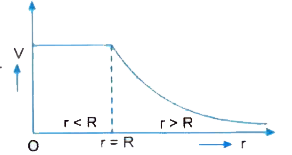 (c) However, inside the shell electric potential at all points is constant, which is equal to the potential at its surface i.e., `V = Q/(4pi epsi_0.R)` A graph showing variation of V with r is SHOWN in Fig. |
|
| 28. |
The method of making nanomaterial by assembling the atoms is called |
|
Answer» TOP down approach |
|
| 29. |
A quantity Q=(El^(2)G^(2))/m^(5) where E,l,G and m are energy, angular momentum gravitational constant and mass respectively. What are the dimensional of Q ? |
|
Answer» `[M^(0)L^(0)T^(0)]` PUTTING the dimensions `Q=([ML^(2)T^(-2)xxM^(2)L^(4)T^(-2)xxM^(2)T^(4)])/([M^(5)]xx[L^(6)])` `=M^(0)L^(0)T^(0)` Thus `(a)` is CORRECT. |
|
| 30. |
A charge 2C is moved between two points where potentials are 17 and 8V respectively. What is the work done in moving the charge. |
|
Answer» |
|
| 31. |
Efficiency of engine is eta_(1)" at T_(1)= 200^(@)C and eta_(2)" at "T_(1)=0^(@)C and T_(2)=-200 K. Find the ratio of (eta_(1))/(eta_(2)) : |
|
Answer» `1 cdot 00` `eta_(2)=1-((-200+273))/(273)=(200)/(273)` `therefore (eta_(1))/(eta_(2))=(273)/(473)=0 cdot 577` So, correct choice is (b). |
|
| 32. |
A conducting wire is dropped along east-west direction, then |
|
Answer» No EMF is INDUCED |
|
| 33. |
A rocket is to be shot radially outward from Earth's surface. Neglecting Earth's rotation, find the radial distance from Earth's center that the rocket reaches if it is launched with (a) 0.400 times the escape speed from Earth and (b) 0.400 times the kinetic energy that is required to escape Earth. (c) At launch, what is the least mechanical energy requiredfor it to escape Earth ? |
| Answer» SOLUTION :(a) `7.58 XX 10^6 N`, (b) `1.06 xx 10^7m`,( c )The mechanical energy is ZERO for the "ESCAPE CONDITION." | |
| 34. |
Waves traveling in same medium having equations: y_(1)=Asin(lamdat-betax)andy_(2)=Acos[alphat+betax-(pi//4)] have different |
|
Answer» speeds |
|
| 35. |
A metal ball hits a wall and does not rebound, where asb a rubber ball of the same mass on hitting the wall with the same velocity rebounds back. It can be concluded that: |
|
Answer» The initial MOMENTUM of METAL ball is GREATER than initial momentum of RUBBER |
|
| 36. |
……...is used to measure Doppler line broadening. |
|
Answer» POLAROID |
|
| 37. |
The work of 146 kJ is performed in order to compress one kilo mole of a gas adiabatically and in this process the temperature of the gas increases by 7^(@)C. The gas is (R 8 cdot 3J" mol"^(-1) K^(-1)): |
|
Answer» DIATOMIC `W=nC_(v)Delta T` `146xx10^(3)=10^(3)C_(v)xx7 rArr C_(v)=20 cdot 85 J" mol"^(-1)K^(-1)` This is same as `C_(v)` for diatomic gas `C_(v)=(5)/(2) R` Thus, CORRECT choice is (a). |
|
| 38. |
In an a.c. circuit , peak value of voltage is 423 volt. Its effective voltage is …… volt. |
|
Answer» 400 `THEREFORE V_(rms)=V_m/sqrt2=423/sqrt2=423/1.41`=300 V |
|
| 39. |
An object is placed between a plane mirror and a convex mirror as shown, Let I_1 and I_2 be the images formed by the plane mirror and the convex mirror respectively. It is found that distance between I_1and I_2 is 100 cm, distance between the object and I_2 is 60 cm and has magnification 1/2. Find focal length of the convex mirror and also the distance between the two mirrors. |
| Answer» SOLUTION :40 CM, 60 cm | |
| 40. |
The momentum of a body decreases by 20%, the percentage decrease in Kinetic energy will be |
| Answer» Answer :B | |
| 41. |
For example 32, considering equal mases, get the expressions for the velocities of bodies after the collision. |
|
Answer» SOLUTION :Put `m_(1)=m_(2)=m(say), ` in equations (x) & (xi) PUTTING `m_(1)m_(2)=m` in equation (10) `v_(1)=(m-m)/(m+m)u_(1)+(2m)/(m+m)u_(2)` `v_(1)=u_(2)` i.e., velocity of A after collision = velocity of B before collision From equation (11) `v_(2)=(2m u_(1))/(m+m)=((m-m)u_(2))/(m+m)` `v_(2)=u_(1)` i.e., velocity of B after collision = velocity of A before collision `implies` When two BODIES of equal masses undergo elastic collision in one dimension, their velocities are interchanged. |
|
| 42. |
Interference pattern is obtained with two coherent light sources of intensity ratio .b.. In the interference pattern, the ratio of (I_("max")-I_("min"))/(I_("max")_I_("min")) will be |
|
Answer» `(SQRT(B))/((b+1))` |
|
| 43. |
Millikan verified Einstein's photoelectric equation. How? |
|
Answer» Solution :According to Einstein.s photoelectric equation, `(1)/(2)mv_("max")^(2)=H(upsilon-upsilon_(0))` If `V_(0)` is the stopping potential, then `(1)/(2) mv_("max")^(2)=eV_(0)` Combining the above two equations we get `eV_(0)=hupsilon-hupsilon_(0) or V_(0)=(h)/(E )upsilon-(h)/(e )upsilon_(0)` The above equation predicts that the `V_(0)` versus `upsilon` curve is a straight line with slope `(h)/(e )`. R.A. Millikan experimentally studied the nature of stopping potential versus frequency curve for different metals. From his experiments he hot straight line as predicted by Einstein.sequation. Not only that he also calculated the VALUE of h using known value of .e. and the slope obtained. 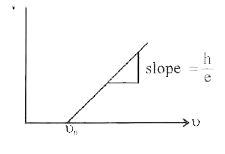 The result obtained `(6.626xx10^(-34)Js)` was in agreement with the actual value of .h.. Thus Millikan experimentally VERIFIED Einstein.s photoelectric equation. |
|
| 44. |
a. Name the gates in the combination . b. Identify the logic operation of the whole gate . c. Give the truth table . |
|
Answer» SOLUTION :a. DOUBLE input NOR GATE and single NOR gate. `barbar(A + B) = A + B` an OR gate . 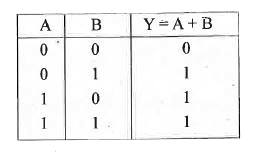
|
|
| 45. |
Name the electro - magnetic waves with their frequency range, produced in (a) some radioactive decay. (b) sparks during electric welding. (c) TV remote. |
|
Answer» Solution :(a) Gamma RAYS ( `gamma` - rays) are PRODUCED in some radioactive decay and their frequency ranges from `10^(18)HZ " to "10^(22)` Hz and even more. (b) Utra violet rays are produced in sparks during ELECTRIC welding . Their frequency varies from `7.5 xx10^(14) Hz " to " 5 xx 10^(17)Hz`. (c) Infrared waves are produced in TV remote and their frequency varies from `10^(12)` Hz to about `4xx10^(14)` Hz. |
|
| 46. |
For one electromagnetic wave propagating along + Z axis frequency is 10^(15) Hz and amplitude of oscillations of electric field is 51 N/C. Find amplitude of oscillations of magnetic field and its rms value. |
| Answer» SOLUTION :`B_(0)=1.7xx10^(-7)T, B_(RMS)=1.202xx10^(-7)T` | |
| 47. |
Explain the principle, construction and working of a cyclotron. |
|
Answer» Solution :Cyclotron. It is a device to produce high speed fi.e., high energy) positively charged particles like protons, deutrons and a-particles. Principle. It is based upon the principle that a charged particle moving at right angles to a uniform magnetic field is acted upon by a force perpendicular to its direction of motion and follow a circular path. Construction. It consists of TWO semicircular hollow metal BOXES `D_1 and D_2` called dees. D.s are separated by a small gap and are connected to terminals of high frequency oscillator providing alternating potential of nearly 10,000 V and millions hertz frequency. Whole of the apparatus is placed in a metal box containing gas at low pressure and placed between the poles of a strong electromagnetic field perpendicular to the plane of D.s. 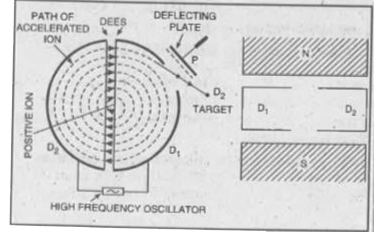 Theory. Let a positive ion (`""_1H^1, ""_1H^2, ""_1He^3 or ""_2He^4`) be located in the gap when D is negatively and `D_2` positively charged, the positive ion will get accelerated, towards `D_1`. Since magnetic field is uniform and acting at right angle to the plane of D.s, the ion traverses a circular path in `D_1`. When the ion emerges out into the gap after completing a semicircle in `D_1`. If during the time taken to cover semicircle, the electric field gets REVERSED, the ion further gets accelerated towards `D_2`. It enters `D_2` with greater speed and moves in `D_2` in a bigger semicircle. The process is represented time and again and each time ion gets an addition kick in the proper direction. The ion becomes faster and faster until it reaches the periphery of the D.s where it is brought out of the CHAMBER by means of deflecting plate P charged to a very high NEGATIVE potential and is made for bombarding the target. Consider the ion to carry a charge q and of mass m. If v is the speed of the ion when it is moving in circular path of radius r, then `(mv^2)/(r) = Bqv` `or v/r = (Bq)/m` Since B, and m are constant v `prop` r greater the speed, bigger the radius. Time taken to complete half rotation = `(pir)/v = pi (m/(Bq))` Time taken to complete one rotation `=2t = (2 pi m)/(Bq)` Frequency, `v = 1/T = (Bq)/(2 pi m)` |
|
| 48. |
Measurement of line spectrum helps in the study of |
|
Answer» Molecularstructure |
|
| 49. |
A magnetic dipole is under the influence of two magnetic fields. The angle between the field direction is 60° and one of the fields has a magnitude of 1.2 xx 10^(-2)T. If the dipole comes to stable equilibrium at an angle of 15^(@) with this field, what is the magnitude of the other field? |
|
Answer» SOLUTION :Here `B_1 = 1.2 XX 10^(-2)T` Inclination of dipole with `B_1 ` is ` theta_1 = 15^(@)` Therefore , inclination of dipole with `B_2` is ` theta_2 = 60^@ - 15^(@) = 45^(@)`  As the dipole is in EQUILIBRIUM , therefore the torque on the dipole due to the two fields are equal and opposite . If M is magnetic dipole moment of the dipole , then `MB_1 sin theta_1 =MB_2 sin theta_2 or B_2 = ( B_1 sin theta_1)/(sin theta_2)` `=(1.2 xx 10^(-2) xx 0.2588)/(0.707) = 4.39 xx 10^(-3)T` |
|
| 50. |
A bar magnet of length 5 cm and magnetic moment 2 Am^2 is broken into two equal pieces. The pole-strength of each piece is : |
| Answer» ANSWER :D | |