Saved Bookmarks
This section includes 7 InterviewSolutions, each offering curated multiple-choice questions to sharpen your Current Affairs knowledge and support exam preparation. Choose a topic below to get started.
| 1. |
If L=20.04m pm0.01m, B=2.52 m pm 0.02 m. The value of (LxxB) is |
|
Answer» `(50.5pm 0.84)m^(2)` `L=20.04m pm (0.01)/(20.04)xx100%=20.04m pm 0.05%` `B=2.52m pm (0.02)/(2.52)xx100%=2.52m pm 0.79%` `LxxB=(20.04xx2.52)m^(2)pm(0.05+0.79)%=50.5m^(2)pm 0.84%` This is the result. However, since the data given in the equation was in terms of absolute errors, so we should given our result ALSO in absolute errors. `LxxB=50.50m^(2)pm (0.84)/(100)xx50.50m^(2)=50.50m^(2)pm0.42m^(2)` |
|
| 2. |
Draw a plot showing the variation of terminal voltage (V) v/s the current (I) drawn from the cell. |
Answer» SOLUTION :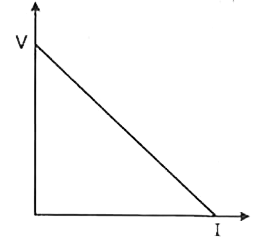
|
|
| 3. |
Dimensions of mutual induction are: |
|
Answer» `[ML^2T^2I^2]` |
|
| 4. |
An electric heater is connected turn by tuen, to d.c. and a.c. sources of equal voltages, will the rate of heat production be same in the two cases? |
|
Answer» Solution :The ELEMENT of the heater is a COIL, having INDUCTANCE L and resistance R. Hence, for an a.c., it.s effective resistance `(Z= 1/sqrt (R^2 + omega^2 L^2))` |
|
| 5. |
The natural angular frequency of vibration of an HF molecule is 7.79xx10^(14) rad/s. There are 13 rotational levels between the zero level and the first excitation level. Estimate distance between the centre of the atoms in this molecule. |
|
Answer» `epsi_(l)=epsi_(0)^(vib)+epsi_(l)^(ROT)=(homega)/2+(l(l+1)h^(2))/(2J)`, where l = 1, 2,........, 13 It is clear from the diagram that the fourteenth vibration-rotational level coincides with the first purely vibrational level: `epsi_(14)=(homega)/2+(14xx15h^(2))/(2f)=(3homega)/2,"where "(14xx15h^(2))/(2J)=homega` This makes it possible to determine the molecule.s MOMENT of inertia about its centre of mass: `J=105h//omega`. On the other hand, the moment of inertia is `J=m_(H)r_(H)^(2)+m_(F)r_(F)^(2),"where "r_(H)+r_(F)=d` is the distance sought between the centres of atoms and `m_(H)r_(H)-m_(F)r_(F)`. But `m_(F)-19m_(H)`. Therefore `r_(H)" "19r_(F)" "19d//20`. Substituting into the expression for the moment of inertia, we obtain `J=m_(H)r_(H)(r_(H)+r_(F))=19/20m_(H)d^(2)` For the distance between the centres we obtain `d=sqrt((2.1xx10^(3)h)/(19omegam_(H)))` 
|
|
| 6. |
Maxwell's equations describe fundamental laws of ….. |
|
Answer» only electricity (i) `OINT vec(E ).vec(d)a = (Q_("ENCLOSED"))/(in_(0))` (Gauss.s law for electricity) (ii)`oint vec(B).vec(d)a=0` (Gauss.s law for magnetism) (iii)`oint vec(E ).vec(d)l=-(d phi_(B))/(dt) ""` (Faraday.s law on electromagnetic induction) (iv) `oint vec(B).vec(d) l = mu_(0)i_(C )+mu_(0)in_(0)(d phi_(E ))/(dt)`(Ampere - Maxwell law) Out of above law, one is for electricity and other three are for magnetism. |
|
| 7. |
How long can an electric lamp of 100W be kept glowing by fusion of 2.0 kg of deuterium? Take the fusion reactions as ""_(1)^(2)H + ""_(1)^(2)H to ""_(2)^(3)He + n + 3.27 MeV. |
|
Answer» Solution :MASS of deuterium = `2.0141 xx 2 = 4.0282u = 4.0282 xx 1.66 xx 10^(-27) KG` No. of fusion in kg of deuterium `= (2)/(4.0282 xx 1.66 xx 10^(-27)) = 2.991 xx 10^(26)kg` ENERGY released per fusion = `3.2 MeV = 3.2 xx 10^6 xx 1.6 xx 10^(-19)J` `:.` Energy released from 2 kg of `""_(1)^(2)H = E = 3.2 xx 10^(6) xx 1.6 xx 10^(-19) xx 2.991 xx 10^(26)J` `= 1.5314 xx 10^(14)J` `E = P xx t` `t = E/P = (1.5314 xx 10^(14))/(100) s = (1.5314 xx 10^(14))/(100 xx 365 xx 24 xx 60 xx 60) = 4.85 xx 10^4` years . |
|
| 9. |
Identify the particle P in the following nuclear reaction. X_(Z)^(A) to Y_(Z+1)^(A) + e_(-1)^(0)+P |
| Answer» SOLUTION :ANTI NEUTRINO. | |
| 11. |
In the working of an n-p-n transistor, the number of free electrons which recombine with holes in the base layer is about |
|
Answer» ` 97 %` of the number injected into the BASE |
|
| 12. |
A coil of inductance 8.4 mH and resistance 6Omegaare connected to a 12 V battery. At what time the current in the coil will be 1.0 A ? |
|
Answer» Solution :`i_0 = E/R = 2 ,` given current , `i=(i_0)/(2)` `therefore i= i_0 (1-e^(t/TAU)) rArr 1/2 = 1-e^(t/tau)` `rArr e^(t/tau) = 2 therefore t= tau ln 2 = L/R ln 2` `i.e., t = (8.4xx 10^(-3) XX 0.6931)/(6) ~~ 1 xx 10^(-3)s` |
|
| 13. |
Which one of the following equation is correct with respect to an ammeter ? |
|
Answer» `I_(G) G = I_(g) S` |
|
| 14. |
Distance between eye lens and its retina is.x. Maximum possible focal length of eye lens for a normal person |
|
Answer» must be slightly LESS than x |
|
| 15. |
How photoelectric current is related to the number of photoelectrons emitted ? |
| Answer» SOLUTION :DIRECTLY PROPORTIONAL. | |
| 16. |
A solid dielectric (K = 1) sphere of radius R is charged uniformly by a total charge Q. At what distance from the centre will the electrostatic potential, be the average of that at the centre and at the surface. |
|
Answer» |
|
| 17. |
The ratio of the electric field due to an electric dipole on its axis and on the perpendicular bisector of the dipole is - |
|
Answer» `1:2` |
|
| 18. |
The frequency of gamma-rays, X-rays and ultraviolet rays are a,b,c and c respectivley. |
| Answer» Answer :a = - b = c. | |
| 19. |
Solar radiation emitted by sun resemble that emitted by black body at 6000 K. Maximum intensity is emitted at wavelength 4800Å. If the sun were to be cooled down from 6000 K to 3000 K, then peak intensity would occur at a wavelength of : |
|
Answer» `4800Å` `lamda_(2)=(lamda_(1)T_(1))/(T_(2))=(4800xx600)/(3000)` `lamda_(2)=9600Å`. THUS CORRECT choice is (B). |
|
| 20. |
Which of the following is the most precise device for measuring length (i) a vernier calipers with 20 divisions on the sliding scale (ii) a screw gauge of pitch 1 mm and 100 divisions on the circular scale (ii) an optical instrument that can measure length to within a wavelength of light? |
|
Answer» Vernier calipers |
|
| 21. |
In the above question if V_(s)(t)=220sqrt2 sin (2pi 50t) , find (a) i(t), (b), va and (c ) vc (t) |
|
Answer» Solution :`(a) i(t)=I_(m)SIN (omegat=phi)=2SIN(2pi50t+45^(@))` `(B) V_(R)=i_(R).R=i(t) R=2xx100sin (100pit+45^(@))` `(c) V_(C)(t)=i_(c)X_(c)("with a phase lag of "90^(@))=2xx10sin(100pit+45-90)` |
|
| 22. |
A galvanometer of resistance, G is shunted by a resistance 5 ohm. To keep the main current in the circuit unchanged, the resistance to be put in series with the galvanometer is |
|
Answer» `(S^(2))/((S+G))` |
|
| 23. |
Obtain the expression for fringe width in the case of interference of light waves. |
Answer» Solution : Consider two coherent sources `S_1` and `S_2`separated by a distance .d.. Let a screen be placed at a distance .D. from the coherent sources. The point .O. on the screen is equidistant from `S_1` and `S_2` . So that path difference between the two light waves from `S_1` and `S_2`reaching O is zero. Thus the point o has maximum INTENSITY. Consider point .P. at a distance .x. from O.. The path difference between the light waves from `S_1` and `S_2`reaching point P is `DELTA = S_2P - S_1P` From the figure `Delta^("le") S_2 PF` `(S_2P)^2 = (S_2F)^2 + (FP)^2` ` = D^2 + (x + d/2)^2` Similarly `Delta^("le")S_1PE` `(S_1P)^2 = (S_1E)^2 + (EP)^2` `=D^2 + (x- d/2)^2` `(S_2P)^2 - (S_1P)^2 = [D^2 + (x + d/2)^2] - [D^2 + (x - d/2)^2] = [D^2 + x^2 + (d^2)/(4) + 2(x) (d/2)] - [D^2 + x^2 + (d^2)/(4) - 2(x) (d/2) ]` `(S_2P)^2 - (S_1P)^2- 2xd` or `S_2P - S_1P = (2xd)/((S_2P + S_1P))` Since .P. is very close to O and d < < D `S_2P + S_1P ~~2D` `therefore` Path difference : `S_2P - S_1P = (2xd)/(2D) = (xd)/(D) to (1)` Equation (1) represents the path difference between light waves from `S_1` and `S_2`superposing at point P. For bright fringe or maximum intensity at P. `S_2P - S_1P = n lamda"" n = 0,1,2,3.......` From eqn(1)`(xd)/(D) = n lamda` or `x = (n lamdaD)/(d)` The distance of the nth bright fringe from the centre .O. of the screen is `x_n = n ((lamda D)/(d))` Thedistance of the `(n + 1)^(th)`bright fringe from the centre .O. of the screen is `x_(n+1) = (n+1) ((lamda D)/(d))` By definition of fringe width `beta = x_(n+1) - x_n` ` = (n+1) ((lamda D)/(d)) - n ((lamda D)/(d))` `(lamda D)/(d) (n +1 -n)` `beta =(lamda D)/(d)` |
|
| 24. |
Who was Adam Smith? |
|
Answer» Chief Scientific OFFICER of Nobel Media. |
|
| 25. |
Identify the correct order in which the value of normal reaction increases object is placed on rough horizontal surface A) the object is pushed with the force F at an angle thetawith horizontal B) the object is pulled with the force F at an angle thetawith horizontal C) the object is pushed down with the force F normally D) the object is pushed up with the force F normally |
| Answer» Answer :B | |
| 26. |
When a man is standing, rain drops appears to him falling at 60^(@) from the horizontal from his front side. When he is travelling at 5 kmph on a horizontal road they appear to him falling at 30' from the horizontal from his front side. The actual speed of the rain is (in kmph) |
|
Answer» 3 |
|
| 27. |
Answer the following : (b) If the earth did not have atmosphere, would its average surface temperature be higher or lower than what it is now ? Explain. |
| Answer» SOLUTION :If the earth did not have an ATMOSPHERE, then its average surface temperature will be lesser than what it is now because in that case GREEN HOUSE effect will be absent. | |
| 28. |
A spectrometer gives the following reading when used to measure the angle of a prism. Main scale reading : 58.5 degree Vernier scale reading : 09 divisions Given that 1 division on main scale corresponds to 0.5 degree. Total divisions on the vernier scale is 30 and match with 29 divisions of the main scale. The angle of the prism from the above data : |
|
Answer» `59` DEGREE `1.V.S.D.=(29)/(30)M.S.D=(29)/(30)xx0.5^(@)` Least count `=1M.S.D.-1V.S.D.` `0.5^(@)-(29)/(30)xx0.5^(@)=(0.5^(@))/(30)` `:.` Reading`=M.S.` reading`+` V.S. reading `XX`least count `=58.5^(@)+9xx(0.5^(@))/(30)=58.65^(@).` Hence CORRECT choice is `(d)`. |
|
| 29. |
In the wave picture of light, intensity of light is determined by the square of the amplitude of the wave. What determines the intensity of light in the photon picture of light. |
| Answer» Solution :For a given frequency, intensity of LIGHT in the photon picture is determined by the number of PHOTONS CROSSING an unit area per unit time. | |
| 30. |
A charge q is placed at the mid - point of the lien joining two charges each of Q. If the whole system is in equilibirum, then the value of q is |
|
Answer» `-(Q)/(2)` |
|
| 31. |
(i) Write two characteristics of a material used for making permanaent magnets. (ii) Why is core of an electromagnet made of ferromagnetic materials ? |
|
Answer» SOLUTION :(i) The materials chosen to MAKE permanent MAGNETS should have (ii) High retentivity so that the magnet is strong. (b) High permeability so that the magnet can be magnetished easily. (i) The core of electromagnets are MADE of ferromagnetic materials, which have high permeability and low retentivity. Soft iron is a SUITABLE material for this purpose. |
|
| 32. |
Photon of frequency Vhas a momentum associated with it. If C is the velocity of radiation, then the momentum is : |
|
Answer» `hv/C` |
|
| 33. |
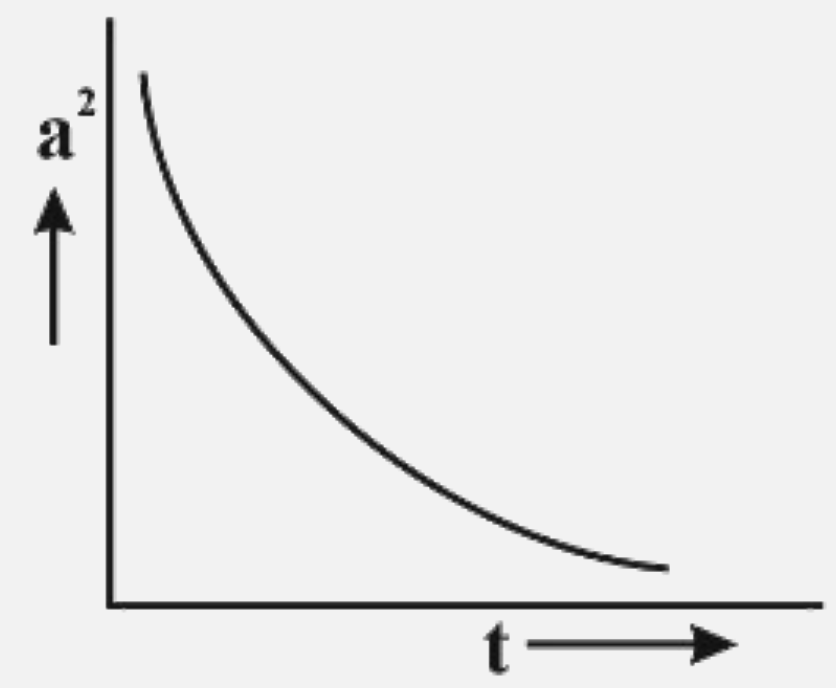
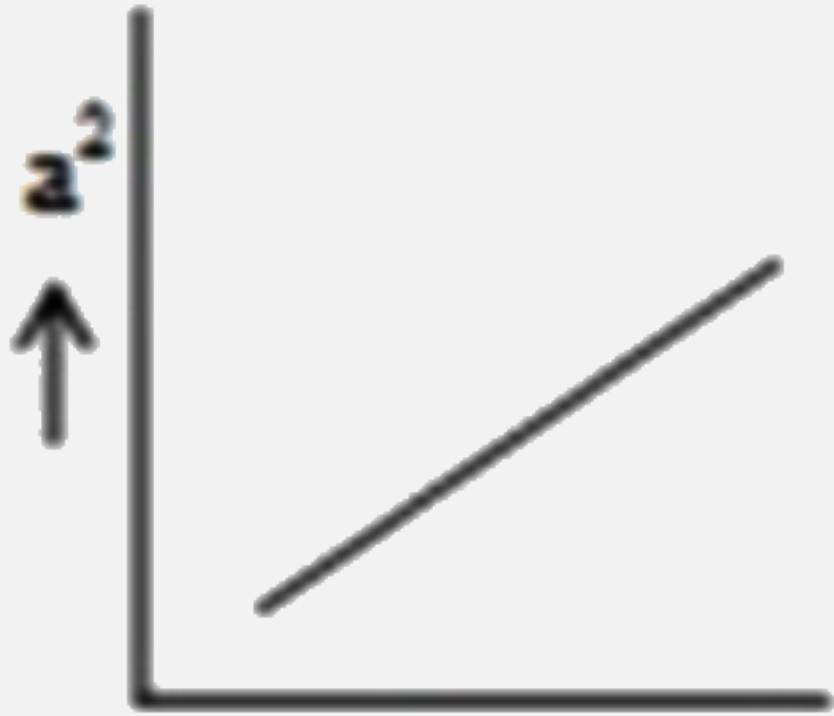
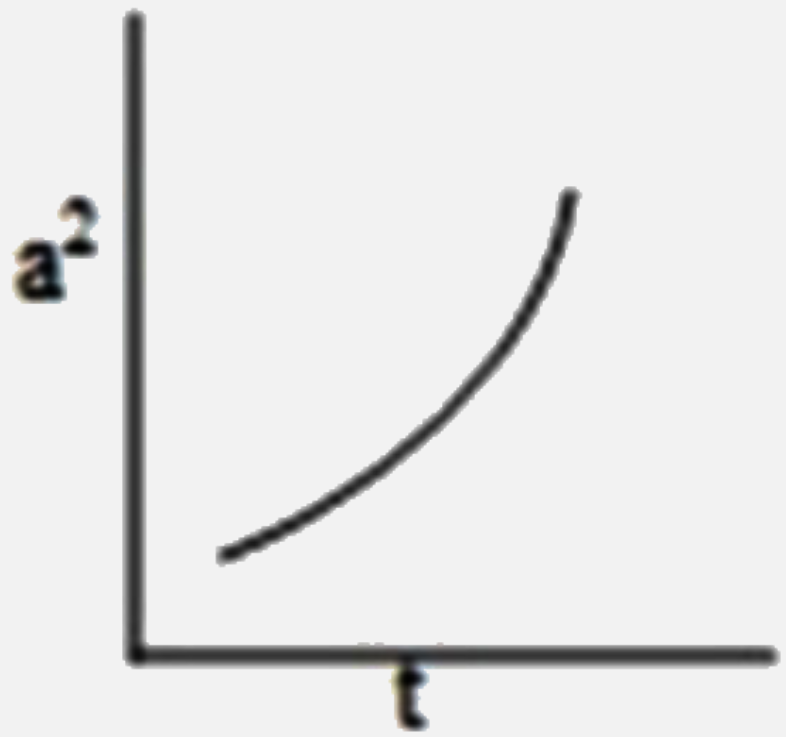
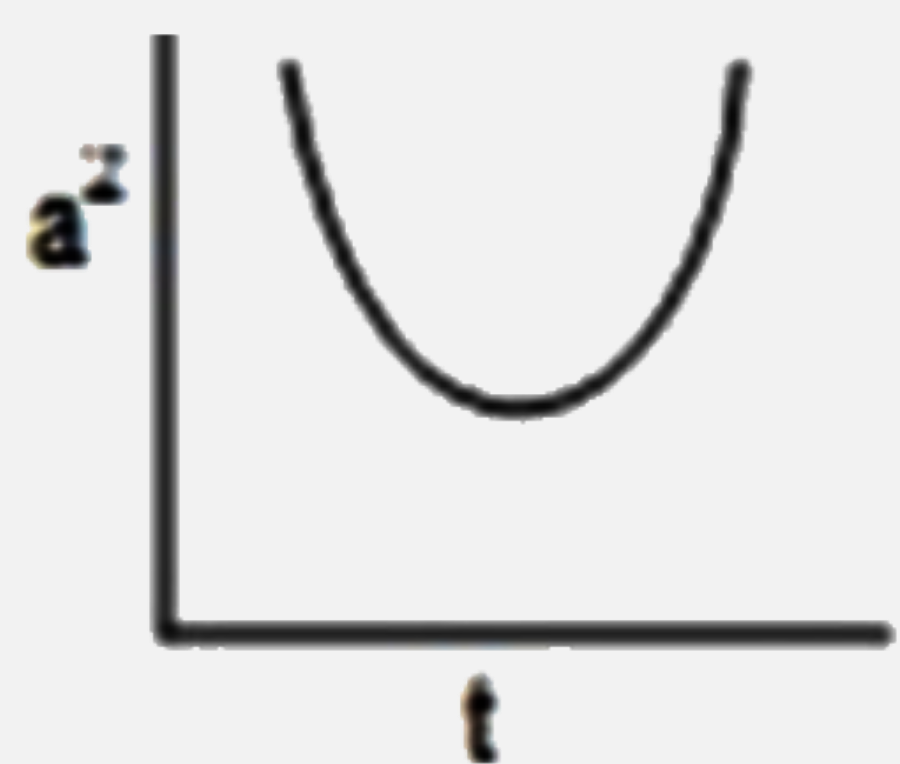
In an experiment , to find the loss of energy with respect to time in case of swinging simple pendulum , the graph between (amplitude)^2 and time is |
|
Answer»
|
|
| 34. |
If a jogger runs with constant speed towards a vehicle, how fast does the image of the jogger appear to move in the rear view mirror when (i)the vehicle is stationery (ii)the vehicle is moving with constant speed towards jogger. |
| Answer» SOLUTION :The SPEED of the image of the JOGGER appears to increase substantially THOUGH jogger is moving with constant speed.Similar phenomenon is observed when vehicle is in motion. | |
| 35. |
Four Gaussian surface are given below with charges inside each Gaussian surface . Rank the electric flux through each Gaussian surface in increasing order …………… . |
|
Answer» `D lt CLT Blt A` |
|
| 36. |
(a) What is the sum free time tau between collisions for the conduction electrons in copper? (b) The mean free path lambda of the conduction electrons in a particular conductor is the average distance traveled by an electron between collisions. What is lambda for the conduction electrons in copper, assuming that their effective speed v_("eff")" is "1.6 xx 10^(6) m//s? |
|
Answer» Solution :(a) The mean freetime `tau` of copper is approximately constant, and in particular does not depend on any electric field that might be APPLIED to a sample of the copper. THUS, we need not consider any particular value of applied, electric field. HOWEVER, because the resistivity p displaced by copper under an electric field depends on `tau`, we can find the mean free time `tau` from `(p=m//z^(2) n tau)`. Calculations: That equation gives us `tau=m/(ne^(2) p)` The number of conduction electrons per unit volume in copper is `8.49 xx 10^(28) m^(-3)`. We take the value of p fro Table 26.1. The denominator then BECOMES. `(8.49 xx 10^(28) m^(-3)) (1.6 xx 10^(-19) C)^(2) (1.69 xx 10^(-8)Omega.m)` `=3.67 xx 10^(-17)C. Omega//m^(2)=3.67 xx 10^(-17) kg//s`. where we converted units as `(C^2.Omega)/(m^(2))=(C^(2))/(m^(2)).V/A=(C^(2))/(m^(2)). (J//C)/(C//s) =(kg. m^(2)//s^(2))/(m^(2)//s)=(kg)/(s)`. Using these results and substitutingfor the electron mass m, we then have `tau=(9.1 xx 10^(-31)kg)/(3.67 xx 1^(-17) kg//s) =2.5 xx 10^(-14)s`. (b) The distance d any particular travels in a certain time t at a constant speed v is d=vt. Calculation : For the electrons in copper, this gives us `lambda =v_("eff") tau` `=(1.6 xx 10^(6) m//s) (2.5 xx 10^(-14)s)` `=4.0 xx 10^(-8)m=40nm`. This is about 150 times the distance between nearest-neighbor atoms in a copper lattice. Thus, on the average, each conduction electron passes many copper atoms before finally hitting one. |
|
| 37. |
If two coils are very tightly would one over the other, will M increase or decrease as compared to the case when the coils are placed some distance apart? |
| Answer» SOLUTION :M will INCREASE | |
| 38. |
In the fission of U^(235) i) Slow neutron is absorbed by U^(235) ii) The products in the process are not samealways, their atomic number varies from 34 to 58 iii) About 200 Mev energy is released per fission iv) The product are always Ba and Kr |
|
Answer» Only i, II & III are true |
|
| 39. |
A particle movesin a circular path such that its speed v varies with distance as v=alphasqrts where alpha is a positive constant. Find the acceleration of particle after traversing a distance S? |
|
Answer» `ALPHA^(2)SQRT((1)/(4)-(S^(2))/(R^(2)))` |
|
| 40. |
In simple harmonic motion, the acceleration of a particle is zero when it's velocity is, |
| Answer» Answer :B | |
| 41. |
In an experiment for finding the specific heat of alcohol, a copper calorimeter of mass 190 gm is filled with alcohol, and the total mass is found to be 390 gm. When it is heated by using a 50 W heater for 9 minute the following reading were recorded with a thermometer and stop watch. Find the specific heat capacity of alcohol. It is not required to take the radiation correction into account. |
|
Answer» |
|
| 42. |
Choose the correct expression of a stationary wave: |
|
Answer» `acoskx` |
|
| 43. |
The emf of a cell is 2V and its internal resistance is 2 ohm. A resistance of 8 ohm is joined to battery in parallel. This is contacted in secondary circuit of potentio meter. If IV standard cell balances for 100cm of potentiometer wire, the balance point of above cell is |
| Answer» ANSWER :C | |
| 44. |
Two long parallel wiresare locatedin a poorly conductingmedium with respectivityrho. The distance betweenthe axesof the wires is equal to l, the cross -section radiusof eachwire equals a. In the casea lt lt l find, (a) the current density at the point equally removed from the axesof the wireby a distancerif the potentialdifferencebetween teh wires is equal to V, (b) the electric resistancesof the medium per unitlength of the wires. |
|
Answer» Solution :(a) The wires themselves will be ASSUMED to be perfect conductors so the RESISTANCE is entirelydue to the medium. If the wireis of length `L`,the resistance `R` of the medium is `alpha (1)/(L)` becausedifferent sections of the wire are CONNECTED in parallel(by the medium) ratherthan in series. Thus if `R_(1)` is the resistance per unit length of the wirethan `R = R_(1)//L`. Unit of `R_(1)` is obnm-meter. The potential at a point `P` is by symmetry and suuperposition (for `l gt gt a`) `varphi = (A)/(2) In (r_(1))/(a) - (A)/(2) In (r_(2))/(a)` `= (A)/(2) In (r_(1))/(r_(2))` Then `varphi_(1) = (V)/(2) = (A)/(2) In (a)/(l)` (for the POTENTIALOF 1) or, `A = - V//IN (l)/(a)` and`varphi = - (V)/(2 In l//a) In r_(1)//r_(2)` We then calculate the field at a point `P` which is equidistanat from 1 & 2 and at a distance `r` from both : Then`E = (V)/(2In l//a) ((1)/(r)) xx 2 sin THETA` `= (Vl)/(2 In l//a) (1)/(r^(2))` and`J = sigma E = (1)/(rho) (V)/(2In l//a) (1)/(r^(2))` (b) Near either wire `E = (V)/(2 In l//a) (1)/(a)` and`J = sigma E = (1)/(rho) (V)/(2 In l//a)` Then `I = (V)/(R) = L (V)/(R_(1)) = J 2pi a L` which gives `R_(1) = (rho)/(pi) In l//a` 
|
|
| 45. |
That end of bar magnet (suspended so as to rotate freely in horizontal plane) which points towards geographic north direction is known as ...... pole of magnet. |
|
Answer» positive |
|
| 46. |
A particle slides down the surface of a smooth fixed sphere of radius R starting from rest at the highest point B. Particle leaves the sphere at some point and then strikes the horizontal plane passing through the lowest point A of the sphere at point P. The distance AP is given by AP=n/27[sqrt(n)+4sqrt(2)]R where 'n' is an integer, find n (Take g=10m//s^(2)) |
|
Answer» `y=(v SIN theta)t+1//2 "gt"^(2)=R(1+costheta)` ……..(1) and `x=(v cos theta)t` ………(2) and `v^(2)=2/3 gR`…..(3) On soving `AP= Rsin theta +x=5/27 (sqrt(5)+4sqrt(2))R` 
|
|
| 47. |
Railway lines are laid with gaps to allow for expansion . The gap between two lines is 0.5 cm at 10^@C and the length of a line is 12m . At what temperature will be lines just touch ? alpha = 11 xx 10^(-6)//^@C . |
|
Answer» Solution :The lines will TOUCH when each LINE expands by 0.25 cm at either end 0.5 cm at both ENDS. From the formula `l_2 - l_1 = l_1 alpha(t_2 - t_1) , t_2 = (l_2-l_1)/(l_1 alpha) + t_1` `= (0.5 xx 10^(-2))/(12 xx 11 xx 10^(-6) )+10` = 37.8 + 10 = `47.8^@C` |
|
| 48. |
Assertion: Microwave communication is preferred power optical communication. Reason: Microwaves provide large number of channels and bandwidth compared to optical signals. |
|
Answer» If both the assertion and reason are TRUE and reason is a true explantion of the assertion. |
|
| 49. |
(A): A unitless physical quantity must be dimensionless. (R): A pure number is always dimensionless. |
|
Answer» Both (A) and (R) are TRUE and (R) is the CORRECT EXPLANATION of (A) |
|
| 50. |
A ray of light is incident at an angle of 75^(@) into a medium having refractive index mu. The reflected and the refracted rays are found to suffer equal deviations in opposite direction. Then mu equals to |
|
Answer» `(sqrt(3)+1)/(sqrt(3)-1)` |
|