

Saved Bookmarks
This section includes 7 InterviewSolutions, each offering curated multiple-choice questions to sharpen your Current Affairs knowledge and support exam preparation. Choose a topic below to get started.
| 1. |
In a certain place, the versted component of earth's magnetic field is 0.5 oersted and dip angle is60^(@) . Theearth'smagnetic fieldat that place is |
|
Answer» 1 orested Vertical COMPONENT of EARTH.smagnetic field , ` V_(E)=0.5 `oerstedAngle of DIP, ` delta= 60^(@)` Earth magneticfield, ` B_(E) = ?` `"As" SIN delta = (V_(E))/(B_(E))thereforeB_(E) = (V_(E))/( sin delta) = (0.5)/( sin 60^(@)) = (0.5)/((sqrt3/2)) = 1/sqrt3` oersted |
|
| 2. |
The intensity of different order maxima is nearly the same in ______ . |
|
Answer» Young's DOUBLE slit EXPERIMENT |
|
| 3. |
There is a unifrom electric field of strenght 10^(3)Vm^(-1) along Y-axis A body of mass 1gm and charge 10^(-6)C is projected into the from origin along the positive X -axis with a velocity of 10ms^(-1) Its speed in ms^(-1) after 10s is (Neglect gravitation) |
| Answer» Answer :C | |
| 4. |
Name the three types of magnetic materials which behave differently when placed in a non uniform magnetic field. Give two properties for each of them. |
Answer» SOLUTION :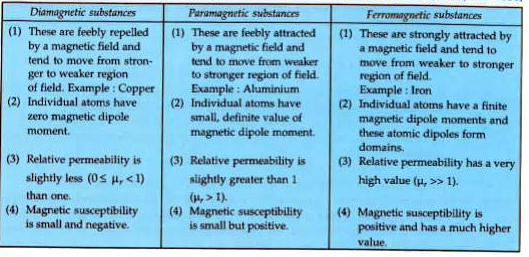
|
|
| 5. |
A car is driven round curved path of radius 18m without the danger of skidding. The co-efficient of friction between the tyres of the car and the surface of the curved path is 0.5. What is the maximum speed in kmph of the car for safe driving nearly? (g = 10ms^(-2)) |
|
Answer» 9.3 |
|
| 6. |
Obtain the answers to (a) and (b) above in Exercise 7.15 if the circuit is connected to a 110 V, 12 kHz supply ? Hence, explain the statement that a capacitor is a conductor at very high frequencies. Compare this behaviour with that of a capacitor in a d.c. circuit after the steady state |
|
Answer» Solution :Here, C = 100 `MUF = 10^(-4)F, R = 40 Omega, V_(rms) = 110V` and v = 12 kHz or `omega = 2pi v = 2 xx 3.14 xx 12 xx 10^(3) = 7.54 xx 10^(4)s^(-1)` (a) `therefore` Impedance `Z = sqrt(R^(2) + (1/C omega)^(2)) = sqrt((40)^(2) + (1/(10^(-4) xx 7.54 xx 10^(4))^(2))) = 40 Omega` `therefore` Maximum current `I_(m) = V_(m)/ Z = (sqrt(2) V_(rms))/Z = (sqrt(2) xx 110)/40 = 3.9 A` (b) `PHI = tan^(-1) (X_(C)/R) = tan^(-1) (1/(10^(-4) xx 7.55 xx 10^(4) xx 40))= tan^(-1) (0.0033) = 0^(@)` i.e.i.e., for all practical purpose, current and voltage are in same phase and there is no time lag between current maximum and voltage maximum. From above observations it is clear that as frequency increases, capacitive reactance goes on decreasing. Thus, at very high frequencies, a capacitor BEHAVES just like a good conductor. In a d.c. circuit after the steady state, a capacitor behaves as an open circuit and blocks the flow ofcurrent altogether. |
|
| 7. |
(A): In a meter bridge, If its wire is replaced by another wire having same length, made of same material but having twice the cross-sectional area, the accuracy decreases (R): If wire of meterbridge is replaced by another wire of same material having same cross-sectional area but of twice the length, accuracy remains same. |
|
Answer» Both 'A' and 'R' are true and 'R' is the CORRECT explanation of 'A' |
|
| 8. |
Is the law of conservation of energy obeyed by interference phenomenon of light ? |
| Answer» SOLUTION :Yes, law of conservation of ENERGY is strictly followed in INTERFERENCE phenomenon. Of COURCE there is redistribution of energy but there is no net loss or gain of energy in ACCORDANCE with the conservation law of energy. | |
| 9. |
Which one of the following devices makes use of the electrons to strike certain substances to produce flurescence |
|
Answer» THERMIONIC valve |
|
| 10. |
Mass numbr of the elements A, B, C and D are 30, 60, 80 and 120 respectilvely. The specific binding energy of them are 5 MeV, 8.5 MeV, 8 MeV and 7 MeV respectively. Then, in which of the following reaction/s energy released ? 1.D. to 2B 2.C to B+A 3.B to 2A |
|
Answer» in (1), (2) and (3) `triangleE=60 xx 8.5 xx 30 xx 5-90 xx 8=-60MeV` `triangleE=2 xx 30 xx 5 -60 xx 8.5 =-105MeV` Hence, ENERGY is relased in (1) only. |
|
| 11. |
In a step up transformer, 220 V is converted into 2200 V, the number of turns in the primary is 600 , what is the number of turns in the seconary is |
|
Answer» 60 |
|
| 12. |
The given situations in Column - I, choose the possible options from Column - II regarding the image formed when u ne oo (u is the object distance from the pole of the mirror) |
|
Answer» |
|
| 13. |
A photon and an alpha particle are accelerated under the same potential difference. The ratio of de-Broglie wavelengths of the proton and the alpha particle is : |
|
Answer» Solution :Kinetic energy of charged, particle, accelerated through a potential DIFFERENCE V, i.e., `K=qV` `:.` Momentum of the particle, `p=SQRT(2mK)= sqrt(2mqV)` de-Broglie wavelenth of the particle `lambda=(h)/(p)=(h)/(sqrt(2mqV))` `:.m_(alpha)=4m_(p) and q_(2)=2q_(1)` `:. (lambda_(p))/(lambda_(alpha))=sqrt((m_(2)q_(2))/(m_(1)q_(1)))= sqrt((4xx2)/(1xx1))= sqrt(8)` |
|
| 14. |
The B_(H) curve for a ferromagnetic material is shown in the figure. The material is placed inside a long solenoid which contains 1000 turns/cm. the current that should be passed in the solenoid to demagnetize the ferromagnet completely is |
| Answer» Solution :1.25 mA | |
| 15. |
Explain working of moving coil galvanometer and write its uses. |
Answer» Solution :1. When a current flow through the coil, torque on it is `tau=NIABsintheta`.  2. The FIELD is radial by design so angle between `vecAandvecB` ALWAYS be `theta`. So, maximum torque is given by `thereforetau_(max)=NIAB""...(1)` 3. The magnetic torque NIAB tends to rotate the coil. A spring `S_(p)` provides a counter torque which is given by, 4. Restoring torque produce in spring G as, `taupropphi` `thereforetau=kphi""...(2)` 5. A spring `S_(p)` provides a counter torque which balances the magnetic torque it indicate steady angular deflection `phi`. 6. At steady state, `thereforetau=tau_(max)` `thereforekphi=NIAB""...(3)` 7. Here, k is the torsional constant of the spring i.e. restoring torque per unit twist. 8. Unit of torsional constant is `("Joule")/("Radian")("From "k=tau/phi)` 9. The deflection `phi` is indicated on the scale by a POINTER attached to the spring we have, `phi=((NAB)/k)I""...(4)` The quantity in brackets is a constant for a given galvanometer. `thereforephipropI""...(5)` Uses : (i) To detect the presence of current. (ii) It is used to measure minute electric current. (iii) By using galvanometer, ammeter and voltmeter can be constructed. |
|
| 16. |
Ten coins each of mass 10 gm are placed one above the other. The reaction force exerted by 7^(th) coin from the bottom on the 8th coin is (g = 10 m//s^2) |
|
Answer» 0.3 N |
|
| 17. |
Degree of x^6−2x^10 is – |
|
Answer» 10 |
|
| 18. |
Let X= A bar(BC) + B bar(CA)+C bar(AB). Evaluate X for a) A = 1, B = 0, C = 1 b) A = B = C, and c) A = B = C = 0 |
|
Answer» 0, 0, 1 |
|
| 19. |
The frequency of the above stationary wave is |
|
Answer» 100Hz `2pin=100pi THEREFORE n=50Hz` |
|
| 20. |
A thin metallic spherical shell of radius R carries a charge Q on its surface . A point charge (Q)/(2) is placed at its centre C and an other charge +2 Q is placed outside the shell at a distance x from the centre as shown in the Fig . Find (i) the force on the charge at the centre of shell and at the point A , (ii) the electric flux through the shell . |
|
Answer» Solution :(i) Force experienced by a CHARGE .q. when placed in an electric FIELD .E. is given by `F = q E`. As at centre C of the shell electric field is ZERO , hence force on the charge at the centre C is zero . At point A the electric field is due to charge `(Q)/(2)` and Q present on the SPHERICAL shell and has a value E = `(1)/(4 pi in_(0)) * (3Q)/(2x^(2))` `therefore` Force on the charge q = (2 Q)placed at A will be `F_(A) = qE = (2 Q) ((1)/(4pi in_(0)) (3Q)/(2x^(2))) = (1)/(4 pi in_(0)) (3Q^(2))/(x^(2))` (ii) The electric flux throughthe shell `phi_(E) = (1)/(in_(0))` (charge enclosed by the shell) `= (1)/(in_(0)) ((Q)/(2) + Q) = (3Q)/(2in_(0))` 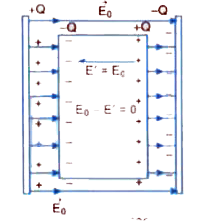
|
|
| 21. |
If P, Q and Rare physical quantities having different dimensions, which of the following combinations can never be a meaningful quantity? |
|
Answer» `(PQ)/(R )` |
|
| 22. |
What is an ideal electric dipole ? |
| Answer» Solution :An ideal electrical dipole is ONE whose either CHARGE tends to INFINITY while the separation between them tends to ZERO. | |
| 23. |
The string of a sonometer is divided into two parts with the help of a wedge. The total length of thestring is 1 m and the two parts differ by 2mm. When sounded together they produced two beats per second. The frequencies of the notes emitted by the two parts are |
|
Answer» 499 & 497 HZ |
|
| 24. |
What is the difference between Rutherford's model and Bohr's ? |
| Answer» Solution :ACCORDING to Rutherford.s model ELECTRONS can REVOLVE in any orbit and can emit radiations of all frequencies, while revolving in it. | |
| 25. |
Speed of sound in air depends upon |
|
Answer» PRESSURE of AIR |
|
| 26. |
A converging lens of 2.5cm focal length is used as a simple microscope producing virtual image at 25cm from the eye. The position of the object from the lens is (nearly) |
|
Answer» 1 cm |
|
| 27. |
A transformer has an efficiency of 80% and works at 100 V and 4 kW. The secondary voltage is 240 V. Calculate the current in the primary and secondary. |
| Answer» SOLUTION :`I_P = 40A ,I_S = 13.33 A` | |
| 28. |
When two cells of different emf.s are connected in series to an external resistance the current is 5A. When the poles of one cell are interchanged, the current is 3A. The ratio of emf.s of two cell is |
|
Answer» `2:1` |
|
| 29. |
The spectrum of an oil flame is an example for |
|
Answer» line emission sepectrum |
|
| 30. |
Electrostatic force on a charged parricle is given by overset(.)F=qvec(E). If q is positive vec(F)uarrrArrvec(E)uarr and if q negative vec(F) uarr rArr vec(E ) darr Question : In the figure m_(A) = m_(B) =1kg. BlockA is neutral while q_(B) = - 1C. Sizes of A and B are negligible. B is relased from rest at a distance 1.8 m from A. Initially spring is neither compressed nor elongated Equilibrium position of the combined mass is at x = ............. m. |
|
Answer» `-(2)/(3)` |
|
| 31. |
Electrostatic force on a charged parricle is given by overset(.)F=qvec(E). If q is positive vec(F)uarrrArrvec(E)uarr and if q negative vec(F) uarr rArr vec(E ) darr Question : In the figure m_(A) = m_(B) =1kg. BlockA is neutral while q_(B) = - 1C. Sizes of A and B are negligible. B is relased from rest at a distance 1.8 m from A. Initially spring is neither compressed nor elongated The amplitude of oscillation of the combined mass will be : |
|
Answer» `(2)/(3)` |
|
| 32. |
Electrostatic force on a charged parricle is given by overset(.)F=qvec(E). If q is positive vec(F)uarrrArrvec(E)uarr and if q negative vec(F) uarr rArr vec(E ) darr Question : In the figure m_(A) = m_(B) =1kg. BlockA is neutral while q_(B) = - 1C. Sizes of A and B are negligible. B is relased from rest at a distance 1.8 m from A. Initially spring is neither compressed nor elongated If cllision between A and B is perfectly inlastic, what is velocity of combined mass just after collision ? |
|
Answer» 6 m/s |
|
| 33. |
In Q.36, the combined resistance of the shunt and the galvanometer is |
|
Answer» `3665 OMEGA` |
|
| 34. |
Two parallel long smooth conducting rails separated by a distance l=10cm are connected by a movable conducting connector of mass m = 4mg. Terminal of the rails are connected by the resistor R=2Omega & the capacitor C=1muF as shown. A uniform magnetic field B=20T perpendicular to the plane of the rails is switched on. The connector isdragged by a constant force F=10 N. The speed of the connector as function of time if the force F is applied at t=0 is equal to v=5(1-e^(-x xx10^(4)xxt))m//s. Find the value of x. |
|
Answer» |
|
| 35. |
Thequantity, when measured from different inertial reference frames, remains the same , among the following is |
|
Answer» FORCE |
|
| 36. |
A full wave p-n junction diode rectifier uses a load resistance of 1300ohm. The internal resistance of each diodeis 9 ohm. Find the efficiencyof this full wave rectifier. |
|
Answer» SOLUTION :Given that `R_(L) = 1300 OMEGA ` `r_(f) = 9 Omega ` ` ETA = ( 0.812 R_(L))/( r_(f) + R_(L)) = ( 0.812 xx 1300)/( 9+ 1300) xx 100` `eta = ( 8120 xx 13)/( 1309) ` ` eta = 80.64 %` |
|
| 37. |
The electric potential V at any point x, y, z in space is given by V = 4 x^2 V. The electric field at the point (1, 0, 2) is_________ V m^(-1). |
| Answer» SOLUTION :`-8hati, VEC E =- (dV)/(dr)HATR = -[(delV)/(delx)hati + (delV)/(dely)HATJ+(delV)/(delz)hatk] = (-del)/(delx) (4 x^2)hati` and at point (1, 0 , 2) we have `vec E = -8 hati` | |
| 38. |
sqrt 0.99 की गणना कीजिए - |
|
Answer» 0.995 |
|
| 39. |
Three capacitors of capacitances 2pF, 3pF and 4pF are connected in parallel. (a) What is the toal capacitance of the combination. (b) Determine the charge on each capacitor if the combination is connected to a 100V supply. |
|
Answer» Solution :`C_(1)=2PF, C_(2)=pF, C_(3)=4pF` a. 9pF B. `Q_(1)= 2 xx 10^(-12) xx 100= 2 xx 10^(-10)C, Q_2=3 xx 10^(-10)C,""Q_(3)=4 xx 10^(-10)C` |
|
| 40. |
BL=mu_(0)I_(e) is intresting by which consequences ? |
|
Answer» Solution :(1) If we consider INFINITE wire as an axis it implies that the FIELD at every point on a circle of radius r is same in magnitude. In other words, the magnetic field possesses what is called a cylindrical symmetry. The field that normally can depend on three coordinates depends only on one which is on r coordinate. (2) The field direction at any point on this circle is TANGENTIAL to it. Thus, the lines of constant magnitude of magnetic field form concentric circles which directly provides a theoretical justification to Oersted.s experiments. (3) Even though the wire is infinite, the field due to it at a non-zero distance is not infinite. It tends to blow up only when we come very close to the wire. The field is directly proportional to the current and inversely proportional to the distance from the infinitely long current source. (4) There exists a simple rule to DETERMINE the direction of the magnetic field due to a long wire. This rule called the right hand rule is state below. "Grasp the wire in your right hand with your extended thumb pointing in the direction on the current. Your fingers will curl around the direction of the magnetic field". |
|
| 41. |
A uniform electric field and a uniform magnetic field are acting along the same direction in a certain region. If an electron is projected in the region such that its velocity is pointed along the direction of fields, then the electron |
|
Answer» Will turn towards left of DIRECTIONOF motion |
|
| 42. |
State the basic assumptions of the Rutherford model of the atom. |
|
Answer» Solution : Basic assumptions of Rutherford.s atom MODEL are as follows: (i) The nucleus of an atom contains whole positive charge and almost whole mass of the atom. Size of a nucleus is extremely small as compared to the overall size of an atom. (ii) Outside the nucleus, there are electrons which revolve in VARIOUS ORBITS as planets revolve ROUND the Sun. (iii) The atom as a whole is electrically neutral. (iv) The space between the nucleus and the electrons is EMPTY. |
|
| 43. |
The gravitational force between a H-atom and another particle of mass m will be given by Newton's law F = G (M.m)/(r^(2)), where r is in km and |
|
Answer» `M=m_"PROTON"+m_"electron"` `=m_"proton"+m_"electron"-B/C^2` where B is binding energy of H-atom which is 13.6 eV. |
|
| 44. |
For the telescope described in Exercise 32 (a ) , whet is the separation between the objective lens and the eyepiece ? |
| Answer» SOLUTION :Separation between the OBJECTIVE and eyepiece = 140 + 5 = 145 CM | |
| 45. |
A capacitor of capacitance C_(0) is charged to a potential V_(0) and is connected with another capacitor of capacitance C as Shown . After closing the switch S, the common potential across the two capacitors becomes V . The capacitance C is given by |
|
Answer» `(C_(0)(V_(0)-V))/(V_(0))` |
|
| 46. |
It is known that polishing a surface beyond a certain limit increases rather than decreases the frictional forces. Explain. ? |
| Answer» Solution :When the surfaces are POLISHED BEYOND a certain limit, the molecules exert strong ATTRACTIVE forces on each other. This is called surface adhesion. 1 overcome these forces, additional forces REQUIRED. Hence, the frictional FORCE increases. | |
| 47. |
Two pith balls carrying equal charges are suspended from a common point by strings of equal length, the equilibrium separation between them is r. Now the strings are rigidly clamped at half the height. The equilibrium separation between the balls now become |
|
Answer» `(1/(SQRT2))^2` |
|
| 49. |
A potential difference between plates of parrallel plate |
|
Answer» `3 xx 10^(-3) J` |
|
| 50. |
The output of a stepdown transformer is measured to be 48 V when connected to a 12 W bulb. The value of peak current is |
|
Answer» `(1)/(sqrt(2))A` Output of STEP down transformer `(V_(s))=48 V` Power associated with secondary coil `(P_(s))=12W` For secondary coil, `I_(s)=(P_(s))/(V_(s))=(12)/(48)=(1)/(4)=0.25 A` Amplitude of current `(I_(o))=I_(s)sqrt(2)` `= 0.25 (sqrt(2))` `= (sqrt(2))/(2)` `= (1)/(2sqrt(2))A` |
|