Saved Bookmarks
This section includes 7 InterviewSolutions, each offering curated multiple-choice questions to sharpen your Current Affairs knowledge and support exam preparation. Choose a topic below to get started.
| 2. |
The law of length of a stretched string is |
|
Answer» nl=constant |
|
| 3. |
Using de-Broglie's hypothesis, explain Bohr's second postulate of quantisation of energy levels in a hydrogen atom. |
|
Answer» Solution :de-Broglie argued that the electron in its circular orbit must be seen as an electron wave. In terms of electron wave, he said that only those STATIONARY Bohr orbits are possible in which total distance (i.e., the CIRCUMFERENCE of the orbit) contains a definite number of these electron waves, Mathematically, total path LENGTH of orbit `n = (lambda_("electron wave"))` `therefore "" 2pi r_(n) = n lambda` where is an integer and may have values 1, 2, 3, 4,. .. etc. From de-Broglie concept of matter waves, we know that wavelength of electron waves may be expressed as. `lambda = (h)/(p_(n)) = (h)/(m v_(n))` . where mass of electron and v. velocity of electron in state corresponding to it. Substituting the value of in de-Broglie.s quantum condition, we get `2 pi r_(n) = n. (h)/(m v_(n)) rArr m v_(n) r_(n) = (h)/(2 pi)` WhichBohr.s quantumcondition on the secondpostulate for quantisation of angle momentum. |
|
| 5. |
In the circuit shown in the figure, the current through |
|
Answer» The `3 OMEGA` RESISTOR is `0.50A` |
|
| 6. |
What are matter waves? |
| Answer» Solution : The WAVES ASSOCIATED with a material PARTICLES in MOTION are called MATTER waves or de-Broglie waves. | |
| 7. |
An electron in hydrogen atom first jumps from second excited state to first excited state and then from first excited state to ground state. Let the ratio of wavelength, momentum and energy of photons emitted in these two cases be a, b and c respectively, Then |
|
Answer» <P>`C= (1)/(a)` Also,`E=(hc )/(lamda)` |
|
| 8. |
A pair of parallel horizontal conducting rails of negligible resistance, shorted at one end is fixed on a table. The distance between the rails is L. A conducting massless rod of resistance R can slide on the rails frictionlessly. The rod is tied to a massless string which passes over a pulley fixed to the edge of the table. A mass m, tied to the other end of the string, hangs vertically. A constant magnetic field B exists perpendicular to the table. If the system is released from rest, calculate : i) the terminal velocity achieved by the rod. ii) the acceleration of the mass at the instant when the velocity of the rod, is half the terminal velocity. |
|
Answer» Solution :i) Let the VELOCITY of ROD = V Intensity of magnetic field = B ` therefore ` emf induced in rod (e) = BLV current induced in rod (i) = `(BLv)/(R )` Force on the rod F ` = BIL = (B^2 vL^2)/( R)` Net force on the system = MG - T mg- T = ma but `T = F = (B^2 vL^2)/(R ) = ma` hence `mg- (B^2 v L^2)/( R) =ma` or`a= g - (B^2 vL^2)/(mR)`........(i) For rod to achieve terminal velocity `V_T, a = 0` ` therefore 0 = g - (B^2 v_T L^2)/(mR)` or Terminal velocity`(v_T) = (mg R)/(B^2 L^2)`.....(ii) (ii) Acceleration of mass when `v = (v_T)/(2)` or `v = (mgR)/(2B^2 L^2)`.Put this value of v in (i) ` therefore a = g- (B^2 L^2)/(mR) xx ((mgR)/(2B^2 L^2)) " or " a = g - g/2` or`a = g/2`.......(iii) |
|
| 9. |
{:("(i) Magnetic moment ",(a)χ_(m)= C /T),("(ii) Tangent Law",(b) 10^(8)"maxwell"),("(iii) Curie's Law",(c )B = B_(H) tan theta),("(iv) I weber",(d) P_(m) = q_(m) vec(d) ):} |
|
Answer» |
|
| 10. |
A forcebar F = (3hat i-4 hat j +b hat k)N is acting on the particle which is moving from point A ( 0-1, 1) m to the point B(2, 2 3) m If net work done by the force on the particle is zero then value of b is |
|
Answer» -3 |
|
| 11. |
The magnifying power of a telescope is m. If the focal length of the eyepiece is doubled,magnifying power will be |
|
Answer» 2M |
|
| 12. |
Current 'i' is flowing in heaxagonal coil of side a. The magnetic induction at the centre of the coil will be |
|
Answer» `(3sqrt3mu_(0)i)/(PIA)` |
|
| 13. |
Two coils of inductance L_(1) and L_(2) respectively are placed close to each other such that magnetic flux in one coil is completely linked with the other coil. Then their mutual inductance is given as M = ______. |
|
Answer» |
|
| 14. |
A:Value of stopping potential depend on frequency of incident light and independent of intensity of light. R:Maximum kinetic energy of photoelectron is proportional to stopping potential . |
|
Answer» Both assertion and reason are true and the reason is CORRECT explanation of the assertion. Stopping potential is MEASURE of MAXIMUM kinetic ENERGY of PHOTOELECTRON. |
|
| 15. |
Two weights are suspended from a string thrown over a light frictional pulley. The mass of one weight is 200g. If a heavy mass M is attached to the other end, the tension in the string is ? |
|
Answer» Zero |
|
| 16. |
There are three concentric thin spherical shells A, B and Cofradii R, 2R, and 3R. Shells A and C are given charges q and 2q and shell B is earthed. Then which of the given is correct? |
|
Answer» CHARGE on inner SURFACE of shell C is ` 4/3 q` |
|
| 17. |
In any ac circuit, is the applied Instantaneous voltage equal to the algebraic sum of the instantaneous voltages across the series elements of the circuit ? Is the same true for rms voltage ? |
| Answer» Solution :YES. The same is not TRUE for rms voltage, because voltages across different elements may not be in phase. SEE, for example, answer to Exercise. | |
| 18. |
If the speed of rotation of a dynamo is doubled then the induced emf will be |
|
Answer» halved |
|
| 19. |
There is region of space where uniform magnetic field of induction B exists. The field exists at all points for which x- coordingates are positive. The direction of field ia along negative z axis. Now a certain charged particle of mass m and charge q a certain speed enters in this region. A magnetic field at a point whose coordinates are x=0,y=-d and z=0 . Magnetic force will start acting on the particle and particle moves in a uniform circular motion, such that origin becomes centre of circular path described by it The particle enters into the region of magneticfield along a direction |
|
Answer» PARALLEL to `y-` AXIS |
|
| 20. |
For a spherical mirror, reciprocal of focal length is equal to the sum of the ____ of distances of object and image from the pole of the mirror |
| Answer» SOLUTION :RECIPROCAL | |
| 21. |
Of the following which one can penetrate through 20 cm thick steel plate ? |
|
Answer» `alpha` - particles |
|
| 22. |
A copper wire of length l metre is bent to form a circular loop. If I amp current flows through the loop, find out the magnitude of magnetic moment of the loop. Or, Write down the Biot-Savart law. Show its vector form. |
|
Answer» <P> Solution :CIRCUMFERENCE `= 2PI r = l or, r = (l)/(2pi)m`So, area of the LOOP, A = `pi r^(2) = pi((l)/(2pi))^(2) = (l^(2))/(4pi)m^(2)` ` therefore` Magnitude of magnetic moment, `P_(m) = IA = (il^(2))/(4pi) Acdot m^(2)` |
|
| 23. |
The acceleration of a particle is increasing linearly with time t as bt. The particle starts from the origin with an initial velocity v_0. The distance travelled by the particle in time t will be |
|
Answer» `nu_(0)t+(1)/(3) BT^(2)` Integrating equation (i) within the conditions of motion we have , `int_(nu_(0))^(nu)dnu=int_(0)^(t)"btdt or "(nu-nu_(0))=(bt^(2))/(2)` or `nu=nu_(0)+(bt^(2))/(2)=(ds)/(dt) " or ds " = nu_(0)dt +(bt^(2))/(2) `dt Integrating equation (II) we get s =` nu_(0)t +(1)/(6) bt^(3)` |
|
| 24. |
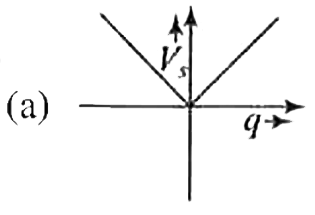
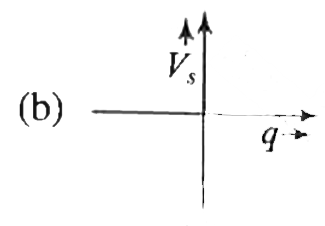
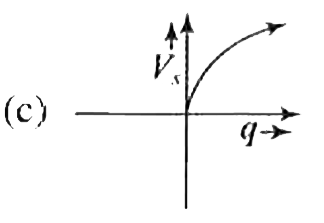
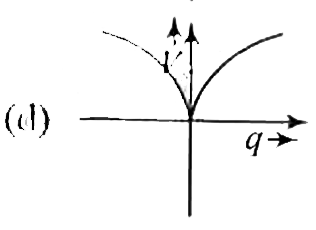
A negative charge Q is distributed uniformly in volume of a sphere is radius R and a point charge particle (may be negative or positive) is present on the surface of this sphere then variation of escape velocity (v_(s)) of charge 'q' as a function of 'q' will be [negect gravitational interaction]. |
|
Answer»
|
|
| 25. |
The given figure shows an incident pulse P reflected from a rigid support(##TRG_PHY_MCQ_XII_C07_E01_037_Q01.png" width="80%">) whichone of A , B ,C and Drepresents the reflected pulse correctly? |
|
Answer»
|
|
| 26. |
The first & second state of two stage rocket separately weight 100 kg and 10 kg and contain 800 kg and 90 kg fuel respectively. If the exhaust velocity of gases is 2 km/sec then find velocity of rocket (nearly (log_(10)5=0.6990) (neglet gravity). |
|
Answer» Solution :`V=V_(0)+2.3` ulog `(m_(0)//m)` VELOCITY as the FIRST stage is detached `= V_(0)` `V_(0)=2.3` ulog `(m_(0)//m)` `=2.3xx2xx10^(3)XX LOG(1000//200)` `=2.3xx2xx0.699xx10^(3)=3.2xx10^(3)` Velocity acquired with second stage = V `V=V_(0)+2.3u log(m_(0)//m)` `=3.2xx10^(3)+2.3xx2xx10^(3)xx log(100//10)` `=3.2xx10^(3)+4.6xx10^(3)=7.8xx10^(3)m//s` |
|
| 27. |
(i)Find the acceleration of the centre of mass of two particle approaching towards each other under their own grabitational field.(ii)A boy of mass 30 kg is standing on a flat boat so that he is 20 meter from the shore. He walks 8 m on the boat towards the shore and then stops. The mass of the boat is 90 kg and friction between the boat and the water surface is negligible. How far is the boy from the shore now ? |
|
Answer» Solution :(i)`a_(cm)=(|m_(1)a_(1)-m_(2)a_(2)|)/(m_(1)+m_(2))=(|F_(1)-F_(2)|)/(m_(1)+m_(2))` Since `F_(1)` & `F_(2)`are equal ln magnitude and opposite in direction, `a_(cm)=0` (ii)Let the boy move a distance `xx` towards left w.r.t ground, the DISPLACEMENT of plank `= 8-x` towards right. As shift in C.M. = 0 due to `F_(axt)=0`. `RARR 0 = (-30x + 90(8-x))/(30+90)` `rArr x = 6 m` `therefore` Required ANSWER is `(20-6)m=14 m` |
|
| 28. |
There are certain material developed in laboratories which have a negative refractive index (See figure). A ray incident from air (medium 1) into such a medium (medium 2) shall follow a path given by |
|
Answer»
|
|
| 29. |
In which case will the nyull condition of a wheatstone beidge change ? |
|
Answer» If the RESISTANCE in DIFFERENT arms are changed |
|
| 30. |
What should be wavelength of light to get 5^(th) bright fringe at a point where 3rd bright fringe is obtained using wavelength 700 nm in Young's experiment? |
|
Answer» 420 nm `:. Lambda_(2)=lambda_(1)XX(n_(1))/(n_(2))` `=700xx(3)/(5)=140xx3=420` nm |
|
| 31. |
In discharge tube with increase in number density of gas intensity of spectral lines… |
|
Answer» decreases |
|
| 32. |
When one mole of zinc combines with sulphuric acid 445 kJ of heat is liberated and when a mole of copper is liberated from blue vitriol 235 kj of heat is absorbed. Avogadro number = 6.023 xx 10^(23), electronic charge = 1.6 xx 10^(-19) C and zinc or copper is divalent. Use these data to find the emf of a Daniell cell. [Hint: Energy liberated in the form of heat is converted into elecrical energy in a Daniel cell] |
|
Answer» |
|
| 33. |
What is the value of inductive reactance of an inductance of 50 henry to the flow of D.C.? |
| Answer» SOLUTION :`X_L = omega_L = 2pi upsilon L = 0, THEREFORE upsilon= O` | |
| 34. |
Derive the equation for angle of deviation produced by a prism and thus obtain the equation for refraction for refactive index of material of the prism. |
|
Answer» Solution :(i) Let LIGHT ray PQ is incident on one of the refracting faces of the prism. The angles of incidence and REFRACTION at the first face AB are `i_1` and `r_1` (ii) The path of the light inside the prism is QR. The angle of incidence and refraction at the second face AC is `r_2` and `i_2` respectively. RS is the ray emerging from the second face. Angle `i_2` is also called angle of emergence. The angle between the direction of the incident ray PQ and the emergent ray RS is called the angle of deviation d. (iv) The two normals drawn at the point of incidence Q and emergence R are QN and RN. They meet at point N. The incident ray and the emergent ray meet at a point M. The deviation d, at the surface AB is, ` angle RQM = d_1 = i_1 - r_1 "" ...(1)` The deviation d, at the surface AC is, ` angle QRM =d_2= i_2 - r_2 "" ..(2)` Total angle of deviation d produced is, ` d = d_1 + d_2`...(3) Substituting for `d_1` and `d_2` ` d = ( i_1 - r_1) + (i_2 -r_2)` After rearranging ` d = ( i_1- r_1) + (i_2 - r_2)`...(4) In the quadrilateral AQNR, two of the angles (at the vertices Q and R) are right angles. Therefore, the sum of the other angles of the quadrilateral is `180^@` ` angle A+ angle QNR = 180^@`....(5) From the triangle `triagle QNR,` ` r_1 + r_2 + angle QNR = 180^@` COMPARING these two equations (4) and (5) we GET, ` r_1 + r_2 = A` Substituting this in equation (4) for angle of deviation, ` d = i_1 + i_2 - A "" ...(6)` At minimum deviation, `i_1 = i_2 = i` and ` r_1 = r_2 = r ` Now, theequation (6) becomes, `D = i_1 + i_2 - A = 2i - A " or " i = ((A+D))/(2)` The equation (5) becomes, ` r_1 + r_2 = A rArr 2r = A " or " r= A/2` Substituting i and r in snell's law ` n = (sin i )/(sin r)` ` n = (sin ((A+D)/(2)))/(sin (A/2))` |
|
| 35. |
Two lenses of focal legths f_(1) and f_(2) are kept in contact coaxially. The resultant power of combination willl be |
|
Answer» <P>`(f_(1)f_(2))/(f_(1) - f_(2))` |
|
| 36. |
What will the angular momentum in fourth orbit, if L is the angular momentum of the electron in the second orbit of hydrogen atom? |
|
Answer» 2L In `L=(NH)/(2pi), n=2` `:. L=(H)/(pi)`, angular momentum in n=4 `L.=(4h)/(2pi)=2L` |
|
| 37. |
(a) For circuits used for transporting electric power, a low power factor implies large power loss in transmission. Explain. (b) Power factor can often be improved by the use of a capacitor of appropriate capacitance in the circuit. Explain. |
|
Answer» Solution :(a) We know that `P = I V cosphi` where `cosphi` is the power factor. To supply a given power at a given voltage, if `cosphi`is small, we have to increase current accordingly. But this will lead to LARGE power loss `(I^(2)R)` in transmission. (b)Suppose in a circuit, current I lags the voltage by an angle `phi`. Then power factor `cosphi =R//Z`. We can improve the power factor (TENDING to 1) by making Z tend to R. Let US understand, with the help of a phasor diagram (Fig.) how this can be achieved. Let us resolve I into two components. `I_(p)` along 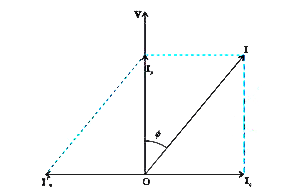 the applied voltage V and `I_(q)`perpendicular to the applied voltage. Iq as you have learnt in Section 7.7, is called the wattless component since corresponding to this component of current, there is no power loss. `I_(p)` is known as the power component because it is in phase with the voltage and corresponds to power loss in the circuit. It’s clear from this analysis that if we want to improve power factor, we must completely neutralize the lagging wattless current `I_(q)` by an equal leading wattless current `I._(q)`. This can be done by connecting a capacitor of appropriate value in PARALLEL so that `I_(q)` and `I._(q)`cancel each other and P is effectively `I_(p) V`. |
|
| 38. |
The resistance of wire is 10 Omega IF the length of wire is increase by n% the new resistance is 10.2 Omega then n….. |
|
Answer» Solution :Here `l_2=l_1+(n% of l_1)` `=l_1+(l_1 times n/100)` `therefore l_2=l_1(1+ n/100)` When a wire is STRETCHED UNIFORMLY, its electrical resistance `R propl^2` `therefore R_1/R_2=l_1^2/l_2^2` `therefore R_1/R_2=l_1^2/(l_1^2(1+n/100)^2)` `therefore R_1/R_2=1/(1+n/100)^2` `therefore 10/10.2=1/(1+n/100)^2` `therefore(1+n/100)^2=10.2/10=1.02` `therefore 1+n/100=sqrt1.02=1.00995` `therefore n/100=0.00995` `therefore n=0.995 =1` |
|
| 39. |
The resonance frequency of a certain RLC series circuit is omega_0, A source of sinusoidal emf, with angular frequency 2omega_0 , is inserted into the circuit. After transients die out the angular frequency of the current oscillations is |
|
Answer» `omega_0//2` |
|
| 40. |
Work done in moving a unit positive charge through a disance x metre on an equipotential surface is |
|
Answer» WORK is DONE on the charge |
|
| 41. |
Give an example for nuclear fusion reaction. |
| Answer» SOLUTION :`._1n^2 + ._1n^2 to ._2n^4` + 23.91 MEV. | |
| 42. |
A circular coil of area 8 m^(2) and number of turns 20 is placed in a magnetic field of 2T with its plane perpendicular to it. It is rotated with an angular velocity of 20 "rev"//s about its natural axis. The emf induced is |
|
Answer» 400V |
|
| 43. |
A cell in secondary circuit gives null deflection for 2.5 m length of potentiometer having 10 m length of wire . If the length of the potentiometer the cell in the primary , the position of the nul point now is |
|
Answer» 3.5m `R_(eq) = (Rxx50)/(R+50)` From ohm 's law , `V= iR_eq1` `(100)/(3) = i((50R)/(R+50))` `i= (100)/(3) ((R+50)/(50R)` and `50kOmega` resistance is connected in series as shown in the figure , `R(eq) =((50R)/(R+50))+50` `100 = [(100)/(3)((R+50)/(50R)][ (50R)/(R+50) +50]` `Rightarrow 100 = (100)/(3) [R+50)/(50R)][(50R)/(R+50)+50]` `Rightarrow (3xx50R)/(R+50) = (50R)/(R+50)+50` `Rightarrow (2xx50R)/(R+50)= 50` `Rightarrow 2R= R+50` `R = 50kOmega` 
|
|
| 44. |
The correct order in which the dimensions of time decreases in the following physical quantities. (a) Power(b) Modulus of elasitcity (c) Moment of inertia (D) angular momentum |
|
Answer» A, B, D , C |
|
| 45. |
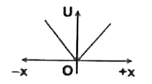
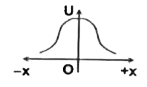
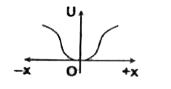
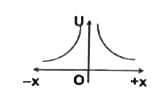
Four identical charges are placed at the four vertices of a square lying in YZ plane. A fifth charge is moved along X axis. The variation of potential energy (U) along X axis is correctly represented by |
|
Answer»
|
|
| 46. |
A ray of light entering from air to glas (mu=1.5) is partly reflected and partly refracted. lf the reflected and refracted rays are at right angles to each other, the angle of refraction is |
|
Answer» `SIN^(-1)(sqrt(2/13))` |
|
| 48. |
There is another useful system of units, besides the SI/MKS. A system, called the CGS (centimeter-gram-second) system. In this system, coulomb's law is given by F=(Qq)/(r^(2))hatr where the distance r is measured in cm(=10^(-2)mu), F in dynes (=10^(-5)N) and the charges in electrostatic units (es units), where 1 es unit of charge =(1)/([3])xx10^(-9)C. The number [3] actually arises from the speed of light in vaccum which is now taken to be exactly given by c=2.99792458xx10^(8)m//s. An approximate value of c, then is c=3xx10^(8)m//s. (i). Show that the coulomb's law in CGS units yields 1 esu of charge =1("dyne")^(1//2)cm. Obtain the dimensions of units of charge in terms of mass M, length L and time T. Show that it is given in terms of fractional powers of M and L. (ii) Write 1esu of cahrge =xC, where x is a dimensionless number. Show that this gives (1)/(4epsi_(0))=(10^(-9))/(x^(2))(Nm^(2))/(C^(2)). With x=(1)/([3])xx10^(-9), we have (1)/(4piepsi_(0))=[3]^(2)xx10^(9)(Nm^(2))/(C^(2)),(1)/(4piepsi_(0))=(2.99792458)^(2)xx10^(9)(Nm^(2))/(C^(2)) (exactly) |
|
Answer» Solution :(i) Fromthe relation, `F=(Qq)/(r^(2))=1` dyne `=[(1" esu of charge"]^(2))/([1" "cm^(2)])` so, 1 esu of charge `=(1" dyne")^(1//2)xx1cm=F^(1//2),L=[MLT^(-2)]^(1//2)L` `implies1` esu of charge `=M^(1//2)L^(3//2)T^(-1)` Thus, esu of charge is represented in terms of FRACTIONAL POWERS `(1)/(2)` of M and ` (3)/(2)` of L. (ii). Let 1 esu of charge =xC, where x is a dimensionless NUMBER. Coulomb FORCE on TWO charges, each of magnitude 1 esu separated by 1 cm is dyne `=10^(-5 )N`. this situation is equivalent to two charges of magitude x C separated by `10^(-2)m`. `thereforeF=(1)/(4piepsi_(0))(x^(2))/((10^(-2))^(2))=1" dyne"=10^(-5)N` `therefore(1)/(4piepsi_(0))=(10^(-9))/(x^(2))(Nm^(2))/(C^(2))` Taking, `x=(1)/(|3|xx10^(9))` we get, `(1)/(4piepsi_(0))=10^(-9)xx|3|^(2)xx10^(18)(Nm^(2))/(C^(2))=9xx10^(9)(Nm^(2))/(C^(2))` ltbr if `|3|to2.99792458` we get `(1)/(4piepsi_(0))=8.98755xx10^(9)Nm^(2)C^(-2)` |
|
| 49. |
In the figure a capacitor of capacitance 2muFis connected to a cell of emf 20 volt. The plates of the capacitor are drawn apart slowly to double the distance between them. The work done by the external agent on the plates is: |
|
Answer» `-200muJ` |
|
` <br>` (##TRG_PHY_MCQ_XII_C07_E01_037_O02.png)