Saved Bookmarks
This section includes 7 InterviewSolutions, each offering curated multiple-choice questions to sharpen your Current Affairs knowledge and support exam preparation. Choose a topic below to get started.
| 1. |
Two particles A and B having different masses arc projected from a tower with same speed. A is projected vertically upward and B vertically downward. On reaching the ground |
|
Answer» VELOCITY of A is greater than that of B. |
|
| 2. |
Find the energy required to split ._8^16O nucleus into four a particles. The mass of an alpha -particle is 4.002603 u and that of oxygen is 15.994915 u. |
|
Answer» 14.43 Mev |
|
| 3. |
Two mirrors AB and CD are arranged along two parallel lines. The maximum number of images of object O that can be seen by any observer is |
|
Answer» one |
|
| 4. |
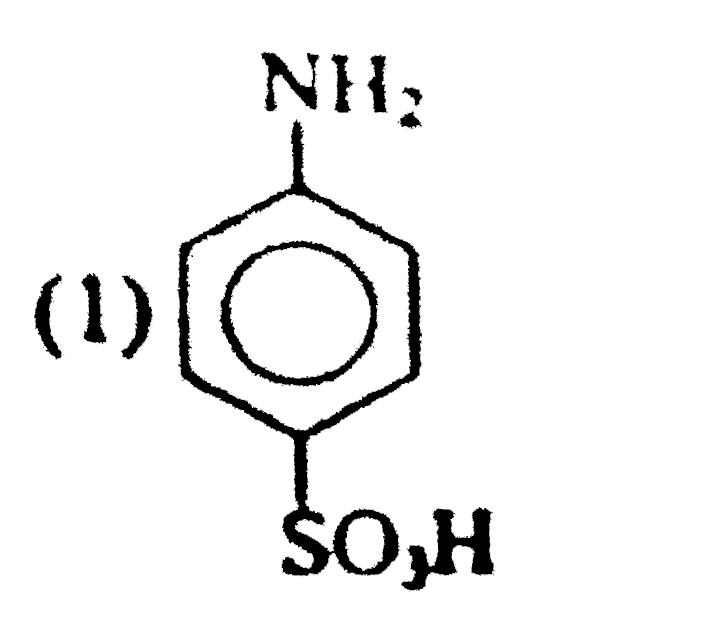
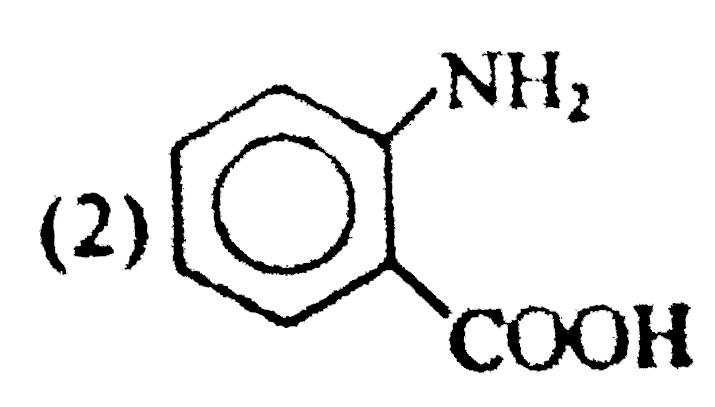
Struture of paracetaamol is - |
|
Answer»
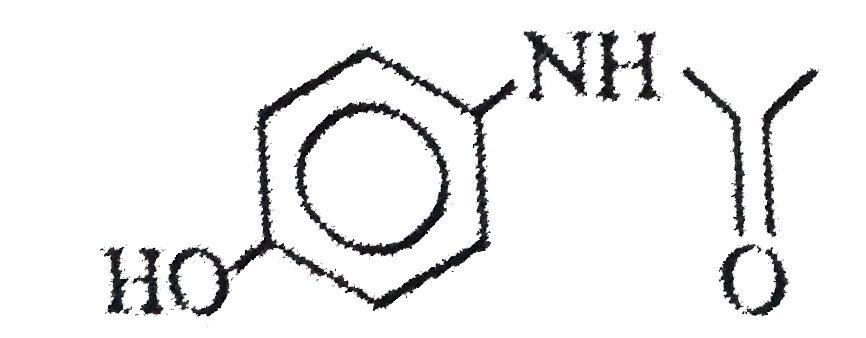 WHICHIS alsocalled a cetaminophen |
|
| 5. |
A step-down transfomer reduces the supply voltage from 220 V to 11 V and increase the current from 6 A to 100 A. Then its efficiency is |
|
Answer» 1.2 |
|
| 6. |
There is no change in the volume of a wire due to change in its length on stretching. The Poisson's ratio of the material of the wire is |
|
Answer» `+0.50` |
|
| 7. |
Find the possible values of energy of a paraticle of mass m located in s spheri |
|
Answer» Solution :The schrodinger equation is `grad^(2)Psi+(2m)/ (ħ^(2))(E-U(r ))Psi=0` when `Psi` depends on `t` only `grad^(2)Psi=(1)/(r^(2))(d)/(dr)(r^(2)(dPsi)/(dr))` If we put`Psi=(chi(r ))/(r ),(dPsi)/(dr)=(chi')/(r )-(chi)/(r^(2))` and `grad^(2)Psi=(chi')/(r )`. Thus we GET `(d^(2)chi)/(dr^(2))+(2m)/( ħ^(2))(E-U(r ))chi=0` The solution is `chi=A sin KR,r LT r_(0)` `k^(2)=(2mE)/( ħ^(2))` and `chi=0r gt r_(0)` (for `r lt r_(0)` we have rejected a TERM `B cos kr` as it does not vanish at `r=0`). Continuity of the wavefunction at `r=r_(0)` requires `kr_(0)=npi` Hence `E_(n)=(n^(2)pi^(2) ħ^(2))/(2mr_(0)^(2))`. |
|
| 8. |
If E and B are the magnitudes of electric and magnetic field respectively in some region of space, then the possibilities for which a charged particle may move in that space with a uniform velocity of magnitude v are |
|
Answer» E= vB Option (c ): Force DUE to electric field and magnetic field can balance each other. `q vec(E )+ q(vec(v) xx vec(B))= 0` Option (d): Both the fields are absent so there is no force. |
|
| 9. |
An aluminium (alpha_(Al)=4xx10^(-3)//^(@)C) wire resistance 'R_(1)' and carbon wire (alpha_(c)=0.5xx10^(-3)//^(@)C) resistance 'R_(2)' are connected in series to have a resultant resistance of 18 ohm at all temperatures The values of R_(1) and R_(2) in ohms |
|
Answer» 2, 16 |
|
| 10. |
In Young's double slit experiment ,momochromatic light of wavelength 630 nm illuminates the pair of slits and produces an interface pattern pattern in which two consecutive bright frings are separated by 8.1 mm. Another source of monochromatic light produce the interface pattern in which the two consecutive bright fringes are seperated by 7.2mm, find the wavelength of light from the second sources . What is the effect to on the interference fringes if the monochromatic sources is replaced by a source of white light ? |
|
Answer» Solution :Here `lambda_(1)=360 nm =630xx10^(-9)m,beta_(1)=8.1 mm` `=8.1xx10^(-3)` `lambda=?,beta_(2)=7.2 mm=7.2xx10^(-3) m` Let `d` be the width and `D` be the distance between slit and SCREEN then `beta_(1)=(lambda_(2)D)/(d) and beta_(2)=(lambda_(2)D)/(d)` `THEREFORE (beta_(1))/(beta_(2))=(lambda_(1)D)/(d)xx(d)/(lambda_(2)D)=(lambda_(1))/(lambda_(2))` `(8.1xx10^(-3))/(7.2xx10^(-3))=(630xx10^(-9))/(lambda_(2))` `(8.1)/(7.2)=(630xx10^(-9))/(lambda_(2))` `therefore lambda_(2)=(7.2xx630xx10^(-9))/(8.1)=560xx10^(-9)m` `=560 nm`. Whenthe monochromatic source is replaced by a source of white light, the fring width is changed. |
|
| 11. |
An electric kettle has two coils of different power. When one coil is switched on, it takes 30 minutes to boil a certain amount of water and when second coil is switched on, it takes 45 minutes to boil same amount of water. Then |
|
Answer» It takes 150 minutes to boil same amount of water when both the coils are used in series combination. `H_(1)=H_(2)implies30/(R_(1))=45/(R_(2))implies3R_(1)=2R_(2)` `H_("series')=(V^(2))/((R_(1)+R_(2))) t_(s)=(V^(2))/((R_(1)+3/2R_(1))) t_(s)=H_(1)=(V^(2))/(R_(1))(30xx60)` `implies t_(s)=(30xx60)5/2 =75` min `H_(P)=((V^(2))/(R_(1))+(V^(2))/(R^(2)))t_(P)+((V^(2))/(R_(1))+(2V^(2))/(3R_(1)))t_(P)` `implies(5V^(2))/(3R_(1)) t_(P)=(V^(2))/(R_(1))(30xx60)` `t_(P)=(3xx30xx60)/5=18` min |
|
| 12. |
Calculate the electric field at point P,Q for the following two cases as shown in the figure (a) A positive point charge +1 muCis placed at the origin (b) A negative point charge -2 muCis placed at the origin |
|
Answer» Solution :The magnitude of the electric field at point P is `E_(p)=(1)/(4piepsilon_(0))=(q)/(r^(2))=(9xx10^(9)xx1xx10^(-6))/(4)=2.25xx10^(3)NC^(-1)` Since the source charge is positive the electric field points AWAY from the charge .So electric field at the point P is given by `vecE_(p)=2.25xx10^(3)NC^(-1)hatj` For the point Q `|vecE_(Q)|=(9xx10^(9)xx1xx10^(-6))/(16)=0.56xx10^(3)NC^(-1)` Hence `vecE_(Q)=0.56xx10^(3)hatj` Case (b) : The magnitude of the electric field at point P `|vecE_(p)|=(kq)/(r^(2))=(1)/(4piepsilon_(0))(q)/(r^(2))=(9xx10^(9)xx2xx10^(-6))/(4)` `=4.5xx10^(3)NC^(-1)` 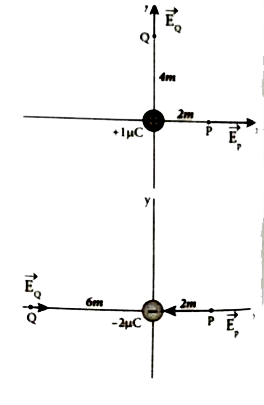 Since the source charge is negative the electric field points towards the charge . So the electric field at the point P is given by `vecE_(p)=-4.5xx10^(3)hatiNC^(-1)` For the point Q, `|vecE_(Q)|=(9xx10^(9)xx2xx10^(-6))/(36)` `=0.5xx10^(3)NC^(-1)` `vecE=0.56xx10^(3)NC^(1)` At the point Q the electric field is directed along the positive x -axis . \ |
|
| 13. |
The energy of an electron in an excited hydrogen atom is -3.4 eV The angular momentum of electron is |
|
Answer» `1.1 xx 10^(-34)JS` `L=(2 xx 6.63 xx 10^(-34) xx 7)/(2 xx 22) =2.11 xx 10^(-34)Js` |
|
| 14. |
A bird is moving towards the water surface perpendicularly downwards. To a fish in a water just below the bird, where will the apparently appear to be in comparison to its actual position? |
|
Answer» Solution :We know, if object is in rarer MEDIUM and OBSERVER in the denser medium then refractive INDEX of denser medium, `mu = ("apparent height of the object")/("real height of the object")` `"Here", " " mu_(w) = ("apparent height of the object (x)")/("real height of BIRD")` `therefore "" x = mu_(w) xx d` `therefore "" mu_(w) gt 1` `therefore "" x gt d` Therefore to the fish, the bird appears to be slightly higher than its actual POSITION. |
|
| 15. |
Indicate the zero - potential line of a magnet . |
Answer» Solution :The PERPENDICULAR bisector of the magnetic axis of a bar magnet is the zero - potential line [ Fig] because , any point lying on this line is equidistant from the two POLES of the magnetic . Let O be any point on the perpendicular bisector of the magnetic axis of the magnet NS having POLE - strength`q_(m)`. If the distance of the point O from each pole is r , then the potential at O is , `V=(q_(m))/(r)-(q_(m))/(r)=0`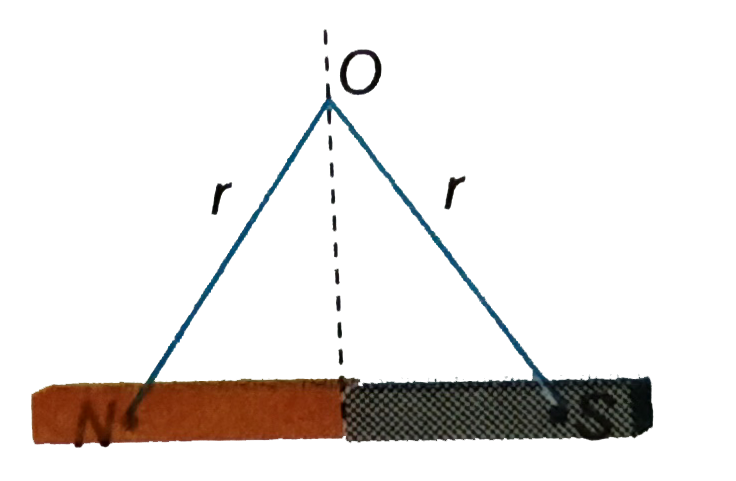
|
|
| 16. |
A proton and an alpha - particle start from rest in a uniform electric field, then the ratio of times of flight to travel same distance in the field is |
| Answer» Answer :D | |
| 17. |
Polarising angle for water is 53^(@). If light is incident at polarising angle on the surface of water and is partly reflected, the angle of refraction will be |
|
Answer» `53^(@)` |
|
| 18. |
What are virtual image ? |
| Answer» SOLUTION :when reflected rays INTERSET when PRODUCED in backward direction, they produce virtual image. | |
| 19. |
By increasing the charge on the plate of capacitor .......... . |
|
Answer» its CAPACITANCE increases increases as a increases and in V = ED, as E increases V ALSO increases. |
|
| 20. |
Two blocks m_(1) 5g and m_(2) = 10 g are hung vertically over a light frictionless pulley. What is the acceleration of the masses when left free? |
|
Answer» `(g)/(3)` `=(10-5)/(10+5).g=(g)/(3)` (a) is the CHOICE. |
|
| 21. |
‘Is your school ready? Who asked this question? |
|
Answer» SAHEB’s mother |
|
| 22. |
The line perpendicular to wavefront and which represents propagation of wave is ....... |
|
Answer» waveline |
|
| 23. |
The sea breeze and land breeze arise due to |
|
Answer» CONVECTION |
|
| 24. |
A few wires of same dimension but of different specific resistances are connected in parallel and than this parallel combination is connected to a battery . In which wire will the rate of production of heat due to Joule effect be maximum? |
|
Answer» Solution :As the wires are connected in parallel , so potential difference across each wire will be same . HEAT produced , `H+(V^(2)t)/(RJ)=(V^(2)t)/(J.rho(l)/(A))` As each wire is of same dimension , the RATE of production of heat will be maximum in wire , whose SPECIFIC resistance is minimum. |
|
| 25. |
Two positively charge particles each of mass 1.7 xx 10^(-27) kg and carrying a charge of 1.6 xx 10^(-19)C are placed r distance apart. If each one experience a repulsive force equal to its weight. Find the distance between them |
|
Answer» 117m |
|
| 26. |
A smooth rod of length l rotates freely in a horizontal plane with the angular velocity about a stationary vertical axis O as shown in Fig. The moment of inertia of the rod is equal to I relative to the axis. A small ring of mass m is located on the rod close to the rotation axis and is tied to it by a thread. When the thread is burned, the ring starts sliding radially outwards along the rod. Find the velocity v of the ring relative to the rod as a function of its distance r from the rotation axis. |
|
Answer» SOLUTION :Consider the rod and the RING as our system. The system is experiencing no external torque about the axis hence, the angular momentum relative to the rotation axis does not VARY. There is no nonconservative force or IMPULSE acting so in the process of motion, the kinetic energy of the system does not vary. Calculation: Since the angular momentum about the axis and kinetic energy of the system are conserved, we have `Iomega_(0)=(I+mr^(2))omega` and `1/2Iomega_(0)^(2)=1/2Iomega^(2)+1/2mv^(2)` where `v^(2)=v.^(2)+omega^(2)r^(2)` as shown in Fig. From the above two equations we obtain `v=omega_(0)r//sqrt(1+mr^(2)//I)` Note: If r = 0, we get v = 0 which is the situation in the beginning. 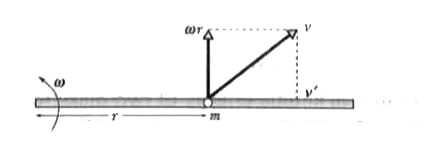
|
|
| 27. |
The measured mass and volume of the body are 22*42g and 4*7cm^(3) respectively with permissible errors 0*01g and 0*1cm^(3). The maximum % error in density is about : |
|
Answer» `0.2%` `:.(Deltarho)/(rho)xx100=(Deltam)/(m)xx100+(DeltaV)/(V)xx100` `=(0*01)/(22*42)xx100+(0*1)/(4*7)xx100=2%` So correct choice is `(b).` |
|
| 28. |
Two capacitors when connected in series the effective capacity is 2muF and when in parallel is 9muF. Calculate the value of each capacitors. |
|
Answer» SOLUTION :Let `C_(1) and C_(2)` be the CAPACITY of two capacitors. Then in series `C_(1)=(C_(1)C_(2))/(C_(1)+C_(2))=2MUF" and in parallel", C_(p)=C_(1)+C_(2)=9muF ......(1)` `C_(1)C_(2)=2(C_(1)+C_(2))=2 XX 9 -18` `C_(2)=(18)/(C_(1)) ......(2)` Substituting eq. (2) in eq. (1) we get, `C_(1)+(18)/(C_(1))=9` i.e, `C_(1)^(2)+18=9C_(1) ""C_(1)^(2)-9C_(1)+18=0""i.e, (C_(1)-6) (C_(1)-3)=0` `C_(1)=6 or 3` Hence, `C_(2)=3 or 6` If `C_(1)=6muF then C_(2)=3muF, or` If `C_1=3muF, then C_(2)=6muF` |
|
| 29. |
Story 'Svayamvara' is about ? |
| Answer» Answer :B | |
| 30. |
A one kg mass attached at one end of the string of 0.5 m long rotates in a horizontal circle when the other end of the string being fixed. The breaking tension of the string is 50 N. The greatest speed that can be given to the mass is, |
|
Answer» 25 m/s |
|
| 31. |
Assertion (A) : The refractive index of a prism depends only on the kind of glass of which it is made of and the colour of light. (Reason): The refractive index of a prism depends upon the refracting angle of the prism and the angle of minimum deviation. |
|
Answer» If both assertion and reason are true and the reason is the correct explanation of the assertion. |
|
| 32. |
Carbon, silicon and germanium have four valence electrons each. These are characterised by valence and conduction bands separated by energy band gap respectively equal to 1(E_(g))_(c), (E_(g))_(s1) and (E_(g))_(G),· Which of the following statement is true ? |
|
Answer» `(E_(g))_(SI) lt (E_(g))_(GE) lt (E_(g))_(C )` |
|
| 33. |
A parallel plate capacitor without any dielectric within its plates, has a capacitance C, and is connected to a battery of emf V. The battery is disconnected and the plates of the capacitor are pulled apart until the separation between the plates is doubled. What is the work done by the agent pulling the plates apart, in this process ? |
|
Answer» `1/2CV^(2)` where A is thearea of eachplateand dis the distancebetweenthe PLATES. Initialenergystoredin the capacitor , `U_(i) = (1)/(2) CV^(2) "".....(ii)` Whenthe separationbetweenthe plates is doubled , itscapcaitancebecomes `C'=(epsi_(0)A)/(2d)=(1)/(2) (epsi_(0)A)/(d) = (C)/(2) ""("USING (i)")"".....(iii)` As the bettaryis disconnected , socharged capacitorbecomes isolatedand charge on itwillreamain constant , `therefore"" Q = Q` `C'V = C'V ""("As" Q = CV)` `V= ((C)/(C))V =(C)/(((C)/(2)))V = 2V "".....(iv)` Finalenergystoredin the capacitor , `U_(f) = (1)/(2) C'V^(2) = (1)/(2) ((C)/(V)) (2V)^(2) = CV^(2)""...(V)` Requiredwork done , `W = U_(f) - U_(i) = CV^(2) - (1)/(2) CV^(2) = (1)/(2)CV^(2) = (1)/(2)CV^(2)` |
|
| 34. |
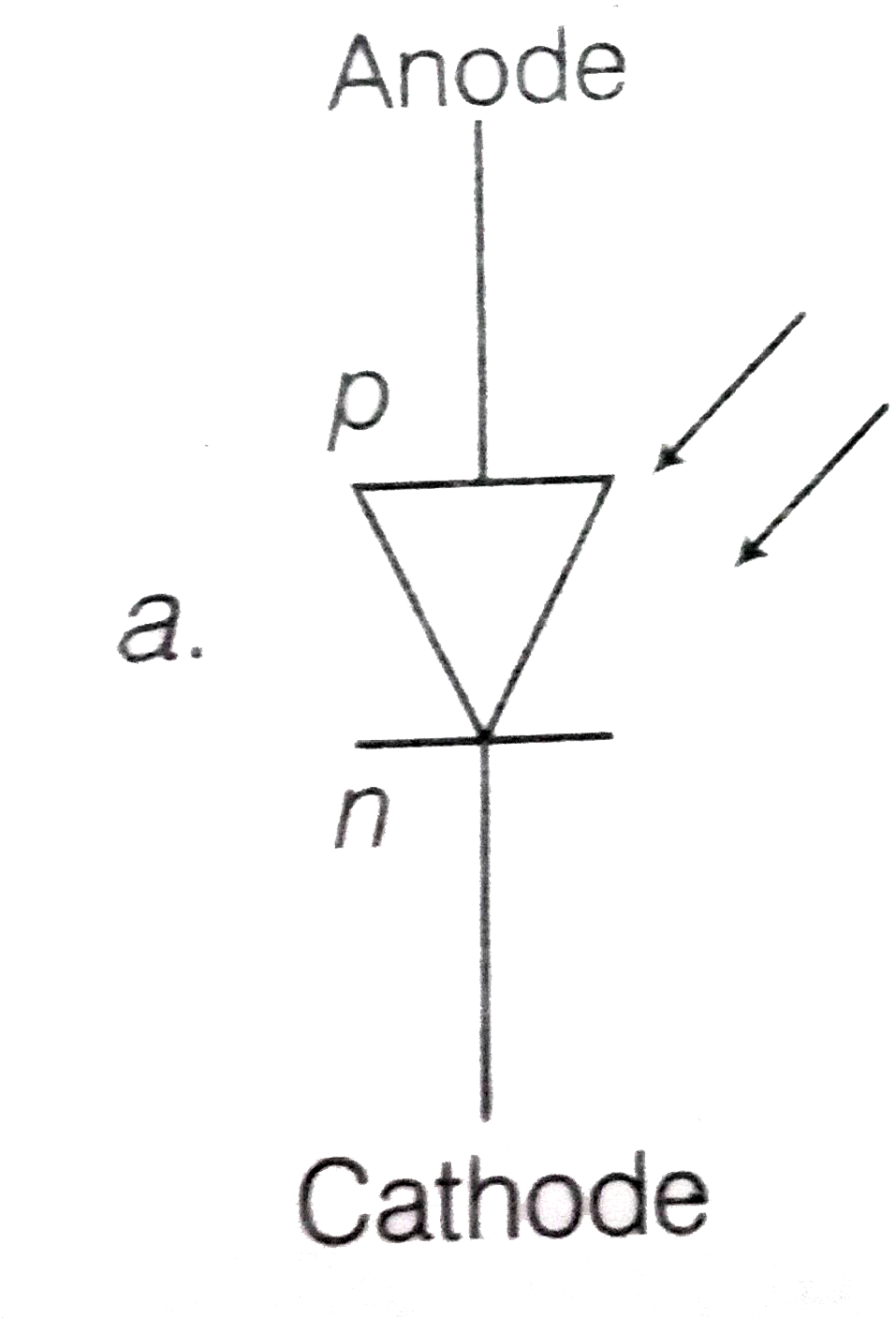
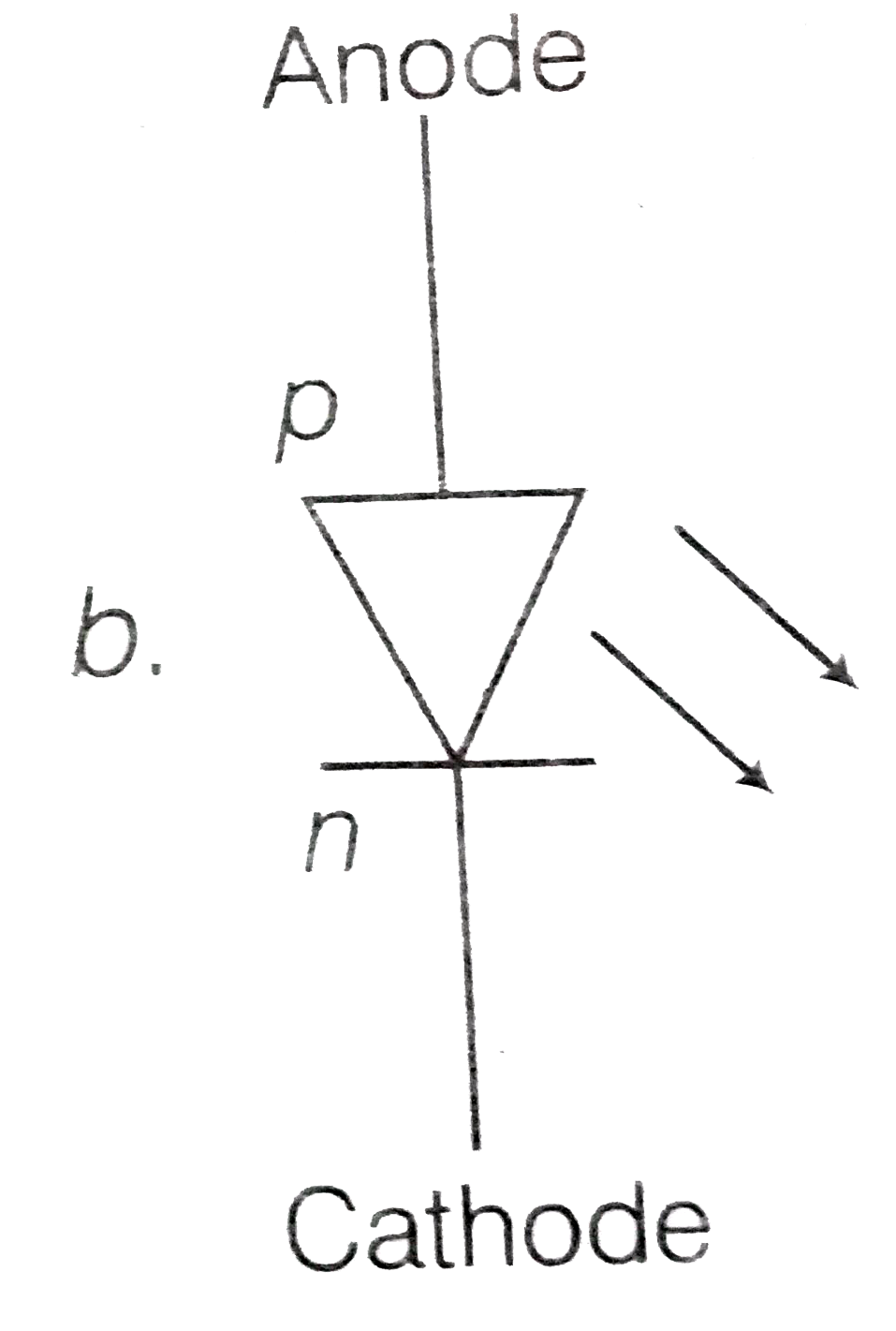
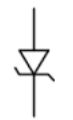
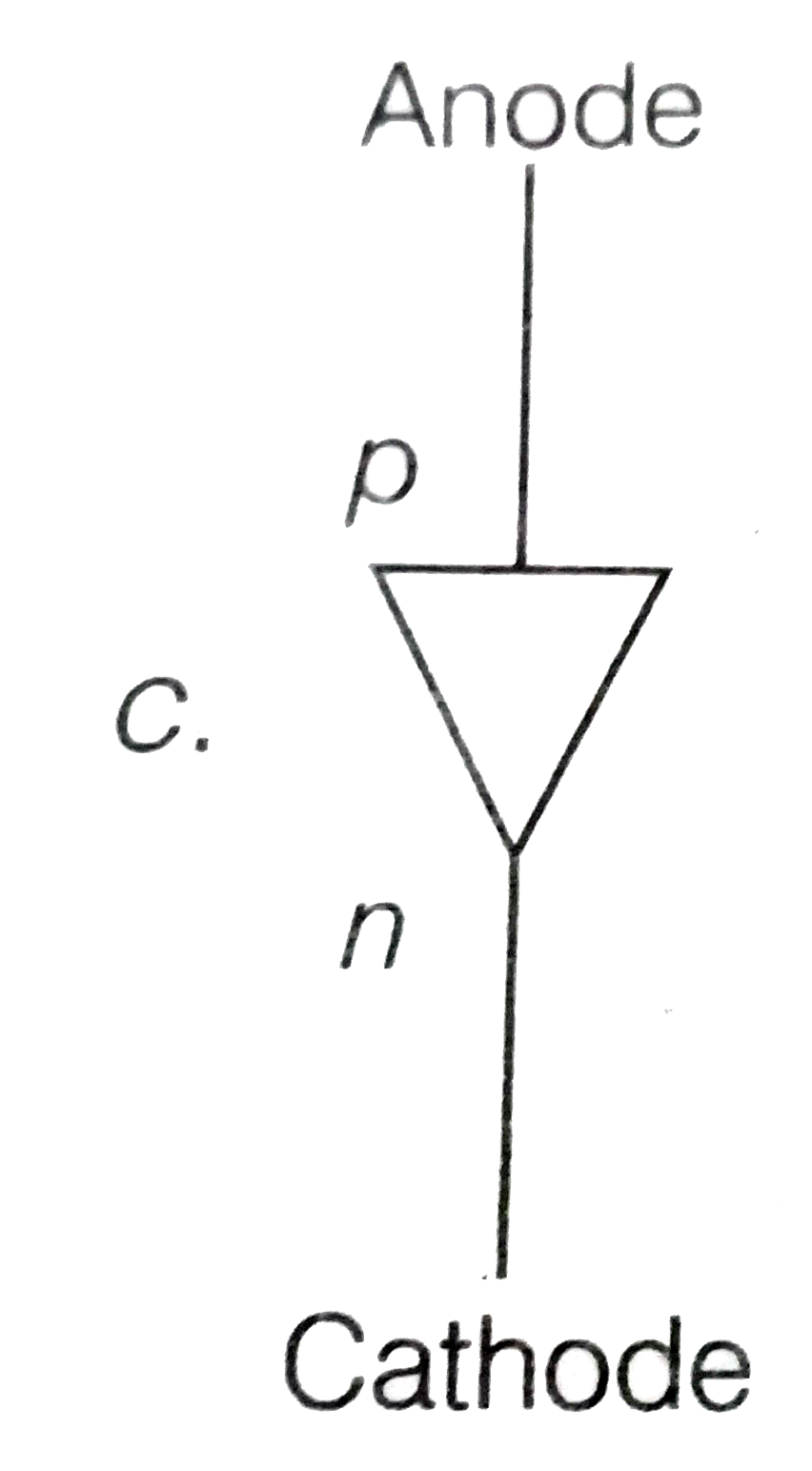
The schematic symbol of light emitting diode (LED) is |
|
Answer»

|
|
| 35. |
A beam of parallel rays of width b cm propagates in glass at an angle theta . to its plane face. What would the beam width b , be after it goes over to air through this face ? (The refractive index of the glass is mu). |
|
Answer» `B MU` |
|
| 36. |
At a place on earth the vertical component of earth's magnetic field is sqrt(3) times its horizontal component. The angle of dip at this place is …... |
|
Answer» `30^(@)`. `tan phi= sqrt(3)` `therefore phi = 60^@`. |
|
| 37. |
If in the above question the Young's modulus of the material is Y, the value of extension x is : |
|
Answer» `((Wl)/(YA))^(1//3)` `Y=(Wl^(3))/(AX^(3))` or `x=(W/(AY))^(1//3)xxl` `therefore` Correct choice is (d). |
|
| 38. |
Identify theset in whichall thethree materialsare goodconductorsof electricity? |
|
Answer» CU,Hg andNaC |
|
| 39. |
The aperture of a telescope is of 1m diameter and wavelength of light incident on the aperture is 5500Å. What is the angular limit of re solution of the telescope? |
| Answer» SOLUTION :`6.71 xx 10^(-7)` radian= 0.14 sec of ARC | |
| 40. |
The focal length of the concave mirror is f and the distance from the object to the principle focus is x, then ratio of the size of the image to the size of the object is : |
|
Answer» `((F + X)/f)` |
|
| 41. |
A deutron and a proton are accelerated by the cyclotron. Can both be accelerated with the same oscillator frequency? Give reason to justify your answer. |
|
Answer» Solution :Reason justification for the correct ANSWER. No The mass of the TWO particles, i.e. deuteron and PROTON, is DIFFERENT. since (cyclotron) FREQUENCY depends inversely on the mass, they cannot be accelerated by the same oscillator frequency. |
|
| 42. |
A sphere of mass M moving with velocity w collides elastically with another of mass m at rest. After collision their final velocities are V and v. The value of vis: |
|
Answer» `(2MU)/(m)` |
|
| 43. |
Two point charges are located at two of the vertices of a right triangle. If a third charge -2q is brought from infinity and placed at the third vertex, what will its electric potential energy be? Use the following values: a=0.15 m , b=0.45 m, and q=2.0 xx 10^(-5) C. |
| Answer» ANSWER :A | |
| 44. |
Geologists claim that besides the main magnetic N-S poles, there are several local poles on the earth's surface oriented in different directions. How is such a thing possible at all ? |
| Answer» Solution :YES, it is possible. The earth.s FIELD is only APPROXIMATELY a dipole field. Local N-S POLES may arise due to, for EXAMPLE, magnetised mineral deposits. | |
| 45. |
In Young.s double-slit experiment, the central bright fringe can be identified |
|
Answer» as it has GREATER intensity than the other bright fringes |
|
| 46. |
The refractive index of water in a biology laboratory tank veries as 1.33 + 0.002//lambda^(2), where lambda is the wavelength of light. Small pieces of organic matter of different colours are seen at the bottom of the tank using a travelling microscope. Then the image of the orgainc matter appears |
|
Answer» deeper for the violet pieces than the green ONES. |
|
| 47. |
Assertion: The introduction of a glass slab between two charges will decrease the magnitude of force between them. Reason:The introduction of a metallic slab between two charges will decrease the magnitude of force to zero. |
|
Answer» Both Assertion and Reason are TRUE and Reason is the correct explanation of Assertion |
|
| 48. |
A crate of mass 100 kg is at rest on a horizontal floor. The coefficient of static friction between the crate and the floor is 0.4, and the coefficient of kinetic friction is 0.3 . A force F of magnitude 344 N is then applied to the crate, parallel to the floor. Which of the following is true ? |
|
Answer» The crate will accelerate across the floor at `0.5 m//s^(2)`. |
|
| 49. |
A bar of length l, breadth b and depth d is supported at its ends and is loaded at the centre by a load W. If Y is the Young's modulus of the material of the bar, then the depression delta at the centre is : |
|
Answer» `(WL^(3))/(4bd^(3)Y)` `delta=(Wl^(3))/(4bd^(3)Y)` Thus correct choice is (a). |
|