

Saved Bookmarks
This section includes 7 InterviewSolutions, each offering curated multiple-choice questions to sharpen your Current Affairs knowledge and support exam preparation. Choose a topic below to get started.
| 1. |
The side of a cube as measured with a vernier calipers of least count 0.01 cm is 3.00 cm . The maximum possible error in the measurement of Volume is |
|
Answer» `PM 0.01 CM^(3)` |
|
| 2. |
The half life of a radioactive substance is 5 hours. In how much time will 15/16 of the material decay ? |
|
Answer» |
|
| 3. |
The intensity of direct sunlight on a surface normal to the rays is I_(0) . What is the intensity of direct sunlight on a surface, whose normal makes an angle of 69^(@) with the rays of the sun |
|
Answer» `I_(0)` |
|
| 4. |
A charge of 10muC is placed at the origin of x-y coordinate system.The potnetial difference between two point (0, a) and (a, 0) in volt will be |
|
Answer» `(9 xx 10^(-4))/(a ) ` |
|
| 5. |
Following figures (1) and (2) represent lines of foree, Which of the following is correct statement? |
|
Answer» figure (1) REPRESENTS marnclic lines of force |
|
| 6. |
SI Unit Of Length Is |
|
Answer» Meter |
|
| 7. |
What is solenoid ? Give information of magnetic field by qualitative discussion. |
|
Answer» Solution :1. A solenoid means an insulated copper wire wound closely in the form of a helix. 2. By a LONG solenoid, we mean that the length of the solenoid is very large as compared to its diameter.  3. If its length is shorter than radius then it is called short solenoid. 4. It consist of a long wire wound in the form of a helix where the neighboring turns are closely spaced. So each turn can be regarded as a circular loop. 5. Enamelled wires are used for winding so that turns are insulated from each other. 6. The net magnetic field is the vector sum of the fields due to all the turns. 7. Figure (a) shows a section of this solenoid in an enlarged manner. 8. Figure (b) shows the entire finite solenoid with its magnetic field. 9. In figure (a), it is clear from the circular loops that the field between two neighboring turns vanishes. 10. In figure (b), we see that the field at the interior mid point P is uniform, strong and along the axis of the solenoid. 11. The field at the exterior mid point Q is weak and moreover is along the axis of the solenoid with no perpendicular or NORMAL component.  12. Its the solenoid is made longer it APPEARS like a long cylindrical metal sheet. 13. Figure represent this idealised picture. The field outside the solenoid approaches zero. We shall assume that the field outside is zero. The field INSIDE becomes everywhere parallel to the axis. |
|
| 8. |
The radius of curvature of curved surface at a thin planoconvex lens is 10 cm and the refractive index is 1.5. If the plane surface is silvered, then the focal length will be, |
|
Answer» 5 cm `R_(1)=oo:R_(2)=-R` `thereforef=(R)/((n-1))(R=10cm,n=1.5)` `f=(10)/((1.5-1))=20CM` |
|
| 9. |
In extrinsic germanium crystal, the holes are provided by : |
|
Answer» ALUMINIUM |
|
| 10. |
At t=0, a transverse wave pulse in wire is described by the function, y = (6)/(x^2+3) Where x and y in metres. Write the function y(x,t) that describes this wave if it is travelling in the positive x-direction with a speed, of 4.50 m/s. |
| Answer» SOLUTION :`y =t/([(X - 4.5t)^2 +3])` | |
| 11. |
The instantaneous current in an AC circuit containing a pur inductor is i=I_(0)sinomegat. The instantaneous emf is : |
|
Answer» `e=E_(0)sin(omegat+(PI)/(2))` |
|
| 12. |
Copper chloride is .............Of Color |
|
Answer» Blue |
|
| 13. |
In Young's slit experiment, if the distance between two slits is halved and the distance between the slits and the screen is doubled then the width of fringe will be..... |
|
Answer» unchanged Finally WIDHT of ringe `barx_(2)=(lambda_(2)D_(2))/(2d_(2))` where `d_(2)=(d_(1))/(2),D_(2)=2D_(1) and lambda_(1)=lambda_(2)` `:. barx_(2)=(lambda_(1)(2D_(1)))/(2((d_(1))/(2)))=(4lambda_(1)D_(1))/(2d_(1))""...(2)` TAKING ratio of EQUATION (2) and (1) `(barx_(2))/(x_(1))=(4lambda_(1)D_(1))/(2d_(1))xx(2d_(1))/(lambda_(1)D_(1))` `:.barx_(2)=4barx_(1)` |
|
| 14. |
Rsistance of a conductor depends on its |
|
Answer» LENGTH |
|
| 15. |
a. Obtain an expression for the mutual inductance between a long straight wire and a square loop of side a as shown in the figure. b. Now assume that the straight wire carries a current of 50 A and the loop is moved to the right with a constant velocity, v=10m//s. Calculate the induced emf in the loop at the instant when x=0.2m. Take a=0.1m and assume that the loop has a large resistance. |
|
Answer» Solution :a. Consider a small rectangular element of the square, of thickness DT at a distance .t. from the conductor carrying a current I. Magnetic FIELD EXPERIENCED by this element `=B=(mu_(0).I)/(2pit)` Area of the element = `dA=a.dt` `therefore` Flux, `dphi_(B)=B.dA=(mu_(0)Ia)/(2pit)dt` Hence net flux, `phi_(B)=underset(t=x)overset(t=a+x)int(mu_(0)Ia)/(2pit)dt=(mu_(0)Ia)/(2pi)log_(e)(1+(a)/(x))` But `phi_(B)=MI`, M - Mutual inductance `therefore M=(mu_(0)a)/(2pi)log_(e)(1+(a)/(x))` b. `varepsilon=(mu_(0)Ia^(2)v)/(2pix(a+x))=(4PIXX10^(-7)xx50xx(0.1)^(2)xx10)/(2pixx0.2(0.1+0.2))=1.66xx10^(-5)=1.7xx10^(-5)V` |
|
| 16. |
About 5% of the power ofa 100 W lightbulb is converted to visible radiation. What is the average intensity of visible radiation (a) at a distance of 1 m from the bulb? (b) at a distance of 10 m? Assume that the radiation is emitted isotropically and neglect reflection. |
|
Answer» Solution :The energy crossing per unit area per unit time perpendicular to the direction of propagation is CALLED intensity. (a) Average intensity of VISIBLE radiation at `1m=(5%" of 100W")/(4pi(1)^(2))=0.4W//m^(2)`. (b) Average intensity of visible radiation at `10m=(5%" of 100 W")/(4pi(10)^(2))=0.04W//m^(2)`. |
|
| 17. |
Find the velocity of the moving rod at time t if the initial velocity of the rod is v and a constant force F is applied on the rod.Neglect the resistance of the rod. |
|
Answer» Solution :At any time `t`, let the velocity of the rod be `v`. Applying Newtons law:`F-ilB=ma` ..(1) Also `Blv=i_(1),R=q/c` Applying `KCL`, `i=i_(1)+(dq)/(dt)=(BlV)/R+d/(dt)(BlvC)` or `i=(BlV)/R+BlC a` Putting the VALUE of `i` in eq.(1), `F-(B^(2)L^(2)V)/R=(m+B^(2)L^(2)C)a=(m+B^(2)L^(2)C)(dv)/(dt)` `(m+B^(2)L^(2)C)(dv)/(F-(B^(2)L^(2)V)/R)=dt` Integrating both sides, and solving we get `v=(FR)/(B^(2)l^(2))(1-e(tB^(2)l^(2))/(R(m+CB^(2)l^(2))))` 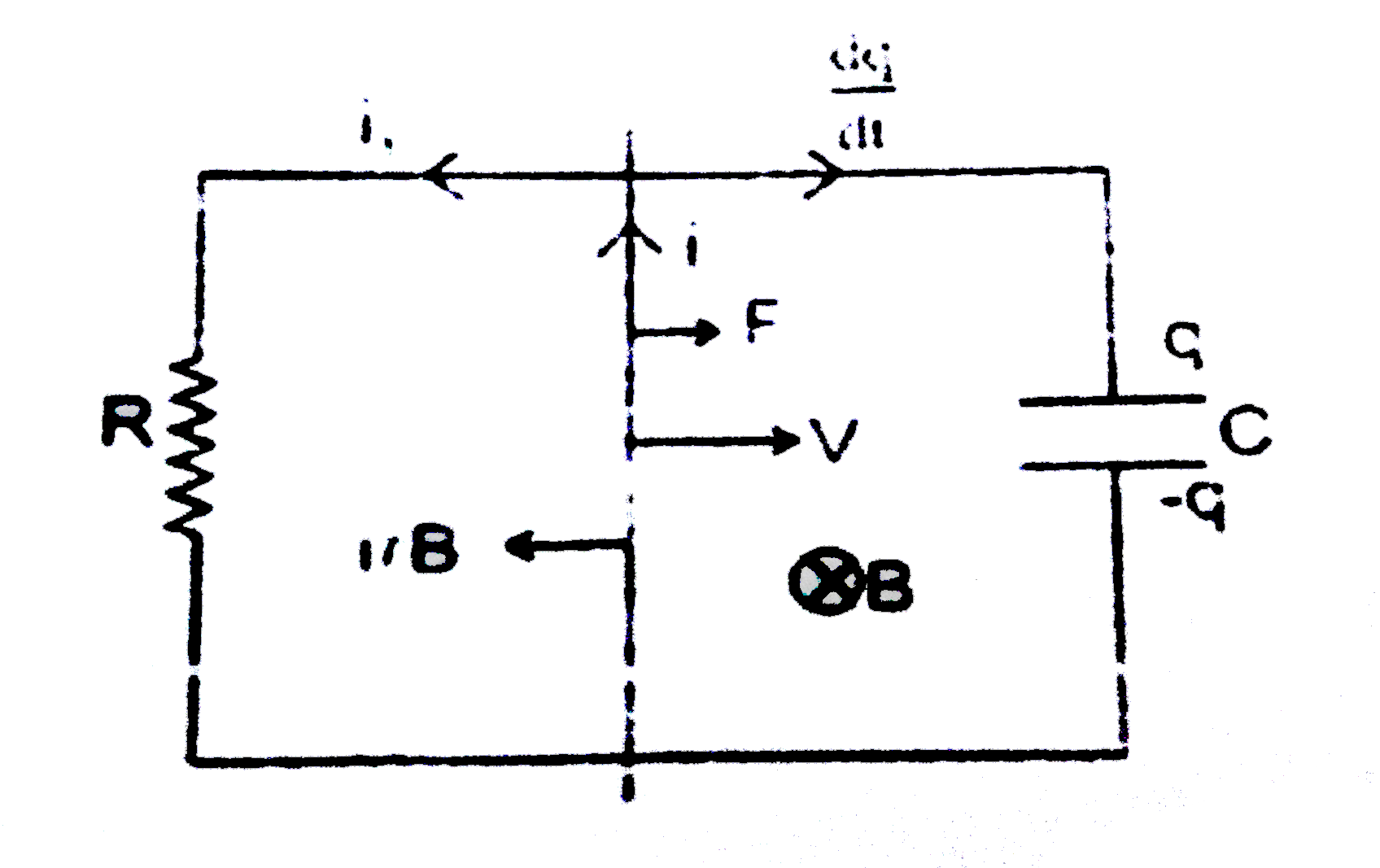
|
|
| 18. |
Radius of orbit of a satellite is R and T is time period. Find T' when orbit radius increase to 9R |
|
Answer» |
|
| 19. |
The following truth table corresponds to the logic gate {:(A,0,0,1,1),(B,0,1,0,1),(X,0,1,1,1):} |
|
Answer» NAND |
|
| 20. |
A small conducting spherical shell with inner radius a and outer radius b is concentric with a larger conducting spherical shell with inner radius c and outer radius d. The inner shell has total charge +2q, and the outer shell has charge +4q. (K=(1)/(4piepsilon_(0))) Find the electric in terms of q and the distance r from the common centre of the two shells for r gt d. |
|
Answer» `(KQ)/(R^(2))` |
|
| 21. |
When the current in a coil changes from 0 to 2A to 4A in 0.05sec, then e.m.f. developed in the coil is 8V. What is the coefficient of self-induction of the coil? |
|
Answer» Solution :`E = L(dI)/dt ` `THEREFORE L = e(dt)/dI` `therefore L = 8xx5/100xx1/2` = 0.2H. |
|
| 22. |
A wave disturbance in a medium is described by y(x,t) = 0.02 cos ( 50 pit +pi/2) cos (10 pi x) , where xand y are in meter and t is in second. |
|
Answer» A node occurs at x = 0.15m |
|
| 23. |
A small conducting spherical shell with inner radius a and outer radius b is concentric with a larger conducting spherical shell with inner radius c and outer radius d. The inner shell has total charge +2q, and the outer shell has charge +4q. (K=(1)/(4piepsilon_(0))) Find the electric field in terms of q and the distance r from the common centre of the two shells for (i) b lt r lt c (ii) c lt r lt d |
|
Answer» `(2q)/(R^(2)),0` |
|
| 24. |
Two protons A and B are placed in between the two plates of a parallel plate capacitor charged to a potential difference Vas shown in Fig. The force onthe two protons are exactly the same. |
| Answer» SOLUTION :TRUE – FORCE on the two protons are equal because electric field is UNIFORM between the plates of capacitor. | |
| 25. |
A conducting ring is placed around the core of an electromagnet as shown in the figure. When key K is pressed, the ring |
|
Answer» REMAIN stationery |
|
| 26. |
A small conducting spherical shell with inner radius a and outer radius b is concentric with a larger conducting spherical shell with inner radius c and outer radius d. The inner shell has total charge +2q, and the outer shell has charge +4q. (K=(1)/(4piepsilon_(0))) Find the electric field in terms of q and the distance r from the common centre of the two shells for (i) r lt a (ii) a lt r lt b |
| Answer» ANSWER :A | |
| 27. |
A ray of light is incident on the hypotenuse of a right angled prism after travelling parallel to the base inside the prism. If mu is the refractive index of the material of the prism, the maximum value of the base angle for which light is totally reflected from the hypotenuse is |
|
Answer» `SIN^(-1) (1/mu)` |
|
| 28. |
One rectangular coil carrying current I, has N no. of identical turns, each with area A. When it is placed in uniform magnetic field, torque exerted on it is vectau = _______ |
|
Answer» `NI(VECA*VECB)` |
|
| 30. |
The minimum potential difference between the base and emitter required to switch a silicon transistor ON is approximately. |
|
Answer» IV |
|
| 31. |
A plano convex lens of refractive index 1.5 and radius of curvature 30 cm is silvered at the curved surface. Now this lens has been used to form the image of a object. At what distance from this lens and object be placed in order to have a real image of the size of the object |
|
Answer» 20 cm |
|
| 32. |
The space-time diagram, shows three events A, B, and C which occurred on the x axis of some inertial reference frame. Find: (a) the time interval between the events A and B in the reference frame where the two events occurred at the same point, (b) the distance between the points at which the events A and C occured in the reference frame where these two events are simultaneous. |
|
Answer» Solution :(a) The FOUR-dimensional interval between A and B (assuming `Deltay=Deltaz=0`) is: `5^2-3^2=16units` Therefore the time interval between these two events in the reference frame in which the events OCCURRED at the same PLACE is `c(t_B^'-t_A^')=sqrt(16)=4m` or `t_B^'-t_A^'=4/c=4/3xx10^-8s` (b) The four dimensional interval between A and C is (assuming `Deltay=Deltaz=0`) `3^2-5^2=-16` So the distance between the two events in the frame in which they are simultaneous is `4 UNITS =4m`. 
|
|
| 33. |
n identical cells, cach of emf epsilon and internal resistance r, are joined in series to form a closed circuit. Once cell (A) is joined with reversed polarity. The potential difference across each cell, except A, is |
|
Answer» `(2epsilon)/(N)` |
|
| 34. |
The ratio between the de Broglie wavelengthassociated with protons, accelerated through a potential of 512 V and that of alpha particles accelerated through a potential of X volts is found to be one. Find the value of X. |
|
Answer» Solution :de-Broglie WAVELENGTH of accelerated CHARGE particle `lambda = (h)/(sqrt(2mqV))` `lambda prop (h)/(sqrt(mq V))` Ratio of wavelength of proton and `ALPHA`-particle. `(lambda_(p))/(lambda_(alpha)) = sqrt((m_(alpha) q_(alpha) V_(alpha))/(m_(p)q_(p) V_(p))) = sqrt(((m_(alpha))/(m_(p)))((q_(alpha))/(q_(p)))((V_(alpha))/(V_(p))))` Here, `(m_(alpha))/(m_(p)) = 4, (q_(alpha))/(q_(p)) = 2, (V_(alpha))/(V_(p)) = (X)/(512), (lambda_(p))/(lambda_(alpha)) = 1` `1 = sqrt(4 xx 2 xx ((X)/(512))) = sqrt((X)/(64)) =(X)/(64)` X = 64 V |
|
| 35. |
Use Gauss's law to derive the expression for the electric field between two uniformly charged large parallel sheets with surface charge densities sigma and -sigma respectively. |
|
Answer» Solution :Electric field due to a uniformly charged infinite plane sheet : Suppose a thin non-conducting uniform surface charge density `sigma`. Electric field intensity `vec(E)` on either side of the sheet must be perpendicular to the plane of sheet having same magnitude at all points equidistant from sheet. Let P be any POINT at a distance r from the sheet. Let the small area element `vec(dS)=dS hat(n)`. `vec(E)` and `hat(n)` are perpendicular on the surface of imagined cylinder, so electric flux is zero. `vec(E)` and `hat(n)` are parallel on the two cylindrical edges P and Q which contributes electric flux. `:.` Electric flux over the edges PAND Q of the cylinder is `2 phi=q/epsi_(0) implies 2 oint vec(E) vec(dS). =q/epsi_(0)` 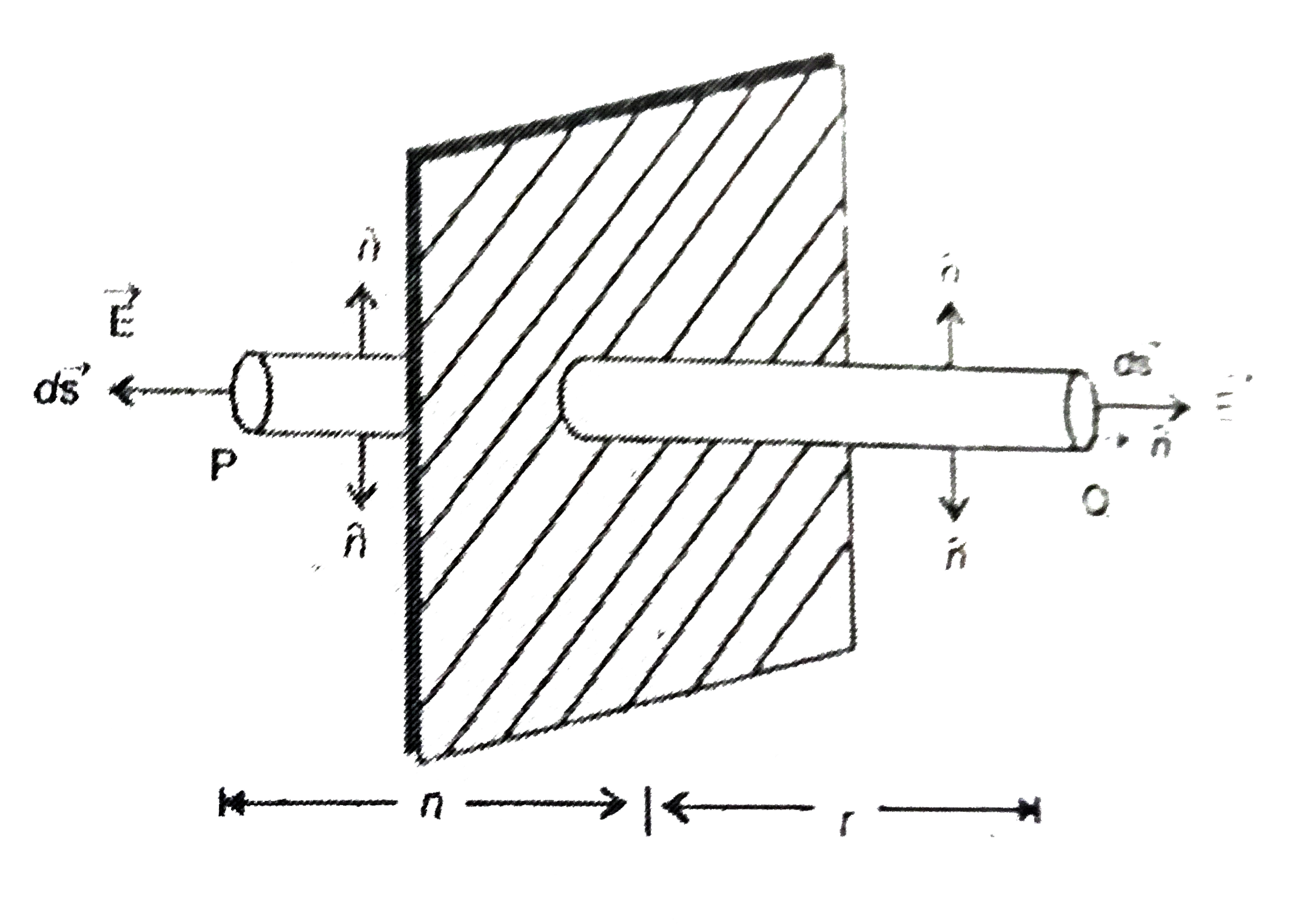 `implies 2 oint vec(E)vec(dS). = q/epsi_(0)` `implies 2 oint E dS=q/epsi_(0)``implies 2 E PI r^(2)=q/epsi_(0) implies E=q/(2pi epsi_(0) r^(2))` `:.` The charge density `sigma=q/S` `implies q= pi r^(2) sigma` `E=(pi r^(2) sigma)/(2 pi epsi_(0) r^(2))` `E= sigma/(2 epsi_(0))`, vectorically `vec(E)= sigma/(2 epsi_(0)) hat(n)` Where `hat(n)` is a unit vector normal to the plane and going away from it. where `sigma gt 0` E is directed away from both sides. Now consider two infinite plane parallel sheets of charge A and B. Let `sigma_(1)=sigma` and `sigma_(2)=- sigma` be the uniform surface density of charge on A and B RESPECTIVELY. The electric field between two PLATES is given by `E=E_(1)-E_(2)` `=sigma_(1)/(2 epsi_(0))-sigma_(2)/( 2 epsi_(0))=sigma/(2 epsi_(0))-((-sigma)/(2epsi_(0)))=(sigma+sigma)/(2epsi_(0))` `:. E=(2 sigma)/(2 epsi_(0)) implies E= sigma/epsi_(0)`. 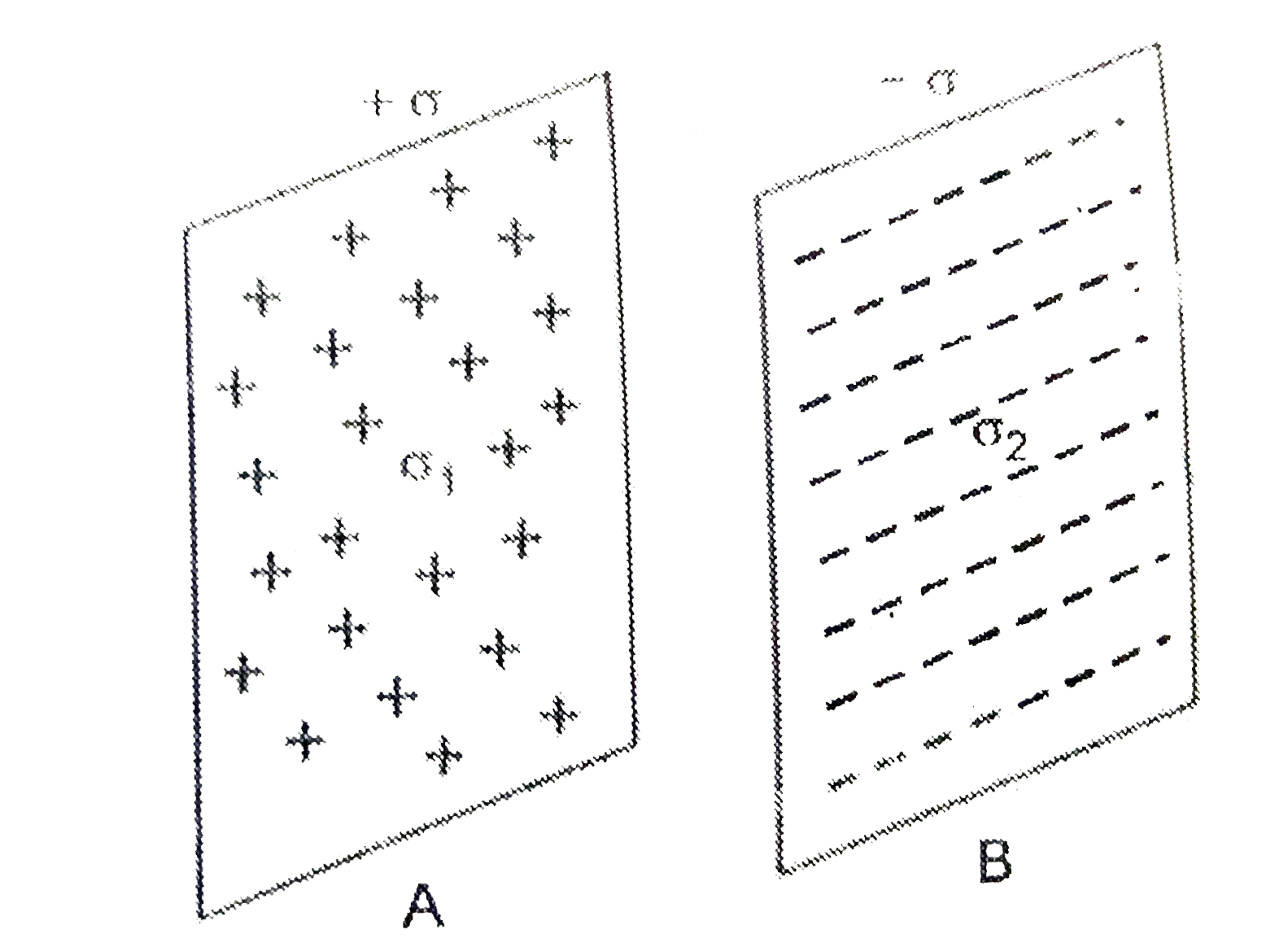
|
|
| 36. |
A body cools from 62^(@)C to 50^(@)C in 10 minutes and to 42^(@)C in the next 10 minutes. Find the temperature of surroundings. |
|
Answer» Solution :For the FIRST ten minutes `(dT)/(dt)=-((62^(@)-50^(@))/10)=-1/2^(@)C//"min"` and `DeltaT=((62^(@)+50^(@))/2)-T_(0)(56-T_(0))^(@)C` `implies-1.2^(@)C//"min"=-KA(56-T_(0))^(@)C`………1 Similarly for the next ten minutes `(dT)/(dt)=[(42^(@)-50^(@))/2]=-0.8^(@)C`/min and `DeltaT=((42^(@)+50^(@))/2)-T_(0)=(45-T_(0))^(@)C` `implies-0.8^(@)` C/min=`-KA(45-T_(0))^(@)C`........2 DIVIDING 1 and 2 `3/2=(56^(@)-T_(0))/(46^(@)-T_(0))` `impliesT_(0)=26^(@)C` |
|
| 37. |
What is a thermopile? On what principle does it work? |
| Answer» Solution :Thermopile is a divice used to detect THERMAL RADIATION. It works on the PRINCIPLE of seedbeck EFFECT. | |
| 38. |
Statement I : The temperature dependence of resistance is usally given as R=R_(0)(1+alphaDeltat). Theresistance is of a wire changes from 100Omega " to "150Omega when its temperature is increased from 27^(@)C" to "227^(@)C. This implies that alpha=2.5xx10^(-3)//^(@)C.Statement II : R=R_(i)(1+alphaDeltaT) is valid only when the change in the temperature DeltaT is small and DeltaR=(R-R_(0))ltltR_(0) |
|
Answer» Statement I ISTRUE , Statement II is false. |
|
| 39. |
A biconvex lens of focal length f forms a circular image of radius r of sun is focal plane. Then, which option is correct? |
|
Answer» `pir^(2)propf` or `r prop f` `:. pi r^(2)propf^(2)` 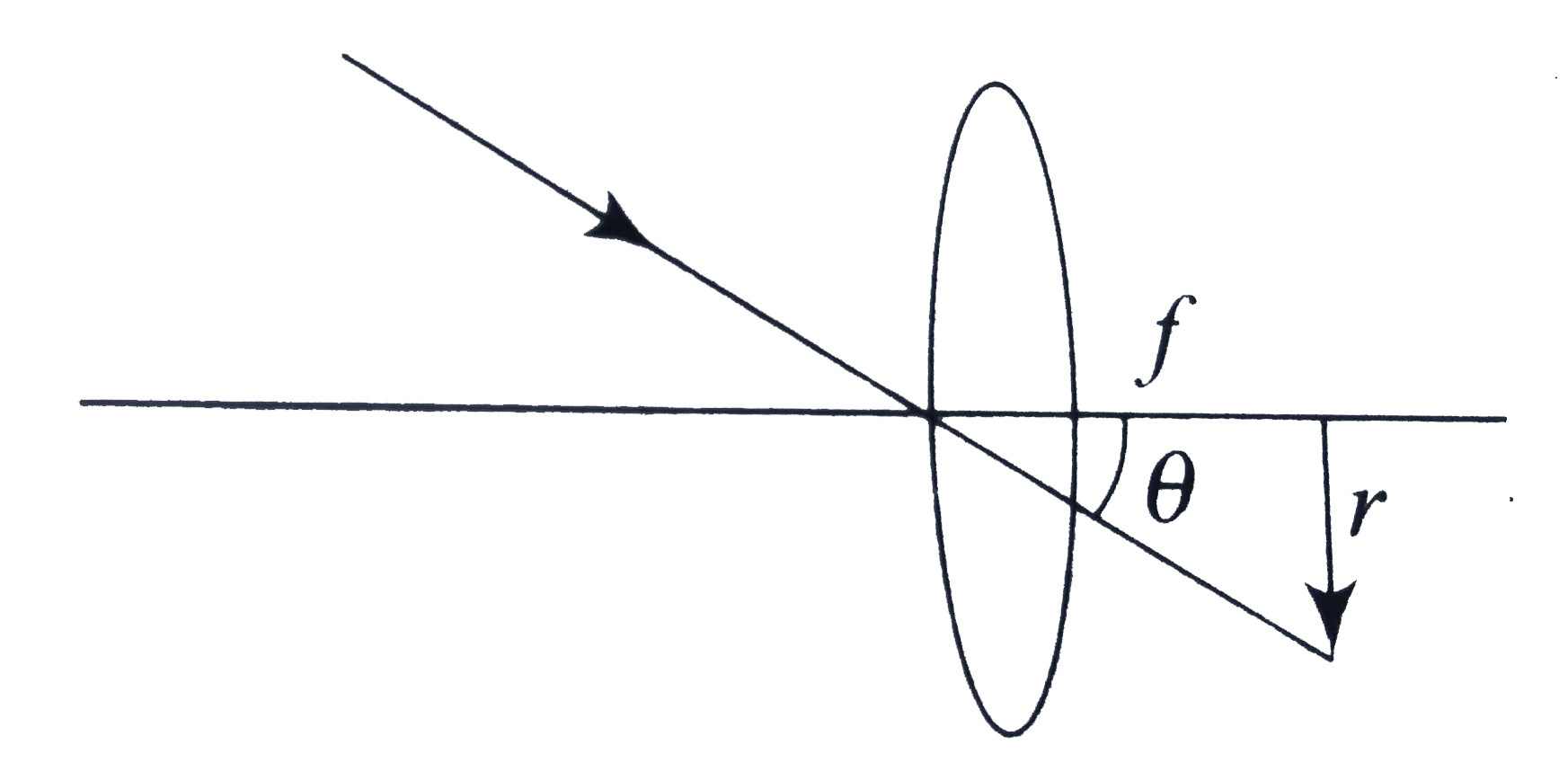
|
|
| 40. |
A anc B are the numerical values of a physical quantity and C and D are its units in two systems of measurement. If CgtD, then |
|
Answer» `A gt B ` |
|
| 41. |
Give reasons why convex mirrors are generally used as driving mirrors. |
|
Answer» PLANE mirror |
|
| 42. |
There are two coils A and B as shown in figure. A current starts flowing in B as shown, when A is moved towards B and stops when A stops moving. The current in A is counter clockwise. B is kept stationary when A moves. We can infer that |
|
Answer» there is a constant current in the clockwise direction in A. Now induced current in loop B is in counter clockwise which indicates that in loop A also current should be in counter clockwise according to Lenz.s law. (Consider loop A as MAGNET and think about how magnetic field lines of loop A link with loop B). |
|
| 43. |
Give the stability position of bar magnet for theta = 0^@, 180^@. |
| Answer» Solution :`theta = 0^@` gives MAXIMUM stable position and `theta = 180^@` gives maximum UNSTABLE position | |
| 44. |
A: Charge cannot exist without mass but mass can exist without charge. B: Charge is invariant but mass is variant with velocity C: Charge is conserved but mass alone may not be conserved. |
|
Answer» A, B, C are true |
|
| 45. |
The band gaps of a conductor, semiconductor and insulator are respectively Eg_(1), and Eg_(2) and Eg_(3). The relationship between them can be given as ……… |
|
Answer» `Eg_(1)=Eg_(2)=Eg_(3)` |
|
| 46. |
The resultant of two forces 2P and sqrt(2) P is sqrt(10) P. The angle between the forces is |
|
Answer» `30^(@)` |
|
| 47. |
The energies of the incident photons are 3, 4, 5 eV. The work functions of the metals are 0.5, 1.5, 2.5 eV. The maximum K.E.s of the photo electrons are in the ratio |
|
Answer» `3:4:5` |
|
| 48. |
In Young's double slit expriment, assume intensity of light on screen due to each source alone is I_(0) and K_(1) is equal to difference of maximum and minimum intensity. Now intensity of one source is made (I_(0))/(4) and K_(2) is again difference of maximum and minimum intensity . Then (K_(1))/(K_(2))= |
|
Answer» 4 |
|
| 49. |
In the Bohr model of the hydrogen atom, an electron revolves in a circular orbit around the nucleus of a single proton. IF the radius of the orbit is 5.28 xx10^(-11) m, find the number of revolutions of the electrons per second. ( Charge on electron =1.6xx10^(-19)Cand charge on proton is same as on electron but positive.) (Hint: Coulomb's force of attraction = omega^(2)r) |
|
Answer» |
|