

Saved Bookmarks
This section includes 7 InterviewSolutions, each offering curated multiple-choice questions to sharpen your Current Affairs knowledge and support exam preparation. Choose a topic below to get started.
| 1. |
Based on equation E=-2.178 xx10^(-15)J (z^(2))/(n^(2))certain conclusion are written. Which of them is not correct ? n = 3, I = 1 and m = 0 |
|
Answer» Larger the VALUE of N, the larger is the orbit radius |
|
| 2. |
Based on equation E=-2.178xx10^(-18)((z^(2))/(n^(2)))J, certain conclusions are written, which of them is not correct- |
|
Answer» equation can be USED to calculate the change in energy when the electron changes orbit |
|
| 3. |
Based on equation E = -2.178 xx 10^(-18)((Z^2)/(n^2)) J certain conclusion are written. Which of them is not correct? |
|
Answer» Equation can be used to CALCULATE the energy change when the electron changes ORBIT. |
|
| 4. |
Based on equation E = - 2.178 xx 10^(-18)J ((Z^(2))/(n^(2))), certain conclusions are written. Which of them is not correct ? |
|
Answer» Equations can be used to calculate the change in energy when the ELECTRON changes orbit |
|
| 5. |
Based on entropy Change predict a spontaneous reaction among the following. (A): (NH_(4))_(2)CO_(3)(s) to 2NH_(3)(g)+CO_(2)(g) +H_(2)O(l)and (B):NH_(3)(g)+H_(2)S(g)to NH_(4)HS_((s). |
| Answer» Solution : Reaction .A. is spontaneous based on the entropy change. One mole of SOLID AMMONIUM carbonate gives three moles of gascous PRODUCTS, there by INCREASING the DISORDERLINESS and entropy. The entropy change is positiye. | |
| 6. |
Based on M.O elecrtonic configuration, compare the magnetic property of O_2 and O_2^2- |
|
Answer» Solution :For `O_2`,B.O = 1/2[10-6] = 4/2 = 2 For `O_2^2-`,B.O = 1/2[10-8] = 2/2 = 1 THUS `O_2` with HIGHER BOND ORDER is more STABLE than `O_2^2-` with lower of bond order. |
|
| 7. |
Base strength of (i)H_(2)Coverset(oplus)CH_(2) (ii) H_(2)C = oplus(CH) and (iii) H- C -= C^(oplus) is in the order of |
|
Answer» `(ii) gt (i) gt (III)` `HC -= CH gt CH_(2) = CH_(2) gt CH_(3) - CH_(3)` ELECTRONEGATIVITY `SP gt SP^(2) gt SP^(3)` |
|
| 8. |
Base strength of underset"(i)"(H_3C oversetthetaCH_2), underset"(ii)"(H_2C=oversetthetaCH) "and" underset"(iii)"(H-C-=C^theta) is in the order of |
|
Answer» (i) gt (III) gt (ii) |
|
| 9. |
barr, average distance also described as expectation value ofthe distance of the electron from the nucleus is different from r_(max). For 1s orbital of H-atom, r_(max)=a_(0), barr=3/2a_(0). For 2s orbital of H-atom r_(max) =0.77a_(0) "and" 5.23a_(0). Find barr"for"r_(max) = 5.23a_(0). Also find barr_(2) for 1s orbital of Li^(2+) ion. Hence find the value of ((barr_(1)xxbarr_(2)))/(a_(0)^(2)). |
|
Answer» |
|
| 10. |
Baryta is |
| Answer» Solution :BaO is called Beryta | |
| 11. |
Barium permangnate solution (20mL, 0.1 M) is mixed with 0.1 N I^(-) giving precipitate fo IO_(3)^(-) and MnO_(2) . Resulting solution is filtered and titrated against Mo^(3+), giving MoO_(2)^(2+) and Mn^(2+). Which required 0.5 M, 10mL acidified Mo^(3+) .Select the correct option (s). |
|
Answer» Volume of `I^(-)` solution taken is 30mL |
|
| 12. |
Barium nitrate is crystallize as ...... salt. |
|
Answer» Complex salt |
|
| 13. |
Barellium and magnesium are of ...... colour. |
|
Answer» ASH like |
|
| 14. |
BaO has a rock-salt type structure. When subjected to high pressure, the ratio of the coordination number of Ba^(+2) ion to O^(-2) changes to |
| Answer» ANSWER :C | |
| 15. |
Balmer series spectral lines are observed in visible region, in the spectrum of which of the following |
|
Answer» HYDROGEN |
|
| 16. |
Balmer gave an equation for wavelength of visible region of H-spectrum as barv =(n^2 - 4)/(Kn^2)where n = principal quantum number of energy level, K = constant terms.of R (Rydberg constant). The value of K in terms of R is: |
|
Answer» R After SIMPLIFICATION of this equation and then comparing with `bar(V) = (n^2 - 4)/(Kn^2) ` we get K = 4/R |
|
| 17. |
Balloons of 4L capacity are to be filled with Hydrogen at a pressure of 1 atm and 27^@C from an 8L cylinder containing Hydrogen at 10 atm at the same temperature. The number of balloons that can be filled is |
|
Answer» 20 |
|
| 18. |
Balancing of molecular equation in alkaline medium.MnO_(2)+O_(2)+KOHrarrK_(2)MnO_(4)+H_(2)O |
Answer» SOLUTION :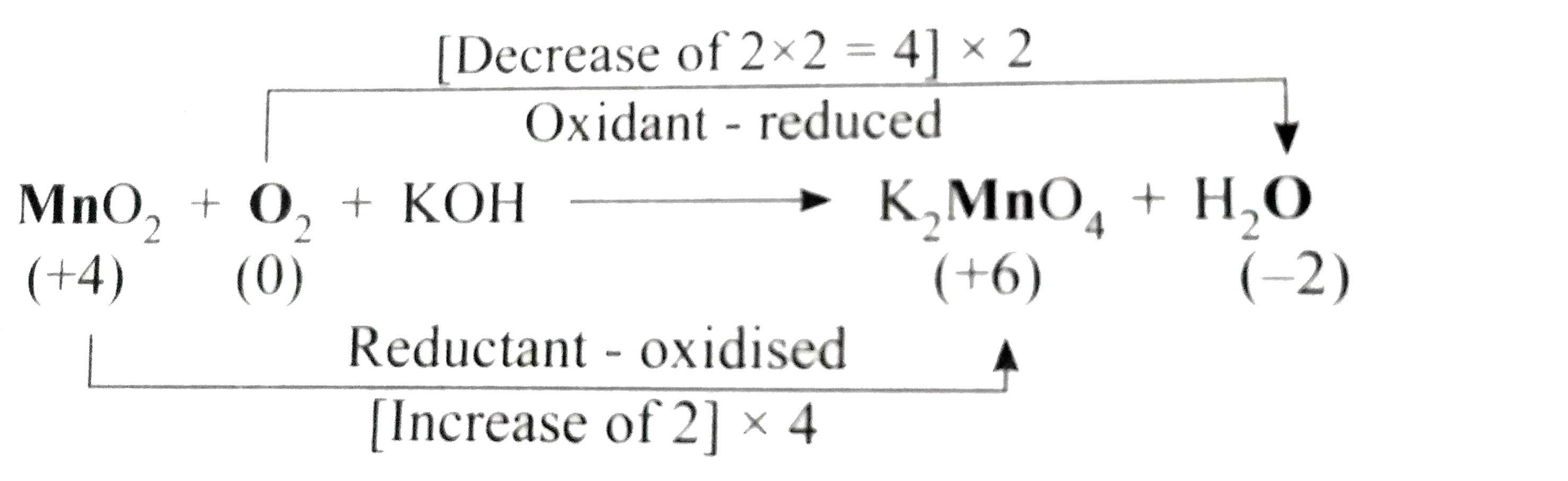 (ii) Balance the CHANGES in O.N. by multiplying the OXIDANT and reductant by suitable numbers ` 4MnO_(2)+2O_(2)+KOHrarrK_(2)MnO_(4)+H_(2)O ` (iii) Balance the equation atomically (except O and H). `4MnO_(2)+2O_(2)+KOHrarr4K_(2)MnO_(4)+H_(2)O` (iv)Balance oxygen and hydrogen atoms by multiplying `H_(2)O` by 4. `4MnO_(2)+2O_(2)+8KOHrarr4K_(2)MnO_(4)+4H_(2)O` |
|
| 19. |
Balance the oxidation reduction rection FeS_(2)+O_(2)rarrFe_(2)O_(3)rarrFe_(2)O_(3)+SO_(2) |
|
Answer» Solution :This is an example of a reaction which occurs in absence of acids and bases nd hence blancing of O atoms cannot be done by addition of`H_(2)O` molecules but has to be done on the basis of GAIN or loss of eelctrons to balance such reactions following steps are followed Step 1 Identify atoms whose oxidation numbers undergo a change writing the oxidation number of each atom above its symbol we have `overset(+2)Feoverset(-1)S_(2)+O_(2) to Fe_(2)O_(3)^(-)+S O_(2)` that of O has decreased form 0 to -2 in other owrds both FE and S of `FeS_(2)` hav been oxidised since Fe and S must maintain therir atomic ratio of 1:2 therefore the change of oxidation number of these two atoms must be considered together Step 2 Determine the total increase nd decrease in oxidation number indicating the increase nd decrease in oxidation numbners in each case we have  Step 3 Balance the total increase and decrease in oxidation numbers To balance the total increase in oxidation number of Feand S and decrease in oxidation number of O multiply Eq (ii) by 4 nadEq (iii) by 11 and adding we have Since `overset(2-)O` does not occur independetly so the `22overset(2-)` must be factorized in such a manner that hey become parts of `Fe_(2)O_(3) and SO_(2)` Rearranging Eq (iv) we have `4FeS_(2)+11 O_(2) to 2Fe_(2)O_(3)+8 SO_(2)` This represents the required balanced equation II Half Reactin mehod or ion electron method This method of balancing redox equation is based upon the principle that electrons lost during oxidation half rection o fnay redox reaction are equal to the eletrons gained during reduction half rection the various steps involved in this method are Step 1 Write the skeletal equation and indicate the oxidation number (O.N) of all the elements which appear in the skeletal equation above their respective symbols Step 2 Find out the specied whihc are oxidaised and which are reduced Step 3 Split the skeletal equation in to two half reactions i.e oxidaion half reaction and reduction half reation Step 4 BALACNE the two half reaction equatin rsepreately by the rules described below (i) In each half reaction first balace the atoms of ht elements which have undergone a change in oxidation number (ii) Add electrons to whatever side is necessary to make up the difference in oxation number in each half reaction (iii) alacne charge by adding `H^(+)` ions if the reaction occurs in the acidic medium and by adding `OH^(-)` ions if the reaction occurs in the basic medium (iv) Balance oxygen atoms by adding required number of `H_(2)O` molecules to the side deficient in O atoms (v)In the acidic medium H atoms are balcned by adding `H^(+)` ions to hte side deficient in H atoms however in an equal number `OH^(-)` ions AE included in the opposidet side of the equation Remove the duplication if any Step 5 The two half reactionare then multiplied by suitable integers so that the totyal number of elctorns gained in one half reaction is equal to the number of electrons lost in the other half reaction The two half reactions are then ADDED up these rules are illustrated by thefollowing expales step 6 verification To verify whether the eaution thus obtained is balaced or not the total charge on sither side the equation must be equal |
|
| 20. |
Balance the redox reaction by oxidation number method. MnO_(4)^(-)(aq)+Br^(-)(aq)toMnO_(2)(s)+BrO_(2)^(-)(aq) (Basic medium) |
Answer» Solution : 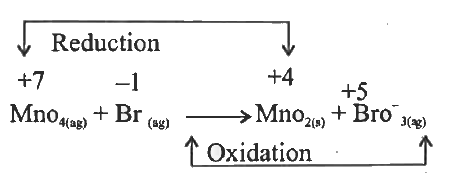 `MnO_(4)^(-) overset(1_(CANCEL(3))"UNITS")(to)MnO_(2)to` REDUCTION `Br^(-)overset(2_(cancel(6))"units")(to)Bro_(3)^(-)to`Oxidation `x^(1y)` The reduction EQN by 2 units and oxidation eqn by 1 unit `{:(MnO_(4)^(-)"" to ""2MnO_(2)),(Br^(-)""to""BrO_(3)^(-)),(______________________________),(2MnO_(4)^(-)+Br^(-)to2MnO_(2)+BrO_(3)^(-)):}` As the Reaction occurs in basic medium to equal ionic charges `20 H^(-)` are added on RHS. To balance hydrogen atom add `H_(2)O` on LHS. `2MnO_(4)^(-)+Br^(-)+H_(2)Oto2MnO_(2)+BrO_(3)^(-)+2OH^(-)` |
|
| 21. |
Balance the Redox reaction using oxidation number method. SO_(2)+H_(2)StoS+H_(2)O |
|
Answer» Solution :`overset(+4)(S)O_(2)overset(1xx4^(2))(to)overset(0)(S)` Reduction `H_(2)overset(-2)(S)overset(1xx2^(1))(to)overset(0)(S)` oxidation MULTIPLY oxidation equatioin by 2 and reduction equation by 1. `SO_(2)toS` `2H_(2)Sto2S` ADD both the EQUATIONS `SO_(2)+2H_(2)Sto3S` Balancing the atoms of hydrogen and oxygen by introducing suitable NUMBER of `H_(2)O` molecules to the product. |
|
| 22. |
Balance the ionic equation in alkaline medium Cr(OH)_(3)+IO_(3)^(-) to I^(-)+CrO_(4)^(2-) |
Answer» Solution :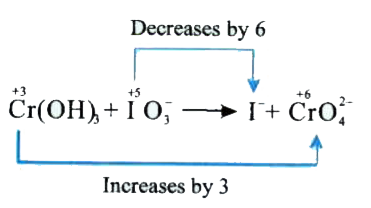 `2Cr(OH)_(3)+IO_(3)^(-) to I^(-)+2CrO_(4)^(2-)` `2Cr(OH)_(3)+IO_(3)^(-)+4OH^(-) to I^(-) +2CrO_(4)^(2-)+H_(2)O+4H_(2)` Now, `2Cr(OH)_(3)+IO_(3)+4OH^(-) to I^(-) 2CrO_(4)^(2-)+5H_(2)O` |
|
| 23. |
Balance the following redox reactions by ion-electron method. MnO_(4)^(-)(aq)+I^(-)(aq)toMnO_(2)(s)+I_(2)(s) (in basic medium) |
|
Answer» Solution :Balance these equations according to the steps discussed in. The BALANCED equations are as given below. `2MnO_(4)^(-)(aq)+6l^(-)(aq)+4H_(2)O(l)to2MnO_(2)(s)+3l_(2)(s)+8OH^(-)(aq)` |
|
| 24. |
Balance the following redox reactions by ion electron method MnO_4^-(aq) + SO_2 (g) toMn^(2+) (aq) + HSO_4^- (aq) (acid medium) |
| Answer» SOLUTION :`2MnO_4^- (AQ) + 6I^-(aq) + 4H_2O(l) + H^-(aq) to 2Mn^(2+) (aq) + 5HSO_4^-`(aq) | |
| 25. |
Balance the following redox reactions by ion-electron method. MnO_(4)^(-)(aq)+SO_(2)(g)toMn^(2+)(aq)+HSO_(4)^(-)(aq) (in acidic solution) |
|
Answer» Solution :BALANCE these EQUATIONS ACCORDING to the steps discussed in. The balanced equations are as given below. `2MnO_(4)^(-)(aq)+5SO_(2)(g)+2H_(2)O(L)+H^(+)(aq)to2Mn^(2+)(aq)+5HSO_(4)^(-)(aq)` |
|
| 26. |
Balance the following redox reaction by ion electron method MnO_4^- (aq) + I^-(aq) toMnO_2(s) + I_2(s)(base medium) |
| Answer» SOLUTION :`2MnO_4^- (aq) + 6I^- (aq) + 4H_2O (l) to 2MnO_2 (s) + 3I_2 (s) + 80 h^-` (aq) | |
| 27. |
Balance the following redox reactions by ion-electron method. H_(2)O_(2)(aq)+Fe^(2+)(aq)toFe^(3+)(aq)+H_(2)O(l) (in acidic solution) |
|
Answer» Solution :BALANCE these equations according to the steps discussed in. The BALANCED equations are as GIVEN below. `H_(2)O_(2)(aq)+2FE^(2+)(aq)+2H^(+)(aq)to2Fe^(3+)(aq)+2H_(2)O(l)` |
|
| 28. |
Balance the following redox reactions by ion -electron method: H_(2)O_(2)(aq)+Fe^(2+)(aq) to Fe^(3+)(aq)+H_(2)O(l)(in acidic solution) |
|
Answer» SOLUTION :Oxidation reaction : `Fe^(2+)(aq)toF^(3+)(aq)+e` Reduction reaction:`H_(2)O_(2)(aq)+2H^(+)_(2)O(l)` Multipying equation (1) and (2) then ADDING it to equation (2), we have `2Fe^(2+)(aq)+H_(2)O_(2)(aq)+2H^(+)(aq)2Fe^(3+)(aq)+2H_(2)O(l)` |
|
| 29. |
Balance the following redox reaction by ion electron method H_2O_2 (aq) + Fe^(2+) (aq) toFe^(3+)(aq) + H_2O (l) (acid medium) |
| Answer» Solution :`H_2O_2 (AQ) + 2Fe^(2+) (aq) + 2H^+ (aq) to 2Fe^(3+) (aq) + 2H_2O (l)` | |
| 30. |
Balance the following redox reactions by ion-electron method. Cr_(2)O_(7)^(2-)+SO_(2)(g)toCr^(3+)(aq)+SO_(4)^(2-)(aq) (in acidic solution) |
|
Answer» Solution :BALANCE these EQUATIONS according to the steps discussed in. The balanced equations are as given below. `Cr_(2)O_(7)^(2-)(aq)+3SO_(2)(g)+2H^(+)(aq)to2Cr^(3+)(aq)+3SO_(4)^(2-)(aq)+H_(2)O(l)` |
|
| 31. |
Balance the following Redox reaction by ion-electron method or oxidation number method (Acid medium).Cr_2O_(7(aq))^(2-) + SO_(2) .............> Cr^(3+) SO_(4(aq))^(2-) |
| Answer» SOLUTION :`Cr_2O_7^(2-) (AQ) + 3SO_2 (g) + 2H^+ (aq) to 2Cr^(3+) (aq) + 3SO_4^(2-) (aq) + H_2O (L)` | |
| 32. |
Balance the following redox reactions by ion electron method : (a) MnO_(4(aq))^(-)+I_((aq))^(-)toMnO_(2(s))+underset(("in basic medium"))(I_(2(s))) (b) MnO_(4(aq))^(-)+SO_(2(g))toMn_((aq))^(2+)+underset(("in acidic solution"))(HSO_(4(aq))^(-)) ( c) H_(2)O_(2(aq))+Fe_((aq))^(2+)toFe_((aq))^(3+)+underset(("in acidic solution"))(H_(2)O_((l))) (d) Cr_(2)O_(7)^(2-)+SO_(2(g))toCr_((aq))^(3+)+underset(("in acidic solution"))(SO_(4(aq))^(2-)) |
|
Answer» Solution :(a) `MnO_(4(aq))^(-)+I_((aq))^(-)toMnO_(2(s))+underset("(BASIC medium)")(I_(2(s)))` Step-1 : Write the half reaction. OHR : `overset(-1)(I_((aq))^(-))tooverset(0)(I_(2(s)))` RHR : `overset(-7)(MnO_(4(aq))^(-))tooverset(+4)(MnO_(2(aq)))` Step-2 : In OHR BALANCE the I and then balance the charge while adding electrons. OHR : `2I_((aq))^(-)toI_(2(s))+2e^(-)` Step-3 : In RHR, oxidation number of Mn is reducing from +7 to +4. Therefore add `3e^(-)` to left side and balance the electric charge. `MnO_(4(aq))^(-)+3e^(-)toMnO_(2(aq))+4OH^(-)` Step-4 : Adding `2H_(2)O`, for the balancing of oxygen. `MnO_(4(aq))^(-)+2H_(2)O+3e^(-)toMnO_(2(aq))+4OH^(-)` Step-5 : In both reaction, balancing the electron O.H.R. is multiply by 3 and R.H.R. is multiply by 2 and adding the reaction.  (b) `MnO_(4(aq))^(-)+SO_(2(g))toMn_((aq))^(2+)+underset(("Acidic medium"))(HSO_(4(aq))^(-))` Step-1 : Half reaction. OHR : `overset(+4)(SO_(2(g)))tooverset(+6)(HSO_(4(aq))^(-))` RHR : `overset(-7)(MnO_(4(aq))^(-))toMn_((aq))^(2+)` Step-2 : In O.H.R. and R.H.R., balancing the oxygen atom, `H_(2)O` is added and as it is acidic medium `H^(+)` is added. `SO_(2(g))+2H_(2)O_((l))toHSO_(4(aq))^(-)+3H_((aq))^(+)` `MnO_(4(aq))^(-)+8H_((aq))^(+)toMn_((aq))^(+2)+4H_(2)O` Step-3 : To balance the electric charge `e^(-)` is added. `SO_(2(g))+2H_(2)O_((l))toHSO_(4(aq))^(-)+3H_((aq))^(+)+2e^(-)` `MnO_(4(aq))^(-)+8H_((aq))^(+)+5e^(-)toMn_((aq))^(+2)+4H_(2)O_((l))` Step-4 : In both the half reaction, balancing the `e^(-)` O.H.R. is multiplyed by 5 and R.H.R. multiplied and added by 2 and adding the reaction.  ( c) `H_(2)O_(2(aq))+Fe_((aq))^(2+)toFe_((aq))^(3+)+underset(("Acidic medium"))(H_(2)O_((l)))` Step-1 : Half reaction. O.H.R. : `Fe_((aq))^(2+)toFe_((aq))^(3+)` R.H.R. : `overset(-1)(H_(2)O_(2(aq)))tooverset(-2)(H_(2)O_((l)))` Step-2 : In R.H.R., oxygen atom is balanced by `H_(2)O` and as it is acidic medium `H^(+)` is added. `H_(2)O_(2(aq))^(+)+2H_((aq))^(+)to2H_(2)O_((l))` Step-3 : Add `e^(-)` to balance the electric charge. O.H.R. : `2Fe_((aq))^(2+)toFe_((aq))^(3+)+e^(-)` R.H.R. : `H_(2)O_(2(aq))+2H_((aq))^(+)+2e^(-)to2H_(2)O_((l))` Step-4 : For balancing half reaction both of side have to multiply by 2 in O.H.R.  (d) `Cr_(2)O_(7)^(2-)+SO_(2(g))toCr_((aq))^(3+)+underset(("Acidic solution"))(SO_(4(aq))^(2-))` Step-1 : Write half reactions. O.H.R. : `overset(+4)(SO_(2(g)))tooverset(+6)(SO_(4(aq))^(2-))` R.H.R. : `underset(+6)(Cr_(2)O_(7)^(2-))tounderset(+3)(Cr_((aq))^(3+))` Step-2 : Multiply by 2 for balance Cr in R.H.R. `Cr_(2)O_(7)^(2-)to2Cr^(+3)` Step-3 : For balancing H and O we have to add `H_(2)OandH^(+)` in acidic medium in both of the side. O.H.R. : `SO_(2(g))+2H_(2)OtoSO_(4(aq))^(2-)+4H_((aq))^(+)` R.H.R. : `Cr_(2)O_(7(aq))^(-2)+4H^(+)to2Cr_((aq))^(+3)+7H_(2)O` Step-4 : Balance charges of half reaction both of the side by electron. O.H.R. : `SO_(2(g))+2H_(2)OtoSO_(4(aq))^(2-)+4H_((aq))^(+)+2e^(-)` R.H.R. : `Cr_(2)O_(7(aq))^(-2)+14H_((aq))^(+)+6e^(-)to2Cr_((aq))^(+3)+7H_(2)O_((l))` Step-5 : For balancing electrons, both of the side multiply 3 on O.H.R. 
|
|
| 33. |
Balance the following redox reactions by ion electon mehtod (a) MnO_(4)^(-)+I^(-)(aq)rarrMnO_(2)(s)+I_(2) (in basic medium) (brgt (b)MnO_(4)^(-)(aq)+SO_(2)(g)rarrMn^(2+)(aq)+HSO_(4)^(-)(in acidic solution ) (c ) H_(2)O_(2)(aq)+Fe^(32+)(aq)rarrFe^(3+)(aq)+H_(2)O(l) (in acidic solution) (d) Cr_(2)O_(7)^(2-)(aq)+SO_(2)(g)rarrCr^(3+)(aq)+SO_(4)^(2-)(aq) (ion acidic solution) |
|
Answer» Solution :(B) following the genal procedure for ion electron method detailed onthe BALANCED half reactionare oxidationhalf equation`SO_(2)(g)+2H_(2)O(l)rarrHSO_(4)^(-)(aq)+3H^(+)(aq)+2e^(-)` reductin half equation : `MnO_(4)^(-)(aq)+8H^(+)(aq)+5e^(-)rarrMn^(2+)(aq)+4 H_(2)O(l)` (C ) oxidation half equation `Fe^(2+)(aq)rarrFe^(3+)(aq)+e^(-)` Multiply eq (i) by 2 and add it to eq (ii) we have `H_(2)O_(2)(aq)+2Fe^(2+)(aq)+2H^(+)(aq)rarr2Fe^(3+)(aq)+2H_(2)O(l)` (d) following the general procedurefor ion electron detailed on the balanced half reaction equation are Oxidation half equation`SO_(2)(g)+2H_(2)O(l)rarrSO_(4)^(2-)(aq)+4H^(+)(aq)+2e^(-)` multiply eq (i) by 3 and add it to eq (ii) we have `Cr_(2)O_(7)^(2)(aq)+3 SO_(2)(q)+2H^(+)(aq)+2H^(+)(aq)rarr2Cr^(3+)(aq)+3SO_(4)^(2-)(aq)+H_(2)O(l)` |
|
| 34. |
Balance the following redox reaction (i) SnO_(2)+c toSn+CO (ii)Fe_(3)O_(4)+c to Fe +CO (iii) I_(2)+HNO_(3) to H_(2)SO_(4) to Fe_(2)(SO_(4))_(3)+NO+H_(2)O (v)Fe+HNO_(3) to Fe(NO_(3))_(2)+NH_(4)NO_(3)+H_(2)O (vi)Sb+HNO_(3) to H_(3)SbO_(4)+NO_(2)+H_(2)O (vii) Hg+HNO_(3) to Hg_(2)(NO_(3))_(2)+NO+H_(2)O |
|
Answer» Solution :(i)`SnO_(2)+2CrarrSn+2CO` (II) `Fe_(3)O_(4)C rarr3Fe+4cO` (III)`I_(2)+10 HNO_(3)rarr 2HIO_(3)+10 NO_(2)+4 H_(2)O` (iv)`6FeSO_(4)+2HNO_(3)+3H_(2)SO_(4)rarr3Fe_(2)(SO_(4))_(3)+2NO+4H_(2)O` (v) `4Fe+10HNO_(3)rarrH_(3)SbO_(4)+5NO_(2)+H_(2)O` `(vi)Sb+5 HNO_(3)rarrH_(3)SbO_(4)+5NO_(2)+H_(2)O` (VII) `6Hg+8 HNO_(3) rarr3Hg_(2)(O_(3))_(2)+2NO+H_(2)O` |
|
| 35. |
Balance the following redox reaction by using Oxidation number method in acidic medium.Cr_2O_7^-2(aq)+SO_3^_2(aq)rarrCr^+3(aq)+SO_4^-2(aq) |
Answer» Solution :`Cr_(2)O_(7)^(2-)+SO_(3)^(2-)toCr^(3+)+SO_(4)^(2-)`(Acidic medium) 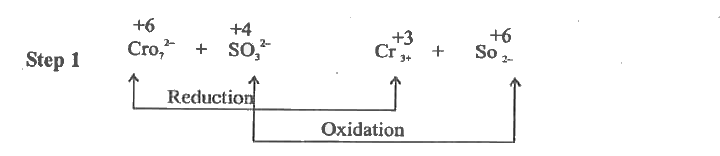 `Cr_(2)O_(7)^(2-)overset(CANCEL(2)xx3"units")(to)2Cr^(3+)` Reduction `SO_(3)^(2-)overset(cancel(2)"units")(to)SO_(4)^(2-)` OXIDATION multiply reduction equation by 1 unit and oxidation equation by 3 units `Cr_(2)O_(7)^(2-)to2Cr^(3+)` `3SO_(3)^(2-)to3SO_(4)^(2-)` Adding both equation `Cr_(2)O_(7)^(2-)+3SO_(3)^(2-)to2Cr^(3+)+3SO_(4)^(2-)` SINCE there are 4 oxygen atom more on LHS, `4H_(2)O` is added on RHS. The equation is balanced WRT H+Ion. `Cr_(2)O_(7)^(2-o)+3SO_(3)^(2-)+8H^(+)to2Cr^(3+)+3SO_(4)^(2-)+4H_(2)O` |
|
| 36. |
Balance the following redox reaction by using oxidation number method. MnO_(2)+Br^(-)toMn^(+2)+Br_(2)+H_(2)O (acid medium) |
Answer» Solution :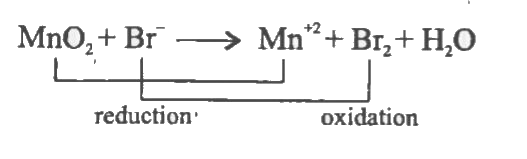 OXIDATION `underset(-1)(2Br^(-1))overset(2xx1"unit")(to)underset("ZERO")(Br_(2))]xxcancel(2)^(1)` Reduction `MnO_(2) overset(1xx2"unit")(to)underset(+2)MN^(+2)]xxcancel(2)^(1)` ______________________________________ `MnO_(2)+2Br^(-1)toMn^(+2)+2B_(2)` Balancing Hydrogen and Oxygen by adding `H_(2)O` molecules and `H^(+)` ions `MnO_(2)+2Br^(-1)+4H^(+)toMn^(+2)+Br_(2)+2H_(2)O` |
|
| 37. |
Balance the following redox equations. Br_(2)+OH^(-)toBrO_(3)^(-)+HBr (Basic medium) |
|
Answer» `3Br_(2)+6OH^(-)to5Br^(-)+5BrO_(3)^(-)+6H_(2)O` 
|
|
| 38. |
Balance the following reactions: a. U(SO_(4))_(2)+KMnO_(4)+H_(2)OrarrH_(2)SO_(4)+K_(2)SO_(4)+MNSO_(4)+UO_(2)SO_(4) b. Bi_(2)O_(3)+NaOH+NaOClrarrNaBiO_(3)+NaCl+H_(2)O c. Ca(Ocl)_(2)+KI+HCIrarrI_(2)+CaCl_(2)+H_(2)O+KCI d. MnO+PbO_(2)+HNO_(3)rarrHMnO_(4)+Pb(NO_(3))_(2)+H_(2)O (e) CeI_(3) + KOH + Cl_(20 rarr K_(2)CrO_(3) + KIO_(4) + Kcl+H_(2)O (g) Na_(2)HasO_(3) + NaI + HCl rarr NaCl + KBr + H_(3)AsO_(4) (g) Na_(2)TeO_(3) + Nal rarr NaCl + Te + H_(2)O+I_(2) (h) K_(3)[Fe(CN)_(6)] + Cr_(2)O_(3) + KOH rarr K_(4)[Fe(CN)_(6)]+K_(2)CrO_(4)+H_(2)O (i) NH_(3)+O_(2) rarr NO + H_(2)O (j) HNO_(3)+HI rarr NO + I_(2) + H_(2)O (k) MnSO_(4)+(NH_(4))_(2)S_(2)O_(8) + H_(2)O rarr MnO_(2) + H_(2)SO_(4)+(NH_(4))_(4) (l)CuO+NH_(3)rarrN_(2)+H_(2)O+Cu m. NaHSO_(4)+Al+NaOHrarrNa_(2)S+Al_(2)O_(3)+H_(2)O n. CoCl_(2)+Na_(2)O_(2)+NaOH+H_(2)OrarrCo(OH)_(3)+NaCl o. [Cu(NH_(3))_(4)]Cl_(2)+KCN+H_(2)rarrNH_(3)+NH_(4)Cl+KCl+KCNO+K_(2)Cu(CN)_(3) p. Sb_(2)O_(3)+KIO_(3)+HCI+H_(2)OrarrHSb(OH)_(6)+KCI+ICI q. WO_(3)+SnCl_(2)+HClrarrW_(3)O_(8)+H_(2)SnCl_(6)+H_(2)O r. CoCl_(2)+KNO_(2)+CIrarrK_(3)Co(CNO_(2))_(6)+NO+KCI+H_(2)O s. V(OH)_(4)Cl+FeCl_(2)+HClrarrVOCl_(2)+FeCl_(2)+FeCl_(3)+H_(2)O t. Ag+KCN+O_(2)+H_(2)OrarrK[Ag(CN)_(2)]+KOH u. KClO_(3)+H_(2)SO_(4)rarrKHSO_(4)+O_(2)+ClO_(2)+H_(2)O v. Cr_(2)O_(3)+Na_(2)CO_(3)+KNO_(3)rarrNa_(2)CrO_(4)+CO_(2)+KNO_(2) w. Au+CN^(ө)+O_(2)rarr[Au(CN)_(4)]^(ө) (aqueous solution) x. Zn+ReO_(4)^(ө)rarrRe^(ө)+Zn^(2+) (acidic medium) |
|
Answer» Solution :a. `U^(4+)(SO_(4)^(2-))_(2)+K^(o+)MnO_(4)^(ө)+H_(2)OSO_(4)^(2-)` `+(overset(o+)K)SO_(4)^(2-)+MN^(2+)+SO_(4)^(2-)+UO_(2)^(2+)SO_(4)^(2-)` Reaction is 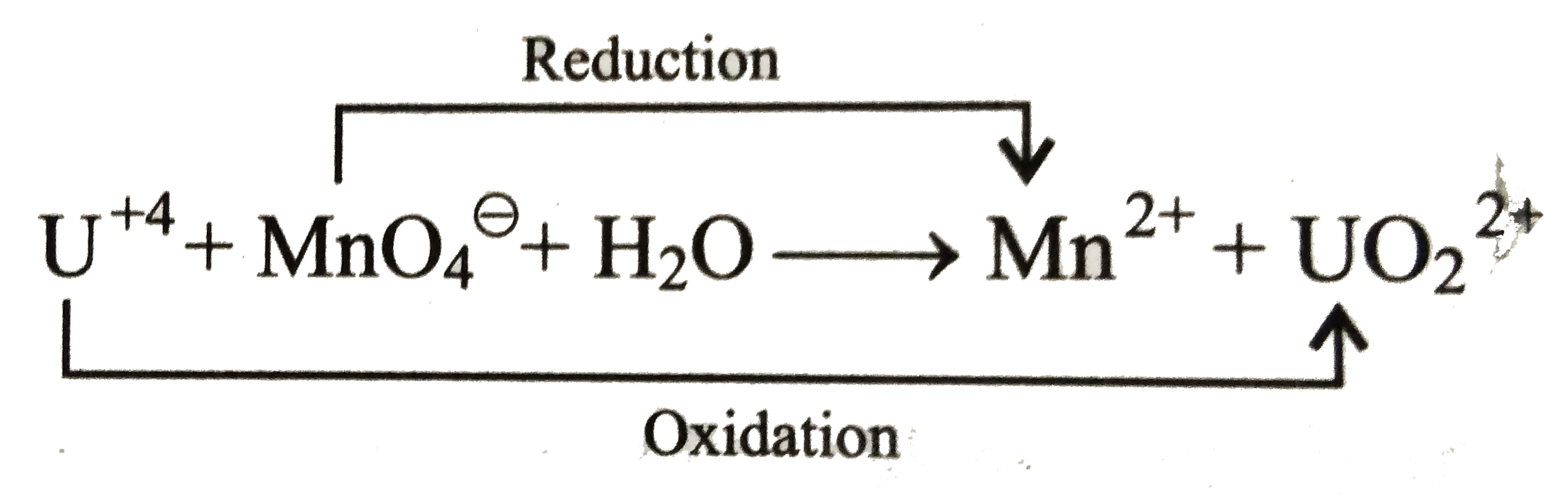 (Oxidation: `U^(4+)+2H_(2))rarrUO_(2)^(2+)+4H^(o+)+2e^(-)"]"xx5` (Reduction `10e^(-)+16H^(o+)+MnO_(4)^(ө)rarr2Mn^(2+)+8H_(2)O)` `ulbar(5U^(4+)+cancel(10overset(2)H_(2)O)+16H^(o+)+2MnO_(4)^(ө)rarr2Mn^(2+)+cancel(8H_(2)O)+5UO_(2)^(2+)+20H^(o))` or `5U(SO_(4))_(2)+2H_(2)O+2KMnO_(4)rarr2MnSO_(4)+5UO_(2)SO_(4)+2H_(2)SO_(4)+K_(2)SO_(4)` b. `Bi_(2)O_(2)+Na^(o+)overset(ө)OH+Na^(o+)OCl^(o+)rarrNa^(o+)Cl^(ө)+H_(2)O+overset(o+)NaBioverset(ө)O_(3)` Reaction is 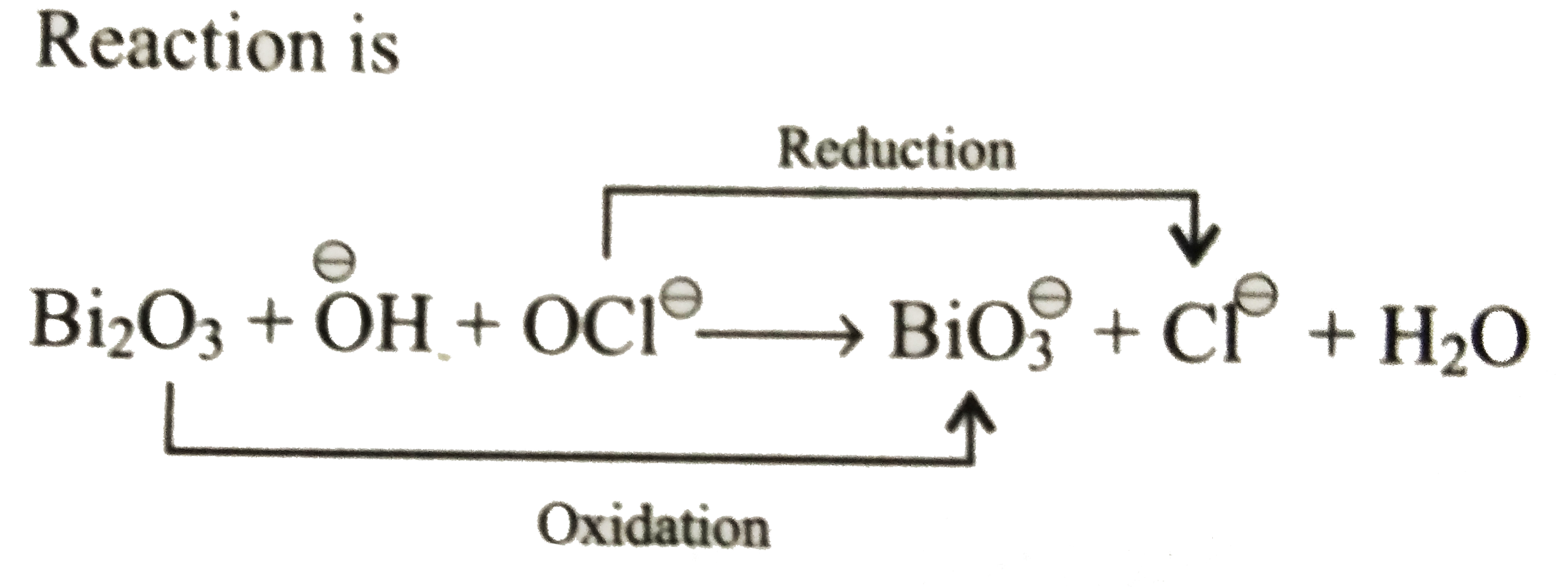 Oxidation: `6overset(ө)OH+Bi_(2)O_(3)^(ө)+3H_(2)O+4e^(-)` Reduction: `2e^(-)+H_(2)O+OCl^(ө)rarrCl^(ө)+2overset(ө)OH"]"xx2` `ulbar(2OCl^(ө)+2overset(ө)OH+Bi_(2)O_(3)rarr2BiO_(3)^(ө)+H_(2)O+2Cl^(ө))` or `ulbar(2NaOCl+2NaOH+Bi_(2)O_(3)rarr2NaBiO_(3)+H_(2)O_NaCl)` c. `Ca^(2+)(OCl^(ө))_(2)+K^(o+)I^(ө)+H^(o+)Cl^(ө)rarrI_(2)+Ca^(2+)(Cl^(ө))+H_(2)O+K^(o+)Cl^(ө)` Reaction is 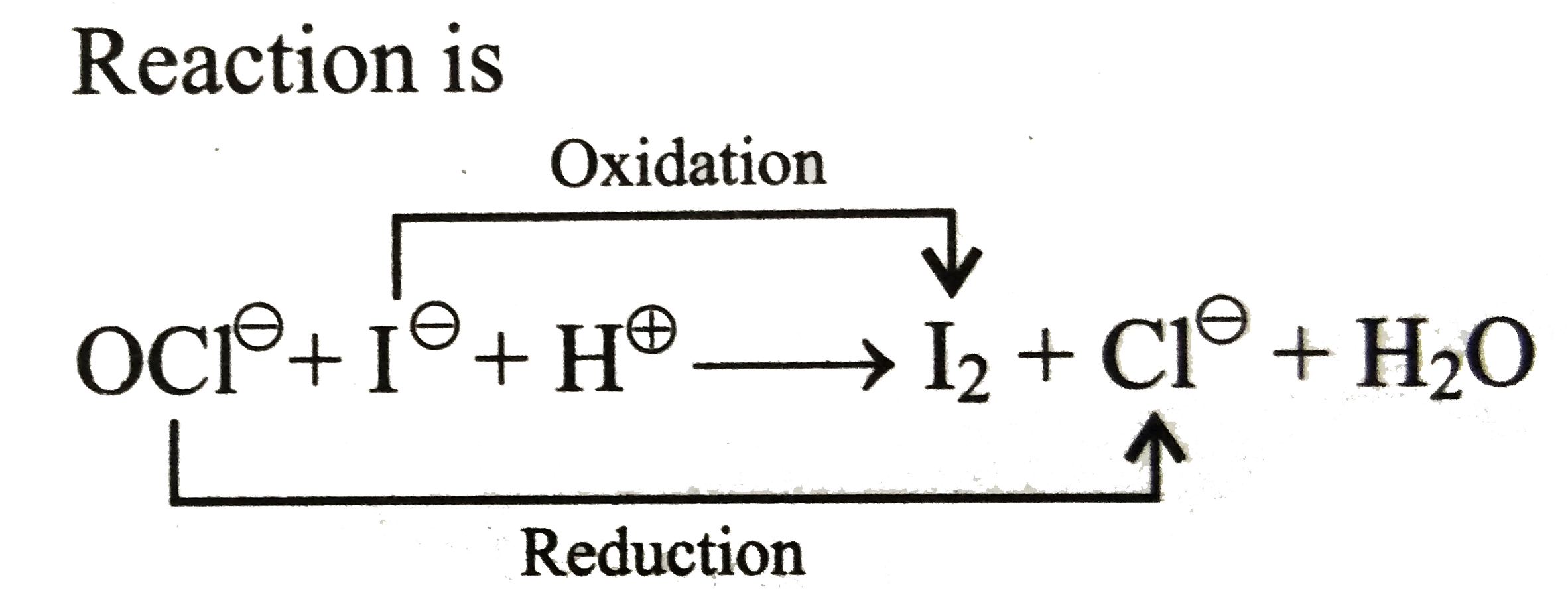 Reduction: `2e^(-)+2H^(o+)+OCl^(ө)rarrCl^(ө)+H_(2)O` Oxidation `2I^(ө)rarrI_(2)+2e^(-)` `ulbar(2I^(ө)+2H^(o+)+OCl^(ө)rarrCl^(ө)+H_(2)+I_(2))` `4KI+4HCl+Ca(OCl)_(2)rarrCaCl_(2)+2H_(2)O+2I_(2)+4KCl` d. `MnO+PbO_(2)+H^(o+)NO_(3)^(ө)rarrH^(o+)MnO_(4)^(ө)+Pb^(2+)(NO_(3)^(ө))_(2)+H_(2)O` Reaction is 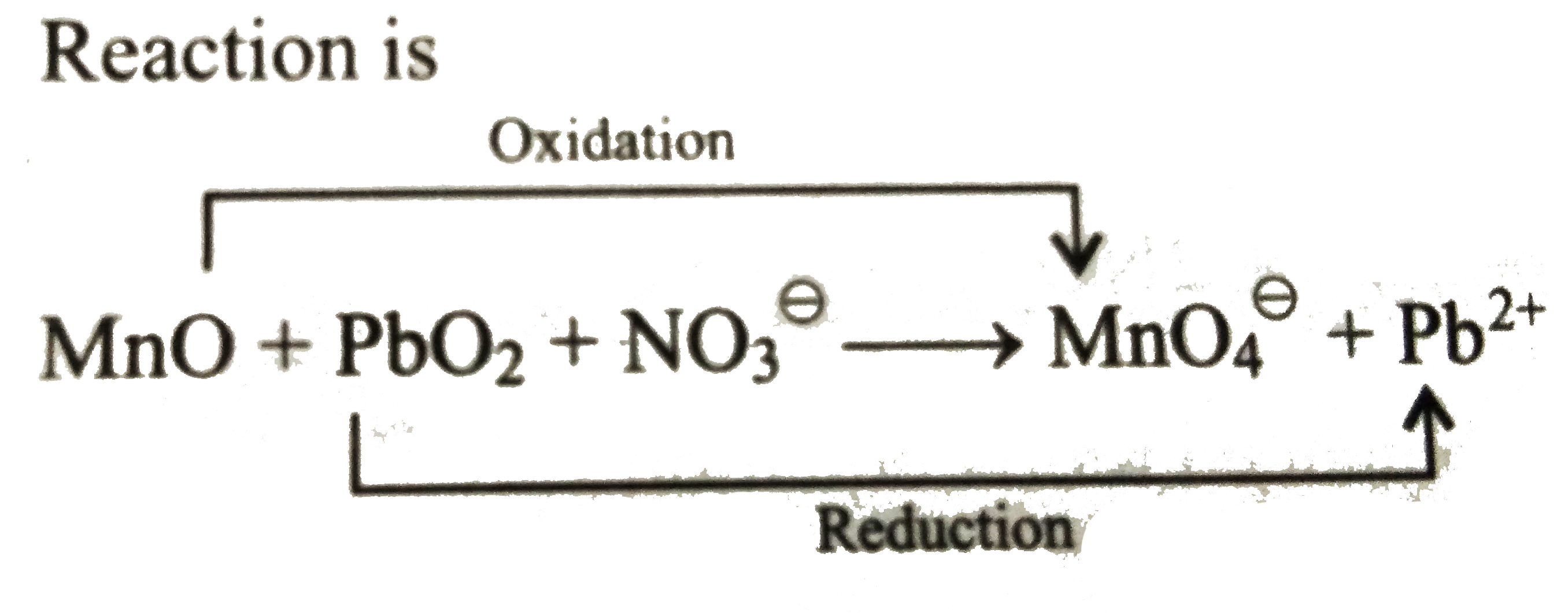 Oxidation: `3H_(2)O+MnOrarrMnO_(4)^(ө)+5e^(-)+6H^(o+)"]"xx2` Reduction: `4H^(o+)-2e^(-)+PbO_(2)rarrPb^(2)+2H_(2)O"]"xx5` `ulbar(2MnO+5PbO_(2)+8H^(o+)rarr2MnO_(4)^(ө)+5Pb^(2+)+4H_(2)O)` or `ulbar(2MnO+5PbO_(2)+10HNO_(3)rarr2HMnO_(4)+5Pb(NO_(3))_(2)+4H_(2)O)` e. `Cr^(3+)(I^(ө))_(3)+K^(o+)OH^(ө)+Cl_(2)rarr(k^(o+))_(2)CrO_(4)^(2-)+K^(o+)IO_(4)^(ө)+K^(o+)Cl^(ө)+H_(2)O` Note that both `I^(ө)` and `Cr^(3+)` are oxidised to `IO_(4)^(ө)` and `CrO_(4)^(2-)`, respectively, in basic medium. Oxidation: `[I^(ө)rarrIO_(4)^(ө)]` and `[Cr^(3+)rarrCrO_(4)^(2-)]` `24overset(ө)OH+12H_(2)O+3I^(ө)rarr3IO_(4)^(ө)+24e^(-)+24H_(2)O` `3x= -3, 3x-24= -3` `3x=21` `8overset(ө)OH+4H_(2)O+Cr^(3+)rarrCrO_(4)^(2-)+3e^(-)+8H_(2)O` `x=3, x-8= -2` `x=6` `ulbar (32overset(ө)OH+CrI_(3)rarr3IO_(4)^(ө)+CrO_(4)^(2-)+16H_(2)O...(i))` Reduction: `[Cl_(2)rarr2Cl^(ө)]` `2e^(-)+Cl_(2)rarr2Cl^(ө)`....(ii) Multiply equation (i) by `2` and equation (ii) by `27` and add to get final redox equation `ulbar(64overset(ө)OH+2CrI_(3)+27Cl_(2)rarr61O_(4)^(ө)+2CrO_(4)^(2-)+54Cl^(ө)+32H_(2)O)` or ltbegt `ulbar(64KOH+2CrI_(2)+27Cl_(2)rarr6KIO_(4)+2K_(2)CrO_(4)+54KCl+32H_(2)O)` f. `(Na)^(o+)HAsO_(3)^(2-)+K^(o+)BrO_(3)^(ө)+H^(o+)Cl^(ө)rarrNa^(o+)Cl^(ө)+K^(o+)Br^(ө)+H_(3)AsO_(4)` Oxidation `[HAsO_(3)^(2-)rarrH_(3)AsO_(4)]` `HAsO_(3)^(2-)+H_(2)OrarrH_(3)AsO_(4)+2e^(-)"]"xx3` N33Reduction `[BrO_(3)^(ө)rarrBr^(ө)]` `{:(6e^(-)+6H^(o+)+BrO_(3)^(ө)rarrBr^(ө)+3H_(2)O),(ulbar(3HAsO_(3)^(2-)+BrO_(3)^(ө)+6H^(o+)toBr^(ө)+3H_(3)AsO_(4))):}` g. `(Na^(o+))_(2)TeO_(3)^(2-)+Na^(o+)I^(ө)+H^(o+)Cl^(ө)rarrNa^(o+)Cl^(ө)+Te+H_(2)O+I_(2)` Oxidation: `[2I^(ө)rarrI_(2)]` `2I^(ө)rarrI_(2)+cancel(2e^(-))"]"xx2` Reduction: `[TeO_(3)^(2-)rarrTe]` `{:(6H^(o+)+cancel(4e^(-))+TeO_(3)^(2-)rarrTe+3H_(2)O),(x-6=-2x=0),(ulbar(4I^(ө)+6H^(o+)+TeO_(3)^(2-)rarr2I_(2)+Te+3H_(2)O)):}` or `ulbar(4Nal+6HCl+Na_(2)TeO_(3)rarr2I_(2)+Te+_3H_(2)O+6NaCl)` h. 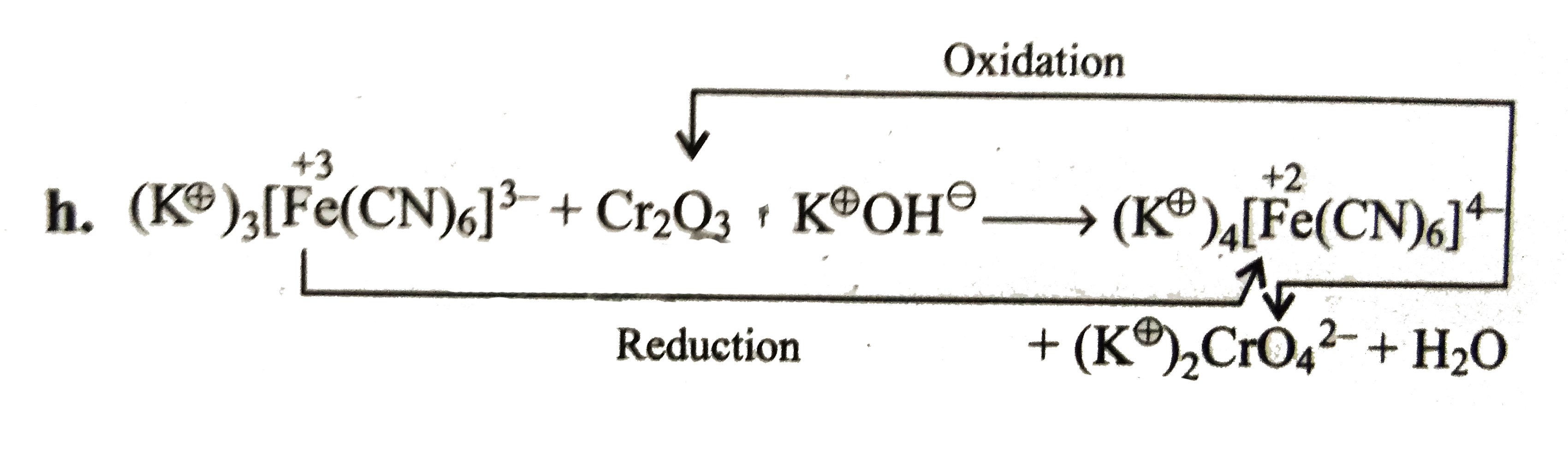 Oxidation (basic medium): `[CrO_(3)rarr2CrO_(4)^(2-)]` `10overset(ө)OH+5H_(2)O+Cr_(3)O_(3)rarr2CrO_(4)^(2-)+cancel(6e^(-))+10H_(2)O` `2x-6=0, 2x-16=-4` `2x=6`, `2x=12` Reduction: `[Fe^(3+)rarrFe^(2+)]` `{:(ul(e^(-)+[Fe^(3+)(CN)_(6)]^(3-)rarr[Fe^(+2)(CN)_(6)]^(4-)xx6)),(ul(10 overset(ө)OH+6[Fe^(3+)(CN)_(6)]^(3-)+Cr_(2)O_(3)0gt6[Fe(CN)_(6)]^(4-)+2CrO_(4)^(2-)+5H_(2)O)),(overset(or)ul(10KOH+6K_(3)[Fe(CN)_(6)]+Cr_(2)O_(3)rarr6K_(4)[Fe(CN)_(6)]+2K_(2)CrO_(4)+5H_(2)O)):}` i. Oxidation: `[NH_(3)rarrNO]` `H_(2)O+NH_(3)rarrNO+cancel(5e^(-))+cancel(5H^(o+))"]"xx4` `x+3=0, x-2=0` `x= -3, x=2` Reduction: `[O_(2)rarr2H_(2)O]` `{:(cancel(4H^(o+))+cancel(5e^(-))+O_(2)rarr2H_(2)O"]"xx5),(2x=04+2x=0),(2x= -4),(ulbar(4NH_(3)+5O_(2)rarr4NO+6H_(2)O)):}` j. `H^(o+)NO_(3)^(ө)+H^(o+)I^(ө)rarrNO+I_(2)+H_(2)O` Oxidation `[2I^(ө)rarrI_(2)]:` `2I^(ө)rarrI_(2)+cancel(2e^(-))"]"xx3` Reduction `[NO_(3)rarrNO]` `{:(4H^(o+)+cancel(3e^(-))+NO_(3)^(ө)rarrNO+2H_(2)O"]"xx2),(x-6= -1 x-2=0),(x=5 x=2),(ulbar(6I^(ө)+8H^(o+)+2NO_(3)^(ө)rarr2NO+3I_(2)+4H_(2)O)),(overset(or)6HI+2HNO_(3)rarr2NO+3I_(2)+4H_(2)):}` `Mn^(2+)SO_(4)^(2-)(overset(o+)NH_(4))_(2)S_(2)O_(8)^(2-)+H_(2)OrarrMnO_(2)` `+(H^(o+))_(2)SO_(4)^(2-)+(overset(o+)NH_(4))_(2)SO_(4)^(2-)` Oxidation: `[Mn^(2+)rarrMnO_(2)]` `2H_(2)O+Mn^(2+)rarroverset(+4)MnO_(2)+cancel(2e^(-))+4^(o+)` Reduction" `[S_(2)O_(8)^(2-)rarr2SO_(4)^(2-)]` `{:(cancel(2e^(-))+S_(2)O_(8)^(2-)rarr2SO_(2)^(2-)),(ulbar(2H_(2)O+Mn^(2+)+S_(2)O_(8)^(2-)rarrMnO_(2)+4H^(o+)+2SO_(4)^(2-))),(overset(or)ulbar(2H_(2)+MnSO_(4)+(NH_(4))_(2)S_(2)O_(8)rarrMnO_(2)+2H_(2)SO_(4)+(NH_(4))_(2)SO_(4))):}` l. Oxidation : `[2NH_(3)rarrN_(2)]` `2NH_(3)rarrN_(2)+cancel(6e^(-))+cancel(6H^(o+))`2x+6=0` , `2x=0` `2x= -6` Reduction : `[CuOrarrCu]` Reduction: `[CuOrarrCu]` `{:(2H^(o+)+cancel(2e^(-))+CuOrarrCu+H_(2)O"]"xx3),(ulbar(2NH_(3)+3CuOrarrN_(2)3Cu+3H_(2)O)):}` m. Oxidation (basic medium): `[2AlrarrAl_(2)O_(3)]` `6overset(ө)OH+3H_(2)O+2AlrarrAl_(2)O_(3)+6e^(-)+6H_(2)O"]"xx4` Reduction: `[HSO_(4)^(ө)rarrS^(2-)]` `{:(7H_(2)P+cancel(8e^(-))+HSO_(4)^(ө)rarrS^(2-)+4H_(2)O+7overset(ө)OH"]"xx3),(ulbar(3overset(ө)OH+8Al+3HSO_(4)^(ө)rarr4Al_(2)O_(3)+3H_(2)O+3S^(2-))),(or),(ulbar(3NaOH+8Al+3NaHSO_(4)rarr4Al_(2)O_(3)+3H_(2)O+3Na_(2)S)):}` n. `Co^(2+)(Cl_(2)^(ө))+Na_(2)O_(2)+Naoverset(ө)OH+H_(2)OrarrCo(OH)_(3)+Na^(o+)Cl^(ө)` Oxidation (basic method): `[Co^(2+)rarrCo(OH)_(3)]` `3overset(ө)OH+cancel(3H_(2)O)+Co^(2+)rarrCo(OH)_(3)+cancel(e^(-))++cancel(3H_(2)O)"]"xx2` Reduction: `[O_(2)^(-2)rarr2overset(ө)OH]` `{:(2H_(2)O+cancel(2e^(-))+O_(2)^(2-)+2overset(ө)OH),(ulbar(4overset(ө)OH+2Co^(2+)+2H_(2)O+O_(2)^(2-)rarr2Co(OH)_(3))),(or),(ulbar(2NaOH+2CoCl_(2)+2H_(2)O+Na_(2)O_(2)rarr2Co(OH)_(3)+4NaCl)):}` o. `Cu(NH_(3))_(2)^(2+)(Cl^(ө))_(2)+K^(o+)CN^(ө)+H_(2)OrarrNH_(3)+overset(o+)NH_(4)Cl^(ө)` `+(K^(o+))_(2)Cu(CN)_(3)^(2-)+K^(o+)CNO^(ө)+K^(o+)Cl^(ө)` Oxidation (basic `NH_(3)`medium): `[CN^(ө)rarrCNO^(ө)]` ` Since the reaction is CARRIED out in `NH_(3)` medium, add `2NH_(3)` to both sides. `2NH_(3) + H_(2)O + CN^(Ө) rarr CNO^(Ө) + 2e^(-)+2NH_(4)^(o+)`...(i) Reduction: `[Cu^(2+) rarrCu^(1+)]` (bacis `NH_(3)` medium) `e^(-) + Cu^(2+) rarrCu^(1+)` Add `4NH_(3)` and `3CN^(Ө)` to both sides: `e^(-) + Cu^(2+) + 4NH_(3) + 3CN^(Ө) rarr Cu^(+1) + 4NH_(3) + 3CN^(Ө)` or `e^(-) + Cu(NH_(3))_(4)^(2+) + 3CN^(Ө) rarr Cu(CN)_(3)^(2-) + 4NH_(3)` or `2e^(-) + 2Cu(NH_(3))_(4)^(2+)+6CN^(Ө) rarr 2Cu(CN)_(3)^(2-) + 8NH_(3)`....(ii) Add equations (i) and (ii) `H_(2)O+7CN^(Ө) + 2Cu(NH_(3))_(4)^(2+) rarr 2Cu(CN)_(3)^(2-)+CNO^(Ө) + 6NH_(3) + overset(o+)(2NH_(4))` ltbr. Net redox reaction is `H_(2)O+7KCN+2Cu(NH_(3))Cl_(2)-2K_(2)Cu(CN)_(3)` `+KCNO+6NH_(3)+2NH_(4)Cl+2KCl` p. 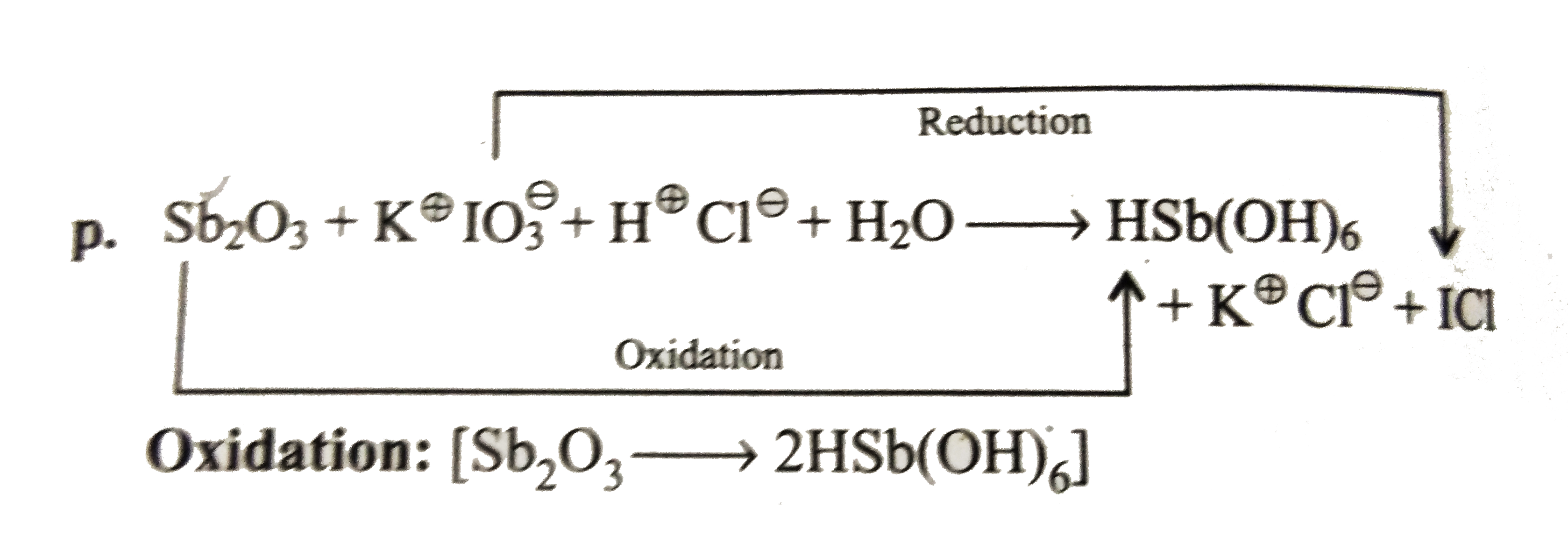 Oxidation `[Sb_(2)O_(3)rarr2HSb(OH)_(6)]` `{:(9H_(2)O+Sb_(2)O_(3)rarr2HSb(OH)_(6)+cancel(4e^(-))+4H^(o+),,,,),(2x-6=0 2+2x-12=0,,,,),(2x=6 2x=10,,,,):}` Reduction `[IO_(3)^(Ө)rarrI^(o+)]` `{:(6H^(o+)+4e^(-)+IO_(3)^(Ө)rarrI^(o+)+3H_(2)O,,,,),(x-6=-1 x=1,,,,),(x=5,,,,):}` `{:(ulbar(6H_(2)O+2H^(o+)+Sb_(2)O_(3)+IO_(3)^(o+)rarr2HSb(OH)_(6)+I^(o+))),(or),(ulbar(6H_(2)O+2HCl+Sb_(2)O_(3)+KIO_(3)rarr2HSb(OH)_(6)+ICl+KCl)):}` q. `WO_(3)+Sn^(2+)(Cl^(Ө))_(2)+H^(o+)Cl^(Ө)rarrW_(3)O_(8)+(H^(o+))_(2)SnCl_(6)^(2-)+H_(2)O` Oxidation: `[Sn^(2+)rarrSnCl_(6)^(2-)]` ``{:(Sn^(2+)rarrSn^(4+)+2e^(-)),(ulbar(6Cl^(Ө)+Sn^(2+)rarrSnCl_(6)^(2-)+Sn^(4+)+cancel(2e^(-)))):}` Reduction: `[3WO_(3)rarrW_(3)O_(8)]` `{:(2H^(o+)+cancel(2e^(-))+3WO_(3)rarrW_(3)O_(8)+H_(2)O`,,,,),(3x-18=0 3x-16=0,,,,),(3x=18 3x=16,,,,):}` `{:(ulbar(2H^(o+)+6Cl^(o+)+3WO_(3)+Sn^(2+)rarrSnCl_(6)^(2-)+W_(3)O_(8)+H_(2)O)),(or),(ulbar(4HCl+3WO_(3)+SnCl_(2)rarrH_(2)SnCl_(6)+W_(3)O_(8)+H_(2)O)):}` r. `Co^(2+)(Cl^(Ө))_(2)+K^(o+)NO_(2)^(Ө)+H^(o+)Cl^(Ө)rarr(K^(o+))_(3)Co^(3+)(NO_(2))_(6)^(3-)+NO+K^(o+)Cl^(Ө)+H_(2)O` Oxidation: `[Co^(2+)0gtCo^(3+)]` `Co^(2+)rarrCo^(3+)+cancel(e^(-))` or `6NO_(2)^(Ө)+Co^(2+)rarrCo(NO_(2))_(6)^(3-)+cancel(e^(-))` Reduction: `[NO_(2)^(Ө)rarrNO]` `{:(2H^(o+)+cancel(2e^(-))+NO_(2)^(Ө)rarrNO+H_(2)O),(ulbar(2H^(o+)+7KNO_(2)^(Ө)+Co^(2+)rarrCo(NO_(2))_(6)^(3-)+NO+H_(2)O)),(or),(ulbar(2HCl+7KNO_(2)+CoCl_(2)rarrK_(2)Co(NO_(2))_(6)+NO+H_(2)O+4KCl)):}` s. `V(OH)_(4)`^(o+)Cl^(Ө)+Fe^(2+)(Cl^(Ө))_(2)+H^(o+)Cl^(Ө)rarrVO^(2+)(Cl^(Ө))_(2)+Fe^(3+)(Cl^(Ө))_(3)+H_(2)O` Oxidation: `[Fe^(2+)rarrFe^(3+)]` Fe^(2+)rarrFe^(+3)+cancel(e^(-))` Reduction": `[V(OH)_(4)^(o+)rarrVO^(2+)]` {:(2H^(o+)+cancel(e^(-))+V(OH)_(4)^(o+)rarrVO^(2+)+3H_(2)O),(ulbar(2H^(o+)+Fe^(2+)+V(OH)_(4)^(o+)rarrVO^(2+)+Fe^(3+)+3H_(2)O)),(or),(ulbar(2HCl+FeCl_(2)+V(OH)_(4)ClrarrVOCl_(2)+FeCl_(3)+3H_(2)O)):}` t. `Ag+K^(o+)CN^(Ө)+O_(2)+H_(2)OrarrK^(o+)Ag(CN)_(2)^(Ө)+K^(o+)overset(Ө)OH` Oxidation: `[AgrarrAg^(o+)]` `AgrarrAg^(o+)+e^(-)` `Ag+2CN^(Ө)rarrAg(CN)_(2)^(Ө)+cancel(e^(-))"]"xx4` reduction: [`O_(2)rarroverset(Ө)OH]` (Basic medium) ``{:({:(2H_(2)O+cancel(4e^(-))+O_(2)rarr2overset(Ө)OH+2overset(Ө)OH,,,,),(2x=0 2x=-4,,,,),(2x=-4,,,,):}),(ulbar(4Ag+8CN^(Ө)+2H_(2)O+O_(2)rarr4Ag(CN)_(2)^(Ө)+4overset(Ө)OH)),(or),(ulbar(4Ag+8KCN+2H_(2)O+O_(2)rarr4KAg(CN)_(2)+4KOH)):}` u. 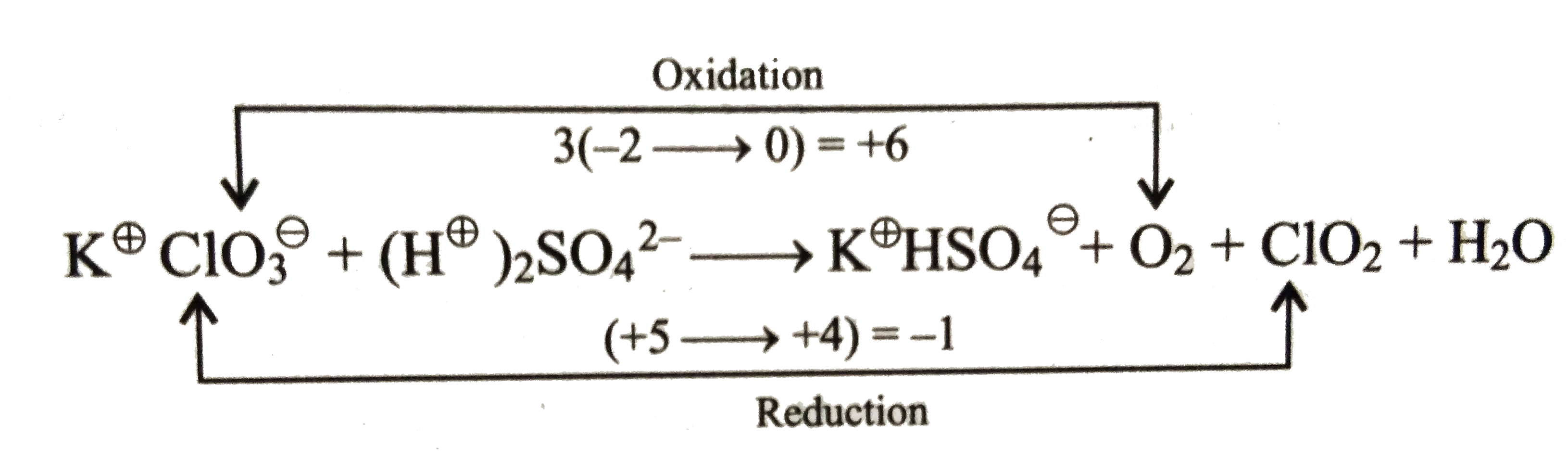 Oxidation `[3O^(2-)rarr(3)/(2)O_(2)+6e^(-)]` Reduction `[e^(-)+overset(+5)(ClO_(3)^(Ө))rarroverset(+4)(ClO_(2))]` `{:(4KClO_(3)rarrO_(2)+4ClO_(2)),(ulbar(4H_(2)SO_(4)+4KClO_(3)rarr4KHSO_(4)+O_(2)+4ClO_(2)+2H_(2)O)):}` 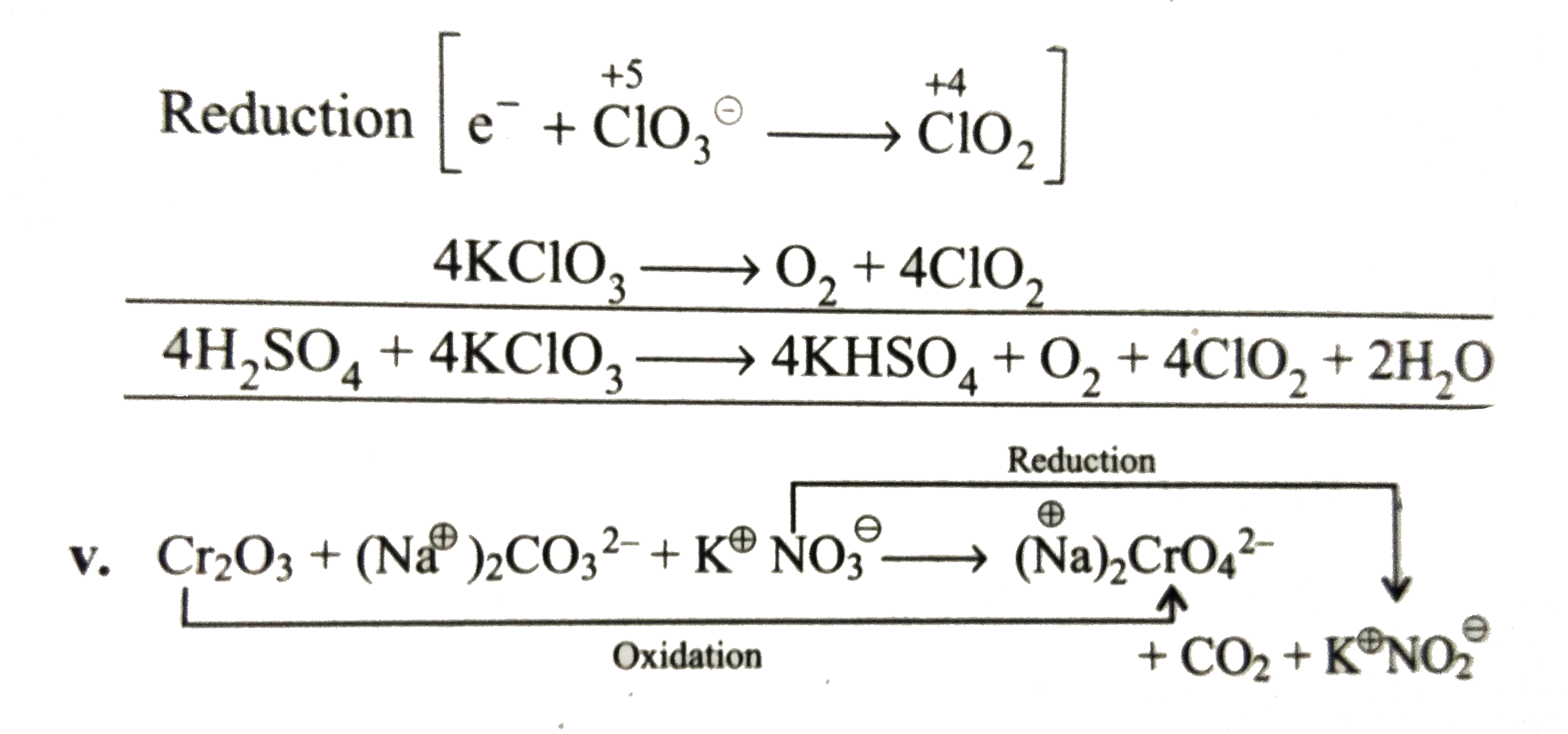 Oxidation `[Cr_(2)O_(3)rarrCrO_(4)^(2-)]` `{(5H_(2)O+Cr_(2)O_(3)rarr2CrO_(4)^(2-)+cancel(6e^(-))+10H^(o+),,,,),(2x-6=0 2x-6= -4,,,,),(2x=6 2x=12,,,,):}` Reduction:`[NO_(3)^(Ө)rarrNO_(2)^(Ө)]` `{:(2H^(o+)+cancel(2^(-))+NO_(3)^(Ө)rarrNO_(2)^(Ө)+H_(2)O"]"xx3),(ulbar(2H_(2)O+Cr_(2)O_(3)+3NO_(3)^(Ө)rarr2CrO_(4)^(2-)+3NO_(2)^(Ө)+4H^(o+))):}` Add `3K^(o+) and `4Na^(o+)` ions to both sides. `2H_(2)O+Cr_(2)O_(3)+3KNO_(3)+4na^(o+)rarr2Na_(2)+CrO_(4)+3KNO_(3)+4H^(o+)` [Now add `2H_(2)CO_(3)` to the lerft and `2CO_(2)+2H_(2)O` to the right of the equation] `[4H^(o+)+2CO_(3)^(2-)-=2CO_(2)+2H_(2)O]` `cancel(2H_(2)O)+Cr_(2)O_(3)+3KNO_(3)+4Na^(o+)+2H_(2)CO_(3)rarr` `2Na_(2)CrO_(4)+3KNO_(3)+4H^(o+)+2CO_(2)+cancel(2H_(2)O)` or `Cr_(2)O_(3)+3KNO_(3)+2Na_(2)CO_(3)+cancel(4H^(o+))rarr2Na_(2)CrO_(4)` `+3KNO_(3)+2CO_(2)+cancel(4H^(o+))` Hence, the net redox reaction is `ulbar(Cr_(2)+3KNO_(3)+2Na_(2)CO_(3)rarr2Na_(2)CrO_(4)+3KNO_(3)+2CO_(2)` w. `Au+CN^(Ө)+O_(2)rarrAu^(3+)(CN)_(4)^(Ө)` `CN^(Ө)` must be kept out of acid solution) Oxidation: `[AurarrAu^(3+)]` Add `4CN^(Ө)` both sides `4CN^(Ө)+AurarrAu(CN)_(4)^(Ө)+cancel(3e^(-))"]"xx4` Reduction: `[O_(2)rarroverset(Ө)OH]` `{:({:(2H_(2)O+cancel(4e^(-))+O_(2)rarr2overset(Ө)OH+2overset(Ө)OH"]"xx3,,,,),(2x=0 2x+2= -2,,,,),(2x=4,,,,):}),(ulbar(4Au+16CN^(Ө)+6H_(2)+3O_(2)rarr4Au(CN)_(4)^(Ө)+12overset(Ө)OH)),(or),(ulbar(4Au+16CN+6H_(2)O+3O_(2)rarr4KAu(CN)_(4)+12KOH)):}` x. Oxidation: `[ZnrarrZn^(2+)]` `Zn+Zn^(2+)+2e^(-)"]"xx4` Reduction: `[ReO_(4)^(Ө)rarrRe^(Ө)]` `{:({:(8H^(o+)+8e^(-)+ReO_(4)^(Ө)+4H_(2)O,,,,),(x-8=-1 x= -1,,,,),(x=7,,,,):}),(ulbar(4Zn+8H^(o+)+ReO_(4)^(Ө)rarr4Zn^(2+)+Re^(Ө)+4H_(2)O)):}` |
|
| 39. |
Balance the following reactions by oxidation number method : (i) FeS_2+O_2 rarrFe_2O_3+SO_2 (ii) MnO_4^(-) +Fe^(2+) rarr underset(("in acidic medium")) (Mn^(2+) +Fe^(3+)) (iii) Cr(OH)_3+IO_3^(-) rarr I^(-)+underset(("in basic medium"))(CrO_4^(2-)) |
|
Answer» Solution :(i) `FeS_2+O_2 rarrFe_2O_3+SO_2` 1. The skeleton equation with oxidation number is : `overset(+2)(Fe)overset(-1)(S_2)+overset(0)O_2rarroverset(+3-2)(Fe_2O_3)+overset(+4-2)(SO_2)` (Note : Oxidation number of S in `FeS_2` is -1 and not -2.) 2. The oxidation number of iron as well as shulphure increases from +2 to +3 and -1 to +4 respectively. Since Fe and S must MAINTAIN their atomic RATIO , the change in oxidation number will be considered together . On the other hand, the oxidation number of oxygen decreases from0 to -2Thus, O.N. increases 1 per Fe and 5 per S atom i.e., `1+2 xx5 =11` per `FeS_2` . 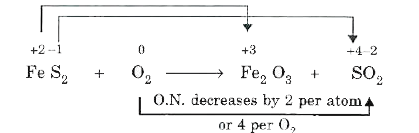 3. To balance increase and decrease of oxidation number , multiply `FeS_2` by 4 and `O_2` by 11. `4FeS_2+11O_2 rarr Fe_2O_3 +SO_2` 4. BALANCING all atoms `4FeS_2+11O_2 rarr 2Fe_2O_3 +8SO_2` (ii) `MnO_4^(-) +Fe^(2+)+H^(+)rarrMn^(2+)+Fe^(3+)+H_2O` 1. The skeleton equation along with oxidation number of each atom is as : `overset(+7)(MN)overset(-2)(" "O_(4)^(-))+overset(+2)(Fe^(2+))+H^+rarroverset(+2)Mn^(2+)+overset(+3)Fe^(3+)+overset(+1-1)(H_2O)` 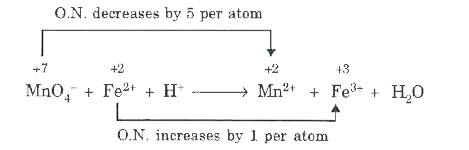 2. The oxidation number of Mn decreases from +7 to +2 while that of Fe increases from +2 to +3. 3. Multiply `Fe^(2+)` by 5 and `MnO_4^(-)` by 1 to balance increases and decreases in oxidation number. `MnO_4^(-) +5Fe^(2+)+H^(+)rarrMn^(2+)+Fe^(3+)+H_2O` 4. Balance all atoms (except H and O) `MnO_4^(-) +5Fe^(2+)+H^(+)rarrMn^(2+)+5Fe^(3+)+H_2O` This reaction takes place in acidic medium . The O and H atoms are balanced as given below : 5. Balance O - atomsby adding equal number of `H_2O` molecules as `MnO_4^(-) +5Fe^(2+)+H^(+)rarrMn^(2+)+5Fe^(3+)+H_2O+3H_2O` 6. Balance H - atoms by adding `H^+` ions on the side deficient in II - atom. `MnO_4^(-) +5Fe^(2+)+H^(+)+7H^(+)rarrMn^(2+)+5Fe^(3+)+4H_2O` or `MnO_4^(-) +5Fe^(2+)+8H^(+)rarrMn^(2+)+5Fe^(3+)+4H_2O` |
|
| 40. |
Balance the following ionic equations (i) Cr_(2)O_(7)^(2-)+H^(+)+I^(-)rarrCr^(3)+I_(2)+H_(2)O (ii) Cr_(2)O_(7)^(2-)+H^(+)rarrCr^(3+)+Fe^(3+)+H_(2)O (iii) MnO_(4)^(-)+SO_(3)^(2-)+H^(+)rarrMn^(2+)+SO_(4)^(2-)+H_(2)O (iv) MnO_(4)^(-)+H^(+)+Br^(-)rarrMn^(2+)+Br_(2)+H_(2)O |
Answer» Solution :(i) step 1 wrtie the O.N of all atoms above their respecitve symbols  step2 divide the gven skeleton E (a) in to two half reaction equatoi reduction half equation : `Cr_(2)O_(7)rarrCr^(3+)` oxdation half equation `E^(-)rarrI_(2)` step 3 to balance reduction half equation (b) following the METHOD discussed under sample problem the balanced reduction half equation is `Cr_(2)O_(7)^(2-)+14H^(+)+6E^(-)rarr2Cr^(3+)+7 H_(2)O` step 4 To balance the oxidation half eqution step 5 To balance the elcrons gained in eq step 1 write the O.N of all atoms above their respectivesymbols  step 2 divide the skeleton Eq (a) in to two halfreaction equation reduction half equatio `MnO_(4)^(-) rarr Mn^(2+)` oxidatoin half equation `SO_(3)^(2-)rarr SO_(4)^(2-)` step 3 to balance reduction half eq (b) following the method disucessed under step 4 To balane oxidation half Eq balance o atoms by adding `H_(2)O` molecule since there are three o atomsL.H.S of eq (f) and FOUR on theR.H.S add 1 `H_(2)O` to he L.H.S of Eq step 5 To balance electrons multiply Eq `2MnO_(4)^(-)+16 H^(+)+10e^(-)rarrr2Mn^(2+)+8H_(2)O` `5MnO_(4)^(-)+5H_(2)Orarr5SO_(4)^(2+)+10H^(+)10 E^(-)` `2 MnO_(4)^(-)+5SO_(3)^(2-)+6H^(+)rarr2Mn^(2+)+5SO_(4)^(2-)+3H_(2)O` this represent the correct balanced redox equation (iv) step 1 write the O.N of all the atoms above their respective symbols  step 2 divide skeleton eq (a) into two half reaction equation reduction half equation`MnO_(4)^(-)rarrMn^(+)` oxidation half equation `Br^(-)rarrBr_(2)` step 3 To balance reduction half equation (b) following the method discussed under `MnO_(4)^(-) +8H^(+)+5e^(-)rarrMn^(2+)+4H_(2)O` step 4 To balance oxidatoin half equatio(c ) balance atoms other O and H since there are two Br atoms on R.H.S and only one on L.H.S of eq (c ) therefore multiple `Br^(-)` on L.H.S of Eq (c ) by 2 we have `2Br^(-)rarrBr_(2)+2e^(-)` This represent balnced oxidation half equatoin step 5 To balance the number of eletrons gaind in Eq and lost in Eq (f) multiply Eq (d) by 2 andeq (f) by5 and add together we have `2MnO_(4)^(-)+16H^(+)+10 E^(-)rarr2 Mn^(2)+8 H_(2)O` `10 br^(-)rarr 5 Br_(2)+10e^(-)` `2MnO_(4)^(-)+10 Br^(-)+16 H^(+)rarr2 Mn^(2+)+5Br_(2)+8H_(2)` This represents the correcty balanced ionic equation |
|
| 41. |
Balance the following reaction by oxidation number method. |
|
Answer» Solution :`MnO_(4)^(-1) +H_(2)S+H^(+) to MN^(2+)+S` (Acidic Medium). (i) Write oxidation number of elements `MnO_(4)^(-1) +H_2S to Mn^(2+)+S` `(+7)(-2) (+1)(-2) (+2) 0` (ii) Balance the number of atoms of the elements in which oxidation number changes `MnO_(4)^(-1) +H_2S to Mn^(2+)+S` `(+7) (-2) (+2) 0` (iii) Decide the oxidation and REDUCTION reaction on the basis of difference of oxidation number. Increase in oxidation number by 2 (Oxidation)  Decrease in oxidation number by 5( Reduction) (IV) On multiplying oxidation reaction by 5 and reduction reaction by 2 to balance the change in oxidation number. `2MnO_(4)^(-1) +5H_(2)S to 2Mn^(2+)+5S` (v) Balance the electric charge and atoms which do not change in oxidation number (spectators). `2MnO_(4)^(-1) +5H_(2)S+6H^(+) to 2Mn^(2+)+5S+8H_(2)O` `2(-1)5(0)+6(+1)=2(+2)+5(0)+8(0)` `-2+6=+4` `+4=+4` In the above reaction the reactants and products are balanced in terms of electric charge and mass EQUIVALENCE. |
|
| 42. |
Balance the following ionic equations (a) Cr_(2)O_(7)^(2-)+H^(+)+I^(-)rarrCr^(3+)+H_(2)O (b) Cr_(2)O_(7)^(2-)+Fe^(2+)+H^(+)rarrCr^(3+)+Fe^(3+)+h_(2)O (c ) MnO_(4)^(-) +SO_(3)^(2-)+H^(+)rarrMn^(2+)+SO_(4)^(2-)+H_(2)O (d)MnO_(4)^(-)+H^(+)+B^(-)rarrMn^(2+)+Br_(2)+H_(2)O |
|
Answer» Solution :Let us balacne the chemical equations by ion electron method (a) `Cr_(2)O_(7)^(2-)+H^(+)+I^(-)rarrCr^(3+)+I_(2)+H_(2)O` step I Separtion of the equation in to the half reactions (i)Write O.N of all the aotms involved in the skeletion equation `(Cr_(2)O_(7))^(2-)+overset(+1)(H)^(+)+overset(-1)(I)rarroverset(+3)Cr+overset(0)I_(2)+overset(+1)H_(2)overset(-2)O` (ii) Identify the atoms which undergo lnchange in O.N `(overset(+6)Cr_(2)overset(-2)O_(7))^(2-)+H^(+)+overset(-1)(I)rarr(overset(+3)Cr)^(3+)+I_(2_(0))+H_(2)O` (iii) Find out teh species involved in oxidation and reduction half rections  StepII Balancing ofoxidaiton half rection. `2I^(-)rarrI_(2)+2e^(-)` stepIII Balancing of redcution half reaction The reduction half reaction is : `(overset(+6)Cr_(2)O_(7))^(2-)rarr(overset(+3)Cr)^(3+)` (i) The decrease in O.N per Cr atom is 3 and the total decrease in O.N for two Cr atoms is 6 Therefore, add `6e^(-)` on the reactant side (ii) Balance Cr atoms on both sides of the equation `(Cr_(2))O_(7)^(2-)+6e^(-)rarr2Cr^(3+)` (iii) In order to balance O atoms add seven `H_(2)O` molecules on the product side and then to balance H atoms add `14^(+)` on the reactant side. `(Cr_(2)O_(7))^(2-)+6e^(-)+14H^(+)rarr2Cr^(3+)+7H_(2)O` Step(iv) Adding the two half reactions In order to equate the electrons multiply equation (i) by 3 and then add to equation (ii) in order to get the final equation `{:(2I^(-)rarrI_(2)+2e^(-)xx3),(Cr_(2)O_(7)^(2-)+6e^(-)+14H^(+)rarr2Cr^(3+)+7H_(2)O),(Cr_(2)O_(7)^(-)+6I^(-)+14H^(+)rarr3I_(2)+2Cr^(3+)+7H_(2)O):}` `(b) (Cr_(2)O_(7))^(2-)+Fe^(2+)+H^+rarrCr^(3+)+Fe^(3+)+H_(2)O` For balancing consult example18.20 (Text PART) `(c )MnO_(4)^(-)+SO_(3)^(2-)+H^(+)rarrMn^(2+)+SO_(4)^(2-)+H_(2)O` ltbr step I Separarion of the equation in to two half rections (i) Write the O.N off all the atoms involved in the skeleton in the skeleton equation `overset(+7)(Mnoverset(-2)O_(4))^(-)+overset(+4)Soverset(-2)O_(3)]^(2-)+overset(+12)[H]^(+)rarroverset(+2)[Mn]^(2+)+overset(+6)Soverset(-2)O_(4)]^(2-)+overset(+1)H_(2)O` (ii) Identify the atoms which undergo CHANGE in O.N `(overset(+7)MnO_(4))^(-)+(overset(+4)SO_(3))^(2-)+H^(+)rarr(overset(+2)[Mn])^(2+)+(overset(+6)SO_(4))^(2-)+H_(2)O` (iii) Find out the species involved in oxidation and reduction half reactions  StepII Balancing the oxidation half reaction The oxidation half rection is :`(overset(+4)SO_(2))^(2-)rarr(overset(+6)SO_(4))^(2-)` (i)As the increase in O.N is 2therefore add two `e^(-)` on the product side to balance lthe change in O.N `SO_(3)^(2)rarr(SO_(4))^(2-)+2e^(-)` (ii) In order to balance oxygen atoms, add one molecule of `H_(2)O` on the reactant sideand two `H^(+)` ions on the product side. `(SO_(3))^(2)+H_(2)Orarr(SO_(4))^(2-)+2e^(-)+2H^(+)` step III Balancing the reduction half reaction The reduction half recation is : `overset(+7)(MnO_(4))^(-)rarroverset(+23)(Mn)` (i)The decrease in O.N of Mn is 5 . Therefore, add `5e^(-)` on the reactant side to balance change in O.N `MnO_(4)^(-)+5e^(-)rarrMn^(2+)` (i) The decrease inO.N of Mn is 5.Therefore, add `5e^(-)` on the reactant side tobalacne change in O.N `MnO_(4)^(-)+5e^(-)rarroverset(+2)(Mn)` (ii) In order tobalance the no of O atoms , add four `H_(2)O`,molecules on the product side and then too balance H atoms add `8H^(+)` on the reactatn side. `MnO_(4)^(-)+8H^(+)+5e^(-)rarrMn^(2+)+4H_(2)O` step IV Adding the twoi half reactions In oder to equate elctons multiply oxidation half reaction by 5 and reduction half reaction by 2.Then adup the two equations `[SO_(3)^(2-)+H_(32)OrarrSO_(4)^(2-)+2H^(+)+2e^(-)]xx5` `{:([MnO_(4)^(-)+8H^(+)+Se^(-)rarrMn^(2+)+4H_(2)O]xx2),(Add:5SO_(3)^(2-)+5H_(2)O+2MnO_(4)^(-)rarr5sO_(4)^(2-)+10H^(+)):}` `+16H^(+)+Oe^(-) 2Mn^(2+)+8H_(2)O` or `5SO_(3)^(2+-)+2MnO_(4)^(-)+6H^(+)rarr5SO_(4)^(2-)+2Mn^(2+)+2H_(2)O` `(b)MnO_(4)^(-)+H^(+)+Br^(-)rarrMn^(2+)+Br_(2)+H_(2)O` please balance the equation of your own. |
|
| 43. |
Balance the following ionic equations (i) Cr_2O_7^(2-) +H^(+)I^(-) rarr Cr^(3+)+I_(2)+H_(2)O (ii) Cr_2O_(7)^(2-) +Fe^(2+)+H^(+)rarrCr^(3+)+Fe^(3+)+H_2O (iii) MnO_(4)^(-) +SO_(3)^(2-)+H^(+)rarrMn^(2+)+SO_4^(2-)+SO_(4)^(2-)+H_2O (iv) MnO_(4)^(-) +H^(+)+Br^(-) rarr Mn^(2+)+Br_(2)+H_(2)O |
Answer» Solution :(i) 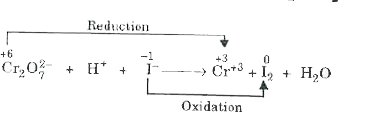 Dividing the equation into two HALF reactions : Oxidation half reaction : `I^(-) rarrI_(2)` REDUCTION half reaction : `Cr_(2)O_(7)^(2-) rarrCr^(3+)` Balancing oxidation and reduction half reactions separately as : Oxidation half reaction `I^(-) rarr I_2` `2I^(-) rarr I_2` `2I^(-) rarr I_2+2e^(-) ""...(i)` Reduction half reaction `Cr_(2)O_(7)^(2-) rarr Cr^(3+)` `Cr_(2)O_(7)^(2-)rarr2Cr^(3+)` `Cr_2O_(7)^(2-) +6e^(-) rarr 2Cr^(3+)+7H_2O""...(ii)` `""("acidic medium")` To balance the electronsmultiply eq(i) by 3 and add to eq (ii) `Cr_(2)O_(7)^(2-) +14H^(+)+6I^(-) rarr 2Cr^(3+)+3I_(2)+7H_2O` (iii) 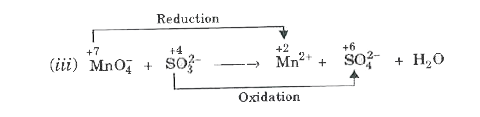 Dividing the equation into two half reactions : Oxidation half reaction : `SO_(3)^(2-) rarr SO_(4)^(2-)` Reduction half reaction : `MnO_(4)^(-) rarr MN^(2+)` Balancing oxidation and reduction half reactions separately as : Oxidation half reation `SO_(3)^(2-) rarr SO_4^(2-)` `SO_3^(2-) rarr SO_(4)^(2-) +2e^(-)` Since the reaction occurs in acidic medium, `SO_3^(2-) rarr SO_4^(2-) +2e^(-) +2H^(+)` `SO_3^(2-) +H_2O rarr SO_4^(2-) +2H^(+) +2e^(-) .....(i)` Reduction half reaction `MnO_4^(-) rarr Mn^(2+)` `MnO_4^(-) +5e^(-) rarr Mn^(2+)` `MnO_4^(-) +8H^(+) +5e^(-) rarr Mn^(2+)` `MnO_4^(-) +8H^(+) +5e^(-) rarr Mn^(2+) +4H_2O""....(ii)` To balance the electrons , multiply eq. (i) by 5 and eq (ii)by 2 and add `2Mn_4^(-) +5SO_(3)^(2-) +6H^(+) rarr 2Mn^(2+)+5SO_4^(2-) +3H_2O` (IV) 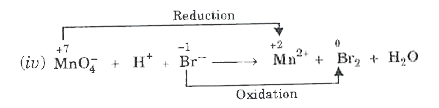 Dividing the equation into two half reactions : Oxidation half reaction : `Br^(-) rarr Br_2` Reduction half reaction : `MnO_4^(-) rarr Mn^(2+)` Balancing oxidation and reduction half reaction separately as : Oxidation half reaction `Br^(-) rarr Br_2` `2Br^(-) rarr Br_2` `2Br^(-) rarr Br_2+2e^(-) ""...(i)` Reduction `MnO_4^(-) rarr Mn^(2+)` `MnO_4^(-) +5e^(-) rarr Mn^(2+)` `MnO_4^(-) +8H^(+) +5e^(-) rarr Mn^(2+)` `MnO_4^(-) +8H^(+) +5e^(-) rarr Mn^(2+)+4H_2O""...(ii)` To balance the electrons, multiply eq (i) by 5 and eq (ii) by 2 and add `2MnO_4^(-) +10Br^(-) +16 H^(+) rarr 2Mn^(2+)+5Br_2+8H_2O` |
|
| 44. |
Balance the following ionic equation. (a) Cr_(2)O_(7)^(-2)+H^(+)+I^(-)toCr^(+3)+I_(2)+H_(2)O (b) Cr_(2)O_(7)^(-2)+Fe^(+2)+H^(+)toCr^(+3)+Fe^(+3)+H_(2)O ( c) MnO_(4)^(-)+SO_(3)^(-2)+H^(+)toMn^(+2)+SO_(4)^(-2)+H_(2)O (d) MnO_(4)^(-)+H^(+)+Br^(-)toMn^(+2)+Br_(2)+H_(2)O |
Answer» Solution :(a)  R.H.E. : `Cr_(2)O_(7)^(-2)TOCR^(+3)` O.H.E. : `I^(-)toI_(2)` R.H.E. : `Cr_(2)O_(7)^(-2)+14H^(+)+6e^(-)to2Cr^(+3)+7H_(2)O` O.H.E. : `2I^(-)toI_(2)+2e^(-)`  O.H.E. : `Fe^(+2)toFe^(+3)` R.H.E. : `Cr_(2)O_(7)^(-2)toCr^(+3)` O.H.E. : `Fe^(+2)toFe^(+3)+e^(-)` R.H.E. : `Cr_(2)O_(7)^(-2)+6e^(-)to2Cr^(+3)` Balance CHARGES : `Cr_(2)O_(7)^(-2)+14H^(+)+6e^(-)to2Cr^(+3)` Balance H and O : `Cr_(2)O_(7)^(-2)+14H^(+)+6e^(-)to2Cr^(+3)+7H_(2)O` Total reaction :  R.H.E. : `MnO_(4)^(-)toMn^(+2)` O.H.E. : `SO_(3)^(2-)toSO_(4)^(-2)` R.H.E. : `MnO_(4)^(-)+8H^(+)+5e^(-)toMn^(+2)+4H_(2)O` O.H.E. : `SO_(3)^(-2)toSO_(4)^(-2)+2e^(-)` Balance charges of reaction. `SO_(3)^(-2)toSO_(4)^(-2)+2H^(+)+2e^(-)` Balance H and O by `H_(2)O`. `SO_(3)^(-2)+H_(2)OtoSO_(4)^(-2)+2H^(+)+2e^(-)` Total reaction :  R.H.E. : `MnO_(4)^(-)toMn^(+2)` O.H.E. : `Br^(-)toBr_(2)` R.H.E. : `MnO_(4)^(-)+8H^(+)+5e^(-)toMn^(+2)+4H_(2)O` O.H.E. : `2Br^(-)to2Br_(2)+2e^(-)` Total reaction : 
|
|
| 45. |
Balance the following ionic equation. MnO_(4)^(-)+H^(+)+Br^(-)toMn^(2+)+Br_(2)+H_(2)O |
Answer» Solution :Write the O.N. of all TEH atoms above their respective symbols <BR> 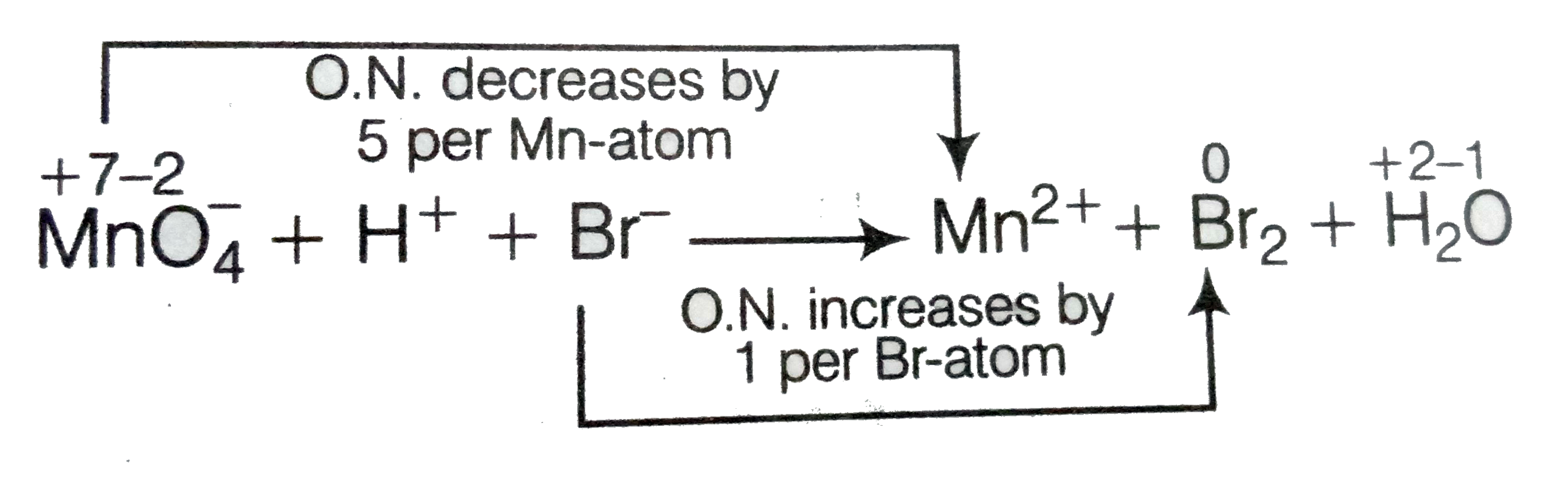 Divide skeleton equation into two half reactions. Reduction half reaction `MnO_(4)^(-)toMn^(2+)` OXIDATION half reaction `Br^(-)toBr_(2)` To balance reduction half reaction `MnO_(4)^(-)+8H^(+)+5e^(-)toMn^(2+)+4H_(2)O` To balance oxidation half reaction `2Br^(-)toBr_(2)+2e^(-)` To balance the reaction `({:(2MnO_(4)^(-)+16H^(+)+10E^(-)to2Mn^(2+)+8H_(2)O),(""10Br^(-)to5Br_(2)+10e^(-)):})/(2MnO_(4)^(-)+10Br^(-)+16H^(+)to2Mn^(2+)+5Br_(2)+8H_(2)O)` This represent the correct balanced ionic equation |
|
| 46. |
Balance the following half cell reactions. MnO_(4)^(-)toMn^(2+) |
|
Answer» Solution :The balanced EQUATIONS are `MnO_(4)^(-)+8H^(+)+5e^(-)toMn^(2+)+4H_(2)O` |
|
| 47. |
Balance the following half cell reactions. H_(2)OtoOH^(-)+H_(2) |
|
Answer» SOLUTION :The BALANCED equations are `2H_(2)O+2e^(-)to2OH^(-)+H_(2)` |
|
| 48. |
Balance the following equations using oxidation number method : {:((i),MnO_4^(-)+H^(+)+Fe^(2+),rarr,Mn^(2+)+Fe^(3+)+H_2O),((ii),""Zn+NO_3^(-)+H^(+),rarr,Zn^(2+)+H_2O),((iii),H_2SO_3+I_2+H_2O,rarr,H_2SO_4+HI),((iv),""HNO_3+I_2,rarr,HIO_3+NO_2+H_2O),((v), MnO_4^(-)+H_2O_2,rarr,MnO_4^(2-)+O_2):} (in alkaline medium) |
|
Answer» (ii) `""4Zn+NO_3^(-) +10H^(+)rarr4Zn^(2+)+NH_4^(+)+3H_2O` (III) `H_2SO_3+I_2+H_2O RARR H_2SO_4+2HI` `""10HNO_3+I_2 rarr 2HIO_3+10NO_2+4H_2O` (V) `2MnO_4^(-) +2OH^(-) +H_2O_2 rarr 2MnO_4^^(2-) +O_2+2H_2O` |
|
| 49. |
Balance the following equations. NO_(3)^(-)+H_(2)StoHSO_(4)^(-)+NH_(4)^(+) |
|
Answer» Solution :Balancing the given equation by ion electron method in acidic medium : Step 1. `NO_(3)^(-)+H_(2)StoHSO_(4)^(-)+NH_(4)^(+)` Step `overset(+5-2)(NO_(3)^(-))+overset(+1-2)(H_(2)S)tooverset(+1+6-2)(HSO_(4)^(-))+overset(-3+1)(NH_(4)^(+))` Step 3. `NO_(3)^(-)toNH_(4)^(+)` (reduction half reaction) `H_(2)StoHSO_(4)^(-)` (OXIDATION half reaction) Step 4. Balancing reduction half reaction : `NO_(3)^(-)toNH_(4)^(+)+3H_(2)O` (balancing O atoms) `NO_(3)^(-)+10H^(+)toNH_(4)^(+)+3H_(2)O` (balancing H atoms) `NO_(3)^(-)+10^(+)+8e^(-)toNH_(4)^(+)+3H_(2)O` (balancing charge) Balancing oxidation half reaction : `H_(2)S+4H_(2)OtoH_(2)SO_(4)^(-)` (balancing O atoms) `H_(2)S+4H_(2)OtoH_(2)SO_(4)^(-)+9H^(+)` (balancing H atoms) `H_(2)S+4H_(2)OtoH_(2)SO_(4)^(-)+9H^(+)+8e^(-)` (balancing charge) Step 5. `{:(NO_(3)^(-)+10H^(+)+8e^(-)toNH_(4)^(+)+3H_(2)O),(H_(2)S+4H_(2)OtoHSO_(4)^(-)+9H^(+)+8e^(-)),(bar(NO_(3)^(-)+H_(2)S+H^(+)+H_(2)OtoNH_(4)^(+)+HSO_(4)^(-))):}` This is the FINAL balanced equation. |
|
| 50. |
Balance the following equations in basic medium by ion-electron method and oxidation number methods and identify the oxidising agent and the reducing agent. (a) P_(4(s))+OH_((aq))^(-)toPH_(3(g))+HPO_(2(aq))^(-) (b) N_(2)H_(4(l))+ClO_(3(aq))^(-)toNO_((g))+Cl_((g))^(-) ( c) Cl_(2)O_(7(g))+H_(2)O_(2(aq))toClO_(2(aq))^(-)+O_(2(g))+H^(+) |
|
Answer» Solution :(a) `P_(4(s))+OH_((aq))^(-)toPH_(3(g))+HPO_(2(aq))^(-)` : Ion electron method : `OVERSET(0)(P_(4(s)))+OH_((aq))^(-)tooverset(-3)(PH_(3(g)))+overset(+2)(HPO_(2(aq))^(-))` Here, oxidation NUMBER of P is increased from 0 to +2 and decreases from 0 to -3, therefore, `P_(4)` is oxidising agent as well as reducing agent. Step-1 : Half reaction. O.H.R. : `overset(0)(P_(4(s)))tooverset(-2)(HPO_(2(aq))^(-))` R.H.R. : `overset(0)(P_(4(s)))tooverset(-3)(PH_(3(g)))` Step-2 : Balancing P. O.H.R. : `P_(4(s))to4HPO_(2(aq))^(-)` R.H.R. : `P_(4(s))to4PH_(3(g))` Step-3 : For balancing the equation ADDITION of electron is must. O.H.R. : `P_(4(s))to4HPO_(2)^(-)+8e^(-)` R.H.R. : `P_(4(s))+12e^(-)to4PH_(3)` Step-4 : Balancing the half reaction with its electic charge. O.H.R. : `P_(4(s))+12OH^(-)to4HPO_(2)^(-)+8e^(-)+4H_(2)O` R.H.R. : `P_(4(s))+12e^(-)+12H_(2)Oto4PH_(3)+12OH^(-)` Step-5 : calculating the `e^(-)`, O.H.R. is multply by 3 and R.H.R. is multiply by 2 and adding the half reaction.  Oxidation number method : Oxidation number decreases when `P_(4(s))` is CONVERTED into `PH_(3)=3xx4=12` Oxidation number increases when `P_(4(s))` is converted into `H_(2)PO_(2)^(-)=2xx4=8` For balancing of oxidation `H_(2)PO_(2)^(-)` multiply by 3 and `PH_(3)` multiply by 2. `P_(4)+OH^(-)toPH_(3)+3HPO_(2)^(-)` Step-1 : Write oxidation number. `overset(0)(P_(4))+OH^(-)tooverset(-3)(PH_(3))+overset(+2)(3HPO_(2)^(-))` Step-2 : Here `P_(4)` is aering as oxidizing agent as well as reducing agent balancing the P.  Step-3 : To balancing difference of oxidation number multiply oxidation reaction into 3 and reduction reaction into 2. `2P_(4)+3P_(4)+OH^(-)to8PH_(3)+12HPO_(2)^(-)` Step-4 : After balancing charges according to basic medium add O and `H_(2)O`. `12H_(2)O+5P_(4)+12OH^(-)to8PH_(3)+12HPO_(2)^(-)` (b) `N_(2)H_(4(l))+ClO_(3(aq))^(-)toNO_((g))+Cl_((g))^(-)` :  Therefore, `N_(2)H_(4)` acts as reducing agent and `ClO_(3)^(-)` acts as oxidizing agent. Oxidation number method : Increasing oxidation number of `N=4xx2=8` Decreasing oxidation number of `Cl=6xx1=6` Therefore, balancing the oxidation number `N_(2)H_(4)` is multiplied by 3 and `ClO_(3)^(-)` is multiplied by 4. `3N_(2)H_(4(l))+4ClO_(3(aq))^(-)toNO_((g))+Cl_((aq))^(-)` Balancing the N and Cl. `3N_(2)H_(4(l))+4ClO_(3(aq))^(-)to6NO_((g))+4Cl_((aq))^(-)` Balancing the O by `H_(2)O`. `3N_(2)H_(4(l))+4ClO_(3(aq))^(-)to6NO_((g))+4Cl_((aq))^(-)+6H_(2)O_((l))` Ion electron method : O.H.R. : `overset(-2)(N_(2)H_(4(l)))tooverset(+2)(NO_((g)))` R.H.R. : `overset(+5)(ClO_(3(aq))^(-))tooverset(-1)(Cl_((aq))^(-))` Balancing the atom execpt H and O. O.H.R. : `overset(-2)(N_(2)H_(4(l)))tooverset(+2)(2NO_((g)))` R.H.R. : `ClO_(3(aq))^(-)toCl_((aq))^(-)` Balancing the oxidation number by adding `e^(-)`. O.H.R. : `N_(2)H_(4(l))to2NO_((g))+8e^(-)` R.H.R. : `ClO_(3(aq))^(-)+6e^(-)toCl_((aq))^(-)` Balancing the electric charge according to its medium. O.H.R. : `N_(2)H_(4(l))+8OH_((aq))^(-)to2NO_((g))+8e^(-)` R.H.R. : `ClO_(3(aq))^(-)+6e^(-)toCl_((aq))^(-)+6OH_((aq))^(-)` Balancing H and O. O.H.R. : `N_(2)H_(4(l))+8OH_((aq))^(-)to2NO_((g))+6H_(2)O_((l))+8e^(-)` R.H.R. : `ClO_(3(aq))^(-)+6e^(-)+3H_(2)O_((l))toCl_((aq))^(-)+6OH_((aq))^(-)` H.O.R. is multiplied by 3 and R.H.R. is multiply be 4 and adding the half reaction.  ( c) `Cl_(2)O_(7(g))+H_(2)O_(2(aq))toClO_(2(aq))^(-)+O_(2(g))+H^(+)` :  Therefore, `H_(2)O_(2)` acts as reducing agent and `Cl_(2)O_(7)` acts as oxidizing agnet. Oxidation number method : Decrease in oxidation number `Cl_(2)O_(7)=4xx2=8` INCREASE in oxidation number `H_(2)O_(2)=2xx1=2` Balancing the increase and decrease in the oxidation number, `H_(2)O_(2)andO_(2)` is multiplied by 4. `Cl_(2)O_(7(g))+4H_(2)O_(2(aq))toClO_(2(aq))^(-)+4O_(2(g))` Balancing the Cl atom. `Cl_(2)O_(7(g))+4H_(2)O_(2(aq))to2ClO_(2(aq))^(-)+4O_(2(g))` Now adding `H_(2)O` for the balancing of oxygen and electric charge. `Cl_(2)O_(7(g))+4H_(2)O_(2(aq))+2OH_((aq))^(-)to2ClO_(2(aq))^(-)+4O_(2(g))+5H_(2)O_((l))` Ion electron method : Half reaction : O.H.R. : `overset(-1)(H_(2)O_(2(aq)))tooverset(0)(O_(2(g)))` R.H.R. : `overset(+7)(Cl_(2)O_(7(g)))tooverset(+3)(ClO_(2(aq))^(-))` Balancing the Cl atom. R.H.R. : `Cl_(2)O_(7(g))to2ClO_(2(aq))^(-)` Adding electron, for the balancing of oxidation number. O.H.R. : `H_(2)O_(2(aq))toO_(2(g))+2e^(-)` R.H.R. : `Cl_(2)O_(7(g))+8e^(-)to2ClO_(2(aq))^(-)` Addition of `OH^(-)`, balancing the electric charge. O.H.R. : `H_(2)O_(2(aq))+2OH_((aq))^(-)toO_(2(g))+2e^(-)` R.H.R. : `Cl_(2)O_(7(g))+8e^(-)to2ClO_(2(aq))^(-)+6OH_((aq))^(-)` Balancing the oxygen atom by auditing `H_(2)O`. O.H.R. : `H_(2)O_(2(aq))+2OH_((aq))^(-)toO_(2)+2H_(2)O_((l))+2e^(-)` R.H.R. : `Cl_(2)O_(7(g))+3H_(2)O_((l))+8e^(-)to2ClO_(2(aq))^(-)+6OH_((aq))^(-)` for balancing O.H.R. in multiplied by 4 and both the half reaction is added 
|
|