

Saved Bookmarks
This section includes 7 InterviewSolutions, each offering curated multiple-choice questions to sharpen your Current Affairs knowledge and support exam preparation. Choose a topic below to get started.
| 1. |
Decay of ""_(92)U^(235) is ……order reaction. |
|
Answer» Zero |
|
| 2. |
Decay constant of a radioactive substance is 69.3 sec^(-1), find t_(1//16) of the same substance |
| Answer» Answer :A | |
| 3. |
Decarboxylation of sodium salicylate with soda lime forms |
|
Answer» SALICYLIC ACID 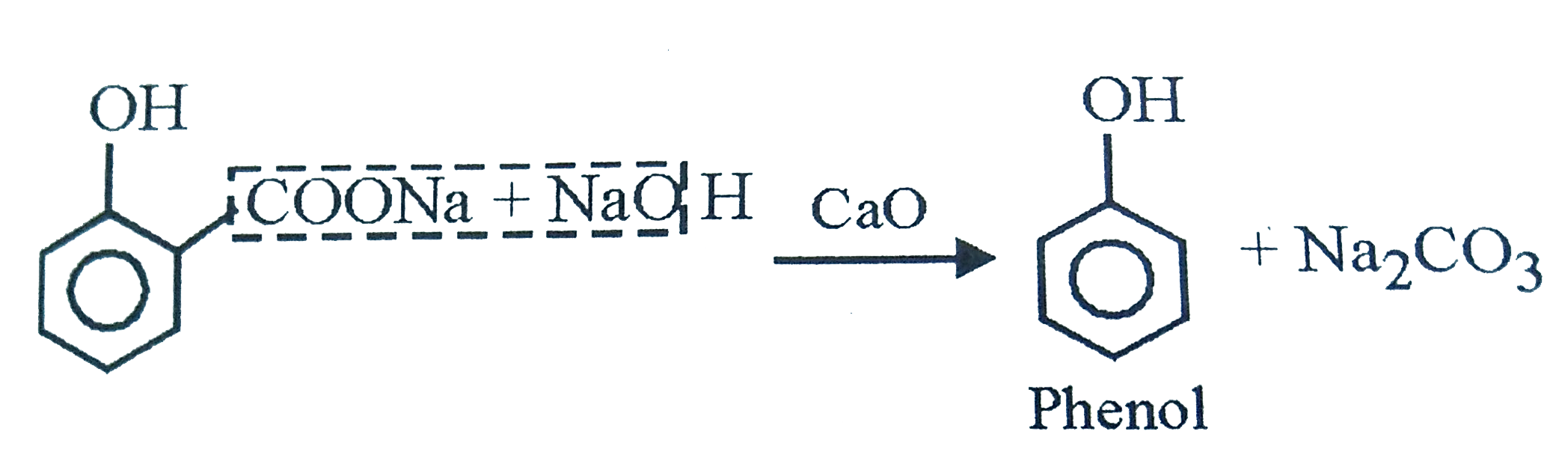
|
|
| 4. |
Dead burnt plaster is …………. |
|
Answer» `CaSO_(4)` `2CaSO_(4)*2H_(2)O to (CaSO_(4))_(2)*(1)/(2)H_(2)O +3H_(2)O` Above 393K, no water of crystallisation is LEFT and anhydrous calcium sulphate, `CaSO_(4)` is formed. This is known as .dead burnt plaster.. `CaSO_(4)*(1)/(2)H_(2)O overset(200^(@)C)tounderset("Anhydride")(CaSO_(4)) overset(1100^(@)C)to CaO+SO_(3)` |
|
| 5. |
Dead burnt plaster is ____________ |
|
Answer» `CaSO_4` |
|
| 6. |
Dead burnt is obtained from gypsum, on heating at |
|
Answer» `35^(@)C` |
|
| 7. |
Dead burnt gypsum on warming with water gives |
|
Answer» Gypsum |
|
| 8. |
Deactivating nature and o- ,p- directing nature of halogens can be explained by the effects respectively |
|
Answer» `- I, - M ` |
|
| 9. |
De-broglie proposet dual nature for matter lambda = (h)/(m v) and lambda = (h)/(sqrt(2mK.E)) where m = mass, h = plancks constant. Dual nature is particle and wave nature. Which one is not related to de-Broglie.s concept |
|
Answer» `lambda = (H)/(m V)` |
|
| 10. |
de-Broglie proposed the dual nature of electron and put forward his wave concept.The wave length of electron in an orbit was given by lambda =h/(mv) The wavelength of moving electron in 3^(rd) Bohr orbit of H-atom is |
|
Answer» `1xx10^(-9)` m |
|
| 11. |
De-broglie proposet dual nature for matter lambda = (h)/(m v) and lambda = (h)/(sqrt(2mK.E)) where m = mass, h = plancks constant. Dual nature is particle and wave nature. If an electron is accelerated by applying 100 V. The wavelength of electron is |
|
Answer» 12.3 A |
|
| 12. |
de-Broglie proposed dual nature for electron moving. The wavelength is given by the equations lambda = (h)/(m u). Later on Heisenburg proposed. The total incertainly uncertainity principle as. If uncertainity in position an momentum of an electron are same, then uncertainty in its velocity can be given by |
|
Answer» `GE sqrt((H)/(4pi m))` |
|
| 13. |
de-Broglie proposed the dual nature of electron and put forward his wave concept.The wave length of electron in an orbit was given by lambda =h/(mv) The circumference of 3^(rd) Bohr orbit in H-atom is |
|
Answer» `3xx10^(-7)` cm |
|
| 14. |
de-Broglie proposed the dual nature of electron and put forward his wave concept.The wave length of electron in an orbit was given by lambda =h/(mv) The de-Broglie.s wavelength (lambda) of the electron subjected to an accelerating potential of V volts is given by |
|
Answer» `(CH)/(sqrt(2mv))` |
|
| 15. |
de-Broglie proposed dual nature for electron moving. The wavelength is given by the equations lambda = (h)/(m u). Later on Heisenburg proposed. The total incertainly uncertainity principle as. With what velocity an electron must travel so that its momentum is equal to that of photon of wavelength of lambda = 5200 Å |
|
Answer» `800 MS^(-1)` |
|
| 17. |
De Broglie poroposed that moving micro particles exhibit wave behaviours. Electron in a Bohr.s orbit also shows dual nature whose wave length is given by lambda_(e) = (h)/(m_(e)V_(e)) m_(e) = mass of electron , V_(e) = velocity of electron , h = planck.s constant Bohr.s atomic model is in good agreement with De-broglie concept and the electron has fixed energy in Bohr.s orbit : 2pi r = n lambda (constructive wave in phase). A ground satte hydrogen atom is supplies with 17.6 ev of energy through alpha photon. What is the De-broglie wave length of the electron knocked out |
|
Answer» 6.125 Å |
|
| 18. |
De Broglie poroposed that moving micro particles exhibit wave behaviours. Electron in a Bohr.s orbit also shows dual nature whose wave length is given by lambda_(e) = (h)/(m_(e)V_(e)) m_(e) = mass of electron , V_(e) = velocity of electron , h = planck.s constant Bohr.s atomic model is in good agreement with De-broglie concept and the electron has fixed energy in Bohr.s orbit : 2pi r = n lambda (constructive wave in phase). The kinetic energy of an electron in alpha Bohr.s orbit of H-atom is 3.4 eV. What is the its De-broglie.s wave length ? |
|
Answer» 3.3 Å |
|
| 19. |
De Broglie poroposed that moving micro particles exhibit wave behaviours. Electron in a Bohr.s orbit also shows dual nature whose wave length is given by lambda_(e) = (h)/(m_(e)V_(e)) m_(e) = mass of electron , V_(e) = velocity of electron , h = planck.s constant Bohr.s atomic model is in good agreement with De-broglie concept and the electron has fixed energy in Bohr.s orbit : 2pi r = n lambda (constructive wave in phase). Two moving micro particles possess their kinetic energies in 2:1 ratio with same De-Broglie.s wave length.s What is the ratio of their masses? |
|
Answer» `1:1` |
|
| 21. |
de-Broglie equation is |
|
Answer» `LAMBDA = mv//h` |
|
| 22. |
de- Broglie equation is ………………. . |
|
Answer» <P>E= hv |
|
| 23. |
De Broglie and Bohr's concepts are in _________with each other. |
|
Answer» OPPOSE |
|
| 24. |
D.D.T. is prepared by heating chlorobenzene with: |
|
Answer» chloroform |
|
| 25. |
DDT is non-biodegradable and persistent.(T/F) |
|
Answer» |
|
| 26. |
DDT is |
|
Answer» A fertilizer |
|
| 28. |
Daniel cell is shown as |
|
Answer» `Zn_((s))//Zn^(2+) (aq)//// Cu_((s))//CU^(2+)((aq))` |
|
| 29. |
Dalton's law of partial pressures is applicable to |
|
Answer» `NO + O_2` |
|
| 30. |
Dalton's law cannot be applied for which gaseous mixture at normal temperatures? |
|
Answer» `O_(2)` and `N_(2)` |
|
| 31. |
Dalton's atomic theory fails to explain.........law of combining volumes |
|
Answer» |
|
| 32. |
Dalda is prepared from oils by |
|
Answer» hydrolysis |
|
| 34. |
D_2O has higher value of following physical parameters than H_2O, except |
|
Answer» MOLECULAR MASS |
|
| 36. |
[D] Match the solutions in Column-I in Column-I with their osmotic properties in Column-II : {:(,"Column-I",,"Column-II"),("(a)",S_(1):0.1M" glucose,"S_(2)0.1M " urea","(p)",S_(1)andS_(2)" are isotonic"),("(b)",S_(1):0.1M " NaCl, "S_(2):0.1M Na_(2)SO_(4),"(q)","No migration of solvent across the membrane"),("(c)",S_(1):0.1" NaCl, "S_(2)=0.1MKCl,"(r)",S_(1)" is hypertonic to "S_(2)),("(d)",S_(1):0.1M CuSO_(4)", "S_(2):0.1M" sucorse","(s)",S_(1)" is hypotonic to "S_(2)):} [Note : Assume that the electrolytes are completely ionised. |
|
Answer» |
|
| 37. |
D-exchange is observed in : |
|
Answer» E1 |
|
| 39. |
The enthalpy of the reaction H _(2 (g)) + 1/2 O _(2(g)) to H _(2) O _((g)) is Delta H _(1) and that of H _(2(g)) + 1/2 O _(2(g)) to H _(2) O _((l)) is Delta H _(2). Then |
|
Answer» `491.5` |
|
| 40. |
Cyclotron is not capable of accelerating |
|
Answer» Neutrons |
|
| 41. |
Cyclonc collector is used for reducing: |
| Answer» Solution :Air pollution | |
| 42. |
Cyclone collector is used for minimising |
|
Answer» RADIOACTIVE POLLUTION |
|
| 43. |
Cyclohexnol is |
|
Answer» Phenol 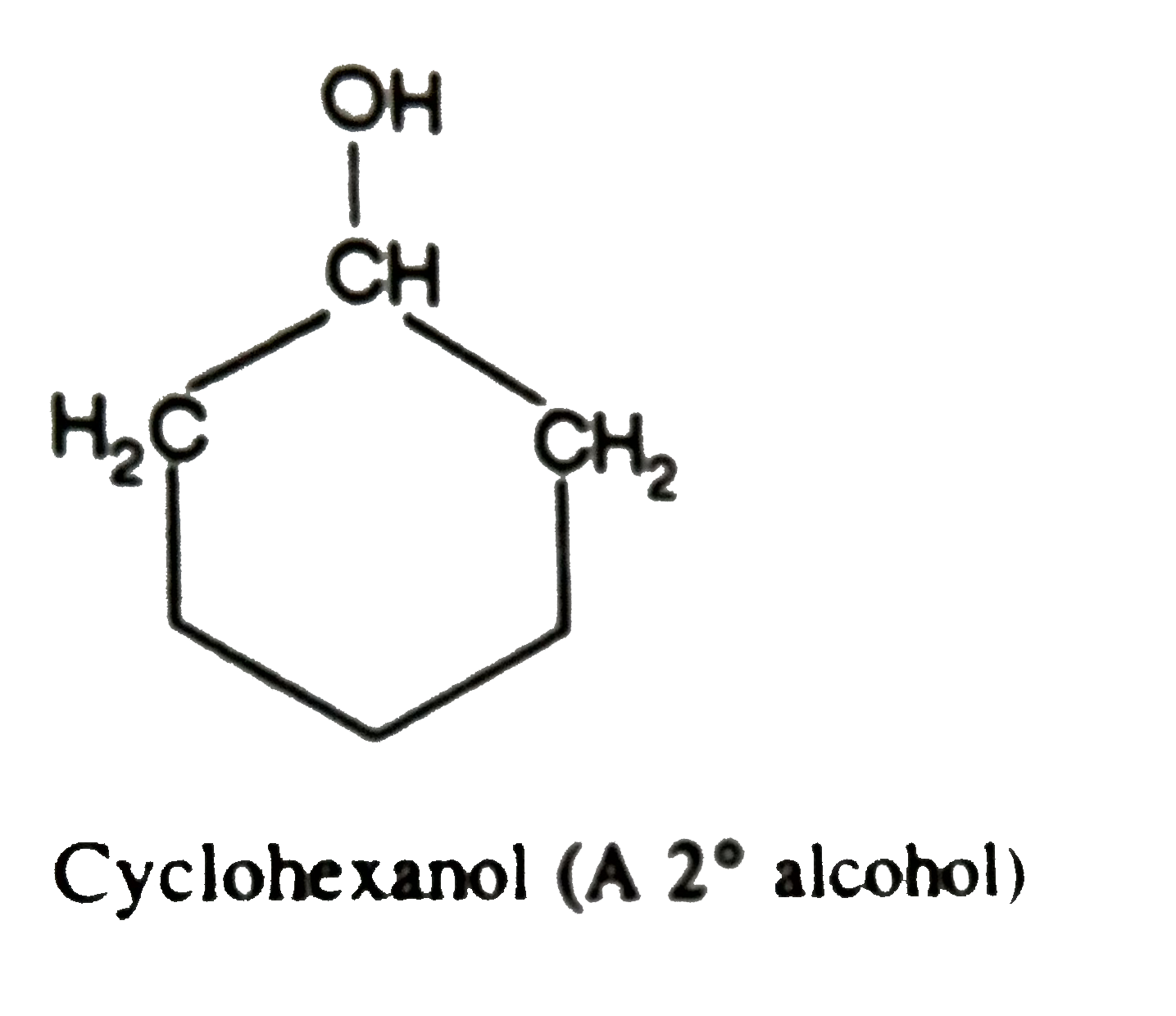
|
|
| 44. |
Cyclohexene…..type and furan is…..type of compound |
| Answer» SOLUTION :CYCLIC, HETEROCYCLIC | |
| 45. |
Cyclohexene reacts with limited amount of bromine in the presence of light to form product X (C_6H_9Br) The statement correct about X is : |
|
Answer» It is racemate |
|
| 46. |
Cyclohexene is best prepared from cyclohexanol by which of the following |
|
Answer» Conc. `H_(3)PO_(4)` |
|
| 47. |
Cyclohexene adds one mole of H_2, where the enthalpy of hydrogenation is -119.6 kJ mol^(-1). The enthalpy of cyclohexatriene is about |
|
Answer» `-119.6 " KJ MOL"^(-1)` |
|
| 48. |
Cyclohexane on chlorination gives |
|
Answer» CHLORO CYCLOHEXANE |
|
| 49. |
Cyclohexane mainly exists in boat conformation |
| Answer» SOLUTION :Cyclohexane EXISTS MAINLY in the CHAIR FORM. | |