Saved Bookmarks
This section includes 7 InterviewSolutions, each offering curated multiple-choice questions to sharpen your Current Affairs knowledge and support exam preparation. Choose a topic below to get started.
| 1. |
Cyclohexane-4,4-idone is a polar compound, having dipole moment value of 1.2 D. If mol fraction of its chair from is 0.80, what will be the dipole moment of twisted boat from ? |
Answer»  twist boat `MU=0` twist boat `MU=0` `mu_("net")=mu_("CHAIR")x_("chair")+m_(t.b.)x_(t.b.)1.2=0+mu_(t.b.)(0.20)` `rArr""mu_(t.b.)6.0` debey `therefore""x_("chair")=0.80` `therefore""x_(t.b.)1-0.80 rArr0.2` |
|
| 2. |
Cyclohexane-1,4-dione is a polar compound, having dipole moment value of 1.2 D. If mole fraction of its chair from is 0.80 what will be the dipole moment of twisted boat from? |
Answer»  `mu=0` TWIST boat `mu=0` `mu_("net")=mu_(CHAIR)x_(chair)+m_(t.b.)x_(t.b.)1.2=0+mu_(t.b.)(0.20)` `rArr""mu_(t.b.=6.0` debye `therefore""x_(chair)=0.80` `therefore""x_(t.b.)=1-0.80 rArr0.2` |
|
| 3. |
Cycloheptatrienyl cation is |
|
Answer» non-benzenoid and non-aromatic |
|
| 4. |
Cycloalkenes and alka- dienes are structural isomers and it is observed that the isomerisation reaction of cyclo-butene into 1,3, buta-diene follows 1st order kinetics with respect to cyclobutene. The rate constant of the reaction can be determined by hydrogenting ( reaction with H_(2) to remove unsaturation) the reaction mixture and different instant and measuring the amount of hydrogen required. In one such experiment two separate glass flasks of volume 1 litres. were added with same amount of cyclobutene and sealed. While one flask was broken after 138.6 min and the contents required 39.2 ml of H_(2) gas at 1 atm pressure and 273K, where as other flask was broken after a very long time and the contents required 44.8 ml of H_(2)gas at 1 tam pressure and 273K . From the information given above and given data, anwer the questions that follows: Delta H_(f)^(@) Cyclobutene=175kJ/mol DeltaH_(f)^(@)Buta-1,3-diene =125kJ/mol The average life of cyclobutene will be: |
|
Answer» 100min |
|
| 5. |
Cyclobutane underset(200^@ C)overset(+H_2// Ni) toproduct in the reaction is |
|
Answer» n-butane |
|
| 6. |
Cycloalkenes and alka- dienes are structural isomers and it is observed that the isomerisation reaction of cyclo-butene into 1,3, buta-diene follows 1st order kinetics with respect to cyclobutene. The rate constant of the reaction can be determined by hydrogenting ( reaction with H_(2) to remove unsaturation) the reaction mixture and different instant and measuring the amount of hydrogen required. In one such experiment two separate glass flasks of volume 1 litres. were added with same amount of cyclobutene and sealed. While one flask was broken after 138.6 min and the contents required 39.2 ml of H_(2) gas at 1 atm pressure and 273K, where as other flask was broken after a very long time and the contents required 44.8 ml of H_(2)gas at 1 tam pressure and 273K . From the information given above and given data, anwer the questions that follows: Delta H_(f)^(@) Cyclobutene=175kJ/mol DeltaH_(f)^(@)Buta-1,3-diene =125kJ/mol The rate at which heat is released in isomerisation of cyclobutene at t=69.3 min |
|
Answer» 50kJ |
|
| 7. |
Cycloalkenes and alka- dienes are structural isomers and it is observed that the isomerisation reaction of cyclo-butene into 1,3, buta-diene follows 1st order kinetics with respect to cyclobutene. The rate constant of the reaction can be determined by hydrogenting ( reaction with H_(2) to remove unsaturation) the reaction mixture and different instant and measuring the amount of hydrogen required. In one such experiment two separate glass flasks of volume 1 litres. were added with same amount of cyclobutene and sealed. While one flask was broken after 138.6 min and the contents required 39.2 ml of H_(2) gas at 1 atm pressure and 273K, where as other flask was broken after a very long time and the contents required 44.8 ml of H_(2)gas at 1 tam pressure and 273K . From the information given above and given data, anwer the questions that follows: Delta H_(f)^(@) Cyclobutene=175kJ/mol DeltaH_(f)^(@)Buta-1,3-diene =125kJ/mol which of the followin cannot be a possible value of volume of hydrogen measured at 1 atm and 300K required if the first bottle is broken at any other tim? |
|
Answer» 20ml |
|
| 8. |
Cycloalkanes mainly resemble with |
|
Answer» ALKANES |
|
| 9. |
Cycloalkanes are isomeric with |
|
Answer» Alkadienes |
|
| 10. |
Cycloalkane formed when 1,4-dibromopentane is heated with sodium is |
|
Answer» methylcyclobutane 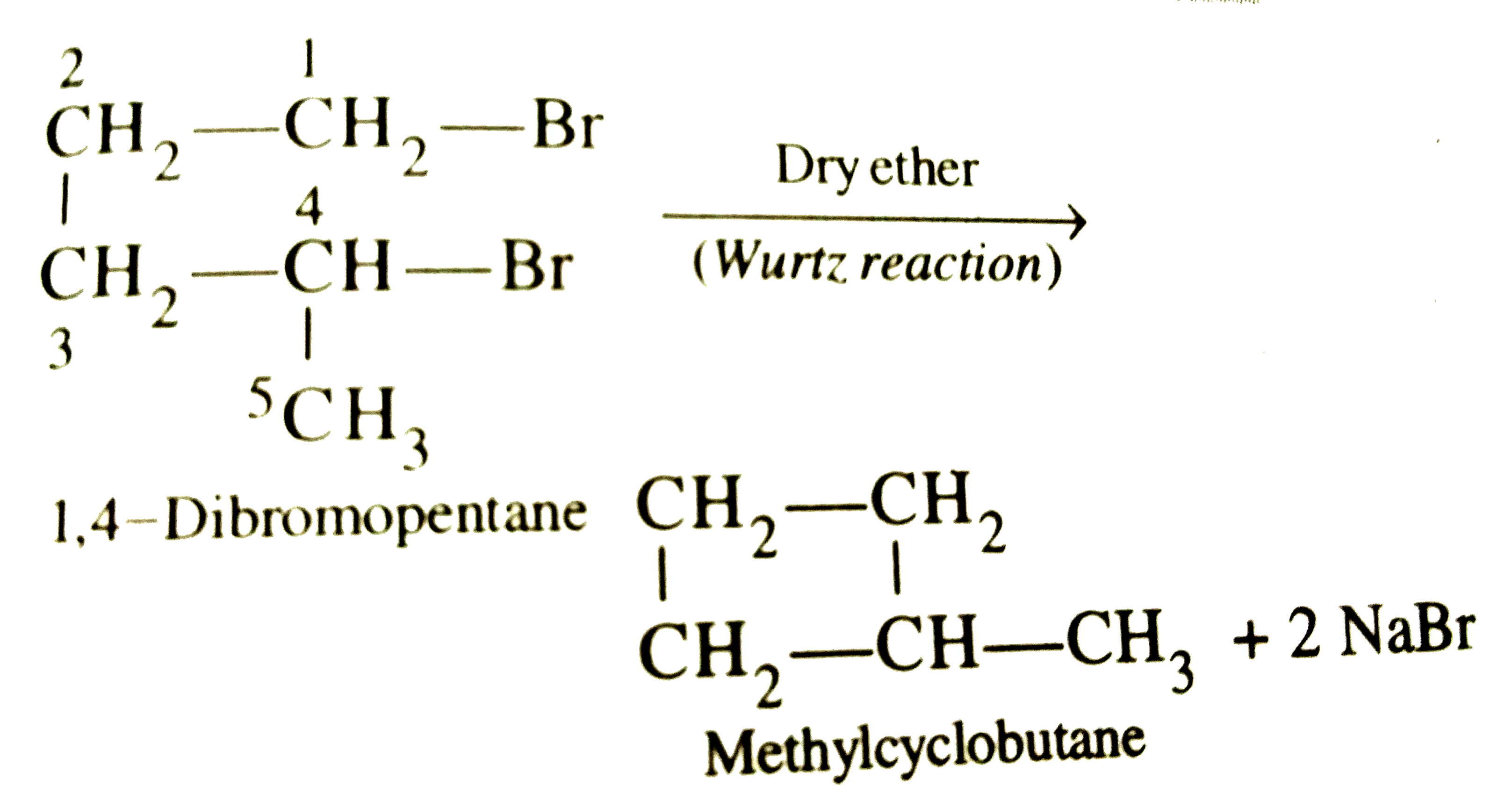
|
|
| 11. |
Cyclo alkanes are |
|
Answer» CARBOCYCLIC |
|
| 12. |
Cyclic osmium ester of alkene after reacting with aqueous solution of sodium bisulphite gives- |
|
Answer» Diol |
|
| 13. |
Cyanohydrin of which of the following forms lactic acid |
|
Answer» `HCHO` |
|
| 14. |
Cyanamide (NH_2CN) is completely burnt in excess oxygen in a bomb calorimeter, DeltaU was found to be -742.7 "kJ mol"^(-1), calculate the enthalpy change of the reaction at 298K. NH_2CN_((s))+3//2O_(2(g)) to N_(2(g)) + CO_(2(g)) +H_2O_((l)) DeltaH =? |
|
Answer» SOLUTION :Given: T=298 K , `DeltaU=-742.4 "kJ mol"^(-1)` `DeltaH`=? `DeltaH=DeltaU+Deltan_g RT` `DeltaH=DeltaU+(n_p-n_r)RT` `DeltaH=-742.4 +(2-3/2)xx8.314xx10^(-3)xx298` `=-742.4+(0.5xx8.314xx10^(-3)xx298)` =-742.4+1.24 `=-741.16 "kJ mol"^(-1)` |
|
| 15. |
C_(v) value of He isalways 3 R//2 but C_(v) value of H_(2) is 3R//2 at low temperatureand5R //2 at moderate temperature and more than 5R//2 at higher temperature . Explain in two or threelines. |
|
Answer» Solution :Refer to ART,page. He is a monoatomic gas. It has only THREE translational DEGREES of freedom. Hence, its energy per mole`= ( 3)/(2) RT:. C_(v) = ((DELTAU)/(DELTAT))_(v) (3)/(2)R` `H_(2)` is a diatomic molecule. It has not only translational motion but also has rotationaland vibrational motion. At moderate temperature,contribution by vibrational motion is negligible but as ithas two rotational degrees of motion ( being a linear molecule), contribution to energyby rotational degrees `2 xx (1)/(2) RT`. Hence total energy `= (5)/(2) RT` and therefore, `C_(v) = ( 5)/(2) R`. On increasing the temperature, contribution from vibrational degrees also starts and hence `C_(v)gt (5)/(2) R` |
|
| 16. |
CuSO_(4).5H_(2)O(s)hArrCuSO_(4).3H_(2)O(s)+2H_(2)O(s) K_(P)=0.4xx10^(-3) atm^(2) Which of following sttement are correct: |
|
Answer» `DeltaG^(@)=-RTlnP_(H_(2)o` where `P_(H_(2)o="Partial pressure of" H_(2)O` at equilibrium. `=0.4xx10^(-3)=4xx10^(-4) atm^(2)` `(P_(H_(2)o)_(equi)=2xx10^(-2)` atm `=2xx10^(-2)` atm `=2xx10^(-2)xx760=15.2` torr (B) Relative humidity`=(15.2)/(15.2)xx100=100%` (If `V.P.=15.2` torr) (C) When `P_(H_(2)O)gt(P_(H_(2)O)_(equi) backward shift so at `24` torr pressure reaction shift backward. (D) In dry atmosphere and open container reaction shift completely in forward. |
|
| 17. |
CuSO_(4),5H_(2)O(s)hArrCuSO_(4)(s)+5H_(2)O(g)K_(P)=10^(-10) "moles of" CuSO_(4).5H_(2)O(s) is taken in a 2.5L container at 27^(@)C then at equilibrium [Take: R=(1)/(12) litre atm mol^(-1)K^(-1)] |
|
Answer» Moles of `CuSO_(4).5H_(2)O` left in the CONTAINER is `9xx10^(-3)` |
|
| 18. |
CuSO_(4).5H_(2)O(s)CuSO_(4).3H_(2)O(s)+2H_(2)O(s) K_(p)=0.4xx10^(-3)atm^(2) Which of following statement are correc: |
|
Answer» `DeltaG^(@)=-RTlnP_(H_(2)O)` where `P_(H_(2)O)="PARTIAL pressure of" H_(2)O` at equilibrium. `=0.4xx10^(-3)=4xx10^(-4)ATM^(2)` `(P_(H_(2^O)))_(equi)=2xx10^(-2)atm` `=2xx10^(-2)atm` `=2xx10^(-2)xx760=15.2` torr (B) Relative humidity`=(15.2)/(15.2)xx100=100%`(IfV.P.`=15.2` torr) (C) When `P_(H_(2)O)gt(P_(H_(2)O))_(equi)` backward shift so at `24` torr pressure reaction shift backward. (D) In dry atmosphere and open container reaction shift completely in forward. |
|
| 19. |
CuSO_(4) .5H_(2)O_((g)) hArr CuSO_(4), 3H_(2)O_((s)) + 2H_(2) O_((g)) , K_(p) = 4 xx 10^(-4) atm^(2). If the vapour pressure of wateris38 torr then percentage of relative humidity is: (Assume all data at constant temperature) |
|
Answer» 4 `= SQRT(K_(P))=2 XX 10^(-2)` ATM, `2 xx 10^(-2) xx 760` MM `% R.H=(P_(H_(2)O))/("vapour pressure of" H_(2)O) xx 100` `=(2 xx 10^(-2) xx 760)/(38) xx 100=40%` |
|
| 20. |
Curium is the member of..... |
|
Answer» ACTINIDE SERIES |
|
| 21. |
Cumene is the compund used for commercial preparation of phenol. Chemically cumene is |
|
Answer» ISOPROPYL benzene 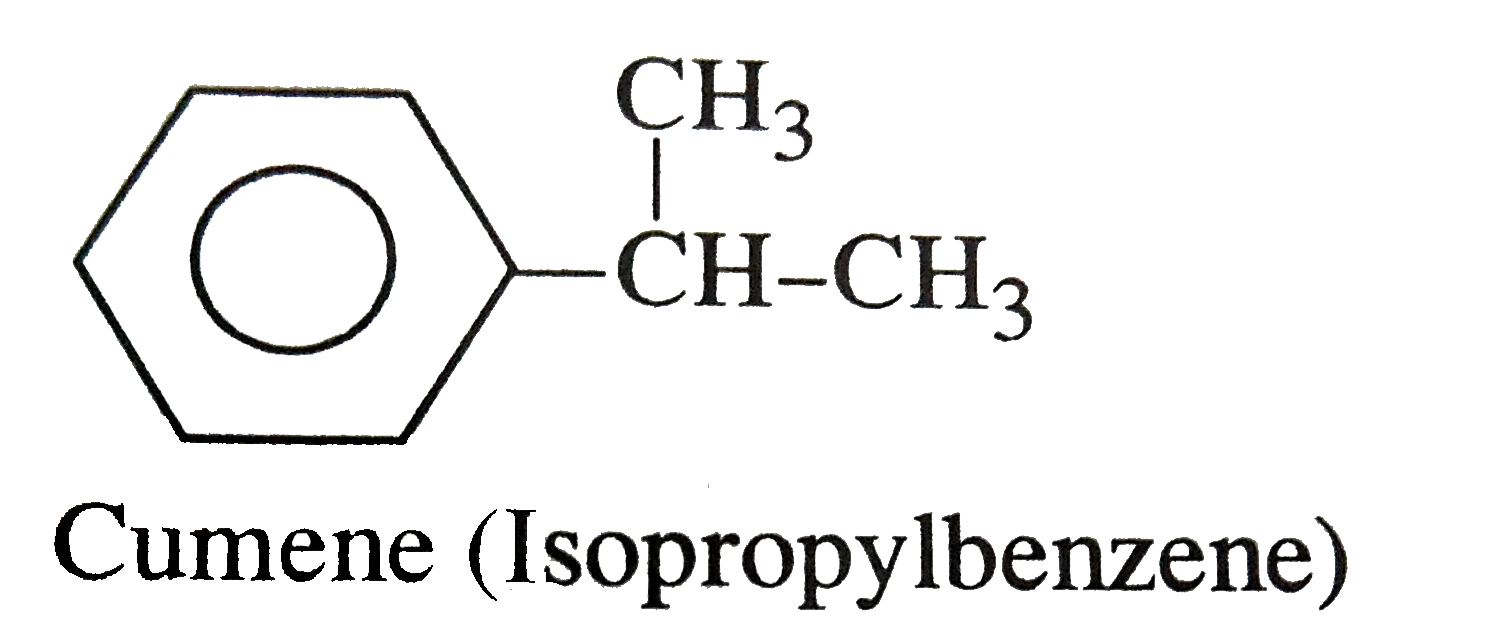
|
|
| 22. |
CuCl is more covalent than NaCl. Give reason. |
|
Answer» Solution :(i) Cation having `ns^(2)np^(6)nd^(10)` configuration show greter polarsing power than the CATIONS with `ns^(2)np^(6)` configuration. Hence they show greater COVALENT character. (ii) CuCl is more covalent than NaCl. As compared to `Na^(+) (1.13A), Cu^(+) (0.6A)` is small and has `3S^(2)3p^(6)3D^(10)` configuration. (iii) Electronic configuration of `Cu^(+)` : `[Ar]2d^(10)` Electroic contiguratton of `Na^(+)` : `[He] 2s^(2)2P^(6)` So CuCl is more covalent than NaCl |
|
| 23. |
Cu_(2)S and M_(2)S are isomorphous. Percent weight of sulphur in Cu_(2)S is 20.14 and in M_(2)S is 12.9. if the atomic mass of Cu is 63.5, Calculate that of the other metal,M. |
|
Answer» SOLUTION :`Cu_(2)S` contain 20.14% S and 79.86% Cu Weight of Cu that combines with 1 g of S `=(79.86)/(20.14)=3.965g` `M_(2)S` contains 12.9% S and 87.1% M Weight of M that combines with 1G of S =`(87.1)/(12.9)=6.765g` From law of isomorphism , (since VALENCY of two metals is same ) ` ("atomic mass of M ")/("atomic mass of Cu")=("Weight of M")/("weight of Cu")` Atomic mass of M `=(6.752)/(3.965)xx63.5=108` |
|
| 24. |
Cu^(2+)+KCN (in excess) rarr soluble complex (X). How many statements are correct regarding complex (X)? (a) The central atom has the co-ordination number of 6 (b) The central atom has the co-ordination number of 4 The complex is square planar (d) The complex is diamagnetic (e) The complex is paramagnetic |
|
Answer» |
|
| 25. |
Cu^(2+) is more stable than Cu^+ in aqueous solution. Explain. |
|
Answer» Solution :`Cu^+` has outermost electronic configuration as `3d^(10)` and THEREFORE, should be most common and most stable STATE because of extra STABILITY associated with completely filled d-subshell `(d^10)`. However, this is not true and `Cu^(2+)` with OUTER electronic configuration `3d^9` is more stable than `Cu^+`. This is due to high hydration energy in aqueous solution and high lattice energy in solid state of `Cu^(2+)` as compared to `Cu^+`. The equilibrium : `2 Cu^+ The constant fordisproportionation of `Cu^+` in aqueous solution shows that `Cu^(2+)` is very stable in aqueous solution as compared to `Cu^+`. |
|
| 26. |
Cu^(2+) ions get precipitated with little H_2 S. While Ni^(2+) ions get precipitated with more H_(2) S . This is because |
|
Answer» `K_(SP)` of Cu S is LOW |
|
| 27. |
Cu+HNO_(3)toCu(NO_(3))_(2)+NO_(2)+H_(2)O The number of Nitrogen atoms, water molecules and the total charge on the product side are respectively when above reaction is balanced ? |
|
Answer» `6,3,0` `CutoCu^(2+)+2NO_(3)^(-)" "...("Oxidation")` `CutoCu^(2+)+2bare" "...(x)("Oxidation half")` (y) Reduction half : (i) `underset(+5)underset(darr)(NO_(3)^(-))tounderset(+4)underset(darr)(NO_(2))" "...("O.N. of N")` (ii) `NO_(3)^(-)+baretoNO_(2)" "..."(Reduction and " BARE)` (iii) `NO_(3)^(-)+bare+2H^(+)toNO_(2)` ... (Charge balance by `H^(+)`) `NO_(3)^(-)+bare+2H^(+)toNO_(2)+H_(2)O` ... (Balance of O, .H. by `H_(2)O`) (iv) `2NO_(3)^(-)+2bare+4H^(+)to2NO_(2)+2H_(2)O" "...(y)`  At product side in the balanced equation, No. of nitrogen atoms = 4 No. of water molecules = 2 Total charge = Zero [SUPPOSE you stop at ionic balance equation (z)] At product side in (z) N = 2, `H_(2)O` = 2 and charge = +2 [But as per data, you can not stop at this stage, you are required to state molecular form from ionic] |
|
| 28. |
Cu forms two oxides cuprous and cupric oxides, which law can be proved by the weights of Cu and O? |
|
Answer» CONSTANT composition |
|
| 29. |
C(s)hArr2A(g)+B(s) If the dissociation of C(s) is alpha and d is the density of the gaseous mixture in the container. Initially container have only C(s) and the reaction is carried at constant temperature and pressure. |
|
Answer»
so `dpropMA` and hence it does not DEPEND on `ALPHA` so `d` will remain CONSTANT. option (d) is correct. |
|
| 30. |
CsCl has cubic sructare, its density is 3.99 g cm^(-3). What is the distance betweenCs^(+)andCl^(-) ions ? ( At. Mass of Cs= 133) |
|
Answer» Solution :CsCl has BCC STRUTURE. It has noe formula unit in the unit cell . So Z=1 ` p = ( Z xx M)/ (a^(3) xx N_(0) )ora^(3) = (Z xx M)/( p xx N_(0)) = (1 xx (133 + 35.5) "g mol" ^(-1))/ (3.99 " g cm"^(-3) xx 6.02 xx 10^(23) " mol" ^(-1)) = 70.15 xx 10^(-24)cm^(3)` ` a = ( 70. 15)^(1//3) xx 10 ^(-8) cm^(3)= ( 70.15) ^(1//3) xx 10^(2) " PM""" ( 1"pm" =10 ^(-10)" cm")` ` = 4.124 xx 10^(2) " pm"= 412.4 "pm"` For BCC structure, Interionic distance (d) ` = (sqrt3a)/2= 1.732/2 xx 412.4 = 357 ` pm(SEE solved sample problem 2, page 1/34) ( To solve ` (70.15)^(1//3) ` , put ` x = ( 70.15)^(1//3)` , Then ` log x = 1/3 log 70.15 = 1/3 xx 1.8460 = 0.6153` x = ANTILOG 0.6153 = 4.124 |
|
| 31. |
CsCl has cubic structure. Its density is 3.99 g cm^(-3). What is the distance between Cs^+ and Cl^- ions ? (At. Mass of Cs =133) |
|
Answer» Solution :CsCl has BCC STRUCTURE. It has ONE formula unit in the unit cell. So Z=1 `RHO=(ZxxM)/(a^3xxN_0)` or `a^3=(ZxxM)/(rhoxxN_0)=(1xx(133+35.5) "g mol"^(-1))/(3.99 g cm^(-3)xx6.02xx10^23 mol^(-1))=70.15xx10^(-24) cm^3` `a=(70.15)^(1//3)xx10^(-8) cm^(3) =(70.15)^(1//3)xx10^2` PM (1pm=`10^(-10)` cm) For BCC structure, Interionic distance (d)`=(sqrt3a)2=1.732/2xx412.4=357` pm ltbr gt [To solve `(70.15)^(1//3)`, PUT `x=(70.15)^(1//3)`. Then log x=`1/3 log 70.15 =1/3xx1.8460=0.6153` x=Antilog 0.6153=4.124] |
|
| 32. |
CsCl has coordination number ratio |
|
Answer» `6:6` |
|
| 33. |
CsCl has bcc arrangement and its unit cell edge length is 400 pm. Calculate the interionic distance in CsCl |
|
Answer» Solution :where BLACK circle is `Cs^+` ion and coloured circles are `CL^-` ions. The aim is to FIND half of the body diagonal AE. If the edge of the UNIT cell is 'a', then `CE=sqrt(a^2+a^2)=sqrt2a` `therefore AE=sqrt((sqrt2a)^2+a^2)=sqrt3a=sqrt3xx400` `therefore` Interionic distance `=1/2AE=sqrt3xx200=346.4` pm |
|
| 34. |
CsCl had bcc arrangement and its uint cell edge length is 400 pm. Calculate the interionic distance in CsCl. |
|
Answer» Solution :The bcc arrangement iof CsCl, wehre balck cricle is ` Cs^(+)` ion and colured circles are` Cl^(-) ` ions. The aim is to find half of the body diagonal AE. If the EDGE of the UNIT cell is 'a' then, ` CE = sqrt(a^(2) +a^(2)) = SQRT2 a` ` AE = sqrt((sqrt2a)^(2) + a^(2)) = sqrt3 a = sqrt3 XX 400` Interionic distanace = `1/2 AE = sqrt 3 xx 200 = 346.4 ` pm 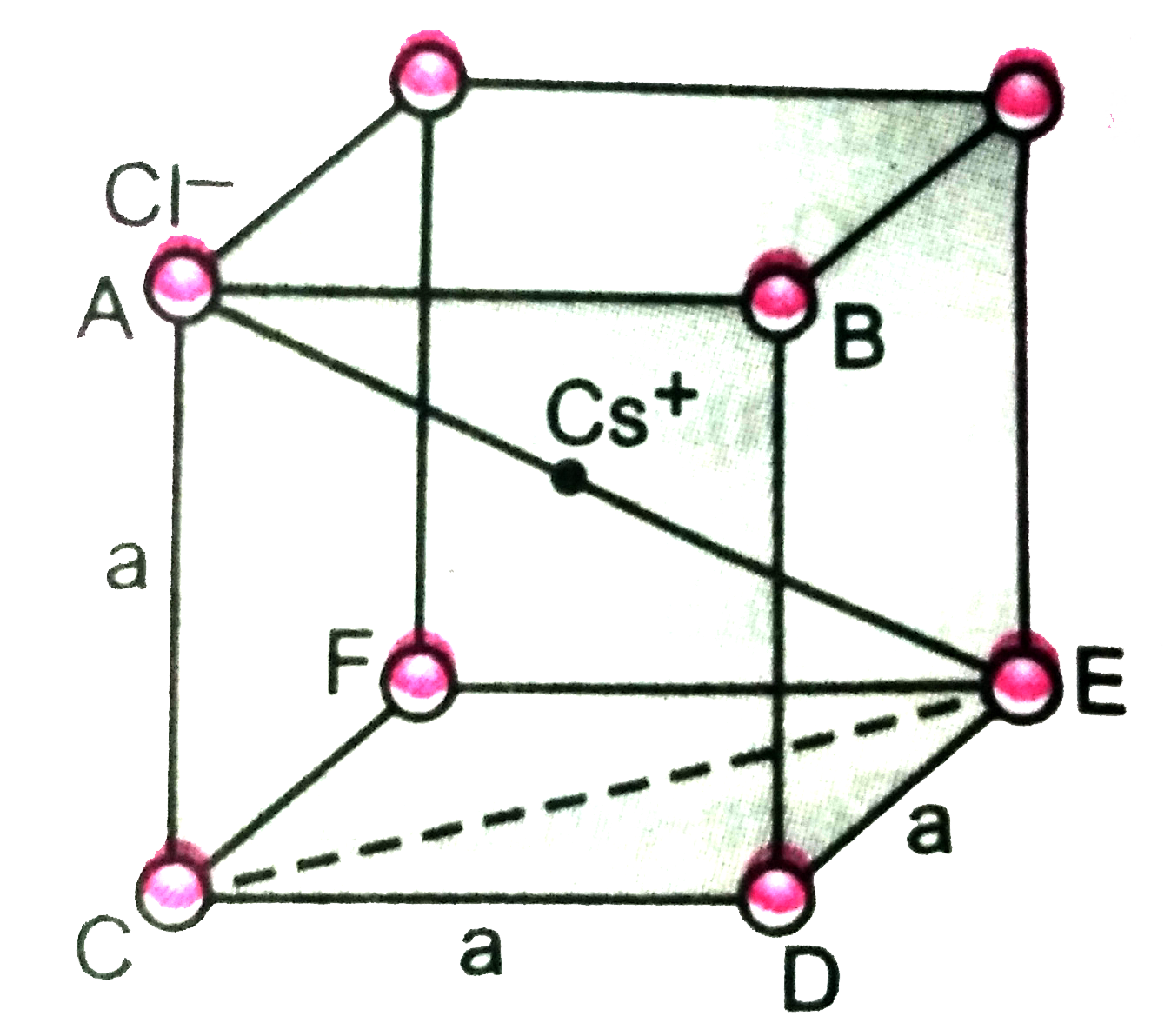
|
|
| 35. |
CsClcrystallises in body-centred cubic lattice. If 'a' is its edge length then which of the following expressions is correct ? |
|
Answer» `r_(Cs^+)+r_(Cl^-)=sqrt3a` 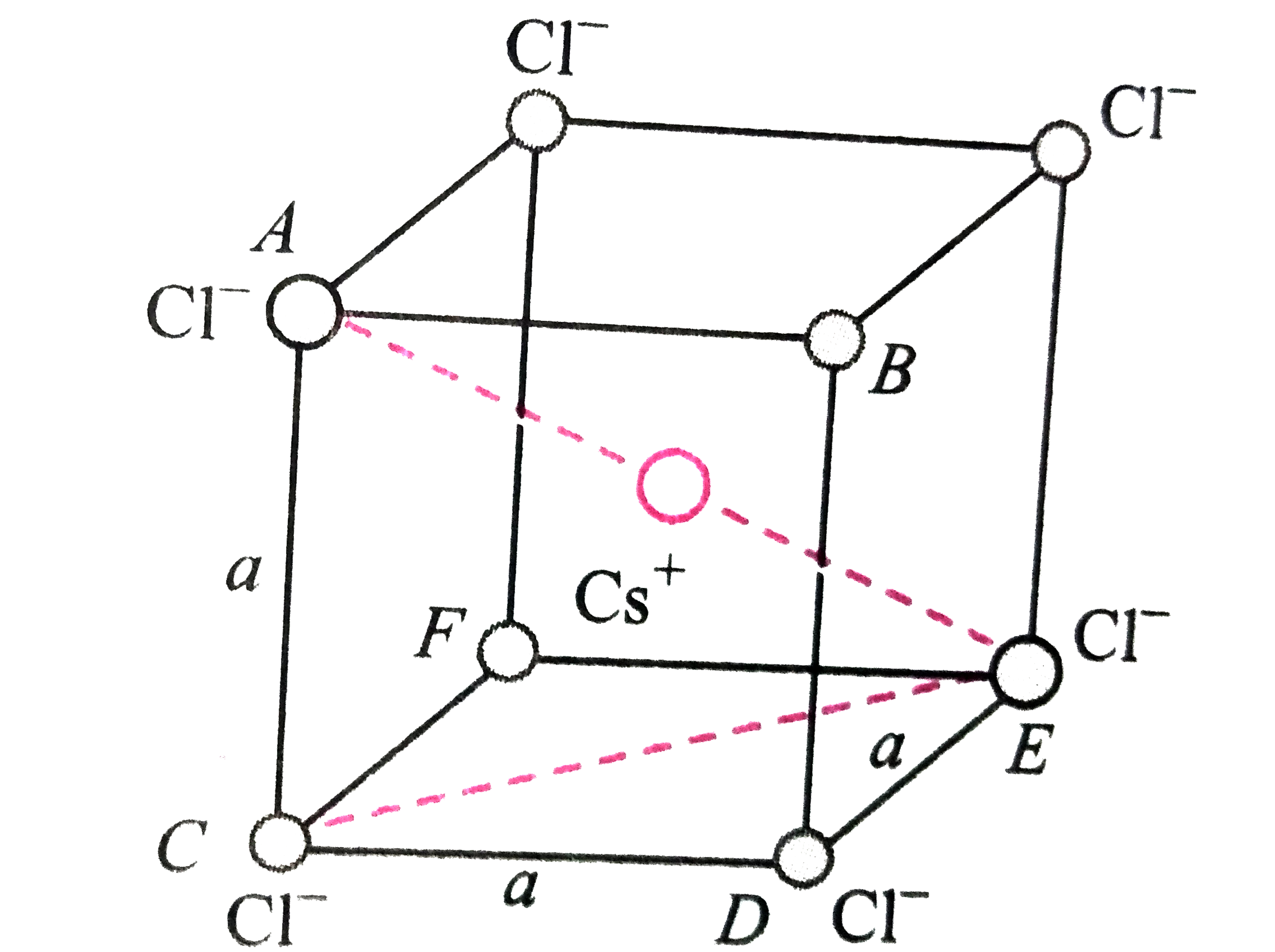 `THEREFORE` Body diagonal, AE=`2r_(Cs^+)+ 2r_(Cl^-)` But body diagonal =`sqrt3a` (From right angled `triangleCDE`, CE=`sqrt(a^2+a^2)=sqrt2a` From right angled `TRIANGLE ACE` , `AE=sqrt(AC^2+CE^2)=sqrt(a^2+2a^2)=sqrt(3a^2)=sqrt3a`) `therefore 2(r_(Cs^+)+r_(Cl^-))=sqrt3a` or `r_(Cs^+) +r_(Cl^(-))=sqrt3/2a` |
|
| 36. |
CsCl crystallises in body - centred cubic lattice. If 'a' is its edge length the which of the following expressions is correct ? |
|
Answer» ` r_(Cs+)+ r_(Cl^(-)) = sqrt3 a ` 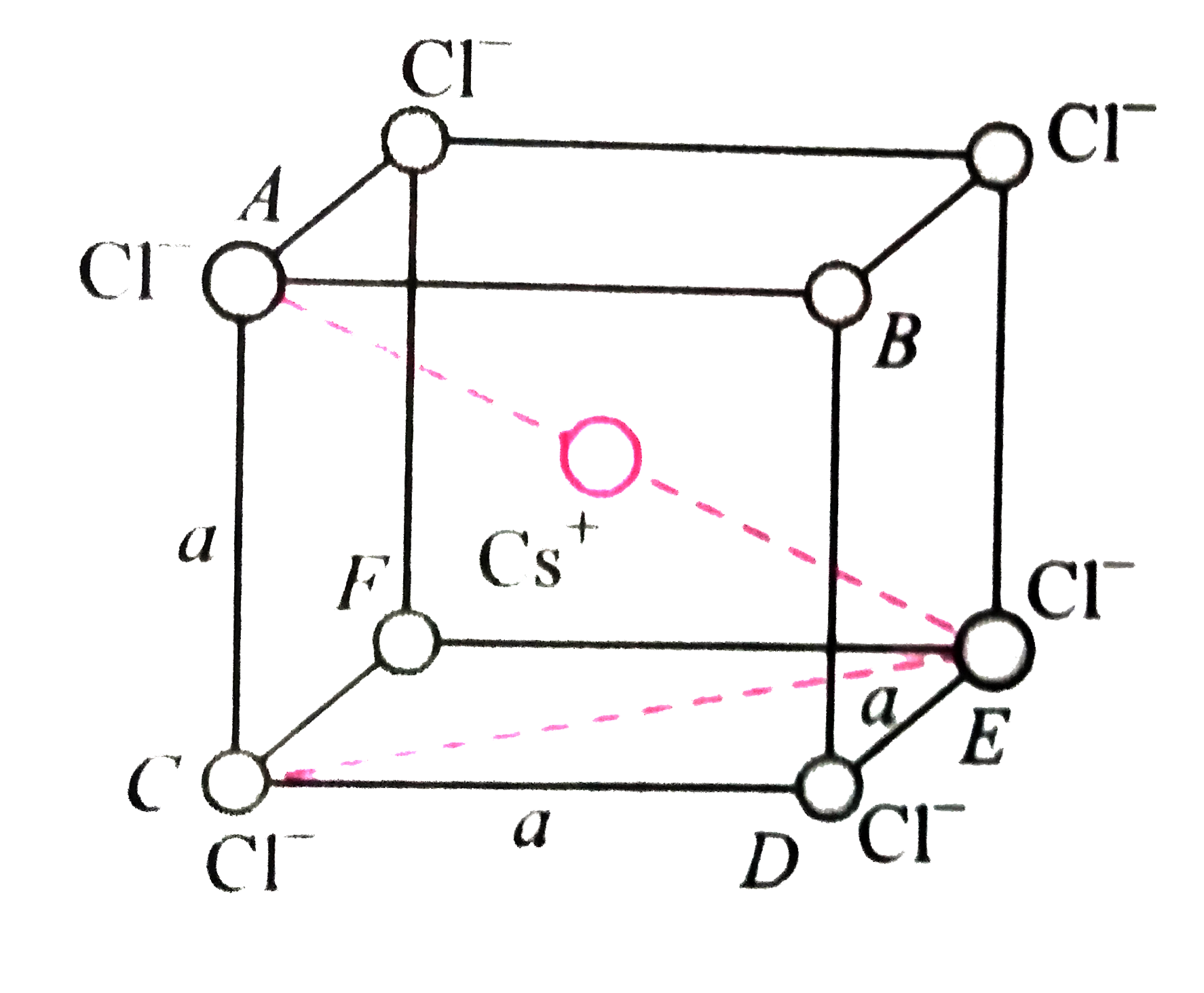 Body diagonal , ` AE = 2r_(Cs^(+)) + 2r_(Cl^(-))` But body diagonal = ` SQRT 3a ` ( From right angled` DeltaCDE, CE =sqrt(a^(2) +a^(2))= sqrt2a ` From right angled ` Delta ACE` ` AE = sqrt( AC^(2)+ CE^(2)) = sqrt(a^(2) + 2a^(2)) = sqrt(3a^(2)) = sqrt3 a `) `2(r_(Cs^(+)) +r_(Cl^(-)) = sqrt3 a or r_(Cs) + r_(Cl^(-)) = sqrt3/2 a ` |
|
| 37. |
CsBr crystallizes in a body centredcubic lattice. The unit cell length is 436.6 pm. Given that the atomic mass of Cs = 133 and that of Br = 80 amu and Avogadro's number being 6.02times10^(23) mol^(-1), the density of CsBr is |
|
Answer» `8.25g//cm^(3)` =`(1times(133+80))/((436.61)^(3)times(6.02times20^(23))times10^(-30))` `4.25 G //cm^(3)` (CSBR CONTAINS, one formula unit per unit CELL) |
|
| 38. |
C_((s))+O_(2(g)) rarr CO_(2(g)) Calculate the standard entropy chage for the above reaction. Given the standard entropies of CO_(2(g)), C_((s)),O_(2(g))are 213.6, 5.740 and 205 JK^(-1) respectively (ii) Identify the compound (A) and (B) . R-C-=N overset(H_2O//H^+) rarr (A) overset(H_2O//H^+) rarr (B) |
|
Answer» Solution :`C(G) + O_(2) rarr CO_(2) (g)` `Delta S_(R)^(0) = Sigma S_("products")^(0) - Sigma S_("REACTIONS")^(0)` `Delta S_(r)^(0)={S_(CO_2)^(0)}-{S_(C)^(0)+S_(O_2)^(0)}` `Delta S_(r)^(0)=213.6 - [5.74 + 205]` `Delta S_(r)^(0)=213.6 - [210.74]` `Delta S_(r)^(0)=286 K^(-1)` (ii) `R-C -= N overset (H_2"O"//H^+)rarr underset("(Amide)(A)")R-CONH_(2) overset(H_2"O"//H^+)rarr underset("(Acid)(B)")(R-COOH)` |
|
| 39. |
C_((s))+H_(2)O_((g))hArrCO_((g))+H_(2(g)):DeltaHltO The above equilibrium will proceed in forward direction when |
|
Answer» It is subjected to high PRESSURE |
|
| 40. |
C(s)+H_(2)O(g) hArr CO(g)+H_(2)(g)""DeltaHgt0 For the system above at equilibrium, which changes will increase the amount of H_(2)(g)? (P) Adding C(s) (Q) Increasing the volume of container (R) Increasing the temperature |
|
Answer» <P>P only |
|
| 41. |
C(s)+CO_(2)(g) hArr 2CO(g). If this system is at equilibrium, which change(s) will alter the value of K_(P)? (P) Raising the temperature (Q) Adding solid C (R) Decreasing the pressure |
| Answer» Answer :A | |
| 42. |
Crystals of washing soda lose nine molecules of water when exposed to dry air. This phenomenon is know as |
|
Answer» Dehydration |
|
| 43. |
Crystals at 100% H_(2)O_(2) is obtained by cooling 90% H_(2)O_(2) with. |
|
Answer» Solid `CO_(2)` and ether |
|
| 44. |
Crystalloids differ from colloids mainly in respect of |
|
Answer» ELECTRICAL behaviour |
|
| 45. |
crystalloid and colloid differ with respect to : |
|
Answer» tyndall effect |
|
| 46. |
Crystalline solids that exhibit different physical properties in all directions are called ---------. |
| Answer» SOLUTION :ANISOTROPIC | |
| 47. |
Crystalline solids are anisotropic in nature'. What does this statement mean ? |
| Answer» SOLUTION :Anisotropic nature of crystalline SOLIDS means that properties like electrical conductivity , refractive index etc. have different values in different directions. | |
| 48. |
Crystalline solids are anisotropic in nature . What does this statement mean ? |
| Answer» Solution :Anisotropic nature of crystalline solids MEANS that properties LIKE ELECTRICAL conductivity . Refrative index etc. have DIFFERENT values in different direaction. | |
| 49. |
Crystal systems in which no two axial lengths are equal are |
|
Answer» TETRAGONAL |
|
| 50. |
Crystal structure of ice is detected by …… |
|
Answer» MICROSCOPE |
|