

Saved Bookmarks
This section includes 7 InterviewSolutions, each offering curated multiple-choice questions to sharpen your Current Affairs knowledge and support exam preparation. Choose a topic below to get started.
| 1. |
Express the following upto four significant figures (i) 6.5089 (ii) 32.3928 (iii) 8.721 xx 10^(4) (iv) 2000 |
|
Answer» |
|
| 2. |
Express the following quantities in scientific notation : (i) 150000 g(ii) 0.0064 cm(iii) 0.059 m. |
|
Answer» Solution :(i) 150000 g can be EXPRESSED as `1.5 xx 10^5` g. (II) 0.0064 cm can be expressed as `6.4 xx 10^(-3)` cm. (iii) 0.059 m can be expressed as `5.9 xx 10^(-2)`m. |
|
| 3. |
Express the number 232.508 in scientific notation. |
|
Answer» |
|
| 4. |
Express the following numbers upto three significant figures. (i)0.006576 (ii) 5.467 xx 10^4 (iii) 125.35 (iv) 64.72 (v) 3.769, (vi) 0.05431 |
|
Answer» |
|
| 5. |
Express the following numbers to four significant figures : (i) 5.607892 (ii) 32.392800 (iii) 1.78986 xx 10^3 (iv) 0.007837. |
|
Answer» Solution :(i) In the NUMBER 5.607892, the DIGIT to be RETAINED is 7. It is followed by digit 8 which is greater than 5. Hence, the rounded off number is 5.608. (ii) In the number 32.392800, the digit to be retained is 9. This is followed by 2 which is less than 5. Hence, 9 is left unchanged and the rounded off number containing four significant FIGURES is 32.39. (iii) In the number `1.78986 xx 10^3`, the digit to be retained is 9. This is followed by 8 which is greater than 5. Hence, the digit 9 is increased by one and the number containing four significant figures is `1.790 xx 10^3`. (IV) The number 0.007837 already contains four significant figures. In exponential notation, this can be written as `7.837 xx 10^(-3)`. This still contains four significant figures. |
|
| 6. |
Expressthefollowingnumbersinexponential notations upto three significant figures, (i) 546200 (ii) 0.0000369 (iii) 124600000 |
|
Answer» |
|
| 7. |
Express the following in SI units : (i) 92 million miles (This is the distance between earth and sun) (ii) 90 miles per hour (the typical speed of Rajdhani express) (iii) 5 feet 4 inches (the average height of Indian female) (iv) 0.74 Ã… (the bond length of hydrogen molecule) (v) 45^(@)C (the peak summer temperature n Jaipur) (vi) 140 pounds (the average weight of Indian male). |
|
Answer» Solution :(i) The `SI` unit of distance = metre (m) 1 mile `= 1.60 km = 1.6 xx 10^(3)` m Conversion FACTOR `= ((1.6xx10^(3)m))/(("1 mile"))` 92 million miles `=92xx10^(6)` miles `92xx10^(6)` miles `=92xx10^(6)`miles `xx` conversion factor `=(92xx10^(6) "miles")xx((1.6xx10^(3)m))/(("1 mile"))=147.2xx10^(9)m=1.47xx10^(11)m` (ii) 1 mile `= 1.6 km = 1.6 xx 10^(3)` m Conversion factor `= ((1.6xx10^(3)m))/(("1 mile"))` 1 hour `=60xx60s=3.6xx10^(3)s` ltbtgt Conversion factor `=((3.6xx10^(3)s))/(("1 HR"))` We have two conversion factors for both the physical quantities i.e., distance and TIME Speed `= ("90 miles")/("1 hr")=("90 miles"xx("conversion factor"))/("1 hr"xx("conversion factor"))` `= ("90 miles")xx((1.6xx10^(3)m))/(("1 miles"))xx(1)/(("1 hr"))xx(("1 hr"))/((3.6xx10^(3)s))=(90xx1.6)/(3.6)ms^(-1)=40 ms^(-1)` (iii) 5 feet and inches `= 5 xx 12 +4 = 64` inches , 1 inch `= 2.54 xx 10^(-2) m` Conversion factor `= ((2.54xx10^(-2)m))/(("1 inch"))` 64 inches = 64 inches `xx` conversion factor `= ("64 inches")xx((2.54xx10^(-2)m))/(("1 inch"))=1.63m` (iv) `1 Ã… = 10^(-10) m` Conversion factor `= (10^(-10)m)/(1 Ã…),0.74 Ã…=0.747xx` conversion factor `=(0.74Ã…)xx((10^(-10)m))/((1Ã…))=0.74xx10^(-10)m=7.4xx10^(-11)m` (v) `0^(@)C=273.15K` `45^(@)C=273.15+45=318.15K` (VI) 1 pound `= 453.6 xx 10^(-3)` kg Conversion factor `= ((453.6xx10^(-3)kg))/(("1 pound"))` 140pounds=(140 pounds)`xx` conversion factor `= ("140 pounds")xx((453.6xx10^(-3)kg))/(("1 pound"))` `=140xx453.6xx10^(-3)kg=63504xx10^(-3)kg=63.5kg`. |
|
| 8. |
Express the following in the scientific notation : (i) 0.0048 (ii) 234,000 (iii) 8008 (iv) 500.0 (v) 6.0012 |
|
Answer» (II) `234,000-2.34xx10^(5)` (iii) `8008-8.008xx10^(3)` (IV) `500.0=5.0xx10^(2)` (v) `6.0012-6.0012xx10^(2)` |
|
| 9. |
Express the final result in each case on the basis of significant figures. (1). (2.4+9.389) (2) 94.48-6.4 (4.25xx0.078999)/(6.007) (4) ((2.36xx10^(-4))(0.3))/(3.8) (5) 3.46xx10^(3)+4.58xx10^(2) (6) (437xx0.00612+208) |
Answer» SOLUTION : LTBRGT LTBRGT 
|
|
| 10. |
Express the following in the scientific notation: (i) 0.0048 (ii) 234,000 (iii) 8008 (iv) 500.0 (v) 6.0012 |
| Answer» Solution :(i) `4.8 XX 10^3`, (ii) `2.34 xx 10^5`, (III) `8.008 xx 10^3`, (IV) `5.000 xx 10^2`, (V) `6.0012 xx 10^0` | |
| 11. |
Express the change in internal energy of a system when (iii) w amount of work is done by the system and q amount of heat is supplied to the system what type of system would it be? |
| Answer» SOLUTION :`DELTAU`=q-w, CLOSED SYSTEM | |
| 12. |
Express the change in internal energy of a system when (i) No heat is absorbed by the system from the surrounding, but work (w) is done on the system. What type of wall does the system have? (ii) No work is done on the system, but q amount of heat is taken out from the system and given to the surrounding. What type of wall does the system have? (iii) w amount of work is done by the systemand q amount of heat is supplied to the system. What type of system would it be ? |
|
Answer» Solution :(i) Here, `q = 0 :. Delta U = q+w= 0+ w_(ad) = w_(ad)` As no HEAT is absorbed by the SYSTEM, the wall id ADIABATIC. (ii) Here, ` w= 0 , q= -q :. Delta U = q + w= -q+0= -q` As heat is taken out, the system must be having thermally CONDUCTING walls. (iii) `w = -w , q= +q``:. Delta u = q+ w = q-w` As work is done by the system on ABSORBING heat, it must be a closed system. |
|
| 13. |
Express the change in internal energy of a system when (ii) No work is done on the system, but q amount of heat is taken out from the system and given to the surroundings. What type of wall does the system have? |
| Answer» SOLUTION :`DeltaU`= -Q, THERMALLY conducting walls | |
| 14. |
Express the change in internal energy of a system when (i) No heat is absorbed by the system from the surroundings, but work (w) is done on the system. What type of wall does the system have? |
| Answer» SOLUTION :`DELTAU`=W , WALL is ADIABATIC | |
| 15. |
Express the change in internal energy of a system when (i) No heat is absorbed by the system from the surroundings, but work (w) is done on the system. What type of wall does the system have ? (ii) No work is done on the system, but q amount of heat is taken out from the system and given to the surroundings. What type of wall does the system have?. (iii) w amount of work is done by the system and q amount of heat is supplied to the system. What type of system would it be ? |
|
Answer» Solution :(i) `Delta U = W_(AD)`, wall is ADIABATIC (ii) `Delta U - q,` thermally conducting WALLS (iii) `Delta U = q-W`, closed for system |
|
| 16. |
Express the average kinetic energy per mole of monostomic gas of molar mass M. at temperature T K in terms of the average speed of the molecules U_("avg"). |
|
Answer» `(8M)/(2PI)U_("AVG")^(2)` |
|
| 17. |
Express one atm pressure in terms of the height of mercury column. |
| Answer» SOLUTION :76 cm or 760 mm Hg | |
| 18. |
Express (i) 5 litre of milk in cubic meter (m^(3)) (ii) 25^(@)Cin Kelvin. |
|
Answer» |
|
| 19. |
Express 6.022 xx 10^23 in the form of a number which contains only three significant figures. |
|
Answer» |
|
| 21. |
Expolain about the extent of reaction of dissociation of bromine mono chloride at 1000 K. |
|
Answer» Solution :`2BrCl(g) hArr Br_(2)(g) + Cl_(2) (g)K_(C) =5` `10^(-3) lt K_(c) lt 10^(3)` Both FORWARD and backward reaction MAKE signhificant progress. Neither forward nor reverse reaction PREDOMINATES. |
|
| 22. |
Explin about inductive effect. (ii) What do you mean by conformation ? Explain about staggered conformation in ethane . |
|
Answer» Solution :It is defined as the change in the polarization of a covalent bond due to the presence of adjacen bonded atoms or groups in the molecule. It is denoted as I-effect . <BR> 2 . Atoms or groups which lose ELECTRON towards a carbon atom are said to have a + I effect. Example `CH_(3)-,(CH_3)_2 CH-,(CH_3)_2C` etc . 3 Atoms or groups which draw electrons AWAY from a carbon atom are said to have a- I effect. Example , `-NO_(2),-I,-Br,-OH,C_6H_5` etc. For example, consider ethane and ethyl chloride. The C-C bond in ethane is non- polar while the C-C bond in ethyl chloride is polar. We know that chlorine is more electronegative than carbon and hence it attracts the shared pair of electrons between C-Cl in ethyl chloride towards itself. `overset(deltadelta^+)underset(2)CH_(3)rarr-overset(delta)underset(1)CH_(2)rarr-overset(delta)Cl` This develops a slight negative charge on chlorine and a slight positive charge on carbon to which chlorine is attached. To compensate it, the `C_1` draws the shared pair of electron between itself and `C_2`. This polarization effect is called inductive effect. (ii) The rotation about C-Csingle bondaxis yielding several ARRANGEMENTS of a hydrocarbon called conformers. Staggered conformation: In this conformation, the hydrogens of both the carbon atoms are FAR apart from each other. The repulsion between the atoms is minimum and it is the most stable conformer. 
|
|
| 24. |
Explain about the classification of matter |
Answer» SOLUTION :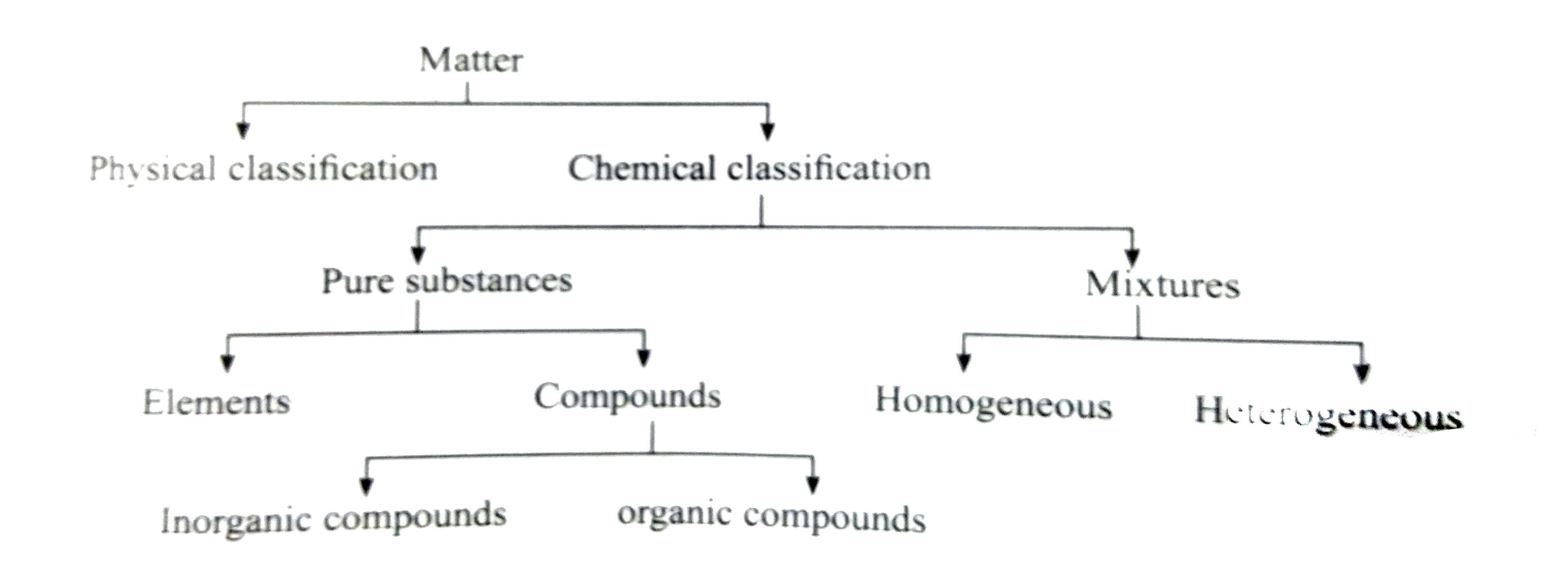
|
|
| 25. |
Explajin formation of four sigma bond with example. OR Explain shape of methane. |
Answer» SOLUTION :In METHANE electron configuration of carbon in ground state is [He] `2s^(2)2P^(2)`, now in excited state one electron of 2s enter in 2p orbital. The energy required is balanced by FREE energy.  Excited carbon has four half filled orbitals 2s, `2p_(x), 2p_(y), 2p_(z) and sp^(3)` these orbital mix together and form four `sp^(3)` orbitals. These `sp^(3)` hybrid orbitals arrange at `109.5^(@)` angle in the four CORNER of tetrahedron. These half filled orbital with 1s orbital of hydrogen on internuclear axis and form 4 C-H `sigma` bond. In this way in `CH_(4)`C- H bond in at `109.5^(@)`. angle and arrange in three dimension direction in tetrahedral structure. So `CH_(4)` has tetrahedral structure H-C-H bond angle is `109.5^(@)`. 
|
|
| 26. |
Explain zeolites compounds. |
|
Answer» Solution :If aluminium atoms replace few silicon atoms in three-dimensional network of silicon dioxide, overall STRUCTURE known as aluminosilicate, ACQUIRES a negative charge. CATIONS such as `Na^(+) , K^(+) , Ca^(+2)` balance the negative charge. Examples are feldspar and zeolites. Uses : Zeolites are widely used as a catalyst in petrochemical industries for CRACKING of hydrocarbons and ISOMERISATION, e.g., ZSM-5 (A type of zeolite) used to convert alcohols directly into gasoline. Hydrated zeolites are used as ion exchangers in softening of "hard" water. |
|
| 27. |
Explain Wurtz reaction with example. |
|
Answer» Solution :Alkaly Halides on treatment with SODIUM metal in dry ether to give higher alkane. `CH_(3)underset("METHYL Bromide")(Br+2Na)+Br-CH_(3) underset("ether")overset("dry")(to)CH_(3)-underset("ETHANE")(CH_(3))+2NaBr` |
|
| 28. |
Explain Wurtz- fitting reaction . |
|
Answer» Solution :Wurtz -fitting reaction : Chlorobenzene and CHLOROETHANE are heated with sodium in ether solution to form ETHYLBENZENE. This reaction is called Wurtz-fitting reaction. `underset("Chlorobenzene")(C_(6) H_(5) Cl) + Na + underset("Chloroethane")(ClC_(2) H_(5)) overset("Ether") underset(Delta)(to) underset("Ethylbenzene") (C_(6) H_(5) - C_(2) H_(5)) + 2 NaCl` |
|
| 29. |
Explain with the help of an example, the difference between bond dissociation energy and bond energy. |
|
Answer» Solution :Bond dissociation energy is the energy required to break 1 MOLEOF bonds. E.g. `H - H(g) rarr 2H(g) ""Delta H = 436 kJ MOL^(-1)` Bond energy is the energy released when 1 mole of bonds are FORMED. Example `2H rarr H_(2)(g) ""Delta H = -436 kJ mol^(-1)` In diatomic molecules both bond dissociation energy and bond energy are EQUAL in MAGNITUDE but opposite in sign. |
|
| 30. |
Explain with suitable example that the resonance structure of molecule do not represent real structure and they are hypothetical |
Answer» Solution :There are many organic molecules whose behaviour cannot be explained by a single Lewis STRUCTURE. An example is that of benzene. Its cyclic structure containing alternating C-C single and C=C DOUBLE bonds shown is inadequate for explaining its characteristic properties. As per the above REPRESENTATION, benzene should exhibit two different bond lengths, due to C-C single and C=C double bonds. Experimentally by X-ray diffraction, in benzene all C-C bond length is 139pm  However, as determined experimentally benzene has a uniform C-C bond distances of 139 pm, a value intermediate between the C-C single (154pm) and C=C double (134pm) bonds. Thus, the structure of benzene cannot be represented adequately by the above structure. Benzene can be represented equally well by the energetically IDENTICAL structures (I) and (II).  Therefore, according to the resonance theory the actual structure of benzene cannot be adequately represented by any of these structures, rather it is a hybrid of the two structures (I and II) called resonance structures as figure (III).  The resonance structures (canonical structures or contributing structures) are hypothetical and individually do not represent any real molecule. They contribute to the actual structure in proportion to their stability. |
|
| 31. |
Explain with resons which of the following half reactions is oxidation and which is reduction? Hg_(2)^(2+)to2Hg^(2+)+2e^(-) |
|
Answer» |
|
| 32. |
Explain with resons which of the following half reactions is oxidation and which is reduction? Cl_(2)+2e^(-)to2Cl^(-) |
|
Answer» |
|
| 33. |
Explain with example the Positive Mesomeric Effect . |
|
Answer» Solution :Positive resonance effect occurs, when the electrons move awayfrom substituent attached to the conjugated SYSTEM. It occurs, if the electron RELEASING substituents are attached to the cojugated system. In such cases. The attached group has a tendency to release electrons through resonance . These electron releasinggroups are usually DENOTED as + R or + M grourp. Examples : ` - OH, - SH, - OR, - SR, - NH_(2), - O-` |
|
| 34. |
Explain with example oxidation of alkene in different situations ? |
|
Answer» SOLUTION :(a) Bayer.s test of alkene of unsaturation test : Preparation : Colour of POTTASIUM permanganate `(KMnO_(4))` is purple in colour. Cold and diluted pottasium permanaganate does the colution colurless when their conformation of unsaturation, Bayer.s test is well known. Alkene is unsaturated hydrocarbon. Treating alkene with potassium permanganate, vicinal diol is formed. Formation of di-ol, known as hydroxylation. There is a oxidation of alkenes. colour of pottasium permangnate disappears. e.g.-1 : Bayer.s test of ethene YIELDS ethelene glycol. `2KMnO_(4) + H_(2)O rarr 2KOH + 2MnO_(2) + 3(O)` `underset("(Ethelene)")underset("Ethene")(CH_(2)=CH_(2))+ubrace((H_(2)O+O))_("From " KMnO_(4)) underset(273 K)overset(dil. KMnO_(4))rarr underset("(Ethelen glycol)")underset("Ethane-2-diol")(underset(OH)underset(|)(CH_(2))-underset(OH)underset(|)(CH_(2)))` e.g.-2 : Bayer.s test of propene yields propane-1, 2-diol. `underset("Propene")(CH_(3)CH)=CH_(2)+H_(2)O+O underset(273 K, (O))overset(Dil. KMnO_(4))rarr underset("Propene-1,2-diol")(CH_(3)-underset(OH)underset(|)(CH)-underset(OH)underset(|)(CH_(2)))` Common reaction in Bayer.s test is :  (b) Oxidation of alkene in presence of strong oxidizing agent : Reactant : Acidic or alkyl pottasium permanganate or potassium dichromate. Reaction : Oxidation of alkene results into acid or ketone. Product depends upto the nature of alkene. reaction examples : (i) Oxidation of 2-methylpropene with `KMnO_(4)` gives propane.  (ii) On oxidation of But-2-ene, ethanoic acid is formed. `underset("But-2-ene")(CH_(3)CH=CHCH_(3))underset(Delta, (O))overset(KMnO_(4), H^(+))rarr underset("Ethanoic acid")(2CH_(3)COOH)` Note : In carboxylation, only main product is, carbonic reaction should be balanced. (iii) `underset("Ethene")(CH_(2)=CH_(2)) underset((O), Delta)overset(KMnO_(4), H^(+))rarr underset("Ethanoic acid")(HCOOH)overset((O))rarr CO_(2)+H_(2)O` |
|
| 35. |
Explain with example acidic dehydration of alcohole. |
|
Answer» Solution :PREPARE : `R-OH` (alcohol) heated with conc. `H_(2)SO_(4), H_(2)O` molecule is released. DEHYDRATION : Alcohol `(C_(n)H_(2n+1)OH`, where `n gt 1`) treated with conc. `H_(2)SO_(4), H_(2)O` molecule is released, since a water molecule is eliminated from the alcohol molecule is eliminated from the alcohol molecule in the presence of acid, this reaction is known as acidic dehydrogenation of alochols.  reaction : In these reaction -OH group and `beta`-carbon hydrogen is REMOVED in the FORM of `H_(2)O` and `pi`-bond is formed between `alpha` and `beta`-carbon. These reaction also known as `beta`-ELIMINATION reaction. |
|
| 36. |
Explain with example dehalogenation of vicinal dihalide. |
|
Answer» Solution :Vicinal dihalide means carbon having dihalides in which two halogen ATOMS are attached to two adjacent carbon atoms are known as vicinal dihalides. DEHALOGENATION : Vicinal dihalides on treatement with zinc metal LOSE a molecule of `ZnX_(2)` to form an alkene. This reaction is known as dehalogenation. e.g., : `CH_(2)BrCHBrCH_(3)` Example : 
|
|
| 37. |
Explain with an example equilibrium involving dissolution of solids in liquids. |
|
Answer» Solution :Example : `CO_(2(g))hArrCO_(2)("solurion")` When a bottle of soda water is OPENED, some of the dissolved `CO_(2)` in it, bubbles out in the form of froth. In the solution, there is a dynamic equilibrium between `CO_(2)` MOLECULES in the gaseous state and the `CO_(2)` molecules dissolved in the liquid under pressure. At equilibrium, the mass of the dissolved gas in a given mass of water is PROPORTIONAL to the pressure above the solution. This is in ACCORDANCE with the HENRY's law of gas solublity in a liquid. |
|
| 38. |
Explain Williamson's synthesis. |
|
Answer» Solution :Williamson.s synthesis: HALOALKANES when boiled with SODIUM alkoxide GIVES the corresponding ether. `CH_(3)underset("BROMO ethane") (-CH_(2) Br) + underset("Sodium ethoxide") (CH_(3) CH_(2)O Na) to CH_(3) - CH_(2)underset("Diethyl ether")(-O-CH_(2)) - CH_(4) + NaBr` |
|
| 39. |
Explain why water has high melting and boiling points as compared to H_(2)S? |
Answer» Solution :This is an ACCOUNT of intermolecular hydrogen bonding which is PRESENT in the molecules of `H_(2)O` but is ABSENT in the molecules of `H_(2)S`. 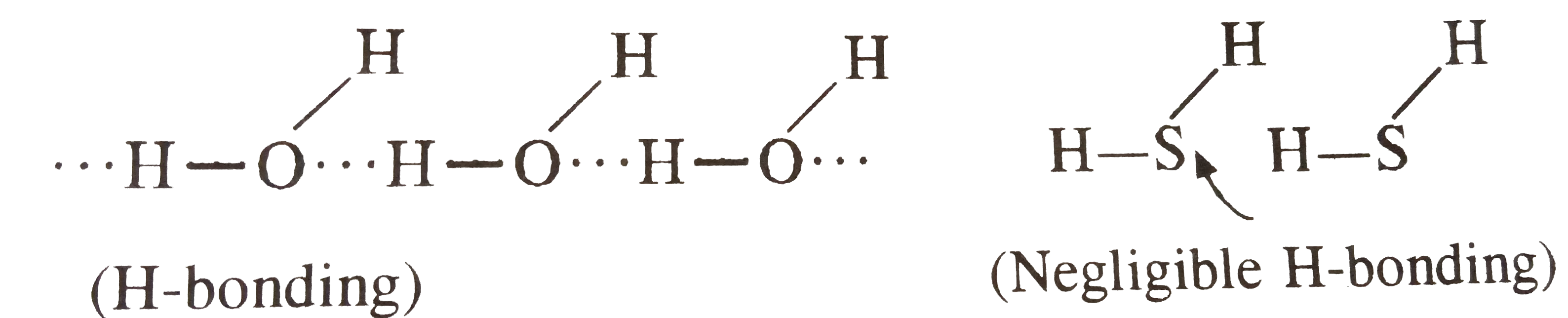 As a result, both melting and boiling point of water are higher than those of hydrogen SULPHIDE. |
|
| 40. |
Explain why (underset(+)(C )H_(3))_(3) overset(+)(C ) is more stable than CH_(3)CH_(2) and CH_(3) is the least stable cation |
| Answer» Solution :Hyperconjugation interaction in `(CH_(3))_(3) overset(+)(C )` is GREATER than in `+CH_(3) overset(+)(C )H_(2)` as the `(CH_(3))_(3) overset(+)(C )` has nine `C-H` bonds. In `CH_(3)`, vacant p orbital is perpendicular to the plane in which `C-H` bonds lie, HENCE cannot overlap with it. THUS, `overset(+)(C )H_(3)` lacks hyperconjugative stability | |
| 41. |
Explain why is there a phenomenal decrease in ionisation enthalpy from carbon to silicon? |
|
Answer» |
|
| 42. |
Explain why the uncertainty principle is significant only for the motion of subatomic particles but is negligible for the macroscopic objects |
| Answer» SOLUTION :The energy of PHOTON is sufficient to DISTURB a subatomic particle so that there is uncertainty in the measurement of position and MOMENTUM of the subatomic particle. However, the energy is insufficient to disturb a MACROSCOPIC object | |
| 43. |
Explain why the uncertainty principle is significant only for the motion of sub-atomic particles but is negligible for the macroscopic objects? |
|
Answer» Solution :The energy of PHOTON is sufficient to disturb a sub-atomic particle so that there is UNCERTAINTY in the MEASUREMENT of position and MOMENTUM of the sub-atomic particle. HOWEVER, the energy is insufficient to disturb a macroscopic object. |
|
| 44. |
Explain why the following two structures, I and II cannot be the major contributors to the real structure of CH_(3)COOCH_(3). underset((I))(CH_(3) - underset(+)overset(overset(bar( : overset(..)O: ))(|))(C )- underset(..)overset(..)(O) - CH_(3)) harr underset((II))(CH_(3) - overset(overset(bar( : overset(..)O: ))(|))(C )= underset(..)overset(+)(O)- CH_(3)) |
|
Answer» Solution :In STRUCTURE (I), the octet is not complete on carbon `C^(+)` and the SEPARATION of CHARGE on adjacent atom so it is UNSTABLE and there is no specific ROLE in real structure. The separation of charge is in structure (II) and It is unstable because negative charge (+) on oxygen atom and no specific role. |
|
| 45. |
Explain why the follwing system is not aromatic: |
| Answer» SOLUTION :The ring contains ONE `sp^3` hybridised carbon. So it is not plannar. Moreover, the `pi` electrons outside the ring cannot fully conjugate with the `pi` electrons of the ring. HENCE it is not a fully conjugated cyclic SYSTEM containing 6 delocalised `pi` electrons. So it is not AROMATIC. | |
| 46. |
Explain why the following two structures, I and II cannot be the major contributors to the real structure of CH_(3)COOCH_(3). |
| Answer» SOLUTION :The two STRUCTURES are less IMPORTANT contributors as they involve charge separation. Additionally, structure I contains a CARBON atom with an INCOMPLETE octet. | |
| 47. |
Explain why the following compounds behave as Lewis acids ? (A)BCl_3 , (B)AlCl_3 |
| Answer» Solution :In both the species, the central atom i.e., Boron and Aluminum are surrounded by 6 ELECTRONS and each CL atom in both is surrounded by 8 electrons. `BCl_3` and `AlCl_3` are ELECTRON deficient and ready to accept a PAIR of electrons. Hence, they act as Lewis acids. | |
| 48. |
Explain why the following reactant in not feasible as a synthesis of butyl iodide. |
| Answer» SOLUTION :The Strongly BASIC `HO^(-)` ion (hydroxide ion) virtually never acts as a LEAVING group, SOMETHING this reaction would require. This reaction would be FEASIBLE under acidc conditions in which case the leaving group would be a water moelcule. | |
| 49. |
Explain why the elements of group-2 form M^(2+) ions but not M^(3+) ions. |
| Answer» SOLUTION :Loss of THIRD electron from group-2 METAL atoms causes loss of stable noble gas CONFIGURATION and for this REASON group- 2 elements form `M^(2+)` ions but not `M^(3+)`ions. | |
| 50. |
Explain why the entropy of a pure crystalline substance is zero at 0 K ?State the law on which it is based. Give the application of this law ? |
| Answer» Solution :At 0 K , there is a perfectly ordered arrangement of the constituent particle of a PURE crystalline substance and there is no DISORDER at all. Hence,its ENTROPY is taken an zero. This statement is based on the third law of thermodynamics. The law is applied to FIND the absolute entropy of a substance in any STATE at any temperature. | |