

Saved Bookmarks
This section includes 7 InterviewSolutions, each offering curated multiple-choice questions to sharpen your Current Affairs knowledge and support exam preparation. Choose a topic below to get started.
| 1. |
Formula for Plaster of Paris.... |
|
Answer» `2CaSO_(4)*2H_(2)O` |
|
| 2. |
Formic acid when treated with H_(2)SO_(4) gives |
|
Answer» `(COOH)_(2)` |
|
| 3. |
Formic acid is prepared by distilling glycerol with: |
|
Answer» CRYSTALLINE OXALIC ACID at 383 K |
|
| 4. |
Formic acid can reduce |
|
Answer» TOLLEN's reagent |
|
| 5. |
Formic acid and acid may be distinguished by the reaction with |
|
Answer» sodium `CH_(3)COOH + KMnO_(4) + H_(2)SO_(4) rarr` No REACTION. |
|
| 6. |
Formic acid and Acetaldehyde can be distinguish by |
| Answer» Answer :A::D | |
| 7. |
Formation of ozone takes place as O_(2)(g) + O(g) rarr O_(3)(g) , DeltaH^(@)=- 107 . 2kJ . Assuming O = O bond energyas 498.8 kJ mol^(-1), the average bond energy of ozone is |
|
Answer» `391.6 kJmol^(-1)` `:. -107.2= 498 + 0 -2BE ( O overset("......")(_)O)` as `O_(3)` is 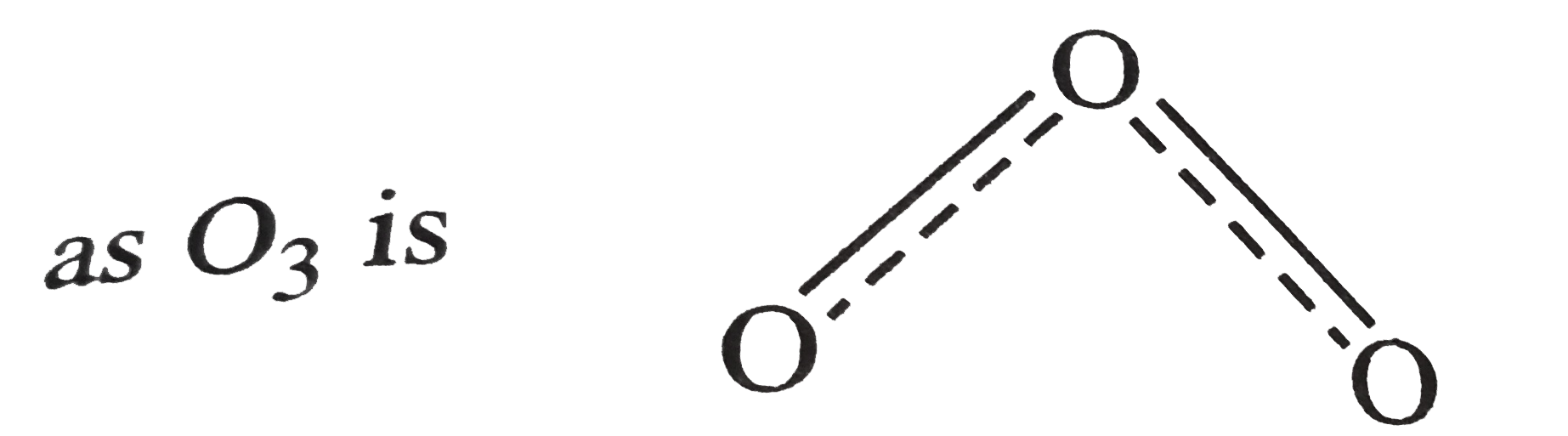 or `2BE ( O overset("….....")(O overset("….....")(_)O) = 498 .0 +107.2 = 605.2` or `BE(Ooverset("….....")(_)O) = ( 605.2)/( 2)= 302.6` |
|
| 8. |
Formation of London smog takes place in |
|
Answer» WINTER during day TIME |
|
| 9. |
Formation of London smog is initiated by a mixture of __________and ___________and is formed in the _______season |
|
Answer» |
|
| 10. |
Formation of benzene from acetylene is |
|
Answer» TRIMERISATION |
|
| 11. |
Formation of ammonia from H_(2) and N_(2) by Haber's process using Fe is an example of |
|
Answer» HETEROGENOUS catalysis `N_(2(g))+3H_(2(g))overset(FE(s))to2NH_(3(g))` The reactants are in gaseous state while the catalyst is in solid state. |
|
| 12. |
Formation of alcohol from alkene. |
|
Answer» Solution :`H_(2)O` means `overset(+delta)(H) overset(-delta)(OH)`. ALKENE reacts with `H_(2)SO_(4)`, an addition of `H_(2)O, -OH` (ALCOHOL) is formed. This reaction is addition of `H_(2)O` or dydrolysis of alkene or formation of alocohol from alkene. This reaction is electrophilic addition reaction. markonikov rule is APPLIED. `underset("Ethene")(CH_(2)=CH_(2))+H_(2)O underset((H_(2)SO_(4)))overset(100^(@)C H^(+), Delta)rarr underset("Ethanol")(CH_(3)-CH_(2)OH)` `underset("Propene")(CH_(3)CH=CH_(2))+H_(2)O underset(H_(2)SO_(4))overset(373 K H^(+))rarr underset("Propane-2-ol")(CH_(3)-underset(OH)underset(|)(CH)-CH_(3))` `underset("2-Methyl prepene")(CH_(3)-underset(CH_(3))underset(|)(C)=CH_(2)+H_(2)O)underset(H_(2)SO_(4))overset(H^(+))rarr underset("2-Methyl prepane-2-ol")(CH_(3)-underset(CH_(3))underset(|)overset(OH)overset(|)(C)-CH_(3))` |
|
| 13. |
Formation of a green edged flame on igniting the vapours evolved by heating an inorganic salt with a few mL of ethyl alcohol and conc. H_(2)SO_(4) indicates the presence of : |
|
Answer» tartarate |
|
| 14. |
Formation heat of H_(2) O is -68 k.cal/mole then, find the formation heat of OH^(-) |
| Answer» SOLUTION :`-54.3` k.cal/mole | |
| 15. |
Formaldehyde reacts with grignard reagent to give____products. |
|
Answer» ADDITION |
|
| 16. |
Formaldehyde polymerises to form glucose according to the reaction 6 HCHO hArr C_(6) H_(12)O_(6) ltbr gt The theoretically computed equiibrium constant for this reaction is found to be6 xx 10^(22).If 1 M solution of glucose dissociates according to the above equilibrium , what will be the concentration of formaldehyde in the solution ? |
|
Answer» Solution :` 6 HCHO hArr C_(6) H_(12)O_(6)` As equilibrium constant for this reaction is very large, therfore for the reverse reaction involving dissociation of glucose, equilibrium constant is very very small . HENCE , for the reverse reaction ` C_(6) H_(12)O_(6) hArr6 HCHO"" (K= 1/(6 xx 10^(22)))^(1//6)` dissociation of glucose is negligible . Starting with 1 M, concentration at equilibrium at equilibrium `cong 1 M` ` K= ([HCHO]^(6))/([C_(6)H_(12)O_(6) )` ` 1/(6 xx 10^(22)) = ([HCHO]^(6))/1 or [HCHO] = (1/(6xx10^(22)))^(1//6)` `log [HCHO] = 1/6 [-log (6xx10^(22)] = 1/6 [-22* 778 ] = -3* 7963 = bar 4* 2137` ` :.[HCHO] = 1* 636 xx 10^(-4) "M"` |
|
| 17. |
Formal charge of an atom can be calculated by the formula……………… |
| Answer» Solution :`N_(V)-[N_(L)+(N_(B))/(2)]` | |
| 18. |
Force is required to maintain the flow of layers of liquid depend upon ? |
|
Answer» SOLUTION :(i) AREA of contact surface (A) and (ii) VELOCITY gradient `((dy)/(DZ))` `F prop A, F prop (dy)/(dz)` So, `F prop (A) ((dy)/(dz))` |
|
| 19. |
Force is "…..........." property whereas pressure is "…......................."property in thermodynamics . |
| Answer» SOLUTION :EXTENSIVE, INTENSIVE | |
| 20. |
For your agricultural field or garden, you have developed a compost producing pit. Discuss the process in the light of bad odour, flies and recycling of wastes for a good produce. |
| Answer» Solution :The compost producing pit should be set up at a suitable place or in a tin to PROTECT ourselves from bad odour and flies It should be kept covered so that fits cannot make entry into it and the bad odour is minimized The RECYCLABLE material like plastics, glans newspapers, etc should be sold to the VENDER who further sells it to the dealer. The dealer further supplies it to the industry involved in recycling process | |
| 21. |
For your agriculture field or garden, you have developed a compost producing pit. Discuss the process in the light of bad odour, flies and recycling of wastes for a good produce. |
| Answer» Solution :The compost PIT shall be set up either away from human in habitance or in containers to CHECK foul smell and slies. The pit has to be covered PROPERLY to protect us from bad odour and flies. Glass, plastic, paper, metal SCRAP etc. are to be send to industry for recycling. | |
| 22. |
For your agricultural field or garden you have developed a compost producing pit. Discuss the process in the light of bad odour, flies and recycling of wastes for a good produce. |
| Answer» Solution :Compost seals to protect man from bad smell proper FITNESS is NEEDED. Keeping it covered keeps it in its scalp these who can be RECYCLED should be brought who can be recyeled should be brought back to the INDUSTRY for REPRODUCTION. | |
| 23. |
For XY_(2 (g)) hArr XY_((g)) + Y_((g)) , initally 1 mole each of XY_(2) & Y are present in 10 lit flask at 500 mm . If the equilibrium pressure of XY is 150 mm , K_(p) is (in mm) |
| Answer» Answer :D | |
| 24. |
For writing the following structure, the no,-1 is given to which end? underset(7)overset(1)(C H_(3)) - underset(6)overset(2)(CH_(2))- underset(underset(underset(underset(CH_(3))(|))(CH_(2)))(5|))overset(2)(CH)- underset(underset(CH_(3))(4|))overset(overset(CH_(3))(4|))(C )- underset(3)overset(5)(CH_(2))- underset(2)overset(6)(CH_(2))- underset(1)overset(7)(C H_(3)) |
|
Answer» Solution :(i) If LEFT side no-1 is given then NAME is 3-ethyl-4, 4-dimethyl (ii) If right side no, -1 is given then name is 5-ethyl-4, 4-dimethyl. In left side the ethyl substitute GET lower no-3 according to alphabetical order `THEREFORE` So, In structure no. 1 is START at left side end |
|
| 25. |
For which substances kjeldahl's method is not useful ? |
| Answer» SOLUTION :For compounds in which NITROGEN is a PART of heterocyclic RING. | |
| 26. |
For which reaction Delta S can be maximum if it is occuring at constant volume ? |
|
Answer» `N_(2(g)) + O_(2(g)) to 2NO_((g))` |
|
| 27. |
For which reacrion (s) is the DeltaH value close to the DeltaE value ? (p)CH_(4)(g)+2O(g)toCO(g)+2H_(2)O(l) (Q) C_(2)H_(4)(g)+3O_(2)(g)to2CO_(2)(g)+2H_(2)O(g) |
|
Answer» <P>P only |
|
| 28. |
For which reaction at equilibrium will a decrease in volume at constant temperature cause a decrease in the amount of product? |
|
Answer» `N_(2)(g)+3H_(2)(g) RARR 2NH_(3)(g)` |
|
| 29. |
For which reaction at equilibrium does a decrease in volume of the container cause a decrease in product(s), quantity at comstant temperature? |
|
Answer» `CaCO_(3)(s)rarrCaO(s)+CO_(2)(G)` |
|
| 30. |
For which one of the following systems DE lt DH |
|
Answer» `2SO_(2(G)) + O_(2(g)) to 2SO_(3(g))` |
|
| 31. |
For which one of the followingreactions , the entropy changes is positive ? |
|
Answer» `UNDERSET((g))(H_2) + underset((g))(1/2O_(2)) rarr underset((L))(H_2O)` |
|
| 32. |
For Which of the reaction below is (are) the heat of reaction euqal to the heat of formation ? (p)(1)/(2)N_(2)(g)+O_(2)(g)to NO_(2)(g) DeltaHgt0 (Q)SO_(2)(g)+(1)/(2)O_(2)(g)to SO_(3)(g) DeltaHlt 0 |
| Answer» Answer :a | |
| 33. |
For whichof thereactionreaction |DeltaH|gt|DeltaU|? |
|
Answer» `C_(2)H_(6)+(7)/( 2)O_(2)to 2CO_(2)+ 3H_(2)O`at 1barand 27 |
|
| 34. |
For which of the process, Delta S is negative? |
|
Answer» `H _(2 (g)) to 2 H _((g))` |
|
| 35. |
for which of the following species, the expression for the energy of electron in the n^(th)[E_(n)=(13.6Z^(2))/(n^(2))eV" atom"^(-1)] has the validity? |
|
Answer» TRITIUM |
|
| 36. |
For which of the following species, the expression for the energy of electron in n^(th) orbit [E_(n) = -(13.6)/(n^(2)) xx Z^(2) e "V atom"^(-1)] has the validity ? |
|
Answer» Tritium |
|
| 37. |
For which of the following species, Bohr theory is not applicable ? |
|
Answer» `Be^(3+)` |
|
| 38. |
For which of the following sparingly soluble salt, the solubility (S) and solubility product (K_(sp)) are related by the expression S=(K_(sp)??4)^(1//3)? |
|
Answer» `BaSO_(4)` `Ca_(3)(PO_(4))_(2)hArr3Ca^(2+)+2PO_(4)^(3-),K_(sp)=(3S)^(3)(2S)^(2)=108S^(5) " or" S=(K_(sp)//108)^(1//5)` `Hg_(2)Cl_(2)hArr Hg_(2)^(2+) + 2 Cl^(-), K_(sp)=S(2S)^(2)=4S^(3) " or" S=(K_(sp)//4)^(1//3)` `Ag_(3)PO_(4)hArr3Ag^(+)+PO_(4)^(3-), K_(sp)=(3S)^(3)S=27S^(4) "or" S=(K_(sp)//27)^(1//4)` `CUS hArr Cu^(2+)+S^(2-), K_(sp)=[S][S]=S^(2) "or" S=(K_(sp))^(1//2)` |
|
| 39. |
For which of the following sets, all the compounds are ionic ? |
|
Answer» `NAF,BF_3 ,MG F_2` |
|
| 40. |
For which of the following reactions, the degree of dissociation cannot be calculated from the vapour density data. I. 2HI_((g))hArrH_(2(g))+I_(2(g)) II. 2NH_(3(g))hArrN_(2(g))+3H_(2(g)) III. 2NO_((g))hArrN_(2(g))+O_(2(g)) IV. PCl_(5(g))hArr PCl_(3(g))+Cl_(2(g)) |
|
Answer» I and III |
|
| 41. |
For which of the following reactions, K_p(RT)^2=K_c |
|
Answer» <P>`PCI_(5(g)) ltimplies PCI_(3(g))+CI_(2(g))` |
|
| 42. |
For which of the following reactions, the degree of dissociation (alpha) and equilibrium constant (K_(p)) are related as K_(p) = (4 alpha^(2) p)/((1 - alpha^(2))) |
|
Answer» `N_2O_(4(g)) harr 2NO_(2(g))` |
|
| 43. |
For which of the following reaction, the degree of dissociation (alpha) and equilibrium constant (K_(p)) are related as K_(p)=(4alpha^(2)P)/((1-alpha))? |
|
Answer» `N_(2)O_(4(G))hArr2NO_(2)(g)` |
|
| 44. |
For which of the following reaction K_(p)=K_(c)? |
|
Answer» `N_(2(G))+3H_(2(g))hArr2NH_(3(g))` |
|
| 45. |
For which of the following reaction Delta H ne Delta E ? |
|
Answer» `H_(2(g)) + I_(2(g)) hArr 2HI_((g))` |
|
| 46. |
For which of the following reaction is aluminium isopropoxide a specific reagent |
|
Answer» `R-NO_(2) rarr R-NOH` [Meerwin-Pondorf-Verley (MPV) reduction]. |
|
| 47. |
For which of the following reaction Delta H = Delta E + 2RT |
|
Answer» `2SO_(2(g)) + O_(2(g)) RARR 2SO_(3(g))` |
|
| 48. |
For which of the following pairs of compounds are the CORRECT notation given |
|
Answer»
|
|
| 49. |
For which of the following K_(p) may be equal to 0.5 atm |
|
Answer» `2HIhArrH_(2) + I_(2)` `Delta n = 1` (since the unit is atm) and `PC1_(5)hArrPC1_(3) + C1_(2)` `Delta n = 1` |
|


