

Saved Bookmarks
This section includes 7 InterviewSolutions, each offering curated multiple-choice questions to sharpen your Current Affairs knowledge and support exam preparation. Choose a topic below to get started.
| 1. |
HCl form polar bond. |
| Answer» Solution :In HCL ELECTRON is not shared EQUALLY, since chlorine is more electronegative than hydrogen and the shared pair SHIFTS more towards chlorine. As a RESULT partially charged `H^(del+)-Cl^(delta-)` reuslt polarity. | |
| 2. |
HCHO underset((ii) H_2O//H^(+))overset((i)CH_3MgI)toX. the product 'X' is ………………. . |
| Answer» SOLUTION : ETHANOL | |
| 3. |
HC -= N + HCl overset(AlCl_(3))rarr X underset(AlCl_(3))overset(C_(6)H_(6))rarr Y overset(H_(2)O)rarr Z In the above sequence X, Y, Z is |
|
Answer» `CH_(2)NCl, C_(6)H_(5)Cl, C_(6)H_(5)OH` |
|
| 4. |
HC-=CHunderset(H_(2)SO_(4))overset(HgSO_(4))rarr overset(CH_(3)CH_(2)CH_(2)Br)rarr overset(PBr_(3))rarr |
|
Answer» `CH_(3)CHBrCH_(3)` |
|
| 5. |
HC-=CHoverset("Tollen's regent")rarrA 'A' is white precipitate. It's molar mass is |
|
Answer» 133 |
|
| 6. |
HC-=CHoverset("Excess Na")rarrAoverset("Excess "CH_(3)Cl)rarrB. The final product B of the above conversion is |
|
Answer» 2-Butyne |
|
| 7. |
HC-=CHoverset(HBr)rarrAoverset(HBr)rarrBunderset(Delta)overset(alc.KOH)rarrC Then C in the reaction is |
| Answer» Answer :D | |
| 8. |
HC-=CH+H_(2)underset("Quinoline")overset(Pd-BaSO_(4))rarrA Aunderset(AlCl_(3))overset(HCl)rarrBunderset("Dry ether")overset(Na)rarrC. Here 'C' is |
|
Answer» `C_(2)H_(6)` |
|
| 9. |
HBr reacts with CH_2=CH-OCH_3 under anhydrous condditions at room temperature to give |
|
Answer» `CH_3CHO` and `CH_3Br` 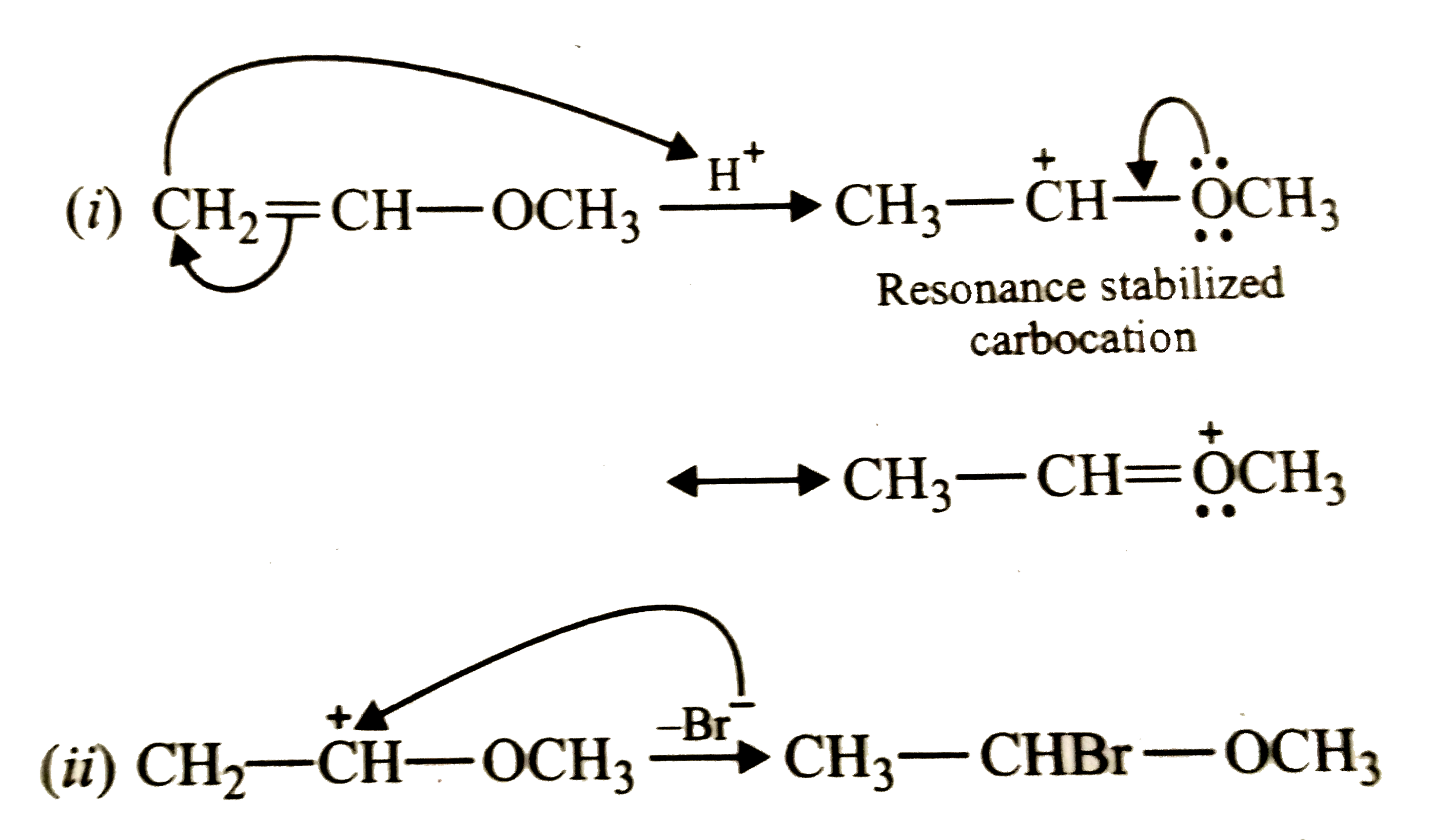
|
|
| 10. |
HBr reacts fastest with |
|
Answer» Propan-1-ol 2-Methylpropan-2-ol is a `3^(@)` alcohol. |
|
| 11. |
Have you ever observed any water pollution in your area ? What measures would you suggest to control it? |
|
Answer» Solution :Water POLLUTION occurs due to various human activities. Due to human activities pollutants entering into water soures and pollute the water. Toxic substances and heavy metals like Fe, Al, Mn are released by industries. Sewage discharges and animal disposal also take part in the pollution of water. Water CONTAINING this substances is not suitable for drinking. Before all the abandon disposal of industries and FACTORIES getting mixed into the water it should be FREE from pollutants and toxic substances. Concentration of this pollutants must be checked regularly. Compost fertilizers. Toxic CHEMICAL must be prevented by entering into the ground water. |
|
| 12. |
Has electroegativity of of an element specific units ? |
|
Answer» |
|
| 13. |
Hardness of water is measured in terms of ppm CaCO_(3). It is the amount in gms of CaCO_(3) present in 10^(6) gms of H_(2)O.In a sample of 10 litre water,0.56 gm of CaO is required to remove temporary hardness of HCO_(3)^(-). Permanent hardness due to SO_(4)^(2-) and Cl^(-)of C^(2+) andMg^(2+) and is removed y the addition of Na_(2)CO_(3). Temperature hardness is due to HCO_(3)^(-) of Ca^(2+) and Mg^(2+). It is removed by the addition of CaO. Ca(HCO_(3))_(2)+CaOrarr2CaCO_(3)+H_(2)O massof CaO required to precipitate 2 gm of CaCO_(3) is |
|
Answer» 2.00 gm |
|
| 14. |
Hardness of water may be termporary or permanent. Permanent hardnes s is due to the presence of |
|
Answer» CHLORIDES of Ca and MG in water |
|
| 15. |
Hardness of water may be temporary or permanent. Permanent hardness is due to the presence of |
|
Answer» chlorides of Ca and Mg in WATER |
|
| 16. |
Hardness of water is expressed as the number of parts by weight of present in 10 parts by weight of water |
|
Answer» `CaCl_2` |
|
| 17. |
Hardness of water is due to the presence of ………..,……… and ……….Of calcium of magnesium |
|
Answer» |
|
| 18. |
Hardness of water is due to ___________ of calcium and magnesium |
|
Answer» bicarbonates |
|
| 19. |
Hardness of water cannot be removed by |
|
Answer» TREATMENT with WASHING soda |
|
| 20. |
Hardness of a water sample is 150 ppm. Its hardness is due to only calcium bicarbonate, the weight of calcium hydroxide that required to remove hardness of one litre of hard water is |
|
Answer» 243 MG |
|
| 21. |
Hard water is softened before using in boilers. Expain. |
| Answer» Solution :Hard water on boiling forms precipitates of `MgCO_(3),CaCO_(3)andCaSO_(4)` which from scales in the boilers. As a result of these scales in the boilers. The boiler gets deteriorated due to over heating. Morevoer, these scales are non-conducting and therefore, more fuel is CONSUMED. Therefore, in order to prevent the formation of scales, hard water softened before USING in boilers. | |
| 22. |
Hard water is one which |
|
Answer» Contains dissolved sodium SALTS |
|
| 23. |
H_(aq)^(+)+OH_(aq)^(-)toH_(2)O, DeltaH=-105Kj//mol 2HA(aq) to BaA_(2(aq)+2H_(2)O, DeltaH=-105KJ//mol Iopnistion enthalpy of weak acid Ha (aq)will be : |
|
Answer» 9KJ/mol |
|
| 24. |
Hydrogens in solid ice each oxygen is surrounded by oxygenin ....position |
|
Answer» SQUARE planar 
|
|
| 25. |
Halogens and chalcogens have highly negative electron gain enthalpies. Why? |
|
Answer» Solution :• Group 16 (chalcogens) and Group 17 (halogens) are INTERESTED to ADD TWO or one electrons respectively to ATTAIN stable noble gas configuration. • Because of this interest these elements have highly negative electron gain enthalpies. |
|
| 27. |
Halogenation of alkanes in the presence of sunlight is |
|
Answer» FREE RADICAL addition |
|
| 28. |
Halogen can be estimated by |
|
Answer» DUMA's METHOD |
|
| 29. |
Haloalkanes undergo nucleophilic substitution reaction whereas haloarenes undergo electrophilic substitution reaction. Comment. |
|
Answer» Solution :(i) Haloalkanes undergo nucleophilic substitution reaction due to high electronegativity of the halogen ATOM, the C-X bond in haloalkenes is SLIGHTLY polar, thereby the C-atom acquires a POSITIVE CHARGE. (ii) Hence, the C-atom is good target for attack by nucleophiles. therefore, the X-atom of the haloalkane is replaces by a nucleophile. (iii) On the other hand in haloarenes, the halogen atom releases electron to the benzene nucleus relatively electron-rich with respect to halogen atom. as a result, the electrophile attacks at ortho and para position. hence haloarenes readily undergo ELECTROPHILIC substitution reaction. |
|
| 30. |
Haloalkanes produce mixture of olefins-say true or false and justify your answer. |
|
Answer» Solution :True. Some haloalkanes yield a mixture of olefins in different amounts. It is explained by Saytzeff's rule, which states that 'In a dehydrohalogenation reaction, the preferred product is that ALKENE which has more number of alkyl groups attached to the DOUBLY bonded carbon (more substituted double BOND is FORMED). Example: `underset("2-Bromopropane")(CH_(3)-underset(Br)underset(|)(C)H-CH_(2)-CH_(3))`. 
|
|
| 31. |
Haloalkanes have higher boiling point and melting point than the parent alkane. Justify this statement. |
| Answer» SOLUTION :Haloalkanes have higher BOILING point than the parent alkane having the same number of CARBON atoms because the intermolecular FORCES of attraction and dipole-dipole interactions are COMPARATIVELY stronger in haloalkanes. | |
| 32. |
Haloalkanes contain halogen atom (s) attached to the sp^(3) hybridised carbon atom of an alkyl group. Identify haloalkane from the following compounds. |
|
Answer» 2-Bromopentane |
|
| 33. |
Haloakane reacts with aqueous solution of KOH or moist silver oxide to form_____ |
|
Answer» ALCOHOL |
|
| 34. |
Halides of Be are dissolve in organic solvents while those of Ba do not . Why is it so ? |
| Answer» SOLUTION :Halides of Be are covalent because of high SUM of `Delta_(i) H_(1) + Delta_(i)H_(2)` of Be while those of Ba are ionic DUE to low sum of `Delta_(i)H_(1) + Delta_(i) H_(2)` of Ba . | |
| 35. |
Halides of Si, Ge and Sn form complexes, while carbon halides do not form complexes, because |
|
Answer» CARBON ATOM has a small size |
|
| 36. |
Half life period of a first order reaction is 100 min. After 144.3 min concentration of the reactant is reduced to of the original concentration |
|
Answer» `1//e` = 1443 min After ONE `T_(av)` CONCENTRATION of the reactant left is 1/e of the original concentration. |
|
| 37. |
Half life of a radioactive substance which disintegrates by 75% in 60 min be |
|
Answer» 120 min 2 half lives =60 min `THEREFORE t_(1//2) = 30` min |
|
| 38. |
Half life of a radioactive particle is 1 second. The initial amountof A is 1000. Then after 3 seconds, A will be |
|
Answer» 500 Amount left after 3 HALF LIVES `=(1000)/(2^(3))=125` |
|
| 39. |
Half-life of "^(223)Fr is 21 seconds. |
| Answer» SOLUTION :FALSE STATEMENT (half-life of `""^(223) Fr` is 21 MINUTE.) | |
| 42. |
Hair cream is an example of |
|
Answer» Gel |
|
| 43. |
Haemoglobin of the blood forms carboxy haemoglobin with |
|
Answer» Carbon DIOXIDE |
|
| 44. |
Haemoglobin is a chromoprotein having four atoms of Fe in each molecule. Analysis showed 0.35% Fe. What is the molecular weight of haemoglobin? |
|
Answer» Solution :Atomic mass of iron = 56 amu Mass of iron in a molecule of HAEMOGLOBIN `56 xx 4 = 224` amu `:' 0.35` amu of Fe is present in 100 amu of haemoglobin `:' 224` amu of Fe will be present in `(100)/(0.35) xx 224` amu of haemoglobin, i.e., 64000 amu Thus, MOLECULAR mass of haemoglobin = 64000 amu |
|
| 45. |
Haemoglobin of the blood forms carboxyhaemoglobin with |
|
Answer» CARBON dioxide |
|
| 46. |
Haemoglobin (Hb) forms bond with oxygen and given oxyhaemoglobin (HbO_2). This process is partially regulated by the concentrationof H_3O(+) and dissolved CO_2 in blood as HbO_2 + H_3O^(+)+CO_2 iff H^(+) - Hb-CO_2 + O_2 + H_2O If there is production of lactic acid andand CO_2 during a muscular exercise , then ............. |
|
Answer» more `HbO_2` is FORMED |
|
| 47. |
Haemoglobin contains 0.33% iron (Fe=56). The molecular weight of haemoglobin is 68000. The number of iron atoms in one molecule of haemoglobin is . |
|
Answer» 2 |
|
| 48. |
Haemoglobin contains 0.25% iron by weight. If one molecule of haemoglobin contains 4 atoms of iron, find the molecular mass of haemoglobin |
|
Answer» |
|
| 49. |
Haemoglobin contains 0.25 % iron by mass. The molecular mass of haemoglobin is 89600. Calculate the number of iron atoms per molecule of haemoglobin. |
|
Answer» 89600 g of haemoglobin has iron `= (0.25g)xx((89600g))/((100g))=224g` No. of gram atoms of iron (FE) `= ((224g))/((56g))=4g` atom Thus, 1 gram mole of haemoglobin has Fe atoms = 4g atom `:.` 1 molecule of haemoglobin has Fe atoms = 4. |
|
| 50. |
Haemoglobin contain 0.33 % of iron by weight. The molecular mass of haemoglobin is approximately 67200. The number ofiron atoms (At mass Fe = 56) present in one molecule of haemoglobins is : |
|
Answer» 6 `= (67200xx0.33)/(100)=222` (app) ATOMIC mass of Fe = 56 No. of Fe ATOMS `= (222)/(56)=4` (app.) |
|