

Saved Bookmarks
This section includes 7 InterviewSolutions, each offering curated multiple-choice questions to sharpen your Current Affairs knowledge and support exam preparation. Choose a topic below to get started.
| 1. |
How will you account for 104.5^(@) bond angle in water ? |
|
Answer» Solution :In water, O undergoes `sp^(3)`-hybridization and hence the `angleHOH` should have been `109^(@)-28'`. In `H_(2)O`, the oxygen atom is SURROUNDING by two SHARED pairs and two lone pairs of electrons. But acconding to VSEPR THEORY, lone pair-lone pair repulsions are stronger than bondpair-BOND pair repulsions. As a result, the HOH bond angle in water slightly decreases from the regular tetrahedral angle of `109^(@)-28'` to `104.5^(@)` . |
|
| 2. |
How will test whether a given solid has been purified or not ? |
| Answer» SOLUTION :By DETERMINING its MELTING POINT TEMPERATURE. | |
| 3. |
How will substitution reactions are classified? |
|
Answer» Solution :SUBSTITUTION reactions can be classified as, (i) Nucleophilic substitution reaction. (II) ELECTROPHILIC substitution reaction. (III) Free radical substitution reaction. |
|
| 4. |
How will bond order in N_(2) and O_(2) be influenced in the following ionization process ? (a)N_(2) to N_(2)^(+) + ^(-)(b)O_(2) to O_(2)^(+) P e^(-) |
| Answer» SOLUTION : (a) Bond ORDER decreases from3.0 to 2.5 . (B) Bond order increases from 2.0 to 2.5 | |
| 5. |
How was mists formed? List out the examples for mist. |
| Answer» Solution :Mists are formed by particles of spray liquids and condensation of vapours in AIR. For EXAMPLE, sulphuric acid mist, herbicides and INSECTICIDES sprays can FORM mists. | |
| 6. |
How vapour pressure of liquid is related to (i) temperature (ii) nature of liquid, (iii) boiling point (iv) atmospheric pressure? |
|
Answer» Solution :(i)Vapour PRESSURE is DIRECTLY proportinal to temperature. (ii) If intermolecular force of attraction is less in the liquid, its vapour pressure will be HIGH. (III) Higher vapour pressure, lower will be boiling POINT. (iv) If atmospheric pressure is low, boiling point will be less and higher will be the vapour pressure. |
|
| 7. |
How toluene can be prepared by this method (i) form n heptane (ii) from 2-methylhexane |
Answer» SOLUTION :
|
|
| 8. |
Howto writethe possible isomers of C_(5)H_(12) |
|
Answer» Solution :(i) tobegindrawthe carbonbackboneof thestraightchainisoner `C-C-C-C-C` (ii) todeterminethe carbonbackhonestructureof theisomersarrange thecarbonatoms in theother WAY (iii) FILL in thehydrogen atomsso thateachcarbonformsfourbonds . `(a) CH_(3)-CH_(2) - CH_(2)-CH_(2)-CH_(2)"" (B)CH_(7) - underset(CH_(3))underset(|)(C H) -CH _(2) - CH_(3)` `(c ) CH_(4)- underset(CH_(3) ) underset(|) overset(CH_(3)) overset(|) (C) - CH_(2)` |
|
| 9. |
How to reduce the effect of free radicals? |
|
Answer» Solution :(i) Use vitamins and minerals to counter theeffects of FREE radicals. (II)Fruits CONTAINS ANTIOXIDANTS which decrease the effects of free radicals. |
|
| 10. |
How to prepare silicones through polymerisation. |
|
Answer» SOLUTION :When a number of dihydroxy dimethyl SILANE undergoes POLYMERISATION to form linear polymers of SILICONE. `nHO-UNDERSET (CH_(3)) underset(|) overset(CH_(3))overset (|)(Si)-OH rarr-O-underset (CH_(3)) underset(|) overset(CH_(3))overset (|)(Si)-O-underset (CH_(3)) underset(|) overset(CH_(3))overset (|)(Si)-O-underset (CH_(3)) underset(|) overset(CH_(3))overset (|)(Si)-O-` |
|
| 11. |
Write the equations during the preparation of sodium carbonate by solvay process. |
|
Answer» Solution :Solvay process to prepare `Na_(2)CO_(3)` is as follows. Step 1 : Ammonical brine is prepared : Ammonia is PASSED through saturated solution of sodium chloride in water and cooled to `30^(@)C`. Step 2 : Carbonation : Carbondioxide is passed through ammonical brine solution to give ammonium hydrogencarbonate later to give a mikly solution of sodium hydrogen carbonate. `NH_(3) + H_(2) O to NH_(4) OH` (ammonium hydroxide) `NH_(4) OH + CO_(2) to N_(2) HCO_(3)` (ammonium hydrogen carbonate) `NH_(4) HCO_(3) + NaCI to underset(("Sodium bicarbonate"))(NaHCO_(3)) + NH_(4) CI` Sodium bicarbonate is removed away by filration to get solid sodiun bicarbonate. Step 3 : Calcination : solid `NaHCO_(3)` on heating gives sodium carbonate and `CO_(2)` `NAHCO_(3) overset(Delta)(to) Na_(2) CO_(3) + H_(2) O + CO_(2) uArr` Again after recrystallisation iron water produces sodium carbonate. `Na_(2) CO_(3) (aq) + 10 H_(2) O overset("recrystallination")(to) Na_(2)CO_(3). 10H_(2)O` Recovery of ammonia: Quick lime is heatd with `NH_(4)CI` in above step to give ammonia gas which is used again to prepare ammonical brine. `CaO + 2NH_(4) CI overset(Delta)(to) CaCI_(2) + 2NH_(3) uArr + H_(2) O` |
|
| 12. |
How to prepare sodium bicarbonate (baking soda) from sodium carbonate? |
|
Answer» Solution :SODIUM bicarbonate is PREPARED by passing `CO_(2)` gas through saturated solution of sodium carbonate. `Na_(2)CO_(3) + CO_(3) + H_(2)O to 2NaHCO_(3)` sodium bicarbonate is less soluble. Hence is separates as a CRYSTALLINE POWDER. |
|
| 13. |
How to prepare NaCl from the Brine salt solution (Sea water) ? |
|
Answer» Solution : The most abundant source of sodium chloride is sea water which contains 2.7 to 2.9% by mass of the salt. Common salt is generally obtained by evaporation of sea water. Crude sodium chloride, generally obtained by crystallization of brine solution, contains sodium sulphate, calcium sulphate, calcium chloride and magnesium chloride as impurities. Calcium chloride, `CaCl_(2)`, and magnesium chloride, `MgCl_(2)` are impurities because they are deliquescent (ABSORB moisture easily from the atmosphere). To obtain pure sodium chloride, the crude salt is dissolved in minimum amount of water and filtered to remove insoluble impurities. The solution is then saturated with hydrogen chloride GAS. Crystals of pure sodium chloride separate out. Calcium and magnesium chloride, being more soluble than sodium chloride, remain in solution. Properties: Sodium chloride melts at 1081K. It has a solubility of 36.0g in 100g of water at 273K. The solubility does not increase appreciably with increase in TEMPERATURE. Uses : (i) It is used as a common salt or table salt for domestic purpose. (ii) It is used for the preparation of `Na_(2)O_(2)` NaOH and `Na_(2)CO_(3)`. |
|
| 14. |
How to prepare hydrogen peroxide from BaO_(2)? |
|
Answer» Solution :Hydrogen peroxide is prepared by the action of DIL. `H_(2)SO_(4)` on hydrated barium peroxide `(BaO_(2).8H_(2)O).` `BaO_(2)*8H_(2)O+H_(2)SO_(4)tounderset("WHITE ppt")(BaSO_(4))darr+H_(2)O_(2)+8H_(2)O` Barium sulphate to REMOVED from the solution of hydrogen peroxide by illustration. |
|
| 15. |
How to prepare hydrogen gas from coal (water gas) ? |
|
Answer» Solution :Step 1 : Steam is passed through coke at 1270 K and Ni as catalyst GIVES water GAS `[CO+H_(2)]` `underset(coke)C+underset("steam")(H_(2)O)underset(Ni)overset(1270K)tounderset("water gas")ubrace(Co(g)+H_(2)(g))` Step 2 : Steam is passed through water gas in presence of `Fe_(2)O_(3)+Cr_(2)O_(3)` catalyst at 773 K gives hydrogen. `underset("Water gase")(CO+H_(2))+underset("Steam")(H_(2)O)underset(773K)overset(Fe_(2)O_(3)+Cr_(2)O_(3))toCO_(2)+2H_(2)` |
|
| 16. |
How to prepare ethene from alcohol? |
|
Answer» Solution :When ethanol are heated with concentrated sulphuric acid, they undergo dehydration to give alkenes. `underset("ethanol ethyl ALCOHOL")(CH_(3) - CH_(2) ) - OH underset(170^(@) C )overset("Conc"-H_(2)SO_(4)) (rarr) underset("ETHENE")(CH_(2) = CH_(2)) + H_(2)O` |
|
| 17. |
How to prepare diborane in laboratory ? |
|
Answer» SOLUTION :Diborane is PREPARED in the laboratory by TREATING BORONTRIFLUORIDE with `LiAlH_(4)` in DIETHYL ether. `4BF_(3(g)) +3LiAlH_(4(s)) to B_(2)H_(6(g)) +3LiF_((s))` |
|
| 18. |
How to prepare carbon monoxide from formic acid ? |
|
Answer» Solution :Pure carbon MONOXIDE is formed by the DEHYDRATION of formic ACID with conc. `H_(2) SO_(4)`. `HCOOH underset("conc"H_(2)SO_(4))overset(373K)(rarr)CO+H_(2)O` |
|
| 19. |
How to prepare calcium oixde (CaO)? |
| Answer» Solution :Calcium oxide (Quick lime) is prepared by heating lime STONE `(CaCO_(3))` in a ROTARY kilin at 1170. `CaCO_(3) OVERSET(1170 K)(hArr) CaO+ CO_(2)` The reaction is REVERSIBLE. Hence, `CO_(2)` is REMOVED gaster to favour forward and completer reaction. | |
| 20. |
How to prepare calcium hydroxide ? |
| Answer» Solution :CALCIUM hydroxide is prepared by ADDING WATER to quick lime, CAO. | |
| 21. |
How to prepare calcium carbonate (Lime stone) from slaked lime ? |
|
Answer» Solution :CALCIUM CARBONATE is PREPARED by passing calculated QUANTITIES of `CO_(2)` through slaked lime. `CA(OH)_(2) to CaCO_(3) + H_(2) O` |
|
| 22. |
How to prepare amorphous boron from borax? Write equations? |
|
Answer» Solution :Borax on hydrolysis with DILUTE acids GIVE boric acid. Boric acid on STRONG heating gives boric ANHYDRIDE. This boric anhydride on reduction with sodium or magnesium gives amorphous boron. `Na_2B_4O_7+2HCl +5H_2O to 2NaCl +4H_3BO_3` `2H_3BO_3 to^(Delta) B_2O_3+3H_2O,B_3O_3+3Mg to 2B+3MgO` |
|
| 23. |
How to prepare alkene by hydrogenation of 2-butyne? |
Answer» Solution :2-butyne on REDUCTION with HYDROGEN in resence of Lindlars catalyst GIVES cis but-2- ene and trans-but-2-ene. 
|
|
| 24. |
How to predict the extent of a reaction. |
|
Answer» SOLUTION :The magnitude of the equilibrium constant tells us how far a REACTION has proceeded by the time equilibrium has been reached. That is, the value of K of a reversible reaction indicates the extent of the reaction. Consider a reaction `A+BhArrC+D` and its equilibrium constant `K_(c)`. `K_(c)=([C][D])/([A][B])` It can be seen that the value of `K_(c)` is directly proportional to the concentration of the products, and is inversely proportional to the concentration of the reactants. Therefore, a high value of `K_(c)` indicates a high concentration of products and vice versa. Case I : `K_(c)gtgt1` The reaction is strongly product-favoured. Because, equilibrium concentartion of products and much greater than equilibrium concentration of reactions. A large value of `K_(c)` suggests that the reaction proceeds nearly to completion. Examples : (1) The ozone depletion reaction in the stratosphere. `NO(g)+O_(3)(g)hArrNO_(2)(g)+O_(2)(g), K_(c)=6XX10^(34)" at "25^(@)C` Case II : `K_(c)ltlt1` : The reaction is strongly reactant favoured. Because, equilibrium concentrations of reactants are greater than that of products. A small value of `K_(c)` suggests that the reaction proceeds only to a negligible extent. Examples : (1) Ozonisation of oxygen. `3O_(2)(g)hArr2O_(3)(g),""K_(c)=6.25xx10^(-58)" at "25^(@)C` Such low values of `K_(c)` in the above two examples indicate that the reactions do not take PLATE at `25^(@)C` Case III : `K_(c)=1` : Equilibrium mixture contains significant concentrations of reactants and products. In this case, `K_(c)` is neither extremely large nor extremely small. Therefore neither the forward reaction nor the backward reaction goes to completion. Examples: 1. Dissociation of `N_(2)O_(4)` has neither a very large nor a very small equilibrium constant. `N_(2)O_(4)(g)hArr2NO_(2)(g),""K_(c)=4.64xx10^(-3)" at "25^(@)C,andK_(c)=1.00" at "118^(@)C` |
|
| 25. |
How to perform iodination of alkane ? Explain with suitable example. |
|
Answer» Solution :Iodination of alkane is carried out in presence of `HIO_(3)` and `HNO_(3)`. For example, iodination of methane is carried out by HI in presence of `HIO_(3)` according to following reaction : `HIO_(3) + 5HI rarr 3I_(2) + 3H_(2)O` `CH_(4) + I_(2) hArr CH_(3)I + HI` |
|
| 26. |
How to obtain cement clinker? |
| Answer» Solution :When clay and LIME are STRONGLY heated together they fuse and REACT to form .CEMENT clinker.. | |
| 27. |
How to obtain Calcium sulphate ? |
| Answer» SOLUTION :It is OBTAINED when GYPSUM, `CaSO_(4)*2H_(2)O`, is heated to 393 K. | |
| 28. |
How to obtain sodium amalgam ? |
| Answer» Solution :A brine solution is electrolysed USING a mercury CATHODE and a carbon ANODE. Sodium metal discharged at the cathode combines with mercury to FORM sodium amalgam. | |
| 29. |
Howto mention theatomnotation? Giveexample |
|
Answer» SOLUTION :In therepresentation of atom element XIS placedwithelementsX atleftsidesuperscriptmass Aosplacedand atleftsideatsubscript atomicnumberZ is placed. X= electron A = massZ= atomicno Example`e.g_(11)^(23)` SODIUM (Na )atomicnumber(Z )is 11 and atomicmass(A )is23 SOZ= 11 , A =23 |
|
| 30. |
How to make buffer of ammonia (pK_a = 9.25), What is the pH of this buffer ? |
|
Answer» Solution :pH of buffer solution prepared from AMMONIA and ammonium chloridesolution having equal CONCENTRATION is 9.25 pH = 9.25 + `"[Conjugate ACID]"/"[Base]"=([NH_4^+])/([NH_3])` But `[NH_4^+] approx [NH_3]` , So pH = 9.25 |
|
| 31. |
How to decide the chemical reactivity of compound ? Give example. |
|
Answer» Solution :As the energy required to break the BOND is less the chemical reactivity of COMPOUND increases. e.g., DUE to `pi`-bond present in alkene , alkene has less bond enthalpy, so alkene is more REACTIVE than ALKANE. |
|
| 32. |
How to convert benzene into hexachlorobenzene? |
Answer» SOLUTION :Benzene reacts with chlorine in sunlight and in the absence of substance like `AlCl_(3)` or `FeCl_(3)`ETC., to form benzene hexa CHLORIDE (BHC) or hexachlorobenzene. 
|
|
| 33. |
How to boron obtainedfrom borax ? Give chemical equationswith reactionconditions. Write the structureof B_(2)H_(6) and its reactionwith HCl. |
|
Answer» Solution :`underset("BORAX")(Na_(2)B_(4)O_(7).10H_(2)O)+H_(2)SO_(4) ("conc".) rarr Na_(2)SO_(4) + underset(" Tetraboric ACID ")(H_(2)B_(4)O_(7)) + 10H_(2)O` `H_(2)B_(4)O_(7) +5H_(2)Orarr underset(" Boric acid ")(4H_(3)BO_(3))` `2H_(3)BO_(3) overset(" Red heat ")rarrunderset(" Boric oxide ")B_(2)O_(3) + 3H_(2)O` `B_(2)O_(3)+3Mgoverset(Delta)rarr2B + 3MgO` For structureof `B_(2)H_(6)`. With dry `HCL,B_(2)H_(6)`evolves `H_(2)` gas `B_(2)H_(6) + HCl ("dry") rarr B_(2)H_(5)CL + H_(2)` |
|
| 34. |
How the silver halide obtained from organic compound is distinguish? |
|
Answer» Solution :(i) White precipitate: CHLORINE is present in it and these precipitate are more soluble in `NH_(4)OH`. (ii) Light yellowish precipitate: Bromine is present in it. The precipitate sparingly soluble in ammonium hydroxide and soluble after heating. (III) YELLOW precipitate: It is insoluble in `NH_(4)OH` and iodine is present |
|
| 35. |
How the purity of compound is decide? |
|
Answer» SOLUTION :(i) The purity of a COMPOUND is ascertained by determining its melting or boiling point. Most of the pure compounds have sharp melting POINTS and boiling points. (II) New methods of checking the purity of an organic compound are based on different types of chromatographic and SPECTROSCOPIC techniques |
|
| 36. |
How the properties of Eka-silicon was related to germanium? |
Answer» SOLUTION :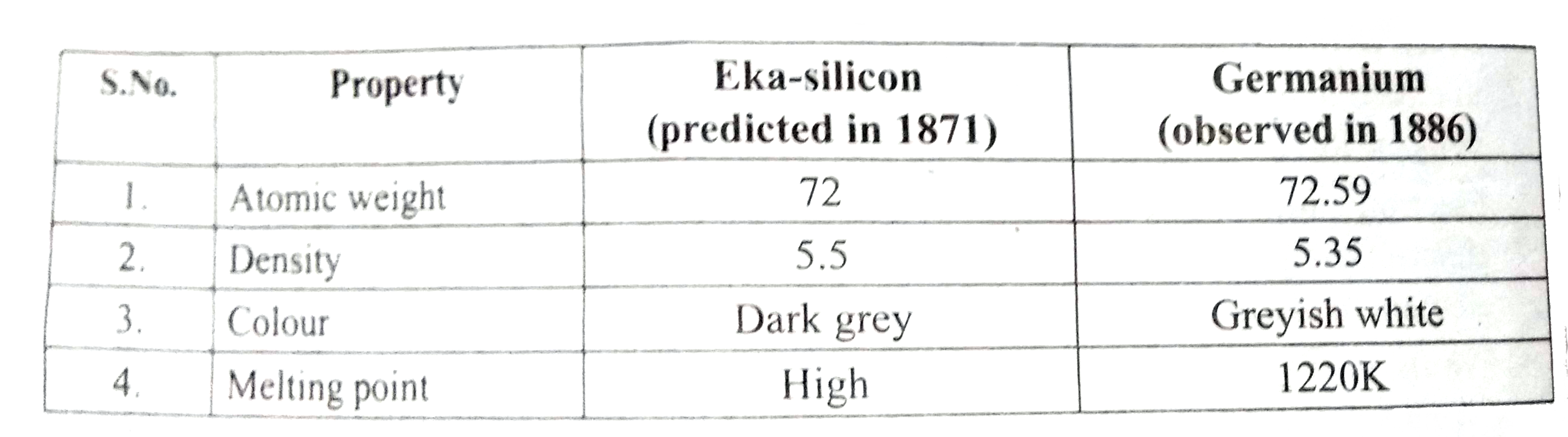
|
|
| 37. |
How the prediction of reaction is carried out ? (a) By the value of K (b) By the value of Q (c) By the value of DeltaG(d) By the value DeltaG^ө . |
|
Answer» SOLUTION :(a) Value of K: By the value of K information about equilibrium can be obtained. (1) If `K_c gt 10^3`,So product is more and reaction is toward completion. (ii) If `K_c lt 10^(-3)` , So product is negligible reaction almost not take place. (iii) If `K_c = 10^3`to `10^(-3)` at equilibrium product and REACTANTS are comparable. (b) Reaction predicting and Value of `Q_c`: (1) If `Q_c ltK_c`, reaction move in forward direction. (ii) If `Q_c gt K_c`,reaction move in reverse direction. (iii) If `Q_c = K_c`,reaction is in equilibrium and will not move forward. (c) Reaction of spontaneity (Predicting) and Value of `DeltaG`: (i)`DeltaG lt 0` reaction is SPONTANEOUS. (ii) `DeltaG gt 0`reaction is non-spontaneous. (iii) `DeltaG = 0` reaction is in equilibrium. (d)`DeltaG^(ө)` and K and Reaction of spontaneity : (i) `DeltaG^(ө)lt0` means negative, So `K_cgt 1`. Reaction is spontaneity and product will be more reaction proceed in forward direction . (ii) `DeltaG^(ө) gt 0`means positive, So `K_clt 1`. Reaction is not spontaneous and product will be less. Reaction proceed in reverse direction. (iii) AGO = 0, K= 1 So, equilibrium state is attain. |
|
| 38. |
How the percentage of oxygen is decided in organic estimation? |
|
Answer» SOLUTION :(i) % O= 100- (The ADDITION of perentage of all atom incompound) (ii) % `O= (32)/(88) xx ("mass of CARBON dioxide m")/("mass of COMPOUND m")xx 100` |
|
| 39. |
How the nitrogen oxide is made ? |
| Answer» Solution :At HIGH altitudes when lightnings STRIKES, dinitrogen and dioxygen COMBINES and form nitrogen OXIDE. | |
| 40. |
Howthe neutrons discoveredby Chadwik ? |
| Answer» SOLUTION :Neutrondiscoveredby CHADWICK (1932) bybombardinga thinsheetof berylliumby`ALPHA-` PARTICLE . | |
| 41. |
How the modern shape develop in organic chemsitry? |
| Answer» Solution :The development of ELECTRONIC theory of COVALENT bonding USHERED ORGANIC chemistry into its modern shape | |
| 42. |
How the ions transfer from solutions ? |
| Answer» Solution :SALT BRIDGE can transfer IONS from SOLUTIONS. | |
| 43. |
How the inter aotmic attractive forces which hold the constitution atoms/ions together in a molecule are called ? |
|
Answer» `sigma`bonds |
|
| 44. |
How the hydrogen bond form ? Give the reason 10 form hydrogen bond with example. |
|
Answer» Solution :Hydrogen bond always present between H and other strong electronegative atom (X). Where X = N, F, Cl, 0 ... etc. electronegative element. Hydrogen bond is represent by a dotted ...... line while solid line - represent the covalent bond. e.g. : In HF `overset(delta + )(H) - overset(delta -)(F) ...... overset(delta)(F) ....... (delta + )(H) - overset(delta - )(F)` Causes of Formation of Hydrogen bond : When hydrogen is bonded to strongly electronegative element .X., the electron pair shared between the two ATOMS moves far away from hydrogen atom. As a result the hydrogen atom becomes highly electron positive with respect to the other atom .X.. SINCE there is displacement of electrons towards X, the hydrogen requires fractional positive charge `(+ delta)`while .X. attain fractional n~tive charge `H^(delta -)` . This result in the formation of a polar MOLECULAR having ELECTROSTATIC force of attraction which can be represented as : `......overset(delta + ) (H) - overset( delta - )(X) ........... overset(delta + )(H) - overset(delta - ) (X) ....... overset(delta + ) (H) - overset(delta - ) (X) `........ |
|
| 45. |
How the inductiv effect is differ from resonance and electromeric effect? |
| Answer» Solution :The INDUCTIVE and resonance effect are PERMANENT effect of group in MOLECULE while electromeric effect is SEEN only in presence of attacking REAGENT | |
| 46. |
How the hybridization of carbon is decide on the base of structure in organic compounds ? |
|
Answer» Solution :`sp^(3)` hybrid CARBON : If carbon have all SINGLE bond ` sp^(2)` hybrid carbon : If carbon have one `pi`-bond. sp hybrid carbon : If carbon have TWO `pi` -bond |
|
| 47. |
How the H_2O_2 should be store ? |
|
Answer» Solution :`H_2O_2` decomposes slowly on exposure to LIGHT. `2H_2O_(2(l)) to 2H_2O_((l))+ O_(2(g))` In the presence of METAL surfaces or traces of alkali (present in glass containers), the above reaction is catalysed. It is, therefore, stored in wax-lined glass or plastic vessels in dark. Urea can be added as a stabiliser. It is kept away from dust because dust can INDUCE explosive decomposition of the compound. |
|
| 48. |
How the glycerol is separated from execs spent-lye in soap industry? |
| Answer» SOLUTION :DISTILLATION at LOW PRESSURE | |
| 49. |
How the functional group can be entered in organic compound? |
|
Answer» Substition of H in HYDROCARBON |
|
| 50. |
How the formation of molecular orbitals ? |
|
Answer» SOLUTION :The formation of molecular obtain by Linear COMBINATION of atomic orbitals (LCAO). `Psi_(MO) = Psi_(A) + Psi_(B) and Psi_(MO)^(*) = Psi_(A) - Psi_(B)` |
|