Saved Bookmarks
This section includes 7 InterviewSolutions, each offering curated multiple-choice questions to sharpen your Current Affairs knowledge and support exam preparation. Choose a topic below to get started.
| 1. |
MnO_(2)+4HClrarrMnCl_(2)+Cl_(2)+2H_(2)O, In the reaction MnO_(2) acts as |
|
Answer» 0.80 mole of `Cl_(2)` is formed `implies MnO_(2)` is limiting reagent `MnO_(2)+4HClrarrMnCl_(2)+Cl_(2)+2H_(2)O` `0.8+4xx0.8rarr0.8` |
|
| 2. |
If 0.75 g of an organic compound in Kjeldahl's method neutralized 30 ml of 0.25N- H_(2)SO_(4), the percentage of nitrogen in the compound is |
|
Answer» 28 |
|
| 3. |
If 0.75 g of an organic compound in Kjeldahl's method neutralized 30 ml of 0.25 NH_(2)SO_(4), the percentage of nitrogen in the compound is |
|
Answer» 28 |
|
| 4. |
If 0.740 g of O_(3) reacts with 0.670 g of NO , how many gram of NO_(2) will be produced ? |
|
Answer» `0.71` G |
|
| 5. |
If 0.7 moles of Barium Chlorine is treatedwith 0.4 mole of potassium sulphate, number of moles of barium sulphate formed are |
| Answer» Solution :`BaCl_(2)+K_(2)SO_(4) RARR BaSO_(4) +2KCl` | |
| 6. |
If 0.561 g of KOH is dissolved in water to give 200 mL of solution at 298 K. Calculate the concentrations of potassium, hydrogen and hydroxyl ions. What is its pH ? (K=39,O=16,H=1) |
|
Answer» Solution :Molarity of KOH=`"WEIGHT (in gm) x 1000"/"Molecular mass x Volume of solution mL"` `M=(0.561 g xx 1000)/(56 "g mol"^(-1) xx "200 mL")` =0.05 M = `5.0xx10^(-2)` M KOH=39+16+1 =56 g `mol^(-1)` [KOH]=`[K^+]=[OH^-]=5.0xx10^(-2)` M `[H^+][OH^-]=1xx10^(-14) = K_w` `therefore [H^+] = (1xx10^(-14))/[[OH^-]]=(1xx10^(-14))/(5.0xx10^(-2))=2.0xx10^(-13)` M PH=-(log` [H^+]` =-log `(2.0xx10^(-13))` `=-(log 2+ log 10^(-13))` =-(0.3010-13.0)=13.0-0.3010 =12.6990 `approx` 12.7 |
|
| 7. |
If 0.561 g KOH is dissolved in water to give 200 mL of solution at 298 K, calculate the concentration of potassium, hydrogen and hydroxyl ions. What is its pH ? |
|
Answer» Solution :`[KOH]=(0.561)/(56)xx(1000)/(200)M=0.050M` As `KOH rarr K^(+)+OH^(-), :. [K^(+)]=[OH^(-)]=0.05M` `[H^(+)]=K_(w)//[OH^(-)] = 10^(-14)//0.05 = 10^(-14)//(5xx10^(-2))=2.0xx10^(-13)M`. `pH = - log [H^(+)]=- log (2.0xx10^(-13))=13-0.3010=12.699` |
|
| 8. |
If 0.52 overset(0)(A) is Bohr's radius for the first orbit. It sugges in the light of the wave mechanical model that |
|
Answer» the product of `psi^(2)` and `4pi R^(2)dr` INCREASE till it reaches at the distance of `0.53 overset(0)(A)` for s-electron 
|
|
| 9. |
If 0.5 mol of BaCl_(2) is mixed with 0.2 mol of Na_(3)PO_(4) the maximum number of moles of Ba_(3)(PO_(4))_(2) that can be formed is |
|
Answer» 0.7 |
|
| 10. |
If 0.2 gram of an organic compound containing carbon, bydrogen and oxygen on combustion, yielded 0.147 gram carbon dioxide and 0.12 gram water. What will be the content of oxygen in the substance ? |
|
Answer» `65.29%` `= (0.147)/(0.2)xx(12)/(44)xx100=20%` `% H=("wt. of "H_(2)O)/("wt. of org. comp").(2)/(19).100` `=6.66%, % O={100-(20+6.66)}~~ 73.4%` |
|
| 11. |
If 0.2 g of an organic compound containing carbon, hydrogen and oxygen on combustion yielded 0.147 g of CO_(2) and 0.12 g of H_(2)O. What will be the content of oxygen in the substance ? |
|
Answer» `73.29 %` |
|
| 12. |
If 0.049 gof H_(2)SO_(4) are present in 10 litre of the solution, the pH of the solution will be |
|
Answer» `:. ` Molar concentration `=(0.0049)/(98) M = 5 XX 10^(-5)M` `[H^(+)]=2[H_(2)SO_(4)]=2xx(5xx10^(-5))=10^(-4)M`. Hence, PH = 4 . |
|
| 13. |
(i)Explain the homolytic fission of a covalent bond? (ii) Why chloroacetic acid is more acidic than acetic acid? |
|
Answer» Solution :(i)1. Homolytic CLEAVAGE is the process in which a co leavage is the process in which a covalent bond breaks symmetrically in such way that each of the bondedatom retains on electron 2. This one of eleavage occurs under high temperature or in the presence of UV light. In a compound CONTAINING non-polar convalent bond formed between atoms of similar electronegativity in such molecules the cleavage of bonds result into free RADICALS. 4. For example, ethane UNDERGO homolytic fission to produce, two methyl free radical 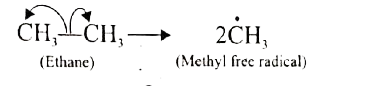 (ii)Chloro acetic acid: `CllarrCH_2larroverset(O)overset(||)ClarrOlarrH` Chloro acetic acid has Cl-group and it has high electronegativity and show -I EFFECT Therfore Cl-atom to facilitate the dissociation of O-H bond very fastly. Thus chloro acetic acid is stronger acid than acetic acid. |
|
| 14. |
(i)Explain-paper chromatography. (ii) What are stereo-isomerism? |
|
Answer» Solution :(a) (i) 1. It is an example of partition chromatography. A strip of paper acts as an adsorbent This METHOD involves continues differential partitioning of components of a mixture between stationary and mobile phase. In paper chromatography, a special quality paper KNOWN as chromatographic paper is USED. This paper act as a stationary phase. 2. A strip of chromatographic paper spotted at the base with the solution of the mixture is suspended in a suitable solvent which acts as the mobile phase. The solvent rises up and flows over the spot. The paper selectivity retains different components according to their different partition in the two phases where a chromatogram is developed 3. The spots of the separated coloured components are visible at different heights Trom the position of initial spots on the chromatogram. The spots of the separate colourless compounds MAY be observed either under ultraviolet LIGHT or by the use of an appropriate spray reagent. (ii) Stereo-Isomerism: The is Isomerism: The isomers which have some bond connectivity but different groups or atoms in space are known as stereoisomers. This phenomenon is known as stereoisomerism. |
|
| 15. |
IE_2 gt IE_1for a given element - Why. |
|
Answer» |
|
| 16. |
IE_1 of O lt IE_1 of N but IE_2 of O gt E_2 of N - explain. |
|
Answer» <P> |
|
| 17. |
(IE)_(1) and (IE)_(2) of Mg_((g)) are 740, 1540 kJ mol^(-1). Calculate percentage of Mg_((g))^(+) and Mg_((g))^(2+) if 1g of Mg_((g)) absorbs 50.0kJof energy. |
|
Answer» `% MG^(+) = 50` and `% Mg^(+2) = 50` |
|
| 18. |
IE_(1) of alkaline earth metals are higher than that of alkali metals, but IE_(2) of alkaline metals are smaller than that of alkali metals. Give reason. |
|
Answer» Solution :`IE_(1)` of ALKALINE EARTH metals gt `IE_(2)` of alkali metals. (ii) `IE_(2)` of alkaline earth metals lt IE, of alkali metals. (iii) This occurs because in alkali metals the SECOND ELECTRON is to be removed from a which has already acquired a noble GAS configuration. (iv) In the case of alkaline earth metals, the second electron is to be removed from a monoval cation, which still has one electron in the outermost shell. (v) Thus, the second electron can be removed more easily in the case of group 2 elements than in group 1 elements. |
|
| 19. |
IE_2 values of alkaline earth metals are much smaller than those of alkali metals. Explain. |
|
Answer» Solution :`IE_(1)` of ALKALINE earth metals gt `IE_(2)` of alkali metals. (ii) `IE_(2)` of alkaline earth metals lt IE, of alkali metals. (iii) This occurs because in alkali metals the second electron is to be removed from a which has already ACQUIRED a noble gas configuration. (iv) In the CASE of alkaline earth metals, the second electron is to be removed from a monoval cation, which still has one electron in the outermost SHELL. (V) Thus, the second electron can be removed more easily in the case of group 2 elements than in group 1 elements. |
|
| 20. |
(IE)_1 and (IE)_2 of Mg_((g)) are 740, 1540 kJ mol^(-1) . Calculate percentage of Mg_((g))^(+) and Mg_((g))^(2+) if 1 g of Mg_((s)) absorbs 50.0 kJ of energy. |
|
Answer» `% Mg^(+) = 50 %%Mg^(+2) = 50 %` |
|
| 21. |
IE_(1)andIE_(2)of Mg are 179 and 348 "kcal mol"^(-1) respectively . The energy required for the reaction "Mg"to"Mg"^(2+)+2e^(-)is |
|
Answer» `+169 KCAL mol^(-1)` |
|
| 22. |
(i)Draw the gas phase and solid phase structure of H_2O_2 (ii) H_2O_2 is a better oxidising agent than water. Explain. |
Answer» SOLUTION :(i)`H_2O_2` has a non-planar STRUCTURE .  (ii)`H_2O_2` is a better oxidising agent then water its reasons are of follow `H_2O_2` oxidises an ACIDIFIED solution of KI to give `I_2` which gives blue colour with starch solution but `H_2O` does not. `2KI+H_2SO_4 + H_2O_2 to K_2SO_4 + 2H_2O + I_2` `H_2SO_4` TURNS block PbS to white `PbSO_4` but `H_2O`does not. `PbS+4H_2O_2 to PbSO_4 + 4H_2O` |
|
| 23. |
(i)Describe the mechanism of nitration of benzene. (ii) How will you prepare m-dinitro benzene. |
|
Answer» Solution : (i) Step-1: Generation of `Noverset(theta)(O)_(2)` ELECTROPHILE. `HNO_(3)+H_(2)SO_(4) toNoverset(theta)(O)_(2)+HSoverset(theta)(O)_(4)+H_(2)O` Step-2: ATTACK of the electrophile on BENZENE ring to form arenium ion. 
|
|
| 24. |
Identity A, B, C, D, E, R and R' in the following: |
Answer» Solution :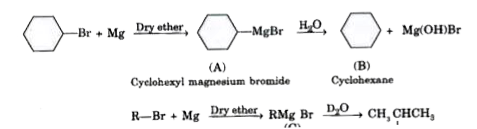 `R-Br+Mg overset("DRY ETHER")to underset((C))(RMgBr) overset(D_(2)O)to CH_(3)underset(D)underset(|)CHCH_(3)` Since D geta attached to mame C-atom on which MgBr or Br was PRESENT so that `R-Br: CH_(3)overset(Br)overset(|)CHCH_(3)` or `R : CH_(3)-overset(H)overset(|)CH-CH_(3)` and `C : CH_(3)-underset(CH_(3))underset(|)CH-MgBr` Tert-alkyl halidea donot undergo Wurtz reaction. Therefore, the QUESTION is not correct. They undergo dehydrohalogenation to give alienes. Hence, `R.=(CH_(3))_(3)CH` `CH_(3)-overset(CH_(3))overset(|)C=CH_(3) underset(-HBr)overset(NA, "ether")larr underset(underset((R.Br))("tert-butylbromide"))(CH_(3)-underset(CH_(3))underset(|) overset(CH_(3))overset(|)C-Br) overset(Mg)to underset((D))(CH_(3)-underset(CH_(3))underset(|) overset(CH_(3))overset(|)C-MgBr) overset(H_(2)O)to underset("2-Methylpropane")(CH_(3)-underset(CH_(3))underset(|) overset(CH_(3))overset(|)C-H)` |
|
| 25. |
identity (A) in the above reaction |
|
Answer» Butanol |
|
| 26. |
Identify''C'' in the following |
|
Answer»  
|
|
| 27. |
Identify Z in the series C_(3)H_(7)OH underset(160^(@)-180^(@))overset(conc. H_(2)SO_(4))rarrX overset(Br_(2))rarrY overset("excess of alc. KOH")rarr |
|
Answer» `CH_(3)-underset(NH_(2))underset(|)(CH)-underset(NH_(2))underset(|)(CH_(2))` |
|
| 28. |
Identify Z in the sequence CH_3-CH_2 -CH = CH_2 overset(HBr// H_2O_2) to Y overset(C_2H_5O^(-)Na^(+))to Z |
|
Answer» `CH_3 - UNDERSET(CH_3)underset(|)CH-CH_2-O-CH_2-CH_3` Williamson.s SYNTHESIS |
|
| 29. |
Identify Z in the following series C_(2)H_(5)OH overset(PBr)rarrX overset(atc.KOH)rarrY underset((ii) H_(2)O+"heat")overset((i) H_(2)SO_(4))rarrZ |
|
Answer» `CH_(2)=CH_(2)` |
|
| 30. |
Identify Z CH_(3)COONH_(4) overset(Delta)rarr X overset(P_(2)O_(5))rarr Y overset(H_(2)O //H^(+))rarr Z |
|
Answer» `CH_(3)CH_(2)CONH_(2)` |
|
| 31. |
Identify (X),(Y) and (Z) in the following synthetic scheme and write their structures.Explain the formation of labelled formaldehyde (H_2C^(**)O) as one of the products when compound (Z) is treated with HBr and subsequently ozonolysed .Mark the C^(**) carbon in the entire scheme . BaCO_3+H_2SO_4 to (X) gas [C^(**) denotes C^14] CH_2=CH-Br underset(underset((iii)H_3O^+)((ii))X)overset((i)Mg " " "ether")to(Y)overset(LiAIH_4)to(Z) |
|
Answer» |
|
| 32. |
Identify X, Y and Z in the following sequence of reactions giving stereochemical structures wherever possible. |
|
Answer» |
|
| 33. |
Identify X in the following sequence of reactions : CH_3-undersetunderset(Br)|CH-undersetunderset(Br)|CH-CH_2-CH_2-CH_3 underset("2.Na in liq." NH_3)overset(1. NaNH_2)to X |
|
Answer» `CH_3-undersetunderset(BR)|CH-undersetunderset(NH_2)|CH-CH_2CH_2CH_3` 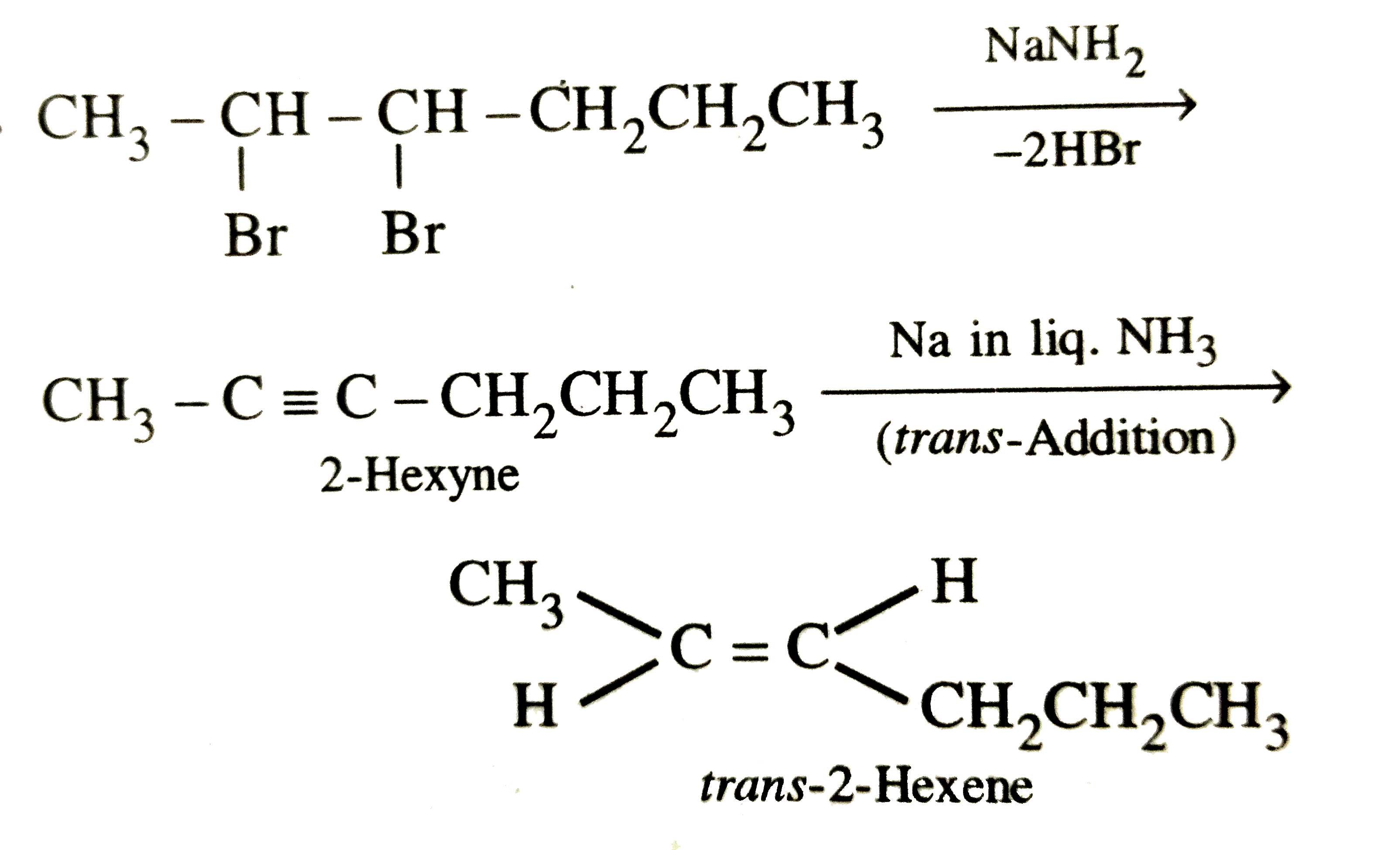
|
|
| 35. |
Identify X and Y in the following reaction BCI_(3) + NH_(4) CI underset(C_(6)H_(5)CI)overset(140^(@)C)(to) X overset(NaBH_(4))(to) Y |
|
Answer» `X = NaBO_(2), Y = B_(2) O_(3)` 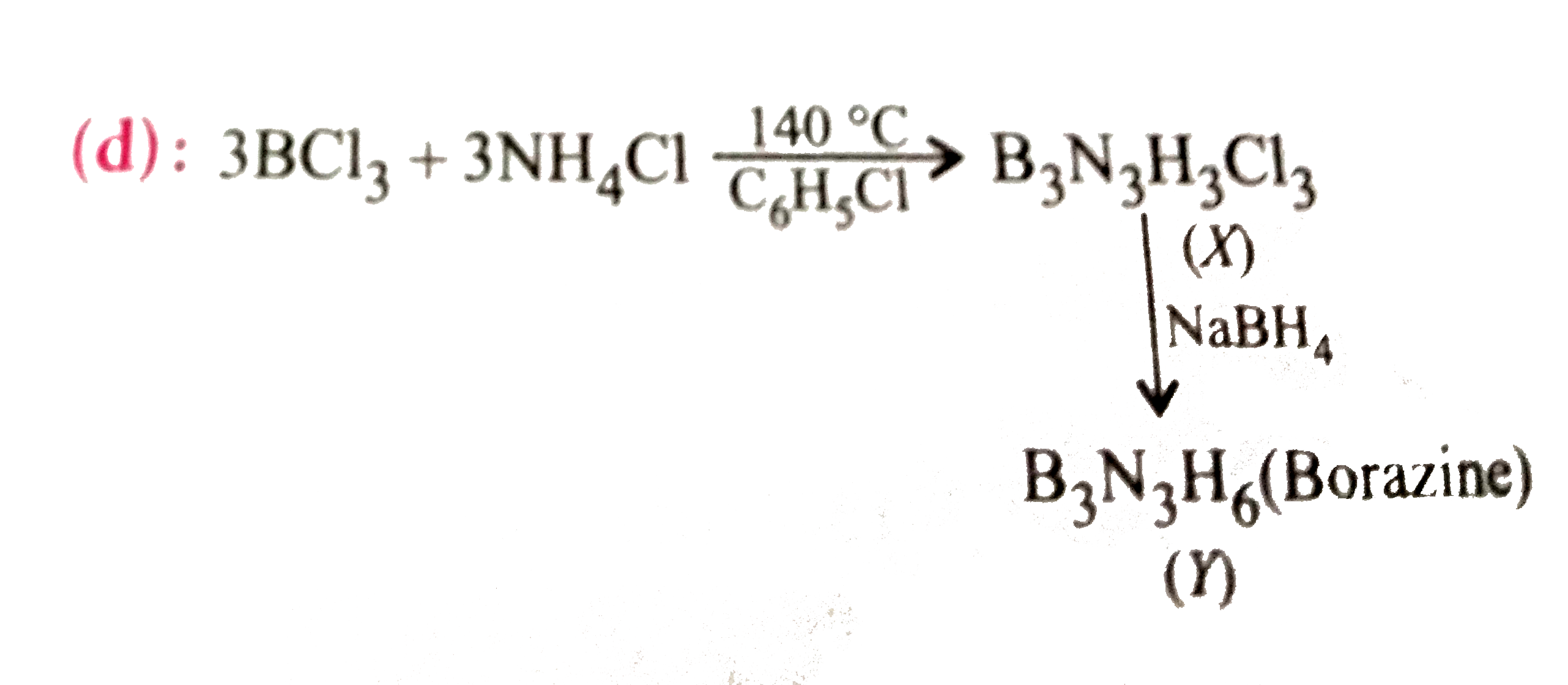
|
|
| 36. |
Identify X and Y in the following H_(2)underset(Br)underset(|)(C)-underset(Br)underset(|)(C)H_(2)+KOH overset("alcohol")to X overset(NaNH_(2))to Y |
|
Answer» `X-CH_(3)CHBR,Y-CH_(2)=CH_(2)` |
|
| 37. |
Identify X and Y in the following reaction sequence Xoverset(Zn)rarrYunderset(Zn-H_(2)O)overset(O_(3))rarr(CH_(3))_(2)CO+CH_(2)O |
|
Answer» `{:("X","Y"),((CH_(3))_(2)underset(BR)underset(|)(CHCH_(3)),CH_(3)CH=CHCH_(3)):}` |
|
| 38. |
Identify X |
|
Answer» `CH_(3)-CH_(2)-C-=C-CH_(2)-CH_(3)` |
|
| 39. |
Identify which of the following shows +I and -I effect? (i) -NO_(2) (ii)-SO_(3)H (iii) -I (iv)-OH (v) CH_(3)O- (vi) CH_(3)- |
| Answer» SOLUTION :`{: ( "+I-effect", "-I-effect"),( "(V)"CH_(3)O-, "(i)"-NO_(2) ) , ("(vi)"CH_(3)-, "(ii)"-SO_(3)H ),(" " ,"(iii)-I"),(" " ,"(iv)-OH") :}` | |
| 40. |
Identify which of the following shows +I and I effect? (i) -NO_(2) (ii) -SO_(3)H (iii) -I (iv) -OH (1) CH_(3)O- (vi) CH_(3)- |
Answer» SOLUTION :
|
|
| 41. |
Identify which of the following are electrophiles and nucleophiles? |
| Answer» SOLUTION :`{: ( "Electrophiles", "Nucleophiles"),( "(ii)"AICI_(3), (i)NH_(3)) , ("(iv)R-X" ,"(III)R-SH"),(" (VI)"BF_(3) ,"(v)R-O-R") :}` | |
| 42. |
Identify type of reaction between F(g) and C(g): |
|
Answer» ION cexchange |
|
| 43. |
Identify true statements from following statements. Select the right option assigning T for true and F for false statement. (i) Ca - metal is liberated and CO_(2) - gas is produced while quick lime reacts with carbon at high temperature. (ii) Hydroxide of Be reacts with NaOH and HCl (iii) Products BeCl_(2) and CO_(2)are obtained when Berilium oxide reacts with Carbon and Chlorine at high temp. (iv) Li and Na form stable super oxides |
|
Answer» FFFT |
|
| 44. |
Identify True and False.(i) For ideal gas Z ne 1(ii) For real gas Z = 1(iii) Z = 0 for both gases (iv) Value of Z for ideal gas is always greater than real gas. |
|
Answer» FFFF |
|
| 45. |
Identify the wrong statement in the following: |
|
Answer» OZONE layer does not permit infrared RADIATION from the SUN to reach the earth |
|
| 46. |
Identify the wrong statement in the following |
|
Answer» The clean water would have a BOD value of more than 5 ppm |
|
| 47. |
Identify the wrong statement from the statements given below. |
|
Answer» Geometrical structwe of `BrF_(5)` is square PYRAMIDAL. This statement is wrong. As .O. has `sp^(3)` hybridization but due to repulsion between lone PAIR on OXYGEN bond angle decrease from `109^(@)28.` and become `104^(@)30.` . 
|
|
| 48. |
Identifythe wrongstatementin thefollowing: |
|
Answer» AMONGST isoelectronicspecies, smallerthepositivechargeon thecationsmalleris theionicradius . |
|
| 49. |
Identify the wrong statement from the following |
|
Answer» Salicylic acid is a monobasic acid |
|
| 50. |
Identify the wrong statement among the following- |
|
Answer» atomic radius of the elements increases as one moves down the first group of the periodic table |
|