

Saved Bookmarks
This section includes 7 InterviewSolutions, each offering curated multiple-choice questions to sharpen your Current Affairs knowledge and support exam preparation. Choose a topic below to get started.
| 1. |
Indicate the type of hybridization of each carbon atom in the following molecules: (i) overset(1)(C)H_(3)-overset(2)(C)H=overset(3)(C)H-overset(4)(C)H_(3) (ii) H-overset(1)(C)-=overset(2)(C)-overset(3)(C)-=overset(4)(C)-H (iii) overset(1)(C)H_(3)-overset(2)(C)-=overset(3)(C)-overset(4)(C)H_(3) (iv) overset(1)(CH_(3) (v) overset(1)(C)H_(3)-overset(2)(C)-=N (vi) H-overset(O)overset(1||)(C)-NH_(2) (vii) overset(1)(C)H_(3)-overset(O)overset(2||)(C)-overset(3)(C)H_(3) (ix) H_(2)C=C=O (x) C(CN)_(4) (xi) CH_(3)overset(+)(CH_(2)) (xii) CH_(3)overset(-)(CH_(2)) (xiii) CH_(2)overset(•)(CH_(2)) |
|
Answer» (iv) All carbon atoms are `sp^(3)`-HYBRIDIZED. (v) `C_(1)=sp^(3), C_(2)=sp` (vi) `C_(1) = sp^(2)` (vii) `C_(1) = sp^(3), C_(2)= sp^(2), C_(3) = sp^(2), C_(4)= sp` (viii) `C_(1) = sp^(3), C_(2)=sp^(2), C_(3) = sp^(3)` (ix) `sp^(2), sp (x) sp, sp^(3)` (xi) `sp^(3), sp^(2) (xii) sp^(3), sp^(3)` (xiii) `sp^(3), sp^(3)` |
|
| 2. |
Indicate the type of bonds present in NH_(4)NO_(5) and state the mode of hybridisation of two N atom in it . |
Answer» Solution :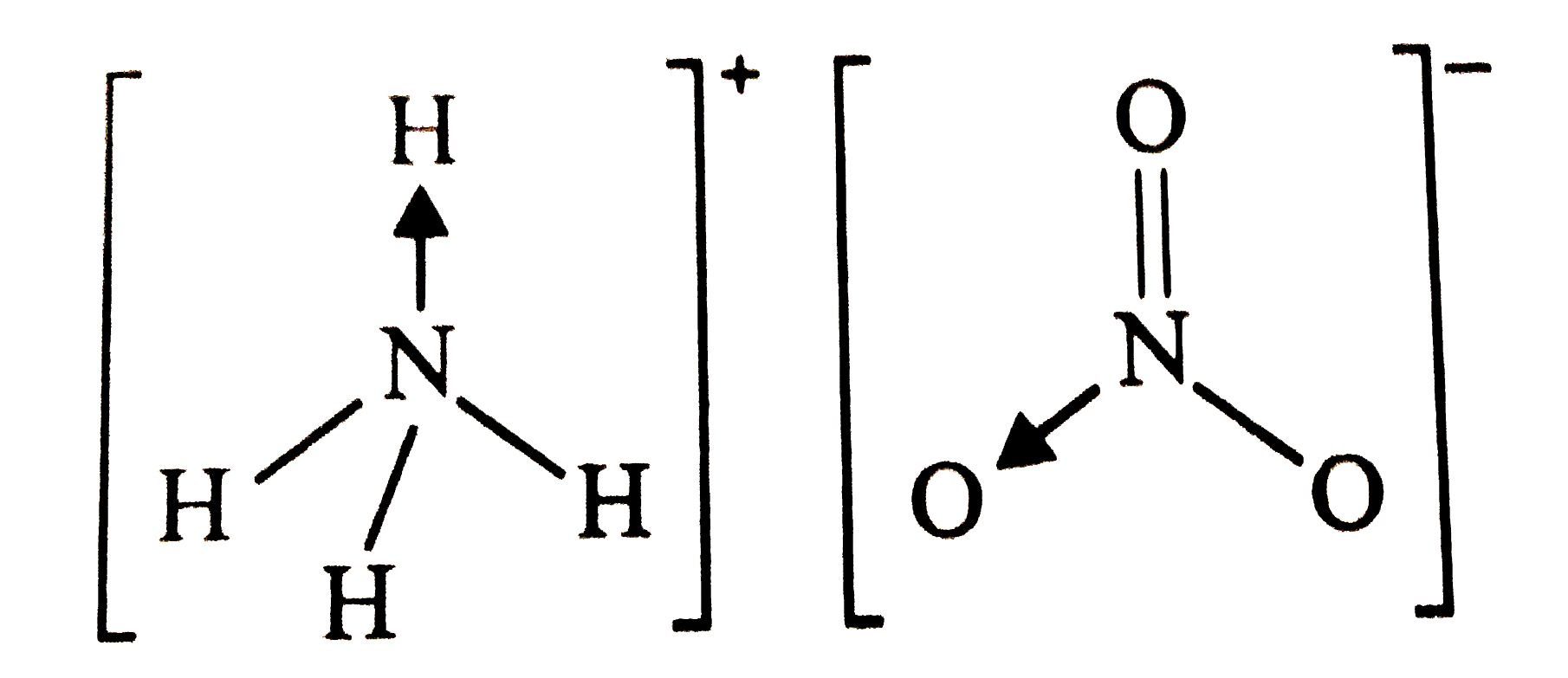 `NH_(4)^(+)` ion contains COVALENT and dative bonds . (It is formed by donation of lone pair of electrons on N in `NH_(3)` to `H^(+)` ion). `NO_(3)^(-)` ion also contains covalent and dative bonds. Bonds between `NH_(4)^(+) and NO_(3)^(-)` ions is IONIC. N of `NH_(4)^(+)` ion is `sp^(3)` hybridised and is tetrehedral., N of ` NO_(3)^(-)` ion is `sp^(2)` hybridised and is PLANAR. |
|
| 3. |
Indicate the sigma and pi bonds in the following molecules: (i) C_(6)H_(6) (ii) C_(6)H_(12) (iii) CH_(2)Cl_(2) (iv) CH_(2) = C = CH_(2) (v) CH_(3) NO_(2) (vi) HCONH CH_(3) |
Answer» Solution :(i) `C_(6)H_(6)`:  In `C- C sigma` bond In `C - H sigma` bond In `3C = C pi` bond (ii) `C_(6)H_(12)`:  In `12C- H sigma` bond In `6C- C sigma` bond zero `pi` bond (iii) `CH_(2) Cl_(2), H underset(sigma)(-) underset(underset(Cl)(|sigma))overset(overset(H)(|sigma))( C)overset(sigma)(-) Cl` In `2 C - H sigma` bond In `2C - Cl sigma` bond TOTAL `4 sigma` bond (iv) `CH_(2) = C = CH_(2)`:  In `4C - H sigma` bond In `2C - C sigma` bond In `2C = C pi` bond (v) `CH_(3)NO_(2)`:  In `3C - H sigma` bond In `2N - O sigma` bond In `1N = O pi` bond `HCONHCH_(3)`: In `4C - H sigma` bond and In `N - H sigma` bond `Hunderset(sigma)- overset(overset(O)(pi||sigma))(C )underset(sigma)- overset(overset(H)(|sigma))(N)underset(sigma)- underset(underset(H)(sigma|))overset(overset(H)(|sigma))(C ) underset(sigma)- H` In `2C- N sigma` bond In `1C - O sigma` bond In `1C = O sigma` bond In `1C = O pi` bond |
|
| 4. |
Indicate the sigma-and-bonds in the following molecules : C_(6)H_(6), C_(6)H_(12), CH_(2)Cl_(2), CH_(2) = C = CH_(2), CH_(3)NO_(2), HCONHCH_(3) |
Answer» SOLUTION :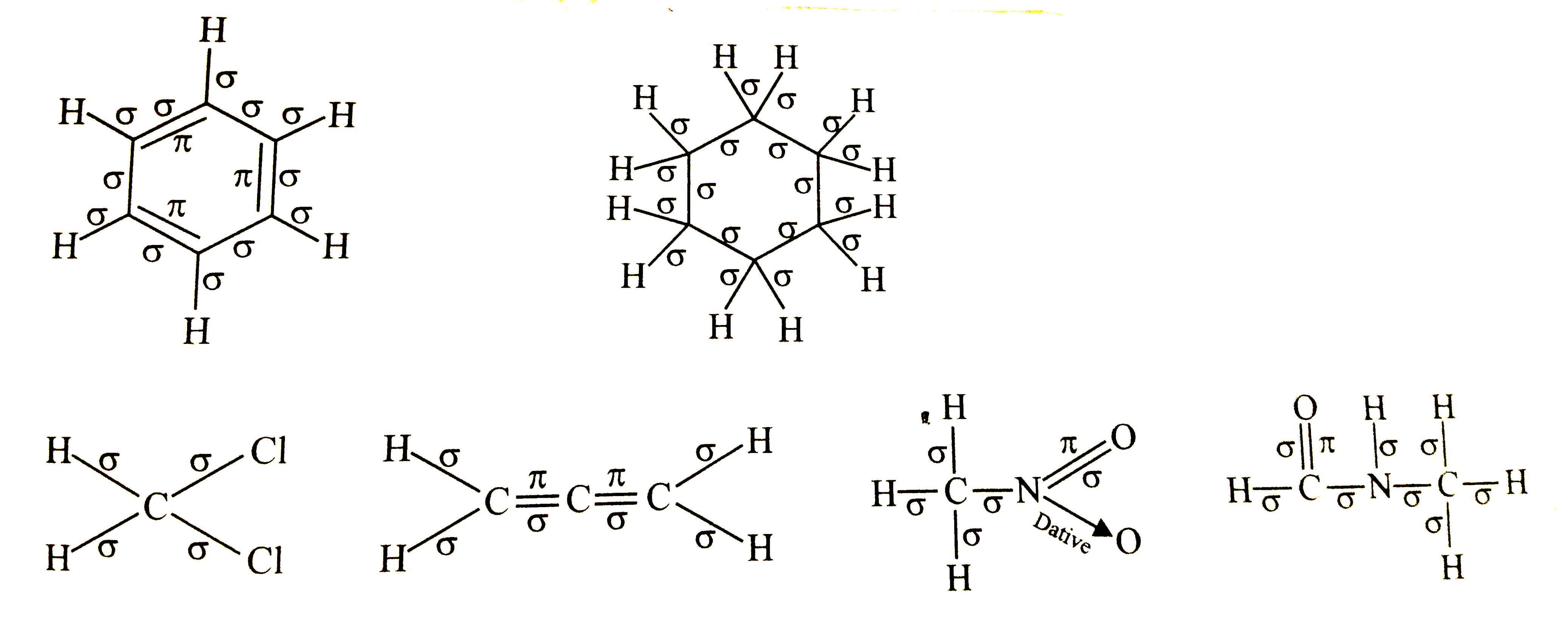
|
|
| 5. |
Indicate the sigma" and " pi bonds in the following molecules. C_(6)H_(6), ""CH_(2)Cl_(2), ""CH_(3)NO_(2), ""CH_(2) = C=CH_(2) |
Answer» SOLUTION :
|
|
| 6. |
Indicate the primary , secondary , tertiary and quanternary carbon atoms in the following : (i)3-Ethyl-2-methylhexane, (ii)2,2,4-Trimethylpentane . |
|
Answer» Solution :(i)`underset(1^@)CH_3-oversetoversetoverset(1^@)(CH_3)|underset(3^@)CH-underset(3^@)oversetoversetoverset(2^@"" 1^@)(CH_2CH_3)|CH-underset(2^@)CH_2-underset(2^@)CH_2-underset(1^@)CH_3` (II)`overset(1^@)CH_3-undersetundersetunderset(1^@)(CH_3)|overset(1^@)overset(CH_3)overset|C-underset(2^@)CH_2-underset(3^@)oversetoversetoverset(1^@)(CH_3)|CH-underset(1^@)CH_3` |
|
| 7. |
Indicate the oxidizing and reducing agents in the following reaction : 2Cu^(2+)+4I^(-) rarr 2CuI+I_2 |
|
Answer» |
|
| 8. |
Indicate the organic structure for product expected when 2-methyl propene is heated with acetyl chloride in presence of anhydrous ZnCl_(2) |
|
Answer» `(CH_(3))_(2) C CL - CH_(2) - COCH_(3)` 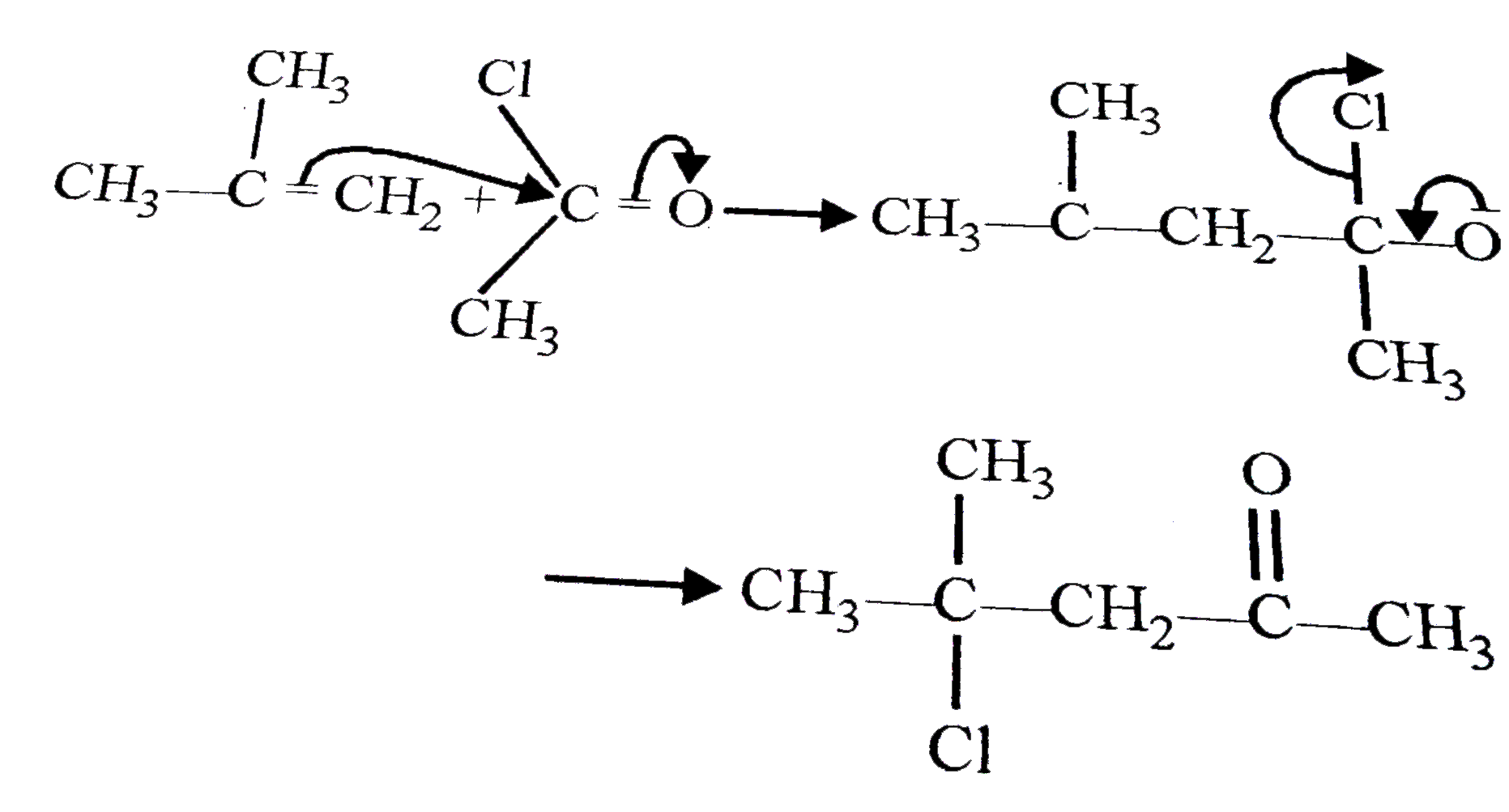
|
|
| 9. |
indicate the numberof unpairedelectronsin (a ) p , (b )Si , (c ) Cr(d )fe and(e ) kr . |
Answer» SOLUTION :Theiratomicnumber and electronconfiguratinis asfollows 
|
|
| 10. |
Indicate the number of unpaired electron in (a) P (b) Si (c) Cr (d) Fe, and (e) Kr |
|
Answer» Solution :(a) `._(15)P = 1s^(2) 2S^(2) 2p^(6) 3s^(2) 3p_(x)^(1) 3p_(y)^(1) 3p_(z)^(1)`. No of unpaired electron = 3 (b) `._(14)Si = 1s^(2) 2s^(2) 2p^(6) 3s^(2) 3p_(x)^(1) 3p_(y)^(1) 3p_(y)^(1)`. No of unpaired electrons = 2 (c) `._(24)Cr = 1s^(2) 2s^(2) 2p^(6) 3s^(2) 3d^(5) 4s^(1)`. No of unpaired electron = 6 (d) `._(26) FE = 1s^(2) 2s^(2) 2p^(6) 3s^(2) 3p^(6) 3d^(6) 4s^(2)`. No of unpaired electron = 4 (in 3 d) (e) `._(36)Kr` = NOBLES gas. All orbitals are filled. Unpaired electrons = 0 |
|
| 11. |
Which of the following oxides are amphoteric .(1) BeO (2) SnO (3) ZnO (4) Al_2O_3 |
| Answer» Solution :(1) COVALENT, (2) covalent, (3) ELECTROVALENT, (4) electrovalant, (5) electrovalent, (6) covalent, (7) electrovalent, (8) electrovalent, covalent and co-ordinate covalent, (9) covalent, (10) electrovalent, (11) covalent, (12) electrovalent, covalent and coordinate covalent. | |
| 12. |
Indicate the correct statement(s) from below : |
|
Answer» `K_(2)S_(2)O_(6)` , when heated with `K_(2)CrO_(4)` and conc. `H_(2)SO_(4)` and in the presence of diethyl ether GIVES a blue colouration. (2) Presence of iodine in a sample of table salt can be tested by adding a few drops of `H_(2)SO_(4)` on a given amount of table salt followed by addition of a few drops of `H_(2)O_(2)` into the resulting mixture (3) `H_(2)O_(2)` needs to be mixed with `FeSO_(4)` to oxidise benzene to PHENOL (4) Poly hydroxy compounds like sorbitol, mannitol ets are used in trace amount to stabilise `H_(2)O_(2)` |
|
| 13. |
Indicate the correct of acidity (first ionization) in the following dicarboxylicacids : |
|
Answer» `I gt II gt III gt IV` |
|
| 14. |
Indicate the conditions under which the ratio of de Broglie wavelengths of an alpha-particle and a proton will be- |
|
Answer» when the RATIO of their VELOCITIES is 4:1 |
|
| 15. |
Indicate in which of the following processes nitrogen is recuced ? |
|
Answer» `NH_(4)^(+) rarrN_2` a) `overset(-3)(NH_4^(+))rarroverset(0)(N_2)` b) `overset(+5)(NO_3^(-)) rarroverset(+2)(NO)` c) `overset(+4)(NO_2)rarroverset(+3)(NO_2^(-))` `overset(+6)(NO_3)rarroverset(+3)(NH_(4)^(+))` |
|
| 16. |
Indiborane: |
|
Answer» 1 bridged HYDROGEN and TWO terminal HYDROGENS are present. |
|
| 18. |
Index of unsaturation (H-deficiency ) of C_8 H_(10)is ........ and if it has a six-membered ring , it can be : |
|
Answer»
|
|
| 19. |
Indentify the correct order of boiling points of the following compounds underset(I)(CH_(3)CH_(2)CH_(2)OH), underset(II)(CH_(3)CH_(2)CH_(2)CHO), underset(III)(CH_(3)CH_(2)CH_(2)COOH) |
|
Answer» `I GT II gt III` 
|
|
| 20. |
Indentify the incorrect statement from the following : |
|
Answer» Oxides of NITROGEN in the atmosphere can cause the depletion of OZONE layer. |
|
| 21. |
Increasing order of stability among the three main conformations (i.e. , eclipse, anti, gauche ) of 2-fluoroethanol is |
|
Answer» eclipse, anti, gauche 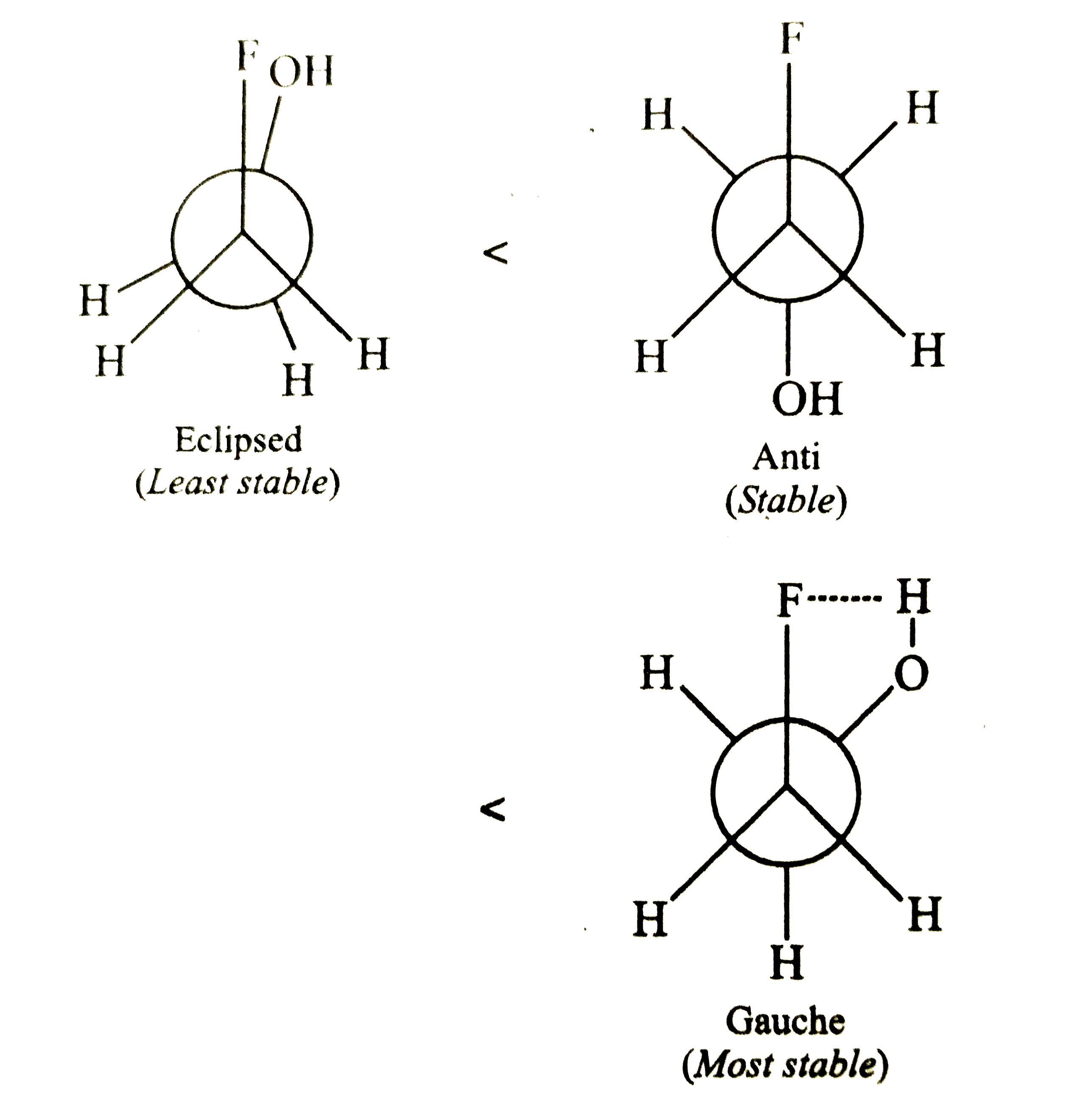 Thus, OPTION (a) is correct. |
|
| 22. |
Increasing order of stability among the three main conformation (i.e., eclips, anti,gauche) of enthalpy glycol is |
|
Answer» ECLIPSE, GAUCHE, ANTI |
|
| 23. |
Increasing order of stability (a) CH_(3)CH = CH- CHO, (b) CH_(3) overset(+)(C )H- CH= overset(overset(H)(|))(C )- underset(..)overset(..)(O):^(-) (c ) overset(+)( C)H_(2)- CH= CH- overset(overset(H)(|))(C )= O |
| Answer» SOLUTION :(C ) `LT` (B) `lt` (a) | |
| 24. |
Increasing order of stability among the three main conformation (i.e. eclipse, anti, gauche) of ethylene glycol is : |
|
Answer» ECLIPSE, GAUCHE, ANTI |
|
| 25. |
Increasing order of rate of reaction with Conc. HNO_(3)//H_(2)SO_(4) is |
|
Answer» iiiltiilti |
|
| 26. |
Increasing order of size of hybrid orbitals is |
|
Answer» `SP, sp^(2),sp^(3)` |
|
| 27. |
Increasing order of rate of reaction with Br_(2)//AlCl_(3) is |
|
Answer» iiiltiltiiltiv |
|
| 28. |
Increasing order of hydrateformation is |
|
Answer» I LT II lt III lt IV |
|
| 29. |
Increasing order of electronegativity of elements P, Bi, S and Cl is |
|
Answer» <P>`P LT Bi lt S lt Cl` |
|
| 30. |
Increasing order of acidic strength Cl_(3)C COOH lt CH_(3)COOH, CHCl_(2)COOH, CH_(2)ClCOOH |
| Answer» Solution :`CH_(3)COOH LT CH_(2)ClCOOH lt CHCl_(2)COOH, lt C Cl_(3)COOH` | |
| 31. |
Increased asthmatic attacks in certain seasons are related to |
|
Answer» Inhalation of seasonal POLLEN |
|
| 32. |
Increase of pressure favours the forward reaction in the following equilibrium |
|
Answer» `H_(2(g))+I_(2(g)) harr 2HI_((g))` |
|
| 33. |
Increase in kinetic energy can overcome intermolecular forces of attraction. How will the viscosity of liquid be affected by the increase in temperature ? |
|
Answer» Increase In other words, as the viscosity of a liquid decreases, there is an increase in temperature. It has been found that the decrease is about 2% per DEGREE RISE in temperature. |
|
| 34. |
Increase in enthalpy of the surroundings is equal to decrease in enthalpy of the system. Will the temperature of system and surroundings be the same when they are in thermal equilibrium ? |
|
Answer» Solution :Yes, the temperature of SYSTEM and surroundings are same when they are in thermal equilibrium. Thermal equilibrium is defined as when two physical systems are BROUGHT into a connection that does not allow transfer of MATTER between them, and does not allow transfer of energy between them, such a connection is said to permit transfer of energy as HEAT, and is called diathermal. If a diathermal connection is made between two physical systems and the making of the connection is FOLLOWED by no change of state of either, then the two systems are said to be in relation of thermal equilibrium, It obeys zeroth law of thermodynamics. |
|
| 35. |
Increase in enthalpy of the surroundings is equal to decreasein enthalpy of the system. Will the temperature of system and surroundings be the same when they are in thermal equilibrium ? |
| Answer» SOLUTION :Yes.When SYSTEM and surroundingsare in THERMAL EQUILIBRIUM , their TEMPERATURES are same. | |
| 36. |
Increase in concentration of pollutant by the process of food chains is called |
|
Answer» EUTROPHICATION |
|
| 37. |
Increase in average temperature of earth may increases the possibilities of disease like ...... |
| Answer» Solution :yellow fever | |
| 38. |
Incorredt relation between given compounds are |
|
Answer» Both are GEOMETRICAL ISOMERS |
|
| 39. |
Incorret statement about addition of halogen to alkenes |
|
Answer» It is electrophilic addition |
|
| 40. |
Incorrect statement (s) regarding H_(2)O_(2) is s/are |
|
Answer» `H_(2)O_(2)`has HIGHER boiling point than water |
|
| 41. |
Incorrect statement related to an irreversible process is |
|
Answer» Entropy of the UNIVERSE goes on INCREASING |
|
| 42. |
Incorrect statement regarding waste management is |
|
Answer» Bio-degradable and non-biodegradable wastes are SEPARATED from garbage waste |
|
| 43. |
Incorrect statement regarding CO_2is |
|
Answer» Cardice is the SOLID `CO_(2)` |
|
| 44. |
Incorrect statement is |
|
Answer» `SO_(2), CO,` Pb and Hg are pollutants |
|
| 45. |
Incorrect statement in the following is |
|
Answer» Dipole - dipole ATTRACTIONS are more, if the molecules have high DIPOLEMOMENT values. |
|
| 46. |
Incorrect statement among the following is |
|
Answer» To study the reaction MECHANISM TRITIUM is USED |
|
| 47. |
Incorrect statement among the following is ? |
|
Answer» In `BF_3` , the BOND order is 1.33 |
|
| 48. |
Incorrect statement about Alum |
|
Answer» In alum each metal ion is surrounded by SIX water molecule. |
|
| 49. |
Inachemical equilibrium,the rate constant for the forward reaction is 2.5 xx 10^2 and the equilibrium constant is 50 . The rate constant for the reverse reaction is …………………… . |
|
Answer» 11.5 `K_C = K_f/K_r` `50= (2.5 xx 10^2)/K_r` `K_r = 5` |
|


