

Saved Bookmarks
This section includes 7 InterviewSolutions, each offering curated multiple-choice questions to sharpen your Current Affairs knowledge and support exam preparation. Choose a topic below to get started.
| 1. |
Moreover, the salt (A) on heating with solid K_(2)Cr_(2)O_(7) and concentrated H_(2)SO_(4) produces deep red vapors which dissolve in sodium hydroxide solution forming a yellow solution. This yellow solution gives yellow precipitate with Ba(NO_(3))_(2) solution. On the basis of teh aforesaid characteristic informations answer the following questions: The black precipitate F on heating with water produces: |
|
Answer» `HG(OH)_(2)` 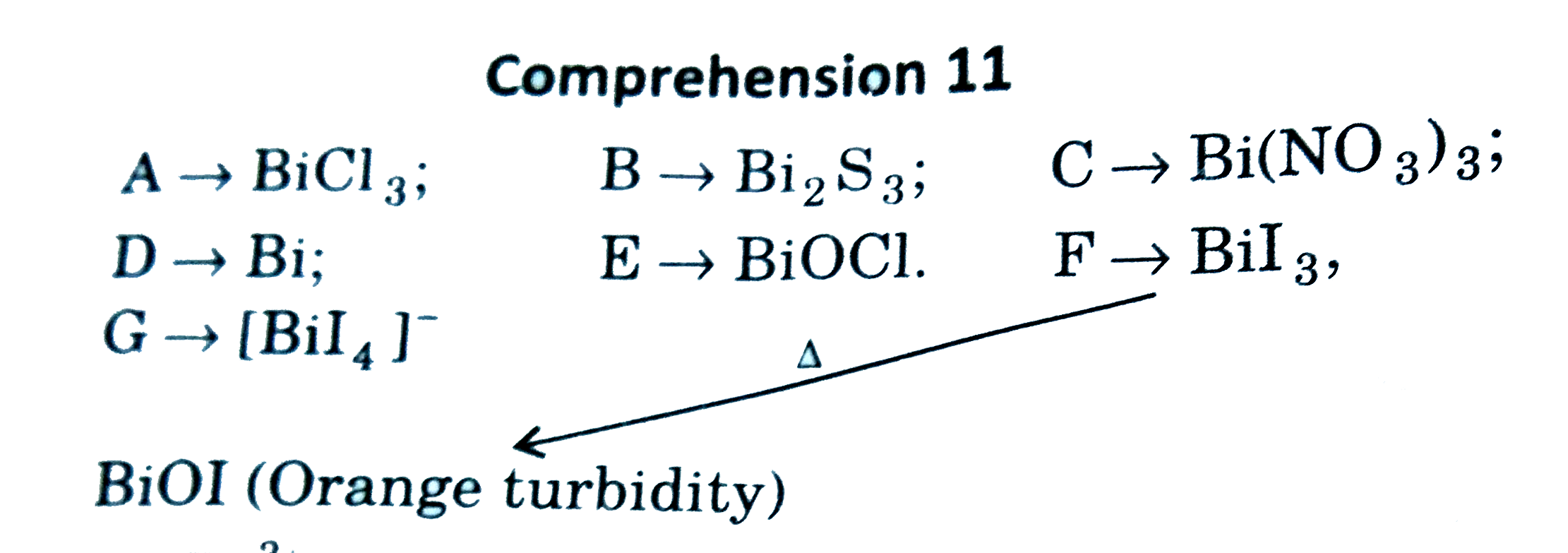
|
|
| 2. |
Moreover, the salt (A) on heating with solid K_(2)Cr_(2)O_(7) and concentrated H_(2)SO_(4) produces deep red vapors which dissolve in sodium hydroxide solution forming a yellow solution. This yellow solution gives yellow precipitate with Ba(NO_(3))_(2) solution. On the basis of teh aforesaid characteristic informations answer the following questions: Acidified solution of A, on treatment with KI gives black precipitate F which dissolves in excess of reagent forming the coloured compound G. The chemical composition of F and G are respectively: |
|
Answer» `HgI_(2)` and `[HgI_(4)]^(2-)` 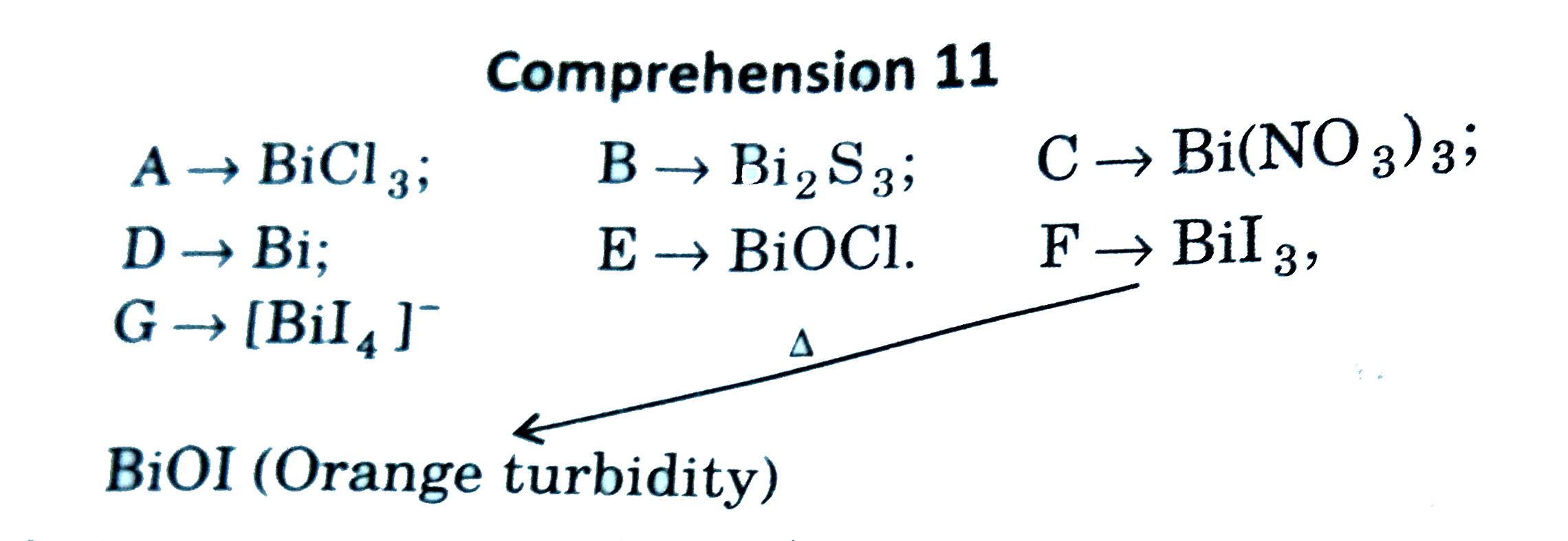
|
|
| 3. |
Moratar is a mixture of |
|
Answer» `CaCO_(3) and CaO` |
|
| 4. |
Monovalent cations having stable electronic configurations similar to the |
|
Answer» ALKALI metals |
|
| 5. |
Monomer in silicone is |
| Answer» Answer :A | |
| 6. |
monohalogenation Q. Which halogen will give the best yield of the monohalogenation product? |
|
Answer» `F_(2)`<BR>`Cl_(2)` |
|
| 7. |
Monoclinic crystal has dimension |
|
Answer» `a NE b ne c , alpha ne beta ne gamma 90^(@)` |
|
| 8. |
Monocarbonyl compounds have very small percentage enol form at equilibrium . Explains. |
|
Answer» |
|
| 9. |
monoatomicanion of unitchargecontains45neutrons and36electrons. What is theatomicmas of the elementand inwhichgroup of theperiodictabledoes it lie ? |
|
Answer» SOLUTION :No.Of neutrons of themonoatomic anion = 45 No. ofelectrons of the MONOATOMICANION = 36`:. `No. of electronsof the monoatomicatom= 36 -1 = 3 `:. ` ATOMICNUMBER of theatom `(Z= 35)`. Thereforethe atomis bromineand itbelongsto group17, i.e.,halogenfamily . No. ofprotons= No. of electrons=35 `:. `Atomicmass =No . ofneutrons +No. ofprotons= 45+ 35=80 |
|
| 11. |
Moltensodiumis usedin nuclearreactorsto ______. |
|
Answer» ABSORB neutronsin ORDERTO contralthechainreaction |
|
| 12. |
Molten sodium chloride conducts electricity due to the presence of |
|
Answer» free electrons |
|
| 13. |
Moltenaluminium bromide ispoor conductor of electricity. Explain. |
| Answer» SOLUTION :Aluminium bromide is a covalent moelcule. Even INTHE MOLTEN state, it ionizesto a very small extentand henceit is a poorconductorof ELECTRICITY. | |
| 14. |
Moles of KHC_(2)O_(4) (potassiumacid oxalate) required to reduce 100 mL of 0.02M KMnO_(4) in acidic medium (to Mn^(2+)) is |
|
Answer» `0.002` `nxx2=0.1xx0.02xx5impliesn=0.005` |
|
| 15. |
Moles of ABC_(3) produced in the following set tio reaction when 180gm of A, 180gm of B and 200gm of C are mixed in a container (given molar mas of A, B ,C and 20,30 and 10 respectively). 2A + 3B + 5C rightarrow A_(2)BC + B_(2)C_(3)……………..(i) B_(2)C_(3) + 3C rightarrow 2BC_(3)..................(ii) BC_(3) + A rightarrow ABC_(3)...............(iii) |
|
Answer» 5 |
|
| 16. |
Molecules with sp^(2) hybridisation will have the followig shape |
|
Answer» linear |
|
| 17. |
Molecules of liquid hydrogenchloride are held with |
|
Answer» LONDON, DISPERSION FORCES |
|
| 18. |
Molecules of a gas are considered as point groups. What does this signify? |
| Answer» SOLUTION :ACTUAL volume OCCUPIED by molecule of a GAS is negligible. This assumption explains great compressibility of gases. | |
| 19. |
Molecules having the least RMS velocity at constant temperature are |
|
Answer» `CO_2` |
|
| 20. |
Molecules having same molecular formula. But differing in structure (or) spatial orientation of atom is known isomers and phenomenon known as isomerism. Molecules which differ in structural formula are known as structural isomers and phenomenon is known as structural isomerism structural isomerism can be broadly classified as (i) Chain isomerism(ii) Positional isomerism(iii) Functional isomerism (iv) Metamerism(v) Tautomerism Molecules having same molecular formula but differing in spatial orientation are known as stereo isomers and the phenomenon known as stereo isomerism. Stero isomerism can be classified as (i) Geometrical isomerism (ii) Optical isomerism The phenomenon in which molecules having same molecular formula and same functional group but differing in the nature of alkyl group attached to functional group known as |
|
Answer» Functional isomerism |
|
| 21. |
Molecules having distorted tetrahedral geometry are- |
|
Answer» `H_(2)O` |
|
| 22. |
Molecules having same molecular formula. But differing in structure (or) spatial orientation of atom is known isomers and phenomenon known as isomerism. Molecules which differ in structural formula are known as structural isomers and phenomenon is known as structural isomerism structural isomerism can be broadly classified as (i) Chain isomerism(ii) Positional isomerism(iii) Functional isomerism (iv) Metamerism(v) Tautomerism Molecules having same molecular formula but differing in spatial orientation are known as stereo isomers and the phenomenon known as stereo isomerism. Stero isomerism can be classified as (i) Geometrical isomerism (ii) Optical isomerism How many structural isomers possible for the given compound C_(4)H_(10)O |
|
Answer» 5 `C-C-UNDERSET(OH)underset(|)C-C""C-C-C-O-C` `C-underset(OH)underset(|)C-C-OH""C-underset( C )underset(|)C-O-C` `C-underset(OH)underset(|)OVERSET( C )overset(|)C-C` |
|
| 23. |
Molecules having same molecular formula. But differing in structure (or) spatial orientation of atom is known isomers and phenomenon known as isomerism. Molecules which differ in structural formula are known as structural isomers and phenomenon is known as structural isomerism structural isomerism can be broadly classified as (i) Chain isomerism(ii) Positional isomerism(iii) Functional isomerism (iv) Metamerism(v) Tautomerism Molecules having same molecular formula but differing in spatial orientation are known as stereo isomers and the phenomenon known as stereo isomerism. Stero isomerism can be classified as (i) Geometrical isomerism (ii) Optical isomerism Which of the following pair exhibit functional isomerism |
|
Answer» ether and alcohol |
|
| 24. |
The molecule having zero dipole moment is |
| Answer» Answer :D | |
| 25. |
Molecule with dipole moment among the following |
|
Answer» `SF_(6)` |
|
| 26. |
Molecule which contains 4 bond pairs and 2 lone pairs of electrons on the central atom is |
|
Answer» `XeF_2` |
|
| 28. |
Molecule is the smallest particle of a substance which is capable of.......... |
|
Answer» |
|
| 29. |
Molecule having an incomplete octet in the central atom is |
|
Answer» `PCl_5` |
|
| 30. |
Molecular weights of ammonia and nitrogen are respectively X_(1) and X_(2). In the reaction of producing ammonia.N_(2)+3H_(2)to2NH_(3) , the equivalent weights ofammoniaand nitrogen are given as respectively y_(1) and y_(2). Then how is (y_(1)-y_(2)) related to molecular weights? |
|
Answer» |
|
| 31. |
Molecular weight of Mohr.s salt is 392. Its equivalent weight when it is oxidised by KMnO_(4) in acidic medium is |
|
Answer» 392 |
|
| 32. |
Molecular weight of orthophosphoric acid is M. Its equivalent weight is |
|
Answer» 3M |
|
| 33. |
Molecular weight of Mohr's salt is 392. Its equivalent weight when it is oxidised by KMnO_4 in acidic medium is |
|
Answer» 392 |
|
| 34. |
Molecular weight of Mohr's salt is 392. Its equivalent weight when it is oxidised by KMnO, in acidic medium is |
|
Answer» 392 |
|
| 35. |
Molecular weight of KMnO_(4) is "M". In a reaction KMnO_(4) is reduced to KMnO_(4). The equivalent weight of KMnO, is |
|
Answer» M |
|
| 36. |
Molecular weight of a gas is 44. The volume occupied by 2.2 grams of the gas under STP is |
|
Answer» 1.12 lit `(2.2)/(44) = ?` |
|
| 38. |
Molecular weight of a dibasic acid is 132. If 33 grams of acid is present in 400ml solution, calculate molarity and normality |
|
Answer» |
|
| 39. |
Molecular orbitals are formed by the overlap of atomic orbitals . Two atomic orbitals combine to form two molecular orbitals, called Bonding Molecular Orbital (BMO) and Anti - Bonding Molecular Orbital (ABMO). Different atomic orbitals of one atom combine with those atomic orbitals of the second atom which have comparable energles and proper orientationFurther, if overlapping is head on, the molecular orbitals is called 'sigma' and if the overlap is lateral, the molecular orbital is called 'pi' . The molecular orbitals are filled with electrons following the same rules as followed for filling of atomic orbitals . However, the order of filling in not the same for of the most important parameter to compare a number of their characteristics In whihc of the following pair the moelcular orbitals are gerade or ungerade ? |
|
Answer» `sigma_(2s), pi_(2p_(x))` |
|
| 40. |
Molecular shapes ofSF_(4), CF_(4), XeFe_(4)are |
|
Answer» the same with 2, 0 and 1 lone PAIRS of electrons RESPECTIVELY |
|
| 41. |
Molecular orbitals are formed by the overlap of atomic orbitals . Two atomic orbitals combine to form two molecular orbitals, called Bonding Molecular Orbital (BMO) and Anti - Bonding Molecular Orbital (ABMO). Different atomic orbitals of one atom combine with those atomic orbitals of the second atom which have comparable energles and proper orientationFurther, if overlapping is head on, the molecular orbitals is called 'sigma' and if the overlap is lateral, the molecular orbital is called 'pi' . The molecular orbitals are filled with electrons following the same rules as followed for filling of atomic orbitals . However, the order of filling in not the same for of the most important parameter to compare a number of their characteristics H_(2), Li_(2), B_(2) eachhas bond order equal to 1 . The order of their stability is |
|
Answer» `H_(2) = Li_(2) = B_(2)` |
|
| 42. |
Molecular orbitals are formed by the overlap of atomic orbitals . Two atomic orbitals combine to form two molecular orbitals, called Bonding Molecular Orbital (BMO) and Anti - Bonding Molecular Orbital (ABMO). Different atomic orbitals of one atom combine with those atomic orbitals of the second atom which have comparable energles and proper orientationFurther, if overlapping is head on, the molecular orbitals is called 'sigma' and if the overlap is lateral, the molecular orbital is called 'pi' . The molecular orbitals are filled with electrons following the same rules as followed for filling of atomic orbitals . However, the order of filling in not the same for of the most important parameter to compare a number of their characteristics Which one of the following has maximum number of nodal planes ? |
|
Answer» `sigma_(1s)^(**)` WHEREAS` pi_(2p_(y))^(**)`has TWO nodal planes |
|
| 43. |
Molecular orbitals are formed by the overlap of atomic orbitals. Two atomic orbitals combine atom from two molecular orbitals called vonding molecular orbital (BOM) and anti bonding molecular orbital (ABMO). Energy of anti bonding orbital is raised above the parent atomic orbitals that have combined and the energy of the bonding orbital is lowered than the parent atomic orbitals. Energies of various molecular orbitals for elements hydrogen to nitrogne increase in the order : sigma_(1s)ltsigma_(1s)^(**)ltsigma_(2s)ltsigma_(2s)^(**)lt(pi_(2py)~~pi_(2py))lt sigma_(2py)lt(pi_(2py)^(**)~~pi_(2py)^(**))ltsigma_(2pz)^(**) and for ozygen and fluorine order of energy of molecular orbitals id given below : sigma_(1s)ltsigma_(1s)^(**)ltsigma_(2s)ltsigma_(2s)^(**)ltsigma_(2pz)lt(pi _(2px)^(**)~~pi_(2py)^(**))sigma_(2pz)^(**) Different atomic orbitals of one atom combine wiht the atomic orbitals of the second atom whihc have comparable energies and proper orientation. Further, if the overlapping is head on, the molecular orbital is called 'Sigma' (sigma) and if the overlap is atreal, the molecular orbital is called 'pi', (pi). The molecular orbitals are filled with electrons according to the same rules as followed for filling of atomic orbitals. However, the order for filling is not the same for all molecules or their ions, Bond order is one the most ipmrtaint parameters to compare the strength of bonds. Which of the following molecular orbital has maximum number of nodal planes ? |
|
Answer» `sigma_(1s)^(**)` |
|
| 44. |
Molecular orbitals are formed by the overlap of atomic orbitals . Two atomic orbitals combine to form two molecular orbitals, called Bonding Molecular Orbital (BMO) and Anti - Bonding Molecular Orbital (ABMO). Different atomic orbitals of one atom combine with those atomic orbitals of the second atom which have comparable energles and proper orientationFurther, if overlapping is head on, the molecular orbitals is called 'sigma' and if the overlap is lateral, the molecular orbital is called 'pi' . The molecular orbitals are filled with electrons following the same rules as followed for filling of atomic orbitals . However, the order of filling in not the same for of the most important parameter to compare a number of their characteristics Whihc one of the following statements is corrects ? |
|
Answer» BMO is lowered by the greater amount of energy by which BMO are lowered as COMPARED to the energy of combining ATOMIC ORBITALS . |
|
| 45. |
Molecular orbitals are formed by the overlap of atomic orbitals. Two atomic orbitals combine atom from two molecular orbitals called vonding molecular orbital (BOM) and anti bonding molecular orbital (ABMO). Energy of anti bonding orbital is raised above the parent atomic orbitals that have combined and the energy of the bonding orbital is lowered than the parent atomic orbitals. Energies of various molecular orbitals for elements hydrogen to nitrogne increase in the order : sigma_(1s)ltsigma_(1s)^(**)ltsigma_(2s)ltsigma_(2s)^(**)lt(pi_(2py)~~pi_(2py))lt sigma_(2py)lt(pi_(2py)^(**)~~pi_(2py)^(**))ltsigma_(2pz)^(**) and for ozygen and fluorine order of energy of molecular orbitals id given below : sigma_(1s)ltsigma_(1s)^(**)ltsigma_(2s)ltsigma_(2s)^(**)ltsigma_(2pz)lt(pi _(2px)^(**)~~pi_(2py)^(**))sigma_(2pz)^(**) Different atomic orbitals of one atom combine wiht the atomic orbitals of the second atom whihc have comparable energies and proper orientation. Further, if the overlapping is head on, the molecular orbital is called 'Sigma' (sigma) and if the overlap is atreal, the molecular orbital is called 'pi', (pi). The molecular orbitals are filled with electrons according to the same rules as followed for filling of atomic orbitals. However, the order for filling is not the same for all molecules or their ions, Bond order is one the most ipmrtaint parameters to compare the strength of bonds. In which of the following molecules sigma_(2pz) molecular orbital is filled after pi _(2px)and pi_(2py) molecular orbitals ? |
|
Answer» `O_(2)` |
|
| 47. |
Molecular mass of phosphoric acid is a 98 gm/mol state Atomic mass of 'P'. |
|
Answer» <P> `:.(3H)+1(P)+4(O)=98` `:.3(1)+1(P)+4(16)=98` `:.3+P+64=98` `:.67+P=98` `:.P=98-67=31` gm/mol `:. P=31` gm/mol |
|
| 49. |
Molecular mass of SrF_2, is 125.6. Solubility of SrF, in water is 1.2 xx 10^(-2) g L^(-1). Calculate the solubility product of SrF_2 |
| Answer» SOLUTION :`3.48 XX 10^(-12)` | |
| 50. |
Molecular mass of liquid ammonia is les than that of liquid hydrogen chloride. But hydrogen chloride is more volatile. Why ? |
|
Answer» Solution :Inter molecular forces in ammonia are HYDROGEN bonds. In liquid hydrogen CHLORIDE, the forces of ATTRACTION are dipole-dipole forces. Thees FORCESARE relatively weak. Hence VOLATILITY is more. |
|