

Saved Bookmarks
This section includes 7 InterviewSolutions, each offering curated multiple-choice questions to sharpen your Current Affairs knowledge and support exam preparation. Choose a topic below to get started.
| 1. |
Molecular mass of a non-volatile organic solid can be determined by: |
|
Answer» VICTOR MEYER's method |
|
| 2. |
Molecular mass of a tribasic acid is M. Its equivalent mass will be : |
| Answer» SOLUTION :N//A | |
| 4. |
Molecular hydrides are classified as electron deficient, electron precise and electron rich compounds. Explain each type with two examples. |
|
Answer» Solution :Molecular HYDRIDES are classified according to the relative numbers of ELECTRONS and BONDS, in their lewis structure as follow. (i) Electron deficient hydrides : In these hydrides there are less than eight electrons present arround the central atom. Group-13 elements make these type of hydrides. e.g., `BH_3, AIH_3`, etc. These hydrides are lewis acid in nature . (ii) Electron PRECISE hydrides : In this type of hydrides central atom have eight electrons. Group-14 elements, give these type of hydrides e.g. `CH_4, SiH_4` (iii) Electron rich hydrides : In these type of hydrides central atom have than 8 electron. Group - 15, 16 and 17 elements gave this type of hydrides. e.g., `NH_3 , H_2O , HF` , etc. |
|
| 5. |
Molecular formula of sodium hexameta phosphate is …….. |
|
Answer» `Na_5P_5O_10` |
|
| 6. |
Molecular formula of Glauber's salt is |
|
Answer» `MgSO_(4).7H_(2)O` |
|
| 7. |
Molecular formula of chili salt peter is...... |
|
Answer» `NaNO_(3)` |
|
| 8. |
Molecular formula of borex is.... |
|
Answer» `Na_(2)B_(4)O_(7)*5H_(2)O` |
|
| 9. |
Molecular formula of benzene is ………… |
| Answer» Answer :a | |
| 10. |
Molecular formula C_(4)H_(6) have two position isomers A and B. both A and B isomer decolourised the bromine water. B release H_(2) gas with sodium metal but isomer a does not release H_2 gas. Write IUPAC name of A and B |
|
Answer» |
|
| 11. |
Molecular formula C_(3)H_(6)O having following structures. (1) CH_(2)=CH-CH_(2)-OH (2) CH_(2)=underset(OH)underset(|)C-CH_(3) (3) underset(OH)underset(|)CH=CH-CH_(3) (4) CH_(3)-CH_(2)-underset(O)underset(||)C-H (5) CH_(3)-underset(O)underset(||)C-CH_(3) (6) CH_(2)=CH-OCH_(3) Find out the incorrect statement. |
|
Answer» (3) and (4) are TAUTOMERS 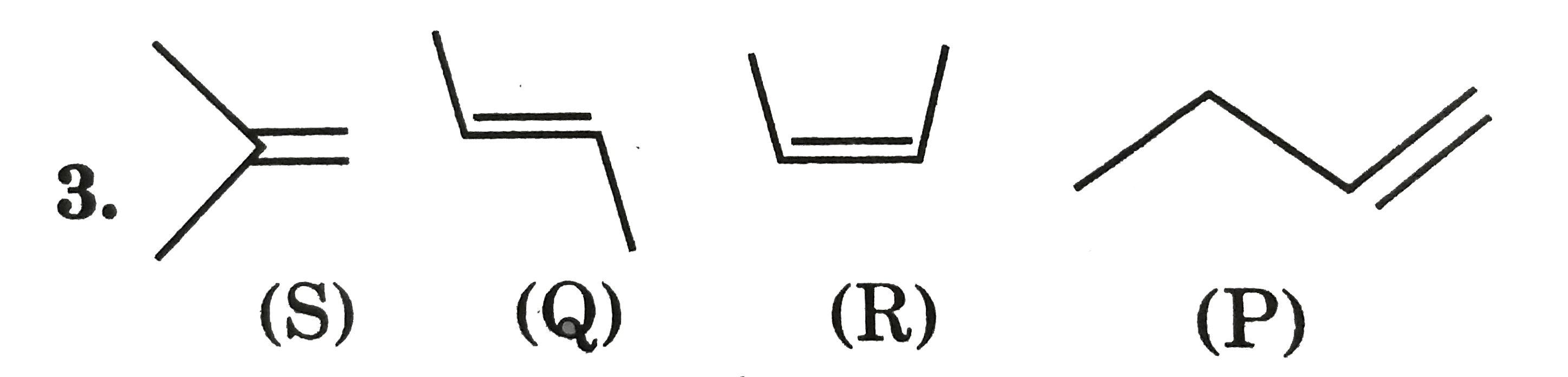 `HCO PROP(1)/("Stability of alkene")` |
|
| 12. |
Molecular formula C_(3)H_(6)O having following structures. (1) CH_(2)=CH-CH_(2)-OH (2) CH_(2)=underset(OH)underset(|)C-CH_(3) (3) underset(OH)underset(|)CH=CH-CH_(3) (4) CH_(3)-CH_(2)-underset(O)underset(||)C-H (5) CH_(3)-underset(O)underset(||)C-CH_(3) (6) CH_(2)=CH-OCH_(3) Which type of isomerism is present between compound (1) and (4) ? |
|
Answer» Tautomers |
|
| 13. |
Molecular formulaC_(3)H_(6)O_(2) have two structure A and B . Structure A releases CO_(2) gas with NaHCO_(3) but B does not. Compound B is fruily smelling liquid. Write the structure & IUPAC name of A and B |
|
Answer» |
|
| 14. |
Molecular formula C_(3)H_(6)O having following structures. (1) CH_(2)=CH-CH_(2)-OH (2) CH_(2)=underset(OH)underset(|)C-CH_(3) (3) underset(OH)underset(|)CH=CH-CH_(3) (4) CH_(3)-CH_(2)-underset(O)underset(||)C-H (5) CH_(3)-underset(O)underset(||)C-CH_(3) (6) CH_(2)=CH-OCH_(3) Which of the following set is not example of positional isomerism? |
| Answer» Solution :N//A | |
| 15. |
Molecualr weight of a tribasic acid is W. Its equivalent weight will be |
|
Answer» `W/2` |
|
| 16. |
mole of same solute is dissolved in 200 moles of water 18.58 kJ of heat is absorbed. Calculate the enthalpy of dilution. |
|
Answer» Solution :During dilution, HEAT is absorbed from 15.9 KJ to 18.58 kJ. Enthalpy of dilution = 18.58 kJ - 15.9 kJ = 2.68 kJ. |
|
| 17. |
Mole is a very large number to indicate the number of atoms, molecules, etc. Write another name for one mole. |
| Answer» Solution :1 MOLE = GRAM atomic mass or 1 gram ATOM 1 MOL = gram MOLECULAR mass or I gram molecule | |
| 18. |
Mole fraction of water in aqueous sulphuric acid solution is 0.85. Calculate the molality. |
|
Answer» |
|
| 19. |
Mole fraction of the solute in a 1.00 molal aqueous solution is |
|
Answer» 0.177 |
|
| 20. |
Mole fraction of solute in a 2.0 molal aqueous solution is : |
|
Answer» 1.77 No. of moles of SOLUTE = 2 MOL No. of moles water `= ((1000G))/(("18 g mol"^(-1)))=55.55` mol Mole FRACTION of solute `= (("2 mol"))/(("2 mol")+("55.55 mol"))=0.347`. |
|
| 21. |
Mole fraction of ethanol in an aqueous solution of ethanol and water is 0.1. The mass percent of ethanol is |
|
Answer» 10 MASS of ethanol = 46X Mass of water = 162x `THEREFORE` mass % of ethanol = `(46x)/(208x)xx100=22%` |
|
| 22. |
Molarity of pure water is …………….. |
|
Answer» Solution :`55.55` MOLARITY `= n/V= ("NUMBER of moles")/("Volume")` Number of moles `= (("Mass")/("MOLAR mass"))/("Volume")= (1000)/(18) = 55.55` |
|
| 23. |
Molarity of 2N aqu. solution of Ca(OH)_(2)is .......... M. |
|
Answer» 1 |
|
| 24. |
The Molarity of 200 ml of HCl solution which can neutralise 10.6 g. of anhydrous Na_2CO_3 is |
|
Answer» 0.1M |
|
| 25. |
Molarity is number of moles of solute dissolved per litre of the solution while normality is number of gm-equivalent of solute dissolved per litre of solution. Molality is number of moles of solute dissolved per Kg of solvent. Normality and molarity change with change of temperature of solution but molality is independent of temperature. In case of monobasic acid normality and molarity are equal but dibasic acid or base molarity is two times of normality. In redox and neutralisation processes number of milliequivalentsof reactants as well as products are always equal. 100 mL solution of .x. M KMnO_(4) oxidised 1.52 gm FeSO_(4) in acidic medium. The value of x is |
|
Answer» `0.01` `0.1xx x xx5=(1.52)/(152)xx1impliesx=0.02` |
|
| 26. |
Molarity is number of moles of solute dissolved per litre of the solution while normality is number of gm-equivalent of solute dissolved per litre of solution. Molality is number of moles of solute dissolved per Kg of solvent. Normality and molarity change with change of temperature of solution but molality is independent of temperature. In case of monobasic acid normality and molarity are equal but dibasic acid or base molarity is two times of normality. In redox and neutralisation processes number of milliequivalentsof reactants as well as products are always equal. The volume of 0.1 M Ca(OH)_(2) required to neutralise 0.2 M H_(3)PO_(3) solution of volume 0.25 dm^(3) will be |
|
Answer» 100mL `Vxx0.1xx=0.2xx0.25xx2` `implies V=0.5L=500mL` |
|
| 27. |
Molarity and Normality of 20 volume H_2O_2 solution is |
|
Answer» 0.892 M, 3.57 M |
|
| 28. |
Molar volume of CO_(2) is maximum at |
|
Answer» N.T.P. |
|
| 29. |
Molar solution is equal to 1 mole solute in..... |
| Answer» Answer :A::C | |
| 30. |
Molar mass of solute of 60g. If 120mL solution contains 0.2mol of solute. Express the %w/v |
|
Answer» |
|
| 31. |
Molar mass of a gas is 34 g mol^(-1). Calculate its density at 190 torr and 127^(@)C. |
| Answer» SOLUTION :0.26 G `L^(-1)` | |
| 32. |
Molar heat of vapourisation of a liquid is 4.8 kJ "mol"^(-1) . If the entropy change is 16 J mol^(-1) K^(-1) , the boiling point of the liquid is |
|
Answer» 323 K `T_b=(DeltaH_V)/(DeltaS_V)="4800 J MOL"^(-1) /("16 J mol"^(-1) K^(-1))=300 K = 27^@C` |
|
| 33. |
Molar heat capacity of water in equilibrium with ice at constant pressure is: |
|
Answer» Zero |
|
| 34. |
Molar heat capacity of water in equilibrium with ice at constant pressure is |
|
Answer» zero |
|
| 35. |
Molar heat capacity of aluminium is 25JK^(-1) mol^(-1). The heat necessary to raise the temperature of 54g of aluminium ( Atomic mass 27g mol^(-1)) from 30^(@)C to 50^(@)C is |
|
Answer» 1.51kJ |
|
| 36. |
Molar heat capacity of aluminium will be "…..............." times its specific heat. |
| Answer» Solution :27 (At MASSOF`AL=27 ,i.e.,`1 mole of`Al = 27 g)` | |
| 37. |
molar conductivity(bidwedge_m) is defined as conducting power of the ions producedd by 1mole of an electrolyte in a solution. bidwedge_m=K/C Where k is conductivity (Scm^2mol^(-1)) and C is molar concentration (in mol//cm^3) The molar conductivity of 0.04 M solution of MgCl_2 is 200 Scm^3mol^(-1) at 298 k. A cell with electrodes that are 2.0cm^2 in surface area and 0.50cm apart is filled with MgCl_2 solution. Conductance of MgCl_2 solution is : |
|
Answer» `8XX10^(-3)`S |
|
| 38. |
Molality is for ........... |
|
Answer» 1 litre SOLUTION |
|
| 39. |
Molality and molarity of 500mL aqueous solution are 2.2 and 1.8 respectively. What is the weight of solvent present in the given aqueous solution? |
|
Answer» |
|
| 40. |
Moist H_(2)O_(2) cannot be dried conc. H_(2)SO_(4) because: |
|
Answer» it can catch fire |
|
| 41. |
M(OH)_x " has " a K_(sp)" of "4 xx 10 ^(-9)and its solubility is 10^(-3)M. The value of x is : |
|
Answer» 4 `"" S "" XS ` ` K_(sp)=(S) (XS)^(x) , K_(sp)=S^(x+1). X^(x) ` ` 4 xx 10^(-9)=X^(x). S ^(x+1)therefore x=2` |
|
| 42. |
Modes of controlling pollution in large cities include |
|
Answer» LESS use of insecticides |
|
| 43. |
Modern periodic, the water gas is known as which gas ? |
|
Answer» NATURAL gas |
|
| 44. |
Modern Periodic table is depend on Atomic number, Explain with table. |
|
Answer» Solution :Atomic number : Atomic number (Z) is known as number of protons or number of electrons in neutral ATOM. Elements and compounds of period is result of physical and chemical properties. After some interval many ASPECTS were thought, (i) Some of them depend upon DIFFERENT types of elements and its chemical reaction and valency. (II) Other aspect is ELECTRONIC configuration of elements. "Modern periodic table is depend upon electronic configuration of elements." It contains 18 groups and 7 periods. Modern periodic table, |
|
| 47. |
Mobile phase and staionary phase respectively in paper chromatogrphy |
|
Answer» liquid-liquid |
|
| 48. |
MnO_4^(2-)undergones disproportionation reaction in acidic medium but MnO_4^(-)does not . Give reason . |
|
Answer» Solution :In `MnO_4^(-)`. Mn is in the highest oxidation STATE (+7)Therefore , it cannot oxidised further and HENCE does not undergo disproportionate. However , in ` MnO_4^(2+)`is in + 6 oxidation state. Therefore , it can increase its O.N to+ 7 and decrease its O.N. to some LOWER value Thus, it undergones DISPROPORTIONATION as : `3MnO_4^(2+) +4H^(+)rarr2MnO_4^(-) +MnO_2+2H_2O` Here O.N. of Mn increases from +6 (in `MnO_4^(2-)` ) to +7 and decreases to +4 (in `MnO_2` ) |
|
| 49. |
MnO_(4)^(2-) underges disproportionation rection in acidic medium but MnO_(4)^(-) does not give reason |
|
Answer» Solution :In `MnO_(4)^(-)`Mn is in the highest oxidation state of +7 and hence it can undergo disproportionation In contrast the O.N of Mn in `MnO_(4)^(-)`is +6 therefore it can increase its O.Nto +7 or DECREASE its cannot to some lower value thus `MnO_(4)^(2-)`undergoes DISPORPORTIONATION according to the following reactio `3MnO_(4)^(2-)+4H^(+)rarr2MnO_(4)^(-)+MnO_(2)^(-)+2H_(2)O` here the O.N of Mn increase from +6 in `MnO_(4)^(2-)` to +7 in `MnO_(4)^(-)` and decreases to +4 in `MnO_(2)` thus `MnO_(4)^(2-)` undergoes disproportionation in acidic medium |
|
| 50. |
MnO_(4)^(-)+SO_(3)^(2-)+H^(+)rarrMn^(2+)+SO_(4)^(2-). The number of H^(+) ions involved is |
|
Answer» 2 |
|