

Saved Bookmarks
This section includes 7 InterviewSolutions, each offering curated multiple-choice questions to sharpen your Current Affairs knowledge and support exam preparation. Choose a topic below to get started.
| 1. |
StateMaxwell'selectromagneticprincipal. |
| Answer» SOLUTION :As perthisprinciplewhenyany chargeparticleis inmotionit emitsradiation. | |
| 2. |
Statemarkoynikoff 's rule |
| Answer» SOLUTION :When an unsymmetricalalkanereacts WITHHYDROGEN HALIDE . The hydrogenalomadds to thecarbonatomthathasnumber ofhydrogenatoms and halogenadd to the carbonatomhavingfewerhydrogenatoms. | |
| 3. |
State limitations of octet rule. |
|
Answer» Solution :(i) It can.t explain SHAPE and bond ANGLE of molecule. (ii) `XeF_(2), KrF_(2), XeOF_(2), PCl_(5), SF_(6) , BeCl_(2)`..... Can.t be explain by LEWIS then . (iii) It can.t explain relative stability of molecule (iv) It can.t GIVE any information of energy of molecule. |
|
| 4. |
State Le - Chaterlier principle. |
| Answer» SOLUTION :It STATES that "If a system at EQUILIBRIUM is disturbed, then the system shifts itself in a DIREACTION that nullidies the effect of the DISTURBANCE. | |
| 5. |
State Le-Chatelier principle. |
| Answer» Solution :It states that "if a SYSTEM at equilibrium is distributed , then the system shifts itself in a DIRECTION that NULLIFIES the effect of that DISTURBANCE. | |
| 6. |
State Law of definite proportions. |
| Answer» Solution :The given compound ALWAYS contains EXACTLY the same PROPORTION of elements by WEIGHT. | |
| 7. |
State law of mass action. |
|
Answer» Solution :The law states that, ''At any instant, the rate of a chemical REACTION at a given temperature is directly PROPORTIONA to the PRODUCT of the active masses of the REACTANTS at that instant'' Rate `alpha" [Reactant]"^(x)` where, x is the stoichimetric COEFFICIENT of the reactant. |
|
| 8. |
State Law of Conservation of Energy of mass. |
| Answer» Solution :The TOTAL mas of the PRODUCTS in a reaction is EQUAL to MASS of the reactionts or the mass neither be CREATED nor be destroyed. | |
| 9. |
State Joule thamson effect. |
| Answer» SOLUTION :This PHENOMENON of expand ADIABATICALLY from a region of HIGH pressure into a region of low pressure is KNOWN as Joule- Thamson effect. | |
| 10. |
State Johann Dobereiner's law of triads. |
Answer» Solution :Johann DOBEREINER noted that elements with SIMILAR properties occur in groups of three which he called triads. It was seen that invariably, the atomic weight of the middle NUMBER of the triad was nearly EQUAL to the arithmetic mean of the weights of the other TWO numbers of the triad. For e.g. 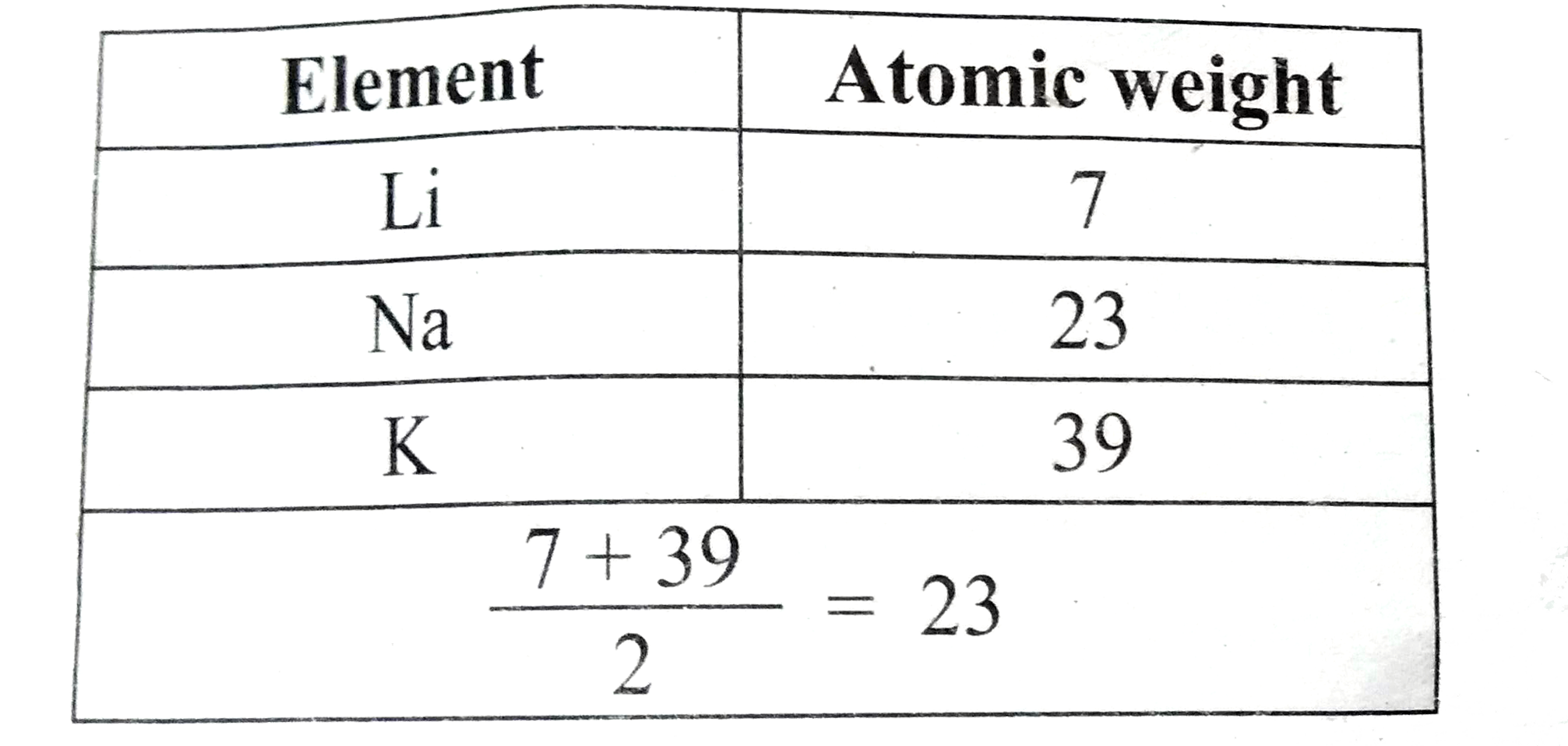
|
|
| 11. |
State Hund's rule of maxium multiplicity. |
| Answer» Solution :It states that electron pairing in the DEGENERATE orbitals does not TAKE place until all the available orbitals contaim one electron each. | |
| 12. |
State Huckel's rule of aromaticity and explain it interms of cyclopentediene, cycloxtateraene and cyclopropenylcation. |
|
Answer» Solution :HUCKEL proposed that AROMATICITY is a function of electronic structure. A compound MAY be aromatic, if it obyes the following rules `(i)` The molecule must be co-planar `(ii)` COMPLETE delocalization of `pi` electron in the RING `(iii)` Pressence of `(4n+2)pi` electrons in the ring where `n` is an integer `(n=0,1,2,.......)` is is known as Huckle's rule. 
|
|
| 13. |
State Hess.s Law of constant heat summation. |
| Answer» Solution :"If a reaction takes place in serval STEPS then its standard reaction enthalpy is the SUM of standard enthalpies of the intermediate reactions into which the OVERALL reaction may be divided at the same temperature. | |
| 14. |
State Hess's law of constant heat summation. |
| Answer» Solution :HESS's Law: The standard enthalpy change of the reaction is same, whether the reaction is carried in ONE step or several STEPS. | |
| 15. |
State Henry's law for slubility of a gas in a liquid. Explain the significance of Henry's law constnat (K_(H)). At the same temperatue, hydrogen is more soluble in water than helium. Which of them will have a higer value of K_(H)and Why? |
|
Answer» Solution :Henry.s law states that the solubility of a gas in liquid at a given temperature is directly PROPORTIONAL to the partial pressure of the gas. `P _(k _(H)X` where P is the pressure of the gas, x is the mole fraction of the gas in the solution and `K_(H)` is the Henry.s law constant. `K_(H)` is a function of the nature of gas. Higher the value of `K_(H)` at a given temperature, lower is the solubility of the gas in the liquid. As helium is less soluble in water, so it has a higher value of `K_(H)` than hydrogen. Henry.s Law: As dissolution of AGAR in liquid is an exothermic PROCESS, therefore, the solubility should decrease with in increase in temperature. |
|
| 16. |
State Henry's law and mention some of its important applications. |
|
Answer» Solution :Henry.s LAW: The solubility of a gas in a liquid is directly proportional to the pressure of the gas. Application of Henry.s law : (i) In the PRODUCTION of carbonated beverage (as solubility of `CO_(2)` increase at high pressure). (ii) In the DEEP sea diving. (iii) In the function of LUNGS. (iv) For climbers or people living at high altitudes. |
|
| 17. |
State Henry's law. |
|
Answer» <P> Solution :HENRY's law states that the SOLUBILITY of a gas is directly proportional to the PARTIAL pressure of the gas above the solution. i.e., MASS of gas dissolved is directly proportional to the pressure applied on the gas.`m=kxxp` where 'p' is the pressure applied on the gas. |
|
| 18. |
State Henry's law . |
|
Answer» Henry's law CANBE expressed as, `P_("solute")propX_("solute in solution")` `P_("solute")=K_(H^(X_("solute in solution")))` Here, `P_("solute") ` REPRESENTS the partial pressure of the gas in vapour state which is COMMONLY called as vapour pressure. |
|
| 20. |
Stategivingclearexplanation whyargon(atomicweight= 39.9) has beenrightlyplacedbeforepotassium(atomicweight39.10 )in the periodictable. |
| Answer» SOLUTION :THISIS because ARGON(Z=18 )has loweratomicnumberthanpotassium(Z= 19) | |
| 22. |
State first law of thermodynamics write its mathematical form. |
|
Answer» |
|
| 23. |
State factors affecting Hydrogen bond. |
|
Answer» Solution :Electronegative : As the electronegative of atom with hydrogen decreases strengths of H-bond decreases. `HF_((s)) gt HF_((l)) gt HF_((g)) ` `larr` strength INCREASES `larr` Strength decrease Physical state : ln solid, liquid and gas INTER- molecular DISTANCE decrease respectively so strength of H-bond also decreases `HF_((s)) gt HF_((l)) gt HF_((g)) ` `larr` INTERMOLECULAR distance decreases `larr` Strength of H-bood increase So , `({:(H_(2)O_((s))),(ICe):})gt ({:(H_(2)O_((l))),("Water"):}) gt ({:(H_(2)O_((g))),("Vapour"):})` `larr` Strength of H-bond increase |
|
| 24. |
state Diffusion Law . |
| Answer» SOLUTION :When TWO non-reactive gases are allowed to mix, the gas molecules migrate from REGION of higher concentration to a region of lower concentration. This PROPERTY of gaswhich involves the movement of the gas molecules through ANOTHER gases is called diffusion. | |
| 25. |
State difference both sigma (sigma) and (pi) bond. |
Answer» SOLUTION : 
|
|
| 26. |
State definition of meter. |
|
Answer»
|
|
| 28. |
State de Broglie principle. |
| Answer» SOLUTION :All material particles in motion have particle character as well as WAVE character. The mass m of the particle is related to the WAVELENGTH `lamda` of the wave by the EQUATION `lamda = (h)/(mv)` where v is the velocity of the particle. | |
| 29. |
State Dalton's law of partial pressure and write mathematical form. |
| Answer» Solution :The total PRESSURE exerted by a mixture of non-reacting GASES is EQUAL to the SUM of the partial pressures of all the component gases at constant temperature. | |
| 30. |
State conjugate base of H_2PO_3^- and conjugate acid of HCO_3^- |
|
Answer» SOLUTION :CONJUGATED BASE of `H_2PO_3^(-) ` is `HPO_3^(2-)` Conjugated ACID of `HCO_3^(-)` is `H_2CO_3` |
|
| 31. |
state Dalton's law of partial pressure. |
| Answer» Solution :"The total pressure of a mixture of non-reactinggases is the sum of partial pressures of the GASES PRESENT in the mixture" | |
| 32. |
State Charle's law. Give the mathmatical expression. |
|
Answer» <P> Solution :Charle.s law states that volume of fixed mass of GAS is directly proportional to absolute temperature at constant PRESSURE. `((V_(1))/(T_(1))=(V_(2))/(T_(2)))_(P)` |
|
| 33. |
State Charle's law. |
|
Answer» Solution :Charle's law : For a fixed mass of a GAS at constant PRESSURE, the volume is DIRECTLY PROPORTIONAL to its temperature (K). Mathematially `V PROP T` at constant P and n(or) `(V)/(T)` = Constant `(V_(1))/(T_(1))=(V_(2))/(T_(2))` = constant |
|
| 34. |
State Boyle's law gases. Give its mathmatical expression. |
| Answer» Solution :Boyls.s law states volume of fixed mass of GAS in INVERSELY proportional to pressure at CONSTANT TEMPERATURE. `(P_(1)V_(1)=P_(2)V_(2))_(T)`. | |
| 35. |
State Boyle's law and give its mathematical form. |
|
Answer» Solution :At constant temperature, VOLUME of a GIVEN FIXED of a mass is inversely proportional to its pressure. `PV=` constant. |
|
| 36. |
State Boyle's law. |
|
Answer» Solution :At a given temperature the volume OCCUPIED by a fixed mass of a gas is inversely proportional to its pressure. Mathematically, the Boyle's LAW can be written as `Valpha(1)/(P)"".......(1)` ( T and n are fixed, T-temperature, n- number of moles) `V=kxx(1)/(P)""......(2)` k- PROPORTIONALITY constant When we REARRANGE equation (2). PV=k at constant temperature and mass |
|
| 37. |
State bond length of O - O and O = O in ozone. |
|
Answer» 148, 121 |
|
| 38. |
State Avogadro law and write mathematical form. |
|
Answer» Solution :The law states that .. equal volumes of all the gases under similar conductions of temperature and PRESSURE CONTAIN equal NUMBER or molecules ... Mathematical form is `v prop n` ( T and P are CONSTANT) Where n is number of moles of the gas. `v=k_(4)n` (where `k_(4)` is constant) |
|
| 39. |
State Avogadro’s Hypothesis. |
| Answer» Solution :It STATES that ‘Equal volume of all gases under the same conditions of temperature and PRESSURE contain the same NUMBER of MOLECULES’. | |
| 40. |
State Avogadro's law. How many atoms of Hydrogen are present in 1 mole of water? |
|
Answer» Solution :Under the same temperature & PRESSURE EQUAL volume of GASES CONTAINS equal number of molecules. `2xx6.022xx1023` ATOMS |
|
| 41. |
State Aufbau principle. |
| Answer» SOLUTION :In the ground state the orbitals are filled in the ORDER of INCREASING energy. | |
| 42. |
State Avogadro's hypothesis. |
| Answer» SOLUTION :Equal VOLUME of the all the gases at the same TEMPERATURE and pressure should CONTAIN equal number of molecules. | |
| 43. |
why alkali metals are prepared by electrolysis of their fused halides |
| Answer» Solution :METAL HALIDE is electrolysed, `H_2` GAS is formed at CATHODE (not the matel).So fused halide is electrolysis so as to DEPOSIT the metal at cathode | |
| 44. |
State as to why sodium is found to be more useful than potassium ? |
| Answer» Solution :Blood plasma and the interstitial fluids SURROUNDING the CELLS are the regions where sodium ions are primarily found. Potassium ions are LOCATED with in the cell fluids. Sodium ions are involved in the transmission of nerve SIGNALS, in regulating the flow of water across the cell membranes, and in TRANSPORTING sugars and amino acids into the cells. Hence, sodium is found to be more useful than potassium. | |
| 45. |
State as to whya solution of Na_(2)CO_(3) is alkaline? |
|
Answer» SOLUTION : When SODIUM carbonate is ADDED to water, it hydrolyses to give sodium bicarbonate and sodium hydroxide (a strong base). As a result, the solution becomes alkaline. `Na_(2)CO_(3)+H_(2)O to NaHCO_(3)+NaOH` |
|
| 46. |
State as to whyalkali metals are prepared by electrolysis of their fused chlorides? |
| Answer» Solution :It is not possible to prepare alkali metals by the chemical reduction of their oxides as they themselves are very strong reducing agents. They cannot be prepared by displacement reactions either (wherein one element is displaced by another). This is because these elements are highly electropositive. Neither can electrolysis of aqueous solutions be USED to extract these elements. This is because the liberated metals react with water. HENCE, to overcome these difficulties, alkali metals are usually prepared by the electrolysis of their FUSED CHLORIDES. | |
| 47. |
State as to why a solution of Na_2CO_3 is alkaline |
| Answer» SOLUTION :An AQUEOUS solution of `Na_2CO_3` is ALKALINE DUE to HYDROLYSIS . `Na_2CO_3+2NaOH+H_2CO_3` | |
| 48. |
State as to why (a) a solution of Na_(2)CO_(3) is alkaline ? (b) alkali metals are prepared by electrolysis of their fused chlorides? (c) sodium is found to be more useful than potassium ? |
|
Answer» Solution :`Na_2CO_3`is a salt of WEAK acid `(H_2CO_3)` and strong base `(NaOH)`. When dissolved in water, it undergoes HYDROYSIS as FOLLOWS. `Na_2CO_3 to 2Na^(+) + CO_3^(2-)` `CO_3^(2-) + 2H_2O to H_2CO_3 + 2OH^(-)` Due to an excess of `OH^(-)` IONS, the solution becomes alkaline. |
|
| 49. |
State as to why (a) Alkali metals show only +1 oxidation state (b) Na and K impart colour to the flame but Mg does not.lt (c) Lithium on being heated in air mainly forms the monoxide and not the peroxide (d) Li is the best reducing agent in aqueous solution |
|
Answer» SOLUTION : Alkali metals have low jonization enthalpies They have a strong tendency to lose 1 electron to form unipositive ions. Thus they show an oxidation state of +1 and are strongly electropositive. (b) Valence electrons of alkali metals LIKE Na and K easily absorb energy from the flame and are excited to higher energy levels. When these electrons return to the ground state, the energy is emitted in the form of light. Magnesium atom has small size so electrons are strongly bound to the nucleus. Thus they need large amount of energy for EXCITATION of electrons to higher energy levels, which is not possible in Bunsen flame. (C) Due to the small size of `Li^(+)` it has a strong positive field, which attracts the negative charge so strongly that it does not permit the oxide ion `(O^(2-))` to combine with another oxygen atom to form peroxide ion. (d) Among alkali metals, lithium has the most negative electrode potential`(Etheta -3.04 V)`, so it is the strongest reducing agent in the aqueous solution |
|
| 50. |
State as to why : (a) a solution of Na_(2)CO_(3) is alkaline ? (b) alkali metals are prepared by electrolysis of their fused chlorides ? (c) Sodium is found to be more useful than potassium ? |
|
Answer» Solution :(a)`Na_(2)CO_(3)` is a salt of a weak acid, carbonic acid `(H_(2)CO_(3))` and a STRONG base , sodium hydroxide `(NaOH)` therefore , it undergoes hydrolysis to undergoes hydrolysis to produce strong base NaOH and hence its aqeous solution is ALKALINE in nature . `Na_(2)CO_(3) (s) + H_(2)O(l)to underset("(Strong base)") (2NaOH (aq)) + underset("(Weak acid)") (H_(2)CO_(3) ) (aq)` (b) Since the discharge potential of alkali metals is much HIGHER than that of hydrogen , therefore , when the aqueous solution of any alkali metal chloride is subjected to electrolysis . `H_(2)` instead of the alkali metal is produced at the cathode . Therefore , to prepare alkali metals , electrolysis of their fused chlorides is carried out . (c) Sodium ions are found primarily in the blood plasma and in the interstitial fluid which surrounds the cells while potassium ions are primarily present within the cell fluids . Sodium ions helps in the transmission of nerve signals , in regulating the flow of water across cell membranes and in the transport of SUGARS and amino acids into the cells . Thus , sodium is found to be more useful than potassium . |
|