Explore topic-wise InterviewSolutions in Current Affairs.

This section includes 7 InterviewSolutions, each offering curated multiple-choice questions to sharpen your Current Affairs knowledge and support exam preparation. Choose a topic below to get started.

1.

The correct statements regarding green chemistry

Answer»

It is a cost effective approach that involves minimum chemical USAGE, minimum WASTE GENERATION
It involves not to produce green house gases like `CH_4,CO_2`
It works for not producing wasteful by products in the PROCESS
All

SOLUTION :It is cost effective apporach that involves minimum chemical usage, minimum waste generation, It involves not to produce green house gases like `CH_4, CO_2`, It works for not producing wasteful by products in the process
2.

The correct statement(s) regarding defects in solids is (are)

Answer»

Frenkel defect in usually favoured by a very small difference in the sizes of cation and anion.
Frenkel efect is a disocation defect.
TRAPPING of an electron in the lattice leads to the formation of F - center
Schottky defects have no effect on the physical properties of solids.

Solution :When an ion is missing from its normal POSITION and occupies and INTERSTITIAL site between the lattice points, Frenkel defect arises, hence is a dislocation defect.
The ELECTRONS trapped in anion vacancies are referred to as F - centers.
Schottky defects asrise when some atoms ot IONS are missing from their normal lattice points. Due to the presence of large number of vacancies in crystals, its density (i.e., physical property) is lowered.
3.

The correct statements is / are : (i) BeCl_2 is a covalent compound (ii) BeCl_2 Can form dimer (iii) BeCl_2 is an electron deficient molecule (iv) The hybridisation of Be in BeCl_2 is sp^2

Answer»

`(i) and (III)
(i), (II) and (iii)
(i) and (IV)
(ii), (iii) and (iv)

ANSWER :B
4.

The correct statements is are :

Answer»

`BeCI_(2)` is a covalent COMPOUND
`BeCI_(2)` can FORM diner
`BeCI_(2)` is an electron deficient molecule
The HYBRID state of Be in `BeCI_(2)` is `sp^(2)`

Solution :Due to high POLARISING power Be can form covalent compounds such as `BeCI_(2)` B) `BeCI_(2)` can form dimer
C) `BeCI_(2)` is electron deficient
5.

The correct statements for the following addition reactions is (are)

Answer»

<P>(M and O) and (N and P) are two pairs of enantiomers
Bromination PROCEEDS through trans-addition in both the reactions
O and P are identical MOLECULES
(M and O) and (N and P) are two pairs of diastereomers

Answer :B::D
6.

The correct statement(s) for orthoboric acid is/are

Answer»

it behaves as a weak acid in water due to self ionization
acidity of its aqueous solution increases upon addition of ethylene GLYCOL
it has a three-dimensional structure due to hydrogen bonding
it isa weak electrolyte in water

Solution :Orthoboric ACIDIS a weak monobasic Lewis acid. It acceptsa pair of electronsfrom `OH^(-)`ion of `H_(2)O` releasinga proton.

On adding ethylene glycol, it acidity increases

`H_(3)BO_(3)`, however, does notundergo self ionization to releasea proton.

Further due to H-bonding , `H_(3)PO_(3)` is a planarmolecule .Thus only OPTION (b,d) correct.
7.

The CORRECT statement(s) for cubic close packed (ccp) three- dimensional structure is (are)

Answer»

The number of neighbours of an atom PRESENT in the topmost layer is 12.
The EFFICIENCY of the atom packing is 74 %
The number of octahedraland tetrahedral voids per atom are 1 and 2 respectively.
The unit cell edge length is `2sqrt2` times the radius of the atom.

SOLUTION :(a) is incorrct because for any atom in the top most layer, coordination number is not 12 as there is no layer above the topmost layer .
(b) is a known FACT.
is correct because in ccp (fcc), number of atoms per unit cell is 4. HENCE, octahedral voids =4 and tetrahedral voids =8. therefore , number of octahdral voids per atom =1 and number of tetrahdral voids per atom =2
(d)For ccp (fcc), ` r= a/(2sqrt2) or a = 2sqrt2 r `
8.

The correct statements are

Answer»

The isotopes of chlorine with mass NUMBER 35 and 37 EXIST in ratio `3:21` if its average atomic mass is 35.5
The mass of one amu is APPROXIMATELY `1.6xx10^(-24)g`
The number of molecules in 1 ml of a gas at STP is called Loschmidt number
If `6.023xx10^(21)` molecules of a solute are present in 100 ml SOLUTION molarity of solution is 0.1M

Solution :a) `35.5=(75xx35+25xx37)/(100)`
d) Molarity = `("No. of molecules of solute")/(6.023xx10^(23))xx(1000)/("volume of solution in ml")`
Molarity = `(6.023xx10^(21))/(6.023xx10^(23))xx(1000)/(10)=0.1M`
9.

The correct statement(s) among the following is/are:

Answer»

All d-orbitals except `d_(Z^(2))` have two ANGULAR NODES.
`d_(x^(2)y^(2)), d_(z^(2))` lie on the axes.
The degeneracy of p-orbitals remains UNAFFECTED in the presence of external MAGNETIC field.
d-orbitals have 3-fold degeneracy.

Answer :A::B::C
10.

The correct statement(s) among the following is (are)

Answer»

first IONIZATION POTENTIAL of Al is less than the first ionization potential of MG
second ionization potential of Mg is greater than the second ionization potential of Na
first ionization potential of Na is less than the first ionization potential of Mg
THIRD ionization potential of Mg is greater than the third ionization potential of Al

Answer :A::C::D
11.

The correct statements among I to III regarding group 13 element for oxides are: (I) Boron trioxide is acidic (II) Oxides of aluminium and gallium are amphoteric. (III) Oxides of indium and thallium are basic.

Answer»

(I) and (II) only .
(I) and (III) only
(II) and (III) only
(I), (II) and (III) only

Solution :(I), (II) and (III) only
12.

The correct statements about 'X' gas is:

Answer»

It is recognized by its PUNGENT ORDER and production of white fumes, on blowing across the mouth of the test tube.
It is recognised by increase in intensity of white fumes when a glass rod moistened with ammonia solution is held near the mouth of the test tube.
It is recognised by its TURNING litmus PAPER blue.
X' gas is `CI_(2)` with GREENISH yellow fumes.

Answer :A::B
13.

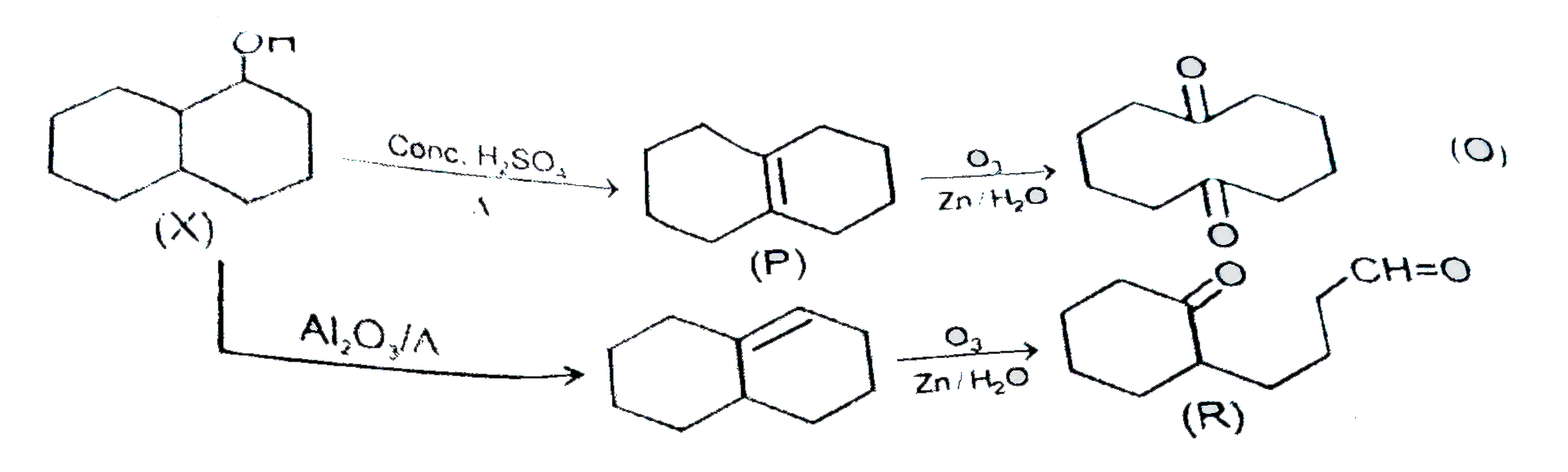
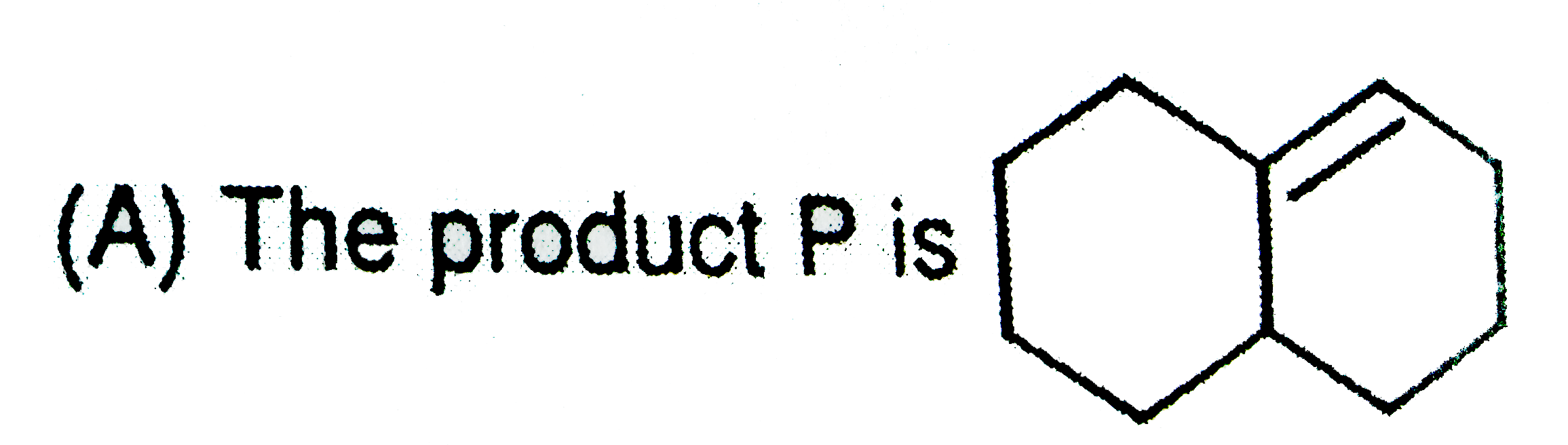
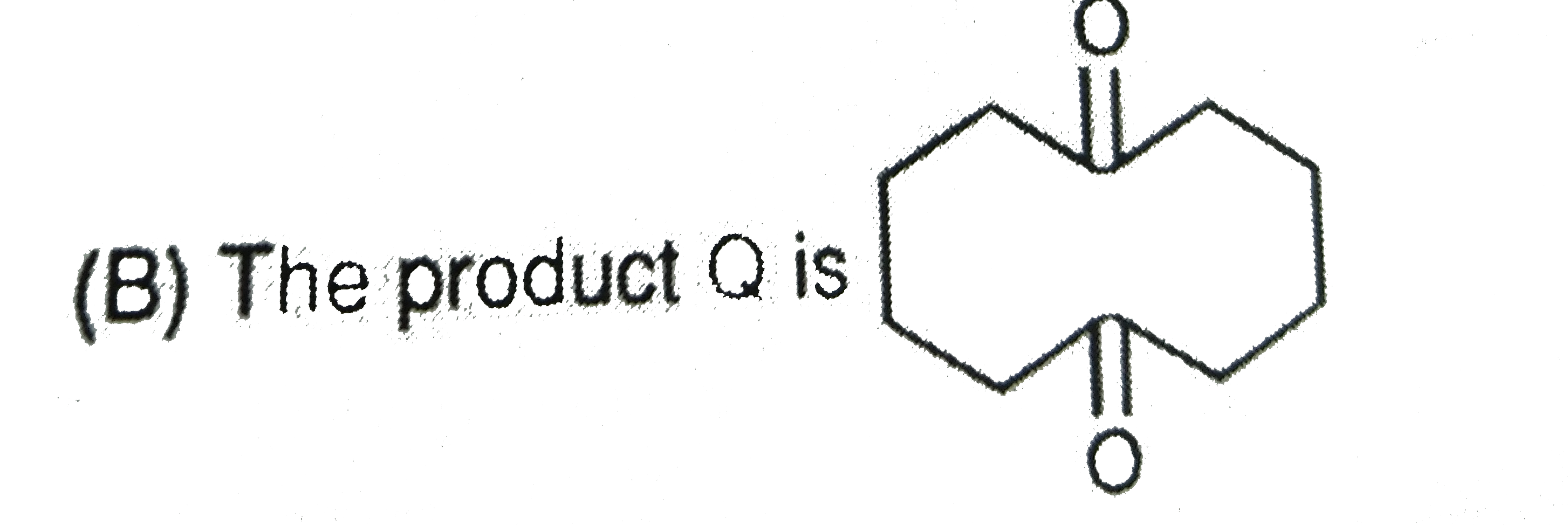
The correct statements about the following reaction are [Hint: Al_2O_3 gives satyzeff's product without any rearrangement]

Answer»


SOLUTION :
14.

The correct statement(s) about the flow diagram is/are:

Answer»

`CH_(3)COONA` may be the salt solution 'X'
Y' may be `[Fe(H_(2)O)_(5)(SCN)]^(2+)` ion
Z' may be the basic ACETATE of IRON (III)
Oxidation state of iron in 'Y' and 'Z' remains constant

Answer :A::C::D
15.

The correct statement(s) about above flow diagram is/are:

Answer»

ADDING an excess of hyposolution to the brown solution, 'D' is reduced to colourless solution and WHITE precipitate BECOMES visible.
F is `Cu_(3)[Fe(CN)_(6)]_(2)`
The reduction of hyposolution YIELDS tetrathionate ions
The co-ordination number of iron in the chocolate brown ppt. (F) is different from that of `K_(4)[Fe(CN)_(6)]`

Answer :A
16.

The correct statement with regard to H_(2)^(+) and H_(2)^(-)is

Answer»

both`H_(2) ^(+) and H_(2)^(-)` do not EXIST
`H_(2)^(-) ` is more stable than ` H_(2)^(+)`
`H_(2)^(+)`is more stable than ` H_(2)^(-)`
both ` H_(2)^(+) and H_(2)^(-)` are equally stable

SOLUTION :B. O . Is same but `H_(2) ^(-)` has ONE eletron is ABMO.
17.

The correct statement (s) regarding defects in solids is (are):

Answer»

Frenkel defect is usually favoured by a very small difference in the sizes of cation and anion
Frenkel defect is a dislocation defect
Trapping of an electron in the LATTICE leads to the FORMATION of F-center
Schottky defects have no EFFECT on the physical PROPERTIES of solids

Answer :B::C
18.

The correctstatement (s) about O_(3)is (are) :

Answer»

O-O bond length are EQUAL
Thermal decomposition of `O_(3)`is endothermic
`O_(3)`is diamgentic in nature
`O_(3)` has a bent STRUCTURE

SOLUTION :(`sp^(2)` hybridization) ltbgt O-O bond lengths are equal due to REASONANCE . It
is DIAMAGNETIC andhas a bent structure. However,
thermal decomposition of `O_(3)` is not endothermic
but it is exothermic
`2O_(3)to3O_(2) +`Heat
19.

The correct statement regarding various types of molecular speeds are

Answer»

increasing TEMPERATURE increases the fraction of molecules having `U_(mps)`
Increasing temperature increases `U_(mps)`
In a SAMPLE of gas at a given temperature, molecules with extremely low and high speeds are less 
At the same temperature lighter gaseous having narrow DISTRIBUTION of molecular speeds than heavier gaseous 

Solution :`U_(mp)` increasing with T, but the fraction decreases. Heavier molecules have narrow distribution.
20.

The correct statement regarding the comparison of staggered and eclipsed conformations of ethane, is :

Answer»

The eclipsed CONFORMATION of ethane is more STABLE than STAGGERED conformation, because eclipsed conformation has no TORSIONAL strain
The eclipsed conformation of ethane is more stable than staggered conformation even though the eclipsed conformation has torsional strain
The staggered conformation of ethane is more stable than eclipsed conformation, because staggered conformation has no torsinal strain
The staggered conformation of ethane is less stable than eclipsed conformation, because staggered conformation has torsional strain

Solution :Staggered is more stable conformer
21.

The correct statement regarding the comparison to staggered and eclipsed conformations of ethane is :

Answer»

The eclipsed conformation of ETHANE is more stable than STAGGERED conformation, because eclipsed conformation has no torsional strain.
The eclipsed conformation of ethane is more stane THA staggered conformation EVEN though the eclipsed conformation has torsional strain.
The staggered conformation of ethane is more stane than eclipsed conformation, because staggered conformation has no tosional strain.
The staggered conformation of ethane is less stable than eclipsed conformation because staggered conformation has torional strain.

Answer :C
22.

The correct statement regarding the comparison of stagged and eclipsed conformations of ethane is ………….. .

Answer»

the eclipsed CONFORMATION of ETHANE is more stable than staggered conformation EVEN though staggered conformation has torsional strain.
the staggered conformation of ethane is more stable than eclipsed conformation, because staggered conformation has no torsional strain.
the staggered conformation of ethane is less stable than eclipsed conformation, because staggered conformation has torsional strain.
the staggered conformation of ethane is less stable than eclipsed conformation, because staggered conformation has no torsional strain.

Answer :B
23.

The correct statement regarding the compariso of staggered and eclipsed conformations of ethane is ……………………

Answer»

the eclipsed conformation of ETHANEIS more stable than staggered conformation EVEN though the eclipsed conformation has torsional strain
the staggered conformation of theane is more stable than eclipsed conformation becasuse staggered conformationhas no torsional strain
the staggered conformatin of ETHANE is less stable than eclipsed conformation because staggered conformation has torsional strain
the staggered conformation of THANE is less stable than eclipsed conformation becausestaggered conformation has torsional strain

ANSWER :b
24.

The correct statement regarding structure of ice. (A) Ice has a highly ordered three dimensional hydrogen bonded structure. (B) Each oxygen atom in ice is surrounded tetrahedrally by four other oxygen atoms at a distance of 276 pm. (C) Hydrogen bonding gives ice a rather open structure with wide holed. These holes can hold some other molecules of approapriate size interstitially.

Answer»

A and B
B and C
A and C
A, B and C

Answer :D
25.

The correct statement regarding structure of ice.

Answer»

ICE has a HIGHLY ordered three dimensional hydrogen bonded structure.
Each oxygen atom in ice is surrounded tetrahedrally by four other oxygen atoms at a distance of 276 pm.
Hydrogen bonding GIVES ice a rather open structure with wide holed. These HOLES can hold some other MOLECULES of approapriate size interstitially.
All are correct

Answer :D
26.

The correct statement regarding Graphite

Answer»

Graphite is not a CONDUCTOR because, it does not contain free ELECTRONS 
Graphite is a THREE dimensional conductor because, the p-electrons are delocalised three dimensionally 
Graphite is a two dimensional conductor because p-electrons are delocalised two dimensionally 
In graphite all the carbon atoms UNDERGO `sp^(3)` hybridization 

Answer :C
27.

The correct statement regarding Graphite is

Answer»

GRAPHITE is not a conductor because, it does not contain free electrons 
Graphite is a three dimensional conductor because, the p-electrons are delocalised three DIMENSIONALLY 
Graphite is a TWO dimensional conductor because p-electrons are delocalised two dimensionally 
In graphite all the carbon atoms undergo SP hybridization 

Answer :B
28.

The correct statement regarding ethane conformation is…..

Answer»

Rotation around carbon-carbon bond in ethane MOLECULE is not POSSIBLE, because ethane molecule contains a pi `(pi)` bond between the carbon and carbon and ethane has very low melting point
Rotation around carbon-carbon bond in ethane molecule is not possible, because ethane molecule contains both SIGMA `(sigma)` bond and pi `(pi)` bond between the carbon and carbon.
Rotation around carbon-carbon bond in ethane molecule is possible because of CYLINDRICAL symmetry of sigma `(sigma)` bond between carbon-carbon atoms
Rotation around carbon-carbon bond in ethane molecule is not possible, because ethane molecule contains both sigma `(sigma)` bond and pi `(pi)` bond between the carbon and carbon and ethane has very high BOILING point

Answer :C
29.

The correct statement regarding entropy is

Answer»

at absolute zero temperature, entropy of a PERFECTLY CRYSTALLINE SOLID is zero
at absolute zero temperature, the entropy of a perfectly crystalline substance is + ve
at absolute zero temperature, the entropy of all crystalline substance is zero
at `0^(@)C`the entropy of a PERFECT crystalline solid is zero.

Answer :A
30.

The correct statement regarding electrophile is

Answer»

ELECTROPHILE is a NEGATIVELY charged SPECIES and canform a bond by accepting a pair of electrons from another electrophite
electrophiles are GENERALLY neutral species and can form a bond by accepting a pair of electrons from a NUCLEOPHILE
electrophile can be either neutral or positively charged species and can form a bond by accepting a pair of electrons from a nucleophile
electrophile is a negatively charged species and can form a bond by accepting a pair of electrons from a nucleophile.

Answer :C
31.

The correct statement regarding defects in crystalline solids is

Answer»

Frenkel DEFECT is a dislocation defect
Frenkel defect is found in HALIDS of alkaline metals
SCHOTTKY defects have no effect on the density of crystalline solids
Frenkel defects decrease the density of crystalline solids

Solution :Frenkel defect is a dislocation defect as some cations are dislocated from lattice sites and OCCUPY intersitial sites.
32.

The correct statement regarding defect in solids is (are)

Answer»

Frenkel defects are USUALLY favoured by a very small differences in the sizes of the cation and anion
Frenkel DEFECT is a dislocation defect
Trapping of an ELECTRON in the lattice leads to the formation of F-centre
Schottky defects have no effect on the physical properties of solids

SOLUTION :Frenkel defect is also CALLED dislocation defect because smaller ions are dislocated from their lattice sites into the interstitial sites. Hence, (b) is correct. Trapping of an electron leads to the formation of F-centre. Hence, (c ) is correct.
33.

The correct statement regarding a carbonyl compound with a hydrogen atom on its alpha carbon is

Answer»

a carbonyl compound with a HYDROGEN atom on its alpha-carbon RAPIDLY equilibrates with its corresponding enol and this process is known as carbonylation
the carbonyl compound with a hydrogen atom on its alpha-carbon rapidly equilibrates with its corresponding enol and this process is known as keto-enol tautomerism
a carbonyl compound withhydrogen atom on its alpha-carbon never equilibrates with its corresponding enol
a carbonyl compound with a hydrogen atom on its alpha-carbon rapidly equilibrates with its corresponding enol and this process is known as aldehyde-ketone equilibrium

Answer :B
34.

The correct statement is / are

Answer»

`BeCI_(2)` is a covalent COMPOUND
`BeCI_(2)` is an ELECTRON deficient molecule
`BeCI_(2)` can from dimer
the HYBRID state of Be in `BeCI_(2)` is `sp^(2)`

SOLUTION :A) Due to less electro positive character and more polarisng power `BeCI_(2)` is covalent
B) In `BeCI_(2)`Be has insuffcient octet configuration it is electron defficient
C) `BeCI_(2)` can from a dimer at below 1200 K
35.

The correct statement is about following compound is-

Answer»


ANSWER :D
36.

the correct statement is

Answer»

`BI_(3)` is the weakestLewis acid AMONG the BORON halides
there is minimum `ppi- ppi`back bonding in `BF_(3)`
`BF_(3)` is the STRONGEST LEWISACID among the otherboronhalides
there ismaximum `ppi-ppi`back bonding in `BF_(3)`.

Solution :There is maximum `ppi-ppi` back bondingin `BF_(3)` due toidentical sizes of `2p`-orbitals of B and F.
37.

The correct statement is :

Answer»

Hydroxide of aluminimum is more acidic than the hydroxide of boron
Hydroxide of boron is basic while the hydroxide of aluminium is amphoteric.
Hydroxide of aluminium is amphoteric since `Al-O` and `O-H` BONDS have NEARLY same ionic charcter
Hydroxide of boron is acidic since it ionizes in WATER to `BO_(3)^(3-)` land `H^(+)` ions.

Answer :C
38.

The correct statement for the molecule, CsI_(3) is

Answer»

It contains `CS^(3+)` and `I^(-)` ions.
It contains `Cs^(+), I^(-)` and lattice `I_(2)` MOLECULE.
It is COVALENT molecule.
It contaisn `Cs^(+)` and `I_(3)^(-)` ions.

SOLUTION :It contains `Cs^(+)` and `I_(3)^(-)` ions.
39.

The correct statement foralpha -elimination is

Answer»

It forms CYCLIC compounds
It forms CARBENE or SUBSTITUTED carbene
Two atoms are removed from `ALPHA " and " beta ` positions
In ` CHCl_(3) alpha ` - eliminationis not possible

Solution :N/A
40.

The correct statement amongst the following is:

Answer»

For every gas there exists a characteristic TEMPERATURE above which it cannot be liquefied no matter however high is the pressure applied called CRITICAL temperature of the gas. 
For every gas there exists a characteristic temperature at which its compressibility factor is equal to unity for some range of pressure. 
Amongst `He, N_2, O_2 and CO_2,CO_2` has the lowest value of "a" and He has the lowest value "b" where a and BARE VANDER walls constants of the gas. 
The extent of departure of Z (compressibility factor) from unity is the measure of the extent of deviation from ideal behavior. 

SOLUTION :a) `T_c "" ` b) `T_b`
c) `CO_2` has highest value of aa
d) Z gives measure of deviation.
41.

The CORRECT statement for cubic close packed (ccp) three-dimensional structure is (are)

Answer»

The number of neighbours of an atom present in the TOPMOST layer is 12
The efficiency of the atom packing is 74%
The number of octahedral and tetrahedral voids per atom are 1 and 2 respectively
The unit cell edge length is `2sqrt2` times the radius of the atom

Solution :(a) is INCORRECT because for any atom in the top most layer, coordination number is not 12 as there is no layer above the topmost layer.
(b ) is a known FACT.
(C ) is correct because in ccp (fcc), number of atoms per unit cell is 4. hence , octahedral voids =4 and tetrahedral voids=8. Therefore , number of octahedral voids per atom =1and number of tetrahedral voids per atom =2.
(d)For ccp (fcc), `r=a/(2sqrt2)` or `a=2sqrt2r`
42.

The correct statement among the following (i) heat of reaction depends on the temperature at which the reaction is carried (ii) heat of neutralisation depends on the temperature at which the experiment is carried. (iii) experimentally heat of combustion is DeltaE.

Answer»

i only correct
ii only correct
iii only correct
all are correct

Solution :STANDARD DEFINITION
43.

The correct statements among the following are.

Answer»

The density of `H_2O_2` is greater than `H_2O`
`H_2O_2` is a better IONIZING solvent thant `H_2O` because of more hydrogen in `H_2O` due to its high DIPOLE MOMENT
BOILING point of `H_2O_2` is more than `H_2O` because of more hydrogen BONDING in `H_2O_2`
On cooling water freezes earlier than `H_2O2`

Solution :The correct statements are
A) The density of `H_2O_2` is greater than `H_2O`
C) Boiling point of `H_2O_2` is more than `H_2O` because of more hydrogenbonding in `H_2O_2`
D) On cooling water freezes earlier than `H_2O_2`
44.

The correct statement about the following is

Answer»

In `H_2` and `D_2`the RATIO of bond length is 1:2
`""_1H^1` ' can be used as a tracer
`""_1H^3`emits LOW ENERGETIC B radiation and no g radiations
all the above

Answer :C
45.

The correct statement about the compounds (a), (b) and (c) is

Answer»

a and B are identical
a and b are diastereomers
a and C are enantiomers
a and b are enantiomers

Solution :Rotate (a) through `180^(@)` WITHIN the plane of the PAPER. Now (a) and (b) are enantiomers
46.

The correct statement about [C] is:

Answer»

Red precipitate is formed due to formation LEAD sulphochloride.
Red precipitate is formed due to DISPROPORTIONATION of `Hg_(2)CI_(2)`
Red precipitate [C] on dilution with water DECOMPOSE into `PbS` and `PbCI_(2)`
Red precipitate [C] on dilution with `H_(2)O`, it decomposes into Hg and `HgCI_(2)`.

Answer :A::C
47.

The correct statement about adsorption are

Answer»

the chemisorption of `H_(2)` as `H` atoms on the surface of glass is endothermic
Physical adsorption does not require ACTIVATION energy
Chemisorption is always unimolecular
In adsorption, only solute from the SOLUTION is adsorbed on the surface surface of the solid adsorbent

Solution :(d) is wrong because SOLVENT from the solution MAY be adsorbed on the adsorbent (negative adsorption).
48.

The correct stability order of the following speicies is

Answer»

cltaltb
C=blta
clta=b
a=b=c

Answer :C
49.

The correct stability order of the following resonating structure is : underset("(I)")(H_(2)C=overset(+)N=overset(-)N)""underset("(II)")(H_(2)overset(+)C-N=overset(-)N)""underset("(III)")(H_(2)overset(-)C-overset(+)N-=N)""underset("(IV)")(H_(2)overset(-)C-N=overset(+)N)

Answer»

`(I)GT(II)gt(IV)gt(III)`
`(I)gt(III)gt(II)gt(IV)`
`(II)gt(I)gt(III)gt(IV)`
`(III)gt(I)gt(IV)gt(II)`

Answer :B
50.

The correct stability order of the following resonance structures is {:((a) H_(2)C = overset(+)N - N^(-) ,""H(2)overset(+)C-N=N^(-)),( (I), ""(II)),(H_(2) overset(-)C-overset(+)N-=N,H_(2)overset(-)C-N=overset(+)N),((III),""(IV)):}

Answer»

`(I) gt (II) gt (IV) gt (III)`
`(I) gt (III) gt (II) gt (IV)`
`(II) gt (I) gt (III) gt (IV)`
`(III) gt (I) gt (IV) gt (II)`

SOLUTION :(i)Greater the number of `pi-`bonds, greater is the delocalisation of electrons, greater is the stability.
(ii) A reaonating structure is more stable is the
negative CHARGE is on ELECTRONEGATIVE atom and
positive charge on electropositive atom.
(iii) Like charge should not be CLOSE and unlike
charges should not be WIDELY separated .
Keeping above points in view , the stability order
will be `(I) gt (III) gt (II) gt (IV)` .