Saved Bookmarks
This section includes 7 InterviewSolutions, each offering curated multiple-choice questions to sharpen your Current Affairs knowledge and support exam preparation. Choose a topic below to get started.
| 1. |
What is the formula of diborane ? |
| Answer» SOLUTION :`B_2 H_6` | |
| 2. |
Thermite is a mixture of x parts of Fe_(2)O_(3) and y parts of aluminium powder, x, y respectively are |
| Answer» Solution :3 : 1 ratio of `Fe_(2)O_(3)` and .Al. powder. | |
| 3. |
What is the basicity of hypohosphours acid ? |
|
Answer» |
|
| 4. |
What type of bondis formed between K^(+) " and "Cl^(-) ?Explain the bond formation . |
|
Answer» SOLUTION :Ionic bond is formed between `K^(+)" and "Cl^(-)` When the electronegativity difference between the two combining atoms is large , the least electrongegative atom completely transfers one or more of its valence electrons to the other combining atom so that both atoms can ATTAIN the nearest inert gas electronic configuration. The complete transfer of electron leads to the formation of a cation and an anion . Both these ions are held together by the electrostatic attractive force which is known as ionic bond. Let us consider the formation potassium chloride . The electronic configuration of potassium and chlorine are Potassium (K) : [Ar] `4s^(1)` Chlorine `(Cl): [Ne]3s^(2),3p^(5)` Potassiumhas one electron in its valence shell and chlorine has seven electron in its valence shell . By loosing one electron potassium attains the inert gas electronic configuration of argon andbecomes a unpositive cation `(K^(+))` and chlorine accepts this electron to become unnegative chloride ion `(Cl^(-))` there by attaining the stable electronicconguration of argon. These two ions combine to FORM an ionic crystal in which they are held together by electrostatic attractive force . The energy required for the formation of one mole of `K^(+)` is `418.81` KJ ( ionization energy) and the energy released during the formation of one mole of `Cl^(-)` is `-348.56` kJ ( electron gain enthalpy) .The sum of these two energies is positive `(70.25 kJ)` . However , during the formation of one mole potassium chloride crystal from its constituent inos, 718 kJ energy is released.This favours the formation of KCl and it stabilises. |
|
| 6. |
What is correct order of electrophillic addition of following alkene? |
|
Answer» II gt IV gt I gt III |
|
| 8. |
Which mechanism has different reactivity order of alkyl halides (1^@,2^@,3^@) than others : |
|
Answer» `S_N1` |
|
| 9. |
Water can be lifted into the water tank at the top of the house with thehelp of a pump . Then why is not considered to be spontaneous ? |
| Answer» Solution :A SPONTANEOUS PROCESS shouldcontinuetaking place by itself after initiation . Bt this is not so in the givencase because WATER will go up so long as the PUMP is working. | |
| 10. |
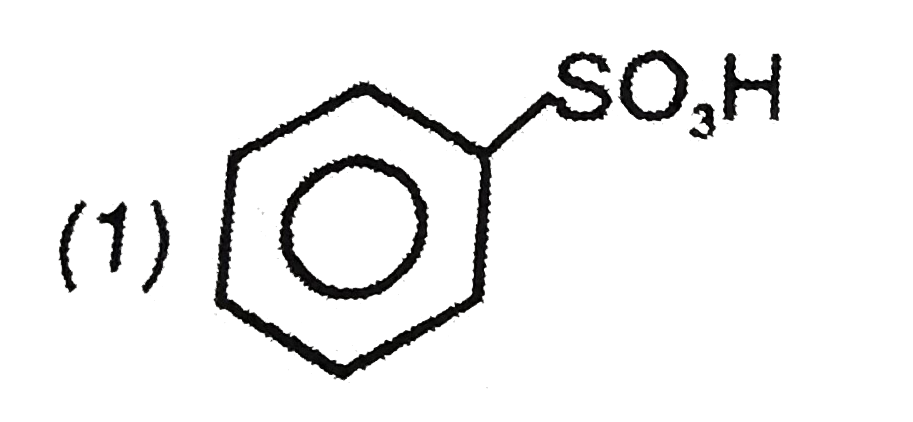
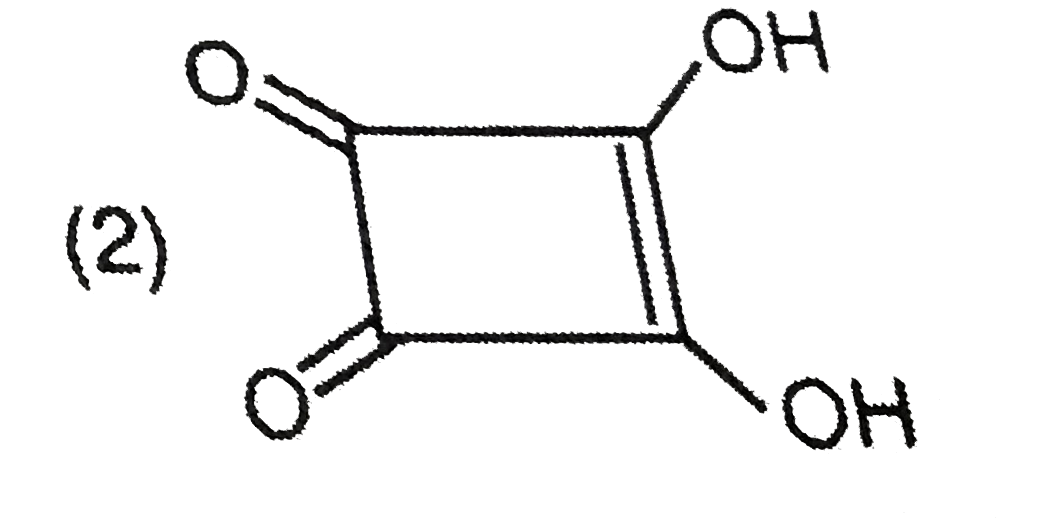
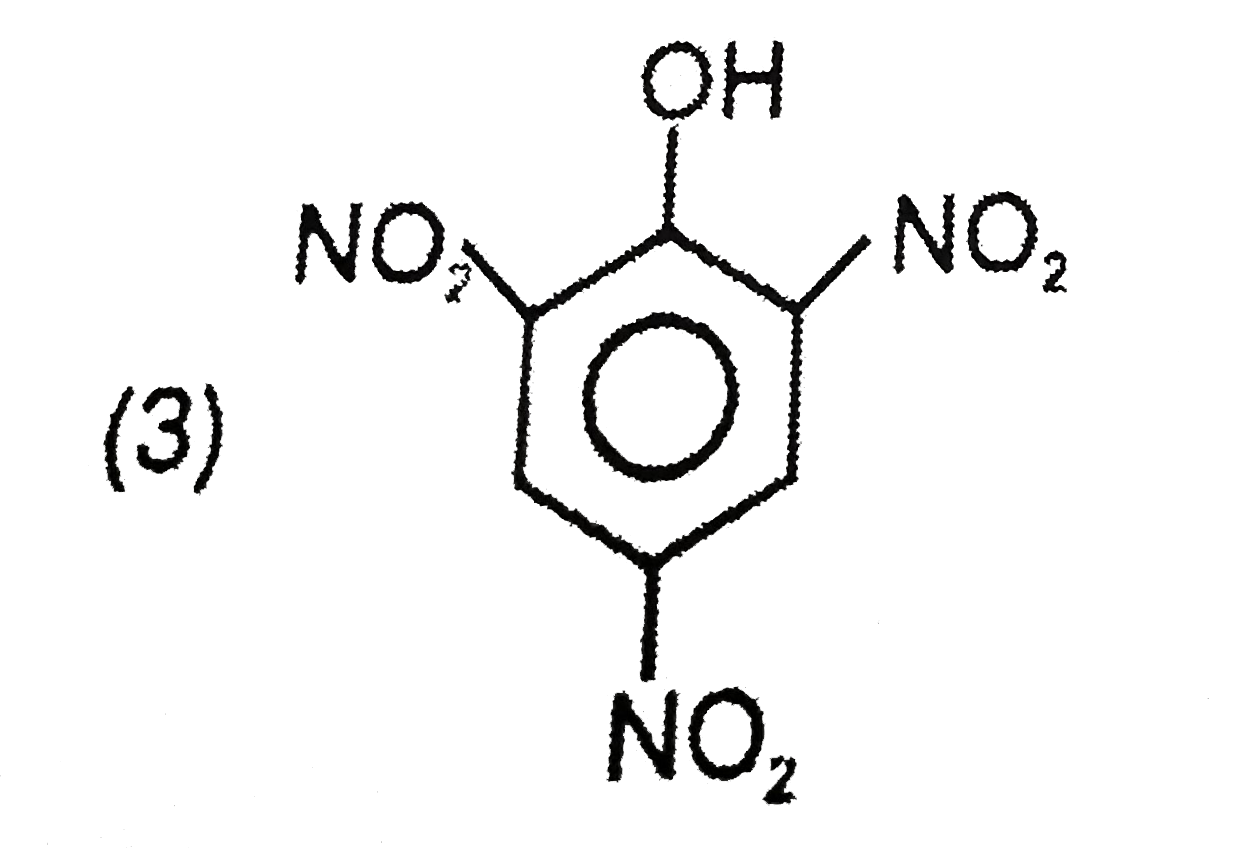
Which of the following would produce effervesence with sodium bicarbonate ? |
|
Answer»
|
|
| 11. |
Which contain maximum atomic radius between metal , non - metal and noble gas. |
| Answer» Solution :NOBLE gas having maximum atomic RADIUS because their OCTATE completed so attraction is not observed in noble gas than compare to covalent radius and METALLIC radius. | |
| 12. |
Which of the following is a non-aqueous solution ? |
|
Answer» Salt solution |
|
| 13. |
which of the structural isomeric ketones having molecular formula (C_(5)H_(10)O) give iodoform test ? |
|
Answer» Phenol gives POSITIVE bromine water test |
|
| 14. |
Which of the following statements concer ning light is false ? |
|
Answer» It is a form of energy |
|
| 15. |
Which of the following groups contain only electrophiles ? |
|
Answer» `BF_(3) , NH_(3), H_(2) O` |
|
| 16. |
Which of the following will have the most negative electron gain enthalpy and which the least negative ? P, S, CI, F. |
| Answer» Solution :Electron gain ENTHALPY generally becomes more negative across a period as we move from left to right. Within a group, electron gain enthalpy becomes less negative down a group. HOWEVER, adding an electron to the 2p-orbital leads to GREATER repulsion than adding an electron to the larger 3p-orbital. Hence the element with most negative electron gain enthalpy is chlorine, the one with the LEAST negative electron gain enthalpy is phosphorus. | |
| 17. |
Whichorbitalis nondirectional ? |
|
Answer» 4P |
|
| 18. |
Which of the following chlorides are soluble in pyridine ? |
|
Answer» LiCl |
|
| 19. |
Write electron order in the following compound, |
|
Answer» |
|
| 21. |
Which are the acids of this reaction ? HCl_((aq)) +H_2O_((aq)) hArr H_3O_((aq))^(+) + Cl_((aq))^(-) Which acid is strong ? |
| Answer» SOLUTION :HCL and `H_3O^+` are ACIDS, In which HCl is STRONG ACID | |
| 24. |
Whichof the following compoundwill exhibit cis trans isomerism |
|
Answer» 2-butene |
|
| 25. |
Write down use of ZSM-5. |
| Answer» Solution :A type of ZEOLITE used to convert ALCOHOLS DIRECTLY into GASOLINE. | |
| 26. |
Which solution having more surface tension form the following ? (i) H_(2)O (ii) NaCl |
| Answer» Solution :SURFACE TENSION of solution of NACL is more than `H_(2)O`. | |
| 28. |
Washing soda on standing in air effloresces. How many water molecules are lost |
|
Answer» |
|
| 29. |
Volume occupied by one molecule of water (density = 1g cm^(-3)) is |
|
Answer» `3.0 XX 10^(-23) cm^3` |
|
| 30. |
Which of these compounds possess highest dipole moment ? |
|
Answer» SOLUTION :The COMPOUND with more NUMBER of electrons on the valence shell , `:. ` is CONSIDERED to be the most electrongative element . ` :. HZ` is the most electrongative element which has highest dipole moment . |
|
| 31. |
Which of the following statements is not correct form the view point of molecular orbital theory ? |
|
Answer» `Be_(2)` is not a stable molecule `sigma _(2s) lt sigma_(2s)^(**) lt (pi_(2_(p_(x))) = pi_(2_(p_(y)))) lt sigma _(2_(p_(z)))lt (pi_(2_(p_(x)))^(**) = pi_(2_(p_(y)))^(**)) lt sigma_(2_(p_(z)))^(**)` |
|
| 32. |
Write one chemical reaction for the preparation of D_2O_2 |
|
Answer» SOLUTION :By the ACTION of `D_2SO_4` DISSOLVED in WATER over `BaO_2`. `BaO_2 + D_2SO_4 to BaSO_4 + D_2O_2` |
|
| 33. |
Which statement about the triple point of a substance is/are incorrect? |
|
Answer» The triple point for a SUBSTANCE varies with pressure |
|
| 34. |
Which of the following statements related to the modern periodic table is incorrect? |
|
Answer» The p-block has 6 columns, because a maximum of 6 electrons can OCCUPY all the orbitals in a p-shell. |
|
| 35. |
Upon irradiating californium with neutrons, a scientist discovered a new nuclidehaving massscientist discovered a new nuclide having mass number of 250 and a half-life of 0.50hr. Three hours after the irradiation the observated radioactivity due to the nuclide was10 dis//min. How many atoms of the nuclide were pereparedinitially? |
|
Answer» |
|
| 36. |
Which of the following reactions will not product H_(2) gas (a) Fe+HCl" dil" (b) Zn-HCl" dil" (c) Cu+HCl" dil" (d) Ag+HCl" dil" |
| Answer» Answer :B | |
| 37. |
What is the main difference between electromagnetic wave theory and planck's quantum theory ? |
| Answer» Solution :According to ELECTROMAGNETIC wave THEORY, the energy is emitted or ABSORBED continuously WHEREAS according to Planck's quantum theory, energy is emitted or absorbed discontinousuly, i.e., in certain definite plackets CALLED 'quanta' | |
| 38. |
X mL of H_(2) gas effuses through a hole in a container in 5 seconds. The time taken for the effusion of the same volume of the gas specified below under identical condition is: |
|
Answer» 10 SECONDS : He |
|
| 39. |
Which of the following easily catalyse the decomposition of H_(2)O_(2) when stored ? (i) Rough surface (ii) Sunlight (iii) Dust particles (iv) Metals |
|
Answer» (i) and (II) |
|
| 40. |
Two electrons occupying the same orbital are distinguished by…………….. |
|
Answer» AZIMUTHAL QUANTUM number For the FIRST ELECTRON MS`=+1/2` For the second electron ms`=-(1/2)` |
|
| 41. |
Use the information and data given below to answer the questions (a) to (c ), Stronger intermolecular forces result in higher boiling point. Strength of Lonson forces increases with the number of electrons in the molecule. Boiling point of HF, HCl, HBr and HI are 293 K, 189 K, 206 K and 238 K respectively ?Which type of intermolecular forces are present in the molecules HF, HCl, HBr and HI ?(b) Looking at the trend of boiling points of HCl, HBr and HI, explain out of dipole - dipole interaction and London interaction, which one is predominant here.Why is boiling point of hydrogen fluoride highest while that of hydrogen chloride lowest ? |
|
Answer» Solution :From the information and data given in the question, we concluded that (a) In HCl, HBr and HI, dipole - dipole and London forces are present as molecules possess permanent dipole. In HF dipole - dipole, London forces and hydrogen BONDING are present. (b) Electronegativity of chlorine, bromine and iodine decreases as follows `Cl gt Br gt I` So, dipole moment should decrease from HCl to HI Thus, dipole - dipole interaction should also decrease from HCl to HI. But boiling POINT becomes higher on moving from HCI to HI. This MEANS London forces are predominant here. This is because London forces increases as the number of `e^(-)` in a molecule increases and in this matter, number of electron is increasing from HCl to HI. (c ) Hydrogen fluide has the highest dipole moment attributes due to the highest electronegativity of fluorine and presence of hydrogen bonding in HF. Thus has highest boiling point. |
|
| 42. |
What is the general electronic configuration of group 13 elements ? |
| Answer» Solution :[ Noble GAS ] `ns^(2) NP^(1)` | |
| 43. |
What do you mean by Sodium potassium pump? |
| Answer» Solution :There is a very CONSIDERABLE VARIATION in the concentration of sodium and POTASSIUM ions found on the OPPOSITE sides of cell membranes is known as Sodium potassium PUMP. | |
| 44. |
What is nodal plane ? |
| Answer» SOLUTION :The areaaroundthe nucleuswheretheprobabilityto findelectronis zerois callednodalplane . | |
| 45. |
What is the product when P_4O_10is dissolves in water ? |
|
Answer» PHOSPHOROUS ACID |
|
| 46. |
Which was the first reasonable attempt towards the creation of periodic table? |
|
Answer» NEWLAND's Octaves |
|
| 47. |
Which d'orbital is involved in dsp hybridisation? |
| Answer» SOLUTION :`d_(x^(3)-y^(2))`. This is because its four lobes lie ALONG the x-axis and y-axis. The two p ORBITALS intermix along these axis. | |
| 48. |
Whatis thefmolecular formula of thealkane, the 5.6litresofwhichwieght11 gat STP? |
| Answer» Answer :C | |
| 49. |
Two moles of an ideal gas initially at 27^(@)C and one atmospheric pressure are compressed isothermally and reversibly till the final pressure of the gasis 10 atm. Calculate q, w AND Delta U for the process. |
|
Answer» Solution :Here, `N = 2` MOLES , `T = 27^(@) C=300 K, P _(1)= 1 atm,P _(2) =10 atm` `w= 2.303n RT log. (P_(2))/(P_(1)) = 2.303 xx 2 molxx 8.314 JK^(-1) mol^(-1) xx 300 K xx log. (10)/(1) = 11488 J ` For isothermal compressionof ideal gas, `Delta U = 0` Further, `Delta U = q+w :. q = -w = -11488J` |
|
| 50. |
Which of the following units represent largest amount of energy? |
|
Answer» CALORIES |
|