

Saved Bookmarks
This section includes 7 InterviewSolutions, each offering curated multiple-choice questions to sharpen your Current Affairs knowledge and support exam preparation. Choose a topic below to get started.
| 1. |
Can we separate a mixture of benzoic acid and camphor by sublimation ? |
|
Answer» |
|
| 2. |
Can we remove completely temporary hardness due to Mg(HCO_(3))_(2) by boiling ? |
|
Answer» SOLUTION :Temporary HARDNESS of water due to `Mg(HCO_(3))_(2)` can be completely removed by boiling because SOLUBLE `Mg(HCO_(3))_(2)` is converted into insoluble `MfCO_(3)` which can be easily removed by filtration. `underset("soluble")(Mg(HCO_(3))_(2))overset("boil")tounderset("insoluble")(MgCO_(3))+CO_(2)uarr+H_(2)O` |
|
| 3. |
Can we purify impure sugar by sublimation process ? |
|
Answer» |
|
| 4. |
Can we have a diatomic molecule with its ground state moleculer orbitals full with electrons ? Give a reason for your answer . |
|
Answer» Solution :No. Becausebond order becomes ZERO, e.g., in CASE of `He_(2), Be_(2), Ne_(2)` , etc . Note that in `H_(2), sigma _(1s)` M.O. is full but`sigma_(1s)^(**)` is EMPTY . |
|
| 5. |
Can we estimate oxygen in an organic compound ? |
| Answer» Solution :Yes. But usually it is INDIRECTLY estimated by subtracting the sum of percentages of all the ELEMENTS PRESENT in an organic COMPOUND from 100. | |
| 6. |
Can we estimate oxygen in a compound ? |
| Answer» SOLUTION :YES, by both THEORETICAL and PRACTICAL METHOD. | |
| 7. |
Can we convert graphite into diamond ? Which one is more stable and why ? |
| Answer» Solution :Theoretically,graphite is CONVERTED into diamond by absorption of heat but besides heat, the conversion requiressome other drastic conditions. Hence, the conversion is noteasy. As graphiteabsorbs energy to change intodiamon, diamond has HIGHER energy and hence LESS STABLE. | |
| 8. |
Can we detect oxygen in a compound by Lassaigne's test ? |
|
Answer» |
|
| 9. |
Can we apply Heisenberg's uncertainty principle to a stationary electron? Why ? |
| Answer» SOLUTION :No, for a stationary electron, VELOCITY = 0 and THUS, POSITION can be measured accurately. | |
| 10. |
Can we apply Heisenberg's uncertaintly principle to a stationary electron ? Why or why not ? |
| Answer» Solution :No, because, VELOCITY = 0 and position can be MEASURED ACCURATELY ? | |
| 11. |
Can the reaction Cr_(2)O_(7)^(2-)+H_(2)O rarr 2CrO_(4)^(2-)+2H^(+) be regarded as a redox reaction? |
|
Answer» Solution :Oxidation number of Cr in `Cr_(2)O_(7)^(2-)=+6` oxidation number of Cr in `CrO_(4)^(2-)=+6` SINCE during this reaction the oxidation number of Cr has neither decreased nor INCREASED therefore the above reaction cannot be regarded as a redox reaction |
|
| 12. |
Can the oxidation number of an atom in a chemical species be fractional? Illustrate by an example? |
| Answer» SOLUTION :YES, it can be fractional. For example, OXIDATION number of Pb in `Pb_3O_4=+8/3` | |
| 13. |
Can the absolute value of internal energy by determined ? Why or why not? |
| Answer» SOLUTION :No, because it is the SUM of DIFFERENT TYPES ofenergies some of which cannot be DETERMINED. | |
| 14. |
Can sodium bicarbonate make water hard ? |
| Answer» SOLUTION :Sodium bicarbonate cannot MAKE WATER hard because soaps themselves are sodium salts of fatty ACIDS which are soluble in water. | |
| 15. |
Can P_x overlap a p_y orbital ? Why or why not? |
| Answer» SOLUTION :No, They cannot OVERLAP because their ORIENTATIONS and SYMMETRIES are notsame. | |
| 16. |
Can propene and propyne be distinguished by using Baeyer's reagent? If not, what is the suitable reagent? |
|
Answer» Solution :Propene and propyne cannot be distinguished by using Baeyer.s reagent, because both can decolourise the pink colour of Baeyer.s reagent. The suitable REAGNET is Tollen.s reagnet. Propyne would GIVE white PRECIPITATE due to the PRESENCE of acidic hydrogen, whereas propene does not contain acidic hydrogen, and so cannot give precipitate. |
|
| 17. |
Can phosphorus with outer electronic configuration 3s^2, 3p^3 form PH_5 ? |
| Answer» Solution :ALTHOUGH phosphorus exhibits +3 and +5 oxidation STATES, it cannot form `PH_5`. Besides some other considerations, high `Delta_a H` value of dihydrogen and `Delta_(eq)H` value of hydrogen do not FAVOUR to exhibit the highest oxidation state of P, and CONSEQUENTLY the formation of `PH_5`. | |
| 18. |
Can phosphorus with other electronic configuration 3s^(2) 3p^(3) from PH_(5)? |
| Answer» Solution :Although P shows oxidation STATES of +3 and +5 , it cannot FORM `PH_(5)` . Due to high `Delta_(H-H)`(435.88 KJ `mol^(-1)`) and slightly negative `Delta`eg H(-73 KJ `mol^(-1)`) dihydrogen acts only as a weak oxidising AGENT. Therefore, it can oxidise P to +3 oxidation state but not to its HIGHEST oxidation state of +5 . Thus, P forms `PH_(3)` but not `PH_(5)` | |
| 19. |
Can PCl_(5) act as an oxidising as well as reducing agent ? Justify. |
|
Answer» Solution :The oxidation state of P in `PCl_(5)" is "+5`. SINCE P has five electrons in its valence shell, therefore, it cannot increase its oxidation state beyond +5 by donating electrons, therefore, `PCl_(5)` cannot act as a reducing agent. HOWEVER, it can decrease its oxidation number from +5 ot +3 or some lower value, therefore, `PCl_(5)` acts as an oxidisting agent. For example, it oxidises Ag to AgCl, Sn to `SnCl_(4)andH_(2)` to HCl. `2overset(0)Ag+overset(+5)PCl_(5)to2overset(+1)AgCl+overset(+3)PCl_(3),overset(0)Sn+2overset(+5)PCl_(5)tooverset(+4)SnCl_(4)+2overset(+3)PCl_(3)` `Poverset(+5)Cl_(5)+H_(2)tooverset(+3)PCl_(3)+2overset(+1)HCl` In These reacitons, oxidation number of P decreases form +5 in `PCl_(5)` to +3 in `PCl_(3)` and that of Ag and H INCREASES from 0 to +1 and that of Snfrom 0 to +4. Thus, `PCl_(5)` acts as an oxidising agent. |
|
| 20. |
Can oxygen exhibit positive oxidation numbers in its compounds? |
| Answer» Solution :Yes. In FLUORIDES, oxygen exhibits positive OXIDATION STATES. Oxidation state in `O_(2)F_(2)` is +1. | |
| 22. |
Can -NO_(2) group act as secondary suffix ? |
| Answer» SOLUTION :No, it is a PRIMARY SUFFIX or SUBSTITUENT. | |
| 23. |
Can methane be obtained by the kolbe's electrolysis ? Why ? |
|
Answer» Solution :Methane cannot be prepared by the Kalbe.s electrolysis because has only 1 CARBON. In electrolysis, there is a attachment of 2 alkyl group means there are 2 or more carbon ATOMS therefore attest 2 carbon MINIMUM alkane is FORMED. `2RCOO^(-)Na^(+) overset("Electrolysis")RARR R-R+2CO_(2)+2NaOH` |
|
| 24. |
Can marine species live in distilled water ? Justify . |
| Answer» SOLUTION :No, because DISTILLED WATER does not contain dissolved oxygen. | |
| 25. |
Can marine species live in distilled water ? |
| Answer» Solution :No, because DISTILLED `H_(2)O` does not contain DISSOLVED `O_(2)` | |
| 26. |
Can Li or K metal be used in place of Na during detection of elements by Lassaigne's test ? |
| Answer» Solution :Li is not used because it is much LESS REACTIVE than NA and hence requires times to complete fusion. K is not because it readily catches fire and hence quite difficult to HANDLE. | |
| 27. |
Can interstitial hydrides be used for storing hydrogen gas ? Comment . |
| Answer» Solution :When d-or f-block elements or their alloys are heated with `H_(2)` , they absorb `H_(2)` to from interstitial HYDRIDES when needed the `H_(2)` GAS can be released on mild HEATING. Thus , interstitial hydrides can be USED for STORING `H_(2)` gas. | |
| 28. |
Can glycerol be purified by simple distillation ? |
|
Answer» |
|
| 29. |
Can distilled water be the called as deionised water ? |
| Answer» Solution :YES. Distilled water does not contain any CATIONS and ANIONS and hence can be called as deinoized water. | |
| 30. |
Can distilled water be called as deionised water? |
| Answer» SOLUTION :Distilled WATER is ALSO be called as deio nised water, because it does not CONTAIN any cations and anions. | |
| 31. |
Can demineralised water be used for drinking ? |
| Answer» SOLUTION :It is not useful for DRINKING purpose, though it is pure. Minerals or SALTS must be added to drinking water, as they are REQUIRED to maintain proper HEALTH | |
| 32. |
Can chlorine gas be stored in a copper cylinder ? Given E^@(Cu^(2+)|Cu)=-0.34V and E^@(Cl^(-)|Cl)=1.36V |
|
Answer» |
|
| 33. |
can be distinguish by |
|
Answer» `CHCl_(3) +KOH` 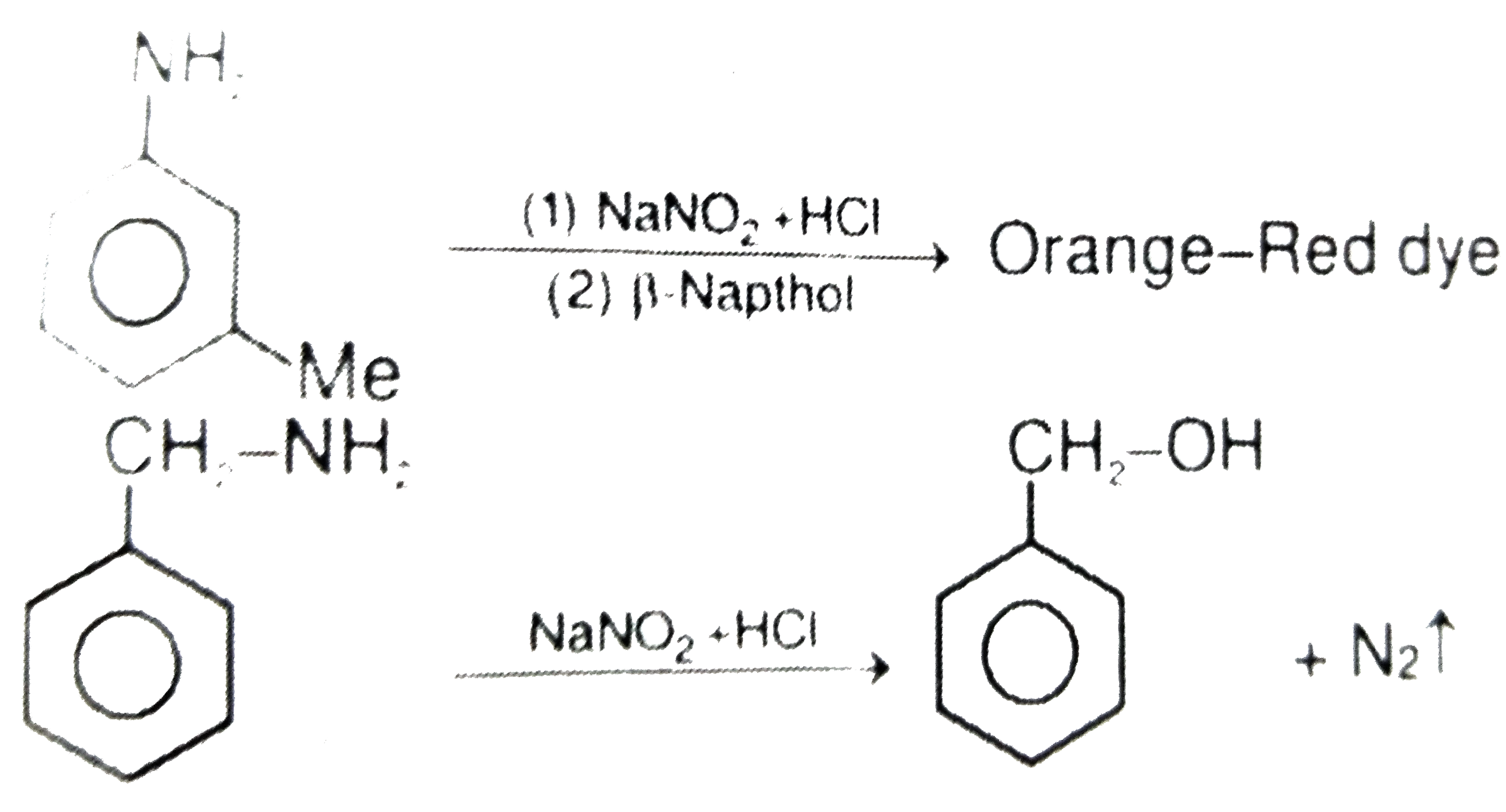
|
|
| 36. |
can be differentiated by : |
|
Answer» carbylamine reaction <BR>iodoform test |
|
| 37. |
Can an organic compound have two OH groups attached to the same carbon atom ? |
|
Answer» |
|
| 39. |
Can anelementwith atomicnumber126, if discoveredbe accommodate in thepresentset up ofthe longform of theperiodictabel ? |
| Answer» SOLUTION :No. themaximumnumberof elementswhichcan beaccommodated in the presentset upof thelong formof the priodictable is`118. thereforefillingof 8s-orbital shallbeginwhichwillaccommodate only twoelectrons . After 8s-orbitals , the filingof 5g- orbitals will begin. Sincewe donot haveanyprovision forg- blockelementsin THEPRESENTSET up OT the longformof theperiodictabletherefore and elementswithatomicnumber126 , itdiscoveredcannotbe accommodatedin thepresentset upof the longformof theperiodictable . | |
| 40. |
Can AgNO_(3) test be used for the detection of fluoride ion in Lassaigne's extract ? |
|
Answer» Solution :No. The reason being that AGF is highly soluble in WATER and HENCE `F^(-)` ion PRESENT in Lassaigne's extract does not PRODUCE any precipitate of AgF. `underset("Lassaigne's extract")(NaF)+AgNO_(3) rarr "No pp.t of AgF"` |
|
| 41. |
Can a Van der Waals gas with a=0 be liquefied? Explain. |
|
Answer» SOLUTION :(i) a=0 for a Vander waals gas i.e for a REAL gas. Vander waals constant a=0. It cannot be liquefied. (ii) If a=0, there is a vary less inter action between the molecules of the gas (iii) a is the measure of strength of vander waals FORCE of ATTACTION between the molecules of the gas. (IV) If a is equal to zero, the vander waals force of attraction is very less and the gas cannot be liquefied. |
|
| 42. |
Can a substance exist in all the three states of matter? Give an example. |
| Answer» SOLUTION :YES, WATER | |
| 43. |
Can a solutionof 1 M ZnSO_(4) be stored ina vessel made of coppr ? Given that E_(Zn,Zn^(2+))^(@)=+0.76 "volt and" E_(Cu^(2+))^(@)Cu=0.34 volt |
|
Answer» `Zn^(2+)+Curarr +Cu^(2+)` In other WORDS `ZnSO_(4)` solution can be SAFELY stored in a copper vessel |
|
| 44. |
Can a solution o f1 M copper suplhate be stroed in a vessel made of nickel metal ? Give that E^(@) Ni,Ni^(2+)=+0.25"volt" , E^(@) Cu,Cu^(2+)=-34volt or is it possible to stroe copper suplhate solution in a nickel vessel ? |
|
Answer» Solution :In this PROBLEM we want to see whether the following reaction takes place or not ltbnr?GT `Ni+CuSO_(4) RARR NiSO_(4)+Cu, i.e NiCu^(2+) rarr Ni^(2+)+Cu` By conventin the cell may be represented as `NiNi^(2+)||Cu^(2+)|Cu` We given oxidation potential as `E_(Ni,Ni^(2))^(@)=+0.25` volt and `E_(Cu,Cu^(2))^(@)=-0.34` volt Henc by reversing the SIGN of oixdation potential the reducitn potential s will Thus EMF comes out to be positive this imlies that `CuSO_(4)` reacts with nickel hence`CuSO_(4)` solution connot be stroed in a nickel vessel Alternatively since `E_(Ni^(2+),Ni)=-0.25` V islower than `E_(Cu^(2+),Cu)^(@)=+0.34` V therefore Ni can easily lose electrons to `Cu^(2+)` ions in other words the following rection `Ni+Cu^(2+)rarrNi^(2+)+Cu` Will occur thus `CuSO_(4)` solution cannot be stored in a nickel vessel |
|
| 45. |
Can a gas with a = 0 be liquefied? |
| Answer» SOLUTION :If a liquid is HEATED to the CRITICAL temperature of its vapour, the vapour PRESSURE of liquid becomes EQUAL to the vapour pressure of its vapour | |
| 46. |
Can a less electropositive metal displace more electropositive metal from its salt solution ? |
|
Answer» |
|
| 47. |
Can 2-pentene show geometrical isomerism ? |
Answer» SOLUTION :YES GEOMETRICAL ISOMERS are
|
|
| 48. |
Camphor is purified of |
|
Answer» DISTILLATION |
|
| 49. |
Oxidation number of Cr inK_3CrO_8 is |
|
Answer» `:.` OXIDATION no. of.= Cr + 5 . |
|
| 50. |
Calssify the following as acid or base according to Bronsted-Lowry theory and name their corresponding conjugate base or acid (i) NH_(3) " " (ii) CH_(3)CO O^(-) (iii) H_(3)O^(+) "" (iv) H^(-)" "(v) HO O^(-) " " (vi) S_(2)O_(8)^(2-). |
|
Answer» SOLUTION :According to Bronsted-Lowry THEORY, an acid is a substance which can donate a proton while base is a substance which can accept a proton. (i) `NH_(3)` is a Bronsted base because it can accept a proton. Its conjugate acid is `NH_(4)^(+)`. `NH_(3)` is also a Bronsted acid because it can donate a proton. Its conjugate base in `NH_(2)^(-)`. (ii) `CH_(3)CO O^(-)` is a Bronsted base `(CH_(3)CO O^(-) + H^(+) rarr CH_(3)CO OH)`. Its CONJUGATEACID is `CH_(3)CO OH`. (iii) `H_(3)O^(+)` is a Bronsted acid `(H_(3)O^(+) rarr H_(2)O+H^(+))`. Its conjugate base is `H_(2)O`. (iv) `H^(-)` is a Bronsted base `(H^(_)+H^(+) rarr H_(2) "in the reaction" H^(-) + H_(2)O hArrH_(2)+OH^(-))`. Its conjugate acid is `H_(2)`. (V) `HO O^(-)` is a Bronsted acid (`HO O^(-) rarr O_(2)^(2-) + H^(+)` in the reaction `H O O^(-) + H_(2)O rarr O_(2)^(2-) + H_(3)O^(+)`). Its conjugate acid is `O_(2)^(2-)` (peroxide ion). (vi) `S_(2)O_(8)^(2-) ` is a Bronsted base `(S_(2)O_(8)^(2-) + 2 H^(+) rarr 2 HSO_(4)^(-) " in the reaction" S_(2)O_(8)^(2-) + 2 H_(2)O hArr 2 HSO_(4)^(-) + OH^(-))`. Its conjugate acid is `HSO_(4)^(-)`. |
|