

Saved Bookmarks
This section includes 7 InterviewSolutions, each offering curated multiple-choice questions to sharpen your Current Affairs knowledge and support exam preparation. Choose a topic below to get started.
| 1. |
Calorific value of hydrogengas is - 143 kJ g^(-1). The standard enthalpy of formation of H_(2)Owill be |
|
Answer» `- 143 kJ mol^(-1)` `:. `1 MOLE , i.e., 2 g `H_(2)` will produce heat`= 286kJ` This is also `Delta_(f)H^(@) ` for `H_(2)O`i.e. `Delta_(f)H^(@) = - 286 kJ mol^(-1)` |
|
| 3. |
Calgon is |
|
Answer» Sodium hexa meta PHOSPHATE |
|
| 4. |
Caleulate the orbital angular momentum ford and f orbital. |
|
Answer» Solution :Orbital angular MOMENTUM `=sqrt(1(1+1) h//2 pi` For d orbital `=sqrt(2 xx3) h//2 pi = sqrt(6) h //2 pi` For F bital`=sqrt(3(3+1)) h//2pi = sqrt(12) h//2 pi` |
|
| 5. |
Calculation the normality of 30 volume solution of hydrogen peroxide |
|
Answer» SOLUTION :Calculation of MASS of `H_(2)O_(2)` per litre of the solution The decomposition of `H_(2)O_(2)` takes PLACE as follows: `2H_(2)O_(2)to 2H_(2)O+O_(2) ` `{:(2(2xx1+2xx16),22400ml),(=68g,"at N.T.P):}` From the equation 22400mL of `O_(2)` at N.T.P are obtained from `H_(2)O_(2)` from `H_(2)O_(2)` =68g 30ML of `O_(2)` at N.T.P are obtained from `H_(2)O_(2)=(68)/(22400)xx30=0.091g` Now, by defination 1mL of hydrogen peroxide solution weights =0.091g 1000ML of hydrogen perooxide solution will weigh=`0.091xx1000=91.0g` The strength of the solution=91//g STEP-II Calculation of equivalent mass of `H_(2)O_(2)` Consider the equation: `underset("68 parts by mass")(2H_(2)O_(2))to 2H_(2)O+underset("32 parts by mass")(O_(2)) ` Now, 32 parts by mass of `O_(2)` are envolved from `H_(2)O_(2)` =68parts 8 parts by mass of `O_(2)` are evolved from `H_(2)O_(2)` `=(68)/(32)xx8=17` parts Thus equivalent mass of `H_(2)O_(2)`=17 or 17g/equiv STEP-III Calculation of normality of the solution `"Normality of solution"=("Strength of solution")/("Equivalent mass")=(91g//L)/(17g//"equiv")=5.35"equiv"L^(-1)=5.35N.` |
|
| 6. |
Calculation of oxidation number of nitrogen in ammonium nitrite NH_(4)NO_(2) |
|
Answer» Solution :This is an IONIC compound containing `NH_(4)^(+) and NO_(2)^(-)`ions. The oxidation number of NITROGEN in `NH_(4)^(+)` ion `= -3` The oxidation number of nitrogen `NO_(2)^(-)` ion `= +3` Thus, ONE atom of nitrogen in ammonium nitrite is in `-3` oxidation STATE, while the other nitrogen atom is in `+3` oxidation state. |
|
| 7. |
Calculation of lattice enthalpy of MgBr_2 from the given data |
|
Answer» SOLUTION :The enthalpy of formation of MgBr2 according to the reaction `Mg (s)+ Br_2(l )to MgBr_2(2) ,Delta_f H^@=- 524 KJ// mol` ` Delta H^@ ""_1`for ` Mg (s)toMg (g)=+148mol^(-1)` `Delta H^@ ""_2`for `Mg(g)to Mg^(2-)(g)+ 2e^(-)+ 2187KJ mol^(-1)` ` DeltaH^@ ""_3`for `Br_2(1)toBr_2(g)= 31KJmol ^(-1)` ` DeltaH^@ ""_4` for `Br_2(g)to 2 Br(g)= 193KJ mol^(-1)` ` Delta H^(@) ""_5` for ` Br(g)+e^( - )(g)Br^(- )=- 331KJ mol ^(-1)` `DeltaH^@""_6` for`Mg^(2+ )(g)+ 2 Br ^-(g)toMgBr_2 (s) =? ` `Delta_fH^@ =DeltaH^@ ""_1+DeltaH^@""_2+ DeltaH^@""_3 + DeltaH^@ ""_4 +DeltaH^@ ""_5+DeltaH^@ ""_6 ` `-524KJ mol^(-1)= ( +148+ 2187 +31+ 193 - 2 (331) +DeltaH^@""_6) KJmol ^(-1)` `=- 2421KJ mol ^(-1)=Delta^@ ""_6` hencelattive enthalpyof `MgBr_2 = DeltaH^@ ""_6= 24 21KJ mol ^(-1)` |
|
| 8. |
Calculation of hydrogen in concentration of following: (a) 0.001 M HNO_3 (b) 0.0001 M KOH |
| Answer» SOLUTION :(a)`1.0xx10^(-3)` M , (B) `1.0xx10^(-10)` M | |
| 9. |
Calculater the strength of 20V solution of hydrogen peroxide. |
|
Answer» 0.03 `2H_(2_)O_(2(l)) rarr O_(2(g))+H_(2)O_((l))` `2 times 34""` 22.4 at STP `""`68gr On BASIS of above equation 22.4L of `O_(2)` is PRODUCED from 68g `H_(2)O_(2)` at STP 20L of `O_(2)` at STPis produced from `(68 times 20)/22.4g=60.71` GRAMS of `H_(2)O_(2)` Therefore strength of `H_(2)O_(2)` in 20V `H_(2)O_(2)` solution = 60.71g/L = 6% of `H_(2)O_(2)` solution |
|
| 10. |
CalculateDeltaU andDeltaH in calories if one moleofa monoatomic ideal gas is heated at constant pressure of 1 atom from 25^(@)C to 50^(@)C |
|
Answer» Solution :For monoatomic ideal gas ,` C_(v) =(3)/( 2) R,C_(p) =(5)/(2) R` But `C_(p) =(DeltaH)/( DeltaT)` `:. DeltaH = C_(p)DeltaT mol^(-1)` ( or `nC_(p)DeltaT ` for nmoles) `=( 5)/( 2) xx1.987 xx25 = 124.2cal` Work done , ` w= -P DeltaV= -P(V_(2)-V_(1)) = -(PV_(2)-PV_(1))= - ( nRT_(2) - nRT_(1))= - NR(T_(2)-T_(1)) ` `= -1 xx 1.987 (323 -298 ) cal = -49.7 cal` ` DeltaU = q+w =124.2 - 49.7 cal =74.5 cal` |
|
| 11. |
Calculate w,q and Delta Uwhen 0.75 mol of an ideal gasexapnds isothermally and reversibly at 27^(@) froma volume of 15 L to 25 L |
|
Answer» Solution :For isothermal reversible expansion of an ideal gas, `w= -nRT LN (V_(2))/(V_(1))= -2.303 nRT log. (V_(2))/(V_(1))` Putting `n= 0.75` mol, `V_(1) =15 L, V_(2) = 25 L, T= 27 + 273 = 300 K` and `R = 8.314 J K^(-1) mol^(-1)` , we get `w= -2.303 xx 0.75 xx 8.314 xx 300 log. (25)/(15) = -955.5 J``( -` ve sign represents work of expansion) For isothermal expansion of an ideal gas, `Delta U = 0` `:. Delta U = q+w` GIVES ` q= -w =+ 955.5 J` |
|
| 12. |
Calculate work done when 1 mole of an ideal gas is expanded reversibly from 20 L to 40 L at a constant temperature of 300 K. |
|
Answer» `7.78 KJ` |
|
| 13. |
The Vividh Bharati station of All India Radio, Delhi, broadcasts on a frequency of 1,368 kHz (kilo hertz). Calculate the wavelength of the electromagnetic radiation emitted by transmitter..Calculate wavenumber |
| Answer» SOLUTION :Calculation of wavenumber `lambda=5800overset@A=5800xx10^(-8)cm=5800xx10^(-10)m`_v^- =1/lambda=1/(5800xx10^(-10)m)=1.724xx10^6m^(-1)=1.724xx10^4cm^(-1)` | |
| 14. |
Calculatewavelength of emittedradiationwhenelectrontransitionfromn=3 to n=2 ? Thisradiationbelongto whichregion. |
| Answer» SOLUTION :`180.2 kJ mol^(-)= 3.03 xx 10^(19)atom^(-1)lambda= 6.56 xx 10^(7)m656 nm ` (visibleregion ) | |
| 15. |
Calculate volume strength of 30.36g/litre H_2O_2 solution. |
|
Answer» SOLUTION :`V=("AML X 22.4")/68` `=(30.36xx22.4)/68`=10.0009 |
|
| 16. |
Calculate, volume of water required to dissolve 0.1 g lead (II) chloride to get a saturated solution. [K_(sp)of PbCl_2 = 3.2 xx 10^(-8), atomicmass of Pb = 207 u). |
|
Answer» Solution :Suppose , SOLUBILITY of `PbCl_2` in water is s mol `L^(-1)` `{:(PbCl_((s)) hArr, Pb_((aq))^(2+) +, 2Cl_((aq))^(-)),((1-s), s,2s):}` `K_(sp)=[Pb^(2+)]. [Cl^-]^2` `K_(sp)=[s] [2s]^2=4s^3` `32xx10^(-8)=4s^3` `s^3=(3.2+10^(-8))/4=0.8xx10^(-8)` `s^3=8.0xx10^(-9)` Solubility of `PbCl_2 , s= 2xx10^(-3) "mol L"^(-1)` Solubility of `PbCl_2` in g `L^(-1)=278xx2xx10^(-3)` =0.556 g `L^(-1)` (` because` Molar mass of `PbCl_2=207+(2xx35.5)`=278) 0.556 g of `PbCl_2` dissolve in 1L of water `THEREFORE` 0.1 g of `PbCl_2`will dissolve in `=(1xx1.01)/0.556` L of water = 0.1798 L To make a SATURATED solution, DISSOLUTION of 0.19 `PbCl_2` in 0.1798 L =0.2 L of water will be required . |
|
| 17. |
Calculate volume of molecules at 300 K temperature and 2 bar pressure of 6.022xx10^(21)CO_(2) molecules.[R=8.314xx10^(-2) " bar "L K^(-1)mol^(-1)] |
|
Answer» |
|
| 18. |
Calculate valur of x+y+z+if xto Number of chiral centre. yto Number of prochiral centre. zto Number of psudeo chiral centre. |
|
Answer» |
|
| 19. |
Calculate value of .n. in given reaction. MnO_(4)^(-)+8H^(+)+n e^(-)toMn^(+2)+4H_(2)O |
|
Answer» Solution :`underset(+7)underset(DARR)(MnO_(4)^(-))tounderset(+2)underset(darr)(Mn^(+2))` `thereforen = 5` |
|
| 20. |
Massof elements9.1 xx 10^(31) kgfindtotaluncertainty(Delta V .Delta x) discuss theresult ?(n =6.626xx 10^(34) J s) |
|
Answer» SOLUTION :h= 6.626 `xx 10^(34) J s = 6.626 xx 10^(34) kg m^(2) s^(-1)` `Delta x =(h)/( 4PI m)= (6.626 xx 10^(34) kg m^(2) s^(-1))/( 4xx 3 .1416 1 xx 10^(6) kg )` `=5.273xx 10^(29)m^(2) s^(1)` thisuncertaintyis veryso forthis muchlessmass alsouncertainty is notabtutinid . |
|
| 21. |
Calculate total number of stereoisomers (Y) of following compound? |
|
Answer» |
|
| 22. |
Calculate total number of fundamental particles present in a molecule of heavy water |
|
Answer» Solution : In each deuterium atom `(""_1H^2)`, totally THREE FUNDAMENTAL particles `(1e^- , 1p , 1n)`are present. In each oxygen atom `(""_8O^16)`, 24 fundamental particles `(8e^(-) , 8p, 8n)`are present. Total number of fundamental particles in a molecule of heavy WATER `(D_2O) = (2xx 3) + 24 = 30` |
|
| 24. |
Calculate theoretically the amount of water formed in the generation of two Faraday of electricity in hydrogen-oxygen fuel cell. |
| Answer» SOLUTION : In hydrogen-oxygen fuel cell, when 2 moles of water PRODUCED then 4 mole of electrons are involved. CHARGE of 4 moles of electrons is 4F and with 4F, 36 gm of water formed theoretically. The amount of water formed with 2 Faradays =18 grams. | |
| 25. |
Calculate the work, when 1 mole ideal gas defuse to 1 atm from 10 atm at 300. K temperature. |
|
Answer» 5744.1 J `w_("REV") = - 2.303 "nRT" log""(P_1)/(P_2)` where, `n =1` mole ideal gas `R=8.314` Joule KELVIN`""^(-1) "mol"^(-1)` `T= 300K` `P_1=`Initial pressure = 10 atm `P_2=` Final pressure = 1 atm `therefore w_("rev") = - 2.303 (1 "mole") (8.314 "Joule Kelvin"^(-1) "mole"^(-1) ) (300 K) log ""(10)/(1)` `= - 2.303 xx 8.314 xx 300 xx 1` J `= -5744.1` J VALUE of w is -ve. So, work done by system = 5744.1 J |
|
| 26. |
Calculate the work of expansion when 100g of water is electrolysed at a constant pressureof1 atm and temperature of 25^(@)C. |
|
Answer» Solution :Electrolysis ofwater takes placeas`:2H_(2)O() rarr 2H_(2)(g) +O_(2)(g)` Thus, 2 moles of `H_(2)O, i.e., 2 XX 18 = 36 g ` of `H_(2)O` on electrolys is produce 2 moles of `H_(2)` gas and one mole of `O_(2)` gas, i.e., totla3 moles of the GASES `:. `100 g of water will produce gases `= (3)/( 36) xx 100= 8.33 ` moles Volume OCCUPIED by 8.33 moles ofgases at `25^(@)C` and 1 atm pressure is given by `V = ( nRT)/( P) ((8.33 "mole") ( 0.0821L atmK^(-1) mol^(-1)) ( 298K))/( 1 atm)= 203.8 L` Taing the volume of liquid water as negligible ( being 100 mL`= 0.1 L ) , DeltaV = 203.8 L` `:. Ww= - P_(ext) DeltaV =- 1 atm xx203.8 L= - 203.8 L atm= - 203. 8 xx 101.3 J= - 20.6 kJ` |
|
| 27. |
Calculate the work done by the torque. |
|
Answer» Solution :(i)The essential condition of expansion or compression of a system is there should be difference between external pressure `(P_"ext")` and internal pressure `(P_"int")` (ii)If the volume of the system is increased against the external pressure, the WORK is done by the system. By convention work done by the system is given a negative sign (-W). (iii) If the volume of the system decreased, the work is done on the system. By convention work done on the system is given positive sign (+W). (iv) For understanding pressure-volume work, let us CONSIDER a cylinder which contains one MOLE of an ideal GAS fitted with a frictionless piston. Total volume of the gas is V and pressure of the gas inside is `P _"int"`. (v)If external pressure is `P_"ext"`which is greater than `P_"int"` Piston is moved i want till the pressure inside becomes equal to `P_"ext"`.It is achieved in a single stepand the finalvolume be `V_f`. (vi)During this compression, piston moves a distance (x) and is cross-sectional area of the piston is A, then, Change in volume = `xA =DeltaV =V_f -V_i` ...(1) `P_"ext"="Force(F)"/"Area (A)"`....(2) `therefore F=P_"ext" A` (vii) If work is done by the system by pushing out the piston against external pressure `(P_"ext")`, then according to the equation, -w=F. x ...(3) -w=`P_"ext".A . x`...(4) -w=`P_"ext".DeltaV`...(5) `-w=P_"ext" (V_f-V_i)` ....(6) Simply `w=-P DeltaV`...(7) (viii)From the above equation, we can predict the sign of work (w). (ix) During expansion,work is done bythe system, since `V_f > V_i` , the sign obtained for workwill be negative. (x)During compression, work is done on the system, since `V_f ltV_i` , the sign obtained for work will be positive. 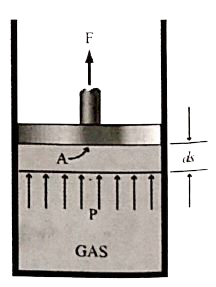
|
|
| 28. |
Calculate the work involved in expansion and compression process. |
|
Answer» Solution :Work involved in expansion : (i) For understanding pressure- volume work, let us consider a cylinder which contains 'n' moles of an IDEAL gas fitted with a frictionless piston of cross sectional area A. The total volume of the gas inside is `V_(i)` and pressure of the gas inside is `P_("int")`. (ii) If the external pressure `P_("EXT")` is greater than `P_("int")`, the piston moves inward till the pressure inside becomes equal to `P_("ext")` . Let this change be achieved in a single step and the final volume of `V_(f)` (iii) In this case, the work is done on the system (+w) . It can be calculated as follows `w=-F.Deltax""...(1)` (iv) where dx is the distance moved by the piston during the compression and F is the force acting on the gas. `F=P_("ext")A""...(2)` Substituting (2) in (1) `w=-P_("ext").A.Deltax` `A.Deltax= " change volume "=V_(f)-V_(i)` `w=-P_("ext").(V_(f)-V_(i))""...(3)` `w=-P_("ext").(-DeltaV)""...(4)` `=P_("ext").DeltaV`  (vi) Since work is done on the system , it is a positive quantity. (vi) If the pressure is not constant , but CHANGES during the process such that the pressure of the gas , then , at each stage of compression , the volume decreases by an infinitesimal amount, dV. In such a case we can calculate the work done on the gas by the relation. `W_("rew")int_(V_(i))^(V_(f))P_("int")dV` (vii) In a compression process, `P_("ext")` the external pressure is always greater than the pressure of the system . i.e. `P_("ext")=(P_("int"+dP))`. (viii) In a expansion process, theexternal pressure is always less than the pressure of the system . i.e. `P_("ext")=(P_("int"-dP))`.  (ix) When pressure is not constant and changes in infinitesimally small steps (reversible condition) during compression from ... The P-V plot looks like in image work done on the gas is respected by the shaded area. (x) `P_("ext")=(P_("int")+dP)` Such processes are called reversible processes. For a compression process work can related to internal pressure of the system under reversible conditions by writing equation `W_("rev")=int_(V_(i))^(v_(f)) =P_("int")dV` For the the system with ideal gas `P_("int")V=nRT` `P_("int")=(nRT)/(V)` `W_("rev")=int_(V_(i))^(V^(f))(nRT)/(V)dV` `W_("rev")=-nRTint_(V_(i))^(V^(f))((dV)/V)` `W_("rev")=-nRTIn((V_(f))/(V_(i)))` `W_("rev")=-2.303nRTlog((V_(f))/(V_(i)))` (xi) If `V_(f)gtV_(i)` (expansion) ,the sign of work done by the process is negative (XII) If `V_(f)ltV_(i)` (compression) the sign of work done on the process is positive. |
|
| 29. |
Calculate the work done when 2 moles of an ideal gas expands reversibly and isothermally from a volume of 500 ml to a volume of 2 L at 25^@C and normal pressure. |
|
Answer» Solution :Given n=2 moles `V_i`=500 ml =0.5 lit `V_f`=2 lit `T=25^@C`=298 K `w=-2.303 nRT LOG (V_f/V_i)` `w=-2.303 xx2xx8.314xx298 xxlog (2/0.5)` w=-2.303 x 2 x 8.314 x 298 x 0.6021 w=-6871 J w=-6.871 kJ |
|
| 30. |
Calculate the work done when 2-mole of an ideal gas expandsreversiblity and isothermally from a volume of 500mL to a volume 2 L at 25"^(@)C and normal pressure. |
Answer» SOLUTION :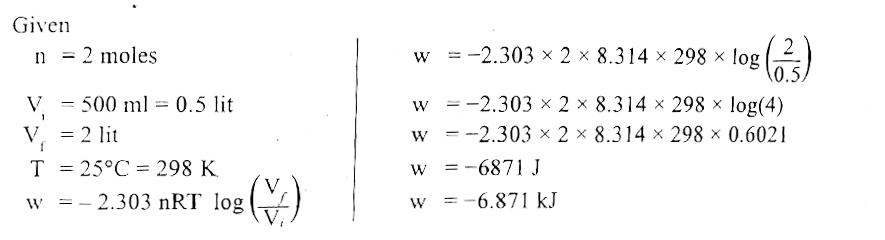
|
|
| 31. |
Calculate the work done when 1.0 mol of water at 373 K vaporizes against an atmospheric pressure of 1.0 atmosphere. Assume ideal gas behaviour. |
|
Answer» Taking volume of LIQUID water to be negligible,`Delta V =V_("VAPOUR") - V_(H_(2)O(l))=30.6 L`. |
|
| 32. |
Calculate the work done when1 moleof an ideal gas is compressed reversibly from 1.0 bar to 4.00 bar at constant temperature of 300K |
|
Answer» `3.46 kJ` |
|
| 33. |
Calculate the work done (in joules) when 0.2 mole of an idealgas at 300 K expands isothermally and reversibly from initialvolume of 2.5 litres to the final volume of 25 litres. |
|
Answer» 996 |
|
| 34. |
Calculate the work done by the system in an irreversible (sing step) adiabatic expansion of 2 mole of a polyatomic gas (gamma= 4//3) from 300K and pressure 10atm to 1 atm: (in KJ) (Give your answer after multiplying with 2.08). |
|
Answer» `-227R` `nC_(V) (T_(2)- T_(1)) = -P_("ext") ((nRT_(2))/(P_(2)) - (nRT_(1))/(P_(1)))` `2 xx 3R(T_(2) - 300) =-1(2R) ((T_(2))/(1) - (300)/(10))` `3(T_(2) - 300) = 30 - T_(2)` `4T_(2) = 930 rArr T_(2) = (930)/(4) = 232.5K` `rArr Delta E= W = n C_(V) Delta T` `=2 xx 3R (232.5 - 300)` = -405R` |
|
| 35. |
Calculate the work done (in J) when 4.5 g of H_(2)O_(2) reacts against a pressure of 1.0 atm at 25^(@)C2H_(2)O_(2)(l)rarr O_(2)(g) +2H_(2)O(l) |
|
Answer» `-1.63 XX 10^(2)` `w=-163.9 J` |
|
| 36. |
Calculate the weight of sodium chloride present in 250mL of 0.1N solution. |
|
Answer» |
|
| 37. |
Compute the mass of potassium chlorate (KClO_(3))that should decompose to produce 8 g of oxygen as per the chemical equation , 2KClO_(3) to 2KCl + 3O_(2)(g) (R.A.M : K = 39, Cl = 35.5,O = 16.) |
|
Answer» Solution :Let us first CONVERT the required volume of oxygen (10.0 L) at S.T.P. `P_1 = 750 " torr " = 750 mm Hg. ""V_1 = 10.0 L`, `T_1 = 25 + 273 = 298 K` and `P_2 = 760 mm Hg " (1 ATM)," ""V_2` = ?, `T_2 = 0^@C = 273 K` According to the gas equation, `(P_1 V_1)/T_1 = (P_2 V_2)/T_2` `:.V_2 = (P_1 V_1 T_2)/(T_1 P_2)=(750 xx 10.0 xx 273)/(298 xx 760)=9.04 L` Hence, the required volume of `O_2` at S.T.P. = 9.04 L The equation involved is `2KCIO_3 to2KCI + 3O_2` `2xx(39+ 35.5+48) "" 3xx22.4L` =`245 g ""S.T.P`. `:. 3 xx 22.4 L " of " O_2 " is produced by the decomposition of " KClO_3 = 245 g` `:.9.04 L " of " O_2`will be produced by the decomposition of `KClO_3 = 245/(3xx22.4)xx 9.04 = 32.9` g Hence, the required amount of `KClO_3 = 32.9` g |
|
| 38. |
Calculate the weight of MnO_2 required to produce 1.50 L of chlorine at 27^@C and 1.50 atm pressure according to the following equation: MnO_2 + 4HCIto MnCl_2 + 2H_2 O + Cl_2 |
|
Answer» Solution :The chemical EQUATION INVOLVED is `MnO_2 + 4HCIto MnCl_2 + 2H_2 O + Cl_2` `54.9+2xx16 "" 22.4 L` `=86.9 "" at S.T.P.` This equation implies that 86.9 g of `MnO_2`will give 22.4 of CHLORINE at S.T.P. Since the given conditions are different from those at S.T.P., therefore we should first convert the given volume corresponding to S.T.P. Therefore, `P_1 = 1.50 " atm, " V_1 = 1.50 L, T_1 = 27 + 273 = 300 K` `P_2 = 1 " atm,"V_2 = ?"" T_2 = 273 K` (S.T.P.) According to the gas equation, `(P_1 V_1)/T_1 = (P_2 V_2)/T_2` or`V_2 = (P_1 V_1 T_2)/(T_1 P_2)= ( 1.50 x× 1.50 xx273)/(300xx1)=2.05L` Thus, 1.5 L of `Cl_2` in the given conditions is equivalent to 2.05 L at S.T.P. `:."" 22.4 " L of chlorine at S.T.P. is given by " MnO_2 = 86.9` g `:.2.05 " L of chlorine at S.T.P. will be given by "MnO_2= (86.89)/(22.4)xx 2.05 = 7.95` g |
|
| 39. |
Calculate the weight of MnO_(2) and the volume of HCl of specific gravirty 1.2 g g mL^(-1) and 5% by weight needed to produce 1.12 L of Cl_(2) at STP by the reaction MnO_(2)+4"HCl"toMnCl_(2)+3H_(2)O+Cl_(2) |
|
Answer» Solution :(a). `N_(HCl)=(% by weightxx10xxd)/(Ew of HCl)` `=(5xx10xx1.2)/(36.5)=1.64` Now, m" Eq of "`MnO_(2)-=m" Eq of "HCl` `-=m" Eq of "Cl_(2) formed`. `-=(1.12)/(11.2)xx10^(3)` `=100[{:("Ew of "Cl_(2)=(M)/(2)),(1 " Eq of "Cl_(2)=11.2L):}]` (b). VOLUME of HCl used: `NxxV=100` `1.64xxV=100` `thereforeV_(HCl)to60.97mL` Bacause HCl is also used to give `MnCl_(2)` thus volume used is DOUBLE that required for the REDUCTION of `MnO_(2)`. `V_(HCl)=2xx60.97=121.94mL` (c). Also, m" Eq of "`MnO_(2)=m" Eq of "HCl=100` `(W)/((87)/(2))xx10^(3)=100(Ew of MnO_(2)=(55+32)/(2))` `thereforeW_(MnO_(2))=4.35g` |
|
| 40. |
Calculate the weight of MnO_(2) and the volume fo HCI of specificgravity1.2g mL^(-1) and 4%nature by weight , needed to produce 1.78 litre of Cl_(2) at STP by the reaction: MnO_(2) + 4HCI rarrMnCl_(2) + 2H_(2)O + CI+_(2) |
|
Answer» Weight of `MnO_(2) = 6.9134g` |
|
| 41. |
Calculate the weight of methane in a 9.00 litres cylinder at 16 atm and 27^@C. |
|
Answer» Solution :According to ideal gas equation, `PV = nRT` In the present CASE, `P= 16 " atm, " "" V = 9.00 L, ""T = 273 + 27 = 300 K" and "R = 0.0821 " litre atm " K^(-1)mol^(-1)` `:."" n = (PV)/(RT) =(16 xx 9.00)/(0.0821 xx 300) = 5.85` The gram MOLECULAR mass of methane `(CH_4) = 16` `:.`One mole of `CH_4`weight = 16 g `:.5.85" moles of " CH_4 " will weight " = 16 xx 5.85 = 93.6 g` Hence, the weight of the gas in the given conditions is 93.6 g. |
|
| 42. |
Calculate the weight of lime (CaO) that can be prepared by heating 200 kg of lime stone (CaCO_(3)) which is 90% pure. |
| Answer» SOLUTION :100.80 KG | |
| 43. |
Calculate the weight of iron which will be converted into its oxide (Fe_(3)O_(4)) by the action 18 g of steam on it. |
|
Answer» `underset(underset("= 168 G= 73 g")(3xx56"" 4 xx 18))(3Fe+4H_(2)O(g))rarrFe_(3)O_(4)(s)+4H_(2)(g)` 72 g of steam `(H_(2)O)` react with iron = 168 g 18 g of steam `(H_(2)O)` react with iron `= (168xx18)/(72)=42G`. |
|
| 44. |
Calculate the weight of carbon of monoxide having the same number of oxygen atoms as are present in 88 g of carbon dioxide. |
|
Answer» Solution :Step I. No of OXYGEN ATOMS in 88.0 of `CO_(2)` 44.0 g GRAMS of `CO_(2)` have oxygen atoms `= 2 XX 6.022 xx 10^(23)` `= 4 xx 6.022 xx 10^(23)` Step II. Calculation of mass of CO `6.022 xx 10^(23)` oxygen atoms are present in CO = 28.0 g `4 xx 6.022 xx 10^(23)` oxygen atoms are present in `CO=28.0xx(4xx6.022xx10^(23))/(6.022xx10^(23))=112.0g`. |
|
| 45. |
Calculate the weight of calcium calcium carbonate required to produce carbondioxide that is sufficient for conversion of one decimole sodium carbonate to sodium bicarbonate. |
|
Answer» Solution :Step 1: Regarding the requirement of cabon dioxide: The balanced equation for conversion of sodium carbonate to sodium bicarbonte is `Na_(2)CO_(3)+H_(2)O+CO_(2) to 2NaHCO_(3)` Decimole =0.1 mole 1mole of `Na_(2)CO_(3)="1 mole of "CO_(2)` Carbondioxide required for 0.1 mole of `Na_(2)CO_(3)=` 0.1 mole (or 4.4 grams) Step 2: Regarding the requirement of CALCIUM carbonate. The balanced equaiton for the decomposition of calcium carbonate is `CaCO_(3) to CaO+CO_(2)` 1 mole of `CO_(2)="1 moleof "CaCO_(3)` 14 grams of `CO_(2_)="100 grams of CaCO_(3)` The weight of calcium carbonate to produce the required 4.4 grams carbondioxide `=(100)/(44) xx4.4 =10"gramas"` |
|
| 46. |
Calculate the weight of anhydrous sodium carbonate required to prepare 250ml of decimolar solution. |
|
Answer» |
|
| 47. |
Calculate the weight of 6.022 xx 10^(23)molecules of CaCO_(3) |
|
Answer» Solution :No. Of MOLES of `CaCO_(3) = ("no.of molecules")/("Av.cons")` `=(6.022 XX 10^(23))/(6.022 xx 10^(23))=1` Weight of `CaCO_3` = no. of moles x MOLECULAR wt. `=1 xx 100 = 100G` |
|
| 48. |
Calculate the weight of 12.044 xx 10^(23)atoms of carbon. |
|
Answer» Solution :No. Of moles of `C =(12.044 xx 10^(23))/(6.022 xx 10^(23))=2` Wt. Of C ATOMS = no. Of moles `xx` at. Wt `=2 xx 12 = 24`g |
|
| 49. |
Calculate the weight of 0.2 mole of sodium carbonate. |
|
Answer» Solution :SODIUM CARBONATE = `Na_(2)CO_(3)` Molecular mass of `Na_(2)CO_(3)=(23 xx2) + (12xx1) + (16xx3)` = 46+ 12 + 48= 106 G Mass of 1 mole of `Na_(2)CO_(3) = (1.6xx0.2)/1` = 21.2 g |
|
| 50. |
Calculate the wavelength of the spectral line obtained in the spectrumof Li^(2+) ion when the transition takes place between two levels whose sum is 4 and the difference is 2 |
|
Answer» Solution :Suppose the transition takes place between LEVELS `n_(1) and n_(2)` Then `n_(1) + n_(2) = 4 and n_(2) - n_(1) = 2` SOLVING these equations, we get `n_(1) = 1, n_(2) = 3 :. (1)/(lamda) = R ((1)/(n_(1)^(2)) - (1)/(n_(2)^(2))) Z^(2)` For `LI^(2+) , Z = 3 :. (1)/(lamda) = 109, 677 cm^(-1) ((1)/(1^(2)) - (1)/(3^(2))) xx 3^(2) = 109, 677 xx ((1)/(1) - (1)/(9)) xx 9 cm^(-1) = 109677 xx 8 cm^(-1)` or `lamda = (1)/(109677 xx 8 cm^(-1)) = 1.14 xx 10^(-6) cm` |
|