

Saved Bookmarks
This section includes 7 InterviewSolutions, each offering curated multiple-choice questions to sharpen your Current Affairs knowledge and support exam preparation. Choose a topic below to get started.
| 1. |
Consider the following ionization energies for a metal M M_((g)) to M_((g))^(+)+e^(-) , DeltaH=+580 kJ/mole M_((g))^(+) to M_((g))^(2+) + e^(-), DeltaH =+1815 kJ/mole M_((g))^(2+) to M_((g))^(3+) + e^(-) , DeltaH=+2740 kJ/mole M_((g))^(3+) + M_((g))^(4+) + e^(-) , DeltaH= + 11600 kJ/mole Which one of the four ions has largest electron affinity? |
|
Answer» `M_((G))^(+)` |
|
| 2. |
Consider the following ionization energies for a metal M M_((g)) to M_((g))^(+)+e^(-) , DeltaH=+580 kJ/mole M_((g))^(+) to M_((g))^(2+) + e^(-), DeltaH =+1815 kJ/mole M_((g))^(2+) to M_((g))^(3+) + e^(-) , DeltaH=+2740 kJ/mole M_((g))^(3+) + M_((g))^(4+) + e^(-) , DeltaH= + 11600 kJ/mole Select correct order. |
|
Answer» `M_((g))^(2+) lt M_((g))^(4+)` (size) |
|
| 3. |
Consider the following ionization energies for a metal M M_((g)) to M_((g))^(+)+e^(-) , DeltaH=+580 kJ/mole M_((g))^(+) to M_((g))^(2+) + e^(-), DeltaH =+1815 kJ/mole M_((g))^(2+) to M_((g))^(3+) + e^(-) , DeltaH=+2740 kJ/mole M_((g))^(3+) + M_((g))^(4+) + e^(-) , DeltaH= + 11600 kJ/mole Total no. of electron(s) in outermost shell of metal M are: |
|
Answer» 2 |
|
| 4. |
Considerthe following ionisationsteps : M ( g) toM^(+) (g) + e^(-), Delta H= 100 eV M ( g) toM^(2+)(g) + 2e^(-), Delta H= 250 eV Selectthe correctstatement: |
|
Answer» `Delta_(i)H_(1)` of Mg (g ) is100 EV |
|
| 5. |
Consider the following graph which shwos heat of eombustions of isomeric pentenes and answer the given wuestion. Which of the following pair shows chain isomerism? |
|
Answer» <P>P,U |
|
| 6. |
Consider the following graph which shows heat of coubustions of isomeric pentenes and match the following. |
Answer» 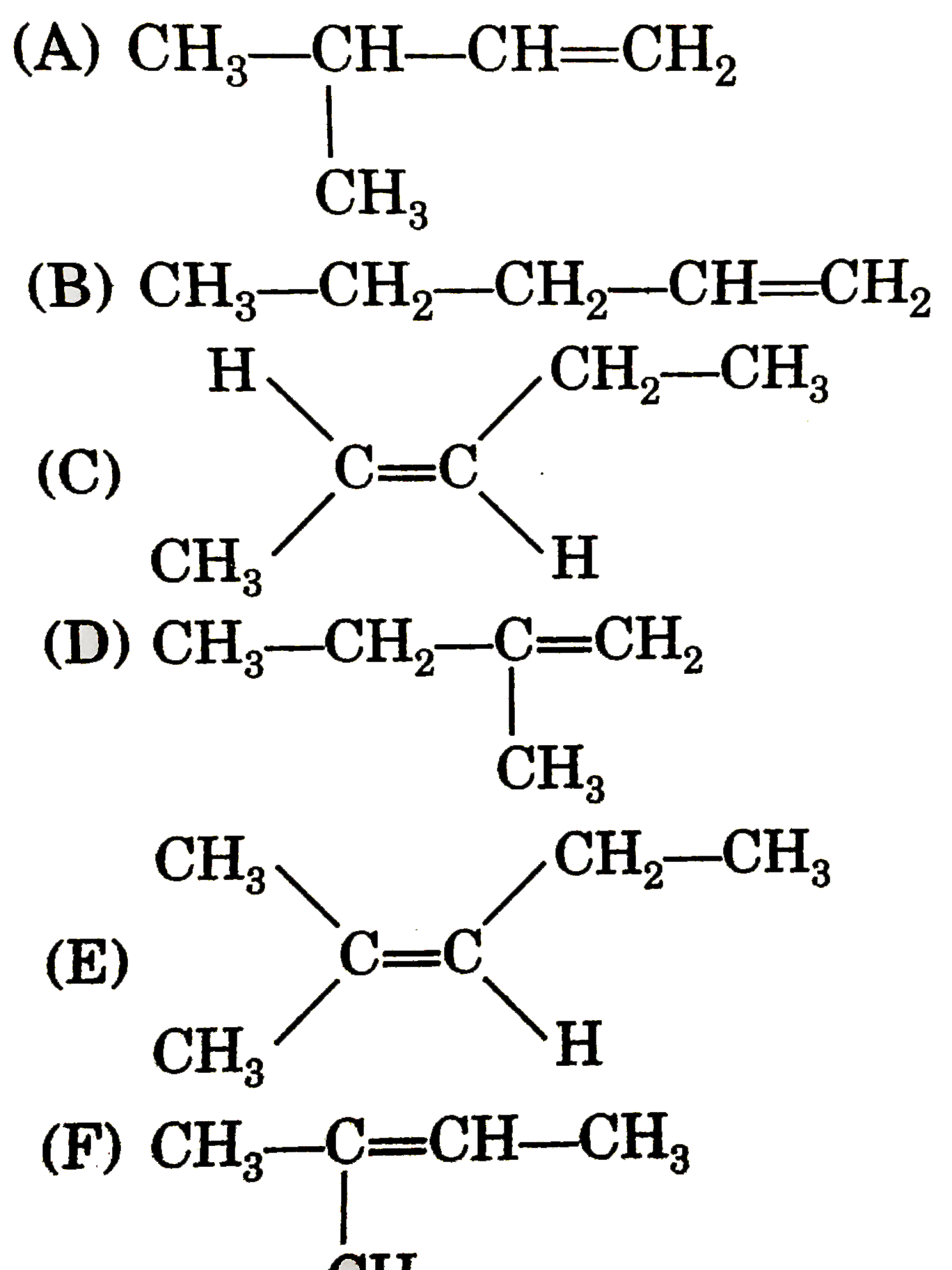
|
|
| 7. |
Consider the following graph which shwos heat of eombustions of isomeric pentenes and answer the given wuestion. Which of the following pair shows positional isomerism ? |
|
Answer» Q,T 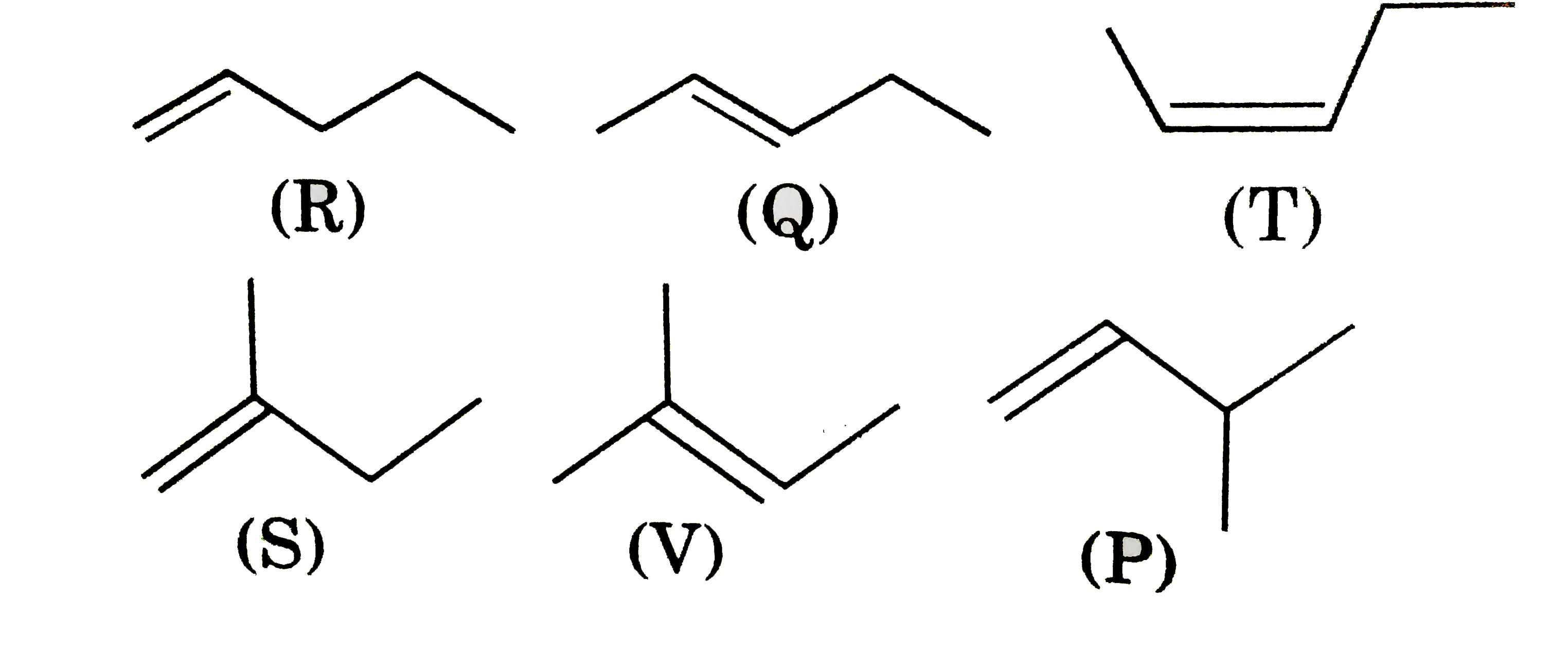
|
|
| 8. |
Consider the following graph which shwos heat of eombustions of isomeric pentenes and answer the given wuestion. Which of the followign can show geometrical isomerism ? |
|
Answer» U |
|
| 9. |
Consider the following graph which shows heat of combustion of isomeric butenes and give answers to th given questions. Q and S are: |
|
Answer» Chain isomers |
|
| 10. |
Consider the following graph which shows heat of combustion of isomeric butenes and give answers to th given questions. Q and R are : |
|
Answer» CHAIN isomer 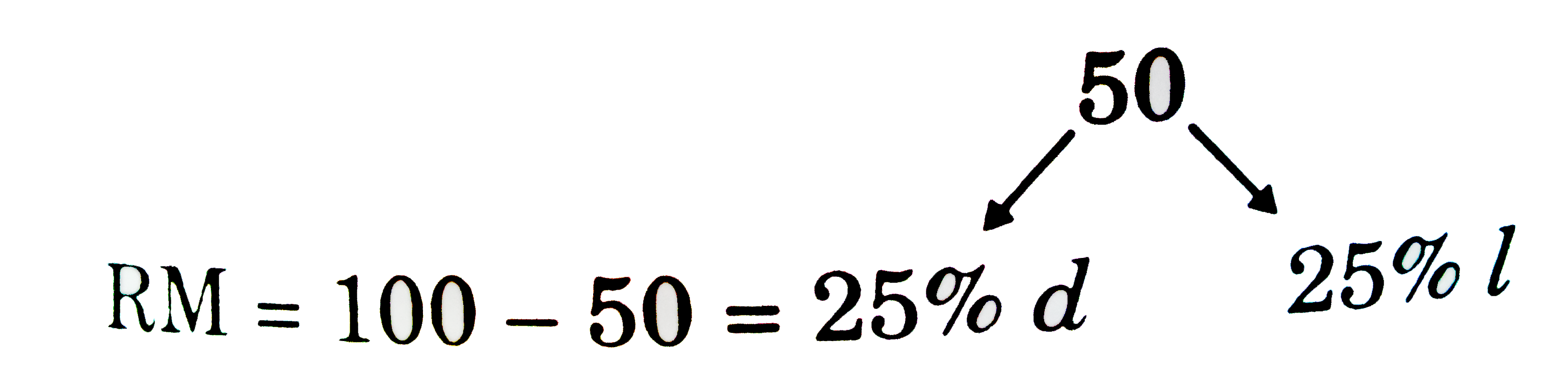 % d from = 50 +25=75% % d from = 50 +25=75%
|
|
| 11. |
Consider the following graph which shows heat of combustion of isomeric butenes and give answers to th given questions. P and R are : |
|
Answer» CHAIN isomers `""1/10xx2` Optical purity `=([alpha])_(MIX)/([alpha]_(pure))xx100=4/12xx100=33.33%` |
|
| 12. |
Consider the following gaseous equilibrium with equilibriumconstantsK_(1) and K_(2) respectivelySO_(2) (g) + 1/2 O_(2) (g) hArr SO_(3) (g) 2 SO_(3) (g) hArr 2 SO_(2)(g) + O_(2) The equilibrium constants are related as |
|
Answer» ` K_(1)^(2) = 1/K_(2)` Obviously `K_(1)^(2)= 1/K_(2)`. |
|
| 13. |
Consider the following "Ethanol" overset(PBr_(3))rarr X overset("alc.KOH")rarr underset((i) "Heat")overset((i) H_(2)SO_(4) "at room temp.")rarrZ The product Z is |
|
Answer» `CH_(3)CH_(2)OH` |
|
| 14. |
Consider the following equilibrium reaction and relate their equilibrium constants …. (i) N_(2) + O_(2) hArr 2 NO , K_(1) (ii) 2NO + O_(2) hArr 2 NO_(2) , K_(2) (iii) N_(2) + 2 O_(2) hArr 2 NO_(2) , K_(3) |
|
Answer» `K_(3) = K_(2) = K_(1)` |
|
| 15. |
Consider the following equilibrium PCl(g) hArr PCl_(3)(g) + Cl_(2)(g)in a closed container. At a fixed temperature, the volume of the reaction container is halved. For this change, which of the following statements holds true regarding the equilibriumconstant (K_(p)) and degree of dissocitation (alpha)? |
|
Answer» NEITHER `K_p` nor `alpha` CHANGES |
|
| 16. |
Consider the following equilibrium in a closed container, N_(2)O_(4(g))hArr2NO_(2(g)) At a fixed temperature, the volume of the reaction container is halved. For this change which of the following statements holds true regarding the equilibrium constant (K_(p)) and degree of dissociation (alpha)? |
|
Answer» <P>Neither `K_(p)` nor `ALPHA` CHANGES |
|
| 17. |
Consider the following equilibrium in a closed container: N_(2)O_(4) (g) hArr2 NO_(2)(g) At a fixed temperature , the volume of the reaction container is halved . For this change , which of the following statement , holds true regarding the equilibrium constant (K_(p)) and degree of dissociation (alpha) ? |
|
Answer» neither `K_(p) "nor" alpha` CHANGES |
|
| 18. |
Consider the following equilibrium 2AB(g)hArrA_(2)(g)+B_(2)(g) The vapour density of the equilibrium mixture does not depend upon |
|
Answer» TEMPERATURE |
|
| 19. |
Consider the followingelements: ._(4)Be, ._(19) F, ._(19)K, ._(20) C (a) Selectthe elementhavingone electron in theoutermostshell. (b) Selecttws element of thesamegroup . (c ) Writethe formula andnatureof the compoundformedwhen theelementK reacts with an elementX ofelectronic configuration2, 8, 7 |
|
Answer» SOLUTION :(a) thefirstperiodhas onlytwoelements beginningwith Li (Z=3) andendingwith Ne (Z= 2) the secondperiodhasalso only8 elementsbeginning with Li (Z=3) and endingwith Ar (Z= 10) The thirdperiodalsohas 8 elementsbeginningwith Na (Z=11) and endingwithKr (Z=18) The Fourthperiodhas 18elementsbeginnings with K (Z=19) and endingwith Kr (Z=36) Since eachperiodbeginswith on AELEMENT havingonly oneelectron in thevalenceshell thereforeout ofthe fourelementslistedin the question(i.e.,._(4)Be, ._(9)F, ._(19)K, ._(20)Ca)` only._(19)K` has oneelectronin thevalence shell. (b) Sincesecondgrouphas twoelectrons in thevalenceshelltherefore`._(4)Be" and" ._(20)Ca` belongto thesamegroup. ( c) theelement Xwithelectronicconfiguration2,8.7 (i.e., , CI ,Z= 17) hasone electronlessthan thenearestinertgas i.e, Ar (Z=18)whileK withelectronicconfiguration (2,8,8,1)has ona electron morethan thenearest INERTGAS Ar (2,8,8) . Thereforeto achieve thethe nearestinertgas configuration, Kloses one electronto FORM `K^(+)`and CIgainsone electronto form `CI^(-)` .Thetwo ionsthencombineto formionic compound `K^(+) CI^(-)` or simplyKCI. 
|
|
| 20. |
Considerthe following electroic arrangments for the d^5 configuration.(a) (i) Which of these represents the ground state(ii)Which configuration has the maximum exchange energy. |
Answer» SOLUTION :(i)(c)  -This REPRESENTS the ground state. -This REPRESENTS the ground state.(II)(c)  -This represents the MAXIMUM echange ENERGY. -This represents the MAXIMUM echange ENERGY.
|
|
| 21. |
Consider the following electronic arrangement for p^(3) configuration . |
|
Answer»
 `**` Among these the elctronic CONFIGURATIONS (a) represents the ground stat. `**` It is considered to be the most STABLE STATE. |
|
| 22. |
Consider the following disintegration reactions ""_(91)Pa^(234) overset(-beta)to ""_(92)U^(234) overset(-alpha)to ""_(90)Th^(230) overset(-alpha)to ""_(88)Ra^(236) Ra belongs to Groups 2 of the long form of the periodic table. To which group nuclide Pa-91 belongs ? |
|
Answer» 5 |
|
| 23. |
Consider the following data: Delta_(f) H^(2) (N_(2)H_(4), l) =50kJ//mol,, Delta_(f) H^(@) (NH_(3), g)=-46 kJ//mol, B.E. (N-H)= 393kJ//mol and B.E. (H-H)= 436 kJ/mol, also Delta_("vap") H (N_(2)H_(4),l)= 18kJ//mol. The N-N bond energy in N_(2)H_(4) is |
|
Answer» 226 kJ/mol `(1)/(2) N_(2) + (3)/(2) H_(2) rarr NH_(3(g)), Delta H_(2) = - 46` `UL(N_(2)H_((l)) rarr N_(2)H_(4(g)), Delta H_(3) = 18)` `N_(2)H_(4(g)) + H_(2) rarr 2NH_(3) , Delta H` `Delta H = - Delta H_(3) + 2 Delta H_(2) - Delta H_(1) = - 160` Theoretically, `Delta H = ((N-N) + 4(N -H) + (H - H)) - (2 xx 3 xx (N-H))` `rArr (N-N) = 190` kJ/mol = 45.45 Kcal/mole |
|
| 24. |
Consider the following cyclic process carried out in two steps on a gas Step 1 : 45J of heat is added to the gas, and 10J of expansion work is performed Step 2: 60J of heat is removed from the gas as the gas is compressed back to the initial state If the work for the gas compression in step 2 is 19x J, then the value of x is |
|
Answer» |
|
| 25. |
Consider the following conformation of 3-AminopropanalAmongst the above conformation (P,Q,R,S) one of tehem is most stable This can be attributed due to |
|
Answer» H-bonding in the conformer |
|
| 26. |
Consider the following conformations of 3-Aminopropanal, amongst the given conformations (P, Q, R, S) one of them is most stable. The correct statements for the above is/are (I) H-bonding is present in the most stable conformer (II) Gauche conformation is the most stable conformer (III) Anti conformation is the most stable conformer (IV) larger groups being separated by maximum distance in the conformer |
|
Answer» <P>II & IV 2) P is most stable due to H-bonding in it.s gauche confomations. |
|
| 27. |
Consider the following compunds (i) C_(6)H_(5)COCl the correct decreasing order of their reactivity towards hydrolysis is |
|
Answer» `II GT IV gt i gt III` |
|
| 28. |
Consider the following compounds: Hyperconjugation occurs in |
|
Answer» III only |
|
| 29. |
Consider the following changes in the physical state of water and state whether orderliness has increased or decreased and consequently predict the direction of entropy of the system. (i) H_(2)O_((l))rarrH_(2)O_((s)) (ii) "Steam "rarr"water" |
|
Answer» Solution :(i) ORDERLINESS INCREASES ,entropy DECREASES. (II) Orderliness increases , entropy decreases. |
|
| 30. |
Consider the following changes a) M_((g))^(+2) rarr M_((g))^(+3) + e^(-) b) M_((g))^(+) rarr M_((g))^(+2) + e^(-) d) M_(g) rarr M_((g))^(+3) + 3e^(-) In Which case more energy is required |
|
Answer» a |
|
| 31. |
Consider the following carbocations. (i) Cl_(3)overset(+)(C) (ii) Cl_(2)overset(+)(C)H (iii) ClCH_(2)^(+) (iv) overset(+)(C)H_(3) The stability sequence follows the order : |
|
Answer» `(iv) lt (i) lt (II) lt (iii)` |
|
| 32. |
Consider the following carbocations I) C_6H_5-overset(o+)CH_2"" II) C_6H_5-CH_(2)overset(o+)CH_2 III) C_6H_5-overset(o+)(CH)-CH_3""IV) C_6H_5-overset(o+)C(CH_3)_2 The correct sequence of stabilities is : |
|
Answer» `I GT II gt III gt IV` |
|
| 33. |
Consider the following carbocations : 1) CH_3-overset(o+)CH_2"" 2) CH_2-overset(o+)CH 3) CH_2=CH-overset(o+)CH_2 "" 4) C_6H_5-overset(o+)CH_2 Stability of these carbonions in decreasing order is |
|
Answer» `4 GT 3 gt 2 gt 1 ` |
|
| 34. |
The order of stability of the following carbanions (I) o-nitrobenzyl carbanion "" (II) m-nitrobenzyl carbanion (III) p-nitrobenzyl carbanion "" (IV) Benzyl carbanion |
|
Answer» `II gt III gt I` |
|
| 35. |
Consider the following base (I) o-nitroaniline"" (II) m-nitroaniline "" (III) p-nitroaniline The decreasing order of basicity is: |
|
Answer» `II GT III gt I` |
|
| 36. |
Consider the following : At constant pressure, boiling point of a solution is greater than the boiling point of its pure liquid solvent because 1. Solute is non-electrolyte 2. Solute is involatile 3. Chemical potential of solvent in solution is less than the chemical potential of solvent in its pure state at constant pressure Which of the above are correct ? |
| Answer» Answer :D | |
| 37. |
Consider the following abbreviations for hydrated alkali ionx=|Li(H_(2)O)_(n)|^(+),y=|K(H_(2)O)_(n)|^(+)z=|Cs(H_(2)O)_(n)|^(+)which is the correct order of size of these hydrated alkali ions |
|
Answer» `X GT y gt Z` |
|
| 38. |
Consider the figure given for solid XY. Answer the following questions Co-ordination number of Y is |
|
Answer» 3 |
|
| 39. |
Consider the equilibrium Ni(s)+4CO(g)hArrNi(CO)_(4)(g), K_(p)=0.125atm^(-3) If equal number of moles of CO "and" Ni(CO)_(4) (ideal gases) are mixed in a small container fitted with a piston, find the maximum total pressure (in atm) to which this mixture must be brough in order to just precipitate out metallic Ni? |
|
Answer» `P P` For backward reaction `Q_(P)geK_(P)` `(P)/(P^(4))geK_(P)` `therefore (1)/(P^(3))ge0.125atm^(-3)` `P^(3)le8atm^(3)` `Ple2atm` `P_(t OTAL)=2P=4atm`. |
|
| 40. |
Consider the equilibrium HgO(s)+4I^(-)(aq)+H_(2)O(l)hArrHgI_(4)^(2-)(aq)+2OH^(-) Which changes will decrease the equilibriumconcentration of HgI_(4)^(2-)? |
|
Answer» Addition of 0.1M (AQ) |
|
| 41. |
Consider the equations given below "Ca CO"_(3(s))hArrCaC_((s))+CO_(2(g)) CO_(2(g))+H_(2)O_((e))hArrH_((aq))^(+)+HCO_(3(aq))^(-) Write the equilibrium constant for these equations and give reason for the exception of concentration of specific compounds. |
|
Answer» Solution :A pure solid always has the same concentration at a given TEMPERATURE, as it does not expand to fill its container. (i.e.) it has same number of `"moles L"^(-1)` of its volume. Therefore, the concentration of a pure solid is constant. The above expression can be modfied as follows. `K_(C)=[CO_(2)(g)]` or `K_(P)=P_(CO_(2))` The equilibrium constant for the above reaction depends only the concetration of CARBON dioxide and not the calcium carbonate or calcium oxide. Similarly, the active mass (concentration) of the pure liquid does not change at a given temperature. Consequently, the concentration terms of pure liquids can also be excluded from the expression of the equilibrium constant. For example, `CO_(2)(g)+H_(2)O(l)hArrH+(aq)+HCO_(3)^(-)(aq)` Since, `H_(2)O(l)` is a pure liquid the `K_(c)` can be expressed as `K_(c)=([H^(+)(aq)][HCO_(3)^(-)(aq)])/([CO_(2)^(-)(g)])` |
|
| 42. |
Consider the equation Z=(PV)/(nRT), which of the following statements is correct? |
|
Answer» When Zgt1, REAL GASES are easier to compress than the ideal gas. |
|
| 43. |
Consider the elements N, P, O and S and arrange them in order of Increasing non-metallic character |
|
Answer» <P> |
|
| 44. |
Consider the elements N, P, O and S and arrange themin order of : (b) Increasing negative electron gain enthalpy |
|
Answer» <P> |
|
| 45. |
Consider the elements : Cs,Ne,I,F (A) Identify the element that exhibits -ve oxidation state (b) Identify the element that exhibits +ve oxidation state (c ) Identify the element that exhibits both +ve and -ve oxidation states (d) Identify the element which neither exhibits -ve nor +ve oxidation state |
|
Answer» SOLUTION :(a) F fluorine beig the most elctrogative element show only a ve OXIDATION state of -1 (b) Cs alkali METALS because of the presence of a singel eletocn in the valence shell exhibit an oxidation state of +1 (c ) 1 because of th present of seven electrons in the valence shell i shows an oxidation state of -1 or an oxidation state of +1 and because of the presence of d orbitals it also exhibits +ve oxidation states of +3 +5 and +7 (d) NE it is insert gas and HENCE it neither exhibits -ve nor +e oxidation states |
|
| 46. |
Consider the elements N, P, O and S and arrange them in order of Increasing first ionization enthalpy |
|
Answer» <P> |
|
| 47. |
Consider the elements : Cs ,Ne , I and F (a) Identify the element that exhibits only negative oxidation state. (b) Identify the element that exhibits only postive oxidation state. (c) Identify the element that exhibits both positive and negative oxidation states. (d) Identify the element which exhibits neither the negative nor does the positive oxidation state. |
| Answer» Solution :I. It is a halogen and contains seven electrons in its VALENCE shell. Therefore, it exhibits an OXIDATION state of -1. However, DUE to the presence of d-orbitals, it ALSO exhibits +1, +3, +5 and +7 oxidation states. | |
| 48. |
Consider the electronic configurations : (i) 1^(2) 2s^(1) (ii) 1s^(2) 3s^(1) (a) Name the element corresponding to (i) (b) Does (ii) correspond to the same or different element ? (c) How can (ii) be obtained from (i) ? (d) Is it easier to remove one electron from (ii) or (i) ? Explain. |
|
Answer» SOLUTION :(a) The element corresponding to (i) is Lithium (Li). (b) This electronic configuration represents the same element in the excited STATE. (c) By supplying energy to the element when the electron jumps from the lower energy 2s-orbital to the higher energy 3s-orbital. (d) It is easier to remove an electron from (ii) than from (i) since inthe former case, the electron is present in a 3s-orbital which is away from the nucleus and HENCE is LESS STRONGLY attracted by the nucleus than an electron in the 2s-orbital. |
|
| 49. |
Consider the elements : Cs, Ne, I and F (a) Identify the element that exhibits only negative oxidation state. (b) Identify the element that exhibits only positive oxidation state. ( c) Identify the element that exhibits both positive and negative oxidation states. (d) Identify the element which exhibits neither the negative nor does the positive oxidation state. |
|
Answer» Solution :(a) F element exhibits only in NEGATIVE oxidation state. (B) CS element exhibits only in positive oxidation state. ( c) .I. can be in both positive and negative oxidation state. .L. has -1, +1, +3, +5, +7 oxidation number. (d) Ne has zero oxidation state. It does not exhibits negative or positive oxidation state. |
|
| 50. |
Consider the DeltaG_(f)^(0) and Delta H_(f)^(0) (kJ/mol) for the following oxides. Which oxide can be most easily decomposed to form the metal and oxygen gas? |
|
Answer» `ZNO (Delta G^(0) = -318.4, Delta H^(0)= -348.3)` |
|


